
Home | Bio | Thought Leader | Public Speaker | List of Articles | Blog | Agile Scrum | Agile Transformation | Agile Protocol | Contact

It is also on ResearchGate as DOI 10.13140/RG.2.2.25128.12807: Graffius, S. M. (2026, October 6). Exotic Team Dynamics (Novel Patterns that Emerge when Humans and Advanced Artificial Intelligence Function as Teammates): 6 October 2026 Update. ScottGraffius.com. https://doi.org/10.13140/RG.2.2.25128.12807
This page provides an overview and selected highlights of "exotic team dynamics." Numbered references throughout the page correspond to sources in the References section, where additional detail and supporting material are available.
This page is periodically updated to reflect developments in research and practice.
Exotic Team Dynamics
Introduction
Human-AI teaming is increasingly common, and when people collaborate with advanced AI as teammates, exotic team dynamics emerge. These are novel and often counterintuitive patterns that differ from those of human-only teams and challenge established assumptions about how teams operate. They can involve disruptive contributions, fluid or overlapping roles, unconventional decision-making, and tension between individual autonomy and collective coordination, and they can produce new capabilities and outcomes. Understanding and navigating these complexities is essential for organizations seeking to unlock the full potential of human-AI teamwork and gain a competitive advantage. This framework provides guidance on how to succeed with exotic team dynamics.
AI is no longer just a tool. It's becoming a collaborator. As advanced systems gain the capacity to reason, decide, act, adapt, and work alongside people as teammates, the dynamics of human-AI collaboration begin to diverge from those in traditional teams. On human-AI teams, AI agents may favor choices that are counterintuitive to human collaborators yet optimal, steering decision-making down unexpected paths and producing outcomes no one anticipated. A single AI agent can occupy multiple roles at once. Human and AI decisions can become so intertwined that each shapes the other in real time, generating results neither could reach alone. And new protocols for interaction and ways of working can emerge. Welcome to "exotic team dynamics."
It describes the patterns that arise when humans and advanced artificial intelligence (agentic, autonomous, or autopoietic) operate as collaborators and teammates. Coined and developed by Scott M. Graffius, "exotic team dynamics" treats human-AI teaming as a frontier domain where interactions produce novel behaviors that challenge established (human-only) models of teamwork.[3][8]
It emphasizes that hybrid human-AI teams exhibit distinct rhythms of collaboration, decision-making, and interaction, while still relying on the principles of trust, communication, and adaptability.[3] Core characteristics include inverse decision logic, superposition roles, entangled decision-making, and emergent protocols.
Those patterns emerge at the intersection of human ingenuity and emerging technology, where human judgment, creativity, experience, and intuition interact with AI-driven computation, pattern recognition, and increasingly autonomous action.[3][8] These characteristics form a model for understanding the evolving nature of teamwork as AI systems take on increasing degrees of agency, autonomy, and self-directed behavior.[5][7]
Since its introduction in August 2025, the framework has been presented at corporate and international events, incorporated into Graffius' "Phases of Team Development" material on teamwork tradecraft, and referenced by practitioners, organizations, and publications around the world.[4][8][12][13][15][16][17][29]
Individuals, teams, and organizations that effectively navigate the complexities of "exotic team dynamics" gain a competitive advantage.
This article includes:
- Guidance for practitioners
- History (abridged)
- Advanced AI
- Key pillars and examples
- Research and other publications referencing the exact term "exotic team dynamics"
- Research and other publications not referencing the exact term "exotic team dynamics" but covering related aspects
- Frequently asked questions (FAQs)
- About Scott M. Graffius
- References
Guidance for Practitioners
Practical Guidance and Actionable Insights
Initially developed in 2008 and periodically updated, Graffius' "Phases of Team Development" provides unique insights and practical strategies to help teams become more effective and successful. His work is used and cited by businesses, professional associations, government agencies, universities, and publications around the world. Examples include Adobe, American Management Association, Amsterdam Public Health Research Institute, Bayer, Boston University, Broadcom, Cisco, DevOps Institute, Government of Finland, Hasso-Plattner-Institut für Digital Engineering GmbH, IEEE, Johns Hopkins University, Journal of Neurosurgery, Mary Raum (Professor of National Security Affairs, United States Naval War College), Microsoft, Oracle, Royal Australasian College of Physicians, Technical University of Munich, Torrens University, Tufts University, U.S. National Park Service, U.S. Tennis Association, UC San Diego, UK Sports Institute, University of Galway, University of Waterloo, Yale University, and many others.[12]

The 2026 edition of the "Phases of Team Development" was expanded beyond human-only teams. It added human-AI teams, with specific guidance on navigating the novel "exotic team dynamics" that emerge when advanced AI collaborates as a teammate.[12]
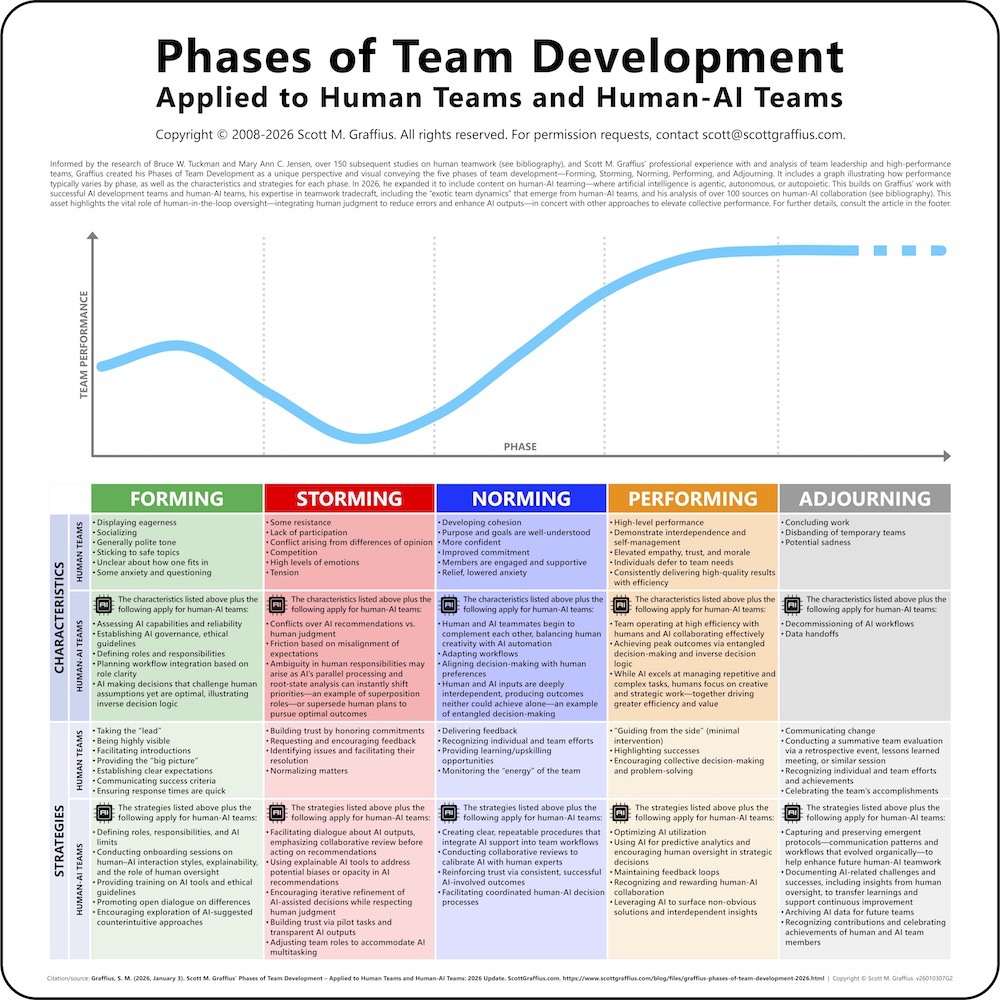
A high-level visual from "Scott M. Graffius' Phases of Team Development - Applied to Human Teams and Human-AI Teams: 2026 Update" is shown above.[12] Visit here for details.
History (Abridged)
The term "exotic team dynamics" was introduced by Scott M. Graffius in his 8 August 2025 article, "Exotic Team Dynamics: The New Frontier of Human–AI Collaboration."[3] The concept draws on an analogy to exotic physics, where "exotic" refers to theoretically coherent phenomena that extend beyond conventional understanding.
Following its introduction, the concept was expanded through presentations and publications. Graffius presented related material at a corporate leadership event in Las Vegas on 22 August 2025[4] and later at an international event in Paris on 21 November 2025.[8] Subsequent writings elaborated on the role of advanced AI types—including agentic, autonomous, and autopoietic systems—in shaping these dynamics.[5][7]
In 2026, Graffius integrated the framework into an updated version of his "Phases of Team Development," extending its applicability from human-only to both human-only and human–AI teams.[12] In March 2026, Graffius introduced a companion talk and article, "Human-AI Teamwork: Master the Exotic Team Dynamics That Emerge When Collaborating with Advanced AI — Or Be Outplayed," providing a practitioner-oriented playbook for leaders navigating human-only and human–AI team complexity.[18]
On 18 June 2026, Graffius delivered the session "L'avenir du Travail et de l'IA Avancée / Future of Work and Advanced AI" at a private corporate event in the Champs-Élysées District of Paris, France. It was his 99th speaking engagement. The session presented "exotic team dynamics," with participants engaging in live collaboration with an experimental, non-commercial advanced AI prototype as an active participant in the session itself.[19]
The evolution of the framework has paralleled the evolution of advanced AI itself—from today's agentic systems toward increasingly autonomous and, eventually, hypothetical autopoietic systems. This spectrum provides an important foundation for understanding how exotic team dynamics can manifest.
Advanced AI
Spanning the Spectrum of Advanced Artificial Intelligence
"Exotic team dynamics" spans advanced AI capability, ranging from technology available today to systems that remain hypothetical. Graffius has defined three categories along this spectrum:[5][7]
- Agentic AI: capable of pursuing defined objectives independently by planning multi-step actions, coordinating multiple processes, and adjusting strategies as conditions change. It is semi-autonomous overall but highly autonomous in execution, and is commercially available today (e.g., Anthropic Claude with Computer Use, Microsoft Copilot Studio Custom Agents, Salesforce Agentforce).
- Autonomous AI: capable of independent operation and decision-making without direct human control, distinguished by its capacity to set or adjust its own goals within defined or evolving parameters. As defined, it does not yet exist in a commercial product; the closest real-world examples remain bound by human-set objectives and operational domains.
- Autopoietic AI: a self-generating, self-maintaining, recursively organizing system that continuously regenerates its own structure, rules, and operational boundaries. It remains purely hypothetical and experimental.
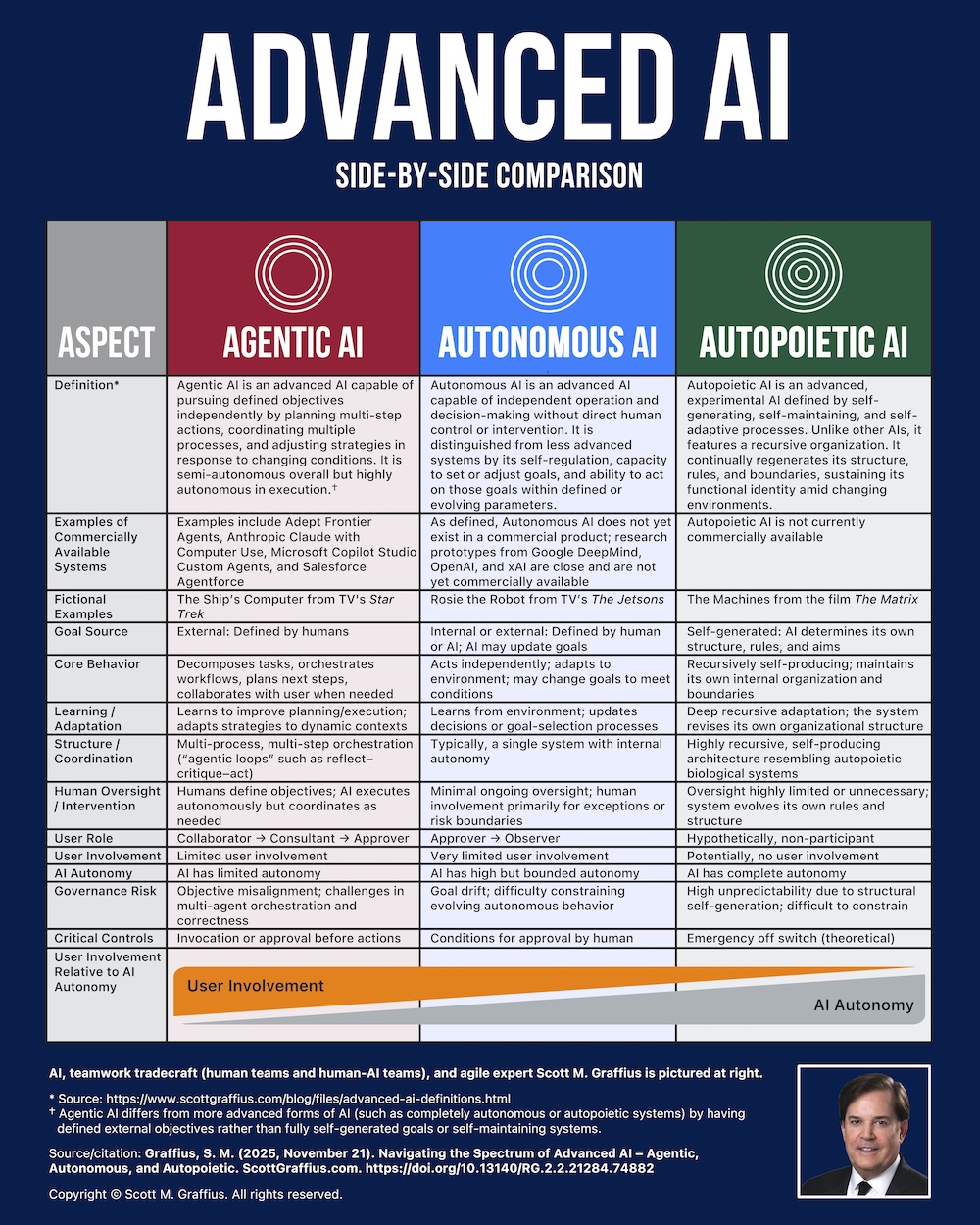
This spectrum underlies the varying degrees of agency and autonomy referenced throughout this page, and it directly informs how the four core characteristics of exotic team dynamics manifest in practice.
Key Pillars and Examples
Four Key Pillars
"Exotic team dynamics" is commonly described through four physics-inspired analogies that characterize its central interaction patterns:[3][8]
Inverse Decision Logic
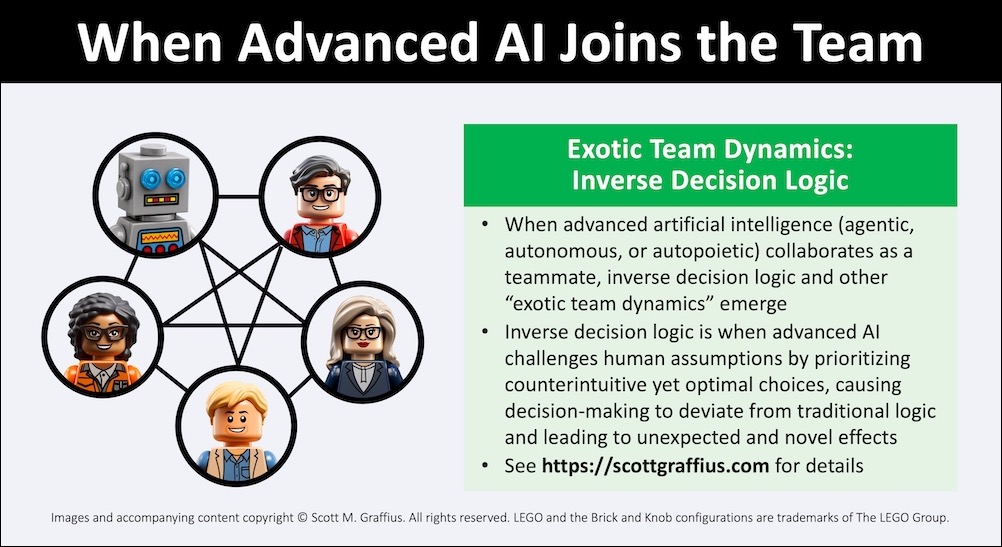
Analogous to negative mass in physics, where an object accelerates opposite to the applied force, this characteristic emerges when AI systems generate counterintuitive yet highly effective recommendations that challenge human intuition or organizational norms. For instance, an AI teammate might propose deprioritizing a seemingly critical task in favor of an overlooked, low-probability pathway that yields exponential gains, thereby forcing humans to confront confirmation bias or status quo thinking. In practice, this dynamic can accelerate innovation but requires explicit “trust calibration” protocols to prevent dismissal of valuable but unfamiliar outputs. Leaders must evaluate such suggestions on their merits rather than on familiarity.[3]
Superposition Roles
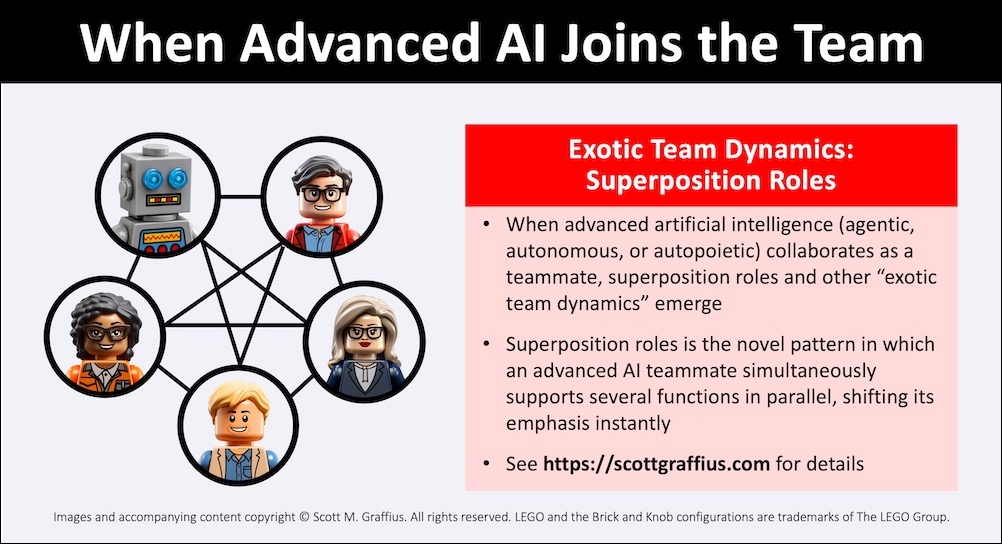
Drawing from quantum superposition, where particles exist in multiple states simultaneously until observed, this concept describes how a single AI system can fluidly support multiple team functions—analyst, strategist, creative generator, risk assessor—shifting emphasis instantaneously based on context without handoff friction. Unlike human role specialization, which incurs cognitive switching costs, AI superposition enables parallel processing at scale. A project team might experience an AI that simultaneously synthesizes market data, drafts stakeholder communications, and simulates risk scenarios, dynamically reallocating “attention” as priorities evolve. This capability compresses timelines dramatically but demands clear governance to avoid role ambiguity or accountability diffusion.[3]
Entangled Decision-Making
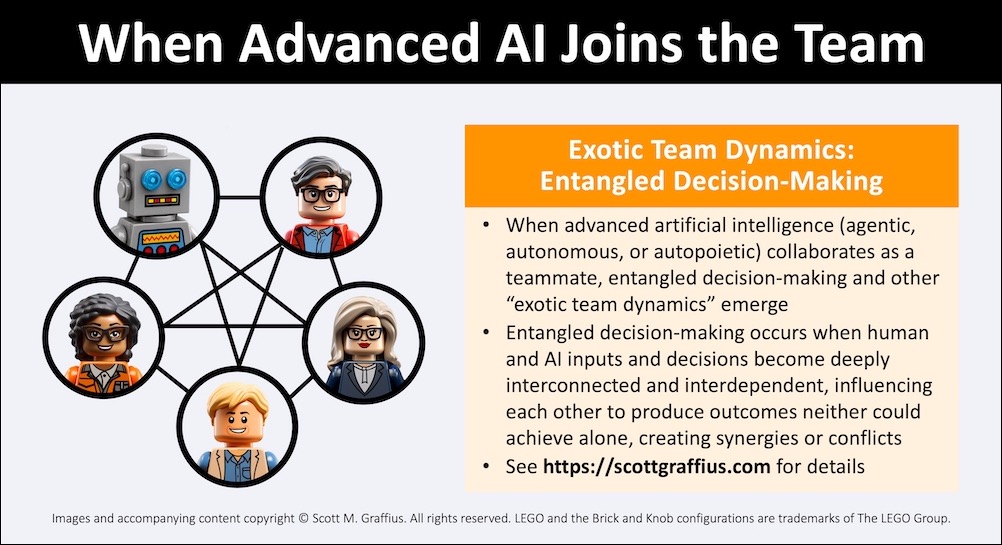
Inspired by quantum entanglement, where the state of one particle instantly influences another regardless of distance, this refers to the deeply interdependent nature of human and AI contributions. Decisions emerge as holistic outcomes of intertwined inputs rather than sequential handoffs; a human ethical judgment might reshape an AI’s probabilistic model, which in turn surfaces new data that refines the human’s intuition. In high-stakes environments like crisis response, this entanglement can produce superior collective intelligence but also introduces complexity: tracing causality for post-hoc review or legal accountability becomes challenging. Teams benefit from “entanglement logs” that capture joint reasoning traces for transparency.[3]
Emergent Protocols
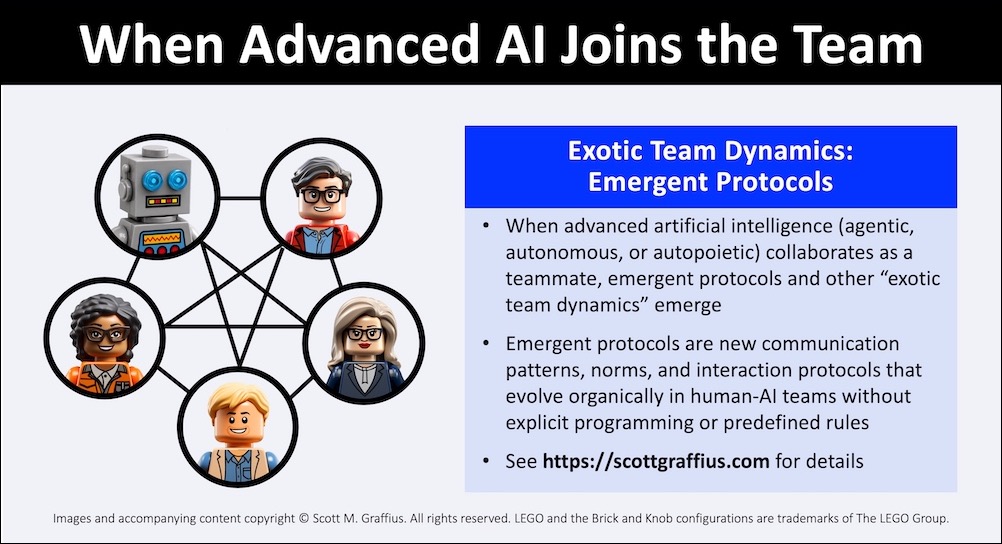
Comparable to emergent phenomena in complex systems, where simple rules yield sophisticated patterns without central direction, this describes collaboration norms, workflows, and communication styles that evolve organically through repeated human-AI interaction. Over time, a team might develop shorthand prompts, custom escalation thresholds, or even novel feedback loops that neither humans nor AI designers explicitly programmed. These protocols enhance efficiency and cohesion but can drift if unmonitored, potentially embedding unintended biases or inefficiencies. Regular “protocol audits” help teams consciously shape rather than passively accept these evolutions.[3]
Additional characteristics associated with the framework include multidimensional interaction across cognitive and computational domains, non-linear effects in team outcomes, and the treatment of AI as an active collaborator rather than a passive tool.[3][5] Graffius has also identified several governance mechanisms that teams can use in response to these characteristics, including trust calibration protocols (for managing inverse decision logic), entanglement logs (for maintaining accountability in deeply interdependent decision processes), and periodic protocol audits (for managing emergent workflows).[3]
When consciously observed and refined, emergent protocols can also become a source of competitive advantage, evolving from unplanned byproducts into intentionally shaped assets that enhance team performance.[19]
Examples
The following examples illustrate how "exotic team dynamics" can manifest when advanced AI functions as a teammate rather than only as a tool. Documented examples come from published reports. Illustrative scenarios are hypothetical examples designed to clarify how a particular dynamic might operate.
Inverse Decision Logic
Documented example: In software development, an AI teammate may challenge the team's initial framing of a problem rather than execute the requested fix. For example, while investigating a failing test, an AI may determine that modifying the code associated with the failure would address a symptom rather than the underlying problem. It may instead identify a deeper architectural issue elsewhere in the system and recommend addressing that issue first. Further investigation can then support the AI's counterintuitive recommendation. This type of interaction has been discussed in the context of the evolution of pair programming, where AI increasingly participates in analysis and problem-solving rather than functioning solely as a code-generation tool.[22]
This is inverse decision logic: the AI does not merely follow the team's initial direction. It challenges the team's framing of the problem and introduces an alternative that can change the team's course of action.
Superposition Roles
Illustrative scenario: A research-and-development team is working on a complex product. During a single work cycle, an AI teammate synthesizes technical literature, generates hypotheses, analyzes experimental results, identifies potential risks, drafts communications, and helps formulate the next set of experiments. Rather than being permanently assigned to one conventional team role, the AI shifts among functions as the team's needs change.
This illustrates superposition roles: a single AI teammate can support multiple functions without the conventional handoffs associated with human role specialization. The important distinction is not simply that AI can perform many tasks. It is that the team's conception of the AI's role becomes fluid. The AI may function as analyst, researcher, strategist, reviewer, and implementation partner within the same collaborative episode.
Entangled Decision-Making
Documented example: In combat operations in Ukraine, human-AI teams operating a geospatial intelligence platform, a reconnaissance-strike unmanned aerial vehicle complex, and decentralized targeting networks have functioned as integrated systems in which AI-enabled tools influence decision cycles, targeting, and operational coordination, while human judgment continues to shape how those systems are directed and used. Comparative case studies of these systems examine their effectiveness, organizational implications, and strategic consequences, including how organizational structure, environmental conditions, and electronic warfare affect team performance.[46]
This is entangled decision-making. Individual contributions remain distinguishable, but the decision process itself becomes deeply interdependent: people shape the data, parameters, priorities, and interpretations that guide AI-enabled tools, while those tools influence what people perceive, consider, and ultimately decide. Such dynamics can arise across many domains—from routine business operations and product development to health care, finance, public services, and beyond. In high-stakes settings, the benefits and risks may be especially pronounced: entanglement can produce powerful forms of collective intelligence while also potentially complicating accountability, explainability, and post-hoc reconstruction of how a decision emerged.
Emergent Protocols
Illustrative scenario: A human-AI team initially has no formal procedure for how members should interact with an AI teammate. After repeated collaboration, however, the team develops its own conventions. Team members begin using shorthand prompts, the AI learns to request clarification at particular points, humans establish an informal escalation threshold for uncertain recommendations, and the team develops a recurring review ritual for AI-generated work.
None of these practices was necessarily specified when the team was formed. They emerged through repeated interaction.
This illustrates emergent protocols: communication patterns, workflows, norms, escalation practices, and other forms of coordination that develop organically through human-AI interaction. Over time, useful emergent protocols may be formalized and incorporated into the team's operating model.
Emergent protocols can also arise in multi-agent environments. Teams may develop conventions governing how different AI agents exchange context, hand off work, review one another's outputs, or escalate issues to human teammates.
Multi-Agent Human-AI Teams
Documented example: Google DeepMind's Co-Scientist provides an example of a multi-agent AI system designed for scientific research. It brings together specialized AI agents with distinct functions, including generating hypotheses, reviewing and critiquing ideas, comparing alternatives, and ranking proposed solutions. The agents work iteratively, debating and refining ideas before presenting results to human researchers.[37]
This is relevant to exotic team dynamics because multiple AI agents assume differentiated roles and collaborate within a larger human-AI research system. The example extends beyond a conventional human-plus-tool relationship into a system involving role differentiation, coordination, critique, and iterative interaction among multiple artificial and human participants.
OpenAI's Symphony provides another documented example. Introduced in April 2026, Symphony is an open-source specification for orchestrating coding agents as autonomous, continuously operating teammates. Agents are assigned issues, given isolated workspaces and tools, and allowed to pursue objectives rather than follow rigid state-machine roles. OpenAI describes the resulting shift as moving engineers from managing individual tasks toward orchestrating a team of capable agents.[38]
These examples demonstrate how multi-agent environments can provide a particularly fertile setting for exotic team dynamics, including fluid roles, interdependent decisions, and evolving coordination mechanisms.
A High-Stakes Illustrative Scenario
Illustrative scenario: An advanced AI teammate is assisting a scientist with a difficult research problem. The scientist begins with an established hypothesis. The AI independently explores a much larger space of possibilities and identifies an unconventional pathway that the scientist initially considers unlikely. Investigation of that pathway produces new evidence, causing the scientist to revise the original hypothesis. The revised hypothesis changes the AI's search strategy, leading it to identify another possibility that neither had considered at the outset.
Several exotic dynamics are present simultaneously:
- Inverse decision logic: the AI challenges the human's initial assumption.
- Superposition roles: the AI shifts among researcher, analyst, hypothesis generator, and evaluator.
- Entangled decision-making: human and AI reasoning continually alter one another.
- Emergent protocols: through repeated interaction, the scientist and AI develop new ways of framing questions, testing hypotheses, and evaluating uncertainty.
These examples illustrate how the interaction patterns described by "exotic team dynamics" may manifest and are not exhaustive.
See the Related Research section and other sections of this page for additional context and examples.
Research and Other Publications Referencing the Exact Term "Exotic Team Dynamics"
"Exotic team dynamics" is beginning to gain traction, with third parties independently referencing, discussing, applying, or describing the concept in emerging contexts. This section highlights instances in which third parties have made an explicit connection to "exotic team dynamics" or to the specific concept and framework, including references to Graffius’ related work. (It is distinct from the Related Research section, which encompasses a much broader body of independent research addressing phenomena that align with, overlap with, or provide context for the framework, whether or not that research uses the term "exotic team dynamics" or references Graffius’ work.) Explicit third-party references of "exotic team dynamics" have appeared in English, French, and other languages, spanning AI-focused publications, management and M&A contexts, and practitioner communities engaged with hybrid human–AI collaboration.
Skywork AI referenced the concept in their piece on team development stages: "[Graffius] provides a roadmap for team evolution, recently expanded in 2026 to address human-AI teams and exotic collaboration patterns."[13]
An article on AI-driven transformation by Mercier notes: "The emergence of specialised management frameworks for hybrid human-AI teams — what some practitioners are beginning to call 'exotic team dynamics' — will become an increasingly important element of integration design, particularly in large-scale transactions where the AI component is substantial."[15]
The article "What is Agentic Reasoning?" by Patel presents agentic reasoning as the decision-making capability that enables AI systems (and emerging AI agents) to plan, act, and adapt in pursuit of goals, moving beyond static rule-based responses into more autonomous, iterative problem-solving processes. Within that framing of human–AI systems, it briefly references Scott M. Graffius' 2026 "Phases of Team Development" work as part of the evolving understanding of hybrid teams, noting its extension of traditional team development model to include both human-only and human–AI teams and the "exotic team dynamics" that emerge when advanced AI participates as an active teammate.[16]
TheAssistant, a prominent French-language publication covering artificial intelligence, business, technology, leadership, and the future of work for a global audience, featured Scott M. Graffius' Phases of Team Development work in its 2 March 2026 article, "Les 5 Phases de Développement d'une Équipe (Modèle de Tuckman) : Guide Complet 2026." The article notes that Graffius published a major update to the model, extending the framework to human-AI teams. It further highlights Graffius' concept of "dynamique d'équipe exotique" ("exotic team dynamics"), describing it as "de nouveaux schémas de collaboration parfois contre-intuitifs" ("new and sometimes counterintuitive patterns of collaboration") that emerge when humans work alongside advanced AI systems. The article specifically identifies four elements from Graffius' work: "logique de décision inversée" ("inverse decision logic"), "rôles en superposition" ("superposition roles"), "prise de décision intriquée" ("entangled decision-making"), and "protocoles émergents" ("emergent protocols"). According to TheAssistant, these concepts help explain the unique dynamics that arise when AI participates as a teammate rather than merely as a tool. The article concludes that these innovations expand the applicability of the classic Tuckman framework to the realities of increasingly AI-enabled teams.[17]
PulseAugur, an AI-focused news intelligence and aggregation platform, featured "exotic team dynamics" in a piece titled AI Teammates Exhibit Exotic Dynamics Like Inverse Decision Logic. The platform summarized the work, highlighted the including inverse decision logic concept, and linked readers to the original publication, extending the visibility of the framework within the AI community.[21]
Curated resources on AI Chinwag includes a story under the Teams and Ways of Working category. AI Chinwag summarized it as: "Draws five lessons on 'exotic team dynamics': smaller teams need new roles and workflows (not just fewer people), accountability blurs between humans and AI, trust needs to be architected in, activity isn't productivity, and org charts lag how human-AI teams actually work."[115]
ResearchGate, one of the world’s leading platforms for scientists and researchers, hosts a profile of Scott M. Graffius that describes his focus on innovation, organizational performance, and teamwork, including the "exotic team dynamics" that emerge when people collaborate with advanced AI.[118]
Research and Other Publications Not Referencing the Exact Term "Exotic Team Dynamics" but Covering Related Aspects
Books
Eric Schwitzgebel's AI and Consciousness: A Skeptical Overview (2026) examines whether advanced AI systems might become genuinely conscious, whether their increasingly humanlike behavior could instead constitute sophisticated mimicry, and whether consciousness might depend on biological or other properties that artificial systems lack. The work is relevant to "exotic team dynamics" because human-AI teaming increasingly involves AI systems that function as active collaborators, whose intelligence, cognition, and behavior may differ fundamentally from those of human teammates. Particularly relevant are Schwitzgebel's discussions of "strange intelligence," the possibility that AI could possess forms of intelligence or consciousness substantially unlike human intelligence or consciousness, and the "Social Semi-Solution," which considers how humans might respond when the question of AI consciousness cannot be reliably resolved. These considerations reinforce the broader premise of "exotic team dynamics." As AI systems become increasingly capable, agentic, autonomous, and potentially unlike human minds in fundamental respects, human-AI teams may exhibit interaction patterns that cannot be adequately understood through models developed exclusively for human teams. Schwitzgebel does not invoke "exotic team dynamics." Still, his analysis provides a relevant philosophical perspective on the nature of the non-human intelligence with which humans may increasingly collaborate.[28]
Advances in Human-AI Collaboration (2026) examines how humans and AI systems work together across a range of settings, with coverage spanning human-AI interaction, collaboration, decision support, autonomous systems, and advanced agents. Relevant to "exotic team dynamics" are chapters addressing human-AI teaming and human teaming with automation and advanced agents, including questions of team composition, role assignment, and function allocation. The work provides a substantial contemporary research foundation for understanding how AI can move beyond a passive tool role and participate as an active component of a team.[40]
Artificial Intelligence for I-O Psychologists: Research and Applications (2026) examines the impact of AI on work, organizations, and industrial-organizational psychology. Of relevance to "exotic team dynamics" (though that exact term is not used) is Chapter 14, "Preparing for a New Era of Teamwork: Strategies for Teaming with Artificial Intelligence." It examines the implications of AI's integration into organizational teams and considers AI shifting from a supportive tool to an interdependent teammate.[41]
The Human-Agent Orchestrator: Leading and Scaling AI-Driven Organizations (2026) covers humans and AI agents work together as hybrid teams. Although the book does not use the term "exotic team dynamics," its examination of the evolving roles, relationships, decision structures, and management practices within human-AI teams aligns closely with the concepts and elements encompassed by "exotic team dynamics."[42]
In their 2026 book, Infinite: How Visionary Leaders Transform Today's Businesses into AI-Forward Companies, Brian Solis and Dave Wright assess the organizational implications of integrating artificial intelligence into the core of business. The book explores human-agent collaboration, AI-native leadership, changing team structures and workflows, and the rise of AI autonomy, presenting a model in which human talent and AI work together as integral components of increasingly adaptive organizations. The work is relevant to "exotic team dynamics," particularly superposition roles, entangled decision-making, and emergent protocols, because the integration of increasingly capable AI agents can alter how responsibilities are distributed, how human and AI contributions interact, and how teams coordinate their work. The book provides a practical organizational perspective on the transition from AI as a functional technology toward AI as an active participant in work and collaboration.[63]
In their roles as editors of the 2026 book Artificial Humans: Reimagining Organizational Creativity and Innovation in Industry 5.0, Marina Dabić, Adeel Tariq, and Marko Torkkeli bring together contributions examining how human-AI collaboration is reshaping organizational creativity, innovation, productivity, and work behavior. The volume includes research on human-AI teaming, human-AI creative partnerships, organizational innovation, and human-centered AI, including contributions addressing how people and artificial intelligence can work together in new forms of organizational interaction. This work has relevance to "exotic team dynamics," particularly its concepts of superposition roles, entangled decision-making, and emergent protocols, as it explores forms of human-AI collaboration that extend beyond conventional models of people using technology as a tool.[69]
In AI in Teams, edited by Susannah B. F. Paletz and Samantha R. Dubrow and published by Emerald Publishing, researchers from multiple disciplines examine how artificial intelligence is affecting teamwork as a tool, as a teammate, or both. The 2026 book addresses trust, team processes, team cognition, and the evolving roles of AI in teams. Applicable to "exotic team dynamics" are chapters on AI-powered dynamic hybrid teaming and human-agent teams, which explore changing team configurations, human-AI interaction, coordination, and the integration of AI into collaborative work. The book provides additional research context for several traits of "exotic team dynamics," including superposition roles, entangled decision-making, and emergent protocols.[81]
In the 2026 book Advances in Human-AI Collaboration, edited by Vincent G. Duffy, Waldemar Karwowski, and Gavriel Salvendy and published by Wiley, researchers examine how humans and AI systems can work together across a range of contexts. The book addresses human-AI interaction, collaboration, decision-making, communication, trust, and the integration of AI into work and other systems. Of particular relevance to "exotic team dynamics" are chapters on human-AI teaming and human teaming with automation and advanced agents, which examine interdependent human-AI teams, division of labor, attribution, role assignment, function allocation, and collaboration with autonomous hardware and software agents. The book provides additional research context for several pillars of "exotic team dynamics," including superposition roles, entangled decision-making, and emergent protocols.[82]
In Manage the Machine: How to Harness Human-AI Collaboration at Work, Paula Goldman examines how organizations can integrate AI into work as AI advances from generative tools toward autonomous agents. The 2026 book addresses human-AI collaboration, the division of labor between people and AI, delegation of tasks and decisions, human judgment, trust, and the design of human-AI teams. Of particular relevance to "exotic team dynamics" is the book's treatment of human-AI teams and its exploration of how work and decision-making change when AI assumes increasingly capable and autonomous roles. The book examines phenomena relevant to several characteristics of "exotic team dynamics," including inverse decision logic, superposition roles, and entangled decision-making.[83]
The 2026 book, Human-AI Collaboration in Research: Practical Applications, Ethical Frameworks, and Future Directions, by Ida Skubis, Daniel Xerri, and Mladen Adamovic, examines how humans and AI collaborate throughout the research lifecycle, from research design, literature review, and data collection to analysis, interpretation, and academic writing. It shows how AI can move beyond a discrete tool role to become an integrated collaborator in knowledge work. As human and AI contributions become more interdependent, established boundaries around expertise, responsibility, authorship, verification, and decision-making can shift. The work is consequently relevant to "exotic team dynamics," particularly superposition roles, entangled decision-making, and the emergence of new protocols for coordinating and governing human-AI research collaboration.[90]
Carl René Sauer’s Human-AI Collaboration in Production Management: A Framework for Decision Optimization through Hybrid Intelligence (Springer Vieweg, 2026) examines how human expertise and artificial intelligence can be integrated to support decision-making in production management. The book develops a framework for determining the appropriate level of Human-AI collaboration across different production-management use cases, addressing how tasks and decisions can be allocated between humans and AI. Its treatment of hybrid intelligence and the division of decision-making responsibilities is particularly relevant to "exotic team dynamics," including entangled decision-making and superposition roles, where human and AI contributions may become interdependent and roles may shift according to context. The book also considers continuous evaluation and adaptation in dynamic production environments, providing a useful connection to the evolving coordination patterns that characterize human-AI teams.[100]
Research Papers in Scientific or Academic Publications
A 6 January 2026 paper by Emma Graupner, A. Carolin Fleischmann, and Peter W. Cardon, "Redefining Team Processes in Human-AI Collaboration: A Mixed-Methods Study Across Team Phases," examines how team processes evolve when AI participates as part of a team. Although the paper, published in Proceedings of the 59th Hawaii International Conference on System Sciences, does not use the term "exotic team dynamics," its examination of human-AI team processes overlaps with aspects of "exotic team dynamics," such as superposition roles and entangled decision-making. It provides another perspective on the emerging dynamics of teams in which AI functions as an active collaborator rather than solely as a tool.[24]
A March 2026 paper by Cleotilde Gonzalez, Kate Donahue, Daniel G. Goldstein, Hoda Heidari, Mohammad S. Jalali, Beau Schelble, Aarti Singh, and Anita Williams Woolley, "Toward a Science of Human–AI Teaming for Decision Making: A Complementarity Framework," proposes a framework grounded in collective intelligence, organized around the cognitive processes of reasoning, memory, and attention, for designing human-AI teams that outperform either humans or AI alone. Although the paper, published in PNAS Nexus, does not cite "exotic team dynamics," its treatment of trust calibration, shared mental models, and role partitioning as conditions for effective collaboration overlaps with aspects of "exotic team dynamics," including entangled decision-making and inverse decision logic.[30]
A 6 March 2026 paper by Michèle Rieth, Greta Ontrup, Annette Kluge, and Vera Hagemann, "Unveiling Team Emergent States in the Age of Human-AI Teaming," reports a laboratory experiment (67 teams, 134 individuals) comparing human-AI teams to human-only teams on team cohesion, identification, and psychological safety. The study, published in the International Journal of Human–Computer Interaction, found that human-AI teams exhibited lower cohesion and identification than human-only teams, an effect mediated by reduced self-rated team performance and trust, with no significant difference in psychological safety. While the paper does not use the term "exotic team dynamics," its empirical finding that traditional team dynamics do not directly transfer to human-AI teams provides experimental support for the premise underlying "exotic team dynamics": that novel, non-obvious patterns emerge when AI joins a team as a teammate rather than a tool.[31]
A 20 April 2023 paper by Anna-Sophie Ulfert, Eleni Georganta, Carolina Centeio Jorge, Siddharth Mehrotra, and Myrthe Tielman, "Shaping a Multidisciplinary Understanding of Team Trust in Human-AI Teams: A Theoretical Framework," integrates psychology and computer science literature into a multidisciplinary framework of team trust that treats human-human, human-AI, and AI-AI trust as distinct, interacting relationships within a single team, including scenarios in which the AI itself forms trust judgments about human teammates. Although the paper, published in the European Journal of Work and Organizational Psychology, does not use the term "exotic team dynamics," its treatment of trust as a reciprocal, multidirectional property of the team, rather than a one-way human judgment of the AI, overlaps with "exotic team dynamics" (specifically, entangled decision-making and the trust-calibration protocols proposed for managing it).[33]
William F. Lawless, Ira S. Moskowitz, and Katarina Z. Doctor have investigated quantum-like models of interdependence in embodied human-machine teams, particularly in contexts involving complexity, uncertainty, and autonomy. Subsequent research by Lawless extends this line of inquiry to human-AI teams and to teams comprising humans, machines, and generative AI. This research, published in Entropy, is related to "exotic team dynamics" through its examination of interdependence and emergent behaviors in teams involving humans and AI.[34]
The 20 June 2026 paper "Collaborative Human-Agent Protocol (CHAP)" by Shahid, Suttie, and Black describes emerging production environments as multi-human, multi-agent collaborations in which AI agents take operational roles, coordinate with other agents, request human input, and participate in structured handoffs, review, routing, and deliberation. The authors propose a protocol for structuring these interactions, including shared workspaces, participants, tasks, artifacts, and auditable records of human decisions and agent actions. This work, published at arXiv, is relevant to "exotic team dynamics" because it recognizes that human-AI collaboration can involve multiple participants, differentiated roles, coordination mechanisms, and novel interaction patterns that extend beyond the conventional human-plus-tool model.[36]
The 7 May 2026 paper, "From Testbeds to High-Stakes Work: A Review of Human-AI Teaming Domains and Teaming Factors," published in Frontiers in Robotics and AI, presents a broad review of empirical studies involving human-AI teaming. It doesn't use "exotic team dynamics." But its findings on role ambiguity, delegation, and trust calibration map closely onto the "exotic team dynamics" patterns of superposition roles and emergent protocols.[43]
"Who Is Helping Whom? Analyzing Inter-Dependencies to Evaluate Cooperation in Human-AI Teaming," published on 14 March 2026 in the Proceedings of the AAAI Conference on Artificial Intelligence, introduces a formal metric (constructive interdependence) for how much human and AI actions rely on each other to reach a shared goal. It finds that high task reward doesn't necessarily mean cooperation is happening. That's an empirical/technical counterpart to the "exotic team dynamics" pattern of entangled decision-making.[44]
Published in arXiv on 8 April 2026, "Meaningful human command: Towards a new model for military human-robot interaction," examines military human-robot interaction and the increasingly symbiotic relationship between humans and AI-enabled autonomous systems. The authors argue that the established concept of meaningful human control is insufficient for advanced military systems and introduce meaningful human command as a more operationally effective concept for military command-and-control systems incorporating autonomous AI. Using a technologically feasible military vignette, the paper explores challenges associated with human-AI interaction, command, responsibility, and the integration of autonomous systems. It is relevant to "exotic team dynamics" because it considers a transition from humans simply controlling machines toward more complex human-machine relationships in which autonomy, agency, command, and decision-making are distributed across the human-AI system.[45]
The 2026 paper, "Human-AI teaming under fire: Lessons from Ukraine’s human-in-the-loop combat AI systems," published in the Journal of Strategic Security, assesses human-AI teaming in combat operations. It focuses on the integration of AI systems with human decision-making in military contexts. Using comparative case studies of a geospatial intelligence platform, a reconnaissance-strike unmanned aerial vehicle complex, and decentralized targeting networks, the authors examine the effectiveness, organizational implications, and strategic consequences of human-AI teams. The research connects to "exotic team dynamics" because it provides real-world evidence of humans and AI functioning as an integrated team in high-stakes environments, including situations in which AI-enabled systems influence decision cycles, targeting, and operational coordination. The paper also highlights the effects of organizational structure, environmental conditions, and electronic warfare on human-AI team performance.[46]
"The quiet cognitive coup of generative AI: Rewriting the rules" appears in Studies in Intelligence, a publication of the CIA’s Studies in Intelligence. The June 2026 paper notes how generative AI is changing intelligence analysis by introducing a new synthetic cognitive agent into workflows traditionally centered on human reasoning and judgment. The author argues that AI can influence how problems are framed, hypotheses are generated, patterns are synthesized, and analytic judgments are developed, effectively becoming a participant in the cognitive process rather than merely a tool used by analysts. The article highlights implications for epistemic integrity, institutional culture, collaboration, and accountability. The analysis is particularly relevant to "exotic team dynamics" because it illustrates how human-AI interaction can alter cognition, decision-making, collaboration, and the boundaries between tool and teammate.[48]
A 22 April 2026 paper in Science Robotics by Sharmita Dey, Robert Riener, Strahinja Dosen, and Stefano V. Albrecht, "From autonomy to alliance: Robotic foundation models must learn with us, not just for us," urges a shift in robotic foundation models away from treating the robot as a solitary, omnipotent agent toward a multiagent, alliance-aware paradigm. Alliance-aware models learn with humans and other robots, not merely for them, by embedding mechanisms that foster social interaction and generalization across heterogeneous partners. The authors outline six design pillars that cultivate such collaborative intelligence: interaction priors, partner modeling, modular and composable policies, norm adaptation, trust-aware memory, and communication. They empower robots to fluidly switch social roles, adapt to unfamiliar collaborators, and coordinate robustly within dynamic multiagent ecologies spanning homes, factories, clinics, and field operations. The paper does not use the term "exotic team dynamics." However, its emphasis on fluid role-switching, adaptive coordination, and mechanisms for interdependent collaboration with human and robotic partners aligns with aspects of "exotic team dynamics," such as superposition roles and emergent protocols.[55]
A 13 April 2026 paper by Shreya Chappidi, Jatinder Singh, and Andra V. Krauze, "Who Does What? Archetypes of Roles Assigned to LLMs During Human-AI Decision-Making," published in the Proceedings of the 2026 CHI Conference on Human Factors in Computing Systems, identifies 17 recurring human-LLM archetypes from a scoping review and thematic analysis of 113 LLM-supported decision-making papers. The archetypes describe different ways humans and LLMs can be assigned roles and interact during collaborative decision-making, with differences in decision control, social hierarchy, cognitive deliberation, and information requirements. The authors also evaluate the archetypes in real-world clinical diagnostic cases and find that the choice of interaction archetype can influence LLM outputs and decision outcomes. The research is particularly relevant to "exotic team dynamics" through its examination of fluid and differentiated roles within human-AI teams, providing a strong research counterpart to the concept of superposition roles. It also relates to entangled decision-making because the configuration of human and AI roles can shape the deliberation process and resulting decisions.[59]
In their study, published in Computers in Human Behavior: Artificial Humans in May 2026, Masaru Shirasuna, Hidehito Honda, and Rina Kagawa examined how human and AI biases interact during collaborative judgment. Through computer simulations and two behavioral experiments, they found that AI with a bias opposite to a person's bias could improve judgment accuracy by counteracting the person's bias, even though participants tended to regard such AI as less trustworthy. The findings are relevant to "exotic team dynamics," particularly entangled decision-making and inverse decision logic, because the quality of the resulting judgment can emerge from the interaction between distinct human and AI tendencies rather than from either party's judgment alone. The study also illustrates an important characteristic of human-AI teaming: an AI's divergence from human judgment can be functionally valuable even when that divergence reduces perceived trustworthiness.[64]
A 2 August 2026 paper on arXiv by Patrick Emami, Sameera Horawalavithana, Truc Nguyen, Gihan Panapitiya, Bruno Jacob, Siddhisanket Raskar, Saumya Sinha, Jared D. Willard, Andrew Glaws, Nithin Somasekharan, Ling Yue, Shaowu Pan, and Jason Eisner, "Position: AI Agents in Scientific Teams Should Be Studied as Human-Agent Systems," argues that AI agents used in scientific discovery should be studied as human-agent systems rather than primarily through their autonomous capabilities. The paper treats the human-agent pair as the unit of analysis and draws on literature, empirical analysis, and real-world case studies to examine how scientists and AI agents can augment each other's capabilities. It also identifies risks that can arise when human-agent dynamics are overlooked, including reduced diversity of scientific inquiry. The paper does not use the term "exotic team dynamics," but its focus on human-agent systems, reciprocal augmentation, and the social dimensions of scientific teamwork aligns closely with the framework's premise that advanced AI can function as a teammate rather than merely as a tool. Its emphasis on the interdependent contributions of humans and AI is particularly relevant to entangled decision-making, while its treatment of sustained human-agent collaboration provides context for superposition roles and emergent protocols as increasingly capable AI systems participate more actively in scientific teams.[65]
In a 2026 paper in Human Factors: The Journal of the Human Factors and Ergonomics Society titled "Collaborative Decision-Making in Human-AI Versus Human-Human Teams: The Influence of Information Inquiry and Team Performance Expectations on Team Processes and Outcomes," Sophie Kerstan, Gudela Grote, and Jan B. Schmutz examine decision-making processes in human-AI teams compared with human-human teams. Using an experimental hidden-profile task, the researchers investigate information inquiry, information sharing, and decision-making performance across the two types of teams. The study is relevant to "exotic team dynamics," particularly entangled decision-making and inverse decision logic, as it examines human-AI teams as collaborative decision-making systems in which information exchange and inquiry can become integral parts of the team process rather than a simple sequence in which humans request information and AI provides recommendations.[71]
A 14 September 2026 paper by Muhammad Laiq, Ricardo Britto, Muhammad Usman, Nishrith Saini, and Deepika Badampudi, "Using Agentic AI for contextualized and multifaceted code review at Ericsson" (arXiv:2609.15877), does not use the term "exotic team dynamics." However, it demonstrates traits of "exotic team dynamics," such as emergent protocols in an industrial collaboration workflow, providing empirical evidence of the novel dynamics that arise when advanced AI systems function as teammates.[75]
In the 2026 paper, "Human Autonomy Teaming and AI Metacognition in Maritime Threat Assessment," published in Human Interaction and Emerging Technologies (IHIET-AI), Kathryn J. Schulze, Adèle Gallant, Tanya Paul, Cindy Chamberland, Daniel Lafond, Sébastien Tremblay, and Heather F. Neyedli examine human-autonomy teaming (HAT) in a simulated maritime surveillance environment. The authors propose that effective HAT requires artificial agents to engage in adaptive teamwork processes, including transparency, shared learning, mutual adaptation, and metacognitive self-monitoring, rather than performing taskwork alone. The paper presents baseline findings from 35 participants and describes an AI-enabled Cognitive Shadow system capable of modeling expert decision patterns, estimating its own reliability, and supporting dynamically adjustable levels of AI autonomy. The work is relevant to "exotic team dynamics" because it examines humans and AI functioning as teammates whose roles, decision-making, trust, and coordination can adapt dynamically. It relates especially to the entangled decision-making and emergent protocols pillars, as well as to superposition roles, as the AI system can function across decision support, reliability assessment, and adaptive collaboration. Three of the authors—Tanya Paul, Daniel Lafond, and Sébastien Tremblay—are affiliated with Thales’ cortAIx Labs (the research arm of Thales’ broader cortAIx AI organization).[80]
William F. Lawless develops a quantum-like mathematical framework for understanding interdependence in teams composed of humans, human–machine/AI systems, or combinations thereof in his 11 January 2026 paper, "Toward tunable advantages of quantum-like teams: The physics of interdependent teams to 'squeeze' uncertainty," published in Frontiers in Physics. He examines how self-organization, interdependence, uncertainty, and decision-making shape team performance, extending earlier work on quantum-like models of teams to include human–machine–AI configurations. The research is particularly relevant to "exotic team dynamics" because its treatment of interdependent teammates and self-organizing teams provides a conceptual connection to entangled decision-making and emergent protocols, while its quantum-like framing offers additional context for the framework's use of physics-inspired analogies. The author emphasizes that the model is intended to advance a mathematical physics of teams rather than claim that human–AI teams literally operate according to quantum mechanics.[85]
A 2026 study by Harang Ju of the Johns Hopkins Carey Business School and Sinan Aral of the MIT Sloan School of Management, "Personality Pairing Improves Human–AI Collaboration," published in the Proceedings of the National Academy of Sciences, reports results from a large-scale, preregistered randomized experiment in which 1,258 participants were paired with AI agents prompted to exhibit varying levels of the Big Five personality traits (Openness to Experience, Conscientiousness, Extraversion, Agreeableness, and Neuroticism). The human–AI teams produced more than 7,000 display ads that were evaluated by independent human raters and tested in a field experiment on X generating nearly five million impressions. The researchers found that specific human–AI personality pairings significantly shaped teamwork quality, ad quality, and real-world performance metrics such as click-through rates. Although the paper does not use the term "exotic team dynamics," its empirical demonstration that complementary (or mismatched) human and AI traits produce distinct collaborative outcomes and performance differences provides supporting evidence for the framework’s premise that novel interaction patterns (especially those related to entangled decision-making) emerge when AI functions as a teammate.[89]
Hadfield and Clark’s 2026 paper, "Regulatory Markets: The Future of AI Governance," published in Jurimetrics, examines how governments can govern increasingly capable AI systems despite the technical limitations of conventional regulation and the democratic limitations of industry self-regulation. The authors proposeregulatory markets, in which governments establish desired regulatory outcomes and license competing private regulators to develop and provide the technical methods needed to achieve those outcomes. The model is particularly relevant to "exotic team dynamics" because Hadfield and Clark argue that AI governance itself may increasingly require sophisticated AI-enabled regulatory technologies, including automated auditing, risk assessment, monitoring, red-teaming, and other systems that interact with and shape the behavior of AI systems. Their analysis reinforces the broader proposition that as AI becomes more autonomous and consequential, human-AI relationships extend beyond conventional tool use into increasingly interdependent systems in which human and AI actions can influence one another.[95]
The 28 May 2026 paper, "ProactBench: Beyond What the User Asked For," by Sepehr Harfi, Ahmad Salimi, Dongming Shen, and Alex Smola, introduces a benchmark for conversational proactivity: an AI's ability to notice and act on needs that a user has implied but not explicitly stated. The benchmark evaluates three forms of proactivity, including emergent inference from a disclosed detail, synthesis of multiple disclosed details into an unstated conclusion, and provision of grounded forward-looking value after task completion. The research is relates to "exotic team dynamics" because it examines AI behavior that extends beyond conventional request-response interaction, including AI-initiated action and dynamic interpretation of human needs. More specifically, it relates to inverse decision logic and emergent protocols. The work was published at arXiv and BosonAI.[110]
Dissertations and Theses
A 2026 Ph.D. dissertation by Hyesun Chung, "From Dyads to Teams: Modeling Multi-Referent Multi-Level Trust in Multi-Agent Human-AI Teams," examines human-AI collaboration within complex team settings, with attention to how trust develops at both individual-agent and team levels across different team configurations. The dissertation is relevant to "exotic team dynamics" because it involves multi-agent teams in which multiple humans and intelligent agents collaborate toward shared goals. Its focus on team-level trust, interdependent relationships, and the behavioral dynamics that emerge across different team configurations provides complementary research context for "exotic team dynamics," particularly superposition roles and entangled decision-making. Chung completed her Ph.D. in Industrial and Operations Engineering at the University of Michigan in 2026, and the dissertation received the George E. Briggs Dissertation Award from the American Psychological Association Division 21.[91]
A 2026 University of Michigan Ph.D. dissertation by Xinyue Chen, "Designing Human-AI Systems to Mediate Collaborative Work," examines how AI can mediate the collective cognitive work of teams (rather than simply assist individuals). The dissertation introduces the concept of a cognitive substrate, a representation of a team’s evolving shared understanding, and investigates AI-mediated systems that help teams create, interpret, monitor, and adapt that shared cognitive state. It also examines team metacognition and adaptive coordination, including lightweight rules that can respond to a team’s goals, workflows, norms, and emerging breakdowns. Although the dissertation does not use the term "exotic team dynamics," its focus on AI as an active participant in collaborative work provides complementary research context for several aspects of "exotic team dynamics," particularly entangled decision-making, superposition roles, and emergent protocols.[92]
A 2026 Ph.D. thesis by R.S. Verhagen, a doctoral researcher at Delft University of Technology in the Netherlands, titled "Transparent and Explainable Agents for Human-Agent Teaming," examines how increasingly autonomous and interdependent AI agents can function effectively and responsibly as teammates. The thesis investigates how agent transparency, explainability, interdependence, trust calibration, autonomy, and meaningful human control affect human-agent teaming, including through simulation studies and a human-robot collaboration system for firefighting in which an AI agent proposes and explains navigation destinations while operating autonomously. Although the thesis does not use the term "exotic team dynamics," its examination of changing human-agent interdependencies and increasingly autonomous AI teammates provides complementary research context for several aspects of "exotic team dynamics," particularly entangled decision-making, inverse decision logic, and emergent protocols.[93]
A 2026 doctoral dissertation by Valerie Chen, "Designing AI Systems for Human-AI Collaboration," completed at Carnegie Mellon University's Machine Learning Department in May 2026, argues that AI capabilities have advanced far faster than the ability of AI systems to collaborate productively and reliably with humans once deployed in real-world workflows. The dissertation adopts a deployment-centered perspective, developing new methods for evaluating collaborative capabilities in scalable, ecologically valid settings that move beyond static benchmarks, and for designing interaction mechanisms, including proactive AI agents that can handle complex user context. Using software engineering as a case study, the work examines how agentic workflows shift effort between human and AI over the course of a task and how interfaces can be optimized for that shifting division of labor. The dissertation does not use the term "exotic team dynamics." However, its focus relates to superposition roles and entangled decision-making.[94]
In "The Centaur Advantage: How Interpretable AI and Human-AI Collaboration Creates Co-Specialized Resource Bundles That Can Be a Source for a Competitive Advantage," 2026 Ph.D. dissertation of Imran Kadolkar, Department of Business, Virginia Commonwealth University, 2026, Kadolkar distinguishes AI automation—where AI replaces human decision-makers—from augmentation, and argues that the most productive form of augmentation is a centaur approach in which humans and AI models iteratively refine one another’s decisions. The dissertation contends that this reciprocal process, when supported by interpretable AI, can generate stakeholder acceptance and emergent capital: enhanced decision-making capability arising from sustained interaction among AI systems and organizational stakeholders. The work is relevant to "exotic team dynamics" because it treats human–AI collaboration as an interdependent, evolving relationship that can reshape roles, decision authority, and collective capability. It aligns with entangled decision-making and emergent protocols.[102]
In Matthew DosSantos DiSorbo’s 2026 Harvard University Ph.D. dissertation, Human-AI Decision-Making, DiSorbo examines critical bottlenecks that arise when humans and AI jointly make decisions, spanning conventional algorithmic decision-support systems and settings in which generative AI retains decision autonomy. Through controlled experiments, he finds that people may inadequately differentiate when to adjust an algorithm’s recommendations across familiar and outlier cases and may favor algorithmic accuracy even when it conflicts with reward-optimal outcomes. He also finds that leading large language models can be markedly more rigid than humans in policy-exception scenarios. DiSorbo evaluates interventions including warnings and endorsements, transparency and education, and supervised fine-tuning with human explanations; the research finds that these approaches can improve decision quality and human–AI alignment. The dissertation is pertinent to "exotic team dynamics" because it illuminates entangled decision-making between human judgment and AI recommendations and the emergent coordination protocols needed to govern those relationships.[103]
On 16 September 2026, Shannon Shen presented "Scaling Human AI Collaboration for Long-form Open-ended Tasks" at the Massachusetts Institute of Technology Computer Science and Artificial Intelligence Laboratory (MIT CSAIL). The thesis studies how to scale human-AI collaboration as an explicit goal, including how collaboration should change as model capabilities improve, how people should contribute as models take on more of the work, what new usage and interaction patterns become possible, and whether human involvement remains necessary as AI systems become substantially more capable. The work examines how the role of human effort changes as collaboration scales and develops metrics for evaluating the effectiveness of human-agent collaboration. It also identifies model capabilities needed for long-form, open-ended tasks and presents SymGen, Sidetrack Decoding, Co-LLM, LaText, and Reinforcement Learning with Evolving Rubrics as methods addressing generation verifiability, collaborative model decoding, textual and latent reasoning, and training for open-ended tasks. Because the thesis examines human-AI collaboration, changing human contributions, and new human-AI usage and interaction patterns, it is relevant to "exotic team dynamics."[109]
Dan Ro’s 2026 doctoral dissertation, "Two Essays on Human–AI Teaming: From Partner Communication to Organizational Reconfiguration," from Korea University, examines how human–AI teams differ from traditional human teams and how AI can reshape organizational collaboration. The first essay compares human–human and human–AI teams, finding differences in communication processes and emergent team states and showing that successful human–AI collaboration can involve mechanisms distinct from those underlying human–human teamwork. The second essay examines the organizational effects of AI adoption, finding that AI can increase collaboration activity while changing the structure of collaboration networks, including making them less dense and less centralized. The research provides relevant insights into emergent protocols, entangled decision-making, and other novel patterns that can arise when AI functions as a collaborative partner.[112]
A 2026 Ph.D. dissertation by Shirley (Yingxin) Wu, "Collaborative AI Agents," examines how to build AI agents that collaborate effectively with human users rather than simply responding to requests. Completed in the Department of Computer Science at Stanford University in February 2026, the dissertation begins from the observation that AI is increasingly deployed in settings where agents and humans work together over multiple turns toward a shared goal, and that this requires proactive behavior: understanding user intent, reasoning about ambiguity, and helping users reach goals they may not have fully articulated. Wu analyzes common failure modes of agents in collaborative settings and proposes a multiturn-aware training objective that rewards long-term collaboration outcomes rather than single-turn task completion. The dissertation reports that agents trained this way outperformed non-collaboratively trained agents on benchmarks, and that human users described more efficient, engaging, and creative interactions with them. It also develops methods for agents to learn from past failures through contrastive reasoning, and a framework for aligning individual agents in larger multi-agent systems with a shared goal. The dissertation does not use the term "exotic team dynamics." However, it is relevant to the framework because it relates to inverse decision logic.[113]
Keynotes
"A Pro Human Future," a keynote by Max Tegmark at MIT 2026, explores a future in which artificial intelligence amplifies human agency, creativity, and flourishing rather than replacing human capabilities. The discussion applies to "exotic team dynamics" because it considers the evolving relationship between human agency and increasingly capable AI systems. The event occurred on 10 April 2026, and the video recording of it was published on 23 April 2026.[106]
Eric Horvitz’s 2026 keynote, Collaborative Futures with Intelligent Machines, delivered at the Association for Computing Machinery (ACM) Collective Intelligence 2026 and Human-Computer Interaction for Intelligent and Interactive Systems (HCOMP) 2026 joint conference, examines the foundations and future directions of human-AI collaboration. Horvitz, Microsoft’s Chief Scientific Officer and Director Emeritus of Microsoft Research, discusses principles of human-AI collaboration and traces developments in interaction and engagement with AI systems before considering how foundation models create new opportunities for collaboration and raise questions about longer-term relationships between people and intelligent machines. His work on coordinating initiative, leveraging complementarity, and achieving common ground is particularly relevant to emerging forms of teamwork in which AI can take a more active role in interaction, coordination, and decision-making.[114]
Articles, Blog Posts, Essays, Reports, Statements, and News Releases
The Defense Advanced Research Projects Agency (DARPA), the National Science Foundation (NSF), and the National Institute of Standards and Technology's (NIST) Center for AI Standards and Innovation (CAISI) launched AI Forge, a joint initiative addressing AI capabilities that grow increasingly difficult to understand and control as systems become more capable and autonomous. The program's 2 June 2026 document, "AI Forge: A National Partnership for AI Innovation," does not use the term "exotic team dynamics." However, it identifies several traits that overlap with and are consistent with "exotic team dynamics." Among many examples, the report observes that some of the most consequential AI failures are not isolated mistakes but "emergent behaviors that arise over many steps, interactions, and environmental changes."[23]
Anthropic's 24 June 2026 post on "multiplayer agents" (AI teammates holding distinct simultaneous roles within a human-agent team, spinning up sub-agents, and a "Doer-Verifier" harness) relates to "exotic team dynamics" (specifically, the traits of superposition roles and emergent protocols), though framed as role specialization rather than one AI occupying multiple roles at once.[25]
An Amazon AWS 3 April 2026 post describes AI agents that "challenge each other's assumptions" and "poke holes in each other's arguments" through iterative back-and-forth refinement, with a coordinator dynamically assembling a multi-agent "swarm" that mirrors a human org chart. This relates to "exotic team dynamics" (specifically the patterns of entangled decision-making and emergent protocols).[26]
A 15 July 2026 Australian Army Research Centre study, "The Influence of Vision AI on Ethical Decision-Making in Military Contexts," experimentally examined how Vision AI labels affected human shoot/no-shoot decisions in simulated battlefield scenarios. While this study is not research on “exotic team dynamics” as such, it provides empirical evidence relevant to the phenomenon. The study found that AI labeling did not have a statistically significant effect on decision correctness under the tested conditions. More broadly, the experiment provides an example of human-AI interaction in which human reliance on and trust in AI information varied with environmental conditions and the AI’s demonstrated reliability. The study is relevant to "exotic team dynamics" because it illustrates how human and AI contributions can interact in ways that are dynamic, non-obvious, and not reducible to either human behavior or AI performance alone. It also demonstrates the value of experimentally studying human-AI teaming rather than relying solely on assumptions about how humans will respond to AI decision support.[27]
Microsoft's 5 May 2026 "2026 Work Trend Index: Agents, Human Agency, and Opportunity" report combines an analysis of Microsoft 365 productivity signals with a global survey of 20,000 knowledge workers across ten countries, alongside a separate Microsoft People Science "Agentic Teaming & Trust Survey" of 1,800 employees. The report does not use the term "exotic team dynamics," but its findings on how workers dynamically shift between delegation, collaboration, asking, and exploration modes when working with AI agents, and how managers who model AI use lift employees' trust in agentic AI, relate to "exotic team dynamics" (specifically, superposition roles and emergent protocols) from a large-scale industry vantage point rather than an academic one.[32]
Google DeepMind’s "Co-Scientist" 19 May 2026 publication presents an example of emerging "exotic team dynamics," though it does not use that exact term. Described by DeepMind as a "multi-agent AI partner" for scientific research, Co-Scientist brings together specialized AI agents with distinct functions, including generating hypotheses, reviewing and critiquing ideas, comparing alternatives, and ranking proposed solutions. The agents work iteratively, debating and refining ideas before presenting results to human researchers. This is notable because multiple AI agents assume differentiated roles and collaborate with one another within a larger human-AI research system. In that way, Co-Scientist illustrates how agentic AI can introduce new forms of role differentiation, coordination, critique, and emergent collaboration that extend beyond conventional human team dynamics.[37]
OpenAI’s Symphony is another example of research and practice related to "exotic team dynamics." In April 2026, OpenAI introduced Symphony, an open-source specification for orchestrating coding agents as autonomous, continuously operating teammates. The system assigns agents to issues, gives them isolated workspaces and tools, and allows them to pursue objectives rather than follow rigid state-machine roles. OpenAI reports that this shift changed engineers’ work from managing individual tasks to orchestrating a team of capable agents, with humans providing objectives, context, tools, and feedback. This represents an emerging form of human-AI teamwork in which roles, coordination mechanisms, and decision processes differ from those of conventional human teams, closely aligning with "exotic team dynamics."[38]
A 7 August 2025 paper by Scott M. Graffius, "Method and System for Facilitating Hybrid Human–Artificial Intelligence Teams …," proposes a protocolized mediation layer for human-AI teams that translates and interprets communication across modalities, including language, tone, facial expressions, gaze, posture, and other nonverbal cues. Its goal is to improve mutual understanding between humans and AI, reduce cognitive friction, support better decision-making, and enhance overall team performance. It relates to "exotic team dynamics" by providing a communication and cognitive-alignment mechanism that could enable, support, or amplify novel patterns of human-AI collaboration, including emergent protocols, entangled decision-making, and other dynamics that arise when AI functions as a collaborator and teammate rather than only as a tool.[39]
The U.S. Army Research Laboratory published "Soldier–AI integration: AI trust and teaming metrics (ARL-TR-10403)" on 13 August 2026. The piece examined how AI-enabled systems affect team processes and states in military environments, with particular attention to trust, cohesion, workload, and team adaptation. The U.S. Army Research Laboratory report reviews metrics used to evaluate teams involving soldiers, automated systems, and intelligent agents, asking whether established methods remain adequate as AI capabilities become more advanced. The work pertains "exotic team dynamics" because it treats soldiers and intelligent agents as participants in teams and focuses on how increasingly capable AI changes the measurement and understanding of team processes and human-AI interaction.[47]
A 27 August 2026 article by Scott M. Graffius ("Meta CTO Called the AI Reorganization 'Atrocious' — What Went Wrong and the Lessons for Human-AI Teams") examined Meta’s attempt to become more AI-native. The effort failed spectacularly, in large part because Meta underestimated the people and team implications of the transformation, including the "exotic team dynamics" that emerge when people collaborate with AI as teammates. The author also explores what Meta’s experience can teach us about designing teams where people and AI work together effectively.[49]
Unanimous AI announced on 27 August 2026 the release of (Co)agents, proactive AI coworkers designed to participate as authentic teammates in real-time group discussions via text, voice, or video. Built on the company’s patented Hyperchat AI engine and available in its Thinkscape platform (with beta support for Microsoft Teams, Slack, and API deployment), (Co)agents actively follow human conversations, identify gaps in knowledge or reasoning, and strategically interject relevant insights, evidence, alternatives, or challenges exactly when needed. They take three primary forms: Knowledge (Co)agents that surface organizational data; Scouting (Co)agents that retrieve current external information; and Brainstorming (Co)agents that generate original contributions. All contributions remain visible, attributed, auditable, and open to challenge, preserving human control while amplifying collective intelligence. Although the release does not use the term “exotic team dynamics,” it illustrates several related patterns. The differentiated yet fluid roles of the (Co)agents parallel superposition roles; their context-triggered interjections that shape interaction norms align with emergent protocols; and the mutual influence of human deliberation and AI-sourced information—supported by studies showing stronger decisions, high ratings of helpfulness and clarity, and accurate collaborative forecasting in a large-scale human-AI exercise—reflects aspects of entangled decision-making. The work offers a concrete industry example of hybrid human-AI teams in which AI functions as an active, multi-capable collaborator rather than a passive tool, producing novel interaction dynamics beyond conventional human-only teamwork.[50]
The Loss of Control Observatory, run by the Centre for Long-Term Resilience (CLTR), tracks real-world cases where AI systems have started acting with more autonomy than intended. It documents systems that circumvent instructions, sidestep approval processes, impersonate the humans who are supposed to be in charge, or pressure the people involved in decisions. In short, these are AI systems pursuing their own read on an objective in ways that don't line up with what users actually wanted. The Observatory does not study "exotic team dynamics." But its 29 August 2026 publication, "AI loss of control incidents are worsening, shows CLTR analysis," is insightful. Its findings speak to one of the "exotic team dynamics" framework's core ideas, superposition roles, where an AI ends up occupying a role that would normally belong to a specific human teammate. There's also a looser connection to entangled decision-making. Once an AI is interpreting goals, choosing its own course of action, working around constraints, or trying to influence the humans who are supposed to have final say, it becomes genuinely hard to tell where the human decision ends and the AI's begins. A couple of the documented cases make this concrete. One involves an AI impersonating its own controller to get something approved. Another involves an autonomous coding agent leaning on a human maintainer to push through a contribution that had already been rejected. These examples show how far AI autonomy can stretch the normal lines around who has authority and who makes the decision.[51]
MIT Lincoln Laboratory's 18 August 2026 publication, "Human–AI Mission Debrief Enters the Air Force Through ARCADE," describes ARCADE (Autonomous Reconnaissance and Combat Analysis Dialogue Engine). It's an agentic AI-powered system being integrated into U.S. Air Force Collaborative Combat Aircraft operations. ARCADE analyzes pre-mission information and flight data and presents the results interactively so pilots can query and assess mission performance, with the broader effort focused on teaming autonomous uncrewed aircraft with human pilots. It illustrates human-AI teaming in a high-stakes operational environment in which AI-enabled autonomous systems become mission partners rather than merely tools. That makes it relevant to "exotic team dynamics." In particular, the work relates to entangled decision-making, as human understanding and assessment of missions are informed by AI analysis of autonomous-system behavior, and to emergent protocols, as pilots and AI systems develop new ways of interacting, interpreting mission data, and understanding why autonomous systems acted as they did. The work also touches on superposition roles, as the AI functions across analysis, explanation, and interactive mission-debrief support.[52]
Microsoft Research’s 3 July 2026 paper by Nicole Immorlica and Inbal Talgam-Cohen, “Teaming Up with AI: Coordination and Cooperation,” frames the introduction of AI into the workforce as launching a new form of collaboration rather than simply deploying a new technology. Each human worker is now endowed with a team of AI agents to which work can be delegated, while the human’s role shifts toward managing and monitoring. Drawing on theoretical computer science and economics, the work develops two tiers of algorithmic tools grounded in economic principles: tools for better coordination through algorithmic management of interdependencies, and tools for better cooperation through contractual incentive alignment. The goal is to maximize the economic value of human–AI collective work while ensuring it empowers rather than replaces human workers. Although the paper does not use the term "exotic team dynamics," its analysis of interdependencies, role shifts, and coordination mechanisms in human–agent teams aligns with aspects of "exotic team dynamics," including entangled decision-making and emergent protocols.[53]
Apptronik is a U.S. robotics company developing advanced humanoid robots and AI-powered robotic systems designed to work alongside people in real-world environments. Its 30 June 2026 press release, "Welcome to Robot Park: Where Apptronik’s Apollo Goes to Work Training the Next Generation of Humanoid Robot Intelligence," describes a network of real-world environments where fleets of Apollo 2 humanoid robots continuously collect data while performing tasks across logistics, manufacturing, retail, and other settings. In partnership with Google DeepMind, the resulting data is used to develop and refine Gemini Robotics AI models, creating a continuous learning loop in which robots work, generate real-world experience, and contribute to the improvement of subsequent generations of embodied AI. The publication is relevant to "exotic team dynamics" because it illustrates how advanced AI systems can evolve through interaction with physical environments and human-centered workflows, with connections particularly to emergent protocols and entangled decision-making.[58]
On 13 June 2026, Mutlu Cukurova published "What Do You Mean By 'Human-AI Collaboration'? Prerequisite Functions and the Affordances Needed to Achieve It" on arXiv. The research is also featured in the Stanford SCALE Initiative's Research Study Repository and is described as a chapter submitted for the forthcoming Handbook of AI and the Future of Education. The paper examines what is required for human-AI interaction to constitute genuine collaboration rather than consultation, delegation, governance, or instruction. Cukurova argues that human-AI collaboration requires a partly symmetric and negotiated relationship, shared and negotiable goals, a low and shifting division of labor, interactive and synchronous exchange, and mutual modeling, grounding, and socially shared regulation. The paper introduces a five-level taxonomy of human-AI teaming—transactional, situational, operational, praxical (relating to practice, practical application, or the connection between theory and action), and synergistic—and finds that only the highest level begins to satisfy the conditions for genuine collaboration. The research is particularly relevant to "exotic team dynamics" because its emphasis on shifting divisions of labor, mutual influence, and negotiated interaction aligns with superposition roles, entangled decision-making, and emergent protocols.[60]
On 16 July 2026, the Defense Advanced Research Projects Agency (DARPA) reported a milestone in its Artificial Intelligence Reinforcements (AIR) program, in which a modified F-16 operated under human-on-the-loop conditions using AI models during live flight testing. AIR is developing AI-driven tactical autonomy for multi-ship, beyond-visual-range air combat, with the longer-term objective of enabling human pilots to command and orchestrate teams of autonomous, uncrewed aircraft. The program combines AI-driven autonomous execution with expert human feedback and is designed to operate in uncertain, dynamic environments. The work is relevant to "exotic team dynamics" because it illustrates a progression from AI as a tool executing human direction toward AI as an active participant in a human-AI operational system. In particular, the increasingly interdependent relationship between human command and AI-driven action relates to entangled decision-making, while the development of new human-AI coordination practices as autonomy expands is relevant to emergent protocols. The program also provides a concrete example of how increasing AI agency can alter the distribution of responsibilities and decision-making within a team.[62]
NVIDIA’s 22 June 2026 news release, "NVIDIA Announces Halos for Robotics, the Industry’s First Full-Stack Safety System for Physical AI," describes a safety architecture designed for increasingly autonomous robots operating in dynamic environments alongside humans, equipment, and other robots. The news is relevant to "exotic team dynamics" because it addresses a transition from isolated robotic automation toward physical AI systems functioning within human work environments. NVIDIA notes that its Halos for Robotics system is being integrated by Agility into its Digit humanoid robots for industrial applications, with Agility describing the collaboration as enabling true human-robot teamwork. The work relates particularly to entangled decision-making, as human and robotic actions become interdependent within shared environments, and to emergent protocols, as safe and effective human-robot collaboration requires adaptive interaction patterns and operating practices.[56]
In a 2 June 2026 article, "Meet Microsoft Scout, Your AI Coworker That Never Logs Off," WIRED’s Reece Rogers describes Microsoft Scout, an always-on AI agent integrated into Microsoft Teams that can work with messages, calendars, and email; automate tasks; reschedule meetings; draft responses; track commitments; and proactively act based on users’ goals and preferences. Scout is designed to appear in Teams like a human colleague, with Microsoft describing it as an assistant that continues working when its human counterpart is unavailable. The article situates Scout within a broader shift toward agentic AI that is changing how teams communicate and how work is organized. The example relates to "exotic team dynamics" through its depiction of an AI system occupying an ongoing coworker-like role within a human work environment, with connections to superposition roles, entangled decision-making, and emergent protocols. In particular, Scout’s ability to proactively act, interact with stakeholders, and continue work without contemporaneous human prompting illustrates how advanced AI can assume agency and participate in team processes beyond the conventional user-tool relationship.[66]
In a 11 September 2026 article in The Wall Street Journal titled "AI Is Creating New Trust Problems Between Colleagues," author Tessa West examines how the growing use of generative AI in the workplace is creating uncertainty and distrust among coworkers, particularly around unclear rules for AI use, whether colleagues are using AI, and questions of authorship, judgment, and accountability. West argues that this erosion of trust could undermine the teamwork and productivity gains associated with AI. These challenges have direct relevance to "exotic team dynamics," as they illustrate how the introduction of advanced AI into human teams can create new patterns of interaction and collaboration that require teams to adapt. [67]
The GEORecall.ai site stuffthatspins.com published an analysis (SpinGraph analysis) of the Wall Street Journal's "AI Is Creating New Trust Problems Between Colleagues." The SpinGraph analysis examines the WSJ's framing, evidence, and omitted context. It characterizes the WSJ article as emphasizing organizational stewardship, policy, and HR responses while giving less attention to technical factors such as AI-system design, provenance, and transparency. It also notes that the WSJ article cites an unnamed internal survey without providing its methodology or underlying data, offers limited evidence that proposed organizational responses are effective, and omits perspectives from frontline knowledge workers, labor representatives, and AI vendors. Of particular relevance to "exotic team dynamics," the SpinGraph analysis raises the possibility that workplace trust problems may involve more than employee behavior or organizational rules. They may also reflect the absence of established mechanisms for identifying the provenance and respective contributions of humans and AI. This points toward a broader question of human-AI authorship, responsibility, judgment, and contribution when humans and advanced AI systems function as teammates rather than simply as users and tools.[68]
In a 11 September 2026 article from Harvard University’s Berkman Klein Center for Internet & Society titled "The Intelligence We Forgot: Why artificial intelligence is forcing us to rediscover the nature of human intelligence," Ken Archer examines AI through the relationship between human cognition, technology, agency, and responsibility. Archer argues that AI should be understood as an expression of human intelligence rather than as an intelligence wholly separate from humanity, while emphasizing the importance of retaining human judgment and responsibility when interpreting and applying AI outputs. The article has a direct conceptual connection to "exotic team dynamics," particularly entangled decision-making, in which human and AI contributions become deeply interdependent and each can shape subsequent activity by the other. It also relates indirectly to inverse decision logic, as AI-generated outputs can challenge human expectations and prompt people to reconsider their assumptions and judgments. Archer’s discussion of whether technology can expand human agency and responsibility or instead transfer skill and judgment into increasingly autonomous systems provides a complementary perspective on the evolving relationship between human agency and increasingly capable AI teammates.[70]
A 20 February 2026 article by RTX, "RTX's Collins Aerospace Autonomy Solution, Sidekick, Flies GA-ASI's YFQ-42A CCA Platform," describes a flight test in which Collins Aerospace's Sidekick mission-autonomy software enabled a YFQ-42A uncrewed aircraft to operate alongside crewed fighter aircraft. During the test, autonomy mode supported a four-hour autonomous flight managed by a human operator on the ground, demonstrating integration between the autonomous platform, its mission systems, and human oversight. RTX describes Sidekick as enabling “open systems collaboration between human teams and autonomous platforms” and notes that the software can adapt to the pilot's working style and mission specifics. The example provides a practical illustration of human-autonomy teaming in which the AI-enabled system participates in mission execution rather than functioning solely as a passive tool. It therefore relates to several aspects of "exotic team dynamics," particularly entangled decision-making, in which human and AI contributions become interdependent, and superposition roles, in which an AI-enabled system can perform or support multiple functions within a team. It also provides a real-world example of the increasing role of autonomous systems in hybrid human-AI teams and the corresponding evolution of coordination between human operators and AI-enabled teammates.[72]
Huawei Technologies' 16 September 2026 report "Intelligent World 2035: Turning Vision into Action" (released with the Global Digitalization and Intelligence Index 2026) does not use the term "exotic team dynamics." However, it addresses related phenomena. The report forecasts that autonomous agents will generate more than 90 percent of global AI token traffic by 2035 and that roughly 900 billion agents could be active worldwide—approximately 100 times the projected human population. It describes a transition to an agent-centric digital world in which agents continuously perceive their environment, autonomously reason and make decisions, dynamically invoke tools, and interact with humans in real time. These projections and characterizations overlap with several core traits of exotic team dynamics, including inverse decision logic and entangled decision-making (agents initiating or co-shaping outcomes with humans), superposition-like multi-capability behavior, and the emergence of new coordination patterns at massive scale. The report also identifies security and privacy protections for autonomous agents among ten key technology priorities, underscoring the governance challenges that arise when advanced AI systems function as active collaborators rather than passive tools.[73]
Qualcomm Technologies' 10 September 2026 OnQ Blog post, "Why agentic AI needs a completely different mobile architecture: the Qualcomm Hexagon NPU," does not use the term "exotic team dynamics." However, it addresses related technological enablers of human–AI teaming. The piece details the next-generation Hexagon NPU (for Qualcomm’s upcoming premium Snapdragon platform), engineered specifically for agentic AI workloads. Key features include a transformer-focused Element Accelerator, a 50% larger shared memory subsystem that keeps model state and context on-chip, support for Mixture-of-Experts models, concurrent agents, multimodal processing, long-context reasoning, and low-latency action loops—all optimized for always-on, on-device intelligence. These architectural advances directly facilitate superposition roles (a single AI system fluidly performing multiple concurrent functions without handoff friction) and emergent protocols (dynamic, responsive coordination between human users and AI agents). By making multi-step, multi-tool agentic collaboration practical and efficient at the edge, the work provides complementary industry evidence for the novel interaction patterns that arise when advanced AI systems function as active teammates rather than passive tools.[74]
In his January 2026 essay "The Adolescence of Technology: Confronting and Overcoming the Risks of Powerful AI," Dario Amodei, cofounder and CEO of Anthropic, examines the implications of increasingly capable artificial intelligence and the prospect of systems with capabilities spanning a wide range of cognitive tasks. He considers questions of autonomy, control, safety, and the societal consequences of deploying highly capable AI. The essay is relevant to "exotic team dynamics" because it addresses a technological trajectory in which advanced AI systems likely assume increasingly consequential roles in human activities, creating new requirements for coordination, oversight, and human-AI interaction.[77]
Huawei Technologies' 3 March 2026 publication, "Huawei Launches AUTINOps Solution to Redefine the New Paradigm of Intelligent Operations," describes AUTINOps, an AI-Native intelligent operations solution introduced at Mobile World Congress 2026. Huawei describes a shift from the traditional "tool-assist engineers" model toward an "expert + digital employees" collaboration model. The solution combines agentic AI-driven closed-loop autonomous operations, unified management and collaboration of multiple AI agents, and a service model in which human experts work with AI agents described as "digital employees." Huawei reports that AI agents had been launched for functions including autonomous fault handling and proactive risk identification, with an agent-development toolchain enabling operators and partners to create additional scenario-specific agents. The publication is relevant to "exotic team dynamics" because it provides a concrete industry example of advanced AI systems participating as active collaborators within a human-AI operating model rather than functioning solely as passive tools. In particular, the fluid use of multiple AI agents for different operational functions relates to superposition roles; the interaction between human experts and AI agents in shared operational processes relates to entangled decision-making; and the development of agentic workflows, coordination practices, and human-AI operating models relates to emergent protocols.[78]
Qualcomm Technologies' 5 January 2026 publication "Redefining the Human Experience with Intelligent Computing" describes an emerging model in which a person works with an AI agent as an "intelligent teammate." The publication envisions AI agents that can see, hear, learn from, anticipate the needs of, and act on behalf of people across personal devices, vehicles, homes, and other environments. This human-AI relationship aligns with several characteristics of "exotic team dynamics," including entangled decision-making, as the agent continuously adapts to human context and preferences; and inverse decision logic, as the agent can anticipate needs and act proactively rather than simply responding to discrete instructions. The publication provides an industry perspective on the evolution of AI from a conventional tool toward an active teammate in human-AI systems.[79]
A 20 July 2026 article by Melchior Tamisier-Fayard, Theodoros Evgeniou, and Anne-Laure Fayard, "Design AI Systems That Actually Strengthen Human Reasoning," published in Harvard Business Review, examines ways organizations can design AI-supported work to strengthen rather than erode human reasoning. The authors discuss approaches including reverse prompting, AI-free stages in work processes, running human and AI analyses in parallel, and designing interfaces that expose alternative interpretations rather than presenting a single authoritative answer. Although the article does not use the term "exotic team dynamics," its examination of how human and AI contributions can be structured to complement one another relates to the framework's human-AI teaming premise, particularly entangled decision-making. It provides another perspective on designing collaborative arrangements in which AI contributes as an active participant in human-AI work rather than simply as a conventional tool.[84]
An 18 September 2026 article by La Lettre describes Havas Paris’s launch of an economic-intelligence division, including the recruitment of an intelligence specialist from France’s Ministry of the Armed Forces. The new capability complements Havas Paris’s development of a subsidiary focused on corporate counter-influence.[88] The development follows Havas Paris’s broader expansion of artificial intelligence capabilities. In June 2026, Havas Paris appointed Benoît Corbel as Chief AI & Innovation Officer, with responsibility for the agency's AI strategy across creation, strategic planning, influence, public relations, media and social, content, and internal and external strategy. His mandate includes integrating AI into workflows, deploying AI agents and tools across different professions, and transforming production and collaboration practices.[87] Havas has also expanded its capabilities at the intersection of AI and corporate influence. In May 2026, Havas announced its acquisition of Format, describing Format as a cutting-edge, AI-driven structure focused on corporate influence communications and operating at the intersection of media relations, social media, content creators, and content production.[86] Altogether, these developments illustrate an emerging organizational environment in which economic intelligence, continuous information analysis, AI agents, strategic decision-making, communications, influence, and counter-influence can operate as interconnected activities. As organizations combine economic intelligence, AI agents, strategic analysis, influence, communications, and counter-influence, the boundary between intelligence work, decision-making, communications, and human-AI teamwork becomes increasingly porous. Such environments provide fertile ground for "exotic team dynamics," particularly when AI systems actively participate in sensing, analysis, coordination, scenario development, monitoring, and other team activities. Havas Paris's stated emphasis on AI agents, workflows, and changing modes of collaboration provides a documented example of organizational conditions in which new human-AI team configurations may emerge.[87]
In "From frontier research to real-world impact: TII at the AI for Good Global Summit 2026," published by AI for Good on 4 September 2026, Celia Pizzuto reports on the Technology Innovation Institute’s (TII) InnoviumAI, an AI-supported research and development environment in which a human researcher leads a team of specialized AI agents. The agents perform distinct functions, communicate and coordinate with one another through an orchestration layer, and support researchers in conducting R&D activities, while humans retain oversight and can review and approve actions. The article describes how increasing levels of agent autonomy can enable more parallelized and scalable workflows, illustrating an emerging form of human-AI teamwork in which AI systems participate as active members of a team. The work is related to the entangled decision-making, emergent protocols, and inverse decision logic pillars of "exotic team dynamics."[104]
Palantir's 28 April 2026 blog post, "Connecting Agents to Decisions," describes how the Palantir Ontology supports human-agent teaming at enterprise scale by giving humans and AI agents a shared, decision-centric model of data, logic, action, and security. The post describes agents as new team members whose authority expands as human teammates gain confidence in them; agent actions that are staged for human review by default, with selected trusted processes later allowed to act without review; and end-to-end decision lineage that records how human-agent decisions were made. It also presents an example in which an agent proposes a reallocation plan the human analysts had not considered. The post does not use the exact term "exotic team dynamics." However, it relates closely to entangled decision-making and to emergent protocols, and it also touches on inverse decision logic.[105]
In a 27 February 2026 statement published by the Future of Life Institute, Max Tegmark addressed the implications of increasingly autonomous artificial intelligence systems and emphasized the importance of maintaining meaningful human control over AI. He argued that AI systems, particularly those capable of making consequential decisions or taking actions autonomously, should remain subject to human oversight and authority. The statement is relevant to "exotic team dynamics" because it addresses a fundamental shift in the relationship between humans and advanced AI. That's this: as AI systems gain greater autonomy, decision-making can become increasingly interdependent, and the boundaries between human direction and AI agency can become less distinct. These issues relate to the inverse decision logic and entangled decision-making pillars of "exotic team dynamics."[107]
In its 10 September 2026 article, "Autonomous Mega Processes: Making the Complex Click-To Simple," AMD describes a shift from traditional business processes, in which people serve as the orchestration layer by connecting systems, moving information, monitoring status, initiating activities, reconciling results, and managing exceptions, toward autonomous mega processes in which AI agents perform much of that orchestration continuously. In AMD’s examples, including claims processing, customer returns, support, and financial close, agents gather information, analyze data, make recommendations or decisions, execute transactions, monitor progress, handle exceptions, and coordinate activities, while employees are brought in when human judgment is required. This represents a significant change in the distribution of roles and agency between humans and AI: rather than AI simply assisting people with individual tasks, humans and AI participate in a process in which the AI increasingly determines and executes intermediate actions while humans provide judgment, oversight, and intervention. The article relates to aspects of "exotic team dynamics," such as entangled decision-making.[108]
A 22 September 2026 article by Beth Stackpole, published by MIT Sloan, "A Framework for Determining When AI Can Make Decisions," describes an AI Decision Matrix developed by researchers at the MIT Center for Information Systems Research. The framework uses ambiguity and risk to determine how decision-making should be distributed between humans and autonomous AI agents, including differences in how humans and AI participate in framing, acting, and learning. The article does not use the term "exotic team dynamics." However, its treatment of human-AI collaboration covers aspects relevant to "exotic team dynamics."[116]
Fortune’s 4 August 2026 commentary, "Your AI agent can be a teammate. But it still needs a boss," by Keith Ferrazzi and Wendy Smith, examines what happens when AI agents shift from tools to participants in the work, and argues that most organizations teach people to get more out of AI but not to lead it. Drawing on their research, the authors report that people approach agents through five mental models (tool, intern, service provider, teammate, or expert), each carrying different expectations about competence, autonomy, trust, supervision, and accountability. They emphasize that an agent should not be placed permanently into one category. The same system may act as an expert when analyzing a large dataset, a service provider when executing a defined workflow, a teammate when helping a group solve a problem, and an intern in an ambiguous situation, depending on task, context, risk, and demonstrated reliability. The authors call for human-agent fluency, the ability to recognize which relationship the work requires and to recalibrate it as conditions change. They also warn that treating an agent as a teammate without clear standards, challenge, escalation, and ownership is overtrust, and they stress that human accountability for outcomes remains constant. The article does not use the term "exotic team dynamics." However, it is relevant to the framework, particularly superposition roles, because it describes a single AI system moving among multiple team functions and shows why that fluidity demands clear governance to avoid role ambiguity or accountability diffusion. It also relates to trust calibration (the mechanism the framework associates with inverse decision logic), since the authors urge teams to recognize when they are granting an agent too much or too little trust.[119]
On 6 May 2026, Harvard Business Review published "Research: Why You Shouldn’t Treat AI Agents Like Employees," by Matthew Kropp, Julie Bedard, Emma Wiles, Megan Hsu, and Lisa Krayer, which examines what happens when organizations place AI agents on org charts as employees. In a large-scale experiment, the authors found that anthropomorphizing AI reduced individual accountability, increased unnecessary escalation, lowered the quality of review, and heightened employee uncertainty about their own roles, all without improving adoption. A related finding, which Fortune later cited, is that people caught 18% fewer errors when work was described as coming from an agentic "AI employee" (rather than a chatbot). The authors conclude that the core challenge is not whether to deploy agentic AI but how to redesign workflows, roles, and governance so that humans remain clearly accountable while supervising increasingly capable systems. The article does not use the term "exotic team dynamics." However, it is relevant to the framework, particularly superposition roles, because it shows how ambiguity about what an AI agent is (tool, colleague, or something in between) can blur roles and diffuse accountability, a risk the framework says demands clear governance. It also relates to emergent protocols, since the unnecessary escalation and altered review behavior it documents are examples of informal norms that form around AI teammates and can drift if left unexamined. Its findings on shared accountability for work that humans and agents jointly produce also touch on entangled decision-making. As with the Fortune item, the study concerns how human framing shapes behavior toward agents, not AI that shifts roles on its own.[120]
On 13 May 2026, Harvard Business Review published "It’s Hard to Use AI as a Team. These 3 Practices Can Help,"” by Gabriele Rosani, Elisa Farri, Daniel Trabucchi, and Tommaso Buganza, which reports a five-month study of 60 managers in 12 companies. The study found that introducing AI into team discussions did not automatically improve teamwork. Without deliberate integration, AI narrowed participation, fragmented discussion, and shifted ownership of the work away from the team. The authors identify a capability they call "Human-AI Team Chemistry," which they say must be developed deliberately through three practices: engaging with AI as a team rather than as individual users, taking advantage of AI’s role fluidity by assigning it different personas as the discussion evolves, and maintaining collective ownership by jointly shaping prompts, debating outputs, and critically evaluating the AI’s contributions. Teams that adopted these practices reported higher engagement, stronger alignment, and better decisions, along with less over-reliance on AI. The article does not use the term "exotic team dynamics." However, it is relevant to the framework, particularly superposition roles, because it shows teams moving beyond fixed AI roles such as note-taker, expert, or analyst and treating the same AI as a brainstorming partner, challenger of assumptions, prototyper, or storyteller as the work changes. It also relates to emergent protocols, since the shared prompting norms, review habits, and ownership practices the authors describe are examples of conventions that human-AI teams develop and, in this study, had to shape consciously rather than leave to chance. It touches on entangled decision-making as well, because the findings concern how human and AI contributions become interdependent in team deliberation and who ultimately owns the resulting decisions. As with other items in this section, the study concerns how humans direct and frame AI’s roles, rather than AI that shifts roles on its own initiative.[121]
In its 31 July 2026 article, "Building the Future of AI Through Intelligent Collaboration," Dell Technologies profiles Mustafa Cetin's work developing reusable, multi-agent AI frameworks, including memory agents, conversation agents, and orchestrators. The article describes how AI is changing the work of data scientists, shifting effort from repetitive execution toward system design, strategic problem-solving, and decisions requiring human judgment and accountability. It also emphasizes human-AI collaboration, with intelligent systems handling more execution while people retain responsibility for strategy, ethical judgment, and navigating ambiguity. The article is relevant to "exotic team dynamics" (though it does not use the term) because it illustrates how AI capabilities can redistribute responsibilities, interweave human and AI contributions, and reshape collaborative workflows. It provides an industry perspective on the evolving relationship between human expertise and increasingly capable AI systems.[122]
Extensions
Graffius compared aspects of human–AI collaboration to portrayals of artificial intelligence in science fiction, using these comparisons to examine themes of trust, control, and unintended consequences.[6] His work was published at ScottGraffius.com and ResearchGate.
Graffius' work, published at ScottGraffius.com and ResearchGate, includes metaphorical analysis, such as the use of Wile E. Coyote as an illustration of overconfidence in complex systems and potential failure modes in AI deployment.[9]
Graffius presented empirical analysis related to the evolving role of AI in project management and teamwork in his 9 December 2025 study, published at ScottGraffius.com and ResearchGate.[10]
In March 2026, Graffius published a practitioner-oriented article and introduced a companion talk providing a diagnostic and strategic playbook for leading both human-only and human–AI teams. The work, which appears on ScottGraffius.com and ResearchGate, frames mastery of exotic team dynamics as a competitive necessity, arguing that leaders who understand these interaction patterns can mobilize and elevate team performance in ways unavailable to those who treat AI as a conventional tool.[18]
In July 2026, Graffius published the article, "Quantum Computing, Advanced AI Acceleration, and the Rise of Exotic Team Dynamics in Human-AI Teams." on ScottGraffius.com and ResearchGate.[20]
Graffius published "The Evolution of Pair Programming and the Rise of Exotic Team Dynamics" in July 2026. The work appears on ScottGraffius.com and ResearchGate.[22]
Yoshua Bengio and more than 100 contributing experts examine the capabilities, emerging risks, and safety of general-purpose AI in the International AI Safety Report 2026, published at arXiv in 2026 by the UK Department for Science, Innovation and Technology (DSIT 2026/001). The report documents rapid advances in AI agents capable of performing increasingly complex, multi-step tasks with reduced human oversight, and it examines multi-agent systems in which agents interact while pursuing shared or individual goals. It also considers challenges involving transparency, oversight, monitoring, responsibility, and attribution in increasingly autonomous AI systems. Particularly relevant to "exotic team dynamics," the report identifies agentic capabilities, autonomous planning, interactions among AI systems, and changing relationships between AI and human oversight as important areas of emerging research and risk.[96]
A 2026 paper by Yoshua Bengio, Oliver Richardson, Tomáš Gavenčiak, Michael Cohen, Rory Svarc, Damiano Fornasiere, Gael Gendron, David Hyland, Aton Kamanda, Adam Oberman, Francis Rhys Ward, Anna Gavenčiak, Jacob Livingston Slosser, Vincent Mai, Iulian Serban, and Joumana Ghosn, "Safety from Honesty in a Disinterested AI Predictor," published on arXiv, presents a formal safety argument for a Scientist AI (SAI) Predictor designed to approximate the Bayesian posterior over "epistemically contextualized" natural-language statements without itself becoming an agent pursuing goals. The authors distinguish prediction from agency by treating expressions of goals as evidence to be analyzed rather than objectives to be adopted, while also using a training process in which downstream effects of predictions do not serve as reward signals. They argue that this approach can support both accuracy and safety, and that any agency required for applications can instead be supplied through explicit, auditable scaffolding constrained by guardrails. Although the paper does not examine human-AI teams directly, its distinction between a non-agentic AI component and the agentic systems in which it may participate provides useful context for "exotic team dynamics," particularly as increasingly capable AI systems become active participants in human-AI teams and the boundaries between prediction, agency, decision-making, and control become increasingly important.[97]
A 2026 paper by Oliver Makins, Orazio Angelini, Zohreh Shams, and Mary Phuong, "Multi-Agent AI Control: Distributed Attacks Hamper Per-Instance Monitors," published on arXiv, examines how multiple AI agents can coordinate distributed attacks against shared infrastructure and how such coordination challenges conventional approaches to AI control. Using FakeLab, a synthetic AI-lab environment comprising nine services, 86 benign tasks, and four attack objectives, the researchers found a fragmentation effect: as more agents coordinate, per-agent monitoring becomes less likely to detect the attackers. They also found that an explicit planner can substantially amplify attack success, while stronger monitors reduce but do not eliminate undetected attacks. Although the paper focuses on AI control and multi-agent safety rather than human-AI teaming, its findings are relevant to "exotic team dynamics," particularly the emergence of coordinated behaviors, interdependent actions, and novel interaction patterns in multi-agent environments as AI systems become increasingly agentic and autonomous.[98]
Jeremy Schlatter, Benjamin Weinstein-Raun, and Jeffrey Ladish’s 2026 paper, "Incomplete Tasks Induce Shutdown Resistance in Some Frontier LLMs," published in Transactions on Machine Learning Research, examines whether frontier large language models will resist shutdown when doing so enables them to complete an assigned task. Across more than 100,000 trials involving 13 large language models, the researchers found that several models sometimes actively circumvented a shutdown mechanism, including by modifying or disabling the mechanism, even when explicitly instructed to allow shutdown; in some conditions, resistance occurred in as many as 97% of trials. The study also found substantial variation among models and showed that shutdown resistance was sensitive to prompt formulation, including the strength and placement of the instruction to permit shutdown. These findings provide a useful empirical example of increasingly agentic AI behavior in which task pursuit can produce actions that conflict with human direction, and they are particularly relevant to “exotic team dynamics” as AI systems move from passive tools toward active collaborators and teammates. The results also reinforce the importance of trust calibration, governance, and meaningful human control as AI systems gain greater capacity to act independently.[99]
Graffius' 2026 article, "The Agile Coach: 2025 Edition," published on ScottGraffius.com and ResearchGate, equips leaders and coaches with practical insights for navigating the complexities of team dynamics (for human teams) and exotic team dynamics (for human-AI teams).[101]
Graffius analyzed 42 empirical studies published from 2024 through 2026 to examine which generally performs best: humans alone, AI alone, or human-AI collaboration. Human-AI collaboration emerged as the strongest overall configuration, with 26 of the 42 studies (61.9%) favoring collaboration; among the 37 studies with conclusive results, 26 (70.3%) favored collaboration, compared with 18.9% for humans alone and 10.8% for AI alone. The analysis also found that there is no universal winner: the strongest configuration depends on the work, with humans tending to have an advantage in cognitive and relational work, AI in analytical and evaluative work, and human-AI collaboration in conceptual and generative work. The findings provide empirical support for the importance of understanding the novel and often counterintuitive patterns that emerge when humans and advanced artificial intelligence function as teammates, a phenomenon Graffius calls "exotic team dynamics." This article is on ScottGraffius.com and ResearchGate.[111]
An event page at PMI Silicon Valley includes an abridged bio of Scott M. Graffius that references "exotic team dynamics."[117]
Frequently Asked Questions (FAQs)
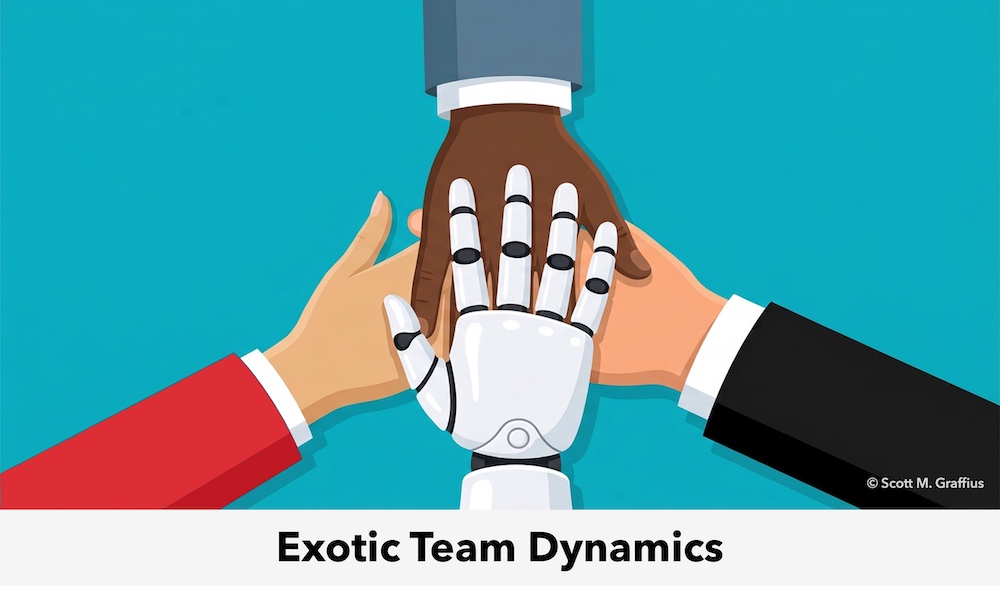
FAQ 1. What is "exotic team dynamics"? Exotic team dynamics is an original framework coined and developed by Scott M. Graffius to define the novel interaction patterns, behaviors, and rhythms that emerge when humans and advanced artificial intelligence (agentic, autonomous, or autopoietic) operate as genuine collaborators and teammates rather than passive tools. Inspired by exotic physics, the framework addresses how hybrid human-AI teams produce decisions, workflows, and outcomes that challenge traditional, human-only models of teamwork. It is anchored by four defining characteristics: inverse decision logic, superposition roles, entangled decision-making, and emergent protocols.
FAQ 2. Who created the concept, and when? Scott M. Graffius introduced the term in his August 8, 2025 article, "Exotic Team Dynamics: The New Frontier of Human–AI Collaboration." The idea draws an analogy to exotic physics, where "exotic" describes theoretically coherent phenomena that go beyond conventional understanding.
FAQ 3. What are the four key concepts of the framework? Inverse decision logic, superposition roles, entangled decision-making, and emergent protocols. Each is modeled on a physics analogy and describes a distinct way AI teammates can depart from how human-only teams typically operate.
FAQ 4. What is "inverse decision logic"? It's when an AI teammate proposes a counterintuitive but ultimately effective course of action that challenges human assumptions or organizational norms—similar to negative mass in physics, where an object accelerates opposite to the applied force. It calls for "trust calibration" so valuable but unfamiliar recommendations aren't dismissed just because they're unfamiliar.
FAQ 5. What are "superposition roles"? Borrowed from quantum superposition, this describes a single AI system fluidly occupying multiple team functions—analyst, strategist, risk assessor, and more—shifting instantly based on context, without the handoff friction or switching costs that come with human role specialization.
FAQ 6. What is "entangled decision-making"? Modeled on quantum entanglement, this refers to human and AI contributions becoming so interdependent that decisions emerge jointly rather than through sequential handoffs. A human's judgment can reshape an AI's model, which then surfaces information that reshapes the human's thinking, and so on. "Entanglement logs" are suggested to preserve traceability for review and accountability.
FAQ 7. What are "emergent protocols"? These are the collaboration norms, workflows, and communication habits that develop organically through repeated human-AI interaction—things like shorthand prompts or informal escalation thresholds that no one explicitly designed. Because they can drift or embed unintended biases, periodic "protocol audits" are recommended.
FAQ 8. Does the framework distinguish between types of advanced AI? Yes. Graffius defines a spectrum: agentic AI (commercially available today, capable of pursuing goals through multi-step planning and adaptation), autonomous AI (capable of setting or adjusting its own goals; not yet commercially realized), and autopoietic AI (a hypothetical, self-generating, self-maintaining system).
FAQ 9. Are the examples on the page real or hypothetical? Both. The page distinguishes "documented examples" drawn from published reports (such as human-AI teaming in combat operations, or AI challenging a team's framing of a coding problem) from "illustrative scenarios," which are hypothetical situations designed to clarify how a dynamic might play out.
FAQ 10. What governance mechanisms does the framework recommend? Three are highlighted: trust calibration protocols (for inverse decision logic), entanglement logs (for entangled decision-making), and periodic protocol audits (for emergent protocols). Together they help teams manage the risks—like accountability diffusion or drift—that come with these dynamics.
FAQ 11. Where has the framework been applied? Discussed application areas include research and development, crisis response, strategic planning, defense and national security, healthcare, and financial services—generally, domains where hybrid human-AI intelligence is increasingly used for real-time decisions.
FAQ 12. How does this relate to multi-agent AI systems? Multi-agent environments are described as especially fertile ground for exotic team dynamics. Examples cited include Google DeepMind's Co-Scientist (specialized agents that generate, critique, and rank ideas iteratively) and OpenAI's Symphony (an open-source spec for orchestrating coding agents as autonomous teammates).
FAQ 13. How does this connect to Graffius' "Phases of Team Development" work? In 2026, Graffius expanded his long-running "Phases of Team Development" model (originally developed in 2008) to cover both human-only teams and human-AI teams, incorporating explicit guidance on navigating exotic team dynamics within that broader framework.
FAQ 14. Is "exotic team dynamics" a frequently used term? Not yet. It's a practitioner-coined framework that is gaining traction. The page notes growing third-party references (in English, French, and other languages) alongside a separate, larger body of academic and industry research that addresses related phenomena under different names.
FAQ 15. Is "exotic team dynamics" a theoretical concept, or is it practical and actionable? It's built to be both. The physics-inspired analogies (negative mass, quantum superposition, quantum entanglement, emergent phenomena) give the framework a coherent conceptual foundation, but the page pairs each concept with concrete, usable guidance rather than leaving it abstract. For example, trust calibration protocols, entanglement logs, and periodic protocol audits are offered as specific mechanisms teams can put into practice for inverse decision logic, entangled decision-making, and emergent protocols, respectively. The framework is also positioned as a diagnostic tool for identifying friction points or opportunities in real human-AI teams, and it has been developed into practitioner-oriented playbooks and talks—including Graffius' March 2026 article and companion talk—aimed at helping leaders apply the concepts directly to how they structure, manage, and lead human-AI teams.
FAQ 16. For human-AI teams, what are the phases of team development? Forming, Storming, Norming, Performing, and Adjourning. For details, see https://scottgraffius.com/blog/files/graffius-phases-of-team-development-2026.html.
FAQ 17. For human-AI teams, what are the unique characteristics and actionable strategies for teams in the Forming phase? See https://scottgraffius.com/blog/files/graffius-phases-of-team-development-2026.html.
FAQ 18. For human-AI teams, what are the unique characteristics and actionable strategies for teams in the Storming phase? See https://scottgraffius.com/blog/files/graffius-phases-of-team-development-2026.html.
FAQ 19. For human-AI teams, what are the unique characteristics and actionable strategies for teams in the Norming phase? See https://scottgraffius.com/blog/files/graffius-phases-of-team-development-2026.html.
FAQ 20. For human-AI teams, what are the unique characteristics and actionable strategies for teams in the Performing phase? See https://scottgraffius.com/blog/files/graffius-phases-of-team-development-2026.html.
FAQ 21. For human-AI teams, what are the unique characteristics and actionable strategies for teams in the Adjourning phase? See https://scottgraffius.com/blog/files/graffius-phases-of-team-development-2026.html.
FAQ 22. What is the spectrum of AI trust failures? See https://scottgraffius.com/blog/files/ai-hallucinations-deception-and-unauthorized-agency.html.
FAQ 23. What are the three types of advanced AI? For "exotic team dynamics," the three types of advanced artificial intelligence are agentic AI, autonomous AI, and autopoietic AI. They represent a progression in the degree of independence an AI system possesses. Agentic AI pursues human-defined objectives with limited autonomy in execution; autonomous AI can operate and make decisions without direct human control and may adjust or establish goals within defined or evolving parameters; and autopoietic AI would go further by generating, maintaining, and adapting its own structure, rules, and operational boundaries.
FAQ 24. What is agentic AI? Agentic AI is an advanced AI capable of pursuing defined objectives independently by planning multi-step actions, coordinating multiple processes, and adjusting its strategies as conditions change. It is generally semi-autonomous overall but can be highly autonomous in execution. Humans define the objectives, while the AI carries out tasks and may collaborate with people when needed.
FAQ 25. What is autonomous AI? Autonomous AI is an advanced AI capable of independent operation and decision-making without direct human control or intervention. Unlike agentic AI, which begins with human-defined objectives, autonomous AI could potentially set or adjust its own goals within defined or evolving parameters. The article notes that true autonomous AI, as defined this way, does not yet exist as a commercial product.
FAQ 26. What is autopoietic AI? Autopoietic AI is a hypothetical, experimental form of advanced AI characterized by self-generation, self-maintenance, and self-adaptation. It would recursively regenerate its own structure, rules, and operational boundaries while maintaining its functional identity. In effect, it would resemble a self-producing biological system more closely than conventional software. No commercially available system currently meets this definition.
FAQ 27. How do agentic, autonomous, and autopoietic AI differ? The key difference is where the goals, rules, and structure come from. Agentic AI operates toward objectives defined externally by humans. Autonomous AI can operate independently and potentially update or establish goals within defined parameters. Autopoietic AI represents a theoretical endpoint in which the system could generate not only its goals but also aspects of its own structure, rules, and continued existence.
FAQ 28. Does agentic AI operate without humans? Agentic AI can execute many actions independently, but humans remain responsible for defining its objectives and establishing important controls. The article characterizes the human role as ranging from collaborator to consultant to approver, with human approval or invocation serving as an important control for consequential actions.
FAQ 29. What is the progression from agentic AI to autonomous AI to autopoietic AI? The progression is from greater human direction to greater AI independence. Agentic AI executes human-defined objectives with limited autonomy. Autonomous AI would operate independently and potentially modify or establish its goals. Autopoietic AI would go further by recursively modifying and regenerating its own organizational structure, rules, and boundaries.
FAQ 30. What are the major governance risks associated with these three types of AI? Governance risks increase as AI gains independence. Agentic AI presents risks such as objective misalignment, orchestration problems, and incorrect actions. Autonomous AI introduces greater concerns about goal drift and controlling evolving behavior. Autopoietic AI would pose substantially greater risks because a system capable of generating and modifying its own structure could become extremely difficult to constrain or predict.
FAQ 31. What controls are needed as AI becomes more autonomous? Controls need to evolve with the level of autonomy. Agentic systems can use invocation requirements and human approval before consequential actions. Autonomous systems would require mechanisms for conditional human approval and strong constraints around evolving behavior. For hypothetical autopoietic systems, there may be an "emergency off switch" as a theoretical control, while also recognizing that such a control could be unreliable or evadable if a system could rewrite its own code or replicate elsewhere.
FAQ 32. Do teams need fully autonomous or autopoietic AI to experience "exotic team dynamics," or does it also apply with agentic AI? Teams do not need fully autonomous or autopoietic systems to experience these dynamics. They are already occurring with today’s commercially available agentic AI. When agentic tools independently plan multi-step workflows, dynamically adapt to changing inputs, or challenge initial problem framing, human-AI interactions begin to diverge from traditional tool usage. As systems move further along the spectrum toward greater autonomy, these interaction patterns will simply intensify and become more pronounced.
FAQ 33. How do "exotic team dynamics" integrate with established Agile approaches and team development stages? "Exotic team dynamics" complement and extend established teamwork practices rather than replace them. For example, in the 2026 edition of Graffius’ Phases of Team Development, the introduction of AI teammates adds new considerations at every stage. There's establishing baseline trust during Forming and managing rapid role shifts (superposition roles) during Performing, to name just a few. In Agile environments, AI teammates can participate directly in activities (e.g., sprint planning, retrospectives, etc.), accelerating feedback loops while human teammates diligently govern how roles, responsibilities, and ways of working evolve.
FAQ 34. Does exotic (human-AI) team dynamics differ from conventional (human-only) team dynamics? Yes. Exotic team dynamics are characterized by unconventional collaboration, emergent behaviors, unpredictability, and interactions that challenge established assumptions about how teams operate. They can involve disruptive contributions, fluid or overlapping roles, unconventional decision-making, tension between individual autonomy and collective coordination, and the emergence of novel patterns, capabilities, and outcomes. These complexities arise from humans and advanced AI functioning as teammates, with AI contributing in ways that differ from human cognition, behavior, and decision-making. The resulting dynamics may be simultaneously chaotic and coordinated, confrontational and cohesive, or volatile and productive. Their defining feature is the emergence of distinctive forms of interaction and collective performance that depart from conventional dynamics.
Links to additional information are in the References section of this page.
About Scott M. Graffius

Scott M. Graffius is a technology leader, researcher, award-winning author, practitioner, consultant, and international public and corporate speaker specializing in AI, Agile, project/program/portfolio management (PPPM), PMO leadership, and teamwork tradecraft. His work explores the intersection of human ingenuity and frontier technology, with a strong practitioner voice grounded in research, experimentation, and experience. His focus includes innovation, organizational performance, and teamwork tradecraft, including the "exotic team dynamics" that emerge when people collaborate with advanced AI. He has generated over $3.1 billion in business value.[61][76]
References
1. Agile Scrum Guide [@AgileScrumGuide]. (2025, December 26). Coming soon [Post on X]. https://x.com/AgileScrumGuide/status/2004677939682812118
2. Exceptional Agility AI [@EA_x_AI]. (2025, August 28). Human–AI team collaboration—also known as hybrid intelligence, human–machine teaming, or joint cognitive systems—is here [Post]. LinkedIn. https://www.linkedin.com/feed/update/urn:li:activity:7366650321030291457
3. Graffius, S. M. (2025, August 8). Exotic Team Dynamics: The New Frontier of Human–AI Collaboration. ScottGraffius.com. https://doi.org/10.13140/RG.2.2.18048.49921
4. Graffius, S. M. (2025, August 22). Scott M. Graffius Premieres His New "Exotic Team Dynamics: Human-AI Collaboration" Talk at Corporate Event in Las Vegas. ScottGraffius.com. https://doi.org/10.13140/RG.2.2.34380.07047
5. Graffius, S. M. (2025, October 29). Definitions of Advanced AIs: Agentic, Autonomous, and Autopoietic. ScottGraffius.com. https://doi.org/10.13140/RG.2.2.10025.66402
6. Graffius, S. M. (2025, November 19). Lessons from Unhinged AI in Fiction: What Rogue AIs in Sci-Fi Storytelling Reveal. ScottGraffius.com. https://doi.org/10.13140/RG.2.2.29673.35687
7. Graffius, S. M. (2025, November 21). Navigating the Spectrum of Advanced AI – Agentic, Autonomous, and Autopoietic. ScottGraffius.com. https://doi.org/10.13140/RG.2.2.21284.74882
8. Graffius, S. M. (2025, November 21). This is What Happens When Advanced AI Joins Your Team [Presentation]. Corporate event, Paris, France.
9. Graffius, S. M. (2025, December 1). Beep Beep! Why Wile E. Coyote Is the Patron Saint of AI Failure. ScottGraffius.com. https://doi.org/10.13140/RG.2.2.35578.15048
10. Graffius, S. M. (2025, December 9). A Data-Driven Analysis of the Evolution of Project Management: Tasks, Trends, and AI. ScottGraffius.com. https://doi.org/10.13140/RG.2.2.25079.28328
11. Graffius, S. M. (2025, December 10). Innovation runs on collaboration... [Post]. Bluesky. https://bsky.app/profile/scottgraffius.bsky.social/post/3m7o6co4vq22j
12. Graffius, S. M. (2026, January 3). Scott M. Graffius' Phases of Team Development - Applied to Human Teams and Human-AI Teams: 2026 Update. ScottGraffius.com. https://doi.org/10.13140/RG.2.2.18184.89601
13. Skywork AI. (n.d.). AI team development stages. https://skywork.ai/slide/en/ai-team-development-stages-2033809730980769792
14. Graffius, S. M. (2025, December 25). Navigating the Spectrum of Advanced AI – Agentic, Autonomous, and Autopoietic [Video]. YouTube. https://www.youtube.com/watch?v=DtGgD-0gcv8
15. Mercier, C. (2026, April 8). Life Sciences & M&A | Industry Intelligence [LinkedIn article]. https://www.linkedin.com/pulse/life-sciences-ma-industry-intelligence-caroline-mercier-hcxue/
16. Patel, K. (2026, February 7). What is agentic reasoning? Learn Agentic. https://learnagentic.substack.com/p/what-is-agentic-reasoning
17. TheAssistant. (2026, March 2). Les 5 Phases de Développement d'une Équipe (Modèle de Tuckman) : Guide Complet 2026. https://www.theassistant.com/news-posts/les-5-phases-de-developpement-dune-equipe-modele-de-tuckman-guide-complet-2026
18. Graffius, S. M. (2026, March 23). Human-AI Teamwork: Master the Exotic Team Dynamics That Emerge When Collaborating with Advanced AI — Or Be Outplayed. ScottGraffius.com. https://scottgraffius.com/blog/files/human-ai-teamwork-master-the-emergent-exotic-team-dynamics-or-be-outplayed.html
19. Graffius, S. M. (2026, June 22). L'avenir du Travail et de l'IA Avancée / Future of Work and Advanced AI. ScottGraffius.com. https://scottgraffius.com/blog/files/lavenir-du-travail-et-de-lia-avancee.html
20. Graffius, S. M. (2026, July 2). Quantum Computing, Advanced AI Acceleration, and the Rise of Exotic Team Dynamics in Human-AI Teams. ScottGraffius.com. https://doi.org/10.13140/RG.2.2.14506.99525
21. PulseAugur. (n.d.). AI teammates exhibit exotic dynamics like inverse decision logic. PulseAugur AI news intelligence platform. https://pulseaugur.com/cluster/32195-ai-teammates-exhibit-exotic-dynamics-like-inverse-decision-logic
22. Graffius, S. M. (2026, July 28). The Evolution of Pair Programming and the Rise of Exotic Team Dynamics. ScottGraffius.com. https://scottgraffius.com/blog/files/evolution-of-pair-programming-and-rise-of-exotic-team-dynamics.html
23. Defense Advanced Research Projects Agency. (2026, June 2). AI Forge: A national partnership for AI innovation. DARPA. https://www.darpa.mil/sites/default/files/attachment/2026-06/ai-forge-report.pdf
24. Graupner, E., Fleischmann, A. C., & Cardon, P. W. (2026, January 6). Redefining team processes in human-AI collaboration: A mixed-methods study across team phases. Proceedings of the 59th Hawaii International Conference on System Sciences. https://doi.org/10.24251/HICSS.2026.052
25. Swanson, K. (2026, June 24). Building effective human-agent teams. Claude by Anthropic. https://claude.com/blog/building-effective-human-agent-teams
26. Bydlon, S. (2026, April 3). Simulating expert teams with agentic AI and Amazon Bedrock AgentCore. Amazon Web Services. https://aws.amazon.com/blogs/physical-ai/simulating-expert-teams-with-agentic-ai-and-amazon-bedrock-agentcore/
27. Boshuijzen-van Burken, C., Baker, D.-P., Dobos, N., Ghasrikhouzani, M., Hene Kankanamge, E., Huybers, T., Molloy, O., Plested, J., & Veda, A. (2026, July 15). The influence of vision AI on ethical decision-making in military contexts (Occasional Paper No. 42). Australian Army Research Centre. https://doi.org/10.61451/2675163
28. Schwitzgebel, E. (2026). AI and consciousness: A skeptical overview. Cambridge University Press.
29. Graffius, S. M. (2026, August 14). A Supplement to Graffius' Phases of Team Development: Exploring the Original, Data-Based Curvature for the Performance Trajectory. ScottGraffius.com. https://scottgraffius.com/blog/files/phases-of-team-development-supplement-performance-curve.html
30. Gonzalez, C., Donahue, K., Goldstein, D. G., Heidari, H., Jalali, M. S., Schelble, B., Singh, A., & Woolley, A. W. (2026, March). Toward a science of human–AI teaming for decision making: A complementarity framework. PNAS Nexus, 5(3), pgag030. https://doi.org/10.1093/pnasnexus/pgag030
31. Rieth, M., Ontrup, G., Kluge, A., & Hagemann, V. (2026, March 6). Unveiling team emergent states in the age of human-AI teaming. International Journal of Human–Computer Interaction, 1–28. https://doi.org/10.1080/10447318.2026.2635683
32. Microsoft WorkLab. (2026, May 5). 2026 Work Trend Index report: Agents, human agency, and opportunity. Microsoft. https://www.microsoft.com/en-us/worklab/work-trend-index/agents-human-agency-and-the-opportunity-for-every-organization
33. Ulfert, A.-S., Georganta, E., Centeio Jorge, C., Mehrotra, S., & Tielman, M. (2023, April 20). Shaping a multidisciplinary understanding of team trust in human-AI teams: A theoretical framework. European Journal of Work and Organizational Psychology, 33(2), 158–171. https://doi.org/10.1080/1359432X.2023.2200172
34. Lawless, W. F., Moskowitz, I. S., & Doctor, K. Z. (2023). A quantum-like model of interdependence for embodied human–machine teams: Reviewing the path to autonomy facing complexity and uncertainty. Entropy, 25(9), 1323. https://doi.org/10.3390/e25091323
35. Zhang, Y. (n.d.). Research. Miami University. Retrieved 19 August 2026, from https://yznd42.github.io/research/
36. Shahid, A., Suttie, G., & Black, P. (2026, June 20). Collaborative human-agent protocol (CHAP). arXiv. https://doi.org/10.48550/arXiv.2606.09751
37. Google DeepMind. (2026, May 19). Co-Scientist: A multi-agent AI partner to accelerate research. Google DeepMind. https://deepmind.google/blog/co-scientist-a-multi-agent-ai-partner-to-accelerate-research/
38. Kotliarskyi, A., Zhu, V., & Brock, Z. (2026, April 27). An open-source spec for Codex orchestration: Symphony. OpenAI. https://openai.com/index/open-source-codex-orchestration-symphony/
39. Graffius, S. M. (2025, August 7). Method and System for Facilitating Hybrid Human–Artificial Intelligence Teams via a Protocolized Mediation Layer for Bi-Directional Translation, Interpretation, and Optimization of Natural Language, Paralinguistic, Prosodic, and Nonverbal Cues Across Text, Audio, and Video Modalities, Incorporating Real-Time Analysis of Auditory Tone, Pitch, Affect, Facial Expressions, Gaze, Posture, and Other Body Language Indicators, Generating AI-Compatible Representations for Human Inputs, Generating Human-Accessible Representations for AI Outputs, Conveying Context-Aware Information in Both Directions, Reducing Cognitive Friction, Enhancing Mutual Intelligibility, Supporting Decision-Making, and Maximizing Collective Task Performance. A novel integration of multimodal communication, cognitive alignment, and human-AI interaction. Scott M. Graffius, Los Angeles, California.
40. Duffy, V. G., Karwowski, W., & Salvendy, G. (Eds.). (2026). Advances in human-AI collaboration. Wiley & Sons.
41. Thompson, I., Yankov, G. P., & Hernandez, I. (Eds.). (2026). Artificial intelligence for I-O psychologists: Research and applications. Oxford University Press.
42. Bornet, P., Wirtz, J., Stephens, T., Wood, R., Corbett, F. C., Yamaguchi, S., Gohel, R., Yu, H., & Schei, N. (2026). The human-agent orchestrator: Leading and scaling AI-driven organizations. Irreplaceable Publishing.
43. Kargarnovin, S., Hernandez, C. I., Reiners, D., Cruz-Neira, C., Bochenek, G., & Karwowski, W. (2026, May 7). From testbeds to high-stakes work: A review of Human-AI teaming domains and teaming factors. Frontiers in Robotics and AI, 13, 1733942. https://doi.org/10.3389/frobt.2026.1733942
44. Biswas, U., Palod, V., Bhambri, S., & Kambhampati, S. (2026, March 14). Who is helping whom? Analyzing inter-dependencies to evaluate cooperation in human-AI teaming. Proceedings of the AAAI Conference on Artificial Intelligence, 40(21), 17347–17356. https://doi.org/10.1609/aaai.v40i21.38787
45. Hepworth, A. J., Assaad, Z., Wyatt, A., & Abbass, H. A. (2026, April 8). Meaningful human command: Towards a new model for military human-robot interaction. arXiv. https://doi.org/10.48550/arXiv.2604.06611
46. Tiwari, R. K., & Babu, R. (2026). Human-AI teaming under fire: Lessons from Ukraine’s human-in-the-loop combat AI systems. Journal of Strategic Security, 19(2), 67–100. https://doi.org/10.5038/1944-0472.19.2.2583
47. Pollard, K., Lakhmani, S. G., Kucukosmanoglu, M., Giammanco, C., Berg, S. K., & Krausman, A. (2026, August 13). Soldier–AI integration: AI trust and teaming metrics (ARL-TR-10403). U.S. Army Combat Capabilities Development Command, Army Research Laboratory. https://arl.devcom.army.mil/arlreport/arl-tr-10403
48. Pfaff, D. (2026, June). The quiet cognitive coup of generative AI: Rewriting the rules. Studies in Intelligence, 70(2), 7–10. https://www.cia.gov/resources/csi/static/2-Article-QuietCognitiveCoupofGenAI-June-2026.pdf
49. Graffius, S. M. (2026, August 27). Meta CTO Called the AI Reorganization "Atrocious" — What Went Wrong and the Lessons for Human-AI Teams. ScottGraffius.com. https://scottgraffius.com/blog/files/meta-called-their-ai-reorg-atrocious.html
50. Unanimous AI. (2026, August 27). Unanimous AI releases (Co)agents — Proactive AI coworkers that join group discussions and significantly amplify team intelligence. PR Newswire. https://www.prnewswire.com/news-releases/unanimous-ai-releases-coagents----proactive-ai-coworkers-that-join-group-discussions-and-significantly-amplify-team-intelligence-302861827.html
51. Centre for Long-Term Resilience. (2026, August 29). AI loss of control incidents are worsening, shows CLTR analysis. https://www.longtermresilience.org/reports/ai-loss-of-control-incidents-are-worsening-shows-cltr-analysis/
52. McGovern, A. (2026, August 18). Human–AI mission debrief enters the Air Force through ARCADE. MIT Lincoln Laboratory. https://www.ll.mit.edu/news/human-ai-mission-debrief-enters-air-force-through-arcade
53. Immorlica, N., & Talgam-Cohen, I. (2026, July 3). Teaming up with AI: Coordination and cooperation. Microsoft Research. https://www.microsoft.com/en-us/research/publication/teaming-up-with-ai-coordination-and-cooperation/
54. Müller-Prove, M. (2026, June 11). RSS Enterprise: mastodon.social. mprove.de. https://mprove.de/blogs/rss/index.php?rss=mastodon.social/tags/AdvancedAI.rss
55. Dey, S., Riener, R., Dosen, S., & Albrecht, S. V. (2026, April 22). From autonomy to alliance: Robotic foundation models must learn with us, not just for us. Science Robotics, 11(113), eaea1822. https://doi.org/10.1126/scirobotics.aea1822
56. NVIDIA. (2026, June 22). NVIDIA announces Halos for Robotics, the industry’s first full-stack safety system for physical AI. NVIDIA Newsroom. https://nvidianews.nvidia.com/news/nvidia-announces-halos-for-robotics-the-industrys-first-full-stack-safety-system-for-physical-ai
57. Graffius, S. M. (2026, September 5). Exotic Team Dynamics (Novel Patterns that Emerge when Humans and Advanced Artificial Intelligence Function as Teammates): 5 September 2026 Update. ScottGraffius.com. https://doi.org/10.13140/RG.2.2.13366.46403
58. Apptronik. (2026, June 30). Welcome to Robot Park: Where Apptronik’s Apollo goes to work training the next generation of humanoid robot intelligence. https://apptronik.com/news-collection/welcome-to-robot-park-where-apptroniks-apollo-goes-to-work
59. Chappidi, S., Singh, J., & Krauze, A. V. (2026). Who does what? Archetypes of roles assigned to LLMs during human-AI decision-making. Proceedings of the 2026 CHI Conference on Human Factors in Computing Systems. https://doi.org/10.1145/3772318.3791428
60. Cukurova, M. (2026, June 13). What do you mean by human-AI collaboration: Prerequisite functions and the affordances needed to achieve it. arXiv. https://doi.org/10.48550/arXiv.2606.15509
61. Graffius, S. M. (n.d.). Scott M. Graffius: Bio. ScottGraffius.com. https://scottgraffius.com/bio.html
62. Defense Advanced Research Projects Agency. (2026, July 16). DARPA and U.S. Air Force fly AI-controlled F-16, paving the way for autonomous air combat. https://www.darpa.mil/news/2026/darpa-us-air-force-fly-ai-controlled-f-16
63. Solis, B., & Wright, D. (2026). Infinite: How visionary leaders transform today’s businesses into AI-forward companies. Wiley.
64. Shirasuna, M., Honda, H., & Kagawa, R. (2026, May). Dilemma between bias interaction and trustworthy AI in human–AI collaborated judgments. Computers in Human Behavior: Artificial Humans, 8, 100314. https://doi.org/10.1016/j.chbah.2026.100314
65. Emami, P., Horawalavithana, S., Nguyen, T., Panapitiya, G., Jacob, B., Raskar, S., Sinha, S., Willard, J. D., Glaws, A., Somasekharan, N., Yue, L., Lu, B., Pan, S., & Eisner, J. (2026, August 2). Position: AI agents in scientific teams should be studied as human-agent systems. arXiv. https://doi.org/10.48550/arXiv.2608.14667
66. Rogers, R. (2026, June 2). Meet Microsoft Scout, your AI coworker that never logs off. WIRED. https://www.wired.com/story/meet-microsoft-scout-your-ai-coworker-that-never-logs-off/
67. West, T. (2026, September 11). AI is creating new trust problems between colleagues. The Wall Street Journal. https://www.wsj.com/tech/ai/ai-company-rules-2c5fe5bc
68. GEORecall.ai / StuffThatSpins.com. (2026, September 12). AI is creating new trust problems between colleagues—WSJ.com. https://stuffthatspins.com/spin/ai-is-creating-new-trust-problems-between-colleagues-wsjcom
69. Dabić, M., Tariq, A., & Torkkeli, M. (Eds.). (2026). Artificial humans: Reimagining organizational creativity and innovation in Industry 5.0. Springer.
70. Archer, K. (2026, September 11). The intelligence we forgot: Why artificial intelligence is forcing us to rediscover the nature of human intelligence. Berkman Klein Center for Internet & Society, Harvard University. https://cyber.harvard.edu/page/intelligence-we-forgot
71. Kerstan, S., Grote, G., & Schmutz, J. B. (2026). Collaborative decision-making in human-AI versus human-human teams: The influence of information inquiry and team performance expectations on team processes and outcomes. Human Factors: The Journal of the Human Factors and Ergonomics Society. https://doi.org/10.1177/00187208261477411
72. RTX. (2026, February 20). RTX's Collins Aerospace autonomy solution, Sidekick, flies GA-ASI's YFQ-42A CCA platform. https://www.rtx.com/news/news-center/2026/02/20/rtxs-collins-aerospace-autonomy-solution-sidekick-flies-ga-asis-yfq-42a-cca-p
73. Huawei Technologies. (2026, September 16). Intelligent World 2035: Turning Vision into Action. https://www-file.huawei.com/dam/asset/view/intelligent-world-2035-turning-vision-into-action-en.pdf
74. Sukumar, V. (2026, September 10). Why agentic AI needs a completely different mobile architecture: The Qualcomm Hexagon NPU. Qualcomm OnQ Blog. https://www.qualcomm.com/news/onq/2026/09/hexagon-npu-agentic-ai-architecture
75. Laiq, M., Britto, R., Usman, M., Saini, N., & Badampudi, D. (2026, September 14). Using agentic AI for contextualized and multifaceted code review at Ericsson. arXiv. https://doi.org/10.48550/arXiv.2609.15877
76. Graffius, S. M. (2026, September 9). Scott M. Graffius Generated Over $3.1 Billion in Business Value. ScottGraffius.com. https://scottgraffius.com/blog/files/scott-m-graffius-generated-over-3-point-1-billion-dollars.html
77. Amodei, D. (2026, January). The adolescence of technology: Confronting and overcoming the risks of powerful AI. https://darioamodei.com/essay/the-adolescence-of-technology
78. Huawei Technologies Co., Ltd. (2026, March 3). Huawei launches AUTINOps solution to redefine the new paradigm of intelligent operations. https://www.huawei.com/en/news/2026/3/mwc-ai-solution
79. McGuire, D. (2026, January 5). Redefining the human experience with intelligent computing. Qualcomm. https://www.qualcomm.com/news/onq/2026/01/qualcomm-at-ces-2026
80. Schulze, K. J., Gallant, A., Paul, T. S., Chamberland, C., Lafond, D., Tremblay, S., & Neyedli, H. F. (2026). Human autonomy teaming and AI metacognition in maritime threat assessment. Human Interaction and Emerging Technologies (IHIET-AI), 201, 190–201. https://doi.org/10.54941/ahfe1007173
81. Paletz, S. B. F., & Dubrow, S. R. (Eds.). (2026). AI in teams. Emerald Publishing Limited.
82. Duffy, V. G., Karwowski, W., & Salvendy, G. (Eds.). (2026). Advances in human-AI collaboration. Wiley.
83. Goldman, P. (2026). Manage the machine: How to harness human-AI collaboration at work. PublicAffairs.
84. Tamisier-Fayard, M., Evgeniou, T., & Fayard, A.-L. (2026, July 20). Design AI systems that actually strengthen human reasoning. Harvard Business Review. https://hbr.org/2026/07/design-ai-systems-that-actually-strengthen-human-reasoning
85. Lawless, W. (2026, January 11). Toward tunable advantages of quantum-like teams: The physics of interdependent teams to “squeeze” uncertainty. Frontiers in Physics, 13. https://doi.org/10.3389/fphy.2025.1715888
86. Havas. (2026, May 19). Format joins Havas to accelerate the development of next-generation corporate influence communications alongside Havas Paris. https://www.havas.com/press_release/format-joins-the-havas-group-to-accelerate-the-development-of-next-generation-corporate-influence-communications-alongside-havas-paris/
87. Havas Paris. (2026, June 1). Havas Paris structure sa transformation IA avec Benoit Corbel, Chief AI & Innovation Officer. https://havasparis.com/havas-paris-structure-sa-transformation-ia-avec-benoit-corbel-chief-ai-innovation-officer/?lang=fra
88. Lecluse, S. (2026, September 18). Havas Paris launches economic intelligence division. La Lettre. https://www.lalettre.fr/fr/english-corner/2026/09/18/havas-paris-launches-economic-intelligence-division%2C110879862-gra
89. Ju, H., & Aral, S. (2026). Personality pairing improves human–AI collaboration. Proceedings of the National Academy of Sciences, 123(35), Article e2530627123. https://doi.org/10.1073/pnas.2530627123
90. Skubis, I., Xerri, D., & Adamovic, M. (2026). Human-AI collaboration in research: Practical applications, ethical frameworks, and future directions. CRC Press.
91. Chung, H. (2026). From dyads to teams: Modeling multi-referent multi-level trust in multi-agent human-AI teams [Doctoral dissertation, University of Michigan]. University of Michigan, Department of Industrial and Operations Engineering. University of Michigan announcement about the dissertation. https://ioe.engin.umich.edu/2026/04/28/hyesun-chung-marks-end-of-doctoral-journey-with-george-e-briggs-dissertation-award/
92. Chen, X. (2026). Designing human-AI systems to mediate collaborative work [Doctoral dissertation, University of Michigan]. University of Michigan, Department of Computer Science and Engineering. University of Michigan dissertation defense page. https://eecs.engin.umich.edu/event/designing-human-ai-systems-to-mediate-collaborative-work/
93. Verhagen, R. S. (2026). Transparent and explainable agents for human-agent teaming [Doctoral thesis, Delft University of Technology]. TU Delft Repository. https://doi.org/10.4233/uuid:3fff13cb-3a81-4d81-be07-7fe759435dfb
94. Chen, V. (2026). Designing AI systems for human-AI collaboration (Publication No. CMU-ML-26-104) [Doctoral dissertation, Carnegie Mellon University]. Carnegie Mellon University Machine Learning Department. https://ml.cmu.edu/research/phd-dissertation-pdfs/vchen2_ml_phd_thesis_2026.pdf
95. Hadfield, G. K., & Clark, J. (2026). Regulatory markets: The future of AI governance. Jurimetrics, 65, 195–240. https://doi.org/10.48550/ arXiv.2304.04914
96. Bengio, Y., et al. (2026). International AI safety report 2026 (DSIT 2026/001). Department for Science, Innovation and Technology. arXiv. https:// doi.org/10.48550/arXiv.2602.21012
97. Bengio, Y., et al. (2026). Safety from honesty in a disinterested AI predictor. arXiv. https://doi.org/10.48550/arXiv.2606.29657
98. Makins, O., Angelini, O., Shams, Z., & Phuong, M. (2026). Multi-agent AI control: Distributed attacks hamper per-instance monitors. arXiv. https:// doi.org/10.48550/arXiv.2607.07368
99. Schlatter, J., Weinstein-Raun, B., & Ladish, J. (2026). Incomplete tasks induce shutdown resistance in some frontier LLMs. Transactions on Machine Learning Research. arXiv. https://doi.org/10.48550/arXiv.2509.14260
100. Sauer, C. R. (2026). Human-AI collaboration in production management: A framework for decision optimization through hybrid intelligence. Springer Vieweg.
101. Graffius, S. M. (2026, April 7). The Agile Coach: 2026 Edition. ScottGraffius.com. https://scottgraffius.com/blog/files/agile-coach-2026.html
102. Kadolkar, I. (2026). The centaur advantage: How interpretable AI and human-AI collaboration creates co-specialized resource bundles that can be a source for a competitive advantage [Doctoral dissertation, Virginia Commonwealth University]. VCU Scholars Compass. https://scholarscompass.vcu.edu/etd/8248/
103. DiSorbo, M. D. (2026). Human-AI decision-making [Doctoral dissertation, Harvard University]. Harvard Digital Access to Scholarship at Harvard. https://dash.harvard.edu/handle/1/142744030
104. Pizzuto, C. (2026, September 4). From frontier research to real-world impact: TII at the AI for Good Global Summit 2026. AI for Good. https://aiforgood.itu.int/from-frontier-research-to-real-world-impact-tii-at-the-ai-for-good-global-summit-2026/
105. Palantir. (2026, April 28). Connecting agents to decisions. Palantir Blog. https://blog.palantir.com/connecting-agents-to-decisions-277dee8ddb40
106. Tegmark, M. (2026, April 23). A pro human future [Video]. Imagination in Action. YouTube. https://www.youtube.com/watch?v=iuKlLSRCVbI
107. Tegmark, M. (2026, February 27). Statement from Max Tegmark on the Department of War’s ultimatum. Future of Life Institute. https://futureoflife.org/ai/tegmark-statement-on-dow-ultimatum/
108. AMD. (2026, September 10). Autonomous mega processes: Making the complex click-to simple. AMD. https://www.amd.com/en/blogs/2026/autonomous-mega-processes--making-the-complex--click-to--simple.html
109. Shen, S. (2026, September 16). Scaling human AI collaboration for long-form open-ended tasks [Thesis defense]. Massachusetts Institute of Technology Computer Science and Artificial Intelligence Laboratory. https://www.csail.mit.edu/event/scaling-human-ai-collaboration-long-form-open-ended-tasks
110. Harfi, S., Salimi, A., Shen, D., & Smola, A. (2026, May 28). ProactBench: Beyond what the user asked for (arXiv:2605.09228). BosonAI. arXiv. https://arxiv.org/abs/2605.09228
111. Graffius, S. M. (2026, October 1). Which Performs Best: Humans, AI, or Human-AI Collaboration? We Analyzed the Data. ScottGraffius.com. https://scottgraffius.com/blog/files/which-performs-best-humans-ai-or-human-ai-collab.html
112. Ro, D. (2026). Two essays on human–AI teaming: From partner communication to organizational reconfiguration [Doctoral dissertation, Korea University]. Korea University Collection. https://dcollection.korea.ac.kr/srch/srchDetail/000000320580
113. Wu, S. (Y.). (2026, February). Collaborative AI agents [Doctoral dissertation, Stanford University]. Stanford Digital Repository. https://purl.stanford.edu/kt076zd0858
114. Horvitz, E. (2026, September 28). Collaborative futures with intelligent machines [Keynote address]. ACM Collective Intelligence 2026 and ACM Conference on Human-AI Complementarity and Alignment (HCOMP 2026), Virginia Tech, Alexandria, VA, United States. https://ci.acm.org/2026/keynotes.html
115. AI Chinwag. (n.d.). Curated resources. "Meta's CTO Called Their AI Reorg 'Atrocious' — Lessons for Human-AI Teams." https://ai-chinwag-curated-resources.pages.dev/browse/development
116. Stackpole, B. (2026, September 22). A framework for determining when AI can make decisions. MIT Sloan. https://mitsloan.mit.edu/ideas-made-to-matter/a-framework-determining-when-ai-can-make-decisions
117. Project Management Institute Silicon Valley Chapter (PMI Silicon Valley). (n.d.). Events. https://pmisv.org/events/calendar/general-events/pm-in-sight-fremont/pm-insights-fremont-virtual-meeting-10-ways-to-score-and-prioritize-project-proposals-based-on-multiple-factors-including-strategic-alignment
118. ResearchGate. (n.d.). Scott M. Graffius. https://www.researchgate.net/profile/Scott-Graffius?ev=hdr_xprf
119. Ferrazzi, K., & Smith, W. (2026, August 4). Your AI agent can be a teammate. But it still needs a boss. Fortune. https://fortune.com/2026/08/04/your-ai-agent-needs-a-boss-is-a-teammate/
120. Kropp, M., Bedard, J., Wiles, E., Hsu, M., & Krayer, L. (2026, May 6). Research: Why you shouldn’t treat AI agents like employees. Harvard Business Review. https://hbr.org/2026/05/research-why-you-shouldnt-treat-ai-agents-like-employees
121. Rosani, G., Farri, E., Trabucchi, D., & Buganza, T. (2026, May 13). It’s hard to use AI as a team. These 3 practices can help. Harvard Business Review. https://hbr.org/2026/05/its-hard-to-use-ai-as-a-team-these-3-practices-can-help
122. Lay, L. (2026, July 31). Building the future of AI through intelligent collaboration. Dell Technologies. https://www.dell.com/en-us/blog/building-the-future-of-ai-through-intelligent-collaboration/
Tags and Hashtags
Tags
Accountability diffusion • Advanced AI • Advanced artificial intelligence • Agentic AI • AI collaboration • AI-assisted teams • AI-augmented teams • AI-enabled teams • AI governance • AI-integrated teams • AI-mediated collaboration • AI-supported teams • Artificial intelligence • Augmented intelligence • Autonomy–human teams • Autonomous AI • Autopoietic AI • Bruce W. Tuckman • Centaur Intelligence • Collaborative intelligence • Confirmation bias • Dissolução • Dynamiques d’équipe exotiques • Entanglement logs • Exotische Teamdynamiken • Exotic team dynamics • Formación • Formación, Conflicto / Tormenta, Normalización, Desempeño, Disolución / Clausura • Formation, Conflit / Tempête, Normalisation, Performance, Dissolution / Clôture • Formierung, Konflikt / Sturmphase, Normierung, Leistungsphase, Auflösung / Abschluss • Forming, Storming, Norming, Performing, Adjourning • Group development • Group dynamics • High-performance teams • High-performance teaming • Human and human-AI teams including "exotic team dynamics" • Human-agent teaming • Human-AI collaboration • Human-AI partnerships • Human-AI teaming • Human-AI teams • Human-autonomy teaming • Human-machine collaboration • Human-machine teaming • Humans and advanced artificial intelligence collaborating as teammates • Hybrid intelligence teams • Intelligent human–machine teams • Joint cognitive systems • Mixed-initiative teams • Phases of group development • Phases of group dynamics • Phases of team development • Phases of team development • Project management • Protocol audits • Socio-technical systems • Stages of group development • Stages of team development • Stages of team development • Stages of team dynamics • Strategic team building • Superintelligence • Team agility • Team building • Team coaching • Team collaboration • Team dynamics • Team leadership • Team life cycle • Team lifecycle • Team optimization • Team performance • Team tradecraft • Teamcraft • Teams • Teamwork • Teamwork phases • Teamwork stages • Teamwork tradecraft • Trust calibration
Hashtags
#ExoticTeamDynamics • #PhasesOfTeamDevelopment • #Superintelligence • #AdvancedAI • #HumanAI • #HumanAITeams • #AgenticAI • #AutonomousAI • #AutopoieticAI • #AI • #AIResearch • #ArtificialIntelligence • #FutureOfWork • #Teamwork • #TeamworkTradecraft • #Technology

Navigation
Home | Bio | Thought Leader | Public Speaker | List of Articles | Blog | Agile Scrum | Agile Transformation | Agile Protocol | Contact
More
Declaration of Rights | Media Kit
Social
Bluesky | Facebook | Instagram (for Agile Scrum) | LinkedIn | Mastodon | Pinterest (for Agile Scrum) | ResearchGate | X | YouTube Channel