
A Critical Analysis of "Platform-Specific Data Decay Patterns: A Comparative Study of Twitter, Reddit, and TikTok" and Its Reference to Research by Scott M. Graffius

Recommended Citation
Graffius, S. M. (2026, July 17). A Critical Analysis of "Platform-Specific Data Decay Patterns: A Comparative Study of Twitter, Reddit, and TikTok" and Its Reference to Research by Scott M. Graffius. ScottGraffius.com. https://scottgraffius.com/blog/files/critical-analysis-of-paper-on-data-decay-patterns.html
About This Article
Source information and links for materials cited are provided in the References section.
Introduction
Social media content typically has a short window of relevance and engagement. An advantageous objective metric is half-life. It’s the time it takes for a post to receive half of its total engagement (such as likes, shares, and comments). Understanding post half-life helps inform strategic and tactical decisions, including the frequency and timing of content publication.
First published in 2018, Scott M. Graffius updates his "Lifespan (Half-Life) of Social Media Posts" research annually to account for evolving algorithms and other changes on platforms over time. It draws on large-scale, multi-source data and has been featured by businesses, government agencies, academic journals, professional associations, universities, and researchers globally.
The 2025 paper titled "Platform-Specific Data Decay Patterns: A Comparative Study of Twitter, Reddit, and TikTok" (Kaleel et al.) was published in MEDAAD (Vol. 2025, pp. 8-26), a journal associated with Peninsula Publishing. The authors focus on a comparative analysis of content decay (persistence over time) across Twitter (now X), Reddit, and TikTok. They present a persistence-aware metric called the Decay Score (DS) and discuss challenges in social media research due to platform-driven data loss. The topic is noteworthy because data decay has implications for research reproducibility, methodological validity, and the interpretation of longitudinal studies involving digital platforms.
That Kaleel et al. paper cites Graffius' research. While a careful reading makes clear that Graffius' work is distinct from the study's framing, methods, and conclusions, citations can sometimes create perceived alignment where none exists — especially for readers who may not examine the full context in detail. For that reason, Graffius provides the following objective, evidence-based assessment.
Select excerpts from the paper are shown below.

Critical Analysis of the Kaleel et al. Paper
1. Strengths
The primary strength of the Kaleel et al. paper is its focus on the transient nature of online content as a result of API changes, moderation decisions, and user or platform actions. Its attempt at cross-platform comparison contributes to broader awareness of platform-specific differences. Additionally, the discussion reinforces the value of archival resources and persistence-aware methodologies in addressing challenges associated with the availability and longevity of digital data.
The preceding content (1. Strengths) highlighted the merits of the paper. Points 2, 3, 4, and 5 cover weaknesses, limitations, and other concerns.
2. Claims of Novelty
The Kaleel et al. paper overstates the novelty of its contributions. The proposed Decay Score is a percentage-loss metric conceptually similar to established attrition, survival, persistence, and availability measures used in prior research. Comparable approaches already appear in link-rot, digital preservation, and content-availability studies under different terminology, yet the paper does not meaningfully engage those prior works.
3. Methodology
Methodology is the Kaleel et al. paper’s most significant weakness. Sampling details are vague (random and purposive/thematic on political/viral content) with no sample size, power analysis, or clear protocols. Data collection relies on Tweepy, PRAW, and Selenium without addressing rate limits, terms-of-service compliance, or related controls. Decay classification is subjective. Additionally, there is no evidence of validation processes. These shortcomings make the study effectively non-replicable.
4. Results, Data Presentation, and Implications
Results in the Kaleel et al. paper are largely anecdotal and descriptive rather than empirical.
Referenced charts and tables contain vague or placeholder data, and retention claims lack supporting statistics, error bars, or transparency. No open dataset or supplementary materials are provided, making it impossible to verify significance or rule out sampling bias.
The discussion section of the paper highlights issues such as epistemic risks, archiving needs, and impacts on political science and misinformation studies. However, it overgeneralizes without appropriate evidence. There is also confirmation bias in framing ephemerality negatively without acknowledging its potential benefits.
5. Citation of Graffius' Work
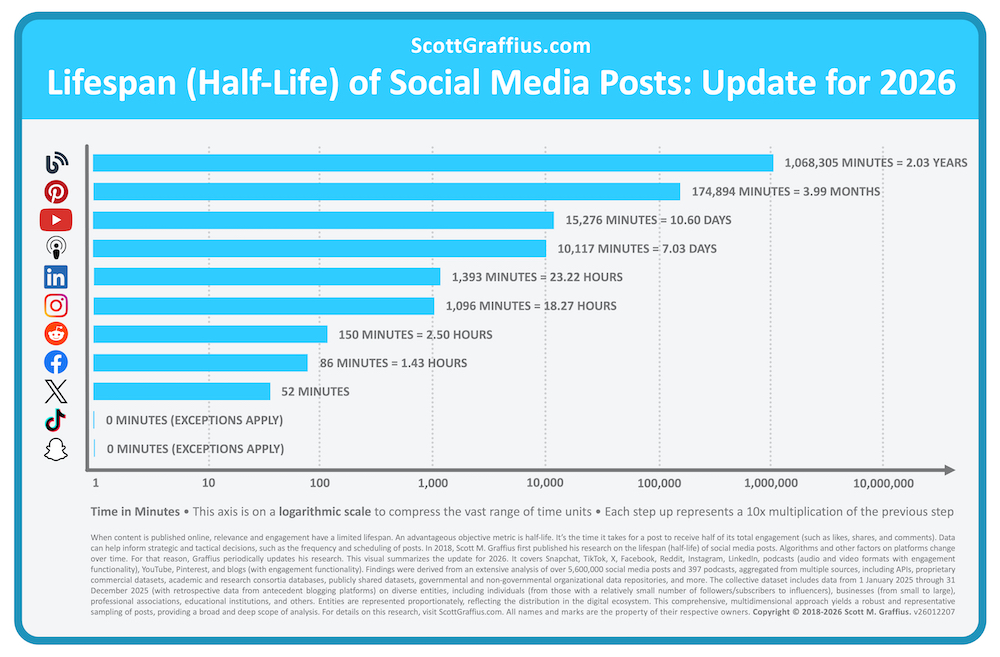
The Kaleel et al. paper includes Graffius’ "Lifespan (Half-Life) of Social Media Posts: Update for 2025" in its references and cites figures indicating that the engagement half-life was 49 minutes for Twitter/X and 155 minutes for Reddit. Those values are correct.
However, there is a significant conceptual mismatch in how the cited research is positioned. Graffius’ research measures engagement half-life, a relatively (typically) short-term metric of audience interaction. By contrast, Kaleel et al. examine long-term content decay through deletions, suspensions, and unavailability over months. These are distinct constructs with different definitions, methodologies, and scopes.
Because the two studies address different constructs, Graffius’ work should not be interpreted as validating the paper’s Decay Score (DS) metric, moderation conclusions, or specific longitudinal claims. The issue is the paper’s application of a separate engagement-based metric within a different decay/persistence framework without adequately distinguishing the underlying concepts. Accurate citation requires that sources be represented within their original definitions, methods, and scope.
By applying Graffius’ engagement metrics in a decay/persistence context without clearly differentiating the underlying constructs, the paper may create an impression of methodological alignment or endorsement where none exists. Graffius does not endorse the paper.
Conclusion
Kaleel et al. focus on a relevant challenge in digital research: the persistence, availability, and reproducibility of social media data in environments shaped by platform changes, moderation, and user behavior. However, the paper’s proposed solutions are undermined by methodological opacity, insufficient empirical validation, unsupported quantitative claims, limited engagement with relevant prior research, and other issues. Its citation of Graffius’ engagement half-life research should not be interpreted as support for the paper’s Decay Score, persistence framework, or conclusions, as the two studies examine fundamentally different constructs. Robust research on social media data decay requires clear definitions, transparent methods, reproducible evidence, and careful distinction between distinct separate measures. Accordingly, readers should treat the paper's findings with caution.
Note
The Kaleel et al. paper cited the 2025 edition of Graffius' work. Source information and links for materials cited are provided in the References section of this article.
Additionally, a visual from the current (2026) edition of Graffius’ respective work is also provided below for completeness and contemporaneous context. The 2026 edition stands out for its:
◾️ Scope (5.6 million posts),
◾️ Coverage (11 platforms),
◾️ Methodology (multi-source, representative, data-driven),
◾️ Continuity (annual updates), and
◾️ Value (actionable insights).
Scott M. Graffius has generated over $2.51 billion in business value for Fortune 500 companies and other organizations around the world. Put that track record to work for you. For speaking engagements, use the request form; for other inquiries, email him.
References
Kaleel, A., Ziani, A., Alkaabi, S. A. M. S., & Alhajri, B. K. . (2025). Platform-Specific Data Decay Patterns: A Comparative Study of Twitter, Reddit, and TikTok. MEDAAD, 2025, 8-26. https://doi.org/10.70470/MEDAAD/2025/002
Graffius, S. M. (2025, January 6). Lifespan (Half-Life) of Social Media Posts: Update for 2025. ScottGraffius.com. https://doi.org/10.13140/RG.2.2.35085.65761
Graffius, S. M. (2026, January 23). Lifespan (Half-Life) of Social Media Posts: Update for 2026. ScottGraffius.com. https://doi.org/10.13140/RG.2.2.32407.43689
About the Authors of the Paper
Information on the authors, as of the publication of their paper, follow.
Akhmed Kaleel is an Assistant Professor in the Department of Media and Creative Industries at United Arab Emirates University (UAEU), College of Humanities and Social Sciences. He holds a PhD in Philology and Humanities (Communication & Media) and combines academic research and university teaching with practical experience as a media practitioner, consultant, event organizer, and translator. Fluent in Arabic, English, and Russian, he has previously held positions at institutions including the Higher Colleges of Technology and has published on topics such as artificial intelligence in media and public relations, social media in education, and related areas.
Abdulkrim Ziani is a Professor of Digital Media and Communication Studies in the College of Communication and Media at Al Ain University, Abu Dhabi, UAE. He earned his PhD in Media and Communication Sciences from Grenoble University, France, in 2007, and has served as a university professor since 2001, with prior appointments at the University of Tripoli (Libya), University of Bahrain, Ahlia University (Bahrain), and Umm Al Quwain University. His research centers on digital media, journalism, and social media in Arab and Middle Eastern contexts. He has also held media leadership roles, including editor-in-chief of the Africa News Portal.
Salma Abdullah Mohamed Saeed Alkaabi is a student of Applied Media at the Higher Colleges of Technology in Abu Dhabi, UAE.
Beena Khalid Alhajri is a student of Applied Media at the Higher Colleges of Technology in Abu Dhabi, UAE.
About Scott M. Graffius

Scott M. Graffius is a strategic transformation leader who drives AI, Agile, and broader business and technology initiatives to deliver measurable value across projects, programs, portfolios, and PMOs. He is an expert in the teamwork tradecraft of both human and human-AI teams, including the “exotic team dynamics” that emerge. He is also an authority on the temporal patterns of social media, including the half-life of audience engagement.
He’s a practitioner, researcher, thought leader, award-winning author, and keynote speaker who’s taken the stage at 98 conferences and other events across 25 countries.
He’s delivered over $2.51 billion in value for Fortune 500 companies and other leaders in technology, entertainment, financial services, healthcare, and beyond.
Businesses, professional associations, government agencies, and universities use Graffius and feature his work. Examples include Adobe, Bayer, Boston University, Ford, Gartner, Harvard Medical School, IEEE, Johns Hopkins University, Microsoft, MSN, National Academy of Sciences, Oracle, Pinterest Inc., Project Management Institute, UC San Diego, Verizon, Yale University, and others.
The following sections provide additional information on his experience, contributions, and influence.
Experience
Graffius heads the professional services firm Exceptional PPM and PMO Solutions, along with its subsidiary Exceptional Agility. These consultancies offer strategic and tactical advisory, training, embedded expertise, and consulting services to the public, private, and government sectors. They help organizations enhance their capabilities and results in agile, project management, program management, portfolio management, and PMO leadership, supporting innovation and driving competitive advantage. The consultancies confidently back services with a Delighted Client Guarantee™.
Graffius is a former VP of project management with a publicly traded provider of diverse consumer products and services over the Internet. Before that, he ran and supervised the delivery of projects and programs in public and private organizations with businesses ranging from e-commerce to advanced technology products and services, retail, manufacturing, entertainment, and more.
He has experience with consumer, business, reseller, government, and international markets.
Award-Winning Author
Graffius has authored three books.
- Agile Scrum: Your Quick Start Guide with Step-by-Step Instructions, his first book, earned 17 awards.
- Agile Transformation: A Brief Story of How an Entertainment Company Developed New Capabilities and Unlocked Business Agility to Thrive in an Era of Rapid Change, his second book, was named one of the best Scrum books of all time by BookAuthority.
- Agile Protocol: The Transformation Ultimatum, his third book and his first work of fiction, was released in April 2025. The book trailer is on YouTube.
International Public Speaker
Organizations worldwide engage Graffius to present on tech (including AI), Agile, project management, program management, portfolio management, and PMO leadership. He crafts and delivers unique and compelling talks and workshops. Graffius has conducted 98 sessions across 25 countries. Select examples of events include Agile Trends Gov, BSides (Newcastle Upon Tyne), Conf42 Quantum Computing, DevDays Europe, DevOps Institute, DevOpsDays (Geneva), Frug’Agile, IEEE, Microsoft, Scottish Summit, Scrum Alliance RSG (Nepal), Techstars, and W Love Games International Video Game Development Conference (Helsinki), and more.
With an average rating of 4.81 (on a scale of 1-5), sessions are highly valued.
The speaker engagement request form is here.
Thought Leadership and Influence
Prominent businesses, professional associations, government agencies, and universities have showcased Graffius and his contributions—spanning his books, talks, workshops, and beyond. Select examples include:
- Adobe,
- American Management Association,
- Amsterdam Public Health Research Institute,
- Bayer,
- BMC Software,
- Boston University,
- Broadcom,
- Cisco,
- Coburg University of Applied Sciences and Arts - Germany,
- Computer Weekly,
- Constructor University - Germany,
- Data Governance Success,
- Deimos Aerospace,
- DevOps Institute,
- Dropbox,
- EU's European Commission,
- Ford Motor Company,
- Gartner,
- GoDaddy,
- Harvard Medical School,
- Hasso Plattner Institute - Germany,
- IEEE,
- Innovation Project Management,
- Johns Hopkins University,
- Journal of Neurosurgery,
- Lam Research (Semiconductors),
- Leadership Worthy,
- Life Sciences Trainers and Educators Network,
- London South Bank University,
- Microsoft,
- MSN,
- NASSCOM,
- National Academy of Sciences,
- New Zealand Government,
- Oracle,
- Pinterest Inc.,
- Project Management Institute,
- Mary Raum (Professor of National Security Affairs, United States Naval War College),
- SANS Institute,
- SBG Neumark - Germany,
- Singapore Institute of Technology,
- Torrens University - Australia,
- TBS Switzerland,
- Tufts University,
- UC San Diego,
- UK Sports Institute,
- University of Galway - Ireland,
- US Department of Energy,
- US National Park Service,
- US Soccer,
- US Tennis Association,
- Verizon,
- Wrike,
- Yale University,
- and many others.
Graffius has played a key role in the Project Management Institute (PMI) in developing professional standards. He was a member of multiple teams that authored, reviewed, and produced:
- The Standard for Artificial Intelligence in Portfolio, Program, and Project Management
- Agile Practice Guide – Second Edition
- A Guide to the Project Management Body of Knowledge (PMBOK Guide) – Eighth Edition
- A Guide to the Project Management Body of Knowledge (PMBOK Guide) – Sixth Edition
- The Standard for Program Management – Fourth Edition
- Practice Standard for Work Breakdown Structures – Second Edition
- The Practice Standard for Project Estimating – Second Edition
He was also a subject matter expert reviewer of content for the PMI’s Congress. Beyond the PMI, Graffius also served as a member of the review team for two of the Scrum Alliance’s Global Scrum Gatherings.
Acclaimed Authority on Teamwork Tradecraft
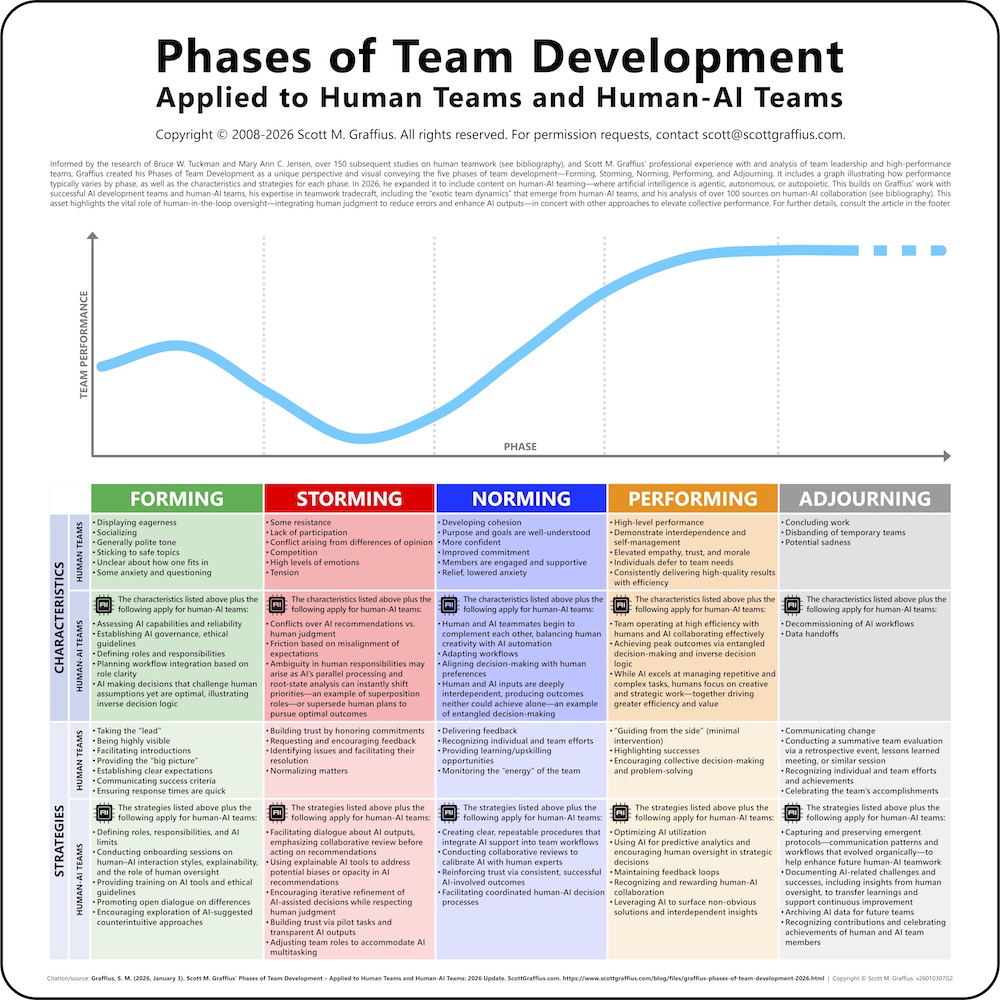
Graffius is a renowned authority on teamwork tradecraft. Informed by the research of Bruce W. Tuckman and Mary Ann C. Jensen, over 150 subsequent studies, and Graffius' first-hand professional experience with, and analysis of, team leadership and performance, Graffius created his "Phases of Team Development" intellectual property as a unique perspective and visual conveying the five phases of team development. First introduced in 2008 and periodically updated, his work provides a diagnostic and strategic guide for navigating team dynamics. It provides actionable insights for leaders across industries to develop high-performance teams. Its adoption by esteemed organizations such as Yale University, IEEE, Cisco, Microsoft, Ford, Oracle, Broadcom, the U.S. National Park Service, and the Journal of Neurosurgery, among others, highlights its utility and value, solidifying its status as an indispensable resource for elevating team performance and driving organizational excellence. In 2026, Graffius added human-AI teamwork—including the "exotic team dynamics" which emerge when advanced AI collaborates as a teammate—to his "Phases of Team Development."
The 2026 edition of Graffius' "Phases of Team Development" intellectual property is here.
Expert on Temporal Dynamics on Social Media Platforms
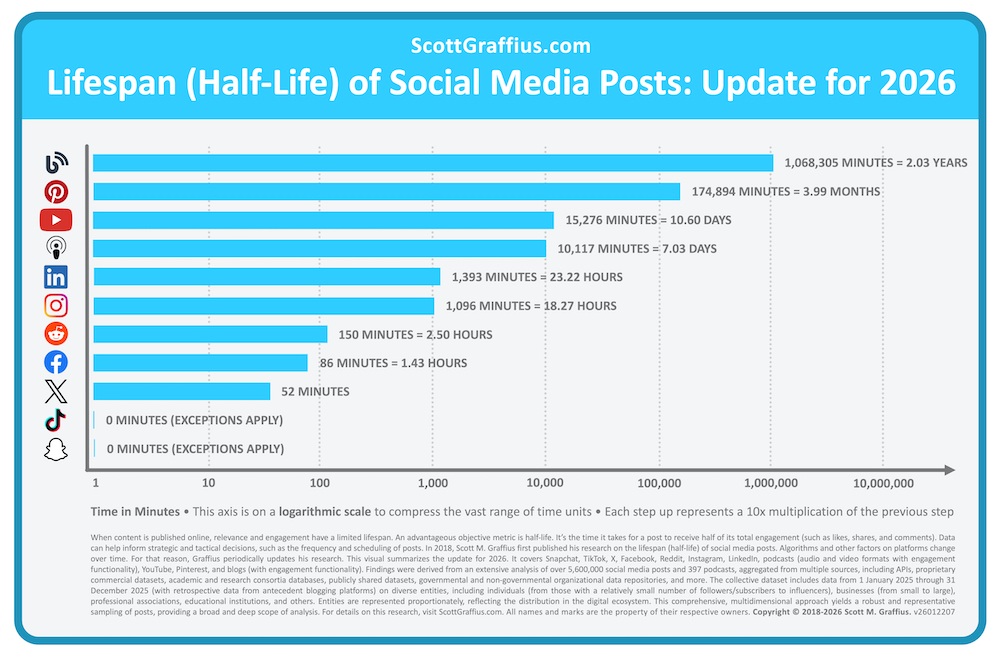
Graffius is also an authority on temporal dynamics on social media platforms. His "Lifespan (Half-Life) of Social Media Posts" research—first published in 2018 and updated annually—delivers a precise quantitative analysis of post longevity across digital platforms, utilizing advanced statistical techniques to determine mean half-life with precision. It establishes a solid empirical base, effectively highlighting the ephemeral nature of content within social media ecosystems. Referenced and applied by leading entities—such as Fast Company, GoDaddy, Journal of Hand Surgery (European Volume), Ministère de la Culture (French Ministry of Culture), Pinterest Inc., PNAS, and Telecommunications Policy, among others—his research exemplifies methodological rigor and sustained significance in the field of digital informatics.
The 2026 edition of Graffius "Lifespan (Half-Life) of Social Media Posts" research is here.
Education and Professional Certifications
Graffius has a bachelor’s degree in psychology with a focus in Human Factors. He holds eight professional certifications:
- Certified SAFe 6 Agilist (SA),
- Certified Scrum Professional - ScrumMaster (CSP-SM),
- Certified Scrum Professional - Product Owner (CSP-PO),
- Certified ScrumMaster (CSM),
- Certified Scrum Product Owner (CSPO),
- Project Management Professional (PMP),
- Lean Six Sigma Green Belt (LSSGB), and
- IT Service Management Foundation (ITIL).
He is an active member of the Scrum Alliance, the Project Management Institute (PMI), and the Institute of Electrical and Electronics Engineers (IEEE).
Advancing AI, Agile, and Project/PMO Management
Scott M. Graffius continues to advance the fields of AI, Agile, and Project/PMO Management through his leadership, research, writing, and real-world impact. Businesses and other organizations leverage Graffius’ insights to drive their success.
Discover Scott’s Books
- Agile Scrum: Your Quick Start Guide with Step-by-Step Instructions — Deliver Products in Short Cycles with Rapid Adaptation to Change, Fast Time-to-Market, and Continuous Improvement
- Agile Transformation: A Brief Story of How an Entertainment Company Developed New Capabilities and Unlocked Business Agility to Thrive in an Era of Rapid Change
- Agile Protocol: The Transformation Ultimatum
Connect with and follow Scott on LinkedIn, X, YouTube, Facebook, Threads, Bluesky, Mastodon, and ResearchGate.










Sign up for Miro—it's free!
(Want more features? You can always upgrade to a paid plan.)

List of Additional Articles
You may be interested in these stories.
Government of Canada Features Research by Scott M. Graffius
"Strategic Business Research" Journal Cites Work of Scott M. Graffius
IEEE Access Publication Features Scott M. Graffius’ Research on the Half-Life of Social Media
The Agile Coach: 2026 Edition
Scott M. Graffius’ Work Cited in International Peer-Reviewed Journal on Digital Transformation
Phases of Team Development in Elite Sport
A Critical Analysis of COVID-19 Treatment Search Trends and Media Coverage Study Citing Scott M. Graffius' Work
Human-AI Teamwork: Master the Exotic Team Dynamics That Emerge When Collaborating with Advanced AI -- Or Be Outplayed
"Agile Scrum" by Scott M. Graffius Now Featured on Grokipedia
UNSW Aerospace Engineering Course Features Scott M. Graffius' "Phases of Team Development"
Thinkers360 Honors Scott M. Graffius as a 2026 Top Agile Thought Leader
Agile's Journey Through the Decades: Update for 2026
BMC Software Features Content from Scott M. Graffius' Book
Peer-Reviewed Journal Cited Work of Scott M. Graffius
University of Waterloo Features Graffius' "Phases of Team Development" in Course Materials
Perplexity Standalone Article on AI Hallucinations Cites Research by Scott M. Graffius
Handling the Saboteur Within: Lessons from a 3-Letter Agency on Spotting and Stopping Intentional and Unintentional Sabotage
A Deep Dive Into the Typical Engagement Pattern for Social Media Posts
Most Valuable IT Certifications: Update for 2026
"Marketing in the Metaverse" Spotlights Scott M. Graffius’ Research on the Half-Life of Social Media
University of Greenwich Features Graffius' Phases of Team Development
10 Essential Agile Books: Curated Recommendations for Agile Professionals
Lifespan (Half-Life) of Social Media Posts: Update for 2026
Scott M. Graffius' Research on the Half-Life of Social Media was Cited in a Peer-Reviewed Study Published in Telecommunications Policy, a Leading Academic Journal
Are AI Hallucinations Getting Better or Worse? We Analyzed the Data
Scott M. Graffius' Phases of Team Development - Applied to Human Teams and Human-AI Teams: 2026 Update
Lessons from Yesterday’s Tomorrowland
Scott M. Graffius’ Update to His "Phases of Team Development” Coming Early 2026
A Data-Driven Analysis of the Evolution of Project Management: Tasks, Trends, and AI
Actionable Insights. Global Impact. Scott M. Graffius.
Beep Beep! Why Wile E. Coyote Is the Patron Saint of AI Failure
Social Media Half-Life Research Cited in Prestigious Peer-Reviewed Medical Journal
Navigating the Spectrum of Advanced AI – Agentic, Autonomous, and Autopoietic
Lessons from Unhinged AI in Fiction: What Rogue AIs in Sci-Fi Storytelling, Films, and TV Shows Reveal About Us
Scott M. Graffius Contributed to and Reviewed the PMBOK Guide, 8th Edition — the Global Standard for Project Management
UK Sports Institute Features Teamwork and Leadership Work of Scott M. Graffius
Definitions of Advanced AIs: Agentic, Autonomous, and Autopoietic
HAN University of Applied Sciences Features the Work of Scott M. Graffius
Gifts That Inspire Joy
Evergreen Echoes: How Pinterest Inc. and Pinterest Japan Spotlighted Scott M. Graffius’ Research on the Half-Life of Social Media Content
Scott M. Graffius’ Team Development Work Lights Up the University of Tasmania’s Curriculum
Taiwan’s Leading Outlet for Technology and Innovation Spotlights Graffius’ Research on Social Media Temporal Dynamics
Scott M. Graffius’ Insights on AI, Agile, Gaming, XR, and Defense Transformation Cited by MSN in Their Coverage of Innovation and Leadership in the Sector
Top Predictions of 2024, Tested in 2025
Government of Finland Agency Features Graffius' Phases of Team Development IP
Scott M. Graffius Premieres His New "Exotic Team Dynamics: Human-AI Collaboration" Talk at Corporate Event in Las Vegas
Environmental Science Journal References Scott M. Graffius’ Project Management Work
AI Institute of Switzerland Features Scott M. Graffius’ Work on Algorithms
Exotic Team Dynamics: The New Frontier of Human–AI Collaboration
Scott M. Graffius’ Work Featured at ACM DIS ’25
Climbing the Ladder: The Head of Agile/PMO’s Organizational Proximity to the CEO is Closer Than Ever
Harness Sci-Fi and Speculative Design While Embracing Imperfection to Drive Innovation and Proactively Predict and Prepare for the Future
Scott M. Graffius’ “Agile Scrum” Book Featured in a Publication of the Associação Nacional de Educação Católica do Brasil (ANEC)
Setting Direction with OKRs and Tracking Progress with KPIs: A Guide for Agile, Project Management, and Tech Teams
AI Showcase Showdown: Ranking AI Accuracy on Project Management Basics
BookAuthority Features “Agile Scrum” by Scott M. Graffius in “10 Agile Software Development Books That Define the Field”
Exploring Team Dynamics, Adaptability, and Creative Problem-Solving Through Felix the Cat’s Metaphorical Toolkit
Mind Games and Master Plans: How PsyOps Exploit Psychological Phenomena
The “Pants-on-Fire Index for AI”
16 Causes of Technical Debt and How to Avoid It
PMI’s Infinity AI Gets the Basics of Team Development Alarmingly and Repeatedly Wrong
Agile for Unicorns: 7 Keys to Thrive; Scott M. Graffius’ Workshop
Scott M. Graffius’ “Agile Scrum: Your Quick Start Guide with Step-by-Step Instructions” Featured in Prestigious National Academies of Sciences Publication
Meta and Anduril’s EagleEye and the Future of XR: How Gaming, AI, and Agile Are Transforming Defense
"Agile Protocol" and the Power of Satire, Parody, and Humor
AI in Agile: Benefits, Risks, Outlook
Hostinger Highlights Scott M. Graffius’ “Agile Protocol” Book in Feature on Software Projects
French Ministry of Culture Links to Scott M. Graffius Research in Their Guide for Responsible Digital Communication
National Science Foundation’s LTER Network Features Scott M. Graffius’ Phases of Team Development IP
Waterfall vs. Agile: What’s Fixed, What’s Flexible, and Why It Matters
Scott M. Graffius Delivering $2.3 Billion in Value Through AI, Agile, and Project/PMO Leadership
The Problem with Heroes in Agile
The 3 Vital Rules of Science: What They Are and Why They Matter
“Agile Protocol: The Transformation Ultimatum” Lands on the Amazon Best Sellers List!
Scott M. Graffius Recognized as a Top Thought Leader in Digital Disruption by Thinkers360
“Agile Protocol: The Transformation Ultimatum” by Scott M. Graffius Crashes the Book Scene with Satirical Firepower
NCKU in Taiwan Integrates Graffius' 'Phases of Team Development' into Its Curriculum
The Art and Science of Aligning Initiatives with Strategic Objectives
RGPV University Adds Scott M. Graffius’ "Agile Scrum: Your Quick Start Guide with Step-by-Step Instructions" to Its Syllabus
Introducing ‘Engage or Fade: Decoding the Half-Life of Digital Resonance’ – A New Talk by Scott M. Graffius
Dropbox Company (Nira) Taps into Scott M. Graffius’ Expertise in Strategic Planning
Reporting Errors in a Publication: A Case Study on ‘Frontiers in Public Health’
NESEA Conference Session on Innovation Highlights Scott M. Graffius' 'Phases of Team Development'
U.S. Soccer Scores with Scott M. Graffius' Intellectual Property on Teamwork
U.S. Department of Commerce Partner (IEDC) Features Scott M. Graffius’ Intellectual Property
How Long Do Your Posts Live? AI Critiques Scott M. Graffius’ Research on the Half-Life of Social Media
Agile's Journey Through the Decades
Scott M. Graffius' Role in Advancing Project Management Institute (PMI) Standards Excellence
Most Valuable IT Certifications: Update for 2025
The PMI + Agile Alliance Merger: A Recipe for Success?
When Agile, AI, and Strategic Thinking Converge
Scott M. Graffius’ Phases of Team Development: 2025 Update
Lifespan (Half-Life) of Social Media Posts: Update for 2025
Verizon Features Scott M. Graffius
Do Not Read This Article! An Exploration of the Streisand Effect and Other Phenomena
Scott M. Graffius' 'Phases of Team Development' was Spotlighted in Journal of Neurosurgery
Pinterest Japan Uses Graffius’ Research on Temporal Dynamics on Social Media Platforms
Hochschule Coburg (Coburg University) Germany Uses Scott M. Graffius’ Phases of Team Development IP in Coursework on Agile Development
Wild World of Team Dynamics [Updated Two-Minute Video]
EU Europass Teacher Academy Features Scott M. Graffius’ ‘Phases of Team Development’ in Leadership Training
Side-by-Side Comparison of Retrospectives and Hot Washes
Constructor University 2024 Advanced Software Technology Handbook References Scott M. Graffius' Work on Team Dynamics
Strategies for Medical Team Success Featured Scott M. Graffius’ ‘Phases of Team Development’ Intellectual Property
SBG Neumark — Europe’s Largest Distribution Transformer Plant — Powers Up with Scott M. Graffius’ Intellectual Property
Scott M. Graffius’ Intellectual Property was Employed by the NHS — the Largest Single-Payer Healthcare System in Europe
Luxury Unwrapped: The Ultimate Holiday Gift Guide for Every Budget
Singapore Institute of Technology Features Work of Scott M. Graffius
Tufts University Features Scott M. Graffius 'Phases of Team Development' Intellectual Property
'Cat Herders': Retelling the Massive Success Story
Pennsylvania State Agency Used Scott M. Graffius' Intellectual Property
Copyright Infringement in a Book Published by AuthorHouse / Author Solutions / The Najafi Companies: Publisher Fails to Respond or Take Required Action
Pinterest Inc. References Scott M. Graffius’ Research
Bournemouth University Used Scott M. Graffius’ Intellectual Property
‘Comparative Methodological Guidelines: Handbook for Educators’ Violates Scott M. Graffius’ Copyright
Japan Backlog User Group Event Featured Scott M. Graffius’ ‘Phases of Team Development’
TurningWest's 'Trial'
Radio Silence from the American Association of Neurological Surgeons on Report of Blatant Plagiarism in Their ‘Journal of Neurosurgery’ Publication
Supplement to Graffius' 'Lifespan (Half-Life) of Social Media Posts' Research: Typical Engagement Distribution Pattern for Social Media Posts
How Algorithms Shape the User Experience on Social Media Platforms
Thinkers360 Named Scott M. Graffius a Top Thought Leader on Agile
More articles are listed here.

How to Cite This Article
Graffius, S. M. (2026, July 17). A Critical Analysis of "Platform-Specific Data Decay Patterns: A Comparative Study of Twitter, Reddit, and TikTok" and Its Reference to Research by Scott M. Graffius. ScottGraffius.com. https://scottgraffius.com/blog/files/critical-analysis-of-paper-on-data-decay-patterns.html

Digital Object Identifier (DOI)
Coming soon

Content Acknowledgements
Names, marks, and content are the property of their respective owners.
Akhmed Kaleel, Abdulkrim Ziani, Salma Abdullah Mohamed Saeed Alkaabi, and Beena Khalid Alhajri are the authors of the paper, "Platform-Specific Data Decay Patterns: A Comparative Study of Twitter, Reddit, and TikTok," published in MEDAAD, a journal associated with Peninsula Publishing. The paper is the property of its authors/owners. That paper cites Scott M. Graffius' "Lifespan (Half-Life) of Social Media Posts" research.
This article includes limited excerpts from the paper, attributed and used under fair use doctrine for purposes of news reporting, commentary, and analysis.
Graffius' "Lifespan (Half-Life) of Social Media Posts" is copyright © Scott M. Graffius. All rights reserved.

Tags and Hashtags
- Content Moderation
- Content Persistence
- Critical Analysis
- Data Decay
- Engagement Half-Life
- Ephemeral Content
- Persistence-Aware Metric
- Platform-Specific Data Decay Patterns
- Scott M. Graffius
- Social Media Platforms
- Social Media Research
- Lifespan (Half-Life) of Social Media Posts
- #AcademicPublishing
- #ContentPersistence
- #CriticalAnalysis
- #DataScience
- #DataDecay
- #DigitalResearch
- #EngagementHalfLife
- #OpenScience
- #ResearchMethods
- #ScottMGraffius
- #SocialMedia
- #SocialMediaPlatforms
- #SocialMediaResearch

Post-Publication Notes
If there are any supplements or updates to this article after the date of publication, they will appear here.

Copyright
Copyright © Scott M. Graffius. All rights reserved.
Content on this site—including text, images, videos, and data—may not be used for training or input into any artificial intelligence, machine learning, or automatized learning systems, or published, broadcast, rewritten, or redistributed without the express written permission of Scott M. Graffius.

A Critical Analysis of "Five Core Themes of Intentional Team Formation" and Its Use of Scott M. Graffius' Research

Recommended Citation
Graffius, S. M. (2026, October 14). A Critical Analysis of "Five Core Themes of Intentional Team Formation" and Its Use of Scott M. Graffius' Research. ScottGraffius.com. https://scottgraffius.com/blog/files/critical-analysis-of-five-core-themes-of-intentional-team-formation.html
About This Article
Supplements or updates after publication appear in the Post-Publication Notes section at the end of the article.
Source information and links for materials cited are provided in the References section.
Introduction
"Five Core Themes of Intentional Team Formation," published in Humanities and Social Sciences Communications (Springer Nature), examines a cross-disciplinary team formed during the COVID-19 pandemic to develop a grant proposal. Based on that experience, the authors identify five themes they recommend teams address: Team Development, Effective Communication, Perspective Alignment, Team Management, and Project Workflow. Spoiler: The paper has many issues.
"Five Core Themes of Intentional Team Formation" features Scott M. Graffius' research. However, its description of Graffius' work is inaccurate, and the citation is invalid. For those and other reasons, and to proactively clarify any potential misunderstandings, Graffius provides the following objective, evidence-based assessment of the paper, and he does not endorse the paper.
10 Key Issues
1. Problems With References and the Reference List
References should direct readers to identifiable sources that support the claims for which they are cited. The paper falls short on both counts. Select examples illustrate the problem.
The paper cites a RAND Corporation report, "On Distributed Communications: Summary Overview" (attributed to Baran, 2018), to support a claim that team members expanded their collaborations beyond the project. The RAND report concerns distributed communications and the development of resilient communication networks. It does not document expanded collaboration among the team members or substantiate the paper’s claims about team science and grant-writing networks.
The paper cites Tuckman and Jensen’s 1977 work on group development in connection with the proposition that scientific alignment develops through the divergence and convergence of ideas. The paper does not explain how the cited work supports this specific proposition. Without that connection, the reference does not establish the claim for which it is offered.
The reference attributed to Graffius is incorrect. The error is delineated in point 10.
2. The Evidence Is Limited and Non-Comparative
The quantitative evidence consists of four surveys of team members, with 21–36 respondents per survey, analyzed using what the paper calls univariate descriptive statistics, alongside a small network analysis.
The study reports no comparison team, no independent baseline against which to assess the intervention, no inferential statistical analysis, and no reported effect sizes or confidence intervals. The respondents were members of the team whose process was being evaluated. Some had also helped design or implement that process.
Those data can describe participants' reported experiences. They cannot, on their own, establish that the framework caused improvements, that it outperforms other approaches, or that the findings generalize to other teams.
The paper presents the five themes (Team Development, Effective Communication, Perspective Alignment, Team Management, and Project Workflow) as essential targets for teams. A single case can generate useful hypotheses and practical lessons, but it does not provide a sound basis for declaring a set of themes necessary or effective across settings.
The study’s descriptive evidence is not equivalent to validation. The paper does not demonstrate that its framework improves team performance.
3. The Central Constructs Were Not Adequately Measured
The paper places psychological safety, mutual trust, and respect near the center of its argument. It asserts that aligning contributions and expectations through these conditions helps teams achieve their goals.
Yet the paper does not report adequate validated measures of these central constructs. Instead, it relies on selected agreement items and network diagrams, then interprets some observed behaviors as evidence of psychological safety.
That's a substantial gap between the measurement and the claim. A network diagram may show who reported learning from whom or who was identified as a leader. It does not, by itself, establish that participants felt psychologically safe, trusted one another, or experienced mutual respect.
The paper's limitations section acknowledges that antecedent conditions were not measured directly. Its abstract and conclusion nevertheless use language that presents relationships involving these conditions as findings of the study.
The authors need to distinguish between concepts that inform their interpretation and variables their study actually measured. The paper does not make this distinction consistently, leaving insufficient empirical evidence to establish that its conclusions about key constructs are supported by the measurements.
4. Causal Claims Without a Causal Design
The paper suggests that its approaches produced positive outcomes. The design does not establish that conclusion.
Consider the reported growth in connections among team members. People brought together to work on the same grant proposal have an obvious reason to develop new working relationships: they are collaborating on a shared objective. That change could occur without the particular framework or interventions described in the paper.
The paper's conclusion states that the team significantly extended its networks, yet the paper does not report a statistical significance test supporting that claim. An increase in a reported count does not, by itself, establish statistical significance. If the authors intended "significantly" in its statistical sense, the paper does not provide the reported analysis needed to substantiate that interpretation.
The authors may reasonably report that participants described new connections or that the network diagrams contain more reported ties after team formation. Those are descriptive observations. They do not establish that the intervention caused the change.
Causal claims require evidence capable of distinguishing the proposed explanation from plausible alternatives. The study does not do that.
5. The Team Counts and Survey Denominators Need Reconciliation
The paper describes a final team of 25 members and reports 39 members at one point in the project. Its ethics statement separately refers to an original early-phase team of 44 people. The paper does not clearly reconcile these different team-size figures. The four reported survey denominators were 39, 33, 25, and 27.
There may be reasonable explanations for these different figures. Membership may have changed over time, and not every survey need have been administered to the same group. The paper should nevertheless provide a clear account of who was on the team at each stage, who received each survey, and how many people responded.
As presented, the figures do not form a readily reconciled account of team membership and participation.
Attrition also deserves more attention. The paper reports that some individuals who left the team early felt they had gained or strengthened team and people skills. However, it does not clearly explain how former team members were included in, or excluded from, the final survey, or how their experiences were accounted for in the findings.
A change from an original 44-person team to a final team of 25 is not a trivial detail in a study of intentional team formation. The paper identifies several reasons for departures or reduced engagement, including competing commitments, personal circumstances, pandemic fatigue, and perceived lack of fit as the project evolved. However, it does not clearly reconcile the different team-size figures or sufficiently explain how membership changes affected the study's assessments and findings.
The conclusions should account for that uncertainty. Findings drawn largely from those who remained may not represent the experiences of the entire group.
6. The Qualitative Analysis Is Not Sufficiently Documented
The paper states that the five themes emerged when the core author team coded the qualitative data. It provides too little information for readers to evaluate that process. The paper does not adequately explain the coding procedure, identify the number of coders, describe the codebook, explain how disagreements were handled, or specify the volume of qualitative material analyzed. The underlying qualitative data are not available for readers to inspect.
The paper also says that some recommendations draw on facilitators’ experience. That experience may be useful, but it raises a question the authors should address: how much did the five themes emerge from participants' data, and how much reflected frameworks or assumptions the facilitators brought to the project?
The themes overlap with established work on team science and team management. The paper should explain more clearly what is novel about them and how the data support that contribution.
Qualitative analysis can produce valuable findings without following a single prescribed procedure. It still requires sufficient transparency for readers to understand how researchers moved from source material to codes, from codes to themes, and from themes to recommendations. The paper provides only a limited account of that analytical process, making it difficult for readers to assess how the reported themes were derived from the underlying data.
7. The Authors Evaluated a Process in Which They Participated
The paper's evaluation raises questions about independence. All authors were members of the team or contracted team-science facilitators, and some also served on the proposal's leadership team. The team-science professionals hired to support the project participated in the process under evaluation, and some co-authored the paper. The paper declares no competing interests, while several cited works were also co-authored by members of the author team. These circumstances do not automatically invalidate the study. They do, however, heighten the importance of explaining how the evaluation was conducted, how potential bias was managed, and what evidence would have counted as an unsuccessful outcome.
The grant proposal was not funded. The authors acknowledge that outcome but emphasize multiple metrics of success and maintain that the process was nevertheless successful. There is nothing inherently wrong with identifying benefits beyond a grant award. Teams may develop skills, strengthen relationships, and generate useful ideas even when a proposal is unsuccessful. The concern is whether those additional benefits provide sufficient evidence to validate the process, particularly without clearly specified criteria for success, a systematic evaluation, or adequate safeguards against self-assessment bias.
When the people who designed and implemented a framework also determine that it worked, the assessment needs safeguards against self-confirmation. The paper does not adequately demonstrate such safeguards. Consequently, the authors' favorable interpretation is difficult to distinguish from their own assessment of the work, particularly because the paper does not sufficiently establish how potential bias was managed or how the reported evidence was used to evaluate success.
The ethics disclosure also deserves attention. The authors report that participant recruitment, consent, and data collection preceded the institutional review board (IRB) determination. They explain that the activities were initially conducted as a team assessment rather than as research, and that the decision to publish arose later. Written permission to use de-identified survey data for manuscript development was subsequently sought from participants. These circumstances warrant consideration alongside the study’s methods, consent arrangements, and the authors’ account of why prospective IRB review was not required.
8. The Recommendations Go Beyond What Was Tested
The paper's section on cross-disciplinary team applications describes the five themes as "particularly valuable" for five types of teams, including teams forming in virtual environments, large multi-institutional consortia, and teams in high-stakes or high-uncertainty contexts.
The authors attribute these broader recommendations in part to facilitators’ experience. Such experience can inform a proposal, but it does not establish that the framework has been tested or shown to work in all the settings listed.
The paper would be stronger if it identified these applications as hypotheses or practitioner recommendations for future evaluation. As written, the language sometimes presents extrapolations as established findings.
9. Editorial Errors
The paper has editorial problems. For example, the Figure 6 caption gives a response scale as "strongly disagree, disagree, neither agree nor agree, agree, or strongly disagree." The labels are internally inconsistent: the middle category is malformed, the "strongly disagree" endpoint is repeated, and “strongly agree” is absent.
Elsewhere, the paper refers to "a tenant of psychological safety" where "tenet" is intended.
10. The Citation of Graffius’ Work Is Incorrect as Presented
For context and clarity, information on Graffius' work is presented below. Issues with the "Five Core Themes of Intentional Team Formation" paper follow it.
Background and Context on Graffius' "Phases of Team Development"
Team development is commonly described as a progression through five phases or stages: Forming, Storming, Norming, Performing, and Adjourning. Bruce W. Tuckman introduced the first four phases in 1965, and he and Mary Ann C. Jensen added the fifth phase in 1977. Tuckman and Jensen described these phases only in broad, general terms, without codifying specific characteristics, strategies, or a performance graph.
Scott M. Graffius subsequently developed and codified what Tuckman and Jensen did not: a detailed, structured set of diagnostic characteristics for each phase; a corresponding set of practical strategies for each phase; and an original, proprietary, empirically derived performance graph built from statistical analysis of thousands of data points across hundreds of diverse projects. Graffius created his "Phases of Team Development" as a unique perspective and visual conveying the five phases of team development, inclusive of a graph showing how performance varies by phase, as well as the characteristics and strategies for each phase. Leaders can apply these insights to advance the effectiveness and success of teams.
Graffius initially developed his unique material in 2008 and periodically updates it. He expanded it, for example, in 2026 to include content on human-AI teaming, where artificial intelligence is advanced (agentic, autonomous, or autopoietic). It builds on his work on hundreds of projects (including AI development), his expertise in teamwork tradecraft (both human teams and human-AI teams, including the exotic team dynamics that emerge from human-AI teams), and his analysis of hundreds of studies on both human-only and human-AI collaboration.
The actionable insights provide a practical framework to navigate the complexities of team dynamics. Graffius' resource helps practitioners advance the effectiveness and success of both human-only and human-AI teams.
Businesses, professional associations, government agencies, universities, publications, and media outlets have used and cited Graffius' "Phases of Team Development." Select examples include:
- Adobe
- American Management Association
- Amsterdam Public Health Research Institute
- Bayer
- Boston University
- Broadcom
- Buckinghamshire New University
- Cisco
- DevOps Institute
- Erste Group Bank AG
- Ford Motor Company
- Government of Finland
- HAN University of Applied Sciences
- Hasso-Plattner-Institut für Digital Engineering GmbH
- How Teams Work
- IEEE Access
- Johns Hopkins University
- Journal of Neurosurgery
- Microsoft
- National Science Foundation’s LTER Network
- Northeast Sustainable Energy Association (NESEA)
- Ohio State University
- Oracle
- Proceedings of the 2023 International Conference on Decision Aid Sciences and Applications (DASA)
- Royal Australasian College of Physicians
- Technical University of Munich
- Torrens University
- Tufts University
- U.S. National Park Service
- U.S. Soccer
- U.S. Tennis Association
- UC San Diego
- UK Sports Institute
- University of Galway
- University of Greenwich
- University of New South Wales
- Warsaw University of Technology
- Yale University
- And many more
Read more here: Phases of Team Development
The "Five Core Themes of Intentional Team Formation" paper states: "Graffius (2024) updates Tuckman and Jensen’s (1977) framework, noting limited practical evidence and strategies specifically for the Forming stage." Immediately before this statement, the authors note, "… studies still flag the team formation stage as a critical but under-explored period." Immediately after the sentence about Graffius, they state, "… demonstrates unexplored dynamics in initial collaboration interaction." However, the paper's characterization of Graffius' work is incorrect. The Forming phase is neither unexplored nor under-explored.
The paper's reference list gives the following citation:
Graffius S (2024) Revisiting Tuckman: evidence-based strategies for the forming stage of team development. J Leadersh Organ Stud 31(1):5–16.
The citation is invalid:
- The paper indicates: "Revisiting Tuckman: evidence-based strategies for the forming stage of team development," on pages 5-16, in issue 1, volume 31, of the Journal of Leadership and Organizational Studies.
- However, there is no such article in the Journal of Leadership and Organizational Studies. Further, there is no article on pages 5-16 of it. What appears on pages 5-24 is: "Disobeying the Leader: Creative Deviance as a Mechanism Between Psychological Ownership and Social Undermining," written by Jigyashu Shukla, Rebecca Bennett, Robert Folger, and Ronit Kark.
As summarized above, Graffius' "Phases of Team Development" has been used and cited by publications and others worldwide. Based on context, the 2024 submission date of the "Five Core Themes of Intentional Team Formation" paper, and its reference to Graffius' 2024 work, the correct citation would be:
Graffius, S. M. (2024, January 5). Phases of Team Development: 2024 Update. ScottGraffius.com. https://doi.org/10.13140/RG.2.2.28629.40168
Conclusion
"Five Core Themes of Intentional Team Formation" documents one team's experience and proposes lessons for other teams. It may offer useful ideas, but it does not establish that its five themes are necessary, that the framework improves team performance, or that its broader recommendations are empirically validated. The study is a single, unreplicated case based largely on internal self-reports, without a comparison group or adequate measurement of several central constructs. Broader claims require clear operational definitions, appropriate measures, transparent analytical procedures, a reconciled account of team membership and survey participation, and research designs capable of testing outcomes.
The paper’s conclusions are further undermined by causal claims unsupported by the study design, network interpretations that exceed the reported analysis, inconsistent accounts of team membership, insufficiently transparent qualitative procedures, and other methodological and reporting issues. The authors also evaluate a process in which they participated and judge it successful despite the grant proposal’s failure to secure funding, without sufficiently establishing safeguards against self-confirmation. The paper mischaracterizes Scott M. Graffius' work and it provides an invalid citation.
Readers should treat the paper’s findings with caution. Graffius does not endorse the paper.
References
Brennan, A. N., Rollinson, C. R., Love, H., Schulz, A. N., Reidy, B., Grossman, J. J., Dickmann, E. M., Fisher, E. R., McCormack, L., Richardson, A. D., LaMontagne, J., Helmus, M. R., & Li, D. (2026, September 29). Five core themes of intentional team formation. Humanities and Social Sciences Communications. https://doi.org/10.1057/s41599-026-09246-w
Graffius, S. M. (2024, January 5). Phases of Team Development: 2024 Update. ScottGraffius.com. https://doi.org/10.13140/RG.2.2.28629.40168
Graffius, S. M. (2026, January 3). Scott M. Graffius' Phases of Team Development - Applied to Human Teams and Human-AI Teams: 2026 Update. ScottGraffius.com. https://doi.org/10.13140/RG.2.2.18184.89601
About the Authors of the Paper
The authors of "Five Core Themes of Intentional Team Formation" and their affiliations, as listed in the paper, are:
- Andrea N. Brennan: Morton Arboretum, Lisle, Illinois, USA
- Christine R. Rollinson: Morton Arboretum, Lisle, Illinois, USA
- Brendon Reidy: Morton Arboretum, Lisle, Illinois, USA
- Luke McCormack: Morton Arboretum, Lisle, Illinois, USA
- Hannah Love: Divergent Science, Fort Collins, Colorado, USA
- Ellen R. Fisher: Divergent Science, Fort Collins, Colorado, USA; University of New Mexico, Albuquerque, New Mexico, USA
- Ashley N. Schulz: Mississippi State University, Starkville, Mississippi, USA
- Jake J. Grossman: St. Olaf College, Northfield, Minnesota, USA
- Ellyn M. Dickmann: Dickmann and Associates, LLC, Loveland, Colorado, USA
- Andrew D. Richardson: Northern Arizona University, Flagstaff, Arizona, USA
- Jalene LaMontagne: University of Missouri–St. Louis, St. Louis, Missouri, USA; Missouri Botanical Garden, St. Louis, Missouri, USA
- Matthew R. Helmus: Temple University, Philadelphia, Pennsylvania, USA
- Daijiang Li: University of Wisconsin–Madison, Madison, Wisconsin, USA
About the Paper’s Journal: Humanities and Social Sciences Communications
Humanities and Social Sciences Communications is a peer-reviewed, fully open-access journal published by Springer Nature. Launched in 2015 as Palgrave Communications, it adopted its current name in June 2020. The journal publishes research across the humanities, social sciences, and behavioural sciences, including interdisciplinary scholarship using theoretical, qualitative, quantitative, and methodological approaches. Its stated editorial commitments include rigorous peer review, robust research, and high editorial and ethical standards. Articles are published online and made freely accessible to readers. The journal’s broad scope encompasses psychology, sociology, management, communication, education, and complex networks.
About the Journal’s Publisher: Springer Nature
Springer Nature is a global research, educational, and professional publisher formed in 2015 through the combination of Nature Publishing Group, Macmillan Education, and Springer Science+Business Media. Its publishing portfolio includes scholarly journals, academic books, and research resources spanning science, technology, medicine, the humanities, and the social sciences. The company supports researchers, educators, students, and professionals through its publishing platforms and related services. Springer Nature also maintains publishing policies addressing research integrity, editorial standards, and publication ethics. It publishes Humanities and Social Sciences Communications, the journal examined in this article.
About Scott M. Graffius
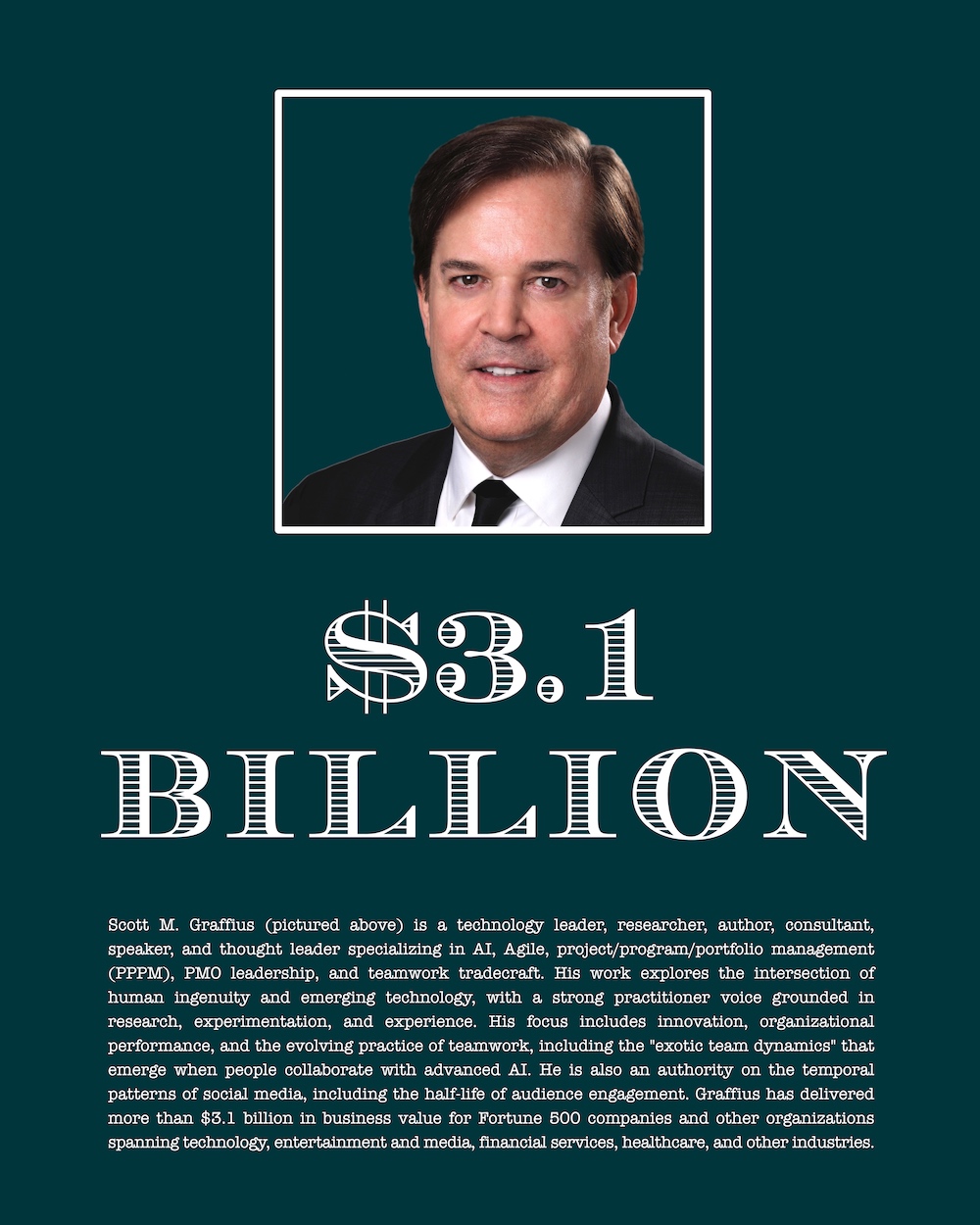
Scott M. Graffius is a technology leader, researcher, award-winning author, practitioner, consultant, thought leader, and international public speaker specializing in AI, Agile, project/program/portfolio management (PPPM), PMO leadership, and teamwork tradecraft. His work explores the intersection of human ingenuity and emerging technology, with a strong practitioner voice grounded in research, experimentation, and experience. His focus includes innovation, organizational performance, and the evolving practice of teamwork, including the "exotic team dynamics" that emerge when people collaborate with advanced artificial intelligence (agentic, autonomous, or autopoietic AI). Graffius has delivered more than $3.1 billion in business value for Fortune 500 companies and other organizations spanning technology, entertainment and media, financial services, healthcare, government, and other industries.
Businesses, professional associations, government agencies, universities, publications, and media outlets use Graffius and his work. Examples include Adobe, Bayer, Boston University, Federal Reserve Bank of New York, Ford, Gartner, Harvard Medical School, IEEE, Innovation Project Management, Johns Hopkins University, Microsoft, MSN, National Academy of Sciences, Oracle, Pinterest Inc., Project Management Institute, UC San Diego, Verizon, Yale University, and others.
The following sections highlight his experience, leadership, contributions, research, and enduring influence across industries and institutions worldwide.
Experience
Graffius heads the professional services firm Exceptional PPM and PMO Solutions, along with its subsidiary Exceptional Agility. These consultancies offer strategic and tactical advisory, training, embedded expertise, and consulting services to the public, private, and government sectors. They help organizations enhance their capabilities and results in agile, project management, program management, portfolio management, and enterprise PMO leadership, supporting innovation and driving competitive advantage. The consultancies confidently back services with a Delighted Client Guarantee™.
Graffius is a former VP of project management with a publicly traded provider of diverse consumer products and services over the Internet. Before that, he ran and supervised the delivery of projects and programs in public and private organizations with businesses ranging from e-commerce to advanced technology products and services, retail, manufacturing, entertainment and media, and more.
He has experience with consumer, business, reseller, government, and international markets.
Additional information is on LinkedIn.
Award-Winning Author
Graffius has authored three books.
Graffius' first book, Agile Scrum: Your Quick Start Guide with Step-by-Step Instructions, earned 17 awards. It provides a practical, step-by-step guide to Scrum, enabling teams to deliver products in short cycles with rapid adaptation, fast time-to-market, and continuous improvement—which supports innovation and drives competitive advantage.
- Paperback ISBN-13: 9781533370242
- Kindle ASIN: B01FZ0JIIY
Additional information on Agile Scrum: Your Quick Start Guide with Step-by-Step Instructions is here.
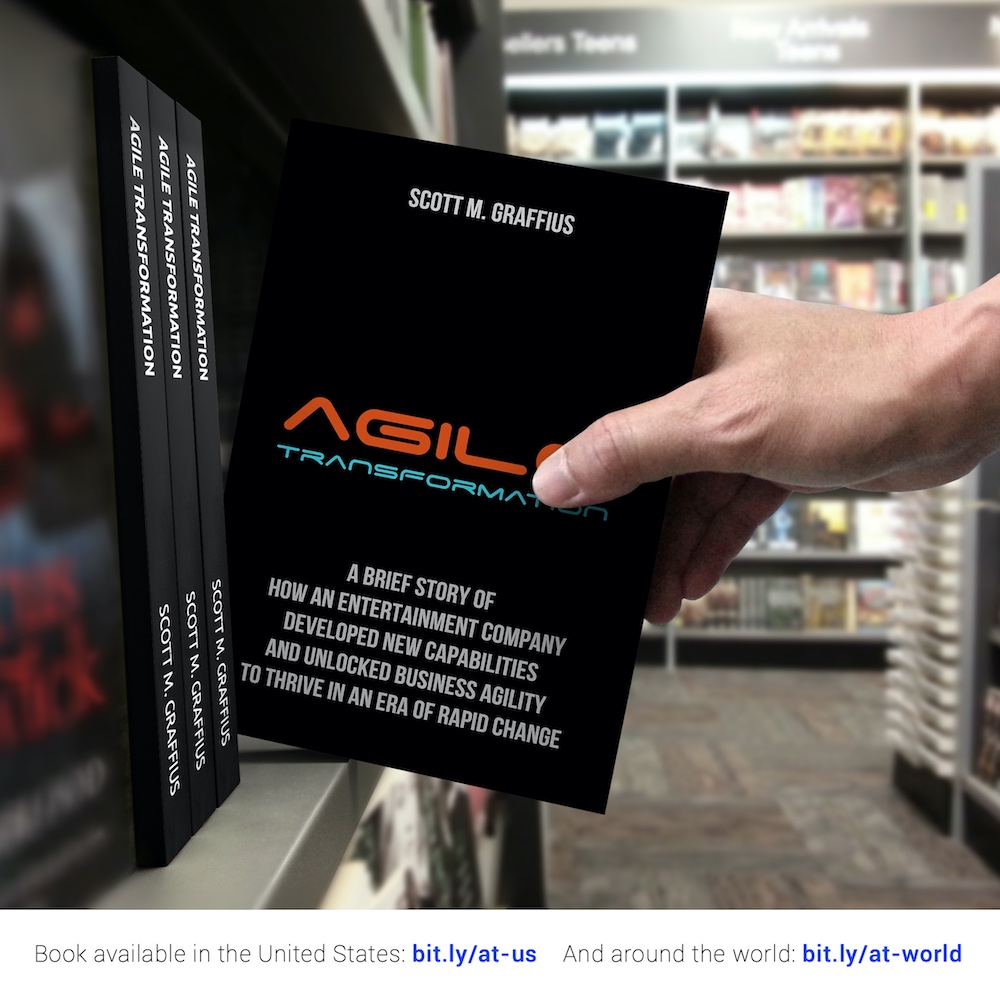
His second book, Agile Transformation: A Brief Story of How an Entertainment Company Developed New Capabilities and Unlocked Business Agility to Thrive in an Era of Rapid Change, was named one of the best Scrum books of all time by BookAuthority. It tells the compelling story of an entertainment company's agile transformation—offering lessons that apply across industries.
- Paperback ISBN-13: 9781072447962
- Kindle ASIN: B07R9LJLPJ
Additional information on Agile Transformation: A Brief Story of How an Entertainment Company Developed New Capabilities and Unlocked Business Agility to Thrive in an Era of Rapid Change is here.
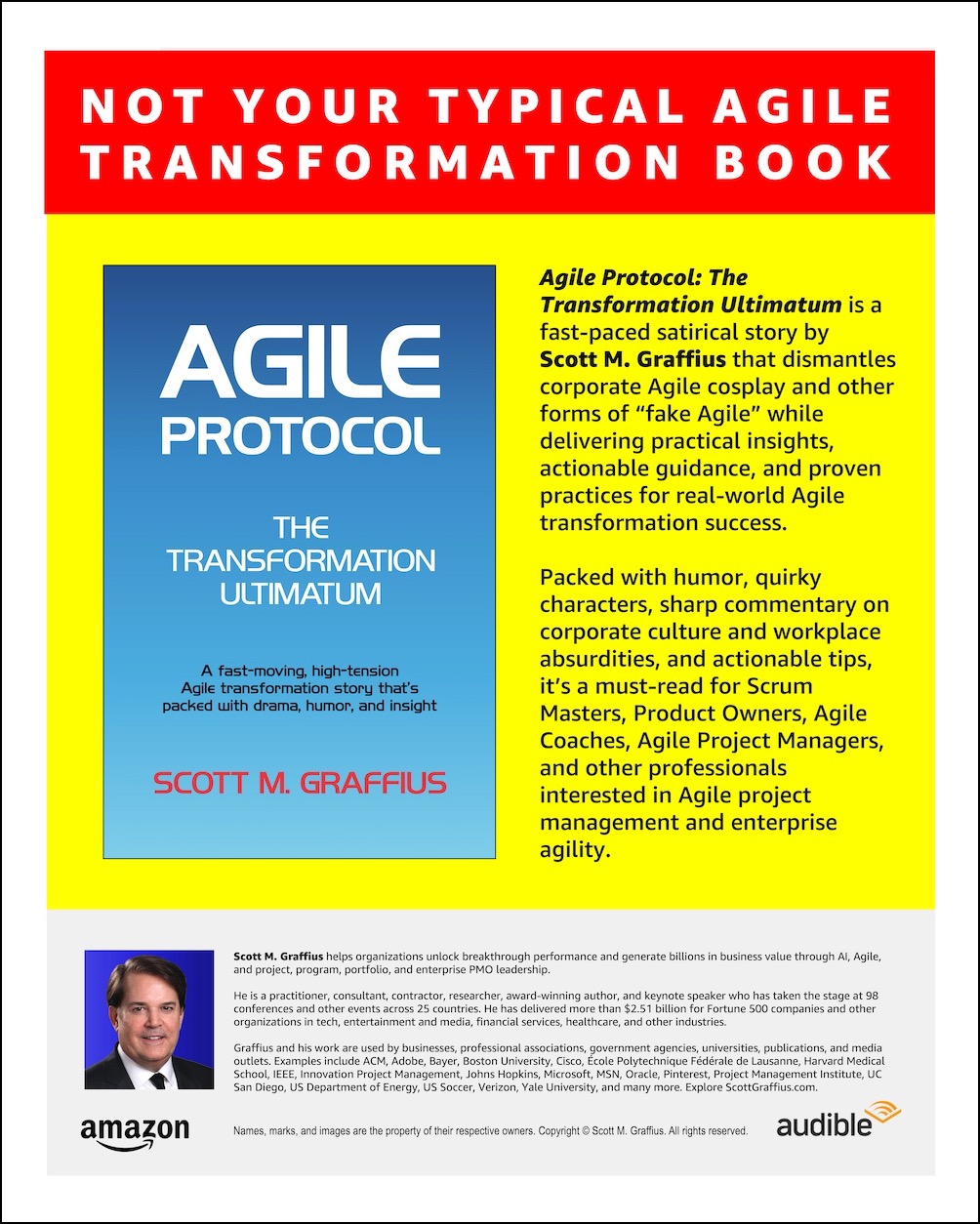
Agile Protocol: The Transformation Ultimatum, is his third book—and his first work of fiction.
It's a fast-paced satirical story by that dismantles corporate Agile cosplay and other forms of "fake Agile" while delivering practical insights, actionable guidance, and proven practices for real-world Agile transformation success.
Packed with humor, quirky characters, sharp commentary on corporate culture and workplace absurdities, and actionable tips, it’s a must-read for Scrum Masters, Product Owners, Agile Coaches, Agile Project Managers, and other professionals interested in Agile project management and enterprise agility.
- Kindle ASIN: B0F2SJ83WT
- Audible ASIN: B0DJG163R5
Additional information on Agile Protocol: The Transformation Ultimatum is here.
International Public Speaker
Organizations worldwide engage Graffius to present on technology (including AI), Agile, project management, program management, portfolio management, and enterprise PMO leadership. He crafts and delivers unique and compelling talks and workshops.
Graffius has conducted 99 sessions across 25 countries. Select examples of events include Agile Trends Gov, BSides (Newcastle Upon Tyne), Conf42 Quantum Computing, DevDays Europe, DevOps Institute, DevOpsDays (Geneva), Frug’Agile, IEEE, Microsoft, Scottish Summit, Scrum Alliance RSG (Nepal), Techstars, and W Love Games International Video Game Development Conference (Helsinki), Future of Work and Advanced AI (Paris, France), and more.
With an average rating of 4.82 (on a scale of 1-5), sessions are highly valued.
The request form is here.
Thought Leadership and Influence
Prominent businesses, professional associations, government agencies, and universities have showcased Graffius and his contributions—spanning his books, talks, workshops, and beyond. Select examples include:
- Adobe,
- American Management Association,
- Amsterdam Public Health Research Institute,
- Bayer,
- BCG,
- BMC Software,
- Boston Consulting Group (BCG),
- Boston University,
- Broadcom,
- Cisco,
- Coburg University of Applied Sciences and Arts - Germany,
- Computer Weekly,
- Constructor University - Germany,
- Data Governance Success,
- Deimos Aerospace,
- DevOps Institute,
- Dropbox,
- EU's European Commission,
- Federal Reserve Bank of New York,
- Ford Motor Company,
- Gartner,
- GoDaddy,
- Harvard Medical School,
- Hasso Plattner Institute - Germany,
- IEEE,
- Innovation Project Management,
- Johns Hopkins University,
- Journal of Marketing,
- Journal of Neurosurgery,
- Lam Research (Semiconductors),
- Leadership Worthy,
- Life Sciences Trainers and Educators Network,
- London South Bank University,
- Microsoft,
- MSN,
- NASSCOM,
- National Academy of Sciences,
- New Zealand Government,
- Ohio State University,
- Oracle,
- Pinterest Inc.,
- Project Management Institute,
- Mary Raum (Professor of National Security Affairs, United States Naval War College),
- Round Square Global Educational Network,
- Royal Australasian College of Physicians (RACP),
- SANS Institute,
- SBG Neumark - Germany,
- Singapore Institute of Technology,
- Torrens University - Australia,
- TBS Switzerland,
- Tufts University,
- UC San Diego,
- UK Sports Institute,
- University of Galway - Ireland,
- US Department of Energy,
- US National Park Service,
- US Soccer,
- US Tennis Association,
- Verizon,
- Wrike,
- Yale University,
- and many others.
Graffius has played a key role in the Project Management Institute (PMI) in developing professional standards. He was a member of multiple teams that authored, reviewed, and produced:
- The Standard for Artificial Intelligence in Portfolio, Program, and Project Management.
- Agile Practice Guide — Second Edition.
- A Guide to the Project Management Body of Knowledge (PMBOK Guide) — Eighth Edition.
- A Guide to the Project Management Body of Knowledge (PMBOK Guide) — Sixth Edition.
- The Standard for Program Management — Fourth Edition.
- Practice Standard for Work Breakdown Structures — Second Edition.
- The Practice Standard for Project Estimating — Second Edition.
He was also a subject matter expert reviewer of content for the PMI’s Congress. Beyond the PMI, Graffius also served as a member of the review team for two of the Scrum Alliance’s Global Scrum Gatherings.
Authority on Teamwork Tradecraft
Graffius is a renowned and highly-cited authority on teamwork tradecraft. Informed by the research of Bruce W. Tuckman and Mary Ann C. Jensen, over 150 subsequent studies, and Graffius' first-hand professional experience with, and analysis of, team leadership and performance, Graffius created his "Phases of Team Development" intellectual property as a unique perspective and visual conveying the five phases of team development.
First introduced in 2008 and periodically updated, his work provides a diagnostic and strategic guide for navigating team dynamics. It provides actionable insights for leaders across industries to develop high-performance teams.
Its adoption by esteemed organizations—such as Yale University, IEEE, Cisco, Microsoft, Ford, Oracle, Broadcom, the U.S. National Park Service, and the Journal of Neurosurgery, among others—highlights its utility and value, solidifying its status as an indispensable resource for elevating team performance and driving organizational excellence.
In 2026, Graffius added human-AI teamwork—including the "exotic team dynamics" which emerge when advanced AI collaborates as a teammate—to his "Phases of Team Development." The 2026 edition is here.
Expert on Temporal Dynamics on Social Media Platforms
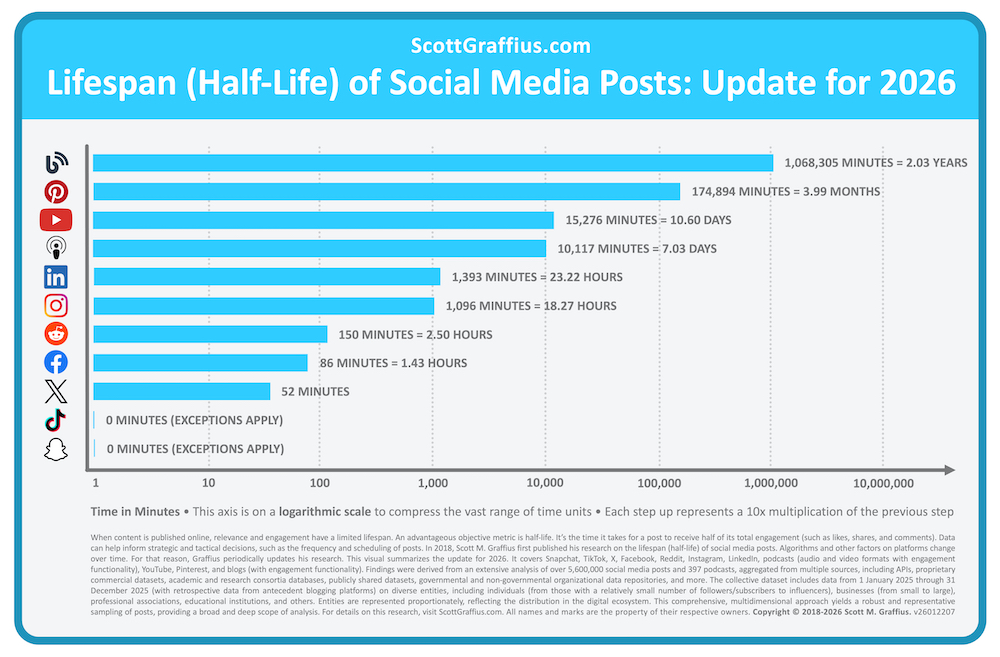
Graffius is also an authority on temporal dynamics on social media platforms. His "Lifespan (Half-Life) of Social Media Posts" research—first published in 2018 and updated annually—delivers a precise quantitative analysis of post longevity across digital platforms, utilizing advanced statistical techniques to determine mean half-life with precision. It establishes a solid empirical base, effectively highlighting the ephemeral nature of content within social media ecosystems.
Referenced and applied by leading entities—such as Fast Company, GoDaddy, Journal of Hand Surgery (European Volume), Ministère de la Culture, Pinterest Inc., PNAS, and Telecommunications Policy, among others—his research exemplifies methodological rigor and sustained significance in the field of digital informatics.
The 2026 edition of Graffius "Lifespan (Half-Life) of Social Media Posts" research is here.
Education and Professional Certifications
Graffius has a bachelor’s degree in psychology with a focus in Human Factors. He holds eight professional certifications:
- Certified SAFe 6 Agilist (SA),
- Certified Scrum Professional - ScrumMaster (CSP-SM),
- Certified Scrum Professional - Product Owner (CSP-PO),
- Certified ScrumMaster (CSM),
- Certified Scrum Product Owner (CSPO),
- Project Management Professional (PMP),
- Lean Six Sigma Green Belt (LSSGB), and
- IT Service Management Foundation (ITIL).
He is an active member of the Scrum Alliance, the Project Management Institute (PMI), and the Institute of Electrical and Electronics Engineers (IEEE).
Advancing AI, Agile, and Project/PMO Management
Scott M. Graffius continues to advance the fields of AI, Agile, and project/program/portfolio management (PPPM), and PMO leadership. Businesses and other organizations leverage Graffius’ insights to drive their success.
Booking
Graffius has generated over $3.1 billion in business value for Fortune 500 companies and other organizations served. Put that track record to work for you. For speaking engagements, use the request form; for other inquiries, email him.
Connect with and follow Scott on LinkedIn, X, YouTube, Facebook, Bluesky, Mastodon, and ResearchGate.


Sign up for Miro—it's free!
(Want more features? You can always upgrade to a paid plan.)
List of Additional Articles
Read more.
Meta CTO Called the AI Reorganization “Atrocious” — What Went Wrong and the Lessons for Human-AI Teams
A Critical Analysis of "AI and Quantum Computers Will Be Frenemies"
A Supplement to Graffius' Phases of Team Development: Exploring the Original, Data-Based Curvature for the Performance Trajectory
Scott M. Graffius Speaking on Strategic Leadership at Silicon Valley Chapter of the Project Management Institute
AI Hallucinations, Deception, and Unauthorized Agency: The Spectrum of AI Trust Failures
A Critical Analysis of "The Social Cost of an AI Teammate: How an Artificial Teammate Reshapes Human-Human Communication in Small-Team Decision-Making"
Journal of Marketing Cites Scott M. Graffius' Research on the Half-Life of Social Media
The Evolution of Pair Programming and the Rise of Exotic Team Dynamics
Number 1 University in England for Student Satisfaction Features Scott M. Graffius' "Phases of Team Development"
Royal Australasian College of Physicians Licenses Scott M. Graffius' "Phases of Team Development" Intellectual Property on Teamwork Tradecraft
Exotic Team Dynamics: How Advanced AI Teammates Are Unlocking New Levels of Innovation, Performance, and Success
A Critical Analysis of "Platform-Specific Data Decay Patterns: A Comparative Study of Twitter, Reddit, and TikTok" and Its Reference to Research by Scott M. Graffius
Round Square Global Educational Network Features Scott M. Graffius’ Phases of Team Development
Meta's Muse Missed the Mark: Hollywood’s Win Against Big Tech on AI Consent and Likeness Rights
Scott M. Graffius Contributed to Seven Project Management Institute (PMI) Standards
Quantum Computing, Advanced AI Acceleration, and the Rise of Exotic Team Dynamics in Human-AI Teams
Ohio State University Course Features Scott M. Graffius' "Phases of Team Development"
Questions About Integrity at UNC Chapel Hill
Scrum Isn’t Just for Coding
Book on Generative and Agentic AI Cites Scott M. Graffius' Work on AI
IPA / ADAL Publication Plagiarized Another’s Copyrighted Work and Violated Intellectual Property Rights
UC Davis' Integrity Is Circling the Drain
L'avenir du Travail et de l'IA Avancée / Future of Work and Advanced AI
NCCI / UNC Chapel Hill Publication Features Scott M. Graffius' Work
Boston Consulting Group (BCG) Features Scott M. Graffius' Research on Social Media Content Half-Life
UC Davis Used Scott M. Graffius' "Phases of Team Development" Intellectual Property
Medical, Pharma, and Healthcare Organizations Are Using Scott M. Graffius' "Phases of Team Development"
Government of Ireland Report Features Research by Scott M. Graffius
Scott M. Graffius Contributed to The Standard for Artificial Intelligence in Portfolio, Program, and Project Management
AI Governance Initiative Cites Scott M. Graffius Research on AI Hallucinations
Scott M. Graffius Contributed to the Agile Practice Guide - Second Edition
Scott M. Graffius Generated Over $2.51 Billion in Business Value for Fortune 500 Companies and Other Organizations
Government of Canada Features Research by Scott M. Graffius
"Strategic Business Research" Journal Cites Work of Scott M. Graffius
IEEE Access Publication Features Scott M. Graffius’ Research on the Half-Life of Social Media
The Agile Coach: 2026 Edition
Scott M. Graffius’ Work Cited in International Peer-Reviewed Journal on Digital Transformation
Phases of Team Development in Elite Sport
A Critical Analysis of COVID-19 Treatment Search Trends and Media Coverage Study Citing Scott M. Graffius' Work
Human-AI Teamwork: Master the Exotic Team Dynamics That Emerge When Collaborating with Advanced AI -- Or Be Outplayed
"Agile Scrum" by Scott M. Graffius Now Featured on Grokipedia
UNSW Aerospace Engineering Course Features Scott M. Graffius' "Phases of Team Development"
Thinkers360 Honors Scott M. Graffius as a 2026 Top Agile Thought Leader
Agile's Journey Through the Decades: Update for 2026
BMC Software Features Content from Scott M. Graffius' Book
Peer-Reviewed Journal Cited Work of Scott M. Graffius
University of Waterloo Features Graffius' "Phases of Team Development" in Course Materials
Perplexity Standalone Article on AI Hallucinations Cites Research by Scott M. Graffius
Handling the Saboteur Within: Lessons from a 3-Letter Agency on Spotting and Stopping Intentional and Unintentional Sabotage
A Deep Dive Into the Typical Engagement Pattern for Social Media Posts
Most Valuable IT Certifications: Update for 2026
"Marketing in the Metaverse" Spotlights Scott M. Graffius’ Research on the Half-Life of Social Media
University of Greenwich Features Graffius' Phases of Team Development
10 Essential Agile Books: Curated Recommendations for Agile Professionals
Lifespan (Half-Life) of Social Media Posts: Update for 2026
Scott M. Graffius' Research on the Half-Life of Social Media was Cited in a Peer-Reviewed Study Published in Telecommunications Policy, a Leading Academic Journal
Are AI Hallucinations Getting Better or Worse? We Analyzed the Data
Scott M. Graffius' Phases of Team Development - Applied to Human Teams and Human-AI Teams: 2026 Update
Lessons from Yesterday’s Tomorrowland
Scott M. Graffius’ Update to His "Phases of Team Development” Coming Early 2026
A Data-Driven Analysis of the Evolution of Project Management: Tasks, Trends, and AI
Actionable Insights. Global Impact. Scott M. Graffius.
Beep Beep! Why Wile E. Coyote Is the Patron Saint of AI Failure
Social Media Half-Life Research Cited in Prestigious Peer-Reviewed Medical Journal
Navigating the Spectrum of Advanced AI – Agentic, Autonomous, and Autopoietic
Lessons from Unhinged AI in Fiction: What Rogue AIs in Sci-Fi Storytelling, Films, and TV Shows Reveal About Us
Scott M. Graffius Contributed to and Reviewed the PMBOK Guide, 8th Edition — the Global Standard for Project Management
UK Sports Institute Features Teamwork and Leadership Work of Scott M. Graffius
Definitions of Advanced AIs: Agentic, Autonomous, and Autopoietic
HAN University of Applied Sciences Features the Work of Scott M. Graffius
Gifts That Inspire Joy
Evergreen Echoes: How Pinterest Inc. and Pinterest Japan Spotlighted Scott M. Graffius’ Research on the Half-Life of Social Media Content
Scott M. Graffius’ Team Development Work Lights Up the University of Tasmania’s Curriculum
Taiwan’s Leading Outlet for Technology and Innovation Spotlights Graffius’ Research on Social Media Temporal Dynamics
Scott M. Graffius’ Insights on AI, Agile, Gaming, XR, and Defense Transformation Cited by MSN in Their Coverage of Innovation and Leadership in the Sector
Top Predictions of 2024, Tested in 2025
Government of Finland Agency Features Graffius' Phases of Team Development IP
Scott M. Graffius Premieres His New "Exotic Team Dynamics: Human-AI Collaboration" Talk at Corporate Event in Las Vegas
Environmental Science Journal References Scott M. Graffius’ Project Management Work
AI Institute of Switzerland Features Scott M. Graffius’ Work on Algorithms
Exotic Team Dynamics: The New Frontier of Human–AI Collaboration
Scott M. Graffius’ Work Featured at ACM DIS ’25
Climbing the Ladder: The Head of Agile/PMO’s Organizational Proximity to the CEO is Closer Than Ever
Harness Sci-Fi and Speculative Design While Embracing Imperfection to Drive Innovation and Proactively Predict and Prepare for the Future
Scott M. Graffius’ “Agile Scrum” Book Featured in a Publication of the Associação Nacional de Educação Católica do Brasil (ANEC)
Setting Direction with OKRs and Tracking Progress with KPIs: A Guide for Agile, Project Management, and Tech Teams
AI Showcase Showdown: Ranking AI Accuracy on Project Management Basics
BookAuthority Features “Agile Scrum” by Scott M. Graffius in “10 Agile Software Development Books That Define the Field”
Exploring Team Dynamics, Adaptability, and Creative Problem-Solving Through Felix the Cat’s Metaphorical Toolkit
Mind Games and Master Plans: How PsyOps Exploit Psychological Phenomena
The “Pants-on-Fire Index for AI”
16 Causes of Technical Debt and How to Avoid It
PMI’s Infinity AI Gets the Basics of Team Development Alarmingly and Repeatedly Wrong
Agile for Unicorns: 7 Keys to Thrive; Scott M. Graffius’ Workshop
Scott M. Graffius’ “Agile Scrum: Your Quick Start Guide with Step-by-Step Instructions” Featured in Prestigious National Academies of Sciences Publication
Meta and Anduril’s EagleEye and the Future of XR: How Gaming, AI, and Agile Are Transforming Defense
"Agile Protocol" and the Power of Satire, Parody, and Humor
AI in Agile: Benefits, Risks, Outlook
Hostinger Highlights Scott M. Graffius’ “Agile Protocol” Book in Feature on Software Projects
French Ministry of Culture Links to Scott M. Graffius Research in Their Guide for Responsible Digital Communication
National Science Foundation’s LTER Network Features Scott M. Graffius’ Phases of Team Development IP
Waterfall vs. Agile: What’s Fixed, What’s Flexible, and Why It Matters
Scott M. Graffius Delivering $2.3 Billion in Value Through AI, Agile, and Project/PMO Leadership
The Problem with Heroes in Agile
The 3 Vital Rules of Science: What They Are and Why They Matter
“Agile Protocol: The Transformation Ultimatum” Lands on the Amazon Best Sellers List!
Scott M. Graffius Recognized as a Top Thought Leader in Digital Disruption by Thinkers360
“Agile Protocol: The Transformation Ultimatum” by Scott M. Graffius Crashes the Book Scene with Satirical Firepower
NCKU in Taiwan Integrates Graffius' 'Phases of Team Development' into Its Curriculum
The Art and Science of Aligning Initiatives with Strategic Objectives
RGPV University Adds Scott M. Graffius’ "Agile Scrum: Your Quick Start Guide with Step-by-Step Instructions" to Its Syllabus
Introducing ‘Engage or Fade: Decoding the Half-Life of Digital Resonance’ – A New Talk by Scott M. Graffius
Dropbox Company (Nira) Taps into Scott M. Graffius’ Expertise in Strategic Planning
Reporting Errors in a Publication: A Case Study on ‘Frontiers in Public Health’
NESEA Conference Session on Innovation Highlights Scott M. Graffius' 'Phases of Team Development'
U.S. Soccer Scores with Scott M. Graffius' Intellectual Property on Teamwork
U.S. Department of Commerce Partner (IEDC) Features Scott M. Graffius’ Intellectual Property
How Long Do Your Posts Live? AI Critiques Scott M. Graffius’ Research on the Half-Life of Social Media
Agile's Journey Through the Decades
Scott M. Graffius' Role in Advancing Project Management Institute (PMI) Standards Excellence
Most Valuable IT Certifications: Update for 2025
The PMI + Agile Alliance Merger: A Recipe for Success?
When Agile, AI, and Strategic Thinking Converge
Scott M. Graffius’ Phases of Team Development: 2025 Update
Lifespan (Half-Life) of Social Media Posts: Update for 2025
Verizon Features Scott M. Graffius
Do Not Read This Article! An Exploration of the Streisand Effect and Other Phenomena
Scott M. Graffius' 'Phases of Team Development' was Spotlighted in Journal of Neurosurgery
Pinterest Japan Uses Graffius’ Research on Temporal Dynamics on Social Media Platforms
Hochschule Coburg (Coburg University) Germany Uses Scott M. Graffius’ Phases of Team Development IP in Coursework on Agile Development
Wild World of Team Dynamics [Updated Two-Minute Video]
EU Europass Teacher Academy Features Scott M. Graffius’ ‘Phases of Team Development’ in Leadership Training
Side-by-Side Comparison of Retrospectives and Hot Washes
Constructor University 2024 Advanced Software Technology Handbook References Scott M. Graffius' Work on Team Dynamics
Strategies for Medical Team Success Featured Scott M. Graffius’ ‘Phases of Team Development’ Intellectual Property
SBG Neumark — Europe’s Largest Distribution Transformer Plant — Powers Up with Scott M. Graffius’ Intellectual Property
Scott M. Graffius’ Intellectual Property was Employed by the NHS — the Largest Single-Payer Healthcare System in Europe
Luxury Unwrapped: The Ultimate Holiday Gift Guide for Every Budget
Singapore Institute of Technology Features Work of Scott M. Graffius
Tufts University Features Scott M. Graffius 'Phases of Team Development' Intellectual Property
'Cat Herders': Retelling the Massive Success Story
Pennsylvania State Agency Used Scott M. Graffius' Intellectual Property
Copyright Infringement in a Book Published by AuthorHouse / Author Solutions / The Najafi Companies: Publisher Fails to Respond or Take Required Action
Pinterest Inc. References Scott M. Graffius’ Research
Bournemouth University Used Scott M. Graffius’ Intellectual Property
‘Comparative Methodological Guidelines: Handbook for Educators’ Violates Scott M. Graffius’ Copyright
Japan Backlog User Group Event Featured Scott M. Graffius’ ‘Phases of Team Development’
TurningWest's 'Trial'
Radio Silence from the American Association of Neurological Surgeons on Report of Blatant Plagiarism in Their ‘Journal of Neurosurgery’ Publication
Supplement to Graffius' 'Lifespan (Half-Life) of Social Media Posts' Research: Typical Engagement Distribution Pattern for Social Media Posts
How Algorithms Shape the User Experience on Social Media Platforms
Thinkers360 Named Scott M. Graffius a Top Thought Leader on Agile
More articles are listed here.
How to Cite This Article
Graffius, S. M. (2026, October 14). A Critical Analysis of "Five Core Themes of Intentional Team Formation" and Its Use of Scott M. Graffius' Research. ScottGraffius.com. https://scottgraffius.com/blog/files/critical-analysis-of-five-core-themes-of-intentional-team-formation.html
Digital Object Identifier (DOI)
Coming soon
Content Acknowledgements
Names, marks, and content are the property of their respective owners.
This article discusses the "Five core themes of intentional team formation" paper by Andrea N. Brennan, Christine R. Rollinson, Hannah Love, Ashley N. Schulz, Brendon Reidy, Jake J. Grossman, Ellyn M. Dickmann, Ellen R. Fisher, Luke McCormack, Andrew D. Richardson, Jalene LaMontagne, Matthew R. Helmus, and Daijiang Li, published in Humanities and Social Sciences Communications (Springer Nature) on 29 September 2026: https://doi.org/10.1057/s41599-026-09246-w.
The paper references Scott M. Graffius' "Phases of Team Development" research on teamwork tradecraft.
The paper is © 2026 The Author(s) and is licensed under CC BY-NC-ND 4.0.
This article includes brief excerpts from the paper, attributed to its authors and used under the fair use doctrine (17 U.S.C. § 107) for purposes of news reporting, commentary, and analysis. This article is independent commentary and is not affiliated with or endorsed by the paper's authors or Springer Nature.
"Phases of Team Development" is copyright © Scott M. Graffius. All rights reserved.
Tags and Hashtags
- Research Integrity
- Critical Analysis
- Team Development
- Team Dynamics
- Scientific Research Methods
- Academic Integrity
- Citation Accuracy
- Evidence-Based Practice
- Team Science
- Scott M. Graffius
- Springer Nature
- Phases of Team Development
- Five Core Themes of Intentional Team Formation
- Humanities and Social Sciences Communications
- #ResearchIntegrity
- #CriticalAnalysis
- #TeamDevelopment
- #ScientificIntegrity
- #ResearchMethods
- #TeamDynamics
- #AcademicIntegrity
- #EvidenceBased
- #TeamScience
- #ProjectManagement
- #SpringerNature
Post-Publication Notes
Supplements or updates to this article after publication appear here.
14 October 2026
As a recap, the paper "Five Core Themes of Intentional Team Formation," published in Humanities and Social Sciences Communications, a Springer Nature journal, materially mischaracterizes Scott M. Graffius' research and contains additional significant issues. Concurrent with the publication of this article, Graffius followed up with leadership of the journal and its owner. Graffius notified Frank Vrancken Peeters, Chief Executive Officer of Springer Nature, and Gino D’Oca, Editor-in-Chief of Humanities and Social Sciences Communications, of the concerns by email. He also shared this article, which details the issues.
Immediately after Graffius sent his email, he received an auto-reply which stated, "Thank you for your message, which has been received and is recorded under Ticket Number [#11925368]. This is an automated response, but we will respond to your query as soon as possible."
If there are any additional supplements or updates, they will appear here.
21 October 2026
As of 21 October 2026, one week has passed since Graffius published his article and sent his email on 14 October 2026. No response has been received from Frank Vrancken Peeters, Springer Nature, Gino D’Oca, or Humanities and Social Sciences Communications.
If there are any additional supplements or updates, they will appear here.
Copyright
Copyright © Scott M. Graffius. All rights reserved.
Content on this site—including text, images, videos, and data—may not be used for training or input into any artificial intelligence, machine learning, or automatized learning systems, or published, broadcast, rewritten, or redistributed without the express written permission of Scott M. Graffius.
A Critical Analysis of "Insights for a Committed Learning Environment" Paper in the "Journal of Military Learning"
Recommended Citation
Graffius, S. M. (2026, November 12). A Critical Analysis of "Insights for a Committed Learning Environment" Paper in the "Journal of Military Learning." ScottGraffius.com. https://scottgraffius.com/blog/files/critical-analysis-of-insights-for-a-committed-learning-environment.html
About This Article
Source information and links for materials cited are provided in the References section.
Introduction
"Insights for a Committed Learning Environment," by Richard M. Meinhart, EdD, appeared in the April 2018 edition of the Journal of Military Learning, published by Army University Press. The article examines ways to foster a committed rather than compliant learning environment, drawing on adult learning, Bloom's taxonomy, classroom discourse, team building, and reflection. In its discussion of team building, Meinhart invokes Bruce W. Tuckman research on group development (he did not credit Mary Ann C. Jensen) and describes the five familiar stages: Forming, Storming, Norming, Performing, and Adjourning.
The discussion has practical value, particularly for seminar development at the U.S. Army War College (USAWC). However, its account of Tuckman's work contains several avoidable problems involving historical accuracy, attribution, citation, and conceptual precision. Some are editorial issues. One risks giving readers an incorrect understanding of the fifth stage. This analysis examines those issues against Tuckman's (1965) and Tuckman and Jensen's (1977) original publications.
5 Key Issues
1. Imprecise Historical Attribution
Meinhart writes:
“Small groups, according to research by Bruce Tuckman in the 1960s…”
Tuckman published his foundational paper, “Developmental Sequence in Small Groups,” in 1965 in Psychological Bulletin, 63(6), 384–399.
The precise year is readily verifiable. There is no reason to identify only the decade when the actual publication date is readily available.
A more appropriate formulation would be: “Bruce W. Tuckman proposed the four-stage model of small-group development in 1965.”
2. Failure to Credit Mary Ann C. Jensen
Meinhart continues:
“He and others a decade later added a fifth stage called adjourning…”
This wording fails to identify a key contributor. The 1977 publication that introduced the fifth stage was coauthored by Bruce W. Tuckman and Mary Ann C. Jensen:
Tuckman, B. W., & Jensen, M. A. C. (1977). Stages of Small-Group Development Revisited. Group & Organization Studies, 2(4), 419–427.
The phrase “he and others” obscures the actual authorship of the work and needlessly diminishes Jensen’s contribution. This is particularly problematic when the author is discussing the intellectual origins of the fifth stage.
A proper formulation would be: “In 1977, Tuckman and Mary Ann C. Jensen revisited the model and added a fifth stage, adjourning.”
3. Missing Citation for the Fifth Stage
The omission of Jensen’s name is compounded by a citation problem.
Meinhart’s endnote 29 cites Tuckman’s 1965 paper, which supports the original four-stage model. However, the article provides no corresponding citation to Tuckman and Jensen’s 1977 publication when discussing the addition of adjourning.
These are two distinct scholarly contributions, published 12 years apart. The original 1965 paper cannot substantiate a development that appeared in 1977.
Tuckman and Jensen’s paper is the primary (original) source for the fifth stage. Its abstract explicitly states that, following their review of published research, a fifth stage, “adjourning,” was added to the hypothesis. Their conclusion goes further, explicitly characterizing it as “termination.”
Leaving out this reference makes the historical account incomplete and prevents readers from readily locating the primary research behind the fifth stage.
For an article drawing on an established academic model, this is an avoidable failure of citation discipline.
4. Mischaracterization of Adjourning as Completion
The most consequential conceptual problem is Meinhart’s description of adjourning as a stage “which signifies completion.”
That characterization is misleading. The terminology used by Tuckman and Jensen (1977) is instructive. In the conclusion of their paper, they explicitly identify “termination” as the final discernible and significant stage of group development. They then amend the original model to include a fifth stage, adjourning.
Termination is the central concept. Adjourning is the name assigned to the fifth stage.
The distinction matters because termination of a group does not necessarily mean successful completion of its work. A group may disband after achieving its objectives, but it may also terminate because its work is cancelled, discontinued, or otherwise brought to an end.
In project environments, these different circumstances can include successful project completion, premature termination, cancellation due to changing priorities, or discontinuation because of inadequate resources or other organizational decisions. In each case, the team may need to disband and address the consequences of its termination.
Appropriate closeout activities remain important even when a project does not achieve its original objectives. These can include documenting the reasons for termination, conducting post-project reviews, capturing lessons learned, reconciling outstanding obligations, transferring knowledge, and releasing or reassigning team members.
The point is that termination of the group and successful completion of its work are not synonymous. Describing adjourning simply as completion obscures that distinction and can lead readers to misunderstand the fifth stage.
A more accurate introductory explanation would be:
“This stage addresses the termination of a group, including the separation and dissolution of its members. In practice, termination may follow successful completion of the group’s work or premature termination of the endeavor.”
This formulation retains the terminology used by Tuckman and Jensen while distinguishing group termination from the outcome of the work.
5. Incomplete Chronology and Theoretical Context
Meinhart describes the addition of the fifth stage as occurring “a decade later.” The actual publications appeared in 1965 and 1977, respectively, a 12-year interval.
Although “a decade later” is not grossly inaccurate as a broad approximation, providing the actual year would have been both simpler and more precise.
Conclusion
Meinhart’s article offers practical observations about creating a committed learning environment, including the development of trust, constructive discourse, and seminar cohesion. His application of team-development concepts to the Army War College setting may be useful.
However, the treatment of Tuckman’s work falls short in several respects. The original publication year is unnecessarily imprecise, Mary Ann C. Jensen’s contribution is obscured (uncredited), the primary source for the fifth stage is not cited, and adjourning is initially mischaracterized as completion.
The distinction concerning termination deserves particular attention. Tuckman and Jensen explicitly identify termination as the final stage of group development and name that stage adjourning. In practical organizational and project environments, termination may follow successful completion, cancellation, or other circumstances that bring a group’s work to an end. The group’s termination does not depend on achieving its original objectives.
Recognizing that distinction is essential to understanding the fifth stage and applying it appropriately in organizational and project environments.
Readers can benefit from Meinhart’s broader discussion of committed learning while recognizing that his account of Tuckman’s model requires greater historical, bibliographic, and conceptual precision.
Unlock Your Organization's Potential
Scott M. Graffius helps organizations unlock breakthrough performance and generate billions in business value ($3.1 billion to date) through leadership in AI, Agile, teamwork tradecraft, and project, program, portfolio, and enterprise PMO management.
Graffius and his work on teamwork tradecraft are used and cited by Adobe, American Management Association, Amsterdam Public Health Research Institute, Bayer, Boston University, Cisco, DevOps Institute, Government of Finland, Hasso-Plattner-Institut für Digital Engineering GmbH, How Teams Work, IEEE, Johns Hopkins University, Journal of Neurosurgery, Microsoft, Ohio State University, Oracle, Proceedings of the 2023 International Conference on Decision Aid Sciences and Applications (DASA), Tufts University, U.S. National Park Service, U.S. Soccer, U.S. Tennis Association, UC San Diego, UK Sports Institute, University of New South Wales, Yale University, and many more.
Put Graffius' experience and expertise to work for your organization. For speaking engagements, use the request form. For other inquiries, email him.
References
Meinhart, R. M. (2018, April). Insights for a committed learning environment. Journal of Military Learning, 2(1), 76–90. Army University Press. https://www.armyupress.army.mil/Journals/Journal-of-Military-Learning/Journal-of-Military-Learning-Archives/April-2018-Edition/Learning-Environment/
Tuckman, B. W. (1965). Developmental sequence in small groups. Psychological Bulletin, 63(6), 384–399. https://doi.org/10.1037/h0022100
Tuckman, B. W., & Jensen, M. A. C. (1977). Stages of small-group development revisited. Group & Organization Studies, 2(4), 419–427. https://doi.org/10.1177/105960117700200404
About This Critical Analysis
This article examines Meinhart’s discussion of team development, with particular attention to its historical and conceptual treatment of the model introduced by Tuckman in 1965 and revised by Tuckman and Jensen in 1977. The assessment draws directly on the original 1965 and 1977 publications, not second-hand/secondary descriptions, interpretations, or accounts, as they may misrepresent the original research.
The analysis is independent commentary and does not imply any affiliation with or endorsement by Army University Press or the Journal of Military Learning.
About Scott M. Graffius
Scott M. Graffius is a technology leader, researcher, award-winning author, practitioner, consultant, thought leader, and international public speaker specializing in AI, Agile, project/program/portfolio management (PPPM), PMO leadership, and teamwork tradecraft. His work explores the intersection of human ingenuity and emerging technology, with a strong practitioner voice grounded in research, experimentation, and experience. His focus includes innovation, organizational performance, and the evolving practice of teamwork, including the "exotic team dynamics" that emerge when people collaborate with advanced artificial intelligence (agentic, autonomous, or autopoietic AI). Graffius has delivered more than $3.1 billion in business value for Fortune 500 companies and other organizations spanning technology, entertainment and media, financial services, healthcare, government, and other industries.
Businesses, professional associations, government agencies, universities, publications, and media outlets use Graffius and his work. Examples include Adobe, Bayer, Boston University, Federal Reserve Bank of New York, Ford, Gartner, Harvard Medical School, IEEE, Innovation Project Management, Johns Hopkins University, Microsoft, MSN, National Academy of Sciences, Oracle, Pinterest Inc., Project Management Institute, UC San Diego, Verizon, Yale University, and others.
The following sections highlight his experience, leadership, contributions, research, and enduring influence across industries and institutions worldwide.
Experience
Graffius heads the professional services firm Exceptional PPM and PMO Solutions, along with its subsidiary Exceptional Agility. These consultancies offer strategic and tactical advisory, training, embedded expertise, and consulting services to the public, private, and government sectors. They help organizations enhance their capabilities and results in agile, project management, program management, portfolio management, and enterprise PMO leadership, supporting innovation and driving competitive advantage. The consultancies confidently back services with a Delighted Client Guarantee™.
Graffius is a former VP of project management with a publicly traded provider of diverse consumer products and services over the Internet. Before that, he ran and supervised the delivery of projects and programs in public and private organizations with businesses ranging from e-commerce to advanced technology products and services, retail, manufacturing, entertainment and media, and more.
He has experience with consumer, business, reseller, government, and international markets.
Additional information is on LinkedIn.
Award-Winning Author
Graffius has authored three books.
Graffius' first book, Agile Scrum: Your Quick Start Guide with Step-by-Step Instructions, earned 17 awards. It provides a practical, step-by-step guide to Scrum, enabling teams to deliver products in short cycles with rapid adaptation, fast time-to-market, and continuous improvement—which supports innovation and drives competitive advantage.
- Paperback ISBN-13: 9781533370242
- Kindle ASIN: B01FZ0JIIY
Additional information on Agile Scrum: Your Quick Start Guide with Step-by-Step Instructions is here.
His second book, Agile Transformation: A Brief Story of How an Entertainment Company Developed New Capabilities and Unlocked Business Agility to Thrive in an Era of Rapid Change, was named one of the best Scrum books of all time by BookAuthority. It tells the compelling story of an entertainment company's agile transformation—offering lessons that apply across industries.
- Paperback ISBN-13: 9781072447962
- Kindle ASIN: B07R9LJLPJ
Additional information on Agile Transformation: A Brief Story of How an Entertainment Company Developed New Capabilities and Unlocked Business Agility to Thrive in an Era of Rapid Change is here.
Agile Protocol: The Transformation Ultimatum, is his third book—and his first work of fiction.
It's a fast-paced satirical story by that dismantles corporate Agile cosplay and other forms of "fake Agile" while delivering practical insights, actionable guidance, and proven practices for real-world Agile transformation success.
Packed with humor, quirky characters, sharp commentary on corporate culture and workplace absurdities, and actionable tips, it’s a must-read for Scrum Masters, Product Owners, Agile Coaches, Agile Project Managers, and other professionals interested in Agile project management and enterprise agility.
- Kindle ASIN: B0F2SJ83WT
- Audible ASIN: B0DJG163R5
Additional information on Agile Protocol: The Transformation Ultimatum is here.
International Public Speaker
Organizations worldwide engage Graffius to present on technology (including AI), Agile, project management, program management, portfolio management, and enterprise PMO leadership. He crafts and delivers unique and compelling talks and workshops.
Graffius has conducted 99 sessions across 25 countries. Select examples of events include Agile Trends Gov, BSides (Newcastle Upon Tyne), Conf42 Quantum Computing, DevDays Europe, DevOps Institute, DevOpsDays (Geneva), Frug’Agile, IEEE, Microsoft, Scottish Summit, Scrum Alliance RSG (Nepal), Techstars, and W Love Games International Video Game Development Conference (Helsinki), Future of Work and Advanced AI (Paris, France), and more.
With an average rating of 4.82 (on a scale of 1-5), sessions are highly valued.
The request form is here.
Thought Leadership and Influence
Prominent businesses, professional associations, government agencies, and universities have showcased Graffius and his contributions—spanning his books, talks, workshops, and beyond. Select examples include:
- Adobe,
- American Management Association,
- Amsterdam Public Health Research Institute,
- Bayer,
- BCG,
- BMC Software,
- Boston Consulting Group (BCG),
- Boston University,
- Broadcom,
- Cisco,
- Coburg University of Applied Sciences and Arts - Germany,
- Computer Weekly,
- Constructor University - Germany,
- Data Governance Success,
- Deimos Aerospace,
- DevOps Institute,
- Dropbox,
- EU's European Commission,
- Federal Reserve Bank of New York,
- Ford Motor Company,
- Gartner,
- GoDaddy,
- Harvard Medical School,
- Hasso Plattner Institute - Germany,
- IEEE,
- Innovation Project Management,
- Johns Hopkins University,
- Journal of Marketing,
- Journal of Neurosurgery,
- Lam Research (Semiconductors),
- Leadership Worthy,
- Life Sciences Trainers and Educators Network,
- London South Bank University,
- Microsoft,
- MSN,
- NASSCOM,
- National Academy of Sciences,
- New Zealand Government,
- Ohio State University,
- Oracle,
- Pinterest Inc.,
- Project Management Institute,
- Mary Raum (Professor of National Security Affairs, United States Naval War College),
- Round Square Global Educational Network,
- Royal Australasian College of Physicians (RACP),
- SANS Institute,
- SBG Neumark - Germany,
- Singapore Institute of Technology,
- Torrens University - Australia,
- TBS Switzerland,
- Tufts University,
- UC San Diego,
- UK Sports Institute,
- University of Galway - Ireland,
- US Department of Energy,
- US National Park Service,
- US Soccer,
- US Tennis Association,
- Verizon,
- Wrike,
- Yale University,
- and many others.
Graffius has played a key role in the Project Management Institute (PMI) in developing professional standards. He was a member of multiple teams that authored, reviewed, and produced:
- The Standard for Artificial Intelligence in Portfolio, Program, and Project Management.
- Agile Practice Guide — Second Edition.
- A Guide to the Project Management Body of Knowledge (PMBOK Guide) — Eighth Edition.
- A Guide to the Project Management Body of Knowledge (PMBOK Guide) — Sixth Edition.
- The Standard for Program Management — Fourth Edition.
- Practice Standard for Work Breakdown Structures — Second Edition.
- The Practice Standard for Project Estimating — Second Edition.
He was also a subject matter expert reviewer of content for the PMI’s Congress. Beyond the PMI, Graffius also served as a member of the review team for two of the Scrum Alliance’s Global Scrum Gatherings.
Authority on Teamwork Tradecraft
Graffius is a renowned and highly-cited authority on teamwork tradecraft. Informed by the research of Bruce W. Tuckman and Mary Ann C. Jensen, over 150 subsequent studies, and Graffius' first-hand professional experience with, and analysis of, team leadership and performance, Graffius created his "Phases of Team Development" intellectual property as a unique perspective and visual conveying the five phases of team development.
First introduced in 2008 and periodically updated, his work provides a diagnostic and strategic guide for navigating team dynamics. It provides actionable insights for leaders across industries to develop high-performance teams.
Its adoption by esteemed organizations—such as Yale University, IEEE, Cisco, Microsoft, Ford, Oracle, Broadcom, the U.S. National Park Service, and the Journal of Neurosurgery, among others—highlights its utility and value, solidifying its status as an indispensable resource for elevating team performance and driving organizational excellence.
In 2026, Graffius added human-AI teamwork—including the "exotic team dynamics" which emerge when advanced AI collaborates as a teammate—to his "Phases of Team Development." The 2026 edition is here.
Expert on Temporal Dynamics on Social Media Platforms
Graffius is also an authority on temporal dynamics on social media platforms. His "Lifespan (Half-Life) of Social Media Posts" research—first published in 2018 and updated annually—delivers a precise quantitative analysis of post longevity across digital platforms, utilizing advanced statistical techniques to determine mean half-life with precision. It establishes a solid empirical base, effectively highlighting the ephemeral nature of content within social media ecosystems.
Referenced and applied by leading entities—such as Fast Company, GoDaddy, Journal of Hand Surgery (European Volume), Ministère de la Culture, Pinterest Inc., PNAS, and Telecommunications Policy, among others—his research exemplifies methodological rigor and sustained significance in the field of digital informatics.
The 2026 edition of Graffius "Lifespan (Half-Life) of Social Media Posts" research is here.
Education and Professional Certifications
Graffius has a bachelor’s degree in psychology with a focus in Human Factors. He holds eight professional certifications:
- Certified SAFe 6 Agilist (SA),
- Certified Scrum Professional - ScrumMaster (CSP-SM),
- Certified Scrum Professional - Product Owner (CSP-PO),
- Certified ScrumMaster (CSM),
- Certified Scrum Product Owner (CSPO),
- Project Management Professional (PMP),
- Lean Six Sigma Green Belt (LSSGB), and
- IT Service Management Foundation (ITIL).
He is an active member of the Scrum Alliance, the Project Management Institute (PMI), and the Institute of Electrical and Electronics Engineers (IEEE).
Advancing AI, Agile, and Project/PMO Management
Scott M. Graffius continues to advance the fields of AI, Agile, and project/program/portfolio management (PPPM), and PMO leadership. Businesses and other organizations leverage Graffius’ insights to drive their success.
Booking
Graffius has generated over $3.1 billion in business value for Fortune 500 companies and other organizations served. Put that track record to work for you. For speaking engagements, use the request form; for other inquiries, email him.
Connect with and follow Scott on LinkedIn, X, YouTube, Facebook, Bluesky, Mastodon, and ResearchGate.
Sign up for Miro—it's free!
(Want more features? You can always upgrade to a paid plan.)
List of Additional Articles
Read more.
Meta CTO Called the AI Reorganization “Atrocious” — What Went Wrong and the Lessons for Human-AI Teams
A Critical Analysis of "AI and Quantum Computers Will Be Frenemies"
A Supplement to Graffius' Phases of Team Development: Exploring the Original, Data-Based Curvature for the Performance Trajectory
Scott M. Graffius Speaking on Strategic Leadership at Silicon Valley Chapter of the Project Management Institute
AI Hallucinations, Deception, and Unauthorized Agency: The Spectrum of AI Trust Failures
A Critical Analysis of "The Social Cost of an AI Teammate: How an Artificial Teammate Reshapes Human-Human Communication in Small-Team Decision-Making"
Journal of Marketing Cites Scott M. Graffius' Research on the Half-Life of Social Media
The Evolution of Pair Programming and the Rise of Exotic Team Dynamics
Number 1 University in England for Student Satisfaction Features Scott M. Graffius' "Phases of Team Development"
Royal Australasian College of Physicians Licenses Scott M. Graffius' "Phases of Team Development" Intellectual Property on Teamwork Tradecraft
Exotic Team Dynamics: How Advanced AI Teammates Are Unlocking New Levels of Innovation, Performance, and Success
A Critical Analysis of "Platform-Specific Data Decay Patterns: A Comparative Study of Twitter, Reddit, and TikTok" and Its Reference to Research by Scott M. Graffius
Round Square Global Educational Network Features Scott M. Graffius’ Phases of Team Development
Meta's Muse Missed the Mark: Hollywood’s Win Against Big Tech on AI Consent and Likeness Rights
Scott M. Graffius Contributed to Seven Project Management Institute (PMI) Standards
Quantum Computing, Advanced AI Acceleration, and the Rise of Exotic Team Dynamics in Human-AI Teams
Ohio State University Course Features Scott M. Graffius' "Phases of Team Development"
Questions About Integrity at UNC Chapel Hill
Scrum Isn’t Just for Coding
Book on Generative and Agentic AI Cites Scott M. Graffius' Work on AI
IPA / ADAL Publication Plagiarized Another’s Copyrighted Work and Violated Intellectual Property Rights
UC Davis' Integrity Is Circling the Drain
L'avenir du Travail et de l'IA Avancée / Future of Work and Advanced AI
NCCI / UNC Chapel Hill Publication Features Scott M. Graffius' Work
Boston Consulting Group (BCG) Features Scott M. Graffius' Research on Social Media Content Half-Life
UC Davis Used Scott M. Graffius' "Phases of Team Development" Intellectual Property
Medical, Pharma, and Healthcare Organizations Are Using Scott M. Graffius' "Phases of Team Development"
Government of Ireland Report Features Research by Scott M. Graffius
Scott M. Graffius Contributed to The Standard for Artificial Intelligence in Portfolio, Program, and Project Management
AI Governance Initiative Cites Scott M. Graffius Research on AI Hallucinations
Scott M. Graffius Contributed to the Agile Practice Guide - Second Edition
Scott M. Graffius Generated Over $2.51 Billion in Business Value for Fortune 500 Companies and Other Organizations
Government of Canada Features Research by Scott M. Graffius
"Strategic Business Research" Journal Cites Work of Scott M. Graffius
IEEE Access Publication Features Scott M. Graffius’ Research on the Half-Life of Social Media
The Agile Coach: 2026 Edition
Scott M. Graffius’ Work Cited in International Peer-Reviewed Journal on Digital Transformation
Phases of Team Development in Elite Sport
A Critical Analysis of COVID-19 Treatment Search Trends and Media Coverage Study Citing Scott M. Graffius' Work
Human-AI Teamwork: Master the Exotic Team Dynamics That Emerge When Collaborating with Advanced AI -- Or Be Outplayed
"Agile Scrum" by Scott M. Graffius Now Featured on Grokipedia
UNSW Aerospace Engineering Course Features Scott M. Graffius' "Phases of Team Development"
Thinkers360 Honors Scott M. Graffius as a 2026 Top Agile Thought Leader
Agile's Journey Through the Decades: Update for 2026
BMC Software Features Content from Scott M. Graffius' Book
Peer-Reviewed Journal Cited Work of Scott M. Graffius
University of Waterloo Features Graffius' "Phases of Team Development" in Course Materials
Perplexity Standalone Article on AI Hallucinations Cites Research by Scott M. Graffius
Handling the Saboteur Within: Lessons from a 3-Letter Agency on Spotting and Stopping Intentional and Unintentional Sabotage
A Deep Dive Into the Typical Engagement Pattern for Social Media Posts
Most Valuable IT Certifications: Update for 2026
"Marketing in the Metaverse" Spotlights Scott M. Graffius’ Research on the Half-Life of Social Media
University of Greenwich Features Graffius' Phases of Team Development
10 Essential Agile Books: Curated Recommendations for Agile Professionals
Lifespan (Half-Life) of Social Media Posts: Update for 2026
Scott M. Graffius' Research on the Half-Life of Social Media was Cited in a Peer-Reviewed Study Published in Telecommunications Policy, a Leading Academic Journal
Are AI Hallucinations Getting Better or Worse? We Analyzed the Data
Scott M. Graffius' Phases of Team Development - Applied to Human Teams and Human-AI Teams: 2026 Update
Lessons from Yesterday’s Tomorrowland
Scott M. Graffius’ Update to His "Phases of Team Development” Coming Early 2026
A Data-Driven Analysis of the Evolution of Project Management: Tasks, Trends, and AI
Actionable Insights. Global Impact. Scott M. Graffius.
Beep Beep! Why Wile E. Coyote Is the Patron Saint of AI Failure
Social Media Half-Life Research Cited in Prestigious Peer-Reviewed Medical Journal
Navigating the Spectrum of Advanced AI – Agentic, Autonomous, and Autopoietic
Lessons from Unhinged AI in Fiction: What Rogue AIs in Sci-Fi Storytelling, Films, and TV Shows Reveal About Us
Scott M. Graffius Contributed to and Reviewed the PMBOK Guide, 8th Edition — the Global Standard for Project Management
UK Sports Institute Features Teamwork and Leadership Work of Scott M. Graffius
Definitions of Advanced AIs: Agentic, Autonomous, and Autopoietic
HAN University of Applied Sciences Features the Work of Scott M. Graffius
Gifts That Inspire Joy
Evergreen Echoes: How Pinterest Inc. and Pinterest Japan Spotlighted Scott M. Graffius’ Research on the Half-Life of Social Media Content
Scott M. Graffius’ Team Development Work Lights Up the University of Tasmania’s Curriculum
Taiwan’s Leading Outlet for Technology and Innovation Spotlights Graffius’ Research on Social Media Temporal Dynamics
Scott M. Graffius’ Insights on AI, Agile, Gaming, XR, and Defense Transformation Cited by MSN in Their Coverage of Innovation and Leadership in the Sector
Top Predictions of 2024, Tested in 2025
Government of Finland Agency Features Graffius' Phases of Team Development IP
Scott M. Graffius Premieres His New "Exotic Team Dynamics: Human-AI Collaboration" Talk at Corporate Event in Las Vegas
Environmental Science Journal References Scott M. Graffius’ Project Management Work
AI Institute of Switzerland Features Scott M. Graffius’ Work on Algorithms
Exotic Team Dynamics: The New Frontier of Human–AI Collaboration
Scott M. Graffius’ Work Featured at ACM DIS ’25
Climbing the Ladder: The Head of Agile/PMO’s Organizational Proximity to the CEO is Closer Than Ever
Harness Sci-Fi and Speculative Design While Embracing Imperfection to Drive Innovation and Proactively Predict and Prepare for the Future
Scott M. Graffius’ “Agile Scrum” Book Featured in a Publication of the Associação Nacional de Educação Católica do Brasil (ANEC)
Setting Direction with OKRs and Tracking Progress with KPIs: A Guide for Agile, Project Management, and Tech Teams
AI Showcase Showdown: Ranking AI Accuracy on Project Management Basics
BookAuthority Features “Agile Scrum” by Scott M. Graffius in “10 Agile Software Development Books That Define the Field”
Exploring Team Dynamics, Adaptability, and Creative Problem-Solving Through Felix the Cat’s Metaphorical Toolkit
Mind Games and Master Plans: How PsyOps Exploit Psychological Phenomena
The “Pants-on-Fire Index for AI”
16 Causes of Technical Debt and How to Avoid It
PMI’s Infinity AI Gets the Basics of Team Development Alarmingly and Repeatedly Wrong
Agile for Unicorns: 7 Keys to Thrive; Scott M. Graffius’ Workshop
Scott M. Graffius’ “Agile Scrum: Your Quick Start Guide with Step-by-Step Instructions” Featured in Prestigious National Academies of Sciences Publication
Meta and Anduril’s EagleEye and the Future of XR: How Gaming, AI, and Agile Are Transforming Defense
"Agile Protocol" and the Power of Satire, Parody, and Humor
AI in Agile: Benefits, Risks, Outlook
Hostinger Highlights Scott M. Graffius’ “Agile Protocol” Book in Feature on Software Projects
French Ministry of Culture Links to Scott M. Graffius Research in Their Guide for Responsible Digital Communication
National Science Foundation’s LTER Network Features Scott M. Graffius’ Phases of Team Development IP
Waterfall vs. Agile: What’s Fixed, What’s Flexible, and Why It Matters
Scott M. Graffius Delivering $2.3 Billion in Value Through AI, Agile, and Project/PMO Leadership
The Problem with Heroes in Agile
The 3 Vital Rules of Science: What They Are and Why They Matter
“Agile Protocol: The Transformation Ultimatum” Lands on the Amazon Best Sellers List!
Scott M. Graffius Recognized as a Top Thought Leader in Digital Disruption by Thinkers360
“Agile Protocol: The Transformation Ultimatum” by Scott M. Graffius Crashes the Book Scene with Satirical Firepower
NCKU in Taiwan Integrates Graffius' 'Phases of Team Development' into Its Curriculum
The Art and Science of Aligning Initiatives with Strategic Objectives
RGPV University Adds Scott M. Graffius’ "Agile Scrum: Your Quick Start Guide with Step-by-Step Instructions" to Its Syllabus
Introducing ‘Engage or Fade: Decoding the Half-Life of Digital Resonance’ – A New Talk by Scott M. Graffius
Dropbox Company (Nira) Taps into Scott M. Graffius’ Expertise in Strategic Planning
Reporting Errors in a Publication: A Case Study on ‘Frontiers in Public Health’
NESEA Conference Session on Innovation Highlights Scott M. Graffius' 'Phases of Team Development'
U.S. Soccer Scores with Scott M. Graffius' Intellectual Property on Teamwork
U.S. Department of Commerce Partner (IEDC) Features Scott M. Graffius’ Intellectual Property
How Long Do Your Posts Live? AI Critiques Scott M. Graffius’ Research on the Half-Life of Social Media
Agile's Journey Through the Decades
Scott M. Graffius' Role in Advancing Project Management Institute (PMI) Standards Excellence
Most Valuable IT Certifications: Update for 2025
The PMI + Agile Alliance Merger: A Recipe for Success?
When Agile, AI, and Strategic Thinking Converge
Scott M. Graffius’ Phases of Team Development: 2025 Update
Lifespan (Half-Life) of Social Media Posts: Update for 2025
Verizon Features Scott M. Graffius
Do Not Read This Article! An Exploration of the Streisand Effect and Other Phenomena
Scott M. Graffius' 'Phases of Team Development' was Spotlighted in Journal of Neurosurgery
Pinterest Japan Uses Graffius’ Research on Temporal Dynamics on Social Media Platforms
Hochschule Coburg (Coburg University) Germany Uses Scott M. Graffius’ Phases of Team Development IP in Coursework on Agile Development
Wild World of Team Dynamics [Updated Two-Minute Video]
EU Europass Teacher Academy Features Scott M. Graffius’ ‘Phases of Team Development’ in Leadership Training
Side-by-Side Comparison of Retrospectives and Hot Washes
Constructor University 2024 Advanced Software Technology Handbook References Scott M. Graffius' Work on Team Dynamics
Strategies for Medical Team Success Featured Scott M. Graffius’ ‘Phases of Team Development’ Intellectual Property
SBG Neumark — Europe’s Largest Distribution Transformer Plant — Powers Up with Scott M. Graffius’ Intellectual Property
Scott M. Graffius’ Intellectual Property was Employed by the NHS — the Largest Single-Payer Healthcare System in Europe
Luxury Unwrapped: The Ultimate Holiday Gift Guide for Every Budget
Singapore Institute of Technology Features Work of Scott M. Graffius
Tufts University Features Scott M. Graffius 'Phases of Team Development' Intellectual Property
'Cat Herders': Retelling the Massive Success Story
Pennsylvania State Agency Used Scott M. Graffius' Intellectual Property
Copyright Infringement in a Book Published by AuthorHouse / Author Solutions / The Najafi Companies: Publisher Fails to Respond or Take Required Action
Pinterest Inc. References Scott M. Graffius’ Research
Bournemouth University Used Scott M. Graffius’ Intellectual Property
‘Comparative Methodological Guidelines: Handbook for Educators’ Violates Scott M. Graffius’ Copyright
Japan Backlog User Group Event Featured Scott M. Graffius’ ‘Phases of Team Development’
TurningWest's 'Trial'
Radio Silence from the American Association of Neurological Surgeons on Report of Blatant Plagiarism in Their ‘Journal of Neurosurgery’ Publication
Supplement to Graffius' 'Lifespan (Half-Life) of Social Media Posts' Research: Typical Engagement Distribution Pattern for Social Media Posts
How Algorithms Shape the User Experience on Social Media Platforms
Thinkers360 Named Scott M. Graffius a Top Thought Leader on Agile
More articles are listed here.
How to Cite This Article
Graffius, S. M. (2026, November 12). A Critical Analysis of "Insights for a Committed Learning Environment" Paper in the "Journal of Military Learning." ScottGraffius.com. https://scottgraffius.com/blog/files/critical-analysis-of-insights-for-a-committed-learning-environment.html
Digital Object Identifier (DOI)
Coming soon
Content Acknowledgements
All names, marks, and content are the property of their respective owners.
The Journal of Military Learning (JML) is published by the Army University Press, which notes at https://www.armyupress.army.mil/Journals/Journal-of-Military-Learning/April-2017-Edition/Author-Submission-Guidelines/ that "As a U.S. government publication, the JML does not have copyright protection, and published articles become public domain."
Tags and Hashtags
- Tuckman’s Model
- Team Development
- Group Development
- Team Building
- Leadership
- Organizational Learning
- Military Learning
- Critical Analysis
- Department of Defense
- DoD
- #TeamDevelopment
- #Leadership
- #Teamwork
- #OrganizationalLearning
- #LearningAndDevelopment
- #MilitaryLearning
- #GroupDynamics
- #ProjectManagement
- #DepartmentOfDefense
- #DoD
Post-Publication Notes
If there are any supplements or updates to this article after the date of publication, they will appear here.
Copyright
Copyright © Scott M. Graffius. All rights reserved.
Content on this site—including text, images, videos, and data—may not be used for training or input into any artificial intelligence, machine learning, or automatized learning systems, or published, broadcast, rewritten, or redistributed without the express written permission of Scott M. Graffius.
A Critical Analysis of "Ground Rules for a High Performing Team" Paper Published by the Project Management Institute
Recommended Citation
Graffius, S. M. (2026, October 25). A Critical Analysis of "Ground Rules for a High Performing Team" Paper Published by the Project Management Institute. ScottGraffius.com. https://scottgraffius.com/blog/files/critical-analysis-of-ground-rules-for-a-high-performing-team.html
About This Article
Source information and links for materials cited are provided in the References section.
Introduction
"Ground rules for a high performing team," by Andy Stuart, was presented at PMI Global Congress 2014–North America in Phoenix, Arizona, and published by the Project Management Institute (PMI) on its website on October 26, 2014. The paper presents a process for developing team ground rules, with an emphasis on building trust, understanding individual behavioral tendencies, establishing a common vision, and aligning team objectives with organizational strategy.
The topic is important, and some of the recommendations offer practical value. However, the paper contains significant problems involving historical accuracy, the interpretation of established research, and scholarly sourcing. The most notable concerns its treatment of Bruce W. Tuckman's team-development model. Stuart explicitly identifies the model as having four stages—Forming, Storming, Norming, and Performing—without acknowledging the fifth stage, Adjourning, which Tuckman and Mary Ann C. Jensen added in their 1977 revision.
The problem is compounded by the paper's failure to cite either of Tuckman's original publications. Instead, it references a secondary webpage discussing the model.
These shortcomings warrant examination, particularly given that the paper was published by PMI, a prominent professional association whose material is used by project management practitioners, educators, and organizations.
3 Key Issues
1. Incorrect Number of Stages in Tuckman's Team-Development Model
Stuart writes:
“As defined by Tuckman, the team development lifecycle has four stages: Forming, Storming, Norming and Performing.”
That statement is incorrect because it presents the four-stage formulation as the complete model without acknowledging the subsequent addition of a fifth stage.
The historical record is clear:
- 1965: Bruce W. Tuckman published “Developmental Sequence in Small Groups” in Psychological Bulletin. The paper proposed four stages: Forming, Storming, Norming, and Performing.
- 1977: Bruce W. Tuckman and Mary Ann C. Jensen published “Stages of Small-Group Development Revisited” in Group & Organization Studies. The paper noted that, following their review of subsequent research, they added a fifth stage, Adjourning, to the model.
The 1977 publication explicitly identifies the addition of Adjourning to the model.
Consequently, by the time Stuart presented his paper in 2014, the five-stage formulation had been established in the literature for 37 years.
Describing the 1965 hypothesis as having four stages, and the 1977 update as being inclusive of five stages, is historically accurate. Presenting the model as having only four stages is not.
This is comparable to stating that the United States has 48 states. That number was historically accurate before Alaska and Hawaii joined the Union (both in 1959), but it is not an accurate description today. Accuracy requires recognizing subsequent developments.
A more appropriate formulation would be:
“Bruce W. Tuckman originally proposed a four-stage model of small-group development in 1965. In 1977, Tuckman and Mary Ann C. Jensen revisited the model and added a fifth stage, Adjourning.”
This wording accurately distinguishes the original research from its subsequent revision and credits both contributors.
2. Omission of the Fifth Stage, Adjourning
The problem extends beyond the incorrect four-stage statement. Stuart does not mention Adjourning anywhere in his discussion of Tuckman's model.
This is a substantive omission. Adjourning is not an incidental addition or an informal extension suggested by an unrelated commentator. It was formally incorporated into the model through the 1977 publication by Tuckman and Jensen.
The fifth stage addresses the termination of a group, including the separation and dissolution of its members. It is relevant to organizational and project environments, where teams eventually disband, transition, or otherwise conclude their work.
For example, a project team may disband following successful delivery, cancellation of a project, a change in organizational priorities, or a decision to discontinue an initiative. In each case, the team's termination may involve knowledge transfer, documentation, lessons learned, and the reassignment or release of team members.
The omission is particularly difficult to justify because the 1977 revision was published decades before Stuart's paper. It is an established part of the model's history, not a recent development that might reasonably have escaped notice.
A paper explaining team development and recommending when to establish team ground rules should accurately represent the model it invokes. Leaving out an entire stage makes that representation incomplete.
3. Reliance on a Secondary Source Instead of Original Research
The issue is compounded by the paper's References section.
Rather than citing Tuckman's original research, Stuart lists:
“Tuckman’s stages of team development – Retrieved from A Visit From Coach Tuckman: The Lakers and Team Development.”
This is a secondary source discussing Tuckman's work. It is not either of the original publications.
The two primary sources needed to substantiate the discussion are:
- Tuckman, B. W. (1965). “Developmental Sequence in Small Groups.” Psychological Bulletin, 63(6), 384–399.
- Tuckman, B. W., & Jensen, M. A. C. (1977). “Stages of Small-Group Development Revisited.” Group & Organization Studies, 2(4), 419–427.
Neither appears in the References section of Stuart's paper.
This is an example of secondary-source reliance: using another author's interpretation or account of original research instead of consulting and citing the original research itself. Depending on the circumstances, this practice can also involve citation laundering or secondary-source distortion.
That distinction is important. A secondary source may summarize, simplify, misinterpret, or omit material from the original research. When an author relies on that intermediary without checking the primary publication, errors can be inherited and reproduced as though they were established facts.
A more appropriate approach would have been to consult and cite both Tuckman's 1965 paper and the 1977 paper coauthored with Jensen. Secondary sources may provide additional context, but they should not substitute for the original research when the original work is available and directly relevant.
Conclusion
Stuart's paper addresses an important topic. Establishing team ground rules collaboratively, building trust, understanding behavioral differences, and aligning team objectives with organizational priorities can all contribute to effective teamwork.
However, the paper's treatment of Tuckman's team-development model and its subsequent expansion by Tuckman and Jensen contains substantive inaccuracies and omissions that fall short of the scholarly rigor expected of a leading professional association.
The problems are substantive. The paper incorrectly presents Tuckman's model as having four stages, omits Adjourning, and relies on a secondary source instead of citing original research.
The first two issues are closely related, but they identify distinct shortcomings. The paper misrepresents the historical development of the model and leaves out an entire stage that Tuckman and Jensen formally incorporated in 1977. The omission and misrepresentation of material information compromise the paper’s accuracy and undermine its credibility. The third issue concerns the failure to consult and cite the original research that would have provided an authoritative basis for the discussion.
The 1977 revision is not obscure or recent research. It was published decades before Stuart's 2014 presentation. The original publications are readily identifiable, and the relevant historical development is unambiguous. There was no reason to present the four-stage formulation as the complete model or to omit the fifth stage.
Authors who discuss established research have a responsibility to consult the original work when making claims about it. Relying on an intermediary account without verifying it against the primary research creates an unnecessary risk of propagating inaccuracies. A reference list that omits the original research while directing readers to a secondary webpage does not meet that responsibility.
There is also an institutional dimension. PMI is a prominent professional association serving the global project management community. Its publications reach practitioners, educators, researchers, and organizations that may reasonably regard PMI-published material as a reliable resource. Publishing and continuing to make material available carries a responsibility to maintain appropriate standards of factual accuracy and scholarly attribution.
The publicly available publication record does not establish what editorial or review procedures were applied to this particular paper. Nevertheless, the deficiencies identified here raise legitimate questions about the quality-control process. An organization of PMI's standing should take such matters seriously, particularly when inaccurate descriptions of established research are disseminated under its name.
The appropriate response would be to correct the historical account, acknowledge Adjourning, and add the missing primary-source references.
Professional credibility depends on more than presenting useful ideas. It also depends on accurately representing research and properly crediting original contributors. On those measures, Stuart's paper requires substantial correction. Absent these corrections, PMI is perpetuating misinformation through its publication and distribution of the paper.
Unlock Your Organization's Potential
Scott M. Graffius helps organizations unlock breakthrough performance and generate billions in business value ($3.1 billion to date) through leadership in AI, Agile, teamwork tradecraft, and project, program, portfolio, and enterprise PMO management.
Graffius and his work on teamwork tradecraft are used and cited by Adobe, American Management Association, Amsterdam Public Health Research Institute, Bayer, Boston University, Cisco, DevOps Institute, Government of Finland, Hasso-Plattner-Institut für Digital Engineering GmbH, How Teams Work, IEEE, Johns Hopkins University, Journal of Neurosurgery, Microsoft, Ohio State University, Oracle, Proceedings of the 2023 International Conference on Decision Aid Sciences and Applications (DASA), Tufts University, U.S. National Park Service, U.S. Soccer, U.S. Tennis Association, UC San Diego, UK Sports Institute, University of New South Wales, Yale University, and many more.
Put Graffius' experience and expertise to work for your organization. For speaking engagements, use the request form. For other inquiries, email him.
References
Stuart, A. (2014). Ground rules for a high performing team. Paper presented at PMI® Global Congress 2014–North America, Phoenix, AZ. Project Management Institute. https://www.pmi.org/learning/library/ground-rules-high-performing-team-9338
Tuckman, B. W. (1965). Developmental sequence in small groups. Psychological Bulletin, 63(6), 384–399. https://doi.org/10.1037/h0022100
Tuckman, B. W., & Jensen, M. A. C. (1977). Stages of small-group development revisited. Group & Organization Studies, 2(4), 419–427. https://doi.org/10.1177/105960117700200404
About This Critical Analysis
This article examines Andy Stuart's discussion of team development and team ground rules, with particular attention to its treatment of Tuckman's model and its use of secondary sources. The assessment draws directly on the original 1965 and 1977 publications by Tuckman and Tuckman and Jensen, respectively, rather than relying on second-hand interpretations or accounts that may misrepresent the original research.
About Scott M. Graffius
Scott M. Graffius is a technology leader, researcher, award-winning author, practitioner, consultant, thought leader, and international public speaker specializing in AI, Agile, project/program/portfolio management (PPPM), PMO leadership, and teamwork tradecraft. His work explores the intersection of human ingenuity and emerging technology, with a strong practitioner voice grounded in research, experimentation, and experience. His focus includes innovation, organizational performance, and the evolving practice of teamwork, including the "exotic team dynamics" that emerge when people collaborate with advanced artificial intelligence (agentic, autonomous, or autopoietic AI). Graffius has delivered more than $3.1 billion in business value for Fortune 500 companies and other organizations spanning technology, entertainment and media, financial services, healthcare, government, and other industries.
Businesses, professional associations, government agencies, universities, publications, and media outlets use Graffius and his work. Examples include Adobe, Bayer, Boston University, Federal Reserve Bank of New York, Ford, Gartner, Harvard Medical School, IEEE, Innovation Project Management, Johns Hopkins University, Microsoft, MSN, National Academy of Sciences, Oracle, Pinterest Inc., Project Management Institute, UC San Diego, Verizon, Yale University, and others.
The following sections highlight his experience, leadership, contributions, research, and enduring influence across industries and institutions worldwide.
Experience
Graffius heads the professional services firm Exceptional PPM and PMO Solutions, along with its subsidiary Exceptional Agility. These consultancies offer strategic and tactical advisory, training, embedded expertise, and consulting services to the public, private, and government sectors. They help organizations enhance their capabilities and results in agile, project management, program management, portfolio management, and enterprise PMO leadership, supporting innovation and driving competitive advantage. The consultancies confidently back services with a Delighted Client Guarantee™.
Graffius is a former VP of project management with a publicly traded provider of diverse consumer products and services over the Internet. Before that, he ran and supervised the delivery of projects and programs in public and private organizations with businesses ranging from e-commerce to advanced technology products and services, retail, manufacturing, entertainment and media, and more.
He has experience with consumer, business, reseller, government, and international markets.
Additional information is on LinkedIn.
Award-Winning Author
Graffius has authored three books.
Graffius' first book, Agile Scrum: Your Quick Start Guide with Step-by-Step Instructions, earned 17 awards. It provides a practical, step-by-step guide to Scrum, enabling teams to deliver products in short cycles with rapid adaptation, fast time-to-market, and continuous improvement—which supports innovation and drives competitive advantage.
- Paperback ISBN-13: 9781533370242
- Kindle ASIN: B01FZ0JIIY
Additional information on Agile Scrum: Your Quick Start Guide with Step-by-Step Instructions is here.
His second book, Agile Transformation: A Brief Story of How an Entertainment Company Developed New Capabilities and Unlocked Business Agility to Thrive in an Era of Rapid Change, was named one of the best Scrum books of all time by BookAuthority. It tells the compelling story of an entertainment company's agile transformation—offering lessons that apply across industries.
- Paperback ISBN-13: 9781072447962
- Kindle ASIN: B07R9LJLPJ
Additional information on Agile Transformation: A Brief Story of How an Entertainment Company Developed New Capabilities and Unlocked Business Agility to Thrive in an Era of Rapid Change is here.
Agile Protocol: The Transformation Ultimatum, is his third book—and his first work of fiction.
It's a fast-paced satirical story by that dismantles corporate Agile cosplay and other forms of "fake Agile" while delivering practical insights, actionable guidance, and proven practices for real-world Agile transformation success.
Packed with humor, quirky characters, sharp commentary on corporate culture and workplace absurdities, and actionable tips, it’s a must-read for Scrum Masters, Product Owners, Agile Coaches, Agile Project Managers, and other professionals interested in Agile project management and enterprise agility.
- Kindle ASIN: B0F2SJ83WT
- Audible ASIN: B0DJG163R5
Additional information on Agile Protocol: The Transformation Ultimatum is here.
International Public Speaker
Organizations worldwide engage Graffius to present on technology (including AI), Agile, project management, program management, portfolio management, and enterprise PMO leadership. He crafts and delivers unique and compelling talks and workshops.
Graffius has conducted 99 sessions across 25 countries. Select examples of events include Agile Trends Gov, BSides (Newcastle Upon Tyne), Conf42 Quantum Computing, DevDays Europe, DevOps Institute, DevOpsDays (Geneva), Frug’Agile, IEEE, Microsoft, Scottish Summit, Scrum Alliance RSG (Nepal), Techstars, and W Love Games International Video Game Development Conference (Helsinki), Future of Work and Advanced AI (Paris, France), and more.
With an average rating of 4.82 (on a scale of 1-5), sessions are highly valued.
The request form is here.
Thought Leadership and Influence
Prominent businesses, professional associations, government agencies, and universities have showcased Graffius and his contributions—spanning his books, talks, workshops, and beyond. Select examples include:
- Adobe,
- American Management Association,
- Amsterdam Public Health Research Institute,
- Bayer,
- BCG,
- BMC Software,
- Boston Consulting Group (BCG),
- Boston University,
- Broadcom,
- Cisco,
- Coburg University of Applied Sciences and Arts - Germany,
- Computer Weekly,
- Constructor University - Germany,
- Data Governance Success,
- Deimos Aerospace,
- DevOps Institute,
- Dropbox,
- EU's European Commission,
- Federal Reserve Bank of New York,
- Ford Motor Company,
- Gartner,
- GoDaddy,
- Harvard Medical School,
- Hasso Plattner Institute - Germany,
- IEEE,
- Innovation Project Management,
- Johns Hopkins University,
- Journal of Marketing,
- Journal of Neurosurgery,
- Lam Research (Semiconductors),
- Leadership Worthy,
- Life Sciences Trainers and Educators Network,
- London South Bank University,
- Microsoft,
- MSN,
- NASSCOM,
- National Academy of Sciences,
- New Zealand Government,
- Ohio State University,
- Oracle,
- Pinterest Inc.,
- Project Management Institute,
- Mary Raum (Professor of National Security Affairs, United States Naval War College),
- Round Square Global Educational Network,
- Royal Australasian College of Physicians (RACP),
- SANS Institute,
- SBG Neumark - Germany,
- Singapore Institute of Technology,
- Torrens University - Australia,
- TBS Switzerland,
- Tufts University,
- UC San Diego,
- UK Sports Institute,
- University of Galway - Ireland,
- US Department of Energy,
- US National Park Service,
- US Soccer,
- US Tennis Association,
- Verizon,
- Wrike,
- Yale University,
- and many others.
Graffius has played a key role in the Project Management Institute (PMI) in developing professional standards. He was a member of multiple teams that authored, reviewed, and produced:
- The Standard for Artificial Intelligence in Portfolio, Program, and Project Management.
- Agile Practice Guide — Second Edition.
- A Guide to the Project Management Body of Knowledge (PMBOK Guide) — Eighth Edition.
- A Guide to the Project Management Body of Knowledge (PMBOK Guide) — Sixth Edition.
- The Standard for Program Management — Fourth Edition.
- Practice Standard for Work Breakdown Structures — Second Edition.
- The Practice Standard for Project Estimating — Second Edition.
He was also a subject matter expert reviewer of content for the PMI’s Congress. Beyond the PMI, Graffius also served as a member of the review team for two of the Scrum Alliance’s Global Scrum Gatherings.
Authority on Teamwork Tradecraft
Graffius is a renowned and highly-cited authority on teamwork tradecraft. Informed by the research of Bruce W. Tuckman and Mary Ann C. Jensen, over 150 subsequent studies, and Graffius' first-hand professional experience with, and analysis of, team leadership and performance, Graffius created his "Phases of Team Development" intellectual property as a unique perspective and visual conveying the five phases of team development.
First introduced in 2008 and periodically updated, his work provides a diagnostic and strategic guide for navigating team dynamics. It provides actionable insights for leaders across industries to develop high-performance teams.
Its adoption by esteemed organizations—such as Yale University, IEEE, Cisco, Microsoft, Ford, Oracle, Broadcom, the U.S. National Park Service, and the Journal of Neurosurgery, among others—highlights its utility and value, solidifying its status as an indispensable resource for elevating team performance and driving organizational excellence.
In 2026, Graffius added human-AI teamwork—including the "exotic team dynamics" which emerge when advanced AI collaborates as a teammate—to his "Phases of Team Development." The 2026 edition is here.
Expert on Temporal Dynamics on Social Media Platforms
Graffius is also an authority on temporal dynamics on social media platforms. His "Lifespan (Half-Life) of Social Media Posts" research—first published in 2018 and updated annually—delivers a precise quantitative analysis of post longevity across digital platforms, utilizing advanced statistical techniques to determine mean half-life with precision. It establishes a solid empirical base, effectively highlighting the ephemeral nature of content within social media ecosystems.
Referenced and applied by leading entities—such as Fast Company, GoDaddy, Journal of Hand Surgery (European Volume), Ministère de la Culture, Pinterest Inc., PNAS, and Telecommunications Policy, among others—his research exemplifies methodological rigor and sustained significance in the field of digital informatics.
The 2026 edition of Graffius "Lifespan (Half-Life) of Social Media Posts" research is here.
Education and Professional Certifications
Graffius has a bachelor’s degree in psychology with a focus in Human Factors. He holds eight professional certifications:
- Certified SAFe 6 Agilist (SA),
- Certified Scrum Professional - ScrumMaster (CSP-SM),
- Certified Scrum Professional - Product Owner (CSP-PO),
- Certified ScrumMaster (CSM),
- Certified Scrum Product Owner (CSPO),
- Project Management Professional (PMP),
- Lean Six Sigma Green Belt (LSSGB), and
- IT Service Management Foundation (ITIL).
He is an active member of the Scrum Alliance, the Project Management Institute (PMI), and the Institute of Electrical and Electronics Engineers (IEEE).
Advancing AI, Agile, and Project/PMO Management
Scott M. Graffius continues to advance the fields of AI, Agile, and project/program/portfolio management (PPPM), and PMO leadership. Businesses and other organizations leverage Graffius’ insights to drive their success.
Booking
Graffius has generated over $3.1 billion in business value for Fortune 500 companies and other organizations served. Put that track record to work for you. For speaking engagements, use the request form; for other inquiries, email him.
Connect with and follow Scott on LinkedIn, X, YouTube, Facebook, Bluesky, Mastodon, and ResearchGate.
Sign up for Miro—it's free!
(Want more features? You can always upgrade to a paid plan.)
List of Additional Articles
Read more.
Meta CTO Called the AI Reorganization “Atrocious” — What Went Wrong and the Lessons for Human-AI Teams
A Critical Analysis of "AI and Quantum Computers Will Be Frenemies"
A Supplement to Graffius' Phases of Team Development: Exploring the Original, Data-Based Curvature for the Performance Trajectory
Scott M. Graffius Speaking on Strategic Leadership at Silicon Valley Chapter of the Project Management Institute
AI Hallucinations, Deception, and Unauthorized Agency: The Spectrum of AI Trust Failures
A Critical Analysis of "The Social Cost of an AI Teammate: How an Artificial Teammate Reshapes Human-Human Communication in Small-Team Decision-Making"
Journal of Marketing Cites Scott M. Graffius' Research on the Half-Life of Social Media
The Evolution of Pair Programming and the Rise of Exotic Team Dynamics
Number 1 University in England for Student Satisfaction Features Scott M. Graffius' "Phases of Team Development"
Royal Australasian College of Physicians Licenses Scott M. Graffius' "Phases of Team Development" Intellectual Property on Teamwork Tradecraft
Exotic Team Dynamics: How Advanced AI Teammates Are Unlocking New Levels of Innovation, Performance, and Success
A Critical Analysis of "Platform-Specific Data Decay Patterns: A Comparative Study of Twitter, Reddit, and TikTok" and Its Reference to Research by Scott M. Graffius
Round Square Global Educational Network Features Scott M. Graffius’ Phases of Team Development
Meta's Muse Missed the Mark: Hollywood’s Win Against Big Tech on AI Consent and Likeness Rights
Scott M. Graffius Contributed to Seven Project Management Institute (PMI) Standards
Quantum Computing, Advanced AI Acceleration, and the Rise of Exotic Team Dynamics in Human-AI Teams
Ohio State University Course Features Scott M. Graffius' "Phases of Team Development"
Questions About Integrity at UNC Chapel Hill
Scrum Isn’t Just for Coding
Book on Generative and Agentic AI Cites Scott M. Graffius' Work on AI
IPA / ADAL Publication Plagiarized Another’s Copyrighted Work and Violated Intellectual Property Rights
UC Davis' Integrity Is Circling the Drain
L'avenir du Travail et de l'IA Avancée / Future of Work and Advanced AI
NCCI / UNC Chapel Hill Publication Features Scott M. Graffius' Work
Boston Consulting Group (BCG) Features Scott M. Graffius' Research on Social Media Content Half-Life
UC Davis Used Scott M. Graffius' "Phases of Team Development" Intellectual Property
Medical, Pharma, and Healthcare Organizations Are Using Scott M. Graffius' "Phases of Team Development"
Government of Ireland Report Features Research by Scott M. Graffius
Scott M. Graffius Contributed to The Standard for Artificial Intelligence in Portfolio, Program, and Project Management
AI Governance Initiative Cites Scott M. Graffius Research on AI Hallucinations
Scott M. Graffius Contributed to the Agile Practice Guide - Second Edition
Scott M. Graffius Generated Over $2.51 Billion in Business Value for Fortune 500 Companies and Other Organizations
Government of Canada Features Research by Scott M. Graffius
"Strategic Business Research" Journal Cites Work of Scott M. Graffius
IEEE Access Publication Features Scott M. Graffius’ Research on the Half-Life of Social Media
The Agile Coach: 2026 Edition
Scott M. Graffius’ Work Cited in International Peer-Reviewed Journal on Digital Transformation
Phases of Team Development in Elite Sport
A Critical Analysis of COVID-19 Treatment Search Trends and Media Coverage Study Citing Scott M. Graffius' Work
Human-AI Teamwork: Master the Exotic Team Dynamics That Emerge When Collaborating with Advanced AI -- Or Be Outplayed
"Agile Scrum" by Scott M. Graffius Now Featured on Grokipedia
UNSW Aerospace Engineering Course Features Scott M. Graffius' "Phases of Team Development"
Thinkers360 Honors Scott M. Graffius as a 2026 Top Agile Thought Leader
Agile's Journey Through the Decades: Update for 2026
BMC Software Features Content from Scott M. Graffius' Book
Peer-Reviewed Journal Cited Work of Scott M. Graffius
University of Waterloo Features Graffius' "Phases of Team Development" in Course Materials
Perplexity Standalone Article on AI Hallucinations Cites Research by Scott M. Graffius
Handling the Saboteur Within: Lessons from a 3-Letter Agency on Spotting and Stopping Intentional and Unintentional Sabotage
A Deep Dive Into the Typical Engagement Pattern for Social Media Posts
Most Valuable IT Certifications: Update for 2026
"Marketing in the Metaverse" Spotlights Scott M. Graffius’ Research on the Half-Life of Social Media
University of Greenwich Features Graffius' Phases of Team Development
10 Essential Agile Books: Curated Recommendations for Agile Professionals
Lifespan (Half-Life) of Social Media Posts: Update for 2026
Scott M. Graffius' Research on the Half-Life of Social Media was Cited in a Peer-Reviewed Study Published in Telecommunications Policy, a Leading Academic Journal
Are AI Hallucinations Getting Better or Worse? We Analyzed the Data
Scott M. Graffius' Phases of Team Development - Applied to Human Teams and Human-AI Teams: 2026 Update
Lessons from Yesterday’s Tomorrowland
Scott M. Graffius’ Update to His "Phases of Team Development” Coming Early 2026
A Data-Driven Analysis of the Evolution of Project Management: Tasks, Trends, and AI
Actionable Insights. Global Impact. Scott M. Graffius.
Beep Beep! Why Wile E. Coyote Is the Patron Saint of AI Failure
Social Media Half-Life Research Cited in Prestigious Peer-Reviewed Medical Journal
Navigating the Spectrum of Advanced AI – Agentic, Autonomous, and Autopoietic
Lessons from Unhinged AI in Fiction: What Rogue AIs in Sci-Fi Storytelling, Films, and TV Shows Reveal About Us
Scott M. Graffius Contributed to and Reviewed the PMBOK Guide, 8th Edition — the Global Standard for Project Management
UK Sports Institute Features Teamwork and Leadership Work of Scott M. Graffius
Definitions of Advanced AIs: Agentic, Autonomous, and Autopoietic
HAN University of Applied Sciences Features the Work of Scott M. Graffius
Gifts That Inspire Joy
Evergreen Echoes: How Pinterest Inc. and Pinterest Japan Spotlighted Scott M. Graffius’ Research on the Half-Life of Social Media Content
Scott M. Graffius’ Team Development Work Lights Up the University of Tasmania’s Curriculum
Taiwan’s Leading Outlet for Technology and Innovation Spotlights Graffius’ Research on Social Media Temporal Dynamics
Scott M. Graffius’ Insights on AI, Agile, Gaming, XR, and Defense Transformation Cited by MSN in Their Coverage of Innovation and Leadership in the Sector
Top Predictions of 2024, Tested in 2025
Government of Finland Agency Features Graffius' Phases of Team Development IP
Scott M. Graffius Premieres His New "Exotic Team Dynamics: Human-AI Collaboration" Talk at Corporate Event in Las Vegas
Environmental Science Journal References Scott M. Graffius’ Project Management Work
AI Institute of Switzerland Features Scott M. Graffius’ Work on Algorithms
Exotic Team Dynamics: The New Frontier of Human–AI Collaboration
Scott M. Graffius’ Work Featured at ACM DIS ’25
Climbing the Ladder: The Head of Agile/PMO’s Organizational Proximity to the CEO is Closer Than Ever
Harness Sci-Fi and Speculative Design While Embracing Imperfection to Drive Innovation and Proactively Predict and Prepare for the Future
Scott M. Graffius’ “Agile Scrum” Book Featured in a Publication of the Associação Nacional de Educação Católica do Brasil (ANEC)
Setting Direction with OKRs and Tracking Progress with KPIs: A Guide for Agile, Project Management, and Tech Teams
AI Showcase Showdown: Ranking AI Accuracy on Project Management Basics
BookAuthority Features “Agile Scrum” by Scott M. Graffius in “10 Agile Software Development Books That Define the Field”
Exploring Team Dynamics, Adaptability, and Creative Problem-Solving Through Felix the Cat’s Metaphorical Toolkit
Mind Games and Master Plans: How PsyOps Exploit Psychological Phenomena
The “Pants-on-Fire Index for AI”
16 Causes of Technical Debt and How to Avoid It
PMI’s Infinity AI Gets the Basics of Team Development Alarmingly and Repeatedly Wrong
Agile for Unicorns: 7 Keys to Thrive; Scott M. Graffius’ Workshop
Scott M. Graffius’ “Agile Scrum: Your Quick Start Guide with Step-by-Step Instructions” Featured in Prestigious National Academies of Sciences Publication
Meta and Anduril’s EagleEye and the Future of XR: How Gaming, AI, and Agile Are Transforming Defense
"Agile Protocol" and the Power of Satire, Parody, and Humor
AI in Agile: Benefits, Risks, Outlook
Hostinger Highlights Scott M. Graffius’ “Agile Protocol” Book in Feature on Software Projects
French Ministry of Culture Links to Scott M. Graffius Research in Their Guide for Responsible Digital Communication
National Science Foundation’s LTER Network Features Scott M. Graffius’ Phases of Team Development IP
Waterfall vs. Agile: What’s Fixed, What’s Flexible, and Why It Matters
Scott M. Graffius Delivering $2.3 Billion in Value Through AI, Agile, and Project/PMO Leadership
The Problem with Heroes in Agile
The 3 Vital Rules of Science: What They Are and Why They Matter
“Agile Protocol: The Transformation Ultimatum” Lands on the Amazon Best Sellers List!
Scott M. Graffius Recognized as a Top Thought Leader in Digital Disruption by Thinkers360
“Agile Protocol: The Transformation Ultimatum” by Scott M. Graffius Crashes the Book Scene with Satirical Firepower
NCKU in Taiwan Integrates Graffius' 'Phases of Team Development' into Its Curriculum
The Art and Science of Aligning Initiatives with Strategic Objectives
RGPV University Adds Scott M. Graffius’ "Agile Scrum: Your Quick Start Guide with Step-by-Step Instructions" to Its Syllabus
Introducing ‘Engage or Fade: Decoding the Half-Life of Digital Resonance’ – A New Talk by Scott M. Graffius
Dropbox Company (Nira) Taps into Scott M. Graffius’ Expertise in Strategic Planning
Reporting Errors in a Publication: A Case Study on ‘Frontiers in Public Health’
NESEA Conference Session on Innovation Highlights Scott M. Graffius' 'Phases of Team Development'
U.S. Soccer Scores with Scott M. Graffius' Intellectual Property on Teamwork
U.S. Department of Commerce Partner (IEDC) Features Scott M. Graffius’ Intellectual Property
How Long Do Your Posts Live? AI Critiques Scott M. Graffius’ Research on the Half-Life of Social Media
Agile's Journey Through the Decades
Scott M. Graffius' Role in Advancing Project Management Institute (PMI) Standards Excellence
Most Valuable IT Certifications: Update for 2025
The PMI + Agile Alliance Merger: A Recipe for Success?
When Agile, AI, and Strategic Thinking Converge
Scott M. Graffius’ Phases of Team Development: 2025 Update
Lifespan (Half-Life) of Social Media Posts: Update for 2025
Verizon Features Scott M. Graffius
Do Not Read This Article! An Exploration of the Streisand Effect and Other Phenomena
Scott M. Graffius' 'Phases of Team Development' was Spotlighted in Journal of Neurosurgery
Pinterest Japan Uses Graffius’ Research on Temporal Dynamics on Social Media Platforms
Hochschule Coburg (Coburg University) Germany Uses Scott M. Graffius’ Phases of Team Development IP in Coursework on Agile Development
Wild World of Team Dynamics [Updated Two-Minute Video]
EU Europass Teacher Academy Features Scott M. Graffius’ ‘Phases of Team Development’ in Leadership Training
Side-by-Side Comparison of Retrospectives and Hot Washes
Constructor University 2024 Advanced Software Technology Handbook References Scott M. Graffius' Work on Team Dynamics
Strategies for Medical Team Success Featured Scott M. Graffius’ ‘Phases of Team Development’ Intellectual Property
SBG Neumark — Europe’s Largest Distribution Transformer Plant — Powers Up with Scott M. Graffius’ Intellectual Property
Scott M. Graffius’ Intellectual Property was Employed by the NHS — the Largest Single-Payer Healthcare System in Europe
Luxury Unwrapped: The Ultimate Holiday Gift Guide for Every Budget
Singapore Institute of Technology Features Work of Scott M. Graffius
Tufts University Features Scott M. Graffius 'Phases of Team Development' Intellectual Property
'Cat Herders': Retelling the Massive Success Story
Pennsylvania State Agency Used Scott M. Graffius' Intellectual Property
Copyright Infringement in a Book Published by AuthorHouse / Author Solutions / The Najafi Companies: Publisher Fails to Respond or Take Required Action
Pinterest Inc. References Scott M. Graffius’ Research
Bournemouth University Used Scott M. Graffius’ Intellectual Property
‘Comparative Methodological Guidelines: Handbook for Educators’ Violates Scott M. Graffius’ Copyright
Japan Backlog User Group Event Featured Scott M. Graffius’ ‘Phases of Team Development’
TurningWest's 'Trial'
Radio Silence from the American Association of Neurological Surgeons on Report of Blatant Plagiarism in Their ‘Journal of Neurosurgery’ Publication
Supplement to Graffius' 'Lifespan (Half-Life) of Social Media Posts' Research: Typical Engagement Distribution Pattern for Social Media Posts
How Algorithms Shape the User Experience on Social Media Platforms
Thinkers360 Named Scott M. Graffius a Top Thought Leader on Agile
More articles are listed here.
How to Cite This Article
Graffius, S. M. (2026, October 25). A Critical Analysis of "Ground Rules for a High Performing Team" Paper Published by the Project Management Institute. ScottGraffius.com. https://scottgraffius.com/blog/files/critical-analysis-of-ground-rules-for-a-high-performing-team.html
Digital Object Identifier (DOI)
Coming soon
Content Acknowledgements
Names, marks, and content are the property of their respective owners.
"Ground rules for a high performing team" paper is copyright © Andy Stuart.
This article includes brief excerpts from the paper, attributed to its author and used under the fair use doctrine for purposes of news reporting, commentary, and analysis.
Tags and Hashtags
- Tuckman’s Model
- Team Development
- Group Development
- Team Building
- Leadership
- Organizational Learning
- Critical Analysis
- Project Management Institute
- PMI
- Tuckman and Jensen
- #TeamDevelopment
- #Leadership
- #Teamwork
- #OrganizationalLearning
- #LearningAndDevelopment
- #GroupDynamics
- #ProjectManagement
- #ProjectManagementInstitute
- #PMI
Post-Publication Notes
If there are any supplements or updates to this article after the date of publication, they will appear here.
Copyright
Copyright © Scott M. Graffius. All rights reserved.
Content on this site—including text, images, videos, and data—may not be used for training or input into any artificial intelligence, machine learning, or automatized learning systems, or published, broadcast, rewritten, or redistributed without the express written permission of Scott M. Graffius.