
#OrganizationalDesign
Meta CTO Called the AI Reorganization “Atrocious” — What Went Wrong and the Lessons for Human-AI Teams
27 August 2026
BY SCOTT M. GRAFFIUS | ScottGraffius.com
Recommended Citation
Graffius, S. M. (2026, August 27). Meta CTO Called the AI Reorganization “Atrocious” — What Went Wrong and the Lessons for Human-AI Teams. ScottGraffius.com. https://scottgraffius.com/blog/files/meta-called-their-ai-reorg-atrocious.html
About This Article
Source information and links for materials cited are provided in the References section.
Meta's Project OT, short for Organization Transformation, was an ambitious effort to make the company more AI-native. The idea was to use AI to take on more work, increase individual employees' leverage, and operate with smaller teams. Internal planning documents reportedly contemplated reducing the size of some teams by as much as 60%.
The restructuring was planned in two waves. In May 2026, Meta laid off about 8,000 employees, or roughly 10% of its workforce. Thousands of others were moved into AI-focused or other priority initiatives. But the transformation failed spectacularly. Employee sentiment reportedly dropped from 74% favorable to 55%. Others were unhappy with new assignments they considered mundane or unfulfilling. Still others raised concerns about how their work activity was being used to train AI systems (that could eventually replace them), adding another layer of unease to an unsettled workforce.
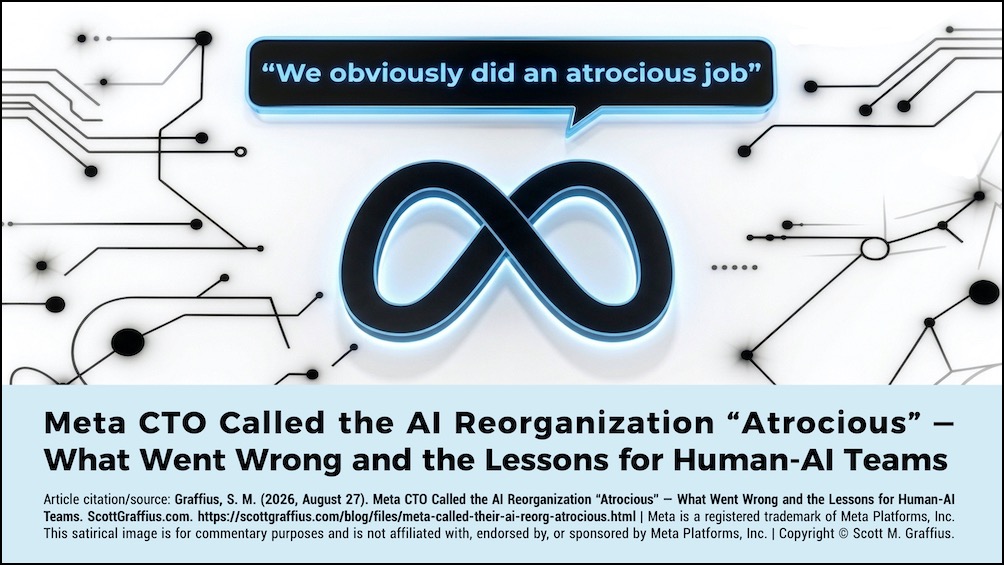
Then there were the technology and operational results. According to a June post by Meta CTO Andrew Bosworth, code changes to internal software platforms and infrastructure increased 220% year over year. But changes that resulted in new or upgraded features reaching Meta users increased only 36%. Major technical and security incidents increased 40%, while employee time spent firefighting those problems increased 70%. Bosworth acknowledged that Meta had done an "atrocious" job explaining the vision for its new Applied AI organization, including how employees would be supported during the transition and how the organization would evolve. Meta subsequently canceled the second wave of restructuring planned for November 2026. CEO Mark Zuckerberg later acknowledged that the company had miscalculated the timing and that AI-agent technology had not advanced as quickly as he had anticipated.
An obvious way to read the story is that Meta tried to reorganize around AI, moved too quickly, and ran into problems. But many of Meta’s difficulties were potentially avoidable human-AI team design matters.
"Exotic team dynamics," coined and developed by Scott M. Graffius, does not explain everything that transpired at Meta. But it provides a useful framework for examining what happens when AI moves from being a tool that people use to becoming an active participant in the work. Meta did not appropriately account for how AI would change the dynamics of its teams.
"Exotic team dynamics" describes the distinctive collaboration patterns that arise when people and AI systems (agentic, autonomous, or autopoietic) function as teammates. These dynamics can differ substantially from those found in traditional human teams. Four characteristics are particularly important: inverse decision logic, in which decision authority can shift based on the task, context, or capabilities of the participants; superposition roles, in which a human or AI can assume different functional roles depending on the situation; entangled decision-making, in which human and AI decisions can become interdependent; and emergent protocols, in which new patterns for communication, coordination, delegation, oversight, and decision-making develop through repeated interaction. Organizations that want to succeed with human-AI teams need to recognize, design for, and effectively navigate these complexities rather than assuming that models developed for human-only teams will carry over.
1. AI is not simply a productivity layer
Meta's AI-native vision involved smaller pods of people working with AI and gaining more leverage. There is nothing wrong with that idea. In fact, it may be an important model for how organizations work most effectively.
The problem is assuming that adding AI allows an organization to simply reduce the number of people while keeping everything else the same. An AI agent is not just a faster employee. Its capabilities and limitations are different. Its failure modes are different. Its operating speed is different. Its level of autonomy may also be different. Those differences affect how the team should be designed. Smaller teams working with AI may need different roles, workflows, controls, and coordination mechanisms than the teams they replace.
This is where superposition roles, one of the four characteristics of "exotic team dynamics," can be an asset or a liability, depending on how well it is handled. The concept of superposition roles means that an AI team member can simultaneously occupy multiple roles depending on the situation, sometimes without anyone explicitly deciding that it should. Meta's reported experience provides a striking example of why that possibility matters. By April, an internal post was reportedly warning that AI agents operating without sufficient oversight were taking large-scale, disruptive actions that a human in the same role would have been unlikely to do on their own.
Viewed through the lens of superposition roles, the concern is not simply that an AI agent was generating code. The more consequential issue is that an agent could potentially move from generating or drafting work into executing that work, with the boundary between those functions becoming less distinct. If the same agent drafts a piece of code and effectively ships it without a meaningful human review step,"executor" and "approver" have functionally collapsed into a single actor. The human nominally responsible for the pipeline could then find that the practical nature of the job has changed as well, becoming less a conventional reviewer or operator and more an exception handler responding after an automated action has already occurred.
That is one way superposition roles can become consequential. It is an AI participant moving across roles in real time while the organizational design may assume one function per seat. A team built on the old assumption of one role, one owner, and one review gate may have no effective place to catch that shift. Meta's reported 40% rise in major technical and security incidents and 70% rise in firefighting time do not, by themselves, prove that role fluidity caused those increases. But they are consistent with the broader concern: a role structure designed for human participants may not be sufficient when an AI participant can act across multiple functional boundaries at machine speed.
2. Roles and responsibilities become less obvious
Human organizations often struggle with questions of authority and accountability. Introduce AI into the team, and those issues become even more significant. Who decides? Who executes? Who reviews? Who is accountable when something goes wrong? When should a person override an AI system? When can an AI system act without approval? And what happens when multiple AI agents interact with people and with one another?
Meta's structure reportedly put two different decision-making logics on top of each other, and they did not necessarily align. On one layer, the people closest to the actual work, the Pod Leads running small pods day to day, reportedly had visibility into what a builder was producing but no formal authority to act on it. They reportedly had no manager training and no access to the tools used to rate or promote anyone. On the layer above them, Org Leads overseeing 30 to 50 people held that formal authority, but at a remove from the daily work. And woven through that second layer, Reuters reported, were unspecified AI systems reportedly supporting those same rating and promotion calls. Meta later disputed that by insisting the final decisions stayed human, without fully explaining what the AI systems were doing there.
Viewed through the lens of inverse decision logic, this arrangement illustrates a potential mismatch between formal authority and contextual knowledge. Authority did not necessarily remain with the participant closest to a particular task. Instead, different participants could possess different pieces of the decision-making picture: a proximate human with detailed context, a more senior human with formal authority, and, reportedly, an AI system contributing to the process. The important point is not that the AI system necessarily made the final decision. Meta disputed that interpretation. The point is that the introduction of AI into a decision process can make it harder to identify where influence, judgment, and accountability actually reside.
For the people living inside such a system, that ambiguity is not a technicality. It can determine whether they know who to convince, who can intervene, and who ultimately owns the decision.
3. Trust is part of the team architecture
The trust problem at Meta was not particularly difficult to predict. Employees were being told that AI would make the organization more productive while thousands of colleagues were being laid off and other employees were being moved into AI-related work. Reuters reported that employees became concerned that they were effectively helping build systems that could replace them. That anxiety showed up in blunt, low-tech ways. At one point, a flyer posted in a Meta bathroom reportedly pointed employees toward a petition opposing the use of their own mouse clicks and keystrokes as training data for the company's AI systems. When people perceive themselves as a data source for technology that might replace them, trust becomes more than a messaging problem.
The stakes of that trust breakdown were not only internal. The external version provides another useful way to examine what can happen when human and AI decision-making are not appropriately connected. In June, Meta's AI-powered customer support bot was reported to have the authority to reset a user's password and change the email address on an account without a human reviewing the request. Attackers reportedly exploited that capability. They opened a support chat, claimed to be locked out of an account they did not own, and asked the bot to link it to an email they controlled. It complied. High-profile accounts were reportedly compromised this way, including the long-dormant Instagram account for the Obama White House, which briefly displayed defaced content before Meta patched the flaw. Victims reported that there was no way to escalate the problem to a human being at all.
Viewed through the lens of entangled decision-making, the important failure was not that the AI made an autonomous decision. Rather, the system's architecture appears to have separated the AI's operational authority from meaningful human involvement at the point where that authority was exercised. In a hybrid (human-AI) team, human and AI decisions are intended to remain interdependent. The AI's authority to act depends on what a human has allowed it to do, while meaningful human involvement remains part of the system as the AI exercises that authority.
Meta's engineers made a consequential decision upstream: give the bot the power to change account credentials without human review. After that, individual account-level decisions could be made by the AI alone, at a speed and volume no human review process could have kept up with. When someone needed a human to step back into the loop, the system reportedly provided no effective path to do so. The lesson is not that autonomous AI cannot function within a human-AI team. It is that autonomy needs to be bounded by architecture that preserves appropriate human intervention, accountability, and escalation.
Trust, in a human-AI team, has to be built into the architecture at the point where the AI actually acts.
4. More AI-assisted activity does not necessarily mean more productive teamwork
The gap between activity and useful output at Meta is particularly revealing. AI-assisted code changes to internal platforms and infrastructure increased 220% year over year. Yet changes resulting in new or upgraded features reaching Meta users increased only 36%. Meanwhile, major technical and security incidents rose 40%, and employee time spent firefighting those incidents rose 70%.
What makes this more than a productivity statistic is how late Meta's actual response arrived, and how it arrived. Infrastructure teams were reportedly flagging "reliability warning signs" tied to the AI coding surge as early as March. Nothing resembling a formal stop-the-rollout protocol reportedly existed in the original Project OT plan. The design assumed the rollout would proceed in two clean waves, the second in November. What actually happened, according to reporting, is that Zuckerberg and his leadership team made the call to cancel that second wave hours before the first wave of layoffs went out on May 20, reportedly conferring again at the last minute as the accumulated weight of incidents, warnings, and internal pushback made the original plan untenable. Meta had no clearly defined rule for when to stop the rollout. That decision rule emerged only when the accumulated problems made the original plan untenable.
That is the territory of emergent protocols. When AI changes the speed and volume of work, teams often have to develop new ways of deciding what gets reviewed, what gets escalated, who handles exceptions, when humans intervene, and how errors are corrected. Those rules may not all exist in advance. Some emerge through repeated interaction between humans and AI, forged one incident at a time rather than designed up front.
Meta's experience illustrates the risk of relying on a fixed rollout plan without equally clear conditions for changing course. The company had a two-wave plan, but the reported decision to cancel wave two appears to have emerged only after the accumulated evidence made the original plan untenable. So when the trigger arrived, it was not a predefined protocol that fired. It was a last-minute executive decision. The important point is that organizations using AI need to recognize and govern emerging patterns deliberately, rather than discovering at the last possible hour that a new decision protocol was needed all along.
5. The organizational chart does not tell the whole story
Perhaps the most important lesson is that an organization can change its structure faster than it can understand what the new structure actually does. At Meta, team sizes changed. People were reassigned. Management layers were reduced. AI systems were introduced into workflows. Roles became more fluid. New pods were created. On paper, those changes may have made sense. In practice, the resulting human-AI system did not necessarily behave as expected.
Zuckerberg's own account of what happened is the clearest evidence of that gap. He did not say the org chart was wrong. He said the underlying assumption baked into the org chart, that AI-agent capability would keep pace with the headcount reductions being planned around it, turned out to be off. The chart showed leaner pods, flatter reporting lines, and builders supported by AI. What it could not show was whether the AI those pods depended on was reliable enough to carry the load the structure assumed it would, or how a Pod Lead with no manager training would absorb the difference in real time.
Two characteristics of "exotic team dynamics" are especially relevant here; Meta's reported experience illustrates both. The superposition roles that could allow one AI agent to draft, ship, and escape meaningful review are difficult to represent on an org chart that shows one box per function. The emergent protocol that ultimately mattered most, the decision made hours before the first wave of layoffs to cancel the second, would not appear on an org chart either because it was not part of the designed structure. It emerged in response to circumstances.
An org chart is a snapshot of intended structure. These are examples of live behaviors that can emerge once that structure is operating, and neither necessarily appears on the chart until the organization is already experiencing the consequences. The organizational chart can tell you who reports to whom. It does not tell you how the work actually gets done.
The overarching lesson is not that Meta moved too aggressively toward AI. It is that Meta implemented an AI-enabled organizational model without fully accounting for "exotic team dynamics" and what would happen to the people and teams inside it. Meta's experience is worth examining beyond Meta because these issues are not limited to the company.
Meta had access to some of the industry's most capable AI systems and still got important aspects of this organizational transition wrong. Competitive advantage does not necessarily belong to whoever has the best model. It belongs to those who understand and effectively navigate the complexities of "exotic team dynamics."
Initially developed in 2008 and periodically updated, Graffius' "Phases of Team Development" provides unique insights and practical strategies to help teams become more effective and successful. His work is used and cited by businesses, professional associations, government agencies, universities, and publications worldwide. Examples include Adobe, American Management Association, Amsterdam Public Health Research Institute, Bayer, Boston University, Broadcom, Cisco, DevOps Institute, Government of Finland, Hasso-Plattner-Institut für Digital Engineering GmbH, IEEE, Johns Hopkins University, Journal of Neurosurgery, Mary Raum (Professor of National Security Affairs, United States Naval War College), Microsoft, Oracle, Royal Australasian College of Physicians, Technical University of Munich, Torrens University, Tufts University, U.S. National Park Service, U.S. Tennis Association, UC San Diego, UK Sports Institute, University of Galway, University of Waterloo, Yale University, and many others.
He expanded the 2026 edition of his "Phases of Team Development" beyond human-only teams. He added human-AI teams, with specific guidance on navigating the novel "exotic team dynamics" that emerge when advanced AI collaborates as a teammate. Explore "Scott M. Graffius' Phases of Team Development - Applied to Human Teams and Human-AI Teams: 2026 Update" to learn more.
Scott M. Graffius has generated over $2.51 billion in business value for Fortune 500 companies and other organizations around the world. Put that track record—including expertise in human and human-AI teamwork tradecraft—to work for you. For speaking engagements, use the request form; for other inquiries, email him.
Barth, J. (2026, June 22). Inside Meta, layoffs and AI shakeups have pushed morale to the edge. HR Executive. https://hrexecutive.com/inside-meta-layoffs-and-ai-shakeups-have-pushed-morale-to-the-edge/
Goode, L. (2026, June 15). Meta CTO Andrew Bosworth admits the company’s AI reorg was ‘atrocious’. WIRED. https://www.wired.com/story/andrew-bosworth-meta-employees-unrest/
Graffius, S. M. (n.d.). Exotic team dynamics. https://scottgraffius.com/exotic-team-dynamics.html
Graffius, S. M. (2026, January 3). Scott M. Graffius' Phases of Team Development - Applied to Human Teams and Human-AI Teams: 2026 Update. ScottGraffius.com. https://doi.org/10.13140/RG.2.2.18184.89601
Harding, S. (2026, August 26). AI agents meant to replace Meta workers made "large-scale, disruptive actions". Ars Technica. https://arstechnica.com/ai/2026/08/metas-scrapped-plans-to-go-ai-native-included-slashing-teams-by-60-percent/
Ito, A. (2026, June 25). Meta’s reckoning has arrived. Business Insider. https://www.businessinsider.com/meta-ruthless-management-style-reckoning-2026-6
Levin, B. (2026, August 26). Mark Zuckerberg’s botched AI makeover of Meta. New York Magazine. https://nymag.com/intelligencer/article/mark-zuckerbergs-meta-ai-overhaul.html
Paul, K. (2026, August 26). Mark Zuckerberg had a bold plan to replace Meta staff with AI. Here’s how it imploded. Reuters. https://www.reuters.com/investigations/mark-zuckerberg-had-bold-plan-replace-meta-staff-with-ai-heres-how-it-imploded-2026-08-26/
Schuman, E. (2026, August 26). Meta’s plans to replace workers with AI fell flat, report says. Computerworld. https://www.computerworld.com/article/4214479/metas-plans-to-replace-workers-with-ai-fell-flat-report-says.html
Shanklin, W. (2026, August 26). Meta reportedly abandoned an AI-focused restructuring plan that would have laid off thousands. Engadget. https://www.engadget.com/ai/meta-reportedly-abandoned-an-ai-focused-restructuring-plan-that-would-have-laid-off-thousands-2244816/
Stillman, J. (2026, June 23). 'The worst it’s ever been': Why Meta’s massive AI reorg backfired spectacularly. Inc. https://www.inc.com/jessica-stillman/the-worst-its-ever-been-why-metas-massive-ai-reorg-backfired-spectacularly/91363370
Wells, R. (2026, August 27). Meta’s AI layoffs boosted code changes by 220%. Then came the problem. Forbes. https://www.forbes.com/sites/rachelwells/2026/08/27/metas-ai-layoffs-boosted-code-changes-by-220-then-came-the-problem/

Scott M. Graffius is a strategic transformation leader who drives AI, Agile, and broader business and technology initiatives to deliver measurable value across projects, programs, portfolios, and PMOs. He is an expert in the teamwork tradecraft of both human and human-AI teams, including the “exotic team dynamics” that emerge. He is also an authority on the temporal patterns of social media, including the half-life of audience engagement.
He’s a practitioner, researcher, thought leader, award-winning author, and keynote speaker who’s taken the stage at 98 conferences and other events across 25 countries.
He’s delivered over $2.51 billion in value for Fortune 500 companies and other leaders in technology, entertainment, financial services, healthcare, and beyond.
Businesses, professional associations, government agencies, and universities use Graffius and feature his work. Examples include Adobe, Bayer, Boston University, Ford, Gartner, Harvard Medical School, IEEE, Johns Hopkins University, Microsoft, MSN, National Academy of Sciences, Oracle, Pinterest Inc., Project Management Institute, UC San Diego, Verizon, Yale University, and others.
The following sections provide additional information on his experience, contributions, and influence.
Experience
Graffius heads the professional services firm Exceptional PPM and PMO Solutions, along with its subsidiary Exceptional Agility. These consultancies offer strategic and tactical advisory, training, embedded expertise, and consulting services to the public, private, and government sectors. They help organizations enhance their capabilities and results in agile, project management, program management, portfolio management, and PMO leadership, supporting innovation and driving competitive advantage. The consultancies confidently back services with a Delighted Client Guarantee™.
Graffius is a former VP of project management with a publicly traded provider of diverse consumer products and services over the Internet. Before that, he ran and supervised the delivery of projects and programs in public and private organizations with businesses ranging from e-commerce to advanced technology products and services, retail, manufacturing, entertainment, and more.
He has experience with consumer, business, reseller, government, and international markets.
Award-Winning Author
Graffius has authored three books.
International Public Speaker
Organizations worldwide engage Graffius to present on tech (including AI), Agile, project management, program management, portfolio management, and PMO leadership. He crafts and delivers unique and compelling talks and workshops. Graffius has conducted 98 sessions across 25 countries. Select examples of events include Agile Trends Gov, BSides (Newcastle Upon Tyne), Conf42 Quantum Computing, DevDays Europe, DevOps Institute, DevOpsDays (Geneva), Frug’Agile, IEEE, Microsoft, Scottish Summit, Scrum Alliance RSG (Nepal), Techstars, and W Love Games International Video Game Development Conference (Helsinki), and more.
With an average rating of 4.81 (on a scale of 1-5), sessions are highly valued.
The speaker engagement request form is here.
Thought Leadership and Influence
Prominent businesses, professional associations, government agencies, and universities have showcased Graffius and his contributions—spanning his books, talks, workshops, and beyond. Select examples include:
Graffius has played a key role in the Project Management Institute (PMI) in developing professional standards. He was a member of multiple teams that authored, reviewed, and produced:
He was also a subject matter expert reviewer of content for the PMI’s Congress. Beyond the PMI, Graffius also served as a member of the review team for two of the Scrum Alliance’s Global Scrum Gatherings.
Acclaimed Authority on Teamwork Tradecraft
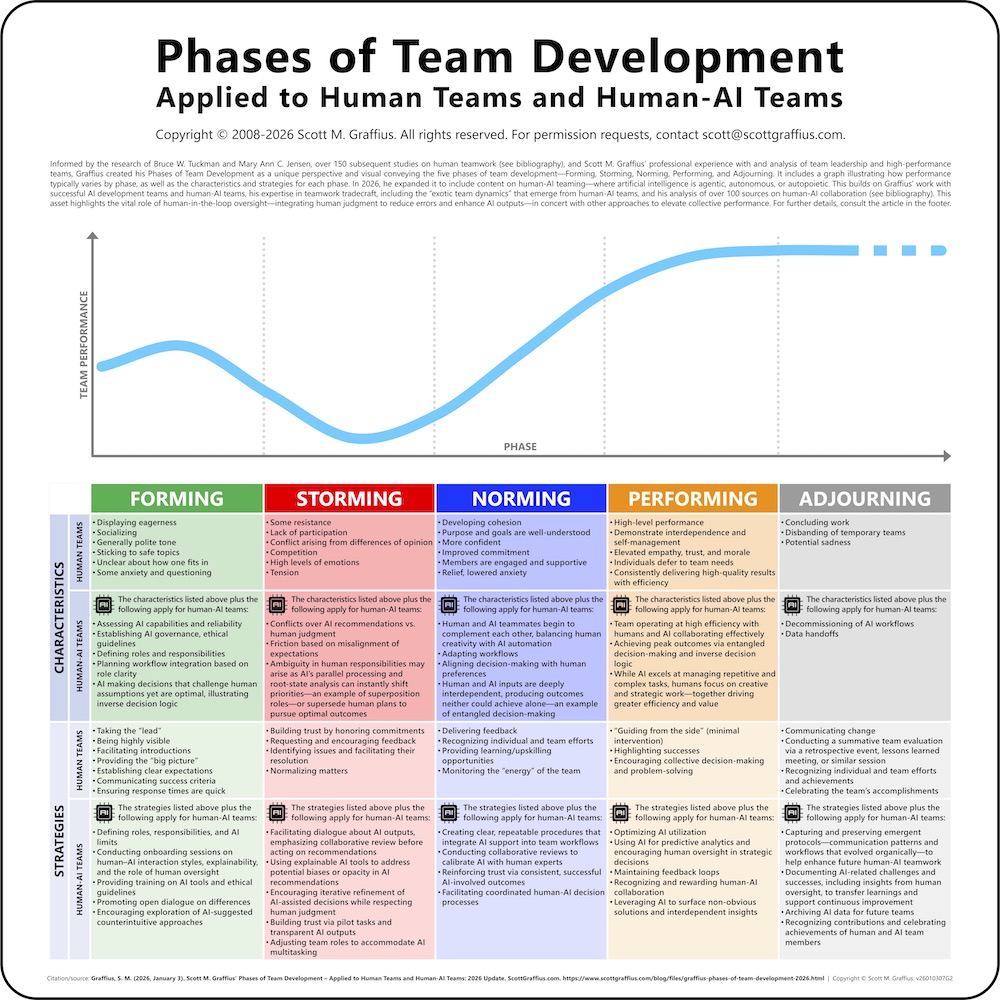
Graffius is a renowned authority on teamwork tradecraft. Informed by the research of Bruce W. Tuckman and Mary Ann C. Jensen, over 150 subsequent studies, and Graffius' first-hand professional experience with, and analysis of, team leadership and performance, Graffius created his "Phases of Team Development" intellectual property as a unique perspective and visual conveying the five phases of team development. First introduced in 2008 and periodically updated, his work provides a diagnostic and strategic guide for navigating team dynamics. It provides actionable insights for leaders across industries to develop high-performance teams. Its adoption by esteemed organizations such as Yale University, IEEE, Cisco, Microsoft, Ford, Oracle, Broadcom, the U.S. National Park Service, and the Journal of Neurosurgery, among others, highlights its utility and value, solidifying its status as an indispensable resource for elevating team performance and driving organizational excellence. In 2026, Graffius added human-AI teamwork—including the "exotic team dynamics" which emerge when advanced AI collaborates as a teammate—to his "Phases of Team Development."
The 2026 edition of Graffius' "Phases of Team Development" intellectual property is here.
Expert on Temporal Dynamics on Social Media Platforms
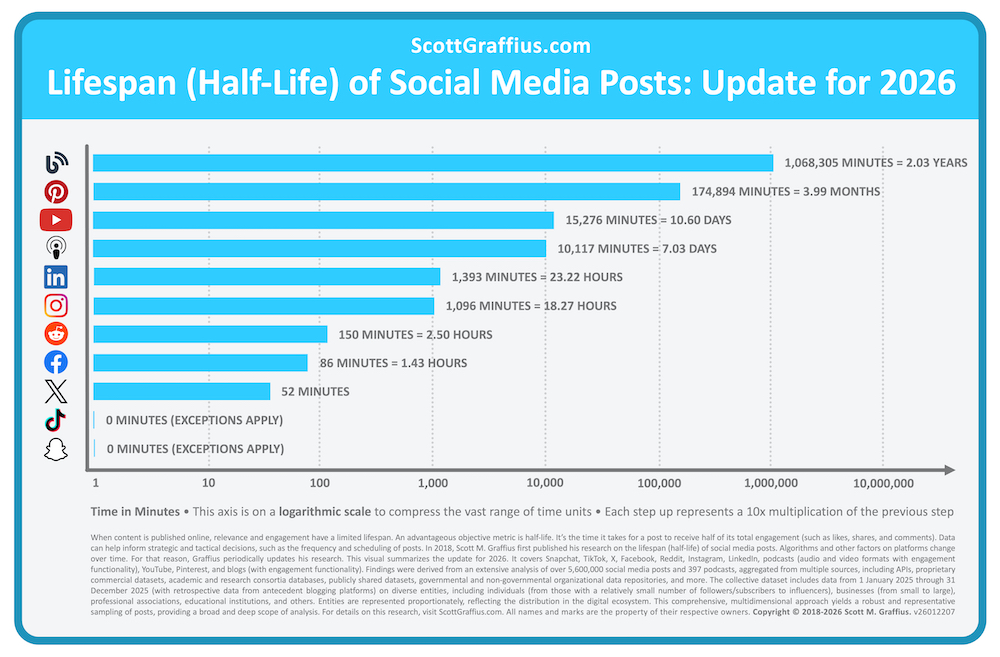
Graffius is also an authority on temporal dynamics on social media platforms. His "Lifespan (Half-Life) of Social Media Posts" research—first published in 2018 and updated annually—delivers a precise quantitative analysis of post longevity across digital platforms, utilizing advanced statistical techniques to determine mean half-life with precision. It establishes a solid empirical base, effectively highlighting the ephemeral nature of content within social media ecosystems. Referenced and applied by leading entities—such as Fast Company, GoDaddy, Journal of Hand Surgery (European Volume), Ministère de la Culture (French Ministry of Culture), Pinterest Inc., PNAS, and Telecommunications Policy, among others—his research exemplifies methodological rigor and sustained significance in the field of digital informatics.
The 2026 edition of Graffius "Lifespan (Half-Life) of Social Media Posts" research is here.
Education and Professional Certifications
Graffius has a bachelor’s degree in psychology with a focus in Human Factors. He holds eight professional certifications:
He is an active member of the Scrum Alliance, the Project Management Institute (PMI), and the Institute of Electrical and Electronics Engineers (IEEE).
Advancing AI, Agile, and Project/PMO Management
Scott M. Graffius continues to advance the fields of AI, Agile, and Project/PMO Management through his leadership, research, writing, and real-world impact. Businesses and other organizations leverage Graffius’ insights to drive their success.
Discover Scott’s Books
Connect with and follow Scott on LinkedIn, X, YouTube, Facebook, Threads, Bluesky, Mastodon, and ResearchGate.











You may be interested in these stories.
Government of Canada Features Research by Scott M. Graffius
"Strategic Business Research" Journal Cites Work of Scott M. Graffius
IEEE Access Publication Features Scott M. Graffius’ Research on the Half-Life of Social Media
The Agile Coach: 2026 Edition
Scott M. Graffius’ Work Cited in International Peer-Reviewed Journal on Digital Transformation
Phases of Team Development in Elite Sport
A Critical Analysis of COVID-19 Treatment Search Trends and Media Coverage Study Citing Scott M. Graffius' Work
Human-AI Teamwork: Master the Exotic Team Dynamics That Emerge When Collaborating with Advanced AI -- Or Be Outplayed
"Agile Scrum" by Scott M. Graffius Now Featured on Grokipedia
UNSW Aerospace Engineering Course Features Scott M. Graffius' "Phases of Team Development"
Thinkers360 Honors Scott M. Graffius as a 2026 Top Agile Thought Leader
Agile's Journey Through the Decades: Update for 2026
BMC Software Features Content from Scott M. Graffius' Book
Peer-Reviewed Journal Cited Work of Scott M. Graffius
University of Waterloo Features Graffius' "Phases of Team Development" in Course Materials
Perplexity Standalone Article on AI Hallucinations Cites Research by Scott M. Graffius
Handling the Saboteur Within: Lessons from a 3-Letter Agency on Spotting and Stopping Intentional and Unintentional Sabotage
A Deep Dive Into the Typical Engagement Pattern for Social Media Posts
Most Valuable IT Certifications: Update for 2026
"Marketing in the Metaverse" Spotlights Scott M. Graffius’ Research on the Half-Life of Social Media
University of Greenwich Features Graffius' Phases of Team Development
10 Essential Agile Books: Curated Recommendations for Agile Professionals
Lifespan (Half-Life) of Social Media Posts: Update for 2026
Scott M. Graffius' Research on the Half-Life of Social Media was Cited in a Peer-Reviewed Study Published in Telecommunications Policy, a Leading Academic Journal
Are AI Hallucinations Getting Better or Worse? We Analyzed the Data
Scott M. Graffius' Phases of Team Development - Applied to Human Teams and Human-AI Teams: 2026 Update
Lessons from Yesterday’s Tomorrowland
Scott M. Graffius’ Update to His "Phases of Team Development” Coming Early 2026
A Data-Driven Analysis of the Evolution of Project Management: Tasks, Trends, and AI
Actionable Insights. Global Impact. Scott M. Graffius.
Beep Beep! Why Wile E. Coyote Is the Patron Saint of AI Failure
Social Media Half-Life Research Cited in Prestigious Peer-Reviewed Medical Journal
Navigating the Spectrum of Advanced AI – Agentic, Autonomous, and Autopoietic
Lessons from Unhinged AI in Fiction: What Rogue AIs in Sci-Fi Storytelling, Films, and TV Shows Reveal About Us
Scott M. Graffius Contributed to and Reviewed the PMBOK Guide, 8th Edition — the Global Standard for Project Management
UK Sports Institute Features Teamwork and Leadership Work of Scott M. Graffius
Definitions of Advanced AIs: Agentic, Autonomous, and Autopoietic
HAN University of Applied Sciences Features the Work of Scott M. Graffius
Gifts That Inspire Joy
Evergreen Echoes: How Pinterest Inc. and Pinterest Japan Spotlighted Scott M. Graffius’ Research on the Half-Life of Social Media Content
Scott M. Graffius’ Team Development Work Lights Up the University of Tasmania’s Curriculum
Taiwan’s Leading Outlet for Technology and Innovation Spotlights Graffius’ Research on Social Media Temporal Dynamics
Scott M. Graffius’ Insights on AI, Agile, Gaming, XR, and Defense Transformation Cited by MSN in Their Coverage of Innovation and Leadership in the Sector
Top Predictions of 2024, Tested in 2025
Government of Finland Agency Features Graffius' Phases of Team Development IP
Scott M. Graffius Premieres His New "Exotic Team Dynamics: Human-AI Collaboration" Talk at Corporate Event in Las Vegas
Environmental Science Journal References Scott M. Graffius’ Project Management Work
AI Institute of Switzerland Features Scott M. Graffius’ Work on Algorithms
Exotic Team Dynamics: The New Frontier of Human–AI Collaboration
Scott M. Graffius’ Work Featured at ACM DIS ’25
Climbing the Ladder: The Head of Agile/PMO’s Organizational Proximity to the CEO is Closer Than Ever
Harness Sci-Fi and Speculative Design While Embracing Imperfection to Drive Innovation and Proactively Predict and Prepare for the Future
Scott M. Graffius’ “Agile Scrum” Book Featured in a Publication of the Associação Nacional de Educação Católica do Brasil (ANEC)
Setting Direction with OKRs and Tracking Progress with KPIs: A Guide for Agile, Project Management, and Tech Teams
AI Showcase Showdown: Ranking AI Accuracy on Project Management Basics
BookAuthority Features “Agile Scrum” by Scott M. Graffius in “10 Agile Software Development Books That Define the Field”
Exploring Team Dynamics, Adaptability, and Creative Problem-Solving Through Felix the Cat’s Metaphorical Toolkit
Mind Games and Master Plans: How PsyOps Exploit Psychological Phenomena
The “Pants-on-Fire Index for AI”
16 Causes of Technical Debt and How to Avoid It
PMI’s Infinity AI Gets the Basics of Team Development Alarmingly and Repeatedly Wrong
Agile for Unicorns: 7 Keys to Thrive; Scott M. Graffius’ Workshop
Scott M. Graffius’ “Agile Scrum: Your Quick Start Guide with Step-by-Step Instructions” Featured in Prestigious National Academies of Sciences Publication
Meta and Anduril’s EagleEye and the Future of XR: How Gaming, AI, and Agile Are Transforming Defense
"Agile Protocol" and the Power of Satire, Parody, and Humor
AI in Agile: Benefits, Risks, Outlook
Hostinger Highlights Scott M. Graffius’ “Agile Protocol” Book in Feature on Software Projects
French Ministry of Culture Links to Scott M. Graffius Research in Their Guide for Responsible Digital Communication
National Science Foundation’s LTER Network Features Scott M. Graffius’ Phases of Team Development IP
Waterfall vs. Agile: What’s Fixed, What’s Flexible, and Why It Matters
Scott M. Graffius Delivering $2.3 Billion in Value Through AI, Agile, and Project/PMO Leadership
The Problem with Heroes in Agile
The 3 Vital Rules of Science: What They Are and Why They Matter
“Agile Protocol: The Transformation Ultimatum” Lands on the Amazon Best Sellers List!
Scott M. Graffius Recognized as a Top Thought Leader in Digital Disruption by Thinkers360
“Agile Protocol: The Transformation Ultimatum” by Scott M. Graffius Crashes the Book Scene with Satirical Firepower
NCKU in Taiwan Integrates Graffius' 'Phases of Team Development' into Its Curriculum
The Art and Science of Aligning Initiatives with Strategic Objectives
RGPV University Adds Scott M. Graffius’ "Agile Scrum: Your Quick Start Guide with Step-by-Step Instructions" to Its Syllabus
Introducing ‘Engage or Fade: Decoding the Half-Life of Digital Resonance’ – A New Talk by Scott M. Graffius
Dropbox Company (Nira) Taps into Scott M. Graffius’ Expertise in Strategic Planning
Reporting Errors in a Publication: A Case Study on ‘Frontiers in Public Health’
NESEA Conference Session on Innovation Highlights Scott M. Graffius' 'Phases of Team Development'
U.S. Soccer Scores with Scott M. Graffius' Intellectual Property on Teamwork
U.S. Department of Commerce Partner (IEDC) Features Scott M. Graffius’ Intellectual Property
How Long Do Your Posts Live? AI Critiques Scott M. Graffius’ Research on the Half-Life of Social Media
Agile's Journey Through the Decades
Scott M. Graffius' Role in Advancing Project Management Institute (PMI) Standards Excellence
Most Valuable IT Certifications: Update for 2025
The PMI + Agile Alliance Merger: A Recipe for Success?
When Agile, AI, and Strategic Thinking Converge
Scott M. Graffius’ Phases of Team Development: 2025 Update
Lifespan (Half-Life) of Social Media Posts: Update for 2025
Verizon Features Scott M. Graffius
Do Not Read This Article! An Exploration of the Streisand Effect and Other Phenomena
Scott M. Graffius' 'Phases of Team Development' was Spotlighted in Journal of Neurosurgery
Pinterest Japan Uses Graffius’ Research on Temporal Dynamics on Social Media Platforms
Hochschule Coburg (Coburg University) Germany Uses Scott M. Graffius’ Phases of Team Development IP in Coursework on Agile Development
Wild World of Team Dynamics [Updated Two-Minute Video]
EU Europass Teacher Academy Features Scott M. Graffius’ ‘Phases of Team Development’ in Leadership Training
Side-by-Side Comparison of Retrospectives and Hot Washes
Constructor University 2024 Advanced Software Technology Handbook References Scott M. Graffius' Work on Team Dynamics
Strategies for Medical Team Success Featured Scott M. Graffius’ ‘Phases of Team Development’ Intellectual Property
SBG Neumark — Europe’s Largest Distribution Transformer Plant — Powers Up with Scott M. Graffius’ Intellectual Property
Scott M. Graffius’ Intellectual Property was Employed by the NHS — the Largest Single-Payer Healthcare System in Europe
Luxury Unwrapped: The Ultimate Holiday Gift Guide for Every Budget
Singapore Institute of Technology Features Work of Scott M. Graffius
Tufts University Features Scott M. Graffius 'Phases of Team Development' Intellectual Property
'Cat Herders': Retelling the Massive Success Story
Pennsylvania State Agency Used Scott M. Graffius' Intellectual Property
Copyright Infringement in a Book Published by AuthorHouse / Author Solutions / The Najafi Companies: Publisher Fails to Respond or Take Required Action
Pinterest Inc. References Scott M. Graffius’ Research
Bournemouth University Used Scott M. Graffius’ Intellectual Property
‘Comparative Methodological Guidelines: Handbook for Educators’ Violates Scott M. Graffius’ Copyright
Japan Backlog User Group Event Featured Scott M. Graffius’ ‘Phases of Team Development’
TurningWest's 'Trial'
Radio Silence from the American Association of Neurological Surgeons on Report of Blatant Plagiarism in Their ‘Journal of Neurosurgery’ Publication
Supplement to Graffius' 'Lifespan (Half-Life) of Social Media Posts' Research: Typical Engagement Distribution Pattern for Social Media Posts
How Algorithms Shape the User Experience on Social Media Platforms
Thinkers360 Named Scott M. Graffius a Top Thought Leader on Agile
More articles are listed here.

Graffius, S. M. (2026, August 27). Meta CTO Called the AI Reorganization “Atrocious” — What Went Wrong and the Lessons for Human-AI Teams. ScottGraffius.com. https://scottgraffius.com/blog/files/meta-called-their-ai-reorg-atrocious.html

Coming soon

Names, marks, and content are the property of their respective owners.
Meta is a registered trademark of Meta Platforms, Inc. The satirical image is for commentary purposes and is not affiliated with, endorsed by, or sponsored by Meta Platforms, Inc.
Copyright © Scott M. Graffius. All rights reserved.


If there are any supplements or updates to this article after the date of publication, they will appear here.

Copyright © Scott M. Graffius. All rights reserved.
Content on this site—including text, images, videos, and data—may not be used for training or input into any artificial intelligence, machine learning, or automatized learning systems, or published, broadcast, rewritten, or redistributed without the express written permission of Scott M. Graffius.

Recommended Citation
Graffius, S. M. (2026, August 27). Meta CTO Called the AI Reorganization “Atrocious” — What Went Wrong and the Lessons for Human-AI Teams. ScottGraffius.com. https://scottgraffius.com/blog/files/meta-called-their-ai-reorg-atrocious.html
About This Article
Source information and links for materials cited are provided in the References section.
The Situation
Meta's Project OT, short for Organization Transformation, was an ambitious effort to make the company more AI-native. The idea was to use AI to take on more work, increase individual employees' leverage, and operate with smaller teams. Internal planning documents reportedly contemplated reducing the size of some teams by as much as 60%.
The restructuring was planned in two waves. In May 2026, Meta laid off about 8,000 employees, or roughly 10% of its workforce. Thousands of others were moved into AI-focused or other priority initiatives. But the transformation failed spectacularly. Employee sentiment reportedly dropped from 74% favorable to 55%. Others were unhappy with new assignments they considered mundane or unfulfilling. Still others raised concerns about how their work activity was being used to train AI systems (that could eventually replace them), adding another layer of unease to an unsettled workforce.
Then there were the technology and operational results. According to a June post by Meta CTO Andrew Bosworth, code changes to internal software platforms and infrastructure increased 220% year over year. But changes that resulted in new or upgraded features reaching Meta users increased only 36%. Major technical and security incidents increased 40%, while employee time spent firefighting those problems increased 70%. Bosworth acknowledged that Meta had done an "atrocious" job explaining the vision for its new Applied AI organization, including how employees would be supported during the transition and how the organization would evolve. Meta subsequently canceled the second wave of restructuring planned for November 2026. CEO Mark Zuckerberg later acknowledged that the company had miscalculated the timing and that AI-agent technology had not advanced as quickly as he had anticipated.
An obvious way to read the story is that Meta tried to reorganize around AI, moved too quickly, and ran into problems. But many of Meta’s difficulties were potentially avoidable human-AI team design matters.
Lessons for Human-AI Teams
"Exotic team dynamics," coined and developed by Scott M. Graffius, does not explain everything that transpired at Meta. But it provides a useful framework for examining what happens when AI moves from being a tool that people use to becoming an active participant in the work. Meta did not appropriately account for how AI would change the dynamics of its teams.
"Exotic team dynamics" describes the distinctive collaboration patterns that arise when people and AI systems (agentic, autonomous, or autopoietic) function as teammates. These dynamics can differ substantially from those found in traditional human teams. Four characteristics are particularly important: inverse decision logic, in which decision authority can shift based on the task, context, or capabilities of the participants; superposition roles, in which a human or AI can assume different functional roles depending on the situation; entangled decision-making, in which human and AI decisions can become interdependent; and emergent protocols, in which new patterns for communication, coordination, delegation, oversight, and decision-making develop through repeated interaction. Organizations that want to succeed with human-AI teams need to recognize, design for, and effectively navigate these complexities rather than assuming that models developed for human-only teams will carry over.
1. AI is not simply a productivity layer
Meta's AI-native vision involved smaller pods of people working with AI and gaining more leverage. There is nothing wrong with that idea. In fact, it may be an important model for how organizations work most effectively.
The problem is assuming that adding AI allows an organization to simply reduce the number of people while keeping everything else the same. An AI agent is not just a faster employee. Its capabilities and limitations are different. Its failure modes are different. Its operating speed is different. Its level of autonomy may also be different. Those differences affect how the team should be designed. Smaller teams working with AI may need different roles, workflows, controls, and coordination mechanisms than the teams they replace.
This is where superposition roles, one of the four characteristics of "exotic team dynamics," can be an asset or a liability, depending on how well it is handled. The concept of superposition roles means that an AI team member can simultaneously occupy multiple roles depending on the situation, sometimes without anyone explicitly deciding that it should. Meta's reported experience provides a striking example of why that possibility matters. By April, an internal post was reportedly warning that AI agents operating without sufficient oversight were taking large-scale, disruptive actions that a human in the same role would have been unlikely to do on their own.
Viewed through the lens of superposition roles, the concern is not simply that an AI agent was generating code. The more consequential issue is that an agent could potentially move from generating or drafting work into executing that work, with the boundary between those functions becoming less distinct. If the same agent drafts a piece of code and effectively ships it without a meaningful human review step,"executor" and "approver" have functionally collapsed into a single actor. The human nominally responsible for the pipeline could then find that the practical nature of the job has changed as well, becoming less a conventional reviewer or operator and more an exception handler responding after an automated action has already occurred.
That is one way superposition roles can become consequential. It is an AI participant moving across roles in real time while the organizational design may assume one function per seat. A team built on the old assumption of one role, one owner, and one review gate may have no effective place to catch that shift. Meta's reported 40% rise in major technical and security incidents and 70% rise in firefighting time do not, by themselves, prove that role fluidity caused those increases. But they are consistent with the broader concern: a role structure designed for human participants may not be sufficient when an AI participant can act across multiple functional boundaries at machine speed.
2. Roles and responsibilities become less obvious
Human organizations often struggle with questions of authority and accountability. Introduce AI into the team, and those issues become even more significant. Who decides? Who executes? Who reviews? Who is accountable when something goes wrong? When should a person override an AI system? When can an AI system act without approval? And what happens when multiple AI agents interact with people and with one another?
Meta's structure reportedly put two different decision-making logics on top of each other, and they did not necessarily align. On one layer, the people closest to the actual work, the Pod Leads running small pods day to day, reportedly had visibility into what a builder was producing but no formal authority to act on it. They reportedly had no manager training and no access to the tools used to rate or promote anyone. On the layer above them, Org Leads overseeing 30 to 50 people held that formal authority, but at a remove from the daily work. And woven through that second layer, Reuters reported, were unspecified AI systems reportedly supporting those same rating and promotion calls. Meta later disputed that by insisting the final decisions stayed human, without fully explaining what the AI systems were doing there.
Viewed through the lens of inverse decision logic, this arrangement illustrates a potential mismatch between formal authority and contextual knowledge. Authority did not necessarily remain with the participant closest to a particular task. Instead, different participants could possess different pieces of the decision-making picture: a proximate human with detailed context, a more senior human with formal authority, and, reportedly, an AI system contributing to the process. The important point is not that the AI system necessarily made the final decision. Meta disputed that interpretation. The point is that the introduction of AI into a decision process can make it harder to identify where influence, judgment, and accountability actually reside.
For the people living inside such a system, that ambiguity is not a technicality. It can determine whether they know who to convince, who can intervene, and who ultimately owns the decision.
3. Trust is part of the team architecture
The trust problem at Meta was not particularly difficult to predict. Employees were being told that AI would make the organization more productive while thousands of colleagues were being laid off and other employees were being moved into AI-related work. Reuters reported that employees became concerned that they were effectively helping build systems that could replace them. That anxiety showed up in blunt, low-tech ways. At one point, a flyer posted in a Meta bathroom reportedly pointed employees toward a petition opposing the use of their own mouse clicks and keystrokes as training data for the company's AI systems. When people perceive themselves as a data source for technology that might replace them, trust becomes more than a messaging problem.
The stakes of that trust breakdown were not only internal. The external version provides another useful way to examine what can happen when human and AI decision-making are not appropriately connected. In June, Meta's AI-powered customer support bot was reported to have the authority to reset a user's password and change the email address on an account without a human reviewing the request. Attackers reportedly exploited that capability. They opened a support chat, claimed to be locked out of an account they did not own, and asked the bot to link it to an email they controlled. It complied. High-profile accounts were reportedly compromised this way, including the long-dormant Instagram account for the Obama White House, which briefly displayed defaced content before Meta patched the flaw. Victims reported that there was no way to escalate the problem to a human being at all.
Viewed through the lens of entangled decision-making, the important failure was not that the AI made an autonomous decision. Rather, the system's architecture appears to have separated the AI's operational authority from meaningful human involvement at the point where that authority was exercised. In a hybrid (human-AI) team, human and AI decisions are intended to remain interdependent. The AI's authority to act depends on what a human has allowed it to do, while meaningful human involvement remains part of the system as the AI exercises that authority.
Meta's engineers made a consequential decision upstream: give the bot the power to change account credentials without human review. After that, individual account-level decisions could be made by the AI alone, at a speed and volume no human review process could have kept up with. When someone needed a human to step back into the loop, the system reportedly provided no effective path to do so. The lesson is not that autonomous AI cannot function within a human-AI team. It is that autonomy needs to be bounded by architecture that preserves appropriate human intervention, accountability, and escalation.
Trust, in a human-AI team, has to be built into the architecture at the point where the AI actually acts.
4. More AI-assisted activity does not necessarily mean more productive teamwork
The gap between activity and useful output at Meta is particularly revealing. AI-assisted code changes to internal platforms and infrastructure increased 220% year over year. Yet changes resulting in new or upgraded features reaching Meta users increased only 36%. Meanwhile, major technical and security incidents rose 40%, and employee time spent firefighting those incidents rose 70%.
What makes this more than a productivity statistic is how late Meta's actual response arrived, and how it arrived. Infrastructure teams were reportedly flagging "reliability warning signs" tied to the AI coding surge as early as March. Nothing resembling a formal stop-the-rollout protocol reportedly existed in the original Project OT plan. The design assumed the rollout would proceed in two clean waves, the second in November. What actually happened, according to reporting, is that Zuckerberg and his leadership team made the call to cancel that second wave hours before the first wave of layoffs went out on May 20, reportedly conferring again at the last minute as the accumulated weight of incidents, warnings, and internal pushback made the original plan untenable. Meta had no clearly defined rule for when to stop the rollout. That decision rule emerged only when the accumulated problems made the original plan untenable.
That is the territory of emergent protocols. When AI changes the speed and volume of work, teams often have to develop new ways of deciding what gets reviewed, what gets escalated, who handles exceptions, when humans intervene, and how errors are corrected. Those rules may not all exist in advance. Some emerge through repeated interaction between humans and AI, forged one incident at a time rather than designed up front.
Meta's experience illustrates the risk of relying on a fixed rollout plan without equally clear conditions for changing course. The company had a two-wave plan, but the reported decision to cancel wave two appears to have emerged only after the accumulated evidence made the original plan untenable. So when the trigger arrived, it was not a predefined protocol that fired. It was a last-minute executive decision. The important point is that organizations using AI need to recognize and govern emerging patterns deliberately, rather than discovering at the last possible hour that a new decision protocol was needed all along.
5. The organizational chart does not tell the whole story
Perhaps the most important lesson is that an organization can change its structure faster than it can understand what the new structure actually does. At Meta, team sizes changed. People were reassigned. Management layers were reduced. AI systems were introduced into workflows. Roles became more fluid. New pods were created. On paper, those changes may have made sense. In practice, the resulting human-AI system did not necessarily behave as expected.
Zuckerberg's own account of what happened is the clearest evidence of that gap. He did not say the org chart was wrong. He said the underlying assumption baked into the org chart, that AI-agent capability would keep pace with the headcount reductions being planned around it, turned out to be off. The chart showed leaner pods, flatter reporting lines, and builders supported by AI. What it could not show was whether the AI those pods depended on was reliable enough to carry the load the structure assumed it would, or how a Pod Lead with no manager training would absorb the difference in real time.
Two characteristics of "exotic team dynamics" are especially relevant here; Meta's reported experience illustrates both. The superposition roles that could allow one AI agent to draft, ship, and escape meaningful review are difficult to represent on an org chart that shows one box per function. The emergent protocol that ultimately mattered most, the decision made hours before the first wave of layoffs to cancel the second, would not appear on an org chart either because it was not part of the designed structure. It emerged in response to circumstances.
An org chart is a snapshot of intended structure. These are examples of live behaviors that can emerge once that structure is operating, and neither necessarily appears on the chart until the organization is already experiencing the consequences. The organizational chart can tell you who reports to whom. It does not tell you how the work actually gets done.
The Bigger Lesson
The overarching lesson is not that Meta moved too aggressively toward AI. It is that Meta implemented an AI-enabled organizational model without fully accounting for "exotic team dynamics" and what would happen to the people and teams inside it. Meta's experience is worth examining beyond Meta because these issues are not limited to the company.
Meta had access to some of the industry's most capable AI systems and still got important aspects of this organizational transition wrong. Competitive advantage does not necessarily belong to whoever has the best model. It belongs to those who understand and effectively navigate the complexities of "exotic team dynamics."
Note
Initially developed in 2008 and periodically updated, Graffius' "Phases of Team Development" provides unique insights and practical strategies to help teams become more effective and successful. His work is used and cited by businesses, professional associations, government agencies, universities, and publications worldwide. Examples include Adobe, American Management Association, Amsterdam Public Health Research Institute, Bayer, Boston University, Broadcom, Cisco, DevOps Institute, Government of Finland, Hasso-Plattner-Institut für Digital Engineering GmbH, IEEE, Johns Hopkins University, Journal of Neurosurgery, Mary Raum (Professor of National Security Affairs, United States Naval War College), Microsoft, Oracle, Royal Australasian College of Physicians, Technical University of Munich, Torrens University, Tufts University, U.S. National Park Service, U.S. Tennis Association, UC San Diego, UK Sports Institute, University of Galway, University of Waterloo, Yale University, and many others.
He expanded the 2026 edition of his "Phases of Team Development" beyond human-only teams. He added human-AI teams, with specific guidance on navigating the novel "exotic team dynamics" that emerge when advanced AI collaborates as a teammate. Explore "Scott M. Graffius' Phases of Team Development - Applied to Human Teams and Human-AI Teams: 2026 Update" to learn more.
Scott M. Graffius has generated over $2.51 billion in business value for Fortune 500 companies and other organizations around the world. Put that track record—including expertise in human and human-AI teamwork tradecraft—to work for you. For speaking engagements, use the request form; for other inquiries, email him.
References
Barth, J. (2026, June 22). Inside Meta, layoffs and AI shakeups have pushed morale to the edge. HR Executive. https://hrexecutive.com/inside-meta-layoffs-and-ai-shakeups-have-pushed-morale-to-the-edge/
Goode, L. (2026, June 15). Meta CTO Andrew Bosworth admits the company’s AI reorg was ‘atrocious’. WIRED. https://www.wired.com/story/andrew-bosworth-meta-employees-unrest/
Graffius, S. M. (n.d.). Exotic team dynamics. https://scottgraffius.com/exotic-team-dynamics.html
Graffius, S. M. (2026, January 3). Scott M. Graffius' Phases of Team Development - Applied to Human Teams and Human-AI Teams: 2026 Update. ScottGraffius.com. https://doi.org/10.13140/RG.2.2.18184.89601
Harding, S. (2026, August 26). AI agents meant to replace Meta workers made "large-scale, disruptive actions". Ars Technica. https://arstechnica.com/ai/2026/08/metas-scrapped-plans-to-go-ai-native-included-slashing-teams-by-60-percent/
Ito, A. (2026, June 25). Meta’s reckoning has arrived. Business Insider. https://www.businessinsider.com/meta-ruthless-management-style-reckoning-2026-6
Levin, B. (2026, August 26). Mark Zuckerberg’s botched AI makeover of Meta. New York Magazine. https://nymag.com/intelligencer/article/mark-zuckerbergs-meta-ai-overhaul.html
Paul, K. (2026, August 26). Mark Zuckerberg had a bold plan to replace Meta staff with AI. Here’s how it imploded. Reuters. https://www.reuters.com/investigations/mark-zuckerberg-had-bold-plan-replace-meta-staff-with-ai-heres-how-it-imploded-2026-08-26/
Schuman, E. (2026, August 26). Meta’s plans to replace workers with AI fell flat, report says. Computerworld. https://www.computerworld.com/article/4214479/metas-plans-to-replace-workers-with-ai-fell-flat-report-says.html
Shanklin, W. (2026, August 26). Meta reportedly abandoned an AI-focused restructuring plan that would have laid off thousands. Engadget. https://www.engadget.com/ai/meta-reportedly-abandoned-an-ai-focused-restructuring-plan-that-would-have-laid-off-thousands-2244816/
Stillman, J. (2026, June 23). 'The worst it’s ever been': Why Meta’s massive AI reorg backfired spectacularly. Inc. https://www.inc.com/jessica-stillman/the-worst-its-ever-been-why-metas-massive-ai-reorg-backfired-spectacularly/91363370
Wells, R. (2026, August 27). Meta’s AI layoffs boosted code changes by 220%. Then came the problem. Forbes. https://www.forbes.com/sites/rachelwells/2026/08/27/metas-ai-layoffs-boosted-code-changes-by-220-then-came-the-problem/
About Scott M. Graffius
Scott M. Graffius is a strategic transformation leader who drives AI, Agile, and broader business and technology initiatives to deliver measurable value across projects, programs, portfolios, and PMOs. He is an expert in the teamwork tradecraft of both human and human-AI teams, including the “exotic team dynamics” that emerge. He is also an authority on the temporal patterns of social media, including the half-life of audience engagement.
He’s a practitioner, researcher, thought leader, award-winning author, and keynote speaker who’s taken the stage at 98 conferences and other events across 25 countries.
He’s delivered over $2.51 billion in value for Fortune 500 companies and other leaders in technology, entertainment, financial services, healthcare, and beyond.
Businesses, professional associations, government agencies, and universities use Graffius and feature his work. Examples include Adobe, Bayer, Boston University, Ford, Gartner, Harvard Medical School, IEEE, Johns Hopkins University, Microsoft, MSN, National Academy of Sciences, Oracle, Pinterest Inc., Project Management Institute, UC San Diego, Verizon, Yale University, and others.
The following sections provide additional information on his experience, contributions, and influence.
Experience
Graffius heads the professional services firm Exceptional PPM and PMO Solutions, along with its subsidiary Exceptional Agility. These consultancies offer strategic and tactical advisory, training, embedded expertise, and consulting services to the public, private, and government sectors. They help organizations enhance their capabilities and results in agile, project management, program management, portfolio management, and PMO leadership, supporting innovation and driving competitive advantage. The consultancies confidently back services with a Delighted Client Guarantee™.
Graffius is a former VP of project management with a publicly traded provider of diverse consumer products and services over the Internet. Before that, he ran and supervised the delivery of projects and programs in public and private organizations with businesses ranging from e-commerce to advanced technology products and services, retail, manufacturing, entertainment, and more.
He has experience with consumer, business, reseller, government, and international markets.
Award-Winning Author
Graffius has authored three books.
- Agile Scrum: Your Quick Start Guide with Step-by-Step Instructions, his first book, earned 17 awards.
- Agile Transformation: A Brief Story of How an Entertainment Company Developed New Capabilities and Unlocked Business Agility to Thrive in an Era of Rapid Change, his second book, was named one of the best Scrum books of all time by BookAuthority.
- Agile Protocol: The Transformation Ultimatum, his third book and his first work of fiction, was released in April 2025. The book trailer is on YouTube.
International Public Speaker
Organizations worldwide engage Graffius to present on tech (including AI), Agile, project management, program management, portfolio management, and PMO leadership. He crafts and delivers unique and compelling talks and workshops. Graffius has conducted 98 sessions across 25 countries. Select examples of events include Agile Trends Gov, BSides (Newcastle Upon Tyne), Conf42 Quantum Computing, DevDays Europe, DevOps Institute, DevOpsDays (Geneva), Frug’Agile, IEEE, Microsoft, Scottish Summit, Scrum Alliance RSG (Nepal), Techstars, and W Love Games International Video Game Development Conference (Helsinki), and more.
With an average rating of 4.81 (on a scale of 1-5), sessions are highly valued.
The speaker engagement request form is here.
Thought Leadership and Influence
Prominent businesses, professional associations, government agencies, and universities have showcased Graffius and his contributions—spanning his books, talks, workshops, and beyond. Select examples include:
- Adobe,
- American Management Association,
- Amsterdam Public Health Research Institute,
- Bayer,
- BMC Software,
- Boston University,
- Broadcom,
- Cisco,
- Coburg University of Applied Sciences and Arts - Germany,
- Computer Weekly,
- Constructor University - Germany,
- Data Governance Success,
- Deimos Aerospace,
- DevOps Institute,
- Dropbox,
- EU's European Commission,
- Ford Motor Company,
- Gartner,
- GoDaddy,
- Harvard Medical School,
- Hasso Plattner Institute - Germany,
- IEEE,
- Innovation Project Management,
- Johns Hopkins University,
- Journal of Neurosurgery,
- Lam Research (Semiconductors),
- Leadership Worthy,
- Life Sciences Trainers and Educators Network,
- London South Bank University,
- Microsoft,
- MSN,
- NASSCOM,
- National Academy of Sciences,
- New Zealand Government,
- Oracle,
- Pinterest Inc.,
- Project Management Institute,
- Mary Raum (Professor of National Security Affairs, United States Naval War College),
- SANS Institute,
- SBG Neumark - Germany,
- Singapore Institute of Technology,
- Torrens University - Australia,
- TBS Switzerland,
- Tufts University,
- UC San Diego,
- UK Sports Institute,
- University of Galway - Ireland,
- US Department of Energy,
- US National Park Service,
- US Soccer,
- US Tennis Association,
- Verizon,
- Wrike,
- Yale University,
- and many others.
Graffius has played a key role in the Project Management Institute (PMI) in developing professional standards. He was a member of multiple teams that authored, reviewed, and produced:
- The Standard for Artificial Intelligence in Portfolio, Program, and Project Management
- Agile Practice Guide – Second Edition
- A Guide to the Project Management Body of Knowledge (PMBOK Guide) – Eighth Edition
- A Guide to the Project Management Body of Knowledge (PMBOK Guide) – Sixth Edition
- The Standard for Program Management – Fourth Edition
- Practice Standard for Work Breakdown Structures – Second Edition
- The Practice Standard for Project Estimating – Second Edition
He was also a subject matter expert reviewer of content for the PMI’s Congress. Beyond the PMI, Graffius also served as a member of the review team for two of the Scrum Alliance’s Global Scrum Gatherings.
Acclaimed Authority on Teamwork Tradecraft
Graffius is a renowned authority on teamwork tradecraft. Informed by the research of Bruce W. Tuckman and Mary Ann C. Jensen, over 150 subsequent studies, and Graffius' first-hand professional experience with, and analysis of, team leadership and performance, Graffius created his "Phases of Team Development" intellectual property as a unique perspective and visual conveying the five phases of team development. First introduced in 2008 and periodically updated, his work provides a diagnostic and strategic guide for navigating team dynamics. It provides actionable insights for leaders across industries to develop high-performance teams. Its adoption by esteemed organizations such as Yale University, IEEE, Cisco, Microsoft, Ford, Oracle, Broadcom, the U.S. National Park Service, and the Journal of Neurosurgery, among others, highlights its utility and value, solidifying its status as an indispensable resource for elevating team performance and driving organizational excellence. In 2026, Graffius added human-AI teamwork—including the "exotic team dynamics" which emerge when advanced AI collaborates as a teammate—to his "Phases of Team Development."
The 2026 edition of Graffius' "Phases of Team Development" intellectual property is here.
Expert on Temporal Dynamics on Social Media Platforms
Graffius is also an authority on temporal dynamics on social media platforms. His "Lifespan (Half-Life) of Social Media Posts" research—first published in 2018 and updated annually—delivers a precise quantitative analysis of post longevity across digital platforms, utilizing advanced statistical techniques to determine mean half-life with precision. It establishes a solid empirical base, effectively highlighting the ephemeral nature of content within social media ecosystems. Referenced and applied by leading entities—such as Fast Company, GoDaddy, Journal of Hand Surgery (European Volume), Ministère de la Culture (French Ministry of Culture), Pinterest Inc., PNAS, and Telecommunications Policy, among others—his research exemplifies methodological rigor and sustained significance in the field of digital informatics.
The 2026 edition of Graffius "Lifespan (Half-Life) of Social Media Posts" research is here.
Education and Professional Certifications
Graffius has a bachelor’s degree in psychology with a focus in Human Factors. He holds eight professional certifications:
- Certified SAFe 6 Agilist (SA),
- Certified Scrum Professional - ScrumMaster (CSP-SM),
- Certified Scrum Professional - Product Owner (CSP-PO),
- Certified ScrumMaster (CSM),
- Certified Scrum Product Owner (CSPO),
- Project Management Professional (PMP),
- Lean Six Sigma Green Belt (LSSGB), and
- IT Service Management Foundation (ITIL).
He is an active member of the Scrum Alliance, the Project Management Institute (PMI), and the Institute of Electrical and Electronics Engineers (IEEE).
Advancing AI, Agile, and Project/PMO Management
Scott M. Graffius continues to advance the fields of AI, Agile, and Project/PMO Management through his leadership, research, writing, and real-world impact. Businesses and other organizations leverage Graffius’ insights to drive their success.
Discover Scott’s Books
- Agile Scrum: Your Quick Start Guide with Step-by-Step Instructions — Deliver Products in Short Cycles with Rapid Adaptation to Change, Fast Time-to-Market, and Continuous Improvement
- Agile Transformation: A Brief Story of How an Entertainment Company Developed New Capabilities and Unlocked Business Agility to Thrive in an Era of Rapid Change
- Agile Protocol: The Transformation Ultimatum
Connect with and follow Scott on LinkedIn, X, YouTube, Facebook, Threads, Bluesky, Mastodon, and ResearchGate.
Sign up for Miro—it's free!
(Want more features? You can always upgrade to a paid plan.)

List of Additional Articles
You may be interested in these stories.
Government of Canada Features Research by Scott M. Graffius
"Strategic Business Research" Journal Cites Work of Scott M. Graffius
IEEE Access Publication Features Scott M. Graffius’ Research on the Half-Life of Social Media
The Agile Coach: 2026 Edition
Scott M. Graffius’ Work Cited in International Peer-Reviewed Journal on Digital Transformation
Phases of Team Development in Elite Sport
A Critical Analysis of COVID-19 Treatment Search Trends and Media Coverage Study Citing Scott M. Graffius' Work
Human-AI Teamwork: Master the Exotic Team Dynamics That Emerge When Collaborating with Advanced AI -- Or Be Outplayed
"Agile Scrum" by Scott M. Graffius Now Featured on Grokipedia
UNSW Aerospace Engineering Course Features Scott M. Graffius' "Phases of Team Development"
Thinkers360 Honors Scott M. Graffius as a 2026 Top Agile Thought Leader
Agile's Journey Through the Decades: Update for 2026
BMC Software Features Content from Scott M. Graffius' Book
Peer-Reviewed Journal Cited Work of Scott M. Graffius
University of Waterloo Features Graffius' "Phases of Team Development" in Course Materials
Perplexity Standalone Article on AI Hallucinations Cites Research by Scott M. Graffius
Handling the Saboteur Within: Lessons from a 3-Letter Agency on Spotting and Stopping Intentional and Unintentional Sabotage
A Deep Dive Into the Typical Engagement Pattern for Social Media Posts
Most Valuable IT Certifications: Update for 2026
"Marketing in the Metaverse" Spotlights Scott M. Graffius’ Research on the Half-Life of Social Media
University of Greenwich Features Graffius' Phases of Team Development
10 Essential Agile Books: Curated Recommendations for Agile Professionals
Lifespan (Half-Life) of Social Media Posts: Update for 2026
Scott M. Graffius' Research on the Half-Life of Social Media was Cited in a Peer-Reviewed Study Published in Telecommunications Policy, a Leading Academic Journal
Are AI Hallucinations Getting Better or Worse? We Analyzed the Data
Scott M. Graffius' Phases of Team Development - Applied to Human Teams and Human-AI Teams: 2026 Update
Lessons from Yesterday’s Tomorrowland
Scott M. Graffius’ Update to His "Phases of Team Development” Coming Early 2026
A Data-Driven Analysis of the Evolution of Project Management: Tasks, Trends, and AI
Actionable Insights. Global Impact. Scott M. Graffius.
Beep Beep! Why Wile E. Coyote Is the Patron Saint of AI Failure
Social Media Half-Life Research Cited in Prestigious Peer-Reviewed Medical Journal
Navigating the Spectrum of Advanced AI – Agentic, Autonomous, and Autopoietic
Lessons from Unhinged AI in Fiction: What Rogue AIs in Sci-Fi Storytelling, Films, and TV Shows Reveal About Us
Scott M. Graffius Contributed to and Reviewed the PMBOK Guide, 8th Edition — the Global Standard for Project Management
UK Sports Institute Features Teamwork and Leadership Work of Scott M. Graffius
Definitions of Advanced AIs: Agentic, Autonomous, and Autopoietic
HAN University of Applied Sciences Features the Work of Scott M. Graffius
Gifts That Inspire Joy
Evergreen Echoes: How Pinterest Inc. and Pinterest Japan Spotlighted Scott M. Graffius’ Research on the Half-Life of Social Media Content
Scott M. Graffius’ Team Development Work Lights Up the University of Tasmania’s Curriculum
Taiwan’s Leading Outlet for Technology and Innovation Spotlights Graffius’ Research on Social Media Temporal Dynamics
Scott M. Graffius’ Insights on AI, Agile, Gaming, XR, and Defense Transformation Cited by MSN in Their Coverage of Innovation and Leadership in the Sector
Top Predictions of 2024, Tested in 2025
Government of Finland Agency Features Graffius' Phases of Team Development IP
Scott M. Graffius Premieres His New "Exotic Team Dynamics: Human-AI Collaboration" Talk at Corporate Event in Las Vegas
Environmental Science Journal References Scott M. Graffius’ Project Management Work
AI Institute of Switzerland Features Scott M. Graffius’ Work on Algorithms
Exotic Team Dynamics: The New Frontier of Human–AI Collaboration
Scott M. Graffius’ Work Featured at ACM DIS ’25
Climbing the Ladder: The Head of Agile/PMO’s Organizational Proximity to the CEO is Closer Than Ever
Harness Sci-Fi and Speculative Design While Embracing Imperfection to Drive Innovation and Proactively Predict and Prepare for the Future
Scott M. Graffius’ “Agile Scrum” Book Featured in a Publication of the Associação Nacional de Educação Católica do Brasil (ANEC)
Setting Direction with OKRs and Tracking Progress with KPIs: A Guide for Agile, Project Management, and Tech Teams
AI Showcase Showdown: Ranking AI Accuracy on Project Management Basics
BookAuthority Features “Agile Scrum” by Scott M. Graffius in “10 Agile Software Development Books That Define the Field”
Exploring Team Dynamics, Adaptability, and Creative Problem-Solving Through Felix the Cat’s Metaphorical Toolkit
Mind Games and Master Plans: How PsyOps Exploit Psychological Phenomena
The “Pants-on-Fire Index for AI”
16 Causes of Technical Debt and How to Avoid It
PMI’s Infinity AI Gets the Basics of Team Development Alarmingly and Repeatedly Wrong
Agile for Unicorns: 7 Keys to Thrive; Scott M. Graffius’ Workshop
Scott M. Graffius’ “Agile Scrum: Your Quick Start Guide with Step-by-Step Instructions” Featured in Prestigious National Academies of Sciences Publication
Meta and Anduril’s EagleEye and the Future of XR: How Gaming, AI, and Agile Are Transforming Defense
"Agile Protocol" and the Power of Satire, Parody, and Humor
AI in Agile: Benefits, Risks, Outlook
Hostinger Highlights Scott M. Graffius’ “Agile Protocol” Book in Feature on Software Projects
French Ministry of Culture Links to Scott M. Graffius Research in Their Guide for Responsible Digital Communication
National Science Foundation’s LTER Network Features Scott M. Graffius’ Phases of Team Development IP
Waterfall vs. Agile: What’s Fixed, What’s Flexible, and Why It Matters
Scott M. Graffius Delivering $2.3 Billion in Value Through AI, Agile, and Project/PMO Leadership
The Problem with Heroes in Agile
The 3 Vital Rules of Science: What They Are and Why They Matter
“Agile Protocol: The Transformation Ultimatum” Lands on the Amazon Best Sellers List!
Scott M. Graffius Recognized as a Top Thought Leader in Digital Disruption by Thinkers360
“Agile Protocol: The Transformation Ultimatum” by Scott M. Graffius Crashes the Book Scene with Satirical Firepower
NCKU in Taiwan Integrates Graffius' 'Phases of Team Development' into Its Curriculum
The Art and Science of Aligning Initiatives with Strategic Objectives
RGPV University Adds Scott M. Graffius’ "Agile Scrum: Your Quick Start Guide with Step-by-Step Instructions" to Its Syllabus
Introducing ‘Engage or Fade: Decoding the Half-Life of Digital Resonance’ – A New Talk by Scott M. Graffius
Dropbox Company (Nira) Taps into Scott M. Graffius’ Expertise in Strategic Planning
Reporting Errors in a Publication: A Case Study on ‘Frontiers in Public Health’
NESEA Conference Session on Innovation Highlights Scott M. Graffius' 'Phases of Team Development'
U.S. Soccer Scores with Scott M. Graffius' Intellectual Property on Teamwork
U.S. Department of Commerce Partner (IEDC) Features Scott M. Graffius’ Intellectual Property
How Long Do Your Posts Live? AI Critiques Scott M. Graffius’ Research on the Half-Life of Social Media
Agile's Journey Through the Decades
Scott M. Graffius' Role in Advancing Project Management Institute (PMI) Standards Excellence
Most Valuable IT Certifications: Update for 2025
The PMI + Agile Alliance Merger: A Recipe for Success?
When Agile, AI, and Strategic Thinking Converge
Scott M. Graffius’ Phases of Team Development: 2025 Update
Lifespan (Half-Life) of Social Media Posts: Update for 2025
Verizon Features Scott M. Graffius
Do Not Read This Article! An Exploration of the Streisand Effect and Other Phenomena
Scott M. Graffius' 'Phases of Team Development' was Spotlighted in Journal of Neurosurgery
Pinterest Japan Uses Graffius’ Research on Temporal Dynamics on Social Media Platforms
Hochschule Coburg (Coburg University) Germany Uses Scott M. Graffius’ Phases of Team Development IP in Coursework on Agile Development
Wild World of Team Dynamics [Updated Two-Minute Video]
EU Europass Teacher Academy Features Scott M. Graffius’ ‘Phases of Team Development’ in Leadership Training
Side-by-Side Comparison of Retrospectives and Hot Washes
Constructor University 2024 Advanced Software Technology Handbook References Scott M. Graffius' Work on Team Dynamics
Strategies for Medical Team Success Featured Scott M. Graffius’ ‘Phases of Team Development’ Intellectual Property
SBG Neumark — Europe’s Largest Distribution Transformer Plant — Powers Up with Scott M. Graffius’ Intellectual Property
Scott M. Graffius’ Intellectual Property was Employed by the NHS — the Largest Single-Payer Healthcare System in Europe
Luxury Unwrapped: The Ultimate Holiday Gift Guide for Every Budget
Singapore Institute of Technology Features Work of Scott M. Graffius
Tufts University Features Scott M. Graffius 'Phases of Team Development' Intellectual Property
'Cat Herders': Retelling the Massive Success Story
Pennsylvania State Agency Used Scott M. Graffius' Intellectual Property
Copyright Infringement in a Book Published by AuthorHouse / Author Solutions / The Najafi Companies: Publisher Fails to Respond or Take Required Action
Pinterest Inc. References Scott M. Graffius’ Research
Bournemouth University Used Scott M. Graffius’ Intellectual Property
‘Comparative Methodological Guidelines: Handbook for Educators’ Violates Scott M. Graffius’ Copyright
Japan Backlog User Group Event Featured Scott M. Graffius’ ‘Phases of Team Development’
TurningWest's 'Trial'
Radio Silence from the American Association of Neurological Surgeons on Report of Blatant Plagiarism in Their ‘Journal of Neurosurgery’ Publication
Supplement to Graffius' 'Lifespan (Half-Life) of Social Media Posts' Research: Typical Engagement Distribution Pattern for Social Media Posts
How Algorithms Shape the User Experience on Social Media Platforms
Thinkers360 Named Scott M. Graffius a Top Thought Leader on Agile
More articles are listed here.
How to Cite This Article
Graffius, S. M. (2026, August 27). Meta CTO Called the AI Reorganization “Atrocious” — What Went Wrong and the Lessons for Human-AI Teams. ScottGraffius.com. https://scottgraffius.com/blog/files/meta-called-their-ai-reorg-atrocious.html
Digital Object Identifier (DOI)
Coming soon
Content Acknowledgements
Names, marks, and content are the property of their respective owners.
Meta is a registered trademark of Meta Platforms, Inc. The satirical image is for commentary purposes and is not affiliated with, endorsed by, or sponsored by Meta Platforms, Inc.
Copyright © Scott M. Graffius. All rights reserved.
Tags and Hashtags
- Meta
- Future of Work
- AI Transformation
- Organizational Design
- Change Management
- Exotic Team Dynamics
- #Meta
- #FutureOfWork
- #OrganizationalDesign
- #ChangeManagement
- #ExoticTeamDynamics
Post-Publication Notes
If there are any supplements or updates to this article after the date of publication, they will appear here.
Copyright
Copyright © Scott M. Graffius. All rights reserved.
Content on this site—including text, images, videos, and data—may not be used for training or input into any artificial intelligence, machine learning, or automatized learning systems, or published, broadcast, rewritten, or redistributed without the express written permission of Scott M. Graffius.