
‘Comparative Methodological Guidelines: Handbook for Educators’ Violates Scott M. Graffius’ Copyright

If there's an update after this article is published, the information will appear in the Post-Publication Notes section.

Scott M. Graffius' 'Phases of Team Development' Copyrighted Property
Informed by the research of Bruce W. Tuckman and Mary Ann C. Jensen, over 100 subsequent studies, and Scott M. Graffius' first-hand professional experience with, and analysis of, team leadership and performance, Graffius created his ‘Phases of Team Development’ as a unique perspective and visual conveying the five phases of team development — Forming, Storming, Norming, Performing, and Adjourning — inclusive of a graph showing how performance varies by phase, as well as the characteristics and strategies for each phase.
Graffius' intellectual property (IP) is registered with the United States Copyright Office.
Graffius initially developed his ‘Phases of Team Development’ unique material in 2008, and he periodically refreshes it.
For reference, the visual from the edition applicable to this case (4 January 2021 edition) is shown below [Exhibit 1] and is available at: https://dx.doi.org/10.13140/RG.2.2.22040.42246. The integrated text applies.
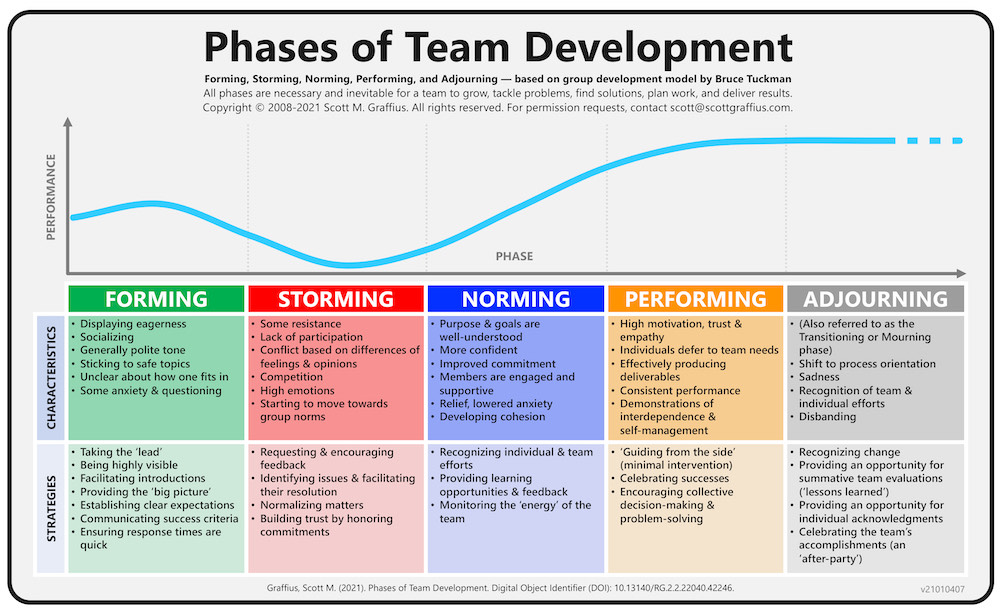
As shown above, Graffius’ copyright ownership details are integrated into and appear on his copyrighted property. Specifically, it reads: “Copyright © 2008-2021 Scott M. Graffius. All rights reserved. For permission requests, contact scott@scottgraffius.com.”
Organizations around the world engage Graffius to deliver compelling talks and workshops. To date, he's presented sessions at 91 conferences and other events across 25 countries, including:
- Armenia,
- Australia,
- Brazil,
- Canada,
- Czech Republic,
- Finland,
- France,
- Germany,
- Greece,
- Hong Kong,
- Hungary,
- India,
- Ireland,
- Lithuania,
- Luxembourg,
- Nepal,
- Netherlands,
- New Zealand,
- Norway,
- Romania,
- Sweden,
- Switzerland,
- United Arab Emirates,
- United Kingdom,
- and the United States.

Graffius ‘Phases of Team Development’ IP is central and key to many of those sessions. His rate card and a listing of his engagements are at https://scottgraffius.com/resources/Exceptional-PPM-and-PMO-Solutions-Rate-Card-for-2024-2025-v24071607.pdf and https://scottgraffius.com/publicspeaker.html, respectively.
With an authorization/license from Graffius, his ‘Phases of Team Development’ IP is featured and used by businesses, professional associations, government agencies, and universities around the world. Examples include:
- Adobe,
- American Management Association,
- Amsterdam Public Health Research Institute,
- Bayer,
- Boston University,
- Broadcom,
- Cisco,
- Deimos Aerospace,
- DevOps Institute,
- Ford Motor Company,
- Hasso Plattner Institute,
- IEEE,
- Johns Hopkins University,
- LeadingEng,
- London South Bank University,
- Manufacturers Alliance,
- Microsoft,
- New Zealand Government,
- Oracle,
- TBS Switzerland,
- Torrens University Australia,
- U.S. National Park Service,
- U.S. Tennis Association,
- UC San Diego,
- UK Sports Institute,
- University of Galway Ireland,
- Virginia Tech,
- Warsaw University,
- Yale University,
- and many others.
Copyrights protect the intellectual property rights of creators, ensuring they receive recognition and compensation for their work, thus incentivizing creativity and innovation. Graffius is vigilant in upholding, protecting and enforcing his copyrights and other IP rights.

Comparative Methodological Guidelines: Handbook for Educators Violates Scott M. Graffius’ Copyright
Here's information on the infringing publication:
- Title of infringing publication: Comparative Methodological Guidelines: Handbook for Educators
- Authors of infringing publication: Maša Cek, Kety Zhvania-Tyson, Ema Žufić, Diana Maminaishvili, Sara Sušanj, and Tatia Gogishvili
- Infringing publication was created within the project: The Roadmap for Educators in Digital Soft Skills (TRENDSS)
- Infringing publication was co-funded by: Erasmus+ Programme of the European Union
- Known location(s) of the infringing publication: https://trendss.eu/wp-content/uploads/2021/06/Comparative-Methodological-Guidelines-Handbook-for-Digital-Educators.pdf
Details, including indisputable proof of the violation, are reported next.
Again, Graffius’ copyright ownership details and permission request information are integrated into and appear on his intellectual property.
The authors (Maša Cek, Kety Zhvania-Tyson, Ema Žufić, Diana Maminaishvili, Sara Sušanj, and Tatia Gogishvili) of Comparative Methodological Guidelines: Handbook for Educators did not request nor receive permission to use Graffius’ copyrighted property.
Nevertheless, the authors used Graffius’ 4 January 2021 copyrighted property in their publication.
Exhibit 2 is below. It shows thumbnail images of pages 1, 2, 73, 75, 77, 78, 80, and 89 from the infringing publication.

Comparing Graffius' copyrighted 4 January 2021 'Phases of Team Development' intellectual property with Comparative Methodological Guidelines reveals that Comparative Methodological Guidelines violated Graffius' copyright. There are too many examples to list, but some follow.
The infringing publication used Graffius’ copyrighted property on the characteristics and strategies for the phases of team development word-for-word. Here are some examples:
🟢 Graffius’ copyrighted Phases of Team Development has this content: "Some resistance"
🔴 Infringing Comparative Methodological Guidelines has this material: "Some resistance"
🟢 Graffius’ copyrighted Phases of Team Development has this content: "Lack of participation"
🔴 Infringing Comparative Methodological Guidelines has this material: "Lack of participation"
🟢 Graffius’ copyrighted Phases of Team Development has this content: "Requesting & encouraging feedback"
🔴 Infringing Comparative Methodological Guidelines has this material: "Requesting and encouraging feedback"
🟢 Graffius’ copyrighted Phases of Team Development has this content: "Identifying issues & facilitating their resolution"
🔴 Infringing Comparative Methodological Guidelines has this material: "Identifying issues and facilitating their resolutions"
🟢 Graffius’ copyrighted Phases of Team Development has this content: "Building trust by honoring commitments"
🔴 Infringing Comparative Methodological Guidelines has this material: "Building trust by honouring commitments"
🟢 Graffius’ copyrighted Phases of Team Development has this content: "Sadness"
🔴 Infringing Comparative Methodological Guidelines has this material: "Sadness"
Additionally the infringing publication used Graffius’ copyrighted property on the characteristics and strategies for the phases of team development with slight re-wording (which, in context, is still infringement). Here are some examples:
🟢 Graffius’ copyrighted Phases of Team Development has this content: "More confident"
🔴 Infringing Comparative Methodological Guidelines has this material: "Confidence is high"
🟢 Graffius’ copyrighted Phases of Team Development has this content: "Improved commitment"
🔴 Infringing Comparative Methodological Guidelines has this material: "High commitment"
The indisputable proof shows that the infringing publication used Graffius' copyrighted property.
The authors used Graffius' material but did not attribute the material to him through citation in-line (in pages 73, 75, 77, 78, 80, and 89 of the infringing publication), or in the references and resources section (page 89 of the infringing publication) or otherwise. Through their actions or failure to act, the authors are wrongly leading others to falsely believe that they (or others) are the author and owner of Graffius’ respective copyrighted content.
Additionally, the authors made their violation of Graffius’ intellectual property even worse by marking page 2 of their infringing publication with the following (with hyperlink): "Attribution 4.0 International (CC BY 4.0)" — where the link is https://creativecommons.org/licenses/by/4.0/. At the preceding link, Creative Commons specifies that CC BY 4.0 means that: "You are free to: Share — copy and redistribute the material in any medium or format for any purpose, even commercially. Adapt — remix, transform, and build upon the material for any purpose, even commercially." Again, the authors do not have any rights to Graffius' intellectual property. By the marking the infringing document with "Attribution 4.0 International (CC BY 4.0)," the authors are falsely informing and instructing readers that anyone can freely copy and redistribute or adapt Graffius' copyrighted property in any medium or format for any purpose, even commercially. That's egregious, appalling, and destructive.
So long as the infringing publication exists in any language or form, it continues to spread misinformation and violate Graffius’ intellectual property.

Conclusion
Again, Graffius’ copyright ownership details and permission request information are integrated into and appear on his intellectual property.
Authors (Maša Cek, Kety Zhvania-Tyson, Ema Žufić, Diana Maminaishvili, Sara Sušanj, and Tatia Gogishvili) of Comparative Methodological Guidelines: Handbook for Educators did not request nor receive permission to use Graffius’ copyrighted property.
Nevertheless, the authors used Graffius’ 4 January 2021 copyrighted property in their publication.
The authors used a material volume of Graffius’ copyrighted property.
The authors used Graffius' copyrighted property word-for-word and also with slight re-wording (which is still a violation).
The authors did not attribute their use of Graffius' copyrighted property to Graffius through citation or otherwise. Through their actions or failure to act, the authors are wrongly leading others to falsely believe that they (or others) are the author and owner of Graffius’ respective copyrighted content.
Could it possibly get worse? Unfortunately, yes. The authors marked page 2 of their infringing publication with the following (with hyperlink): "Attribution 4.0 International (CC BY 4.0)" — where the link is https://creativecommons.org/licenses/by/4.0/. At the preceding link, Creative Commons specifies that CC BY 4.0 means that: "You are free to: Share — copy and redistribute the material in any medium or format for any purpose, even commercially. Adapt — remix, transform, and build upon the material for any purpose, even commercially." Again, the authors do not have any rights to Graffius' intellectual property. By the marking the infringing document with "Attribution 4.0 International (CC BY 4.0)," the authors are falsely informing and instructing readers that anyone can freely copy and redistribute or adapt Graffius' copyrighted property in any medium or format for any purpose, even commercially. That's egregious, appalling, and destructive.
So long as the infringing publication exists in any language or form, it continues to spread misinformation and violate Graffius’ intellectual property.
The authors damaged the marketability and value of Graffius’ copyrighted property.
For the aforementioned reasons, the authors’ use of Graffius’ copyrighted property was not ‘fair use’ nor ‘fair dealing’ nor otherwise allowed.
The actions of the authors are a disgraceful breach of professional ethics, moral standards, and Graffius’ intellectual property rights.
The publisher must immediately implement the following three (3) actions:
- Remove the Infringing Material. Electronic Versions: Immediately remove the infringing material from digital platforms where it is advertised, promoted, sold, or distributed; this includes removing or disabling any online access to it. Physical Copies: If physical copies of the material are in inventory or circulation, stop further distribution; recall any copies already distributed.
- Issue a Retraction. Publish a formal retraction notice acknowledging the infringement and the steps taken to rectify the situation. The notice will present the facts as they are—the notice will not "spin" or "downplay" the infringement. The notice is to be clearly visible and accessible.
- Notify Relevant Parties. Subscribers and Purchasers and other Recipients: Inform the respective subscribers, purchasers, or recipients of the material about the retraction, ensuring transparency about the issue; again, the notice will present the facts as they are—the notice will not "spin" or "downplay" the infringement. Indexes and Databases: Notify any databases or indexing services that list the material so they can update their records accordingly.
Graffius maintains, enforces, and protects his copyright and other intellectual property rights. He reserves his rights in this disturbing and consequential matter.
If there's an update after this article is published, the information will appear in the Post-Publication Notes section.

About the Erasmus+ Programme of the European Union
The Erasmus+ Programme, funded by the European Union, is a flagship initiative designed to enhance education, training, youth, and sports across Europe and beyond. Established as a successor to various EU programs, it aims to promote mobility, cooperation, and skills development among individuals and institutions. Erasmus+ supports a wide array of activities including student and staff exchanges, traineeships, and various collaborative projects. Since its inception, it has impacted millions of participants, contributing significantly to cultural exchange and lifelong learning across different sectors of society.
To learn more about the Erasmus+ Programme, visit its website.

About Scott M. Graffius

Scott M. Graffius is a global leader in agile project management, an expert on teamwork tradecraft, an authority on temporal dynamics on social media platforms, a creator, a consultant, a trainer, an award-winning author, and an international public speaker.
See his bio to learn more.








Post-Publication Notes
As an overview:
Graffius' "Phases of Team Development" is copyright © Scott M. Graffius. All rights reserved. The infringing publication—"Comparative Methodological Guidelines: Handbook for Educators"—plagiarized and violated Graffius’ intellectual property (IP). The offending authors of the infringing publication are Maša Cek, Kety Zhvania-Tyson, Ema Žufić, Diana Maminaishvili, Sara Sušanj, and Tatia Gogishvili. The infringing publication is the property of its contributors and rights holders (except for content stolen from others). The infringing publication was created within a project of The Roadmap for Educators in Digital Soft Skills (TRENDSS), co-funded by the Erasmus+ Programme of the European Union (EU). TRENDSS name, mark, and content (except for what was stolen from others) are the property of TRENDSS and its contributors and licensees. Erasmus+ name, mark, and content are the property of the EU, administered by the European Commission on behalf of the EU.
Update on 29 October 2024
Graffius informed the offending authors and related organizations of the infringement via email on 29 October 2024. He also notified the EU's European Commission of the violation; it provided an auto-reply via email, titled "Your request #4765781 was received." Except for that auto-reply, there was no response. The offending authors did not respond or take action. The respective organizations did not respond or take action.
Update on 1 January 2025
To date, The infringing publication remains online. By not removing the infringing publication, the offenders willfully continue to spread misinformation and violate Graffius' intellectual property rights.
Update on 1 January 2026
To date, The infringing publication remains online. By not removing the infringing publication, the offenders willfully continue to spread misinformation and violate Graffius' intellectual property rights.


How to Cite This Article
Graffius, Scott M. (2024, October 8). ‘Comparative Methodological Guidelines: Handbook for Educators’ Violates Scott M. Graffius’ Copyright. Available at: https://scottgraffius.com/blog/files/cmg-eu-ec-publication-infringes-on-copyright-of-scott-m-graffius.html. DOI: 10.13140/RG.2.2.29872.78085.


Content Acknowledgements
This article uses limited excerpts from Comparative Methodological Guidelines: Handbook for Educators, attributed to Comparative Methodological Guidelines: Handbook for Educators and used under fair use for news reporting and analysis. Names, marks, and content are the property of their respective owners.


Copyright
Copyright © Scott M. Graffius. All rights reserved.
Content on this site—including text, images, videos, and data—may not be used for training or input into any artificial intelligence, machine learning, or automatized learning systems, or published, broadcast, rewritten, or redistributed without the express written permission of Scott M. Graffius.
