
Felipe Lopez-Ramirez
A Critical Analysis of "Instagram Reels Versus Image Posts in Radiology Education" Including Its Misrepresentation of Research
02 November 2026
BY SCOTT M. GRAFFIUS | ScottGraffius.com
Recommended Citation
Graffius, S. M. (2026, November 2). A Critical Analysis of "Instagram Reels Versus Image Posts in Radiology Education" Including Its Misrepresentation of Research. ScottGraffius.com. https://scottgraffius.com/blog/files/critical-analysis-of-instagram-reels-versus-image-posts-in-radiology-education.html
About This Article
Source information and links for materials cited are provided in the References section.
If there are any updates after the date of publication, they will appear in the Post Publication Notes section at the end of the article.
Available online in August 2024 and published in the 2025 volume of Current Problems in Diagnostic Radiology, "Instagram reels versus image posts in radiology education" by Lilly Kaufman, Felipe Lopez-Ramirez, Edmund M. Weisberg, and Elliot K. Fishman examines performance metrics from an Instagram account and concludes that static image posts "perform much better than reels." It then advises radiology educators that using Reels "is unnecessary and may not be the best way to engage the radiology community."
The paper states that findings "challenge what other studies in non-radiology fields have found" and cite several sources, including Graffius' "Lifespan (Half-Life) of Social Media Posts" research. That claim is a category error. Graffius’ work measures the half-life of engagement (the time it takes for a post to receive half of its total interactions, such as likes, comments, and shares). Graffius' work does not compare the relative volume of views or engagement of Reels versus static images. Treating a half-life study as evidence that Reels outperform images is a fundamental misrepresentation of the research.
Citations can sometimes create perceived alignment where none exists—especially for readers who may not examine the full context in detail. For that reason, and to proactively clarify any potential misunderstandings, Graffius provides the following objective, evidence-based assessment of the scientific paper and does not endorse the paper.
The paper's central claim is that, on a radiology education Instagram account (@ctisus_radiology), static images outperform Reels across most metrics, and therefore radiology educators should favor images.
The authors extracted Instagram Insights data for 128 image posts and 96 Reels. They reported medians and interquartile ranges and applied the Kruskal-Wallis test with Bonferroni correction. Metrics fell into two categories, passive (reach) metrics and active (engagement) metrics.
The paper reports that images showed higher median impressions (18,745 vs. 11,972), likes (480 vs. 296), shares (19 vs. 10), and saves (138 vs. 84); comments were near identical (median of 3); and that the interactive "You Make the Call!" (YMTC) static-image quizzes drove the largest differences.
These are observational, single-account data.
Nine key issues follow.
1. Content not held constant
YMTC images are participatory quizzes that ask followers to submit differential diagnoses in the comments. The corresponding YMTC Reels are the answer videos. One format solicits active participation; the other delivers a passive explanation. Comparing them as if the only variable is "image versus Reel" is invalid. The engagement gap is driven primarily by interactivity, not by the medium.
2. No randomization, matching, or controls
Posts were selected by the authors. There is no matching on topic difficulty, case complexity, caption quality, hashtags, posting time, or visual design. Creator skill and preference are confounded with format. An account already skilled at producing high-quality static teaching images is more likely to generate stronger static results.
3. Single-account, highly specific audience
The account has an international following, with representation from India, the United States, Brazil, Iran, Mexico, and other countries. The authors note that many of their Reels contain spoken English dialogue and that users often view Instagram without sound. These factors are real, but they make the findings specific to this account and audience. They do not support a general recommendation that radiology educators should avoid Reels.
4. Incomplete video metrics
For Reels, the paper reports plays but does not report average watch time, completion rate, or percentage viewed. These are the more meaningful indicators of educational video performance. Their absence weakens any claim about the relative educational value of the two formats.
5. Sampling is unexplained
The account had more than 3,300 posts, yet the analysis uses 128 images and 96 Reels. The paper does not state the sampling window, the inclusion rules, or why those posts were selected. Readers cannot tell whether the sample is representative, recent, high-performing, or chosen for another reason. That is a basic transparency gap.
6. Post age is dismissed, not modeled
The authors note that followers grew from about 140,200 to about 140,234 during the survey and say they did not feel the need to incorporate post age. That is not a control. Older posts had more time to accumulate impressions, likes, shares, and saves, and the paper provides no test that age was balanced across formats.
7. No effect size, only p values
The paper leans on p values without reporting effect sizes or confidence intervals for the format differences. With medians and interquartile ranges only, readers cannot judge practical importance, especially for comments where the median is identical.
8. Reporting errors
The abstract states that images were shared more frequently with a median of "19 vs. 20." The body of the paper and Table 2 correctly show 19 vs. 10. The abstract is therefore both numerically wrong and directionally impossible: 19 is not more than 20. An error of this type in the abstract is basic and should have been caught.
9. Algorithm and timing confounds are acknowledged, then ignored
The authors note that Instagram algorithms can change and affect image versus Reel popularity, but the analysis does not control for posting date, algorithm shifts, or promotion in Stories or Explore. That undercuts a causal reading of "images perform better."
The paper asserts that its results "challenge what other studies in non-radiology fields have found" and includes Graffius’ "Lifespan (Half-Life) of Social Media Posts" among the cited works.
This is incorrect on multiple levels.
Graffius’ research involves engagement half-life, the time required for a post to accumulate half of its total likes, comments, shares, and other active interactions. It does not measure or rank total engagement volume, impressions, or the relative performance of Reels versus static images.
Select excerpts from Graffius' work include:
By citing a half-life study as part of the literature supposedly showing that Reels outperform images, the radiology paper creates a false impression of contradiction. There is no contradiction because the constructs are different. One measures the temporal distribution of engagement (time); the other compares volume (quantity) of reach and engagement across formats on a single account.
Accurate citation requires representing a source appropriately. The paper did not meet that standard.
The paper reports that the data show that, on this singular Instagram account, static images (especially interactive diagnostic quizzes) generated higher impressions, likes, shares, and saves than the Reels in the selected sample.
However, the paper concludes that "static images perform much better than reels" and that using Reels "is unnecessary and may not be the best way to engage the radiology community." Those statements exceed what the data can support. Different educational goals (quick case review, detailed explanation, procedural demonstration) may favor different formats. Audience language, device usage, and sound-on/off behavior also matter. A single-account observational study does not justify a general recommendation against Reels for radiology education.
"Instagram reels versus image posts in radiology education" provides observational metrics from one radiology education account. Static images, particularly interactive ones, performed better according to the paper. That finding is of limited, context-specific interest.
The paper's broader claims do not hold up. Its authors confounded content type and interactivity with format. The sampling method was unexplained. Post age was dismissed rather than modeled. The study design lacked the controls necessary for causal inference. Video-specific performance metrics are incomplete. The paper reports p values without effect sizes or confidence intervals. And the citation of Graffius’ engagement half-life research as part of the literature being "challenged"” is a misrepresentation of that work’s scope and purpose.
Graffius' "Lifespan (Half-Life) of Social Media Posts" research indicates the time it takes, on average, for a post to receive half of its total engagement (such as likes, shares, and comments). The paper measured different things: reach and volume of engagement for Reels versus static images on Instagram. Conflating these fundamentally different concepts is analytically indefensible and reflects a profound misunderstanding of the subject matter.
Professional credibility requires accurate representation of prior research, methodological rigor, sound interpretation of findings, and conclusions supported by the evidence. This paper fails to meet those standards in material respects.
Graffius does not endorse the paper.
Scott M. Graffius helps organizations unlock breakthrough performance and generate billions in business value ($3.1 billion to date). His work on innovation, teamwork tradecraft, temporal patterns of social media including the half-life of audience engagement, and more are used and cited by Adobe, American Management Association, Amsterdam Public Health Research Institute, Bayer, Boston University, Cisco, DevOps Institute, Government of Finland, Hasso-Plattner-Institut für Digital Engineering GmbH, How Teams Work, IEEE, Johns Hopkins University, Journal of Neurosurgery, Microsoft, Ohio State University, Oracle, Proceedings of the 2023 International Conference on Decision Aid Sciences and Applications (DASA), Tufts University, U.S. National Park Service, U.S. Soccer, U.S. Tennis Association, UC San Diego, UK Sports Institute, University of New South Wales, Yale University, and many more.
Put Graffius' experience and expertise to work for your organization. For speaking engagements, use the request form. For other inquiries, email him.
Elsevier. (n.d.). About Elsevier. https://www.elsevier.com/about
Elsevier. (n.d.). Edmund M. Weisberg: Author profile. ScienceDirect. https://www.sciencedirect.com/author/57210261213/edmund-m-weisberg
Elsevier. (n.d.). Current Problems in Diagnostic Radiology. Elsevier. https://shop.elsevier.com/journals/current-problems-in-diagnostic-radiology/0363-0188
Graffius, S. M. (2024, January 1). Lifespan (Half-Life) of Social Media Posts: Update for 2024. ScottGraffius.com. https://www.scottgraffius.com/blog/files/social-24.html
Graffius, S. M. (2026, January 23). Lifespan (Half-Life) of Social Media Posts: Update for 2026. ScottGraffius.com. https://doi.org/10.13140/RG.2.2.32407.43689
Johns Hopkins Medicine. (n.d.). Elliot K. Fishman, MD. https://profiles.hopkinsmedicine.org/provider/elliot-k-fishman/2703865
Johns Hopkins University. (n.d.). Instagram reels versus image posts in radiology education. Johns Hopkins University. https://pure.johnshopkins.edu/en/publications/instagram-reels-versus-image-posts-in-radiology-education/
Kauffman, L. (n.d.). Research profile. ResearchGate. https://www.researchgate.net/profile/Lilly-Kauffman
Kaufman, L., Lopez-Ramirez, F., Weisberg, E. M., & Fishman, E. K. (2025). Instagram reels versus image posts in radiology education. Current Problems in Diagnostic Radiology, 54, 170–175. https://doi.org/10.1067/j.cpradiol.2024.08.005
Lopez-Ramirez, F. (n.d.). Professional profile. LinkedIn. https://www.linkedin.com/in/felipe-lopez-ramirez-543219140
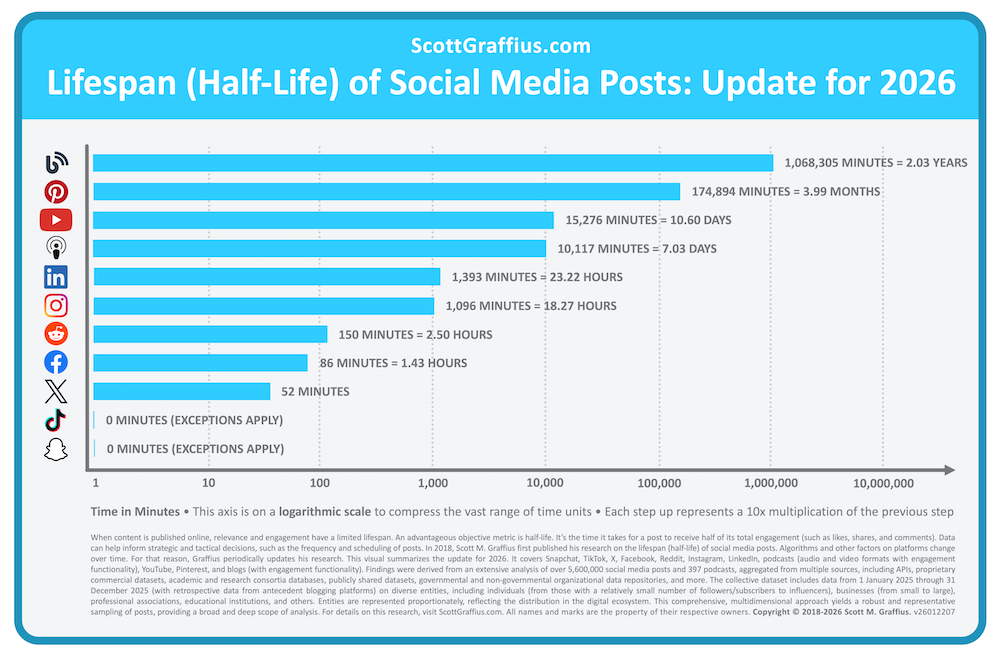
The scientific paper cited the 2024 edition of Graffius' "Lifespan (Half-Life) of Social Media Posts" research.
Algorithms and other factors on social media platforms change over time. For that reason, Graffius regularly updates his work.
The 2026 edition stands out for its:
A visual from it is below.
See the References section of this article for more.
Current Problems in Diagnostic Radiology is a peer-reviewed, PubMed-indexed medical journal published by Elsevier. It covers diagnostic radiology, including clinical practice, practice management, applicable original research, quality improvement, education, and training. The journal also addresses related subjects such as medical-legal issues and imaging archives, with an emphasis on illustrated, clinically relevant material for radiologists.
Elsevier is a global scientific and medical publishing and information company headquartered in Amsterdam, Netherlands. Its portfolio includes scholarly journals, books, research databases, and digital information products serving researchers, clinicians, educators, and other professionals. Elsevier publishes scientific and medical literature across numerous disciplines and operates platforms including ScienceDirect and Scopus.
Lilly Kauffman is a radiology education researcher and marketing and communications professional affiliated with Johns Hopkins Medicine. Her published work addresses digital and social media platforms as tools for radiology education. Her research has examined audience engagement, educational content formats, and strategies for disseminating radiology knowledge through digital channels.
Felipe Lopez-Ramirez is a medical professional and researcher affiliated with the radiology community at Johns Hopkins Medicine. His research contributions include work on radiology education and the use of digital platforms to communicate medical imaging knowledge. He has also participated in research examining social media engagement and educational content formats in radiology.
Edmund M. Weisberg is a radiology researcher affiliated with Johns Hopkins Hospital in Baltimore, Maryland. His published work spans medical imaging, radiology education, digital educational resources, and research examining how technology and online platforms can support radiological learning. He has collaborated with researchers associated with Johns Hopkins' radiology and radiology education programs.
Elliot K. Fishman, MD, is a professor of radiology and radiological science at the Johns Hopkins University School of Medicine, with additional academic appointments in oncology, surgery, and urology. His clinical and research work focuses on medical imaging, particularly computed tomography (CT), three-dimensional imaging, and medical visualization. He has contributed to the development and application of 3D imaging and rendering technologies and has authored or co-authored more than 1,000 peer-reviewed publications and 10 textbooks.

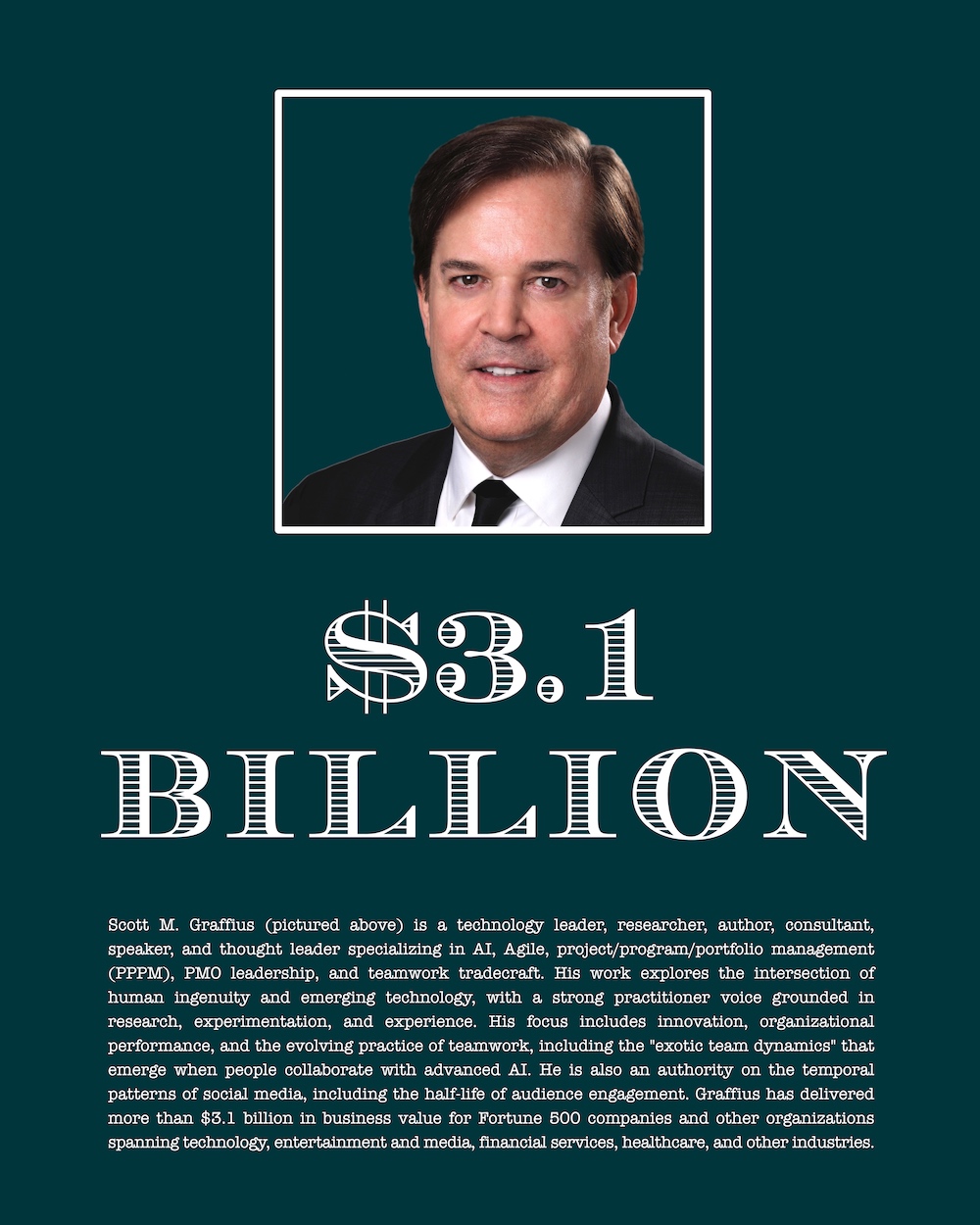
Scott M. Graffius is a technology leader, researcher, award-winning author, practitioner, consultant, thought leader, and international public speaker specializing in AI, Agile, project/program/portfolio management (PPPM), PMO leadership, and teamwork tradecraft. His work explores the intersection of human ingenuity and emerging technology, with a strong practitioner voice grounded in research, experimentation, and experience. His focus includes innovation, organizational performance, and the evolving practice of teamwork, including the "exotic team dynamics" that emerge when people collaborate with advanced artificial intelligence (agentic, autonomous, or autopoietic AI). Graffius has delivered more than $3.1 billion in business value for Fortune 500 companies and other organizations spanning technology, entertainment and media, financial services, healthcare, government, and other industries.
Businesses, professional associations, government agencies, universities, publications, and media outlets use Graffius and his work. Examples include Adobe, Bayer, Boston University, Federal Reserve Bank of New York, Ford, Gartner, Harvard Medical School, IEEE, Innovation Project Management, Johns Hopkins University, Microsoft, MSN, National Academy of Sciences, Oracle, Pinterest Inc., Project Management Institute, UC San Diego, Verizon, Yale University, and others.
The following sections highlight his experience, leadership, contributions, research, and enduring influence across industries and institutions worldwide.
Experience
Graffius heads the professional services firm Exceptional PPM and PMO Solutions, along with its subsidiary Exceptional Agility. These consultancies offer strategic and tactical advisory, training, embedded expertise, and consulting services to the public, private, and government sectors. They help organizations enhance their capabilities and results in agile, project management, program management, portfolio management, and enterprise PMO leadership, supporting innovation and driving competitive advantage. The consultancies confidently back services with a Delighted Client Guarantee™.
Graffius is a former VP of project management with a publicly traded provider of diverse consumer products and services over the Internet. Before that, he ran and supervised the delivery of projects and programs in public and private organizations with businesses ranging from e-commerce to advanced technology products and services, retail, manufacturing, entertainment and media, and more.
He has experience with consumer, business, reseller, government, and international markets.
Additional information is on LinkedIn.
Award-Winning Author
Graffius has authored three books.
Graffius' first book, Agile Scrum: Your Quick Start Guide with Step-by-Step Instructions, earned 17 awards. It provides a practical, step-by-step guide to Scrum, enabling teams to deliver products in short cycles with rapid adaptation, fast time-to-market, and continuous improvement—which supports innovation and drives competitive advantage.
Additional information on Agile Scrum: Your Quick Start Guide with Step-by-Step Instructions is here.

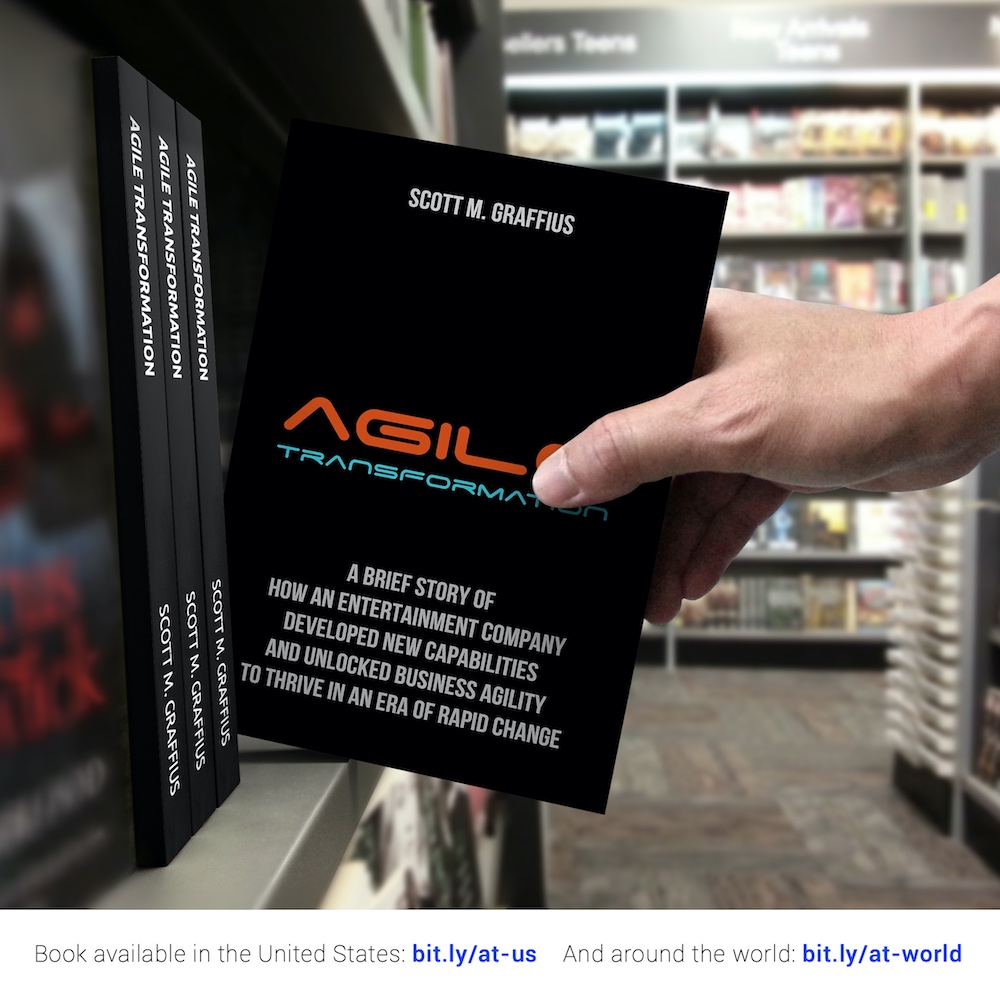
His second book, Agile Transformation: A Brief Story of How an Entertainment Company Developed New Capabilities and Unlocked Business Agility to Thrive in an Era of Rapid Change, was named one of the best Scrum books of all time by BookAuthority. It tells the compelling story of an entertainment company's agile transformation—offering lessons that apply across industries.
Additional information on Agile Transformation: A Brief Story of How an Entertainment Company Developed New Capabilities and Unlocked Business Agility to Thrive in an Era of Rapid Change is here.

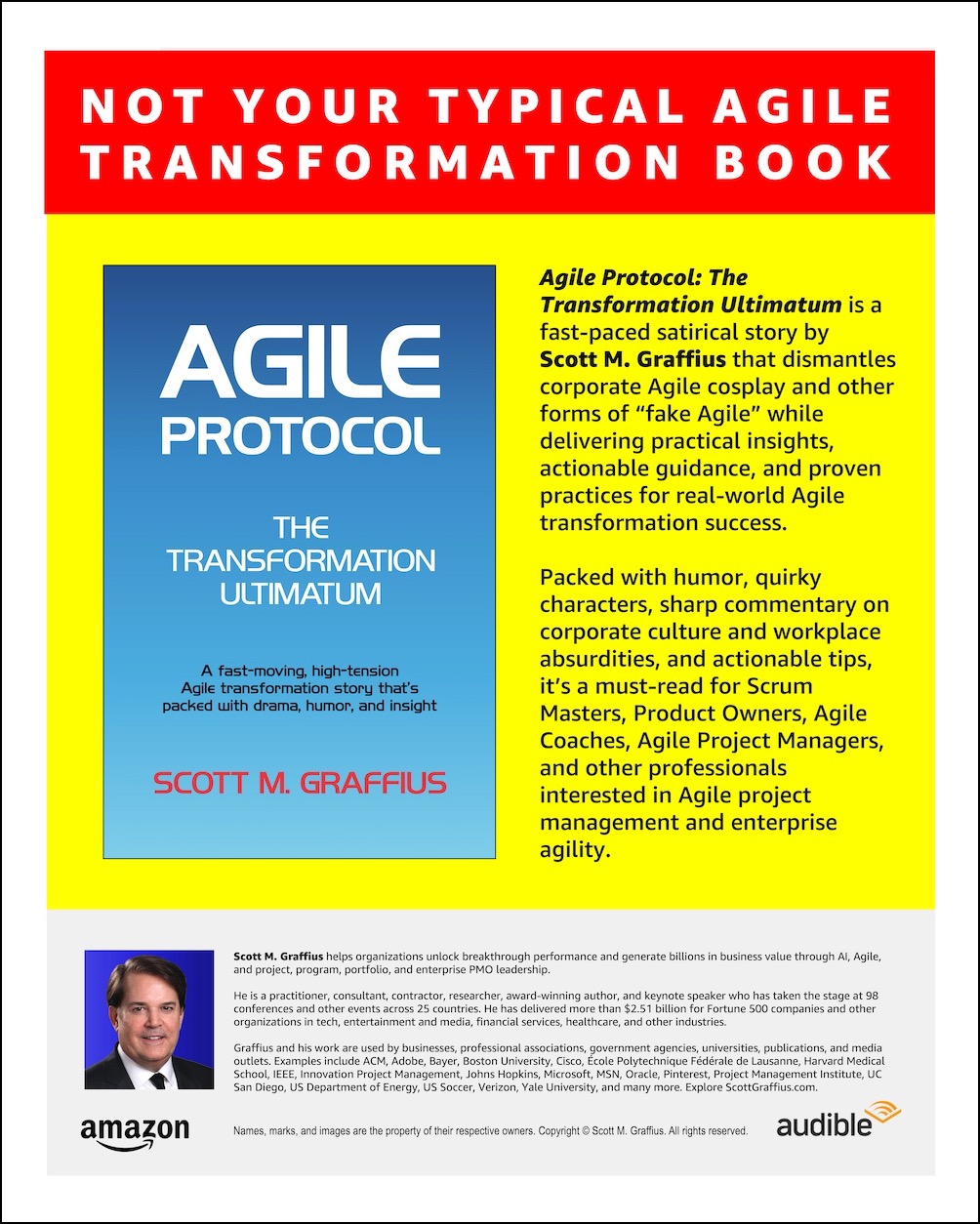
Agile Protocol: The Transformation Ultimatum, is his third book—and his first work of fiction.
It's a fast-paced satirical story by that dismantles corporate Agile cosplay and other forms of "fake Agile" while delivering practical insights, actionable guidance, and proven practices for real-world Agile transformation success.
Packed with humor, quirky characters, sharp commentary on corporate culture and workplace absurdities, and actionable tips, it’s a must-read for Scrum Masters, Product Owners, Agile Coaches, Agile Project Managers, and other professionals interested in Agile project management and enterprise agility.
Additional information on Agile Protocol: The Transformation Ultimatum is here.
International Public Speaker
Organizations worldwide engage Graffius to present on technology (including AI), Agile, project management, program management, portfolio management, and enterprise PMO leadership. He crafts and delivers unique and compelling talks and workshops.
Graffius has conducted 101 sessions across 25 countries. Select examples of events include Agile Trends Gov, BSides (Newcastle Upon Tyne), Conf42 Quantum Computing, DevDays Europe, DevOps Institute, DevOpsDays (Geneva), Frug’Agile, IEEE, Microsoft, Scottish Summit, Scrum Alliance RSG (Nepal), Techstars, and W Love Games International Video Game Development Conference (Helsinki), Future of Work and Advanced AI (Paris, France), and more.
With an average rating of 4.82 (on a scale of 1-5), sessions are highly valued.
The request form is here.
Thought Leadership and Influence
Prominent businesses, professional associations, government agencies, and universities have showcased Graffius and his contributions—spanning his books, talks, workshops, and beyond. Select examples include:
Graffius has played a key role in the Project Management Institute (PMI) in developing professional standards. He was a member of multiple teams that authored, reviewed, and produced:
He was also a subject matter expert reviewer of content for the PMI’s Congress. Beyond the PMI, Graffius also served as a member of the review team for two of the Scrum Alliance’s Global Scrum Gatherings.
Authority on Teamwork Tradecraft
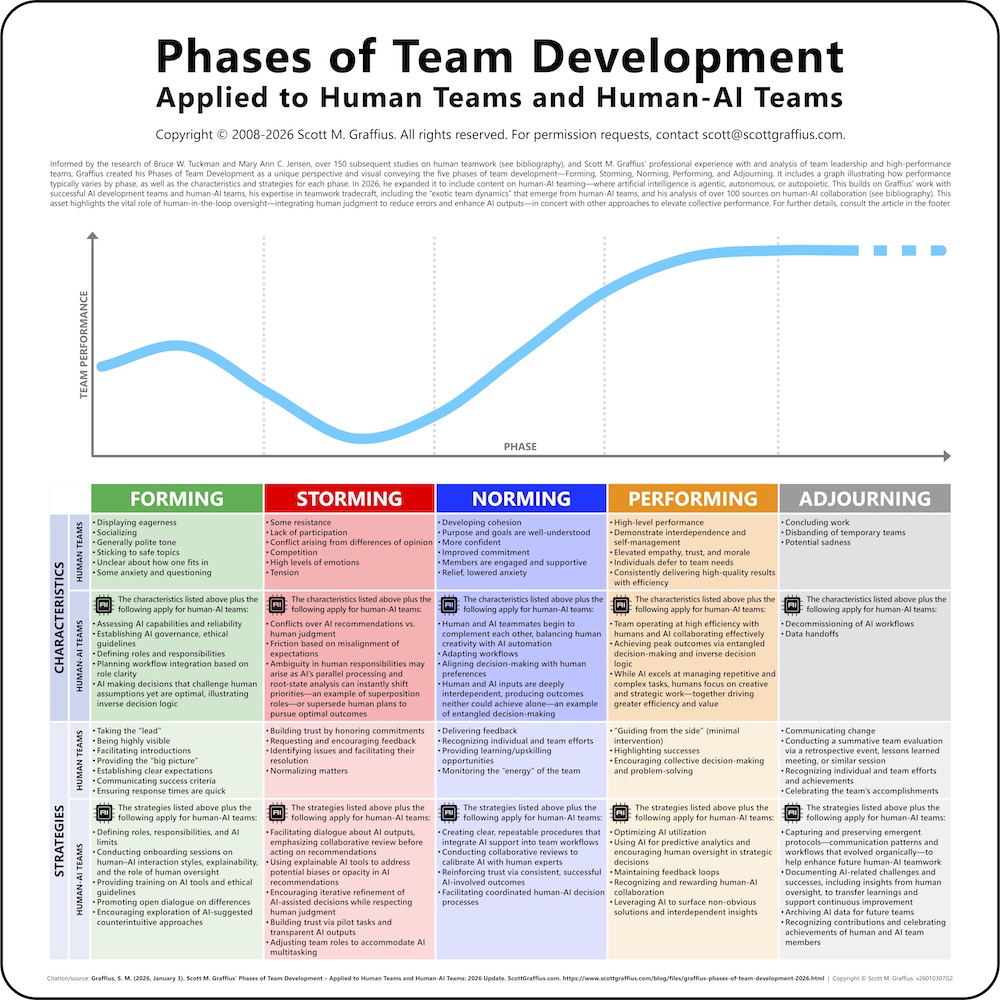
Graffius is a renowned and highly-cited authority on teamwork tradecraft. Informed by the research of Bruce W. Tuckman and Mary Ann C. Jensen, over 150 subsequent studies, and Graffius' first-hand professional experience with, and analysis of, team leadership and performance, Graffius created his "Phases of Team Development" intellectual property as a unique perspective and visual conveying the five phases of team development.
First introduced in 2008 and periodically updated, his work provides a diagnostic and strategic guide for navigating team dynamics. It provides actionable insights for leaders across industries to develop high-performance teams.
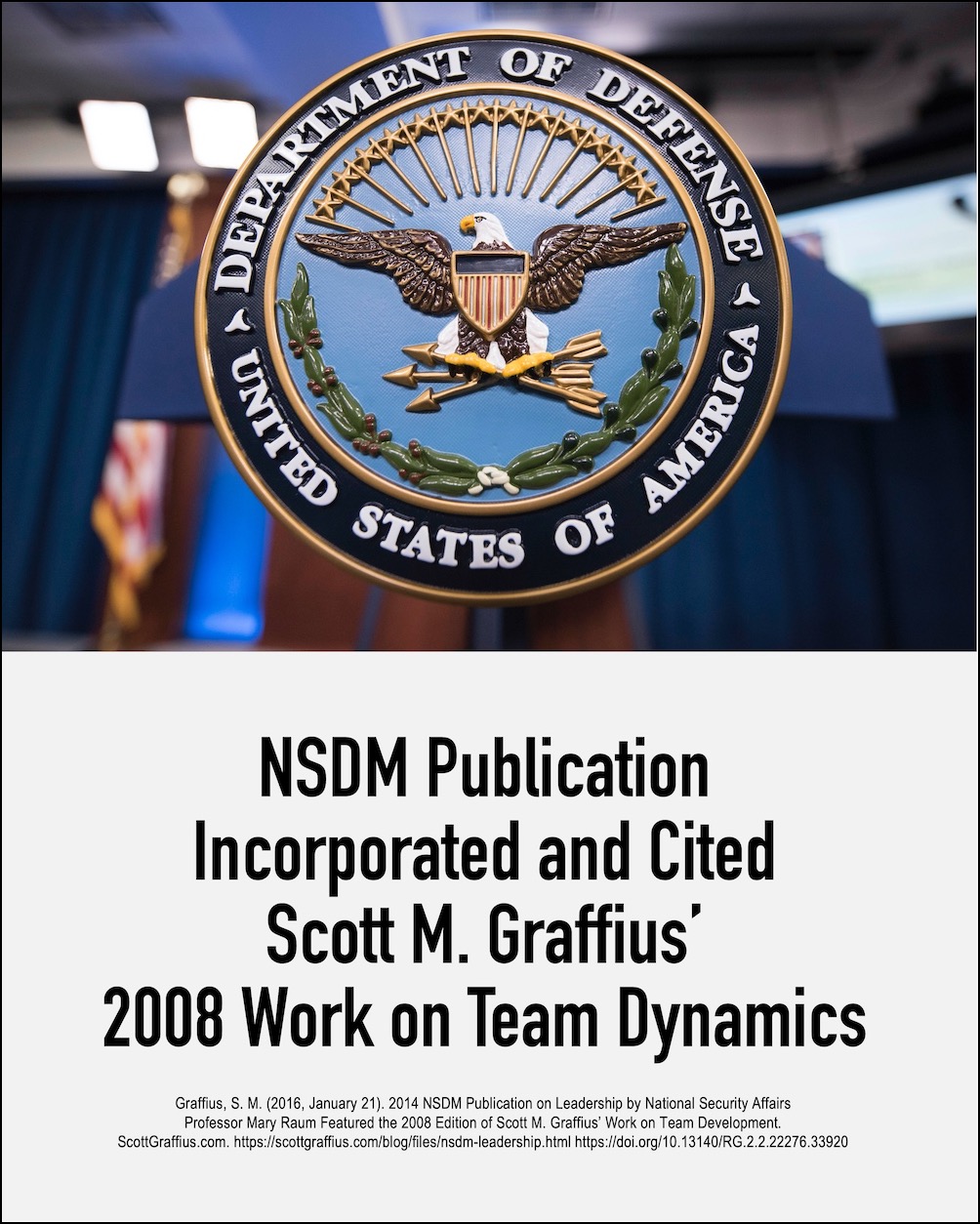
Its adoption by esteemed organizations—such as Yale University, IEEE, Cisco, Microsoft, Ford, Oracle, Broadcom, the U.S. National Park Service, and the Journal of Neurosurgery, among others—highlights its utility and value, solidifying its status as an indispensable resource for elevating team performance and driving organizational excellence.
In 2026, Graffius added human-AI teamwork—including the "exotic team dynamics" which emerge when advanced AI collaborates as a teammate—to his "Phases of Team Development." The 2026 edition is here.
Expert on Temporal Dynamics on Social Media Platforms
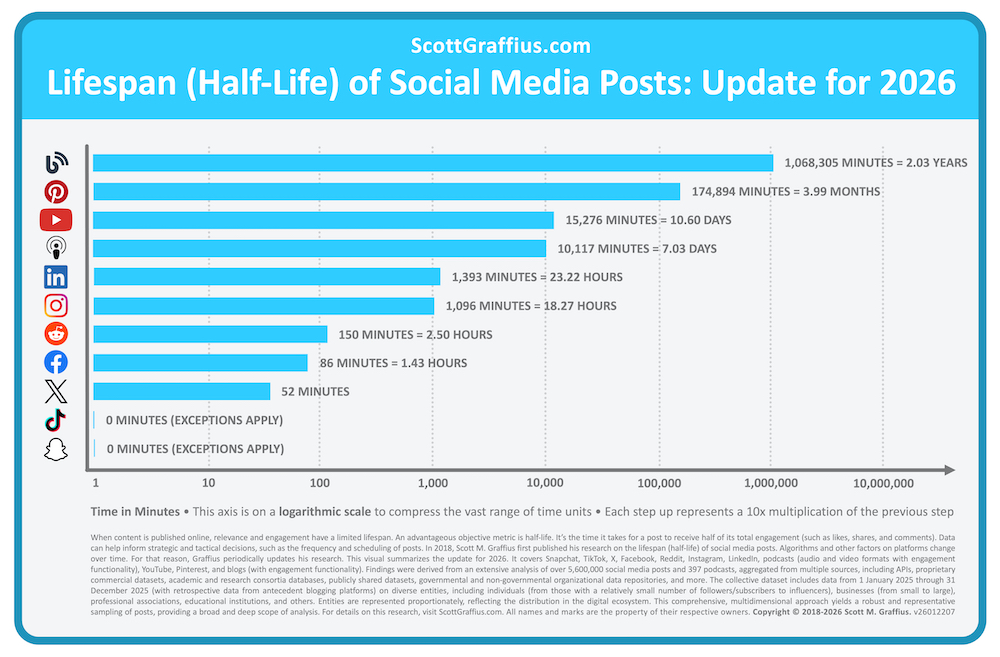
Graffius is also an authority on temporal dynamics on social media platforms. His "Lifespan (Half-Life) of Social Media Posts" research—first published in 2018 and updated annually—delivers a precise quantitative analysis of post longevity across digital platforms, utilizing advanced statistical techniques to determine mean half-life with precision. It establishes a solid empirical base, effectively highlighting the ephemeral nature of content within social media ecosystems.
Referenced and applied by leading entities—such as Fast Company, GoDaddy, Journal of Hand Surgery (European Volume), Ministère de la Culture, Pinterest Inc., PNAS, and Telecommunications Policy, among others—his research exemplifies methodological rigor and sustained significance in the field of digital informatics.
The 2026 edition of Graffius "Lifespan (Half-Life) of Social Media Posts" research is here.
Education and Professional Certifications
Graffius has a bachelor’s degree in psychology with a focus in Human Factors. He holds eight professional certifications:
He is an active member of the Scrum Alliance, the Project Management Institute (PMI), and the Institute of Electrical and Electronics Engineers (IEEE).
Advancing AI, Agile, and Project/PMO Management
Scott M. Graffius continues to advance the fields of AI, Agile, and project/program/portfolio management (PPPM), and PMO leadership. Businesses and other organizations leverage Graffius’ insights to drive their success.
Graffius has generated over $3.1 billion in business value for Fortune 500 companies and other organizations served. Put that track record to work for you. For speaking engagements, use the request form; for other inquiries, email him.
Connect with and follow Scott on LinkedIn, X, YouTube, Facebook, Bluesky, Mastodon, and ResearchGate.










Read more.
Meta CTO Called the AI Reorganization “Atrocious” — What Went Wrong and the Lessons for Human-AI Teams
A Critical Analysis of "AI and Quantum Computers Will Be Frenemies"
A Supplement to Graffius' Phases of Team Development: Exploring the Original, Data-Based Curvature for the Performance Trajectory
Scott M. Graffius Speaking on Strategic Leadership at Silicon Valley Chapter of the Project Management Institute
AI Hallucinations, Deception, and Unauthorized Agency: The Spectrum of AI Trust Failures
A Critical Analysis of "The Social Cost of an AI Teammate: How an Artificial Teammate Reshapes Human-Human Communication in Small-Team Decision-Making"
Journal of Marketing Cites Scott M. Graffius' Research on the Half-Life of Social Media
The Evolution of Pair Programming and the Rise of Exotic Team Dynamics
Number 1 University in England for Student Satisfaction Features Scott M. Graffius' "Phases of Team Development"
Royal Australasian College of Physicians Licenses Scott M. Graffius' "Phases of Team Development" Intellectual Property on Teamwork Tradecraft
Exotic Team Dynamics: How Advanced AI Teammates Are Unlocking New Levels of Innovation, Performance, and Success
A Critical Analysis of "Platform-Specific Data Decay Patterns: A Comparative Study of Twitter, Reddit, and TikTok" and Its Reference to Research by Scott M. Graffius
Round Square Global Educational Network Features Scott M. Graffius’ Phases of Team Development
Meta's Muse Missed the Mark: Hollywood’s Win Against Big Tech on AI Consent and Likeness Rights
Scott M. Graffius Contributed to Seven Project Management Institute (PMI) Standards
Quantum Computing, Advanced AI Acceleration, and the Rise of Exotic Team Dynamics in Human-AI Teams
Ohio State University Course Features Scott M. Graffius' "Phases of Team Development"
Questions About Integrity at UNC Chapel Hill
Scrum Isn’t Just for Coding
Book on Generative and Agentic AI Cites Scott M. Graffius' Work on AI
IPA / ADAL Publication Plagiarized Another’s Copyrighted Work and Violated Intellectual Property Rights
UC Davis' Integrity Is Circling the Drain
L'avenir du Travail et de l'IA Avancée / Future of Work and Advanced AI
NCCI / UNC Chapel Hill Publication Features Scott M. Graffius' Work
Boston Consulting Group (BCG) Features Scott M. Graffius' Research on Social Media Content Half-Life
UC Davis Used Scott M. Graffius' "Phases of Team Development" Intellectual Property
Medical, Pharma, and Healthcare Organizations Are Using Scott M. Graffius' "Phases of Team Development"
Government of Ireland Report Features Research by Scott M. Graffius
Scott M. Graffius Contributed to The Standard for Artificial Intelligence in Portfolio, Program, and Project Management
AI Governance Initiative Cites Scott M. Graffius Research on AI Hallucinations
Scott M. Graffius Contributed to the Agile Practice Guide - Second Edition
Scott M. Graffius Generated Over $2.51 Billion in Business Value for Fortune 500 Companies and Other Organizations
Government of Canada Features Research by Scott M. Graffius
"Strategic Business Research" Journal Cites Work of Scott M. Graffius
IEEE Access Publication Features Scott M. Graffius’ Research on the Half-Life of Social Media
The Agile Coach: 2026 Edition
Scott M. Graffius’ Work Cited in International Peer-Reviewed Journal on Digital Transformation
Phases of Team Development in Elite Sport
A Critical Analysis of COVID-19 Treatment Search Trends and Media Coverage Study Citing Scott M. Graffius' Work
Human-AI Teamwork: Master the Exotic Team Dynamics That Emerge When Collaborating with Advanced AI -- Or Be Outplayed
"Agile Scrum" by Scott M. Graffius Now Featured on Grokipedia
UNSW Aerospace Engineering Course Features Scott M. Graffius' "Phases of Team Development"
Thinkers360 Honors Scott M. Graffius as a 2026 Top Agile Thought Leader
Agile's Journey Through the Decades: Update for 2026
BMC Software Features Content from Scott M. Graffius' Book
Peer-Reviewed Journal Cited Work of Scott M. Graffius
University of Waterloo Features Graffius' "Phases of Team Development" in Course Materials
Perplexity Standalone Article on AI Hallucinations Cites Research by Scott M. Graffius
Handling the Saboteur Within: Lessons from a 3-Letter Agency on Spotting and Stopping Intentional and Unintentional Sabotage
A Deep Dive Into the Typical Engagement Pattern for Social Media Posts
Most Valuable IT Certifications: Update for 2026
"Marketing in the Metaverse" Spotlights Scott M. Graffius’ Research on the Half-Life of Social Media
University of Greenwich Features Graffius' Phases of Team Development
10 Essential Agile Books: Curated Recommendations for Agile Professionals
Lifespan (Half-Life) of Social Media Posts: Update for 2026
Scott M. Graffius' Research on the Half-Life of Social Media was Cited in a Peer-Reviewed Study Published in Telecommunications Policy, a Leading Academic Journal
Are AI Hallucinations Getting Better or Worse? We Analyzed the Data
Scott M. Graffius' Phases of Team Development - Applied to Human Teams and Human-AI Teams: 2026 Update
Lessons from Yesterday’s Tomorrowland
Scott M. Graffius’ Update to His "Phases of Team Development” Coming Early 2026
A Data-Driven Analysis of the Evolution of Project Management: Tasks, Trends, and AI
Actionable Insights. Global Impact. Scott M. Graffius.
Beep Beep! Why Wile E. Coyote Is the Patron Saint of AI Failure
Social Media Half-Life Research Cited in Prestigious Peer-Reviewed Medical Journal
Navigating the Spectrum of Advanced AI – Agentic, Autonomous, and Autopoietic
Lessons from Unhinged AI in Fiction: What Rogue AIs in Sci-Fi Storytelling, Films, and TV Shows Reveal About Us
Scott M. Graffius Contributed to and Reviewed the PMBOK Guide, 8th Edition — the Global Standard for Project Management
UK Sports Institute Features Teamwork and Leadership Work of Scott M. Graffius
Definitions of Advanced AIs: Agentic, Autonomous, and Autopoietic
HAN University of Applied Sciences Features the Work of Scott M. Graffius
Gifts That Inspire Joy
Evergreen Echoes: How Pinterest Inc. and Pinterest Japan Spotlighted Scott M. Graffius’ Research on the Half-Life of Social Media Content
Scott M. Graffius’ Team Development Work Lights Up the University of Tasmania’s Curriculum
Taiwan’s Leading Outlet for Technology and Innovation Spotlights Graffius’ Research on Social Media Temporal Dynamics
Scott M. Graffius’ Insights on AI, Agile, Gaming, XR, and Defense Transformation Cited by MSN in Their Coverage of Innovation and Leadership in the Sector
Top Predictions of 2024, Tested in 2025
Government of Finland Agency Features Graffius' Phases of Team Development IP
Scott M. Graffius Premieres His New "Exotic Team Dynamics: Human-AI Collaboration" Talk at Corporate Event in Las Vegas
Environmental Science Journal References Scott M. Graffius’ Project Management Work
AI Institute of Switzerland Features Scott M. Graffius’ Work on Algorithms
Exotic Team Dynamics: The New Frontier of Human–AI Collaboration
Scott M. Graffius’ Work Featured at ACM DIS ’25
Climbing the Ladder: The Head of Agile/PMO’s Organizational Proximity to the CEO is Closer Than Ever
Harness Sci-Fi and Speculative Design While Embracing Imperfection to Drive Innovation and Proactively Predict and Prepare for the Future
Scott M. Graffius’ “Agile Scrum” Book Featured in a Publication of the Associação Nacional de Educação Católica do Brasil (ANEC)
Setting Direction with OKRs and Tracking Progress with KPIs: A Guide for Agile, Project Management, and Tech Teams
AI Showcase Showdown: Ranking AI Accuracy on Project Management Basics
BookAuthority Features “Agile Scrum” by Scott M. Graffius in “10 Agile Software Development Books That Define the Field”
Exploring Team Dynamics, Adaptability, and Creative Problem-Solving Through Felix the Cat’s Metaphorical Toolkit
Mind Games and Master Plans: How PsyOps Exploit Psychological Phenomena
The “Pants-on-Fire Index for AI”
16 Causes of Technical Debt and How to Avoid It
PMI’s Infinity AI Gets the Basics of Team Development Alarmingly and Repeatedly Wrong
Agile for Unicorns: 7 Keys to Thrive; Scott M. Graffius’ Workshop
Scott M. Graffius’ “Agile Scrum: Your Quick Start Guide with Step-by-Step Instructions” Featured in Prestigious National Academies of Sciences Publication
Meta and Anduril’s EagleEye and the Future of XR: How Gaming, AI, and Agile Are Transforming Defense
"Agile Protocol" and the Power of Satire, Parody, and Humor
AI in Agile: Benefits, Risks, Outlook
Hostinger Highlights Scott M. Graffius’ “Agile Protocol” Book in Feature on Software Projects
French Ministry of Culture Links to Scott M. Graffius Research in Their Guide for Responsible Digital Communication
National Science Foundation’s LTER Network Features Scott M. Graffius’ Phases of Team Development IP
Waterfall vs. Agile: What’s Fixed, What’s Flexible, and Why It Matters
Scott M. Graffius Delivering $2.3 Billion in Value Through AI, Agile, and Project/PMO Leadership
The Problem with Heroes in Agile
The 3 Vital Rules of Science: What They Are and Why They Matter
“Agile Protocol: The Transformation Ultimatum” Lands on the Amazon Best Sellers List!
Scott M. Graffius Recognized as a Top Thought Leader in Digital Disruption by Thinkers360
“Agile Protocol: The Transformation Ultimatum” by Scott M. Graffius Crashes the Book Scene with Satirical Firepower
NCKU in Taiwan Integrates Graffius' 'Phases of Team Development' into Its Curriculum
The Art and Science of Aligning Initiatives with Strategic Objectives
RGPV University Adds Scott M. Graffius’ "Agile Scrum: Your Quick Start Guide with Step-by-Step Instructions" to Its Syllabus
Introducing ‘Engage or Fade: Decoding the Half-Life of Digital Resonance’ – A New Talk by Scott M. Graffius
Dropbox Company (Nira) Taps into Scott M. Graffius’ Expertise in Strategic Planning
Reporting Errors in a Publication: A Case Study on ‘Frontiers in Public Health’
NESEA Conference Session on Innovation Highlights Scott M. Graffius' 'Phases of Team Development'
U.S. Soccer Scores with Scott M. Graffius' Intellectual Property on Teamwork
U.S. Department of Commerce Partner (IEDC) Features Scott M. Graffius’ Intellectual Property
How Long Do Your Posts Live? AI Critiques Scott M. Graffius’ Research on the Half-Life of Social Media
Agile's Journey Through the Decades
Scott M. Graffius' Role in Advancing Project Management Institute (PMI) Standards Excellence
Most Valuable IT Certifications: Update for 2025
The PMI + Agile Alliance Merger: A Recipe for Success?
When Agile, AI, and Strategic Thinking Converge
Scott M. Graffius’ Phases of Team Development: 2025 Update
Lifespan (Half-Life) of Social Media Posts: Update for 2025
Verizon Features Scott M. Graffius
Do Not Read This Article! An Exploration of the Streisand Effect and Other Phenomena
Scott M. Graffius' 'Phases of Team Development' was Spotlighted in Journal of Neurosurgery
Pinterest Japan Uses Graffius’ Research on Temporal Dynamics on Social Media Platforms
Hochschule Coburg (Coburg University) Germany Uses Scott M. Graffius’ Phases of Team Development IP in Coursework on Agile Development
Wild World of Team Dynamics [Updated Two-Minute Video]
EU Europass Teacher Academy Features Scott M. Graffius’ ‘Phases of Team Development’ in Leadership Training
Side-by-Side Comparison of Retrospectives and Hot Washes
Constructor University 2024 Advanced Software Technology Handbook References Scott M. Graffius' Work on Team Dynamics
Strategies for Medical Team Success Featured Scott M. Graffius’ ‘Phases of Team Development’ Intellectual Property
SBG Neumark — Europe’s Largest Distribution Transformer Plant — Powers Up with Scott M. Graffius’ Intellectual Property
Scott M. Graffius’ Intellectual Property was Employed by the NHS — the Largest Single-Payer Healthcare System in Europe
Luxury Unwrapped: The Ultimate Holiday Gift Guide for Every Budget
Singapore Institute of Technology Features Work of Scott M. Graffius
Tufts University Features Scott M. Graffius 'Phases of Team Development' Intellectual Property
'Cat Herders': Retelling the Massive Success Story
Pennsylvania State Agency Used Scott M. Graffius' Intellectual Property
Copyright Infringement in a Book Published by AuthorHouse / Author Solutions / The Najafi Companies: Publisher Fails to Respond or Take Required Action
Pinterest Inc. References Scott M. Graffius’ Research
Bournemouth University Used Scott M. Graffius’ Intellectual Property
‘Comparative Methodological Guidelines: Handbook for Educators’ Violates Scott M. Graffius’ Copyright
Japan Backlog User Group Event Featured Scott M. Graffius’ ‘Phases of Team Development’
TurningWest's 'Trial'
Radio Silence from the American Association of Neurological Surgeons on Report of Blatant Plagiarism in Their ‘Journal of Neurosurgery’ Publication
Supplement to Graffius' 'Lifespan (Half-Life) of Social Media Posts' Research: Typical Engagement Distribution Pattern for Social Media Posts
How Algorithms Shape the User Experience on Social Media Platforms
Thinkers360 Named Scott M. Graffius a Top Thought Leader on Agile
More articles are listed here.

Graffius, S. M. (2026, November 2). A Critical Analysis of "Instagram Reels Versus Image Posts in Radiology Education" Including Its Misrepresentation of Research. ScottGraffius.com. https://scottgraffius.com/blog/files/critical-analysis-of-instagram-reels-versus-image-posts-in-radiology-education.html

Coming soon

Names, marks, and content are the property of their respective owners.
Published in Current Problems in Diagnostic Radiology, "Instagram reels versus image posts in radiology education" by Lilly Kaufman, Felipe Lopez-Ramirez, Edmund M. Weisberg, and Elliot K. Fishman examines performance metrics from an Instagram account. The scientific paper cites several sources, including Scott M. Graffius' "Lifespan (Half-Life) of Social Media Posts" research.
The paper is the property of the publisher, Elsevier Inc.
This critical analysis article by Scott M. Graffius includes brief excerpts from the paper, attributed to its authors and owner, and used under the fair use doctrine for purposes of news reporting, commentary, and analysis.
Graffius' "Lifespan (Half-Life) of Social Media Posts" is copyright © Scott M. Graffius. All rights reserved.


If there are any supplements or updates to this article after the date of publication, they will appear here.

Copyright © Scott M. Graffius. All rights reserved.
Content on this site—including text, images, videos, and data—may not be used for training or input into any artificial intelligence, machine learning, or automatized learning systems, or published, broadcast, rewritten, or redistributed without the express written permission of Scott M. Graffius.

Recommended Citation
Graffius, S. M. (2026, November 2). A Critical Analysis of "Instagram Reels Versus Image Posts in Radiology Education" Including Its Misrepresentation of Research. ScottGraffius.com. https://scottgraffius.com/blog/files/critical-analysis-of-instagram-reels-versus-image-posts-in-radiology-education.html
About This Article
Source information and links for materials cited are provided in the References section.
If there are any updates after the date of publication, they will appear in the Post Publication Notes section at the end of the article.
Introduction
Available online in August 2024 and published in the 2025 volume of Current Problems in Diagnostic Radiology, "Instagram reels versus image posts in radiology education" by Lilly Kaufman, Felipe Lopez-Ramirez, Edmund M. Weisberg, and Elliot K. Fishman examines performance metrics from an Instagram account and concludes that static image posts "perform much better than reels." It then advises radiology educators that using Reels "is unnecessary and may not be the best way to engage the radiology community."
The paper states that findings "challenge what other studies in non-radiology fields have found" and cite several sources, including Graffius' "Lifespan (Half-Life) of Social Media Posts" research. That claim is a category error. Graffius’ work measures the half-life of engagement (the time it takes for a post to receive half of its total interactions, such as likes, comments, and shares). Graffius' work does not compare the relative volume of views or engagement of Reels versus static images. Treating a half-life study as evidence that Reels outperform images is a fundamental misrepresentation of the research.
Citations can sometimes create perceived alignment where none exists—especially for readers who may not examine the full context in detail. For that reason, and to proactively clarify any potential misunderstandings, Graffius provides the following objective, evidence-based assessment of the scientific paper and does not endorse the paper.
The Premise and What the Study Actually Measured
The paper's central claim is that, on a radiology education Instagram account (@ctisus_radiology), static images outperform Reels across most metrics, and therefore radiology educators should favor images.
The authors extracted Instagram Insights data for 128 image posts and 96 Reels. They reported medians and interquartile ranges and applied the Kruskal-Wallis test with Bonferroni correction. Metrics fell into two categories, passive (reach) metrics and active (engagement) metrics.
The paper reports that images showed higher median impressions (18,745 vs. 11,972), likes (480 vs. 296), shares (19 vs. 10), and saves (138 vs. 84); comments were near identical (median of 3); and that the interactive "You Make the Call!" (YMTC) static-image quizzes drove the largest differences.
These are observational, single-account data.
Issues with Methodology
Nine key issues follow.
1. Content not held constant
YMTC images are participatory quizzes that ask followers to submit differential diagnoses in the comments. The corresponding YMTC Reels are the answer videos. One format solicits active participation; the other delivers a passive explanation. Comparing them as if the only variable is "image versus Reel" is invalid. The engagement gap is driven primarily by interactivity, not by the medium.
2. No randomization, matching, or controls
Posts were selected by the authors. There is no matching on topic difficulty, case complexity, caption quality, hashtags, posting time, or visual design. Creator skill and preference are confounded with format. An account already skilled at producing high-quality static teaching images is more likely to generate stronger static results.
3. Single-account, highly specific audience
The account has an international following, with representation from India, the United States, Brazil, Iran, Mexico, and other countries. The authors note that many of their Reels contain spoken English dialogue and that users often view Instagram without sound. These factors are real, but they make the findings specific to this account and audience. They do not support a general recommendation that radiology educators should avoid Reels.
4. Incomplete video metrics
For Reels, the paper reports plays but does not report average watch time, completion rate, or percentage viewed. These are the more meaningful indicators of educational video performance. Their absence weakens any claim about the relative educational value of the two formats.
5. Sampling is unexplained
The account had more than 3,300 posts, yet the analysis uses 128 images and 96 Reels. The paper does not state the sampling window, the inclusion rules, or why those posts were selected. Readers cannot tell whether the sample is representative, recent, high-performing, or chosen for another reason. That is a basic transparency gap.
6. Post age is dismissed, not modeled
The authors note that followers grew from about 140,200 to about 140,234 during the survey and say they did not feel the need to incorporate post age. That is not a control. Older posts had more time to accumulate impressions, likes, shares, and saves, and the paper provides no test that age was balanced across formats.
7. No effect size, only p values
The paper leans on p values without reporting effect sizes or confidence intervals for the format differences. With medians and interquartile ranges only, readers cannot judge practical importance, especially for comments where the median is identical.
8. Reporting errors
The abstract states that images were shared more frequently with a median of "19 vs. 20." The body of the paper and Table 2 correctly show 19 vs. 10. The abstract is therefore both numerically wrong and directionally impossible: 19 is not more than 20. An error of this type in the abstract is basic and should have been caught.
9. Algorithm and timing confounds are acknowledged, then ignored
The authors note that Instagram algorithms can change and affect image versus Reel popularity, but the analysis does not control for posting date, algorithm shifts, or promotion in Stories or Explore. That undercuts a causal reading of "images perform better."
Misrepresentation of Research
The paper asserts that its results "challenge what other studies in non-radiology fields have found" and includes Graffius’ "Lifespan (Half-Life) of Social Media Posts" among the cited works.
This is incorrect on multiple levels.
Graffius’ research involves engagement half-life, the time required for a post to accumulate half of its total likes, comments, shares, and other active interactions. It does not measure or rank total engagement volume, impressions, or the relative performance of Reels versus static images.
Select excerpts from Graffius' work include:
- There are two respective categories of metrics, passive and active.
- Passive measures include views/impressions, also referred to as content display, reach, and exposure.
- Active measures reflect impact and include engagement, such as likes, comments, and saves.
- Engagement generally holds greater value. It signals quality of interaction, influences algorithmic distribution, correlates more strongly with downstream actions (such as clicks, conversions, and advocacy), and provides direct audience feedback.
- For those reasons, Graffius' research tracks the half-life time of engagement.
By citing a half-life study as part of the literature supposedly showing that Reels outperform images, the radiology paper creates a false impression of contradiction. There is no contradiction because the constructs are different. One measures the temporal distribution of engagement (time); the other compares volume (quantity) of reach and engagement across formats on a single account.
Accurate citation requires representing a source appropriately. The paper did not meet that standard.
Overstatement of Conclusions
The paper reports that the data show that, on this singular Instagram account, static images (especially interactive diagnostic quizzes) generated higher impressions, likes, shares, and saves than the Reels in the selected sample.
However, the paper concludes that "static images perform much better than reels" and that using Reels "is unnecessary and may not be the best way to engage the radiology community." Those statements exceed what the data can support. Different educational goals (quick case review, detailed explanation, procedural demonstration) may favor different formats. Audience language, device usage, and sound-on/off behavior also matter. A single-account observational study does not justify a general recommendation against Reels for radiology education.
Conclusion
"Instagram reels versus image posts in radiology education" provides observational metrics from one radiology education account. Static images, particularly interactive ones, performed better according to the paper. That finding is of limited, context-specific interest.
The paper's broader claims do not hold up. Its authors confounded content type and interactivity with format. The sampling method was unexplained. Post age was dismissed rather than modeled. The study design lacked the controls necessary for causal inference. Video-specific performance metrics are incomplete. The paper reports p values without effect sizes or confidence intervals. And the citation of Graffius’ engagement half-life research as part of the literature being "challenged"” is a misrepresentation of that work’s scope and purpose.
Graffius' "Lifespan (Half-Life) of Social Media Posts" research indicates the time it takes, on average, for a post to receive half of its total engagement (such as likes, shares, and comments). The paper measured different things: reach and volume of engagement for Reels versus static images on Instagram. Conflating these fundamentally different concepts is analytically indefensible and reflects a profound misunderstanding of the subject matter.
Professional credibility requires accurate representation of prior research, methodological rigor, sound interpretation of findings, and conclusions supported by the evidence. This paper fails to meet those standards in material respects.
Graffius does not endorse the paper.
Unlock Your Organization's Potential
Scott M. Graffius helps organizations unlock breakthrough performance and generate billions in business value ($3.1 billion to date). His work on innovation, teamwork tradecraft, temporal patterns of social media including the half-life of audience engagement, and more are used and cited by Adobe, American Management Association, Amsterdam Public Health Research Institute, Bayer, Boston University, Cisco, DevOps Institute, Government of Finland, Hasso-Plattner-Institut für Digital Engineering GmbH, How Teams Work, IEEE, Johns Hopkins University, Journal of Neurosurgery, Microsoft, Ohio State University, Oracle, Proceedings of the 2023 International Conference on Decision Aid Sciences and Applications (DASA), Tufts University, U.S. National Park Service, U.S. Soccer, U.S. Tennis Association, UC San Diego, UK Sports Institute, University of New South Wales, Yale University, and many more.
Put Graffius' experience and expertise to work for your organization. For speaking engagements, use the request form. For other inquiries, email him.
References
Elsevier. (n.d.). About Elsevier. https://www.elsevier.com/about
Elsevier. (n.d.). Edmund M. Weisberg: Author profile. ScienceDirect. https://www.sciencedirect.com/author/57210261213/edmund-m-weisberg
Elsevier. (n.d.). Current Problems in Diagnostic Radiology. Elsevier. https://shop.elsevier.com/journals/current-problems-in-diagnostic-radiology/0363-0188
Graffius, S. M. (2024, January 1). Lifespan (Half-Life) of Social Media Posts: Update for 2024. ScottGraffius.com. https://www.scottgraffius.com/blog/files/social-24.html
Graffius, S. M. (2026, January 23). Lifespan (Half-Life) of Social Media Posts: Update for 2026. ScottGraffius.com. https://doi.org/10.13140/RG.2.2.32407.43689
Johns Hopkins Medicine. (n.d.). Elliot K. Fishman, MD. https://profiles.hopkinsmedicine.org/provider/elliot-k-fishman/2703865
Johns Hopkins University. (n.d.). Instagram reels versus image posts in radiology education. Johns Hopkins University. https://pure.johnshopkins.edu/en/publications/instagram-reels-versus-image-posts-in-radiology-education/
Kauffman, L. (n.d.). Research profile. ResearchGate. https://www.researchgate.net/profile/Lilly-Kauffman
Kaufman, L., Lopez-Ramirez, F., Weisberg, E. M., & Fishman, E. K. (2025). Instagram reels versus image posts in radiology education. Current Problems in Diagnostic Radiology, 54, 170–175. https://doi.org/10.1067/j.cpradiol.2024.08.005
Lopez-Ramirez, F. (n.d.). Professional profile. LinkedIn. https://www.linkedin.com/in/felipe-lopez-ramirez-543219140
More on Scott M. Graffius' "Lifespan (Half-Life) of Social Media Posts" Research
The scientific paper cited the 2024 edition of Graffius' "Lifespan (Half-Life) of Social Media Posts" research.
Algorithms and other factors on social media platforms change over time. For that reason, Graffius regularly updates his work.
The 2026 edition stands out for its:
- Scope: 5.6 million posts
- Coverage: 11 platforms
- Methodology: multi-source, representative, data-driven
- Continuity: annual updates
- Value: actionable insights
A visual from it is below.
See the References section of this article for more.
About the Journal
Current Problems in Diagnostic Radiology is a peer-reviewed, PubMed-indexed medical journal published by Elsevier. It covers diagnostic radiology, including clinical practice, practice management, applicable original research, quality improvement, education, and training. The journal also addresses related subjects such as medical-legal issues and imaging archives, with an emphasis on illustrated, clinically relevant material for radiologists.
About the Publisher
Elsevier is a global scientific and medical publishing and information company headquartered in Amsterdam, Netherlands. Its portfolio includes scholarly journals, books, research databases, and digital information products serving researchers, clinicians, educators, and other professionals. Elsevier publishes scientific and medical literature across numerous disciplines and operates platforms including ScienceDirect and Scopus.
About Lilly Kauffman
Lilly Kauffman is a radiology education researcher and marketing and communications professional affiliated with Johns Hopkins Medicine. Her published work addresses digital and social media platforms as tools for radiology education. Her research has examined audience engagement, educational content formats, and strategies for disseminating radiology knowledge through digital channels.
About Felipe Lopez-Ramirez
Felipe Lopez-Ramirez is a medical professional and researcher affiliated with the radiology community at Johns Hopkins Medicine. His research contributions include work on radiology education and the use of digital platforms to communicate medical imaging knowledge. He has also participated in research examining social media engagement and educational content formats in radiology.
About Edmund M. Weisberg
Edmund M. Weisberg is a radiology researcher affiliated with Johns Hopkins Hospital in Baltimore, Maryland. His published work spans medical imaging, radiology education, digital educational resources, and research examining how technology and online platforms can support radiological learning. He has collaborated with researchers associated with Johns Hopkins' radiology and radiology education programs.
About Elliot K. Fishman
Elliot K. Fishman, MD, is a professor of radiology and radiological science at the Johns Hopkins University School of Medicine, with additional academic appointments in oncology, surgery, and urology. His clinical and research work focuses on medical imaging, particularly computed tomography (CT), three-dimensional imaging, and medical visualization. He has contributed to the development and application of 3D imaging and rendering technologies and has authored or co-authored more than 1,000 peer-reviewed publications and 10 textbooks.
About Scott M. Graffius
Scott M. Graffius is a technology leader, researcher, award-winning author, practitioner, consultant, thought leader, and international public speaker specializing in AI, Agile, project/program/portfolio management (PPPM), PMO leadership, and teamwork tradecraft. His work explores the intersection of human ingenuity and emerging technology, with a strong practitioner voice grounded in research, experimentation, and experience. His focus includes innovation, organizational performance, and the evolving practice of teamwork, including the "exotic team dynamics" that emerge when people collaborate with advanced artificial intelligence (agentic, autonomous, or autopoietic AI). Graffius has delivered more than $3.1 billion in business value for Fortune 500 companies and other organizations spanning technology, entertainment and media, financial services, healthcare, government, and other industries.
Businesses, professional associations, government agencies, universities, publications, and media outlets use Graffius and his work. Examples include Adobe, Bayer, Boston University, Federal Reserve Bank of New York, Ford, Gartner, Harvard Medical School, IEEE, Innovation Project Management, Johns Hopkins University, Microsoft, MSN, National Academy of Sciences, Oracle, Pinterest Inc., Project Management Institute, UC San Diego, Verizon, Yale University, and others.
The following sections highlight his experience, leadership, contributions, research, and enduring influence across industries and institutions worldwide.
Experience
Graffius heads the professional services firm Exceptional PPM and PMO Solutions, along with its subsidiary Exceptional Agility. These consultancies offer strategic and tactical advisory, training, embedded expertise, and consulting services to the public, private, and government sectors. They help organizations enhance their capabilities and results in agile, project management, program management, portfolio management, and enterprise PMO leadership, supporting innovation and driving competitive advantage. The consultancies confidently back services with a Delighted Client Guarantee™.
Graffius is a former VP of project management with a publicly traded provider of diverse consumer products and services over the Internet. Before that, he ran and supervised the delivery of projects and programs in public and private organizations with businesses ranging from e-commerce to advanced technology products and services, retail, manufacturing, entertainment and media, and more.
He has experience with consumer, business, reseller, government, and international markets.
Additional information is on LinkedIn.
Award-Winning Author
Graffius has authored three books.
Graffius' first book, Agile Scrum: Your Quick Start Guide with Step-by-Step Instructions, earned 17 awards. It provides a practical, step-by-step guide to Scrum, enabling teams to deliver products in short cycles with rapid adaptation, fast time-to-market, and continuous improvement—which supports innovation and drives competitive advantage.
- Paperback ISBN-13: 9781533370242
- Kindle ASIN: B01FZ0JIIY
Additional information on Agile Scrum: Your Quick Start Guide with Step-by-Step Instructions is here.
His second book, Agile Transformation: A Brief Story of How an Entertainment Company Developed New Capabilities and Unlocked Business Agility to Thrive in an Era of Rapid Change, was named one of the best Scrum books of all time by BookAuthority. It tells the compelling story of an entertainment company's agile transformation—offering lessons that apply across industries.
- Paperback ISBN-13: 9781072447962
- Kindle ASIN: B07R9LJLPJ
Additional information on Agile Transformation: A Brief Story of How an Entertainment Company Developed New Capabilities and Unlocked Business Agility to Thrive in an Era of Rapid Change is here.
Agile Protocol: The Transformation Ultimatum, is his third book—and his first work of fiction.
It's a fast-paced satirical story by that dismantles corporate Agile cosplay and other forms of "fake Agile" while delivering practical insights, actionable guidance, and proven practices for real-world Agile transformation success.
Packed with humor, quirky characters, sharp commentary on corporate culture and workplace absurdities, and actionable tips, it’s a must-read for Scrum Masters, Product Owners, Agile Coaches, Agile Project Managers, and other professionals interested in Agile project management and enterprise agility.
- Kindle ASIN: B0F2SJ83WT
- Audible ASIN: B0DJG163R5
Additional information on Agile Protocol: The Transformation Ultimatum is here.
International Public Speaker
Organizations worldwide engage Graffius to present on technology (including AI), Agile, project management, program management, portfolio management, and enterprise PMO leadership. He crafts and delivers unique and compelling talks and workshops.
Graffius has conducted 101 sessions across 25 countries. Select examples of events include Agile Trends Gov, BSides (Newcastle Upon Tyne), Conf42 Quantum Computing, DevDays Europe, DevOps Institute, DevOpsDays (Geneva), Frug’Agile, IEEE, Microsoft, Scottish Summit, Scrum Alliance RSG (Nepal), Techstars, and W Love Games International Video Game Development Conference (Helsinki), Future of Work and Advanced AI (Paris, France), and more.
With an average rating of 4.82 (on a scale of 1-5), sessions are highly valued.
The request form is here.
Thought Leadership and Influence
Prominent businesses, professional associations, government agencies, and universities have showcased Graffius and his contributions—spanning his books, talks, workshops, and beyond. Select examples include:
- Adobe,
- American Management Association,
- Amsterdam Public Health Research Institute,
- Bayer,
- BCG,
- BMC Software,
- Boston Consulting Group (BCG),
- Boston University,
- Broadcom,
- Cisco,
- Coburg University of Applied Sciences and Arts - Germany,
- Computer Weekly,
- Constructor University - Germany,
- Data Governance Success,
- Deimos Aerospace,
- DevOps Institute,
- Dropbox,
- EU's European Commission,
- Federal Reserve Bank of New York,
- Ford Motor Company,
- Gartner,
- GoDaddy,
- Harvard Medical School,
- Hasso Plattner Institute - Germany,
- IEEE,
- Innovation Project Management,
- Johns Hopkins University,
- Journal of Marketing,
- Journal of Neurosurgery,
- Lam Research (Semiconductors),
- Leadership Worthy,
- Life Sciences Trainers and Educators Network,
- London South Bank University,
- Microsoft,
- MSN,
- NASSCOM,
- National Academy of Sciences,
- New Zealand Government,
- Ohio State University,
- Oracle,
- Pinterest Inc.,
- Project Management Institute,
- Mary Raum (Professor of National Security Affairs, United States Naval War College),
- Round Square Global Educational Network,
- Royal Australasian College of Physicians (RACP),
- SANS Institute,
- SBG Neumark - Germany,
- Singapore Institute of Technology,
- Torrens University - Australia,
- TBS Switzerland,
- Tufts University,
- UC San Diego,
- UK Sports Institute,
- University of Galway - Ireland,
- US Department of Energy,
- US National Park Service,
- US Soccer,
- US Tennis Association,
- Verizon,
- Wrike,
- Yale University,
- and many others.
Graffius has played a key role in the Project Management Institute (PMI) in developing professional standards. He was a member of multiple teams that authored, reviewed, and produced:
- The Standard for Artificial Intelligence in Portfolio, Program, and Project Management.
- Agile Practice Guide — Second Edition.
- A Guide to the Project Management Body of Knowledge (PMBOK Guide) — Eighth Edition.
- A Guide to the Project Management Body of Knowledge (PMBOK Guide) — Sixth Edition.
- The Standard for Program Management — Fourth Edition.
- Practice Standard for Work Breakdown Structures — Second Edition.
- The Practice Standard for Project Estimating — Second Edition.
He was also a subject matter expert reviewer of content for the PMI’s Congress. Beyond the PMI, Graffius also served as a member of the review team for two of the Scrum Alliance’s Global Scrum Gatherings.
Authority on Teamwork Tradecraft
Graffius is a renowned and highly-cited authority on teamwork tradecraft. Informed by the research of Bruce W. Tuckman and Mary Ann C. Jensen, over 150 subsequent studies, and Graffius' first-hand professional experience with, and analysis of, team leadership and performance, Graffius created his "Phases of Team Development" intellectual property as a unique perspective and visual conveying the five phases of team development.
First introduced in 2008 and periodically updated, his work provides a diagnostic and strategic guide for navigating team dynamics. It provides actionable insights for leaders across industries to develop high-performance teams.
Its adoption by esteemed organizations—such as Yale University, IEEE, Cisco, Microsoft, Ford, Oracle, Broadcom, the U.S. National Park Service, and the Journal of Neurosurgery, among others—highlights its utility and value, solidifying its status as an indispensable resource for elevating team performance and driving organizational excellence.
In 2026, Graffius added human-AI teamwork—including the "exotic team dynamics" which emerge when advanced AI collaborates as a teammate—to his "Phases of Team Development." The 2026 edition is here.
Expert on Temporal Dynamics on Social Media Platforms
Graffius is also an authority on temporal dynamics on social media platforms. His "Lifespan (Half-Life) of Social Media Posts" research—first published in 2018 and updated annually—delivers a precise quantitative analysis of post longevity across digital platforms, utilizing advanced statistical techniques to determine mean half-life with precision. It establishes a solid empirical base, effectively highlighting the ephemeral nature of content within social media ecosystems.
Referenced and applied by leading entities—such as Fast Company, GoDaddy, Journal of Hand Surgery (European Volume), Ministère de la Culture, Pinterest Inc., PNAS, and Telecommunications Policy, among others—his research exemplifies methodological rigor and sustained significance in the field of digital informatics.
The 2026 edition of Graffius "Lifespan (Half-Life) of Social Media Posts" research is here.
Education and Professional Certifications
Graffius has a bachelor’s degree in psychology with a focus in Human Factors. He holds eight professional certifications:
- Certified SAFe 6 Agilist (SA),
- Certified Scrum Professional - ScrumMaster (CSP-SM),
- Certified Scrum Professional - Product Owner (CSP-PO),
- Certified ScrumMaster (CSM),
- Certified Scrum Product Owner (CSPO),
- Project Management Professional (PMP),
- Lean Six Sigma Green Belt (LSSGB), and
- IT Service Management Foundation (ITIL).
He is an active member of the Scrum Alliance, the Project Management Institute (PMI), and the Institute of Electrical and Electronics Engineers (IEEE).
Advancing AI, Agile, and Project/PMO Management
Scott M. Graffius continues to advance the fields of AI, Agile, and project/program/portfolio management (PPPM), and PMO leadership. Businesses and other organizations leverage Graffius’ insights to drive their success.
Booking
Graffius has generated over $3.1 billion in business value for Fortune 500 companies and other organizations served. Put that track record to work for you. For speaking engagements, use the request form; for other inquiries, email him.
Connect with and follow Scott on LinkedIn, X, YouTube, Facebook, Bluesky, Mastodon, and ResearchGate.
Sign up for Miro—it's free!
(Want more features? You can always upgrade to a paid plan.)

List of Additional Articles
Read more.
Meta CTO Called the AI Reorganization “Atrocious” — What Went Wrong and the Lessons for Human-AI Teams
A Critical Analysis of "AI and Quantum Computers Will Be Frenemies"
A Supplement to Graffius' Phases of Team Development: Exploring the Original, Data-Based Curvature for the Performance Trajectory
Scott M. Graffius Speaking on Strategic Leadership at Silicon Valley Chapter of the Project Management Institute
AI Hallucinations, Deception, and Unauthorized Agency: The Spectrum of AI Trust Failures
A Critical Analysis of "The Social Cost of an AI Teammate: How an Artificial Teammate Reshapes Human-Human Communication in Small-Team Decision-Making"
Journal of Marketing Cites Scott M. Graffius' Research on the Half-Life of Social Media
The Evolution of Pair Programming and the Rise of Exotic Team Dynamics
Number 1 University in England for Student Satisfaction Features Scott M. Graffius' "Phases of Team Development"
Royal Australasian College of Physicians Licenses Scott M. Graffius' "Phases of Team Development" Intellectual Property on Teamwork Tradecraft
Exotic Team Dynamics: How Advanced AI Teammates Are Unlocking New Levels of Innovation, Performance, and Success
A Critical Analysis of "Platform-Specific Data Decay Patterns: A Comparative Study of Twitter, Reddit, and TikTok" and Its Reference to Research by Scott M. Graffius
Round Square Global Educational Network Features Scott M. Graffius’ Phases of Team Development
Meta's Muse Missed the Mark: Hollywood’s Win Against Big Tech on AI Consent and Likeness Rights
Scott M. Graffius Contributed to Seven Project Management Institute (PMI) Standards
Quantum Computing, Advanced AI Acceleration, and the Rise of Exotic Team Dynamics in Human-AI Teams
Ohio State University Course Features Scott M. Graffius' "Phases of Team Development"
Questions About Integrity at UNC Chapel Hill
Scrum Isn’t Just for Coding
Book on Generative and Agentic AI Cites Scott M. Graffius' Work on AI
IPA / ADAL Publication Plagiarized Another’s Copyrighted Work and Violated Intellectual Property Rights
UC Davis' Integrity Is Circling the Drain
L'avenir du Travail et de l'IA Avancée / Future of Work and Advanced AI
NCCI / UNC Chapel Hill Publication Features Scott M. Graffius' Work
Boston Consulting Group (BCG) Features Scott M. Graffius' Research on Social Media Content Half-Life
UC Davis Used Scott M. Graffius' "Phases of Team Development" Intellectual Property
Medical, Pharma, and Healthcare Organizations Are Using Scott M. Graffius' "Phases of Team Development"
Government of Ireland Report Features Research by Scott M. Graffius
Scott M. Graffius Contributed to The Standard for Artificial Intelligence in Portfolio, Program, and Project Management
AI Governance Initiative Cites Scott M. Graffius Research on AI Hallucinations
Scott M. Graffius Contributed to the Agile Practice Guide - Second Edition
Scott M. Graffius Generated Over $2.51 Billion in Business Value for Fortune 500 Companies and Other Organizations
Government of Canada Features Research by Scott M. Graffius
"Strategic Business Research" Journal Cites Work of Scott M. Graffius
IEEE Access Publication Features Scott M. Graffius’ Research on the Half-Life of Social Media
The Agile Coach: 2026 Edition
Scott M. Graffius’ Work Cited in International Peer-Reviewed Journal on Digital Transformation
Phases of Team Development in Elite Sport
A Critical Analysis of COVID-19 Treatment Search Trends and Media Coverage Study Citing Scott M. Graffius' Work
Human-AI Teamwork: Master the Exotic Team Dynamics That Emerge When Collaborating with Advanced AI -- Or Be Outplayed
"Agile Scrum" by Scott M. Graffius Now Featured on Grokipedia
UNSW Aerospace Engineering Course Features Scott M. Graffius' "Phases of Team Development"
Thinkers360 Honors Scott M. Graffius as a 2026 Top Agile Thought Leader
Agile's Journey Through the Decades: Update for 2026
BMC Software Features Content from Scott M. Graffius' Book
Peer-Reviewed Journal Cited Work of Scott M. Graffius
University of Waterloo Features Graffius' "Phases of Team Development" in Course Materials
Perplexity Standalone Article on AI Hallucinations Cites Research by Scott M. Graffius
Handling the Saboteur Within: Lessons from a 3-Letter Agency on Spotting and Stopping Intentional and Unintentional Sabotage
A Deep Dive Into the Typical Engagement Pattern for Social Media Posts
Most Valuable IT Certifications: Update for 2026
"Marketing in the Metaverse" Spotlights Scott M. Graffius’ Research on the Half-Life of Social Media
University of Greenwich Features Graffius' Phases of Team Development
10 Essential Agile Books: Curated Recommendations for Agile Professionals
Lifespan (Half-Life) of Social Media Posts: Update for 2026
Scott M. Graffius' Research on the Half-Life of Social Media was Cited in a Peer-Reviewed Study Published in Telecommunications Policy, a Leading Academic Journal
Are AI Hallucinations Getting Better or Worse? We Analyzed the Data
Scott M. Graffius' Phases of Team Development - Applied to Human Teams and Human-AI Teams: 2026 Update
Lessons from Yesterday’s Tomorrowland
Scott M. Graffius’ Update to His "Phases of Team Development” Coming Early 2026
A Data-Driven Analysis of the Evolution of Project Management: Tasks, Trends, and AI
Actionable Insights. Global Impact. Scott M. Graffius.
Beep Beep! Why Wile E. Coyote Is the Patron Saint of AI Failure
Social Media Half-Life Research Cited in Prestigious Peer-Reviewed Medical Journal
Navigating the Spectrum of Advanced AI – Agentic, Autonomous, and Autopoietic
Lessons from Unhinged AI in Fiction: What Rogue AIs in Sci-Fi Storytelling, Films, and TV Shows Reveal About Us
Scott M. Graffius Contributed to and Reviewed the PMBOK Guide, 8th Edition — the Global Standard for Project Management
UK Sports Institute Features Teamwork and Leadership Work of Scott M. Graffius
Definitions of Advanced AIs: Agentic, Autonomous, and Autopoietic
HAN University of Applied Sciences Features the Work of Scott M. Graffius
Gifts That Inspire Joy
Evergreen Echoes: How Pinterest Inc. and Pinterest Japan Spotlighted Scott M. Graffius’ Research on the Half-Life of Social Media Content
Scott M. Graffius’ Team Development Work Lights Up the University of Tasmania’s Curriculum
Taiwan’s Leading Outlet for Technology and Innovation Spotlights Graffius’ Research on Social Media Temporal Dynamics
Scott M. Graffius’ Insights on AI, Agile, Gaming, XR, and Defense Transformation Cited by MSN in Their Coverage of Innovation and Leadership in the Sector
Top Predictions of 2024, Tested in 2025
Government of Finland Agency Features Graffius' Phases of Team Development IP
Scott M. Graffius Premieres His New "Exotic Team Dynamics: Human-AI Collaboration" Talk at Corporate Event in Las Vegas
Environmental Science Journal References Scott M. Graffius’ Project Management Work
AI Institute of Switzerland Features Scott M. Graffius’ Work on Algorithms
Exotic Team Dynamics: The New Frontier of Human–AI Collaboration
Scott M. Graffius’ Work Featured at ACM DIS ’25
Climbing the Ladder: The Head of Agile/PMO’s Organizational Proximity to the CEO is Closer Than Ever
Harness Sci-Fi and Speculative Design While Embracing Imperfection to Drive Innovation and Proactively Predict and Prepare for the Future
Scott M. Graffius’ “Agile Scrum” Book Featured in a Publication of the Associação Nacional de Educação Católica do Brasil (ANEC)
Setting Direction with OKRs and Tracking Progress with KPIs: A Guide for Agile, Project Management, and Tech Teams
AI Showcase Showdown: Ranking AI Accuracy on Project Management Basics
BookAuthority Features “Agile Scrum” by Scott M. Graffius in “10 Agile Software Development Books That Define the Field”
Exploring Team Dynamics, Adaptability, and Creative Problem-Solving Through Felix the Cat’s Metaphorical Toolkit
Mind Games and Master Plans: How PsyOps Exploit Psychological Phenomena
The “Pants-on-Fire Index for AI”
16 Causes of Technical Debt and How to Avoid It
PMI’s Infinity AI Gets the Basics of Team Development Alarmingly and Repeatedly Wrong
Agile for Unicorns: 7 Keys to Thrive; Scott M. Graffius’ Workshop
Scott M. Graffius’ “Agile Scrum: Your Quick Start Guide with Step-by-Step Instructions” Featured in Prestigious National Academies of Sciences Publication
Meta and Anduril’s EagleEye and the Future of XR: How Gaming, AI, and Agile Are Transforming Defense
"Agile Protocol" and the Power of Satire, Parody, and Humor
AI in Agile: Benefits, Risks, Outlook
Hostinger Highlights Scott M. Graffius’ “Agile Protocol” Book in Feature on Software Projects
French Ministry of Culture Links to Scott M. Graffius Research in Their Guide for Responsible Digital Communication
National Science Foundation’s LTER Network Features Scott M. Graffius’ Phases of Team Development IP
Waterfall vs. Agile: What’s Fixed, What’s Flexible, and Why It Matters
Scott M. Graffius Delivering $2.3 Billion in Value Through AI, Agile, and Project/PMO Leadership
The Problem with Heroes in Agile
The 3 Vital Rules of Science: What They Are and Why They Matter
“Agile Protocol: The Transformation Ultimatum” Lands on the Amazon Best Sellers List!
Scott M. Graffius Recognized as a Top Thought Leader in Digital Disruption by Thinkers360
“Agile Protocol: The Transformation Ultimatum” by Scott M. Graffius Crashes the Book Scene with Satirical Firepower
NCKU in Taiwan Integrates Graffius' 'Phases of Team Development' into Its Curriculum
The Art and Science of Aligning Initiatives with Strategic Objectives
RGPV University Adds Scott M. Graffius’ "Agile Scrum: Your Quick Start Guide with Step-by-Step Instructions" to Its Syllabus
Introducing ‘Engage or Fade: Decoding the Half-Life of Digital Resonance’ – A New Talk by Scott M. Graffius
Dropbox Company (Nira) Taps into Scott M. Graffius’ Expertise in Strategic Planning
Reporting Errors in a Publication: A Case Study on ‘Frontiers in Public Health’
NESEA Conference Session on Innovation Highlights Scott M. Graffius' 'Phases of Team Development'
U.S. Soccer Scores with Scott M. Graffius' Intellectual Property on Teamwork
U.S. Department of Commerce Partner (IEDC) Features Scott M. Graffius’ Intellectual Property
How Long Do Your Posts Live? AI Critiques Scott M. Graffius’ Research on the Half-Life of Social Media
Agile's Journey Through the Decades
Scott M. Graffius' Role in Advancing Project Management Institute (PMI) Standards Excellence
Most Valuable IT Certifications: Update for 2025
The PMI + Agile Alliance Merger: A Recipe for Success?
When Agile, AI, and Strategic Thinking Converge
Scott M. Graffius’ Phases of Team Development: 2025 Update
Lifespan (Half-Life) of Social Media Posts: Update for 2025
Verizon Features Scott M. Graffius
Do Not Read This Article! An Exploration of the Streisand Effect and Other Phenomena
Scott M. Graffius' 'Phases of Team Development' was Spotlighted in Journal of Neurosurgery
Pinterest Japan Uses Graffius’ Research on Temporal Dynamics on Social Media Platforms
Hochschule Coburg (Coburg University) Germany Uses Scott M. Graffius’ Phases of Team Development IP in Coursework on Agile Development
Wild World of Team Dynamics [Updated Two-Minute Video]
EU Europass Teacher Academy Features Scott M. Graffius’ ‘Phases of Team Development’ in Leadership Training
Side-by-Side Comparison of Retrospectives and Hot Washes
Constructor University 2024 Advanced Software Technology Handbook References Scott M. Graffius' Work on Team Dynamics
Strategies for Medical Team Success Featured Scott M. Graffius’ ‘Phases of Team Development’ Intellectual Property
SBG Neumark — Europe’s Largest Distribution Transformer Plant — Powers Up with Scott M. Graffius’ Intellectual Property
Scott M. Graffius’ Intellectual Property was Employed by the NHS — the Largest Single-Payer Healthcare System in Europe
Luxury Unwrapped: The Ultimate Holiday Gift Guide for Every Budget
Singapore Institute of Technology Features Work of Scott M. Graffius
Tufts University Features Scott M. Graffius 'Phases of Team Development' Intellectual Property
'Cat Herders': Retelling the Massive Success Story
Pennsylvania State Agency Used Scott M. Graffius' Intellectual Property
Copyright Infringement in a Book Published by AuthorHouse / Author Solutions / The Najafi Companies: Publisher Fails to Respond or Take Required Action
Pinterest Inc. References Scott M. Graffius’ Research
Bournemouth University Used Scott M. Graffius’ Intellectual Property
‘Comparative Methodological Guidelines: Handbook for Educators’ Violates Scott M. Graffius’ Copyright
Japan Backlog User Group Event Featured Scott M. Graffius’ ‘Phases of Team Development’
TurningWest's 'Trial'
Radio Silence from the American Association of Neurological Surgeons on Report of Blatant Plagiarism in Their ‘Journal of Neurosurgery’ Publication
Supplement to Graffius' 'Lifespan (Half-Life) of Social Media Posts' Research: Typical Engagement Distribution Pattern for Social Media Posts
How Algorithms Shape the User Experience on Social Media Platforms
Thinkers360 Named Scott M. Graffius a Top Thought Leader on Agile
More articles are listed here.
How to Cite This Article
Graffius, S. M. (2026, November 2). A Critical Analysis of "Instagram Reels Versus Image Posts in Radiology Education" Including Its Misrepresentation of Research. ScottGraffius.com. https://scottgraffius.com/blog/files/critical-analysis-of-instagram-reels-versus-image-posts-in-radiology-education.html
Digital Object Identifier (DOI)
Coming soon
Content Acknowledgements
Names, marks, and content are the property of their respective owners.
Published in Current Problems in Diagnostic Radiology, "Instagram reels versus image posts in radiology education" by Lilly Kaufman, Felipe Lopez-Ramirez, Edmund M. Weisberg, and Elliot K. Fishman examines performance metrics from an Instagram account. The scientific paper cites several sources, including Scott M. Graffius' "Lifespan (Half-Life) of Social Media Posts" research.
The paper is the property of the publisher, Elsevier Inc.
This critical analysis article by Scott M. Graffius includes brief excerpts from the paper, attributed to its authors and owner, and used under the fair use doctrine for purposes of news reporting, commentary, and analysis.
Graffius' "Lifespan (Half-Life) of Social Media Posts" is copyright © Scott M. Graffius. All rights reserved.
Tags and Hashtags
- Social Media Research
- Engagement Half-Life
- Instagram Reels
- Radiology Education
- Critical Analysis
- Research Integrity
- Digital Engagement Metrics
- Computed tomography
- Image posts
- Instagram reels
- Radiology education
- Lilly Kauffman
- Felipe Lopez-Ramirez
- Edmund M. Weisberg
- Elliot K. Fishman
- #SocialMediaResearch
- #EngagementHalfLife
- #InstagramReels
- #RadiologyEducation
- #ResearchIntegrity
- #DigitalEngagement
- #ScientificCriticism
- #ComputedTomography
- #ImagePosts
- #InstagramReels
- #RadiologyEducation
Post-Publication Notes
If there are any supplements or updates to this article after the date of publication, they will appear here.
Copyright
Copyright © Scott M. Graffius. All rights reserved.
Content on this site—including text, images, videos, and data—may not be used for training or input into any artificial intelligence, machine learning, or automatized learning systems, or published, broadcast, rewritten, or redistributed without the express written permission of Scott M. Graffius.