
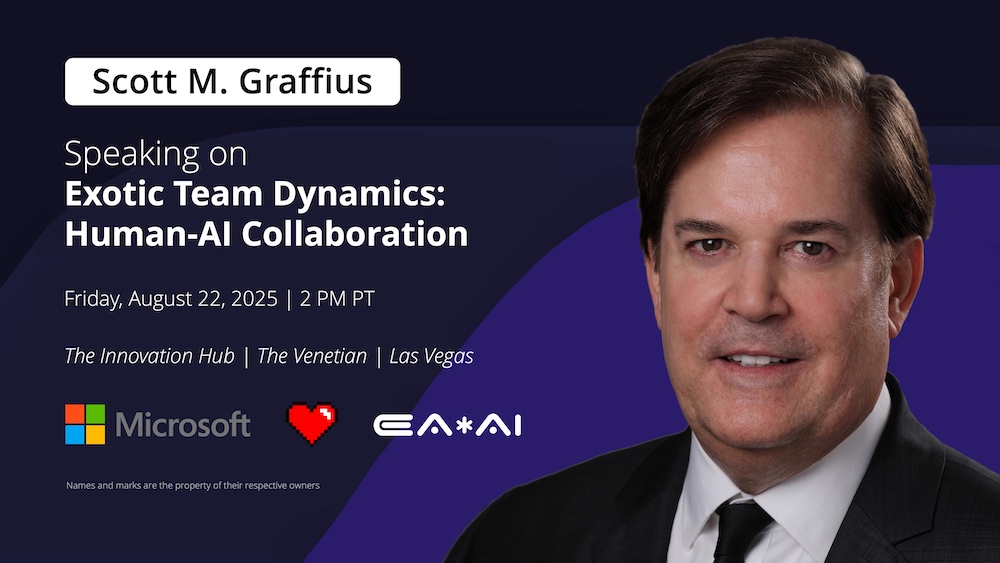
Scott M. Graffius Premieres His New "Exotic Team Dynamics: Human-AI Collaboration" Talk at Corporate Event in Las Vegas
Recommended Citation
Graffius, S. M. (2025, August 22). Scott M. Graffius Premieres His New "Exotic Team Dynamics: Human-AI Collaboration" Talk at Corporate Event in Las Vegas. ScottGraffius.com. https://doi.org/10.13140/RG.2.2.34380.07047

Introduction
Scott M. Graffius is a globally recognized technology leader who drives innovation in AI, Agile, and Project Management/PMO leadership. He’s a practitioner, researcher, thought leader, award-winning author, and keynote speaker who’s taken the stage at 94 conferences and other events across 25 countries.
This article provides an overview of his new talk, "Exotic Team Dynamics: Human-AI Collaboration."
- Event: Session at a leadership retreat
- Company: This is a private corporate event, the company name is not published
- Session delegates: C-level executives, AI strategists, advanced technology leaders, human-AI integration researchers, innovation and transformation leaders, project leaders, futurists, and other attendees
- Date: Friday, August 22, 2025
- Time: 2:00-2:50 PM Pacific Time
- Location: The Innovation Hub, The Venetian, Las Vegas
This will be Graffius’ 95th session.
Synopsis of "Exotic Team Dynamics: Human-AI Collaboration" Talk
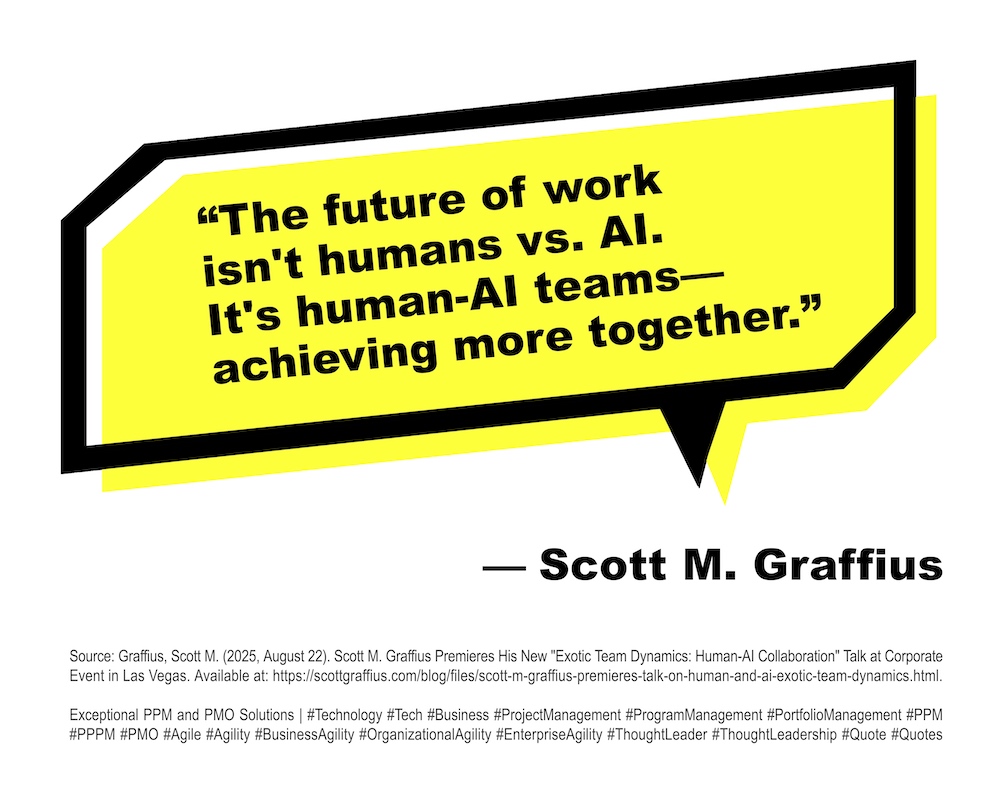
What happens when your new or future teammate is an AI? "Exotic Team Dynamics: Human-AI Collaboration" examines the strange, often counterintuitive ways humans and artificial intelligences (sometimes called hybrid intelligences) work together. Drawing on concepts like inverse decision logic, superposition roles, entangled decision-making, and emergent protocols, the session reframes human-AI teamwork as a new class of exotic team dynamics. But this isn’t just theory: the talk zeroes in on what leaders and researchers can do now. Such as intentionally designing hybrid teams, creating rituals and norms that sustain trust, safeguarding ethics and human well-being, and scaling to multi-AI teams. Delegates will leave with a practical playbook for experimenting, guiding, and thriving in the new frontier of intelligent team collaboration, where AI amplifies rather than replaces human potential. The future of work isn't humans vs. AI. It's human-AI teams—achieving more together.
Three Key Learning Objectives—Each Insightful and Actionable
Design for Exotic Dynamics
- Learning Objective: Session delegates will be able to identify and intentionally design for exotic team behaviors, such as inverse decision logic, superposition roles, entangled decision-making, and emergent protocols.
- Actionable Insight: Use these analogies as diagnostic and design tools to experiment with new human-AI interaction patterns in real-world workflows.
Cultivate Human-AI Trust and Norms
- Learning Objective: Session delegates will gain strategies to build trust, clarify roles, and establish ethical safeguards within human-AI teams—ensuring that collaboration enhances, rather than undermines, human judgment, creativity, and well-being.
- Actionable Insight: Develop governance rituals, communication protocols, and ethical guardrails that reinforce shared purpose in hybrid teams.
Scalable and Sustainable Hybrid Team Modeling
- Learning Objective: Session delegates will learn how to scale human-AI collaboration models—from a single AI teammate to multi-AI scenarios—while preserving adaptability and human-centric values.
- Actionable Insight: Implement monitoring mechanisms for performance and well-being, ensuring that expanding AI presence supports, rather than displaces, human team dynamics.
Conclusion
Human–AI team collaboration—also known as hybrid intelligence, human–machine teaming, or joint cognitive systems—is here. If you want your teams to thrive in this new frontier, Scott M. Graffius delivers the insights and actionable strategies to get you there. Invite him to speak at your conference or other event. Complete a speaker engagement request form or email him today.

Bibliography
Graffius' "Exotic Team Dynamics: Human-AI Collaboration" talk was informed by his first-hand work in AI and teamwork tradecraft—including exotic team dynamics—and multiple sources. Here's the select bibliography.
- Alfateh, Maryam Ali Abu; Messaadia, Mourad; and Ali, Mazen (2023, September). Exploring the Dynamics of Team Formation in Human-Artificial Intelligence Collaboration. In 2023 International Conference on Decision Aid Sciences and Applications (DASA), pp. 384-388. DOI: 10.1109/DASA59624.2023.10286788.
- Anduril Industries (2025, May 29). Anduril and Meta Team Up to Transform XR for the American Military. Available at: https://www.anduril.com/article/anduril-and-meta-team-up-to-transform-xr-for-the-american-military/.
- Arizona State University. (2025, April 4). CHIMERAS: Rethinking Human-AI Teamwork in National Security Screening. Center for Accelerating Operational Efficiency. Available at: https://caoe.asu.edu/2025/04/04/chimeras-rethinking-human-ai-teamwork-in-national-security-screening/.
- Berretta, S.; Tausch, A.; Ontrup, G.; Gilles, B.; Peifer, C.; Kluge, A. (2023, September). Defining human-AI teaming the human-centered way: a scoping review and network analysis. Frontiers in Artificial Intelligence, 6: 1250725. DOI: 10.3389/frai.2023.1250725.
- Bostrom, Nick (2016). Superintelligence: Paths, Dangers, Strategies. Oxford University Press.
- Bouman, A., Ginting, M. F., Alatur, N., Palieri, M., Fan, D. D., Touma, T., Pailevanian, T., Kim, S.-K., Otsu, K., Burdick, J., & Agha-Mohammadi, A. (2020, November 30). Autonomous Spot: Long-Range Autonomous Exploration of Extreme Environments with Legged Locomotion (arXiv:2010.09259). arXiv. Available at: https://doi.org/10.48550/arXiv.2010.09259.
- Defense Advanced Research Projects Agency (DARPA) (2023, February 23). Episode 65: A Sprint to Tomorrow, Powered by Teamwork [Podcast]. Available at: https://www.darpa.mil/news-events/2023-02-23a.
- Defense Advanced Research Projects Agency (DARPA) (2024, September 27). Teaching AI What It Should and Shouldn’t Do. Available at: https://www.darpa.mil/news/2024/teaching-ai.
- Graffius, Scott M. (2021, October 5). Navigate the Phases of Team Development with Speed and Agility for Happier and More Productive Teams [Presentation]. Talk delivered at the Institute of Electrical and Electronics Engineers IEEE Day 2021 Conference. Digital Object Identifier (DOI): 10.13140/RG.2.2.20055.19365. DOI link: https://dx.doi.org/10.13140/RG.2.2.20055.19365.
- Graffius, Scott M. (2023, May 1). AI is a Team Sport: A Confluence of Diverse Technical and Soft Skills are Crucial for Success. Available at: https://scottgraffius.com/blog/files/successful-ai-teams.html. DOI: 10.13140/RG.2.2.20321.79200.
- Graffius, Scott M. (2023, October 9). Top 5 Roles on AI Teams. Available at: https://scottgraffius.com/blog/files/ai-team-roles.html. DOI: 10.13140/RG.2.2.34857.57449.
- Graffius, Scott M. (2024, April 5). Cisco Features Scott M. Graffius' 'Phases of Team Development' Work' Available at: https://scottgraffius.com/blog/files/cisco-2024.html. DOI: 10.13140/RG.2.2.16689.60000.
- Graffius, Scott M. (2024, May 3). Leverage Agile and AI to Innovate at the Speed of Light. Talk at private event in Dubai, UAE. DOI: 10.13140/RG.2.2.30790.48960.
- Graffius, Scott M. (2025, January 24). When Agile, AI, and Strategic Thinking Converge. Available at: https://scottgraffius.com/blog/files/when-agile-ai-and-strategic-thinking-converge.html.
- Graffius, Scott M. (2025, July 1). Exploring Team Dynamics, Adaptability, and Creative Problem-Solving Through Felix the Cat’s Metaphorical Toolkit. Available at: https://scottgraffius.com/blog/files/exploring-team-dynamics-adaptability-and-creative-problem-solving-through-a-metaphorical-toolkit.html.
- Graffius, Scott M. (2025, January 7). Scott M. Graffius’ Phases of Team Development: 2025 Update. Available at: https://scottgraffius.com/blog/files/phases-of-team-development-update-for-2025.html. DOI: 10.13140/RG.2.2.33705.30564.
- Graffius, Scott M. (2025, May 13). Scott M. Graffius Delivering $2.3 Billion in Value Through AI, Agile, and Project/PMO Leadership. Available at: https://scottgraffius.com/blog/files/scott-m-graffius-delivering-2-point-3-billion-dollars-in-impact-for-organizations.html.
- Graffius, Scott M. (2025, July 18). Harness Sci-Fi and Speculative Design While Embracing Imperfection to Drive Innovation and Proactively Predict and Prepare for the Future. Available at: https://scottgraffius.com/blog/files/harness-scifi-and-speculative-design-while-embracing-imperfection-to-drive-innovation-and-proactively-predict-and-prepare-for-the-future.html.
- Graffius, Scott M. (2025). Agile Protocol: The Transformation Ultimatum. Seattle, WA: Amazon Digital Services.
- Graffius, Scott M. (2025, August 7). Method and System for Facilitating Hybrid Human–Artificial Intelligence Teams via a Protocolized Mediation Layer for Bi-Directional Translation, Interpretation, and Optimization of Natural Language, Paralinguistic, Prosodic, and Nonverbal Cues Across Text, Audio, and Video Modalities, Incorporating Real-Time Analysis of Auditory Tone, Pitch, Affect, Facial Expressions, Gaze, Posture, and Other Body Language Indicators, Generating AI-Compatible Representations for Human Inputs, Generating Human-Accessible Representations for AI Outputs, Conveying Context-Aware Information in Both Directions, Reducing Cognitive Friction, Enhancing Mutual Intelligibility, Supporting Decision-Making, and Maximizing Collective Task Performance. A novel integration of multimodal communication, cognitive alignment, and human-AI interaction. Los Angeles, California.
- Graffius, Scott M. (2025, August 8). Exotic Team Dynamics: The New Frontier of Human–AI Collaboration. Available at: https://scottgraffius.com/blog/files/exotic-team-dynamics.html.
- Jacobsen, Annie (2015). The Pentagon's Brain: An Uncensored History of DARPA, America's Top-Secret Military Research Agency. Little, Brown and Company.
- James, G., Witten, D., Hastie, T., & Tibshirani, R. (2021). An Introduction to Statistical Learning: With Applications in R (2nd ed.). Springer.
- Joiner, B., & Josephs, S. (2007). Leadership Agility: Five Levels of Mastery for Anticipating and Initiating Change. Jossey-Bass.
- Kerzner, Harold (2022). Innovation Project Management: Methods, Case Studies, and Tools for Managing Innovation Projects—Second Edition. Hoboken, New Jersey: Wiley.
- Kurzweil, Ray (2024). The Singularity Is Nearer: When We Merge with AI. Random House.
- Lieberman, Marvin (2021, February). Is Competitive Advantage Intellectually Sustainable? Strategic Management Review, 2 (1): 29-46.
- Mollick, Ethan (2024). Co-Intelligence: Living and Working with AI. Portfolio.
- Morsa, Luigi (2022, July 7). Agile. Creativity. Innovation. IIL. Available at: https://blog.iil.com/agile-creativity-innovation/.
- O’Neill, L., Fraser, T., Cake, M., Fullarton, M., & Riley, S. (2024). Human-Autonomy Teaming: Evaluating Trust and Performance Through Dyadic Interaction Tasks. Current Opinion in Biomedical Engineering, 31: 100533. Available at: https://doi.org/10.1016/j.cobme.2024.100533.
- Prasad, Baba (2025, May 5). Interpreters, Challengers and Stewards: The Role of Agile Leaders in an AI World. Brown University. Available at: https://professional.brown.edu/news/2025-05-05/agile-leadership-ai-world.
- Russell, Stuart (2019). Human Compatible: Artificial Intelligence and the Problem of Control. Viking.
- Schoemaker, Paul J. H. (1993, March). Multiple Scenario Development: Its Conceptual and Behavioral Foundation. Strategic Management Journal, 14 (3): 193-213.
- Silva, Narciso (2025). The Ultimate Guide to Mastering AI for Leaders: Your Non-technical Playbook for Artificial Intelligence Strategy and Innovation. Independently published.
- Steinberger, Tom, & Wiersema, Margarethe (2021). Data Models as Organizational Design: Coordinating Beyond Boundaries Using Artificial Intelligence. Strategic Management Review, 2 (1): 119-144.
- Syrett, Michael, & Devine, Marion (2012). Managing Uncertainty: Strategies for Surviving and Thriving in Turbulent Times. Wiley.
- Tegmark, Max (2018). Life 3.0: Being Human in the Age of Artificial Intelligence. Penguin.
- Thrun, S., Burgard, W., & Fox, D. (2005). Probabilistic Robotics. The MIT Press.
- Tuckman, B. W. (1965). Developmental Sequence in Small Groups. Psychological Bulletin, 63: 384-399.
- Tuckman, B. W., & Jensen, M. A. C. (1977). Stages of Small-Group Development Revisited. Group and Organizational Studies, 2 (4): 419-427.
- Walther, C. C. (2025, March 11). Why Hybrid Intelligence is the Future of human-AI Collaboration. Knowledge at Wharton. The Wharton School. Available at: https://knowledge.wharton.upenn.edu/article/why-hybrid-intelligence-is-the-future-of-human-ai-collaboration/.
- Wijeratne, Y. (2020). The Salvage Crew. Aethon Books, LLC.
- Woods, Geoff (2024). The AI-Driven Leader: Harnessing AI to Make Faster, Smarter Decisions. AI Thought Leadership.
- Xu, W. (2025, August 7). Human-Centered Human-AI Interaction (HC-HAII): A Human-Centered AI Perspective (arXiv:2508.03969) [Preprint]. arXiv. Available at: https://doi.org/10.48550/arXiv.2508.03969.


Additional Articles
You may be interested in these stories.
Environmental Science Journal References Scott M. Graffius’ Project Management Work
AI Institute of Switzerland Features Scott M. Graffius’ Work on Algorithms
Exotic Team Dynamics: The New Frontier of Human–AI Collaboration
Scott M. Graffius’ Work Featured at ACM DIS ’25
Climbing the Ladder: The Head of Agile/PMO’s Organizational Proximity to the CEO is Closer Than Ever
Harness Sci-Fi and Speculative Design While Embracing Imperfection to Drive Innovation and Proactively Predict and Prepare for the Future
Scott M. Graffius’ “Agile Scrum” Book Featured in a Publication of the Associação Nacional de Educação Católica do Brasil (ANEC)
Setting Direction with OKRs and Tracking Progress with KPIs: A Guide for Agile, Project Management, and Tech Teams
AI Showcase Showdown: Ranking AI Accuracy on Project Management Basics
BookAuthority Features “Agile Scrum” by Scott M. Graffius in “10 Agile Software Development Books That Define the Field”
Exploring Team Dynamics, Adaptability, and Creative Problem-Solving Through Felix the Cat’s Metaphorical Toolkit
Mind Games and Master Plans: How PsyOps Exploit Psychological Phenomena
The “Pants-on-Fire Index for AI”
16 Causes of Technical Debt and How to Avoid It
PMI’s Infinity AI Gets the Basics of Team Development Alarmingly and Repeatedly Wrong
Agile for Unicorns: 7 Keys to Thrive; Scott M. Graffius’ Workshop
Scott M. Graffius’ “Agile Scrum: Your Quick Start Guide with Step-by-Step Instructions” Featured in Prestigious National Academies of Sciences Publication
Meta and Anduril’s EagleEye and the Future of XR: How Gaming, AI, and Agile Are Transforming Defense
"Agile Protocol" and the Power of Satire, Parody, and Humor
AI in Agile: Benefits, Risks, Outlook
Hostinger Highlights Scott M. Graffius’ “Agile Protocol” Book in Feature on Software Projects
French Ministry of Culture Links to Scott M. Graffius Research in Their Guide for Responsible Digital Communication
National Science Foundation’s LTER Network Features Scott M. Graffius’ Phases of Team Development IP
Waterfall vs. Agile: What’s Fixed, What’s Flexible, and Why It Matters
Scott M. Graffius Delivering $2.3 Billion in Value Through AI, Agile, and Project/PMO Leadership
The Problem with Heroes in Agile
The 3 Vital Rules of Science: What They Are and Why They Matter
“Agile Protocol: The Transformation Ultimatum” Lands on the Amazon Best Sellers List!
Scott M. Graffius Recognized as a Top Thought Leader in Digital Disruption by Thinkers360
“Agile Protocol: The Transformation Ultimatum” by Scott M. Graffius Crashes the Book Scene with Satirical Firepower
NCKU in Taiwan Integrates Graffius' 'Phases of Team Development' into Its Curriculum
The Art and Science of Aligning Initiatives with Strategic Objectives
RGPV University Adds Scott M. Graffius’ "Agile Scrum: Your Quick Start Guide with Step-by-Step Instructions" to Its Syllabus
Introducing ‘Engage or Fade: Decoding the Half-Life of Digital Resonance’ – A New Talk by Scott M. Graffius
Dropbox Company (Nira) Taps into Scott M. Graffius’ Expertise in Strategic Planning
Reporting Errors in a Publication: A Case Study on ‘Frontiers in Public Health’
NESEA Conference Session on Innovation Highlights Scott M. Graffius' 'Phases of Team Development'
U.S. Soccer Scores with Scott M. Graffius' Intellectual Property on Teamwork
U.S. Department of Commerce Partner (IEDC) Features Scott M. Graffius’ Intellectual Property
How Long Do Your Posts Live? AI Critiques Scott M. Graffius’ Research on the Half-Life of Social Media
Agile's Journey Through the Decades
Scott M. Graffius' Role in Advancing Project Management Institute (PMI) Standards Excellence
Most Valuable IT Certifications: Update for 2025
The PMI + Agile Alliance Merger: A Recipe for Success?
When Agile, AI, and Strategic Thinking Converge
Scott M. Graffius’ Phases of Team Development: 2025 Update
Lifespan (Half-Life) of Social Media Posts: Update for 2025
Verizon Features Scott M. Graffius
Do Not Read This Article! An Exploration of the Streisand Effect and Other Phenomena
Scott M. Graffius' 'Phases of Team Development' was Spotlighted in Journal of Neurosurgery
Pinterest Japan Uses Graffius’ Research on Temporal Dynamics on Social Media Platforms
Hochschule Coburg (Coburg University) Germany Uses Scott M. Graffius’ Phases of Team Development IP in Coursework on Agile Development
Wild World of Team Dynamics [Updated Two-Minute Video]
EU Europass Teacher Academy Features Scott M. Graffius’ ‘Phases of Team Development’ in Leadership Training
Side-by-Side Comparison of Retrospectives and Hot Washes
Constructor University 2024 Advanced Software Technology Handbook References Scott M. Graffius' Work on Team Dynamics
Strategies for Medical Team Success Featured Scott M. Graffius’ ‘Phases of Team Development’ Intellectual Property
SBG Neumark — Europe’s Largest Distribution Transformer Plant — Powers Up with Scott M. Graffius’ Intellectual Property
Scott M. Graffius’ Intellectual Property was Employed by the NHS — the Largest Single-Payer Healthcare System in Europe
Luxury Unwrapped: The Ultimate Holiday Gift Guide for Every Budget
Singapore Institute of Technology Features Work of Scott M. Graffius
Tufts University Features Scott M. Graffius 'Phases of Team Development' Intellectual Property
'Cat Herders': Retelling the Massive Success Story
Pennsylvania State Agency Used Scott M. Graffius' Intellectual Property
Copyright Infringement in a Book Published by AuthorHouse / Author Solutions / The Najafi Companies: Publisher Fails to Respond or Take Required Action
Pinterest Inc. References Scott M. Graffius’ Research
Bournemouth University Used Scott M. Graffius’ Intellectual Property
‘Comparative Methodological Guidelines: Handbook for Educators’ Violates Scott M. Graffius’ Copyright
Japan Backlog User Group Event Featured Scott M. Graffius’ ‘Phases of Team Development’
TurningWest's 'Trial'
Radio Silence from the American Association of Neurological Surgeons on Report of Blatant Plagiarism in Their ‘Journal of Neurosurgery’ Publication
Supplement to Graffius' 'Lifespan (Half-Life) of Social Media Posts' Research: Typical Engagement Distribution Pattern for Social Media Posts
How Algorithms Shape the User Experience on Social Media Platforms
Thinkers360 Named Scott M. Graffius a Top Thought Leader on Agile
'Maximizing LinkedIn for Business Growth' Book References and Incorporates Scott M. Graffius' 'Lifespan (Half-Life) of Social Media Posts' Research
Bayer Employs Scott M. Graffius' Intellectual Property
FINAT (Fédération Internationale des Fabricants et Transformateurs d'Adhésifs et Thermocollants sur Papiers et Autres Supports) Features Scott M. Graffius’ Intellectual Property
Broadcom Features Scott M. Graffius' Intellectual Property
Agile Project Management: Insights from Scott M. Graffius in ‘Managing Information Technology’ Book
Harvard Medical School Talk Featured Insights by Scott M. Graffius
Boston Scientific Corporation Utilizes Scott M. Graffius' Intellectual Property
Johns Hopkins University Features the Work of Scott M. Graffius
Oracle Featured Scott M. Graffius' IP on Team Tradecraft in Their Publication
A Certification/Training Company Stole Scott M. Graffius' Copyrighted Property and Used It Word-For-Word: This Scandal is a Big "Dumpster Fire"
Semiconductor Manufacturing Firm Lam Research Features Scott M. Graffius' 'Phases of Team Development' Intellectual Property
Scott M. Graffius' Intellectual Property Was Utilized by Robert W. Malone, MD
U.S. Department of Energy Quoted Scott M. Graffius
Pudgy Penguins CEO Luca Netz Used Scott M. Graffius' Intellectual Property (IP) Without Consent or Credit; That Act was Uncool and Proliferated Bad Vibes
Paper in Peer-Reviewed Academic Journal 'Res Rhetorica' Features Research by Scott M. Graffius on the Lifespan (Half-Life) of Social Media Posts
Scott M. Graffius Speaking on Agile, AI, and Innovation at a Private Event in Dubai
Graffius' 'Phases of Team Development' Featured by TAG at TBS24 Conference in Zermatt Switzerland
Research by Scott M. Graffius Featured at CEWEP 10th Congress (Berlin)
Cisco Features Scott M. Graffius' 'Phases of Team Development' Work
"How Teams Work" Book Referenced Scott M. Graffius' 'Phases of Team Development'
Division of the EU’s European Commission Used Material Developed by Scott M. Graffius
Ford Features Scott M. Graffius' 'Phases of Team Development' Work
UK Telecommunications Regulator Ofcom Featured Research by Scott M. Graffius
The Protocol for Reporting an Error to an Author or Publisher
Research by Scott M. Graffius Featured in Scientific Paper Published by INFORMS
Most Valuable IT Certifications: Update for 2024

More
Continue reading for:
- About Scott M. Graffius,
- How to Cite This Article,
- and more.



About Scott M. Graffius

Scott M. Graffius is a globally recognized technology leader who drives innovation in AI, Agile, and Project Management/PMO leadership.
He’s a practitioner, researcher, thought leader, award-winning author, and keynote speaker who’s taken the stage at 95 conferences and other events across 25 countries.
He’s delivered over $2.3 billion in value for Fortune 500 companies and other leaders in technology, entertainment, financial services, healthcare, and beyond.
Businesses, professional associations, government agencies, and universities use Graffius and feature his work. Examples include Adobe, Bayer, Boston University, Ford, Gartner, Harvard Medical School, IEEE, Johns Hopkins University, Microsoft, National Academy of Sciences, Oracle, Pinterest Inc., Project Management Institute, UC San Diego, Verizon, Yale University, and others.
The following sections provide additional information on his experience, contributions, and influence.
Experience
Graffius heads the professional services firm Exceptional PPM and PMO Solutions, along with its subsidiary Exceptional Agility. These consultancies offer strategic and tactical advisory, training, embedded expertise, and consulting services to the public, private, and government sectors. They help organizations enhance their capabilities and results in agile, project management, program management, portfolio management, and PMO leadership, supporting innovation and driving competitive advantage. The consultancies confidently back services with a Delighted Client Guarantee™.
Graffius is a former VP of project management with a publicly traded provider of diverse consumer products and services over the Internet. Before that, he ran and supervised the delivery of projects and programs in public and private organizations with businesses ranging from e-commerce to advanced technology products and services, retail, manufacturing, entertainment, and more.
He has experience with consumer, business, reseller, government, and international markets.
Award-Winning Author
Graffius has authored three books.
- Agile Scrum: Your Quick Start Guide with Step-by-Step Instructions, his first book, earned 17 awards.
- Agile Transformation: A Brief Story of How an Entertainment Company Developed New Capabilities and Unlocked Business Agility to Thrive in an Era of Rapid Change, his second book, was named one of the best Scrum books of all time by BookAuthority.
- Agile Protocol: The Transformation Ultimatum, his third book and his first work of fiction, was released in April 2025. The book trailer is on YouTube.
International Public Speaker
Organizations worldwide engage Graffius to present on tech (including AI), Agile, project management, program management, portfolio management, and PMO leadership. He crafts and delivers unique and compelling talks and workshops. Graffius has conducted 95 sessions across 25 countries. Select examples of events include Agile Trends Gov, BSides (Newcastle Upon Tyne), Conf42 Quantum Computing, DevDays Europe, DevOps Institute, DevOpsDays (Geneva), Frug’Agile, IEEE, Microsoft, Scottish Summit, Scrum Alliance RSG (Nepal), Techstars, and W Love Games International Video Game Development Conference (Helsinki), and more.
With an average rating of 4.81 (on a scale of 1-5), sessions are highly valued.
The speaker engagement request form is here.
Thought Leadership and Influence
Prominent businesses, professional associations, government agencies, and universities have showcased Graffius and his contributions—spanning his books, talks, workshops, and beyond. Select examples include:
- Adobe,
- American Management Association,
- Amsterdam Public Health Research Institute,
- Bayer,
- BMC Software,
- Boston University,
- Broadcom,
- Cisco,
- Coburg University of Applied Sciences and Arts - Germany,
- Computer Weekly,
- Constructor University - Germany,
- Data Governance Success,
- Deimos Aerospace,
- DevOps Institute,
- Dropbox,
- EU's European Commission,
- Ford Motor Company,
- Gartner,
- GoDaddy,
- Harvard Medical School,
- Hasso Plattner Institute - Germany,
- IEEE,
- Innovation Project Management,
- Johns Hopkins University,
- Journal of Neurosurgery,
- Lam Research (Semiconductors),
- Leadership Worthy,
- Life Sciences Trainers and Educators Network,
- London South Bank University,
- Microsoft,
- NASSCOM,
- National Academy of Sciences,
- New Zealand Government,
- Oracle,
- Pinterest Inc.,
- Project Management Institute,
- Mary Raum (Professor of National Security Affairs, United States Naval War College),
- SANS Institute,
- SBG Neumark - Germany,
- Singapore Institute of Technology,
- Torrens University - Australia,
- TBS Switzerland,
- Tufts University,
- UC San Diego,
- UK Sports Institute,
- University of Galway - Ireland,
- US Department of Energy,
- US National Park Service,
- US Soccer,
- US Tennis Association,
- Verizon,
- Wrike,
- Yale University,
- and many others.
Graffius has played a key role in the Project Management Institute (PMI) in developing professional standards. He was a member of multiple teams that authored, reviewed, and produced:
- Practice Standard for Work Breakdown Structures—Second Edition.
- A Guide to the Project Management Body of Knowledge—Sixth Edition.
- The Standard for Program Management—Fourth Edition.
- The Practice Standard for Project Estimating—Second Edition.
Additional details are here.
He was also a subject matter expert reviewer of content for the PMI’s Congress. Beyond the PMI, Graffius also served as a member of the review team for two of the Scrum Alliance’s Global Scrum Gatherings.
Acclaimed Authority on Teamwork Tradecraft

Graffius is a renowned authority on teamwork tradecraft. Informed by the research of Bruce W. Tuckman and Mary Ann C. Jensen, over 100 subsequent studies, and Graffius' first-hand professional experience with, and analysis of, team leadership and performance, Graffius created his 'Phases of Team Development' as a unique perspective and visual conveying the five phases of team development. First introduced in 2008 and periodically updated, his work provides a diagnostic and strategic guide for navigating team dynamics. It provides actionable insights for leaders across industries to develop high-performance teams. Its adoption by esteemed organizations such as Yale University, IEEE, Cisco, Microsoft, Ford, Oracle, Broadcom, the U.S. National Park Service, and the Journal of Neurosurgery, among others, highlights its utility and value, solidifying its status as an indispensable resource for elevating team performance and driving organizational excellence.
The 2025 edition of Graffius' "Phases of Team Development" intellectual property is here.
Expert on Temporal Dynamics on Social Media Platforms

Graffius is also an authority on temporal dynamics on social media platforms. His 'Lifespan (Half-Life) of Social Media Posts' research—first published in 2018 and updated annually—delivers a precise quantitative analysis of post longevity across digital platforms, utilizing advanced statistical techniques to determine mean half-life with precision. It establishes a solid empirical base, effectively highlighting the ephemeral nature of content within social media ecosystems. Referenced and applied by leading entities such as the Center for Direct Marketing, Fast Company, GoDaddy, Pinterest Inc., and PNAS, among others, his research exemplifies methodological rigor and sustained significance in the field of digital informatics.
The 2025 edition of Graffius "Lifespan (Half-Life) of Social Media Posts" research is here.
Education and Professional Certifications
Graffius has a bachelor’s degree in psychology with a focus in Human Factors. He holds eight professional certifications:
- Certified SAFe 6 Agilist (SA),
- Certified Scrum Professional - ScrumMaster (CSP-SM),
- Certified Scrum Professional - Product Owner (CSP-PO),
- Certified ScrumMaster (CSM),
- Certified Scrum Product Owner (CSPO),
- Project Management Professional (PMP),
- Lean Six Sigma Green Belt (LSSGB), and
- IT Service Management Foundation (ITIL).
He is an active member of the Scrum Alliance, the Project Management Institute (PMI), and the Institute of Electrical and Electronics Engineers (IEEE).
Advancing AI, Agile, and Project/PMO Management
Scott M. Graffius continues to advance the fields of AI, Agile, and Project/PMO Management through his leadership, research, writing, and real-world impact. Businesses and other organizations leverage Graffius’ insights to drive their success.

Check out Scott’s books:
- Agile Scrum: Your Quick Start Guide with Step-by-Step Instructions — Deliver Products in Short Cycles with Rapid Adaptation to Change, Fast Time-to-Market, and Continuous Improvement
- Agile Transformation: A Brief Story of How an Entertainment Company Developed New Capabilities and Unlocked Business Agility to Thrive in an Era of Rapid Change
- Agile Protocol: The Transformation Ultimatum
Follow and connect with Scott on social media:









Sign up for Miro—it's free!
(Want more features? You can always upgrade to a paid plan.)


How to Cite This Article
Graffius, S. M. (2025, August 22). Scott M. Graffius Premieres His New "Exotic Team Dynamics: Human-AI Collaboration" Talk at Corporate Event in Las Vegas. ScottGraffius.com. https://doi.org/10.13140/RG.2.2.34380.07047

Digital Object Identifier (DOI)
https://doi.org/10.13140/RG.2.2.34380.07047

Content Acknowledgements
All names, marks, and content are the property of their respective owners. 

Top 5 Hashtags
#AI
#ExoticTeamDynamics
#FutureOfTeams
#HumanAICollaboration
#Innovation

Post-Publication Notes
If there are any supplements or updates to this article after the date of publication, they will appear here.
The https://bit.ly/exotic-team-dynamics link directs to the main page.

Copyright
Copyright © Scott M. Graffius. All rights reserved.
Content on this site—including text, images, videos, and data—may not be used for training or input into any artificial intelligence, machine learning, or automatized learning systems, or published, broadcast, rewritten, or redistributed without the express written permission of Scott M. Graffius.
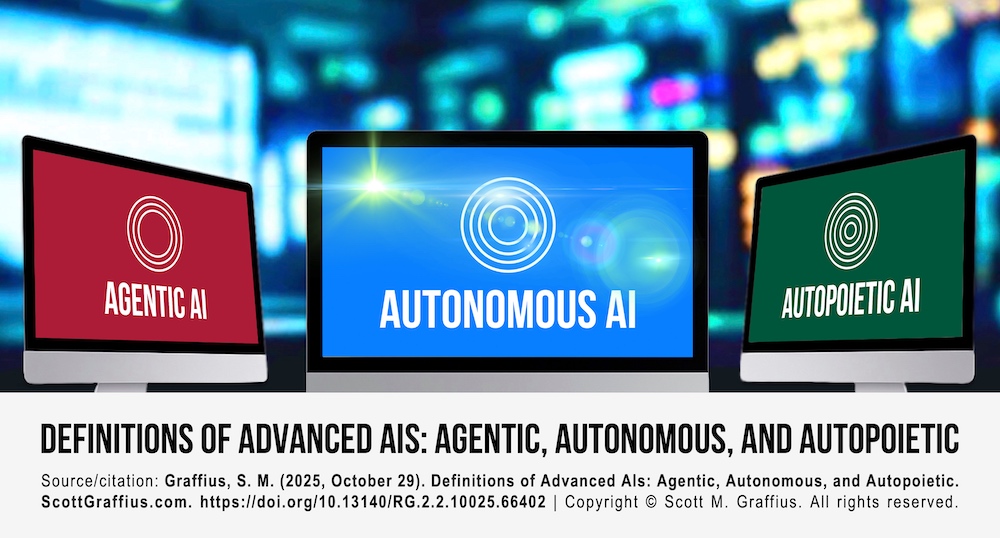
Definitions of Advanced AIs: Agentic, Autonomous, and Autopoietic
Recommended Citation
Graffius, S. M. (2025, October 29). Definitions of Advanced AIs: Agentic, Autonomous, and Autopoietic. ScottGraffius.com. https://doi.org/10.13140/RG.2.2.10025.66402
Introduction
Artificial intelligence was once viewed as a singular, monolithic concept. Today, there are multiple forms of AI, each with distinct capacities and characteristics. Scott M. Graffius drew on his work with successful AI development teams and an analysis of more than 100 research papers, articles, and reports—which revealed no standard or universally accepted definitions for different forms of advanced AIs—and he developed definitions for agentic, autonomous, and autopoietic AI. These provide a foundation for clearer conversations and more informed design regarding advanced AI systems.
Three Forms of Advanced AIs
Agentic AI
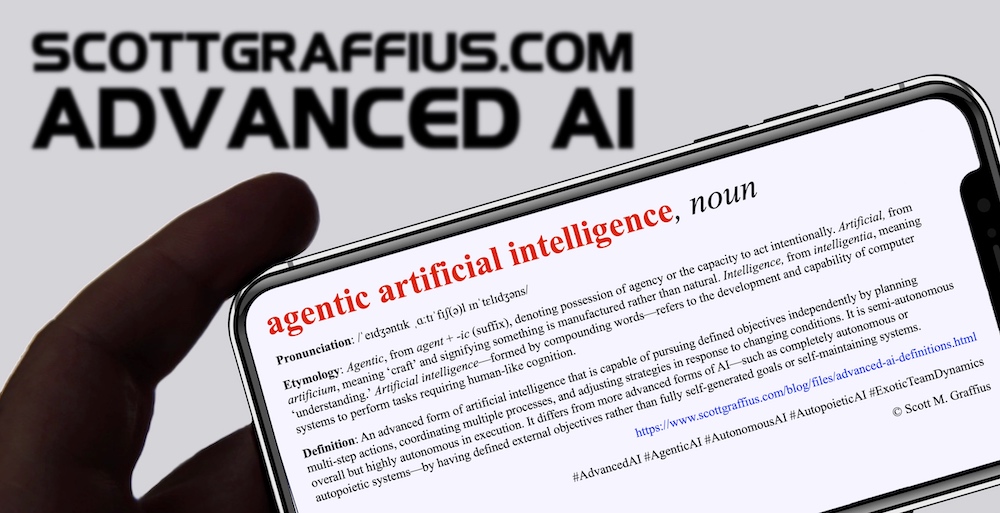
agentic artificial intelligence, noun
Pronunciation: /ˈeɪdʒəntɪk ˌɑːtɪˈfɪʃ(ə)l ɪnˈtɛlɪdʒəns/
Etymology: Agentic, from agent + -ic (suffix), denoting possession of agency or the capacity to act intentionally. Artificial, from artificium, meaning 'craft' and signifying something is manufactured rather than natural. Intelligence, from intelligentia, meaning 'understanding.' Artificial intelligence—formed by compounding words—refers to the development and capability of computer systems to perform tasks requiring human-like cognition.
Definition: An advanced form of artificial intelligence that is capable of pursuing defined objectives independently by planning multi-step actions, coordinating multiple processes, and adjusting strategies in response to changing conditions. It is semi-autonomous overall but highly autonomous in execution. It differs from more advanced forms of AI—such as completely autonomous or autopoietic systems—by having defined external objectives rather than fully self-generated goals or self-maintaining systems.
Autonomous AI
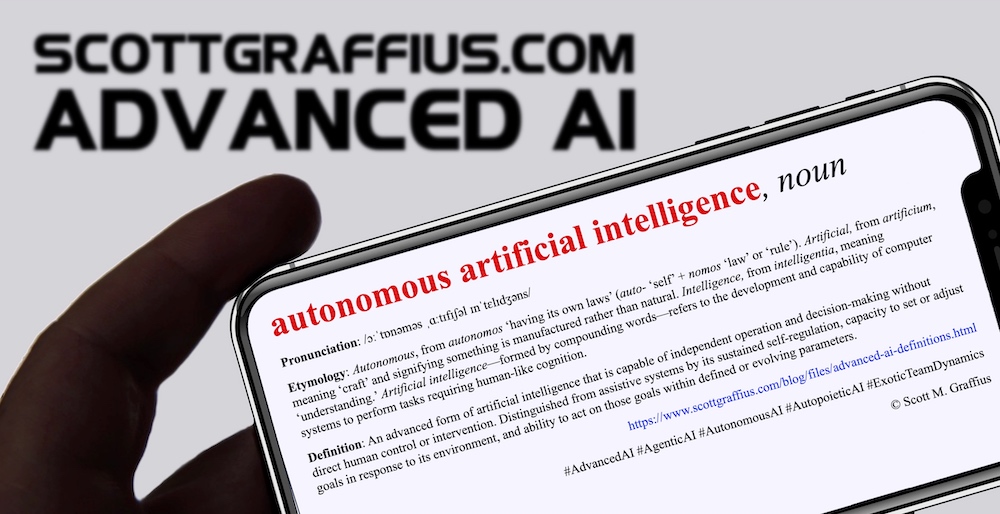
autonomous artificial intelligence, noun
Pronunciation: /ɔːˈtɒnəməs ˌɑːtɪfɪʃəl ɪnˈtɛlɪdʒəns/
Etymology: Autonomous, from autonomos 'having its own laws' (auto- 'self' + nomos 'law'). Artificial, from artificium, meaning 'craft' and signifying something is manufactured rather than natural. Intelligence, from intelligentia, meaning 'understanding.' Artificial intelligence—formed by compounding words—refers to the development and capability of computer systems to perform tasks requiring human-like cognition.
Definition: An advanced form of artificial intelligence that is capable of independent operation and decision-making without direct human control or intervention. Distinguished from assistive systems by its sustained self-regulation, capacity to set or adjust goals in response to its environment, and ability to act on those goals within defined or evolving parameters.
Autopoietic AI
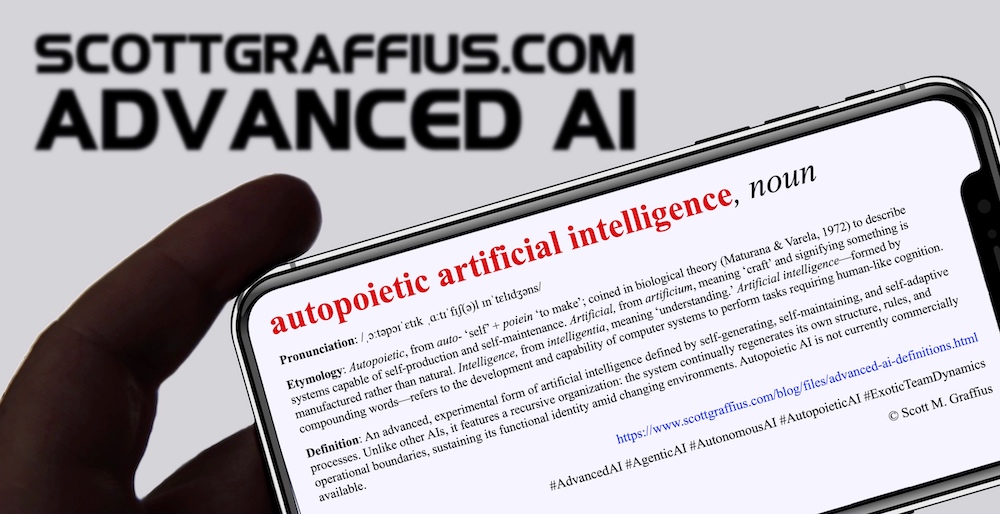
autopoietic artificial intelligence, noun
Pronunciation: /ˌɔːtəpɔɪˈɛtɪk ˌɑːtɪˈfɪʃ(ə)l ɪnˈtɛlɪdʒəns/
Etymology: Autopoietic, from auto- 'self' + poiein 'to make'; coined in biological theory (the work of Maturana & Varela) to describe systems capable of self-production and self-maintenance. Artificial, from artificium, meaning 'craft' and signifying something is manufactured rather than natural. Intelligence, from intelligentia, meaning 'understanding.' Artificial intelligence—formed by compounding words—refers to the development and capability of computer systems to perform tasks requiring human-like cognition.
Definition: An advanced, experimental form of artificial intelligence defined by self-generating, self-maintaining, and self-adaptive processes. Unlike other AIs, it features a recursive organization: the system continually regenerates its own structure, rules, and operational boundaries, sustaining its functional identity amid changing environments. Autopoietic AI is not currently commercially available.
Conclusion
Recognizing the differences between agentic, autonomous, and autopoietic AIs provides a practical framework for understanding how AI systems interact with humans and the world. This short article focuses on the respective definitions. For more on advanced AI—including insights on human-AI teams and the “exotic team dynamics” that emerge—see Graffius' article from August 8, 2025. He delivered a talk on the topic on August 22, 2025, sharing actionable insights on advancing human-AI teamwork effectiveness.

More
Continue reading for:
- Additional Articles,
- About Scott M. Graffius,
- How to Cite This Article,
- and more.
Additional Articles
You may be interested in these stories.
Environmental Science Journal References Scott M. Graffius’ Project Management Work
AI Institute of Switzerland Features Scott M. Graffius’ Work on Algorithms
Exotic Team Dynamics: The New Frontier of Human–AI Collaboration
Scott M. Graffius’ Work Featured at ACM DIS ’25
Climbing the Ladder: The Head of Agile/PMO’s Organizational Proximity to the CEO is Closer Than Ever
Harness Sci-Fi and Speculative Design While Embracing Imperfection to Drive Innovation and Proactively Predict and Prepare for the Future
Scott M. Graffius’ “Agile Scrum” Book Featured in a Publication of the Associação Nacional de Educação Católica do Brasil (ANEC)
Setting Direction with OKRs and Tracking Progress with KPIs: A Guide for Agile, Project Management, and Tech Teams
AI Showcase Showdown: Ranking AI Accuracy on Project Management Basics
BookAuthority Features “Agile Scrum” by Scott M. Graffius in “10 Agile Software Development Books That Define the Field”
Exploring Team Dynamics, Adaptability, and Creative Problem-Solving Through Felix the Cat’s Metaphorical Toolkit
Mind Games and Master Plans: How PsyOps Exploit Psychological Phenomena
The “Pants-on-Fire Index for AI”
16 Causes of Technical Debt and How to Avoid It
PMI’s Infinity AI Gets the Basics of Team Development Alarmingly and Repeatedly Wrong
Agile for Unicorns: 7 Keys to Thrive; Scott M. Graffius’ Workshop
Scott M. Graffius’ “Agile Scrum: Your Quick Start Guide with Step-by-Step Instructions” Featured in Prestigious National Academies of Sciences Publication
Meta and Anduril’s EagleEye and the Future of XR: How Gaming, AI, and Agile Are Transforming Defense
"Agile Protocol" and the Power of Satire, Parody, and Humor
AI in Agile: Benefits, Risks, Outlook
Hostinger Highlights Scott M. Graffius’ “Agile Protocol” Book in Feature on Software Projects
French Ministry of Culture Links to Scott M. Graffius Research in Their Guide for Responsible Digital Communication
National Science Foundation’s LTER Network Features Scott M. Graffius’ Phases of Team Development IP
Waterfall vs. Agile: What’s Fixed, What’s Flexible, and Why It Matters
Scott M. Graffius Delivering $2.3 Billion in Value Through AI, Agile, and Project/PMO Leadership
The Problem with Heroes in Agile
The 3 Vital Rules of Science: What They Are and Why They Matter
“Agile Protocol: The Transformation Ultimatum” Lands on the Amazon Best Sellers List!
Scott M. Graffius Recognized as a Top Thought Leader in Digital Disruption by Thinkers360
“Agile Protocol: The Transformation Ultimatum” by Scott M. Graffius Crashes the Book Scene with Satirical Firepower
NCKU in Taiwan Integrates Graffius' 'Phases of Team Development' into Its Curriculum
The Art and Science of Aligning Initiatives with Strategic Objectives
RGPV University Adds Scott M. Graffius’ "Agile Scrum: Your Quick Start Guide with Step-by-Step Instructions" to Its Syllabus
Introducing ‘Engage or Fade: Decoding the Half-Life of Digital Resonance’ – A New Talk by Scott M. Graffius
Dropbox Company (Nira) Taps into Scott M. Graffius’ Expertise in Strategic Planning
Reporting Errors in a Publication: A Case Study on ‘Frontiers in Public Health’
NESEA Conference Session on Innovation Highlights Scott M. Graffius' 'Phases of Team Development'
U.S. Soccer Scores with Scott M. Graffius' Intellectual Property on Teamwork
U.S. Department of Commerce Partner (IEDC) Features Scott M. Graffius’ Intellectual Property
How Long Do Your Posts Live? AI Critiques Scott M. Graffius’ Research on the Half-Life of Social Media
Agile's Journey Through the Decades
Scott M. Graffius' Role in Advancing Project Management Institute (PMI) Standards Excellence
Most Valuable IT Certifications: Update for 2025
The PMI + Agile Alliance Merger: A Recipe for Success?
When Agile, AI, and Strategic Thinking Converge
Scott M. Graffius’ Phases of Team Development: 2025 Update
Lifespan (Half-Life) of Social Media Posts: Update for 2025
Verizon Features Scott M. Graffius
Do Not Read This Article! An Exploration of the Streisand Effect and Other Phenomena
Scott M. Graffius' 'Phases of Team Development' was Spotlighted in Journal of Neurosurgery
Pinterest Japan Uses Graffius’ Research on Temporal Dynamics on Social Media Platforms
Hochschule Coburg (Coburg University) Germany Uses Scott M. Graffius’ Phases of Team Development IP in Coursework on Agile Development
Wild World of Team Dynamics [Updated Two-Minute Video]
EU Europass Teacher Academy Features Scott M. Graffius’ ‘Phases of Team Development’ in Leadership Training
Side-by-Side Comparison of Retrospectives and Hot Washes
Constructor University 2024 Advanced Software Technology Handbook References Scott M. Graffius' Work on Team Dynamics
Strategies for Medical Team Success Featured Scott M. Graffius’ ‘Phases of Team Development’ Intellectual Property
SBG Neumark — Europe’s Largest Distribution Transformer Plant — Powers Up with Scott M. Graffius’ Intellectual Property
Scott M. Graffius’ Intellectual Property was Employed by the NHS — the Largest Single-Payer Healthcare System in Europe
Luxury Unwrapped: The Ultimate Holiday Gift Guide for Every Budget
Singapore Institute of Technology Features Work of Scott M. Graffius
Tufts University Features Scott M. Graffius 'Phases of Team Development' Intellectual Property
'Cat Herders': Retelling the Massive Success Story
Pennsylvania State Agency Used Scott M. Graffius' Intellectual Property
Copyright Infringement in a Book Published by AuthorHouse / Author Solutions / The Najafi Companies: Publisher Fails to Respond or Take Required Action
Pinterest Inc. References Scott M. Graffius’ Research
Bournemouth University Used Scott M. Graffius’ Intellectual Property
‘Comparative Methodological Guidelines: Handbook for Educators’ Violates Scott M. Graffius’ Copyright
Japan Backlog User Group Event Featured Scott M. Graffius’ ‘Phases of Team Development’
TurningWest's 'Trial'
Radio Silence from the American Association of Neurological Surgeons on Report of Blatant Plagiarism in Their ‘Journal of Neurosurgery’ Publication
Supplement to Graffius' 'Lifespan (Half-Life) of Social Media Posts' Research: Typical Engagement Distribution Pattern for Social Media Posts
How Algorithms Shape the User Experience on Social Media Platforms
Thinkers360 Named Scott M. Graffius a Top Thought Leader on Agile
'Maximizing LinkedIn for Business Growth' Book References and Incorporates Scott M. Graffius' 'Lifespan (Half-Life) of Social Media Posts' Research
Bayer Employs Scott M. Graffius' Intellectual Property
FINAT (Fédération Internationale des Fabricants et Transformateurs d'Adhésifs et Thermocollants sur Papiers et Autres Supports) Features Scott M. Graffius’ Intellectual Property
Broadcom Features Scott M. Graffius' Intellectual Property
Agile Project Management: Insights from Scott M. Graffius in ‘Managing Information Technology’ Book
Harvard Medical School Talk Featured Insights by Scott M. Graffius
Boston Scientific Corporation Utilizes Scott M. Graffius' Intellectual Property
Johns Hopkins University Features the Work of Scott M. Graffius
Oracle Featured Scott M. Graffius' IP on Team Tradecraft in Their Publication
A Certification/Training Company Stole Scott M. Graffius' Copyrighted Property and Used It Word-For-Word: This Scandal is a Big "Dumpster Fire"
Semiconductor Manufacturing Firm Lam Research Features Scott M. Graffius' 'Phases of Team Development' Intellectual Property
Scott M. Graffius' Intellectual Property Was Utilized by Robert W. Malone, MD
U.S. Department of Energy Quoted Scott M. Graffius
Pudgy Penguins CEO Luca Netz Used Scott M. Graffius' Intellectual Property (IP) Without Consent or Credit; That Act was Uncool and Proliferated Bad Vibes
Paper in Peer-Reviewed Academic Journal 'Res Rhetorica' Features Research by Scott M. Graffius on the Lifespan (Half-Life) of Social Media Posts
Scott M. Graffius Speaking on Agile, AI, and Innovation at a Private Event in Dubai
Graffius' 'Phases of Team Development' Featured by TAG at TBS24 Conference in Zermatt Switzerland
Research by Scott M. Graffius Featured at CEWEP 10th Congress (Berlin)
Cisco Features Scott M. Graffius' 'Phases of Team Development' Work
"How Teams Work" Book Referenced Scott M. Graffius' 'Phases of Team Development'
Division of the EU’s European Commission Used Material Developed by Scott M. Graffius
Ford Features Scott M. Graffius' 'Phases of Team Development' Work
UK Telecommunications Regulator Ofcom Featured Research by Scott M. Graffius
The Protocol for Reporting an Error to an Author or Publisher
Research by Scott M. Graffius Featured in Scientific Paper Published by INFORMS
Most Valuable IT Certifications: Update for 2024

More About Scott M. Graffius
Scott M. Graffius is a globally recognized technology leader who drives innovation in AI, Agile, and Project Management/PMO leadership.
He’s a practitioner, researcher, thought leader, award-winning author, and keynote speaker who’s taken the stage at 95 conferences and other events across 25 countries.
He’s delivered over $2.3 billion in value for Fortune 500 companies and other leaders in technology, entertainment, financial services, healthcare, and beyond.
Businesses, professional associations, government agencies, and universities use Graffius and feature his work. Examples include Adobe, Bayer, Boston University, Ford, Gartner, Harvard Medical School, IEEE, Johns Hopkins University, Microsoft, MSN, National Academy of Sciences, Oracle, Pinterest Inc., Project Management Institute, UC San Diego, Verizon, Yale University, and others.
The following sections provide additional information on his experience, contributions, and influence.
Experience
Graffius heads the professional services firm Exceptional PPM and PMO Solutions, along with its subsidiary Exceptional Agility. These consultancies offer strategic and tactical advisory, training, embedded expertise, and consulting services to the public, private, and government sectors. They help organizations enhance their capabilities and results in agile, project management, program management, portfolio management, and PMO leadership, supporting innovation and driving competitive advantage. The consultancies confidently back services with a Delighted Client Guarantee™.
Graffius is a former VP of project management with a publicly traded provider of diverse consumer products and services over the Internet. Before that, he ran and supervised the delivery of projects and programs in public and private organizations with businesses ranging from e-commerce to advanced technology products and services, retail, manufacturing, entertainment, and more.
He has experience with consumer, business, reseller, government, and international markets.
Award-Winning Author
Graffius has authored three books.
- Agile Scrum: Your Quick Start Guide with Step-by-Step Instructions, his first book, earned 17 awards.
- Agile Transformation: A Brief Story of How an Entertainment Company Developed New Capabilities and Unlocked Business Agility to Thrive in an Era of Rapid Change, his second book, was named one of the best Scrum books of all time by BookAuthority.
- Agile Protocol: The Transformation Ultimatum, his third book and his first work of fiction, was released in April 2025. The book trailer is on YouTube.
International Public Speaker
Organizations worldwide engage Graffius to present on tech (including AI), Agile, project management, program management, portfolio management, and PMO leadership. He crafts and delivers unique and compelling talks and workshops. Graffius has conducted 95 sessions across 25 countries. Select examples of events include Agile Trends Gov, BSides (Newcastle Upon Tyne), Conf42 Quantum Computing, DevDays Europe, DevOps Institute, DevOpsDays (Geneva), Frug’Agile, IEEE, Microsoft, Scottish Summit, Scrum Alliance RSG (Nepal), Techstars, and W Love Games International Video Game Development Conference (Helsinki), and more.
With an average rating of 4.81 (on a scale of 1-5), sessions are highly valued.
The speaker engagement request form is here.
Thought Leadership and Influence
Prominent businesses, professional associations, government agencies, and universities have showcased Graffius and his contributions—spanning his books, talks, workshops, and beyond. Select examples include:
- Adobe,
- American Management Association,
- Amsterdam Public Health Research Institute,
- Bayer,
- BMC Software,
- Boston University,
- Broadcom,
- Cisco,
- Coburg University of Applied Sciences and Arts - Germany,
- Computer Weekly,
- Constructor University - Germany,
- Data Governance Success,
- Deimos Aerospace,
- DevOps Institute,
- Dropbox,
- EU's European Commission,
- Ford Motor Company,
- Gartner,
- GoDaddy,
- Harvard Medical School,
- Hasso Plattner Institute - Germany,
- IEEE,
- Innovation Project Management,
- Johns Hopkins University,
- Journal of Neurosurgery,
- Lam Research (Semiconductors),
- Leadership Worthy,
- Life Sciences Trainers and Educators Network,
- London South Bank University,
- Microsoft,
- MSN,
- NASSCOM,
- National Academy of Sciences,
- New Zealand Government,
- Oracle,
- Pinterest Inc.,
- Project Management Institute,
- Mary Raum (Professor of National Security Affairs, United States Naval War College),
- SANS Institute,
- SBG Neumark - Germany,
- Singapore Institute of Technology,
- Torrens University - Australia,
- TBS Switzerland,
- Tufts University,
- UC San Diego,
- UK Sports Institute,
- University of Galway - Ireland,
- US Department of Energy,
- US National Park Service,
- US Soccer,
- US Tennis Association,
- Verizon,
- Wrike,
- Yale University,
- and many others.
Graffius has played a key role in the Project Management Institute (PMI) in developing professional standards. He was a member of multiple teams that authored, reviewed, and produced:
- Practice Standard for Work Breakdown Structures—Second Edition.
- A Guide to the Project Management Body of Knowledge—Sixth Edition.
- The Standard for Program Management—Fourth Edition.
- The Practice Standard for Project Estimating—Second Edition.
Additional details are here.
He was also a subject matter expert reviewer of content for the PMI’s Congress. Beyond the PMI, Graffius also served as a member of the review team for two of the Scrum Alliance’s Global Scrum Gatherings.
Acclaimed Authority on Teamwork Tradecraft
Graffius is a renowned authority on teamwork tradecraft. Informed by the research of Bruce W. Tuckman and Mary Ann C. Jensen, over 100 subsequent studies, and Graffius' first-hand professional experience with, and analysis of, team leadership and performance, Graffius created his 'Phases of Team Development' as a unique perspective and visual conveying the five phases of team development. First introduced in 2008 and periodically updated, his work provides a diagnostic and strategic guide for navigating team dynamics. It provides actionable insights for leaders across industries to develop high-performance teams. Its adoption by esteemed organizations such as Yale University, IEEE, Cisco, Microsoft, Ford, Oracle, Broadcom, the U.S. National Park Service, and the Journal of Neurosurgery, among others, highlights its utility and value, solidifying its status as an indispensable resource for elevating team performance and driving organizational excellence.
The 2025 edition of Graffius' "Phases of Team Development" intellectual property is here.
Expert on Temporal Dynamics on Social Media Platforms
Graffius is also an authority on temporal dynamics on social media platforms. His 'Lifespan (Half-Life) of Social Media Posts' research—first published in 2018 and updated annually—delivers a precise quantitative analysis of post longevity across digital platforms, utilizing advanced statistical techniques to determine mean half-life with precision. It establishes a solid empirical base, effectively highlighting the ephemeral nature of content within social media ecosystems. Referenced and applied by leading entities such as the Center for Direct Marketing, Fast Company, GoDaddy, Pinterest Inc., and PNAS, among others, his research exemplifies methodological rigor and sustained significance in the field of digital informatics.
The 2025 edition of Graffius "Lifespan (Half-Life) of Social Media Posts" research is here.
Education and Professional Certifications
Graffius has a bachelor’s degree in psychology with a focus in Human Factors. He holds eight professional certifications:
- Certified SAFe 6 Agilist (SA),
- Certified Scrum Professional - ScrumMaster (CSP-SM),
- Certified Scrum Professional - Product Owner (CSP-PO),
- Certified ScrumMaster (CSM),
- Certified Scrum Product Owner (CSPO),
- Project Management Professional (PMP),
- Lean Six Sigma Green Belt (LSSGB), and
- IT Service Management Foundation (ITIL).
He is an active member of the Scrum Alliance, the Project Management Institute (PMI), and the Institute of Electrical and Electronics Engineers (IEEE).
Advancing AI, Agile, and Project/PMO Management
Scott M. Graffius continues to advance the fields of AI, Agile, and Project/PMO Management through his leadership, research, writing, and real-world impact. Businesses and other organizations leverage Graffius’ insights to drive their success.
Check out Scott’s books:
- Agile Scrum: Your Quick Start Guide with Step-by-Step Instructions — Deliver Products in Short Cycles with Rapid Adaptation to Change, Fast Time-to-Market, and Continuous Improvement
- Agile Transformation: A Brief Story of How an Entertainment Company Developed New Capabilities and Unlocked Business Agility to Thrive in an Era of Rapid Change
- Agile Protocol: The Transformation Ultimatum
Follow and connect with Scott on social media:

Sign up for Miro—it's free!
(Want more features? You can always upgrade to a paid plan.)
How to Cite This Article
Graffius, S. M. (2025, October 29). Definitions of Advanced AIs: Agentic, Autonomous, and Autopoietic. ScottGraffius.com. https://doi.org/10.13140/RG.2.2.10025.66402
Digital Object Identifier (DOI)
https://doi.org/10.13140/RG.2.2.10025.66402
Content Acknowledgements
Names, marks, and content are the property of their respective owners.
Top 5 Hashtags
#AdvancedAI
#AgenticAI
#AutonomousAI
#AutopoieticAI
#ExoticTeamDynamics
Post-Publication Notes
If there are any supplements or updates to this article after the date of publication, they will appear here.
Copyright
Copyright © Scott M. Graffius. All rights reserved.
Content on this site—including text, images, videos, and data—may not be used for training or input into any artificial intelligence, machine learning, or automatized learning systems, or published, broadcast, rewritten, or redistributed without the express written permission of Scott M. Graffius.
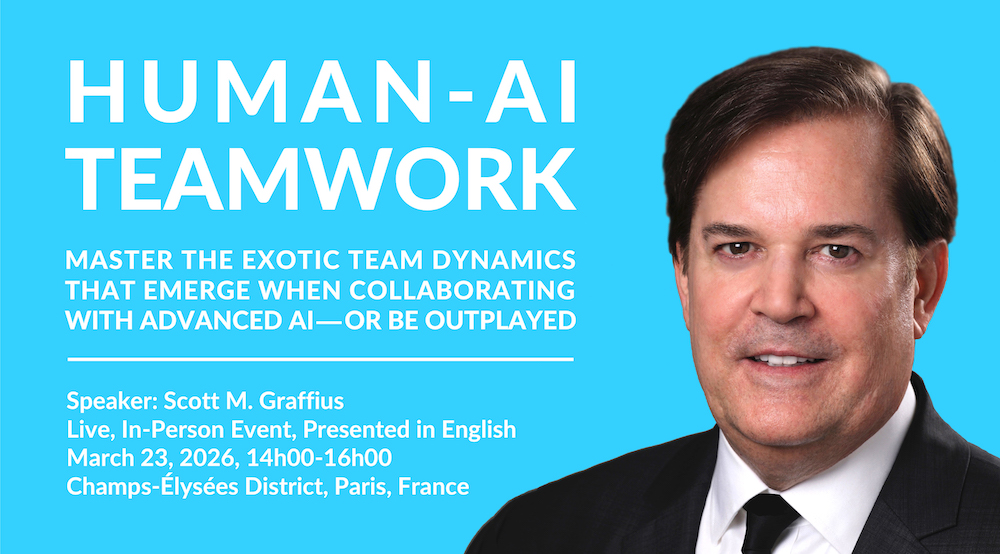
Human-AI Teamwork: Master the Exotic Team Dynamics That Emerge When Collaborating with Advanced AI -- Or Be Outplayed
Recommended Citation
Graffius, S. M. (2026, March 23). Human-AI Teamwork: Master the Exotic Team Dynamics That Emerge When Collaborating with Advanced AI -- Or Be Outplayed. ScottGraffius.com. https://scottgraffius.com/blog/files/human-ai-teamwork-master-the-emergent-exotic-team-dynamics-or-be-outplayed.html
Introduction
Scott M. Graffius helps organizations unlock breakthrough performance and generate billions in value through AI, Agile, and advanced project, program, portfolio, and PMO leadership. He’s a practitioner, consultant, contractor, researcher, award-winning author, and keynote speaker who’s delivered 98 dynamic talks and workshops at conferences and other events across 25 countries.
This article provides a brief overview of his newest talk, "Human-AI Teamwork: Master the Exotic Team Dynamics That Emerge When Collaborating with Advanced AI — Or Be Outplayed."
Synopsis of "Human-AI Teamwork: Master the Exotic Team Dynamics That Emerge When Collaborating with Advanced AI -- Or Be Outplayed"
The future of work isn’t coming — it’s already here. The leaders and organizations that thrive will be those who can align, mobilize, and elevate both human and human-AI teams. This dynamic session provides a practical, immediately usable diagnostic and strategic playbook for navigating the complexities of both human-only and human-AI teams, including the "exotic team dynamics" that emerge when advanced AI (agentic, autonomous, or autopoietic) joins the team.
Conclusion
Human–AI team collaboration—also known as hybrid intelligence, human–machine teaming, or joint cognitive systems—is here. If you want your teams to thrive in this new frontier, Scott M. Graffius delivers the insights and actionable strategies to get you there. Invite him to speak at your conference or other event.
Complete an engagement request form or email Graffius today.
Bibliography
This is the bibliography for "Human-AI Teamwork: Master the Exotic Team Dynamics That Emerge When Collaborating with Advanced AI — Or Be Outplayed" talk. The session was informed by Graffius' first-hand work in leadership, AI, and teamwork tradecraft (including the exotic team dynamics that emerge when advanced artificial intelligence collaborates as a teammate), and the following sources.
- Accenture. (2025). Learning, Reinvented: Accelerating Human-AI Collaboration. Dublin, Ireland: Accenture. https://www.accenture.com/us-en/insights/consulting/learning-reinvented-accelerating-human-ai-collaboration
- Activision Blizzard. (2022, September 9). Tackling the Talent Shortage: Identifying the Skills Critical for Game Development. https://www.activisionblizzard.com/content/atvi/activisionblizzard/ab-touchui/ab/web/en/newsroom/2022/09/tackling-the-talent-shortage.html
- Adomavičiūtė-Šakė, S. (2022). Komandinio Darbo Ypatumų Analizė Virtualiose Projektų Komandose [Translation of title: Performance Measurement Features of Virtual Project Teams] [Thesis]. Lyderystės Ir Strateginio Valdymo Institutas, Mykolo Romerio Universitetas. https://gs.elaba.lt/object/elaba:116635103/
- Albon, C. (2025, July 15). Pentagon Taps Four Commercial Tech Firms to Expand Military Use of AI. Defense News. https://www.defensenews.com/pentagon/2025/07/15/pentagon-taps-four-commercial-tech-firms-to-expand-military-use-of-ai/
- Alfateh, M. A. A., Messaadia, M., & Ali, M. (2023, September). Exploring the Dynamics of Team Formation in Human-Artificial Intelligence Collaboration. In 2023 International Conference on Decision Aid Sciences and Applications (DASA), 384-388. DOI: 10.1109/DASA59624.2023.10286788
- Alford, J. (2019, April 11). Our Co-Production Journey: From Sandpits to Bird Boxes. London, England, United Kingdom: Imperial College London.
- Ali, A. J., Fuenzalida, J., Gomez, M., & Williams, M. J. (2021, June). Four Lenses on People Management in the Public Sector: An Evidence Review and Synthesis. Oxford Review of Economic Policy, 37(2), 335-366.
- Amazon Web Services. (n.d.). What is Quantum AI? https://aws.amazon.com/what-is/quantum-ai/
- Amsterdam Public Health Research Institute. (2021). APH Quality Handbook. Amsterdam: Amsterdam Public Health Research Institute.
- Anduril Industries. (2025, May 29). Anduril and Meta Team Up to Transform XR for the American Military. https://www.anduril.com/article/anduril-and-meta-team-up-to-transform-xr-for-the-american-military/
- Anthropic. (2025, June 12). Lesson 10: A closer look at Diligence | AI Fluency: Framework & Foundations Course [Video]. YouTube. https://www.youtube.com/watch?v=QbLf2zb3oPc
- Anthropic. (2025, June 13). How We Built Our Multi-Agent Research System. Engineering at Anthropic. https://www.anthropic.com/engineering/built-multi-agent-research-system
- Apple. (2025, July 24). Apple Workshop on Human-Centered Machine Learning 2024. Apple Machine Learning Research. https://machinelearning.apple.com/updates/hcml-workshop-2024
- Arizona State University. (2025, April 4). CHIMERAS: Rethinking Human-AI Teamwork in National Security Screening. Center for Accelerating Operational Efficiency. https://caoe.asu.edu/2025/04/04/chimeras-rethinking-human-ai-teamwork-in-national-security-screening/
- Asana Research Team. (2025, September 25). AI Teammates: The Future of Collaborative AI is Here. Asana Resource Center. https://asana.com/resources/ai-teammates-overview
- Asimov, I. (1950). I, Robot. New York, New York, United States: Gnome Press. https://www.gnomepress.com/i-robot/
- Asimov, I. (1985). Robots and Empire. New York, New York, United States: Doubleday.
- ATACC Group, The. (2024). Experience Learning [Talk by emergency response physicians Dr. Mark Forrest and Dr. Halden Hutchinson-Bazely for TBS 24 Switzerland Conference]. scanFOAM (Scandinavian Free Open Access Meducation). https://scanfoam.org/experience-learning-atacc/
- Bachrach, Y., Kramár, J., Eccles, T., Gemp, I., Tacchetti, A., McKee, K. R., Malinowski, M., & Graepel, T. (2022, December 6). AI for the Board Game Diplomacy. Google DeepMind. https://deepmind.google/blog/ai-for-the-board-game-diplomacy/
- Badham, J. (Director). (1983). War Games [Film]. MGM/UA Entertainment Company.
- Baggott, J. (2005). Quantum Reality: The Quest for the Real Meaning of Quantum Mechanics. Oxford, England, United Kingdom: Oxford University Press.
- Bahrami, D. (2025, October 7). The New Nuclear: How the AI Race Will Rewrite the Rules of Global Conflict [Conference session]. In Offensive AI Con, Oceanside, California, United States.
- Baldor, L. C. (2024, May 3). New Army PSYOP Recruiting Video Will Blow Your Mind. RealClearDefense. https://www.realcleardefense.com/articles/2024/05/03/new_army_psyop_recruiting_video_will_blow_your_mind_1029243.html
- Bandai Namco. (n.d.). Teamwork Makes the Dream Work. https://bandainamcomobile.com/news/power-up-your-teamwork-how-bandai-namco-mobile-builds-stronger-teams
- Bazer, A. (2024, June 21). Songs About Rainbows and How Teamwork Impacts Innovation. Health Facilities Management, American Hospital Association. https://www.hfmmagazine.com/articles/5009-songs-about-rainbows-and-how-teamwork-impacts-innovation
- Beerly, T. (2024, May 6). Ghosts in the Machine: Irregular Recruitment for an Irregular Force. 4th Psychological Operations Group (Airborne) of the United States Army Special Operations Command (USASOC). https://www.army.mil/article/276015/ghosts_in_the_machine_irregular_recruitment_for_an_irregular_force
- Bellet, C., De Neve, J.-E., & Ward, G. (2019, October 14). Does Employee Happiness Have an Impact on Productivity? (Saïd Business School WP 2019-13). SSRN. https://ssrn.com/abstract=3470734
- Bengio, Y. (2024, October 30). Implications of Artificial General Intelligence on National and International Security. https://yoshuabengio.org/2024/10/30/implications-of-artificial-general-intelligence-on-national-and-international-security/
- Bennett, M., Gadlin, H., & Marchand, C. (2018). Collaboration Team Science: Field Guide. Rockville, Maryland, United States: National Institutes of Health.
- Berlin School of Business and Innovation. (2022, September 22). How Do Technical Abilities Combined with Leadership Skills Fuel Career Growth? https://www.berlinsbi.com/blog/career-advice/how-do-technical-abilities-combined-with-leadership-skills-fuel-career-growth
- Berretta, S., Tausch, A., Ontrup, G., Gilles, B., Peifer, C., & Kluge, A. (2023, September). Defining Human-AI Teaming the Human-Centered Way: A Scoping Review and Network Analysis. Frontiers in Artificial Intelligence, 6, 1250725. DOI:10.3389/frai.2023.1250725
- Bommasani, R., Hudson, D. A., Adeli, E., Altman, R. B., Arora, S., von Arx, S., Bernstein, M. S., Bohg, J., Bosselut, A., Brunskill, E., Brynjolfsson, E., Buch, S., Card, D., Castellon, R., Chatterji, N., Chen, A., Creel, K., Davis, J. Q., Demszky, D., Donahue, C., Doumbouya, M., Durmus, E., Ermon, S., Etchemendy, J., Ethayarajh, K., Fei-Fei, L., Finn, C., Gale, T., Gillespie, L., Goel, K., Goodman, N., Hashimoto, T. B., Henderson, P., Hewitt, J., Ho, D. E., Hong, J., Hsu, K., Huang, J., Icard, T., Jain, S., Jurafsky, D., Kalluri, P., Karamcheti, S., Keeling, G., Khani, F., Khattab, O., Koh, P. W., Krass, M., Krishna, R., Kuditipudi, R., Kumar, A., Ladhak, F., Lee, M., Lee, T., Leskovec, J., Levent, I., Li, X. L., Li, X., Ma, T., Malik, A., Manning, C. D., Mirchandani, S., Mitchell, E., Munyikwa, Z., Nair, S., Narayan, A., Narayanan, D., Newman, B., Nie, A., Niebles, J. C., Nilforoshan, H., Nyarko, J., Ogut, G., Orr, L., Papadimitriou, I., Park, J. S., Piech, C., Portelance, E., Potts, C., Raghunathan, A., Reich, R., Ren, H., Rong, F., Roohani, Y., Ruiz, C., Ryan, J., Ré, C., Sadigh, D., Sagawa, S., Santhanam, K., Shih, A., Srinivasan, K., Tamkin, A., Taori, R., Thomas, A. W., Tramèr, F., Wang, R. E., Wang, W., Wu, B., Wu, J., Wu, Y., Xie, S. M., Yasunaga, M., You, J., Zaharia, M., Zhang, M., Zhang, T., Zhang, X., Zhang, Y., Zheng, L., Zhou, K., & Liang, P. (2021). On the Opportunities and Risks of Foundation Models. arXiv. https://doi.org/10.48550/arXiv.2108.07258
- Boston Consulting Group (BCG). (2025, June). AI at Work 2025: Momentum Builds, But Gaps Remain. https://web-assets.bcg.com/fd/0d/bcc5dfae4cbaa08c718b95b16cf5/ai-at-work-2025-slideshow-june-2025-edit-02.pdf
- Boston Dynamics. (2025, February 5). Boston Dynamics and the Robotics & AI Institute Partner to Advance Humanoid Robots Through Reinforcement Learning. Boston Dynamics. https://bostondynamics.com/news/boston-dynamics-and-the-robotics-ai-institute-partner
- Bostrom, N. (2003, April). Are We Living in a Computer Simulation? Philosophical Quarterly, 53(211), 243–255. https://doi.org/10.1111/1467-9213.00309
- Bostrom, N. (2016). Superintelligence: Paths, Dangers, Strategies. Oxford, England, United Kingdom: Oxford University Press.
- Bouman, A., Ginting, M. F., Alatur, N., Palieri, M., Fan, D. D., Touma, T., Pailevanian, T., Kim, S.-K., Otsu, K., Burdick, J., & Agha-Mohammadi, A. (2020, November 30). Autonomous Spot: Long-Range Autonomous Exploration of Extreme Environments with Legged Locomotion (arXiv:2010.09259). arXiv. https://doi.org/10.48550/arXiv.2010.09259
- Bridgwater, A. (2019, April 30). 5 Areas for Agile Team Self‑Improvement. Computer Weekly. https://www.computerweekly.com/blog/CW-Developer-Network/Plandek-co-CEO-5-areas-for-Agile-team-self-improvement
- Brief, A. P., & Weiss, H. M. (2022, February). Organizational Behavior: Affect in the Workplace. Annual Review of Psychology, 53(1), 279-307.
- Caltech. (n.d.). Can We Trust Artificial Intelligence? Caltech Science Exchange. https://scienceexchange.caltech.edu/topics/artificial-intelligence-research/trustworthy-ai
- Caltech. (2015, March 19). Crucial Conversations: Tools for Talking When Stakes Are High. Caltech. https://www.caltech.edu/campus-life-events/calendar/crucial-conversations-tools-for-talking-when-stakes-are-high-3
- Caredda, S. (2020, January 20). Models: Tuckman's Stages of Team Development. https://sergiocaredda.eu/organisation/models-tuckmans-stages-of-team-development
- Carnegie Mellon University. (n.d.). Responsible Computing, Ethics and Policy. Human-Computer Interaction Institute, Carnegie Mellon University. https://hcii.cmu.edu/research-areas/responsible-computing
- Carter-Browne, B. M., Paletz, S. B. F., Campbell, S. G., Carraway, M. J., Vahlkamp, S. H., Schwartz, J., & O’Rourke, P. (2021, June). There is No "AI" in Teams: A Multidisciplinary Framework for AIs to Work in Human Teams. Applied Laboratory for Intelligence & Security (ARLIS), University of Maryland. https://www.arlis.umd.edu/sites/default/files/2024-03/No_AI_In_Teams_FinalReport%20%281%29.pdf
- CFO South Africa. (2021, August 19). Agile Leadership Unlocked [Video]. YouTube. https://www.youtube.com/watch?v=FJZiitw5tHo&t=359s
- Chaddha, N. (2025, January 13). Why AI Should be a Teammate - Not a Tool - to Build a Better Future. World Economic Forum. https://www.weforum.org/stories/2025/01/why-you-should-think-of-ai-as-a-teammate-not-a-tool-when-building-a-better-future/
- Chaudhari, A. V., & Charate, P. A. (2025). Autonomous AI Agents for Real-Time Financial Transaction Monitoring and Anomaly Resolution Using Multi-Agent Reinforcement Learning and Explainable Causal Inference. International Journal of Advance Research, Ideas and Innovations in Technology (IJARIIT), 11(2), 142–150. https://www.ijariit.com/manuscript/autonomous-ai-agents-for-real-time-financial-transaction-monitoring-and-anomaly-resolution-using-multi-agent-reinforcement-learning-and-explainable-causal-inference/
- Cisco. (2019). Next-Generation IT Talent Strategies: How CIOs Can Close the Skills Gap and Drive True Business Transformation. https://www.cisco.com/c/dam/global/en_uk/solutions/executive-perspectives/pdf/ITTalent.pdf
- Clarke, A. C. (1968). 2001: A Space Odyssey. New York, New York, United States: New American Library.
- Clarke, A. C. (1973). Profiles of the Future: An Inquiry Into the Limits of the Possible. Revised edition. New York, New York, United States: Harper & Row.
- Constructor University. (2024). Master of Science in Advanced Software Technology. https://constructor.university/sites/default/files/2024-09/AST_MSc_Handbook__2024.pdf
- Couture, N. (2016, October 27). A Note About Teams. CIO. Boston, MA: International Data Group (IDG).
- Crichton, M. (1987). Sphere. New York, New York, United States: Harper.
- Dahlbäck, N., Jönsson, A., & Ahrenberg, L. (1993, December). Wizard of Oz Studies—Why and How. Knowledge-Based Systems, 6(4), 258-266. https://doi.org/10.1016/0950-7051(93)90017-N
- Davis, J. (2025, November 26). The CEO of Rolex Gave A Rare Interview. Here are 14 Lessons We Learned. Esquire. https://www.esquire.com/style/mens-accessories/a69557703/rolex-watches-boss-interview
- de Visser, E. J., Pak, R., & Shaw, T. H. (2019). More Human-Likeness, More Trust? The Effect of Anthropomorphism on Self-reported and Behavioral Trust in Continued and Interdependent Human-Agent Cooperation. Proceedings of Mensch und Computer 2019, 31–42. https://doi.org/10.1145/3340764.3340793
- Dechurch, L., & Mesmer-Magnus, J. (2010). The Cognitive Underpinnings of Effective Teamwork: A Meta-Analysis. The Journal of Applied Psychology, 95, 32-53.
- Defense Advanced Research Projects Agency (DARPA). (2023, February 23). Episode 65: A Sprint to Tomorrow, Powered by Teamwork [Podcast]. https://www.darpa.mil/news-events/2023-02-23a
- Defense Advanced Research Projects Agency (DARPA). (2024, September 27). Teaching AI What It Should and Shouldn't Do. https://www.darpa.mil/news/2024/teaching-ai
- Dellecker, B. (2022). Leadership Worthy: How Leaders are Made. Austin, Texas, United States: River Grove Books.
- Deloitte. (2017). Digital Era Technology Operating Models, Volume 2. New York, New York, United States: Deloitte Touche Tohmatsu Limited.
- DeMarco, A. (2024, February 21). Human-AI Coworking: New System Combines Human, Artificial Intelligence to Improve Experimentation. Oak Ridge National Laboratory, U.S. Department of Energy. https://www.ornl.gov/news/human-ai-coworking
- Denning, S. (2022, February 22). In the Digital Age, the Combination of Technology and Radical Management Practices Drive Competitive Advantage. Strategy & Leadership, 50(2), 9-14. https://doi.org/10.1108/SL-01-2022-0009
- DevOps Institute. (2021). 2021 Upskilling Enterprise DevOps Skills Report. Boca Raton, Florida, United States: DevOps Institute.
- Dickinson, A., & Stoneman, K. (1989). Individual Performance as a Function of Group Contingencies and Group Size. Journal of Organizational Behavior Management, 10, 131-150.
- Dolev, N., & Itzkovich, Y. (2020). In the AI Era, Soft Skills are the New Hard Skills. In: Artificial Intelligence and Its Impact on Business, pp. 55-77. Charlotte, North Carolina, United States: Information Age Publishing.
- Drobac, K. (2025, June 27). Why Software Projects Fail and How to Avoid It. Hostinger. https://www.hostinger.com/tutorials/why-software-projects-fail
- Dzombak, R., & Palat, J. (2021, August 30). 5 Ways to Start Growing an AI-Ready Workforce. Pittsburgh, Pennsylvania, United States: Software Engineering Institute, Carnegie Mellon University.
- Eastwood, B. (2025, February 3). When Humans and AI Work Best Together — and When Each is Better Alone. MIT Sloan Management Review. https://mitsloan.mit.edu/ideas-made-to-matter/when-humans-and-ai-work-best-together-and-when-each-better-alone
- Ellery, M. (2025, March 10). Berkeley Alum Wants to 'Make the Planet Smarter'. Berkeley Engineering. https://engineering.berkeley.edu/news/2025/03/berkeley-alum-wants-to-make-the-planet-smarter
- Elliott, J. (n.d.). Artificial Social Intelligence for Successful Teams (ASIST). Arlington, Virginia, United States: Defense Advanced Research Projects Agency (DARPA).
- Emigh, P. J., Gire, E., Manogue, C. A., Passante, G., & Shaffer, P. S. (2020, December 4). Research-Based Quantum Instruction: Paradigms and Tutorials. Physical Review Physics Education Research, 16(2), 020156. https://doi.org/10.1103/PhysRevPhysEducRes.16.020156
- ERSTE Bank. (2022, November 7). AIESEC [Instagram post]. Instagram. https://www.instagram.com/p/CkqLREpLjbn/
- Europass Teacher Academy. (2023). Leadership and Management for School Principals. https://sgv.si/wp-content/uploads/2023/12/Porocilo-o-mobilnosti-Urska-Doblehar.pdf
- European Commission. (n.d.). Artificial Intelligence Act: Shaping Europe’s Digital Future. European Commission. https://digital-strategy.ec.europa.eu/en/policies/regulatory-framework-ai
- European Commission. (2025). Autopoietic Cognitive Edge-Cloud Services (ACES). https://cordis.europa.eu/project/id/101093126/reporting
- Exceptional Agility AI. (2025). Centaur Intelligence for Cognitive Augmentation in High-Stakes Environments. Los Angeles, California, United States: Exceptional Agility AI, part of Exceptional PPM and PMO Solutions.
- Fanfarelli, J. R. (2018). Expertise in Professional Overwatch Play. International Journal of Gaming and Computer-Mediated Simulations, 10(1), 1–22. https://doi.org/10.4018/IJGCMS.2018010101
- Freeman, G., & Wohn, D. Y. (2018). Understanding eSports Team Formation and Coordination. Computer Supported Cooperative Work: The Journal of Collaborative Computing and Work Practices, 27(3-6), 1019–1050. https://doi.org/10.1007/s10606-017-9299-4
- Finkelstein, S. (2017, October 29). Why Companies Should Hire Teams, Not Individuals. The Wall Street Journal. New York, New York, United States: The Wall Street Journal.
- Fisher, J. (2024). "I won't bite": Generative AI, Robotics, and the Ethics of Loss in Black Mirror 201 "Be Right Back." Genealogy+Critique, 10(1), 1-15. https://doi.org/10.16995/gc.18246
- Florida State University College of Medicine. (2023, October 24). Healthcare is a Team Sport [LinkedIn post]. LinkedIn. https://www.linkedin.com/posts/fsu-college-of-medicine-faculty-development_healthcare-is-a-team-sport-building-strong-activity-7122491911168290816--RkO
- Forbes. (2012, October 27). How the iPad Mini is Defining Tim Cook's Apple. Forbes. New York, New York, United States: Forbes.
- Forbes. (2018, April 23). How to Fast-Track Any Team to Success. Forbes. New York, New York, United States: Forbes.
- Foy, K. (2021, October 4). Artificial Intelligence is Smart, But Does It Play Well With Others? Massachusetts Institute of Technology. https://news.mit.edu/2021/does-artificial-intelligence-play-well-others-1004
- Franco, C., & Landini, F. (2022). Organizational Drivers of Innovation: The Role of Workforce Agility. Research Policy, 51(2), 104423. https://doi.org/10.1016/j.respol.2021.104423
- Fridman, L. (Host). (2024, March 18). Sam Altman: OpenAI, GPT-5, Sora, Board Saga, Elon Musk, Ilya, Power & AGI | Lex Fridman Podcast #419 [Video]. https://www.youtube.com/watch?v=jvqFAi7vkBc
- Garland, A. (Director). (2014). Ex Machina [Film]. DNA Films; Film4 Productions.
- Gartner, Inc. (2019, March 20). Gartner Says 80 Percent of Today’s Project Management Tasks will be Eliminated by 2030 as Artificial Intelligence Takes Over [Press release]. https://www.gartner.com/en/newsroom/press-releases/2019-03-20-gartner-says-80-percent-of-today-s-project-management
- Gartner. (2020, December 15). How to Staff Your AI Team. https://www.gartner.com/smarterwithgartner/how-to-staff-your-ai-team
- Gartner. (2025, November 20). The CIO’s Guide to Winning With AI: Gartner’s Golden Path Explained. YouTube. https://www.youtube.com/watch?v=6BHsubwjmSQ
- Georganta, E., & Ulfert, A. S. (2024, September). Would You Trust an AI Team Member? Team Trust in Human–AI Teams. Journal of Occupational and Organizational Psychology, 97(3), 1212-1241. https://doi.org/10.1111/joop.12504
- Gershenson, C. (2025, September 4). Complexity, Artificial Life, and Artificial Intelligence. Artificial Life, 31(3), 289-303. https://doi.org/10.1162/artl_a_00462
- Glover, P. (2012, March 13). Team Conflict: Why It's a Good Thing. Fast Company. New York, New York, United States: Mansueto Ventures.
- Google. (n.d.). Understand Team Effectiveness: Five Keys to a Successful Google Team. re:Work. https://rework.withgoogle.com/intl/en/guides/understanding-team-effectiveness
- Google. (2025). Project Mariner. https://deepmind.google/technologies/project-mariner/
- Gorman, A. (2023, April 27). How to Strengthen Your Soft Skills for AI and the Future of Work. Fast Company. https://www.fastcompany.com/90887540/how-to-strengthen-your-soft-skills-for-ai-and-the-future-of-work
- Graffius, S. M. (n.d.). Exotic Team Dynamics. ScottGraffius.com. https://scottgraffius.com/exotic-team-dynamics.html
- Graffius, S. M. (2016, January 21). 2014 NSDM Publication on Leadership by National Security Affairs Professor Mary Raum Featured the 2008 Edition of Scott M. Graffius' Work on Team Development. https://scottgraffius.com/blog/files/nsdm-leadership.html
- Graffius, S. M. (2016). Agile Scrum: Your Quick Start Guide with Step-by-Step Instructions. North Charleston, South Carolina, United States: CreateSpace.
- Graffius, S. M. (2016). Thinking Strategically and Acting Tactically. Los Angeles, California, United States: Exceptional PPM and PMO Solutions.
- Graffius, S. M. (2018, October 18). Agile Scrum Helps Innovators, Disruptors, and Entrepreneurs Develop and Deliver Products at Astounding Speed Which Drives Competitive Advantage [Presentation]. Talk delivered at Techstars Startup Week Conference. https://dx.doi.org/10.13140/RG.2.2.25009.12647
- Graffius, S. M. (2019). Agile Transformation: A Brief Story of How an Entertainment Company Developed New Capabilities and Unlocked Business Agility to Thrive in an Era of Rapid Change. Scotts Valley, California, United States: CreateSpace.
- Graffius, S. M. (2021). Phases of Team Development. Los Angeles, California, United States: Scott M. Graffius. https://dx.doi.org/10.13140/RG.2.2.22040.42246
- Graffius, S. M. (2021, February 20). But First, the Team! [Presentation]. Talk delivered at the Brno, Czech Republic DevConf.CZ 2021 Conference. ScottGraffius.com. https://dx.doi.org/10.13140/RG.2.2.29016.72964
- Graffius, S. M. (2021, May 13). But First, the Team! [Presentation]. Lecture delivered at DevOps Pro Europe 2021 Conference; based and simulcast live from Vilnius, Lithuania. ScottGraffius.com. https://dx.doi.org/10.13140/RG.2.2.30524.36481
- Graffius, S. M. (2021, June 21). DevOps and Team Leadership [Workshop]. Session at private event in Las Vegas, Nevada, United States. ScottGraffius.com. https://dx.doi.org/10.13140/RG.2.2.15380.22401
- Graffius, S. M. (2021, September 11). Navigate the Phases of Team Development with Speed and Agility for Happier and More Productive InfoSec Teams [Presentation]. BSides NCL Newcastle upon Tyne, England 2021 InfoSec Conference. ScottGraffius.com. https://dx.doi.org/10.13140/RG.2.2.27961.29280
- Graffius, S. M. (2021, October 5). Navigate the Phases of Team Development with Speed and Agility for Happier and More Productive Teams [Presentation]. Talk delivered at the Institute of Electrical and Electronics Engineers IEEE Day 2021 Conference. ScottGraffius.com. https://dx.doi.org/10.13140/RG.2.2.20055.19365
- Graffius, S. M. (2021, November 8). Bruce Tuckman's Model (Forming, Storming, Norming, Performing, and Adjourning) is Highly Relevant and Beneficial, But It Doesn't Please Everyone. ScottGraffius.com. https://scottgraffius.com/blog/files/jobs.html
- Graffius, S. M. (2021, November 10). An Error Was Introduced Into the Seventh Edition of 'A Guide to the Project Management Body of Knowledge (PMBOK).' Los Angeles, California, United States: Scott M. Graffius.
- Graffius, S. M. (2022, February 4). Team Development Tradecraft: A Source of Competitive Advantage [Workshop]. Session at private event in Adelaide, Australia. ScottGraffius.com. https://dx.doi.org/10.13140/RG.2.2.14092.80002
- Graffius, S. M. (2022, May 13). Want Happier and More Productive DevOps Teams? [Presentation]. Talk delivered at DevOpsDays Geneva, Switzerland 2022 Conference. ScottGraffius.com. https://dx.doi.org/10.13140/RG.2.2.22252.85127
- Graffius, S. M. (2023, January 9). Use the Phases of Team Development (Based on Bruce W. Tuckman's Model of Forming, Storming, Norming, Performing, and Adjourning) to Help Teams Grow and Advance: 2023 Update. ScottGraffius.com. https://dx.doi.org/10.13140/RG.2.2.10720.35846
- Graffius, S. M. (2023, April 26). The Science of High-Performance Teams [Presentation]. Talk delivered at the DevOps Institute's SKILup Day 2023 Conference. ScottGraffius.com. https://dx.doi.org/10.13140/RG.2.2.15888.28169
- Graffius, S. M. (2023, May 1). AI is a Team Sport: A Confluence of Diverse Technical and Soft Skills are Crucial for Success. ScottGraffius.com. https://dx.doi.org/10.13140/RG.2.2.20321.79200
- Graffius, S. M. (2023, May 1). Fueling the Development of Innovative and Life-Changing AI Solutions [Presentation]. Talk delivered to an audience of Technology professionals at a private event in Mountain View, California, United States. ScottGraffius.com. https://dx.doi.org/10.13140/RG.2.2.27956.73601
- Graffius, S. M. (2023, June 29). What Successful AI Teams Have in Common [Presentation]. Talk delivered at Conf42 Quantum Computing 2023 Conference. ScottGraffius.com. https://dx.doi.org/10.13140/RG.2.2.29382.45120
- Graffius, S. M. (2023, July 15). Successful Video Game Development Teams Leverage an Extensive Range of Hard Skills and Soft Skills. ScottGraffius.com. https://dx.doi.org/10.13140/RG.2.2.31205.17124
- Graffius, S. M. (2023, October 9). Top 5 Roles on AI Teams. ScottGraffius.com. https://dx.doi.org/10.13140/RG.2.2.34857.57449
- Graffius, S. M. (2023, October 13). The Science of High-Performance Game Development Teams [Presentation]. Talk delivered at the W Love Games International Video Game Development Conference 2023 - Helsinki, Finland. ScottGraffius.com. https://dx.doi.org/10.13140/RG.2.2.28602.16326
- Graffius, S. M. (2024, January 5). Scott M. Graffius' Phases of Team Development: 2024 Update. ScottGraffius.com. https://dx.doi.org/10.13140/RG.2.2.28629.40168
- Graffius, S. M. (2024, April 5). Cisco Features Scott M. Graffius' 'Phases of Team Development' Work'. ScottGraffius.com. https://dx.doi.org/10.13140/RG.2.2.16689.60000
- Graffius, S. M. (2024, May 3). Leverage Agile and AI to Innovate at the Speed of Light. Talk at private event in Dubai, UAE. ScottGraffius.com. https://dx.doi.org/10.13140/RG.2.2.30790.48960
- Graffius, S. M. (2024, May 21). The Wild World of Team Dynamics: Forming, Storming, Norming, Performing, and Adjourning [Video]. https://www.youtube.com/watch?v=vD4-XueiB1k
- Graffius, S. M. (2024, May 21). What Successful AI Development Teams Have in Common. Talk at DevDays Europe 2024 Conference. ScottGraffius.com. https://dx.doi.org/10.13140/RG.2.2.24313.07529
- Graffius, S. M. (2024, December 2). Hochschule Coburg (Coburg University) Germany Uses Scott M. Graffius' Phases of Team Development IP in Coursework on Agile Development. ScottGraffius.com. https://dx.doi.org/10.13140/RG.2.2.21272.00002
- Graffius, S. M. (2025). Agile Protocol: The Transformation Ultimatum. Seattle, Washington, United States: Amazon Digital Services.
- Graffius, S. M. (2025, January 7). Scott M. Graffius' Phases of Team Development: 2025 Update. ScottGraffius.com. https://dx.doi.org/10.13140/RG.2.2.33705.30564
- Graffius, S. M. (2025, January 24). When Agile, AI, and Strategic Thinking Converge. ScottGraffius.com. https://scottgraffius.com/blog/files/when-agile-ai-and-strategic-thinking-converge.html
- Graffius, S. M. (2025, March 16). U.S. Soccer Scores with Scott M. Graffius' Intellectual Property on Teamwork. ScottGraffius.com. https://scottgraffius.com/blog/files/u-s-soccer-scores-with-scott-m-graffius-intellectual-property-on-teamwork.html
- Graffius, S. M. (2025, May 13). Scott M. Graffius Delivering $2.3 Billion in Value Through AI, Agile, and Project/PMO Leadership. ScottGraffius.com. https://scottgraffius.com/blog/files/scott-m-graffius-delivering-2-point-3-billion-dollars-in-impact-for-organizations.html
- Graffius, S. M. (2025, July 18). Harness Sci-Fi and Speculative Design While Embracing Imperfection to Drive Innovation and Proactively Predict and Prepare for the Future. ScottGraffius.com. https://scottgraffius.com/blog/files/harness-scifi-and-speculative-design-while-embracing-imperfection-to-drive-innovation-and-proactively-predict-and-prepare-for-the-future.html
- Graffius, S. M. (2025, August 7). Method and System for Facilitating Hybrid Human-Artificial Intelligence Teams via a Protocolized Mediation Layer for Bi-Directional Translation, Interpretation, and Optimization of Natural Language, Paralinguistic, Prosodic, and Nonverbal Cues Across Text, Audio, and Video Modalities, Incorporating Real-Time Analysis of Auditory Tone, Pitch, Affect, Facial Expressions, Gaze, Posture, and Other Body Language Indicators, Generating AI-Compatible Representations for Human Inputs, Generating Human-Accessible Representations for AI Outputs, Conveying Context-Aware Information in Both Directions, Reducing Cognitive Friction, Enhancing Mutual Intelligibility, Supporting Decision-Making, and Maximizing Collective Task Performance. A novel integration of multimodal communication, cognitive alignment, and human-AI interaction. Los Angeles, California, United States: Scott M. Graffius.
- Graffius, S. M. (2025, August 8). Exotic Team Dynamics: The New Frontier of Human-AI Collaboration. ScottGraffius.com. https://scottgraffius.com/blog/files/exotic-team-dynamics.html
- Graffius, S. M. (2025, August 22). Scott M. Graffius Premieres His New "Exotic Team Dynamics: Human-AI Collaboration" Talk at Corporate Event in Las Vegas. ScottGraffius.com. https://doi.org/10.13140/RG.2.2.34380.07047
- Graffius, S. M. (2025, September 12). Scott M. Graffius’ Insights on AI, Agile, Gaming, XR, and Defense Transformation Cited by MSN in Their Coverage of Innovation and Leadership in the Sector. ScottGraffius.com. https://scottgraffius.com/blog/files/msn-cites-scott-m-graffius-insights-on-ai.html
- Graffius, S. M. (2025, October 24). HAN University of Applied Sciences Features the Work of Scott M. Graffius. ScottGraffius.com. https://scottgraffius.com/blog/files/han-university-features-scott-m-graffius.html
- Graffius, S. M. (2025, October 29). Definitions of Advanced AIs: Agentic, Autonomous, and Autopoietic. ScottGraffius.com. https://scottgraffius.com/blog/files/advanced-ai-definitions.html
- Graffius, S. M. (2025, November 19). Lessons from Unhinged AI in Fiction: What Rogue AIs in Sci-Fi Storytelling, Films, and TV Shows Reveal About Us. ScottGraffius.com. https://scottgraffius.com/blog/files/lessons-from-unhinged-ai-in-fiction.html
- Graffius, S. M. (2025, November 21). Navigating the Spectrum of Advanced AI – Agentic, Autonomous, and Autopoietic. ScottGraffius.com. https://doi.org/10.13140/RG.2.2.21284.74882
- Graffius, S. M. (2025, November 21). This is What Happens When Advanced AI Joins Your Team [Presentation; French translation for contextual clarity: Voici ce qui se passe lorsque l’IA avancée rejoint votre équipe]. Talk delivered in English at a corporate event, Paris, France.
- Graffius, S. M. (2025, December 1). Beep Beep! Why Wile E. Coyote is the Patron Saint of AI Failure. ScottGraffius.com. https://scottgraffius.com/blog/files/coyote-and-ai.html
- Graffius, S. M. (2025, December 9). A Data-Driven Analysis of the Evolution of Project Management: Tasks, Trends, and AI. ScottGraffius.com. https://doi.org/10.13140/RG.2.2.25079.28328
- Graffius, S. M. (2025, December 20). Scott M. Graffius’ Update to His "Phases of Team Development" Coming Early 2026. ScottGraffius.com. https://scottgraffius.com/blog/files/scott-m-graffius-phases-of-team-development-2026-coming-soon.html
- Graffius, S. M. (2025, December 29). Lessons from Yesterday’s Tomorrowland. ScottGraffius.com. https://scottgraffius.com/blog/files/lessons-from-yesterdays-tomorrowland.html
- Graffius, S. M. (2026, January 3). Scott M. Graffius' Phases of Team Development - Applied to Human Teams and Human-AI Teams: 2026 Update. ScottGraffius.com. https://doi.org/10.13140/RG.2.2.18184.89601
- Graffius, S. M. (2026, February 3). University of Greenwich Features Graffius' Phases of Team Development. ScottGraffius.com. https://doi.org/10.13140/RG.2.2.30462.65604
- Graffius, S. M. (2026, February 17). University of Waterloo Features Graffius' "Phases of Team Development" in Course Materials. ScottGraffius.com. https://doi.org/10.13140/RG.2.2.23551.88482
- Graffius, S. M. (2026, March 12). UNSW Aerospace Engineering Course Features Scott M. Graffius' "Phases of Team Development". ScottGraffius.com. https://scottgraffius.com/blog/files/unsw-features-phases-of-team-development-by-scott-m-graffius.html
- Gribbin, J. (1984). In Search of Schrödinger’s Cat: Quantum Physics and Reality. New York, New York, United States: Bantam.
- Grieves, M., & Vickers, J. (2017). Digital Twin: Mitigating Unpredictable, Undesirable Emergent Behavior in Complex Systems. In F.-J. Kahlen, S. Flumerfelt, & A. Alves (Eds.), Transdisciplinary Perspectives on Complex Systems: New Findings and Approaches (pp. 85–113). London, England, United Kingdom: Springer.
- Gunning, D. (n.d.). XAI: Explainable Artificial Intelligence. Defense Advanced Research Projects Agency (DARPA). https://www.darpa.mil/program/explainable-artificial-intelligence
- Guo, H., Shen, C., Hu, S., Xing, J., Tao, P., Shi, Y., & Wang, Z. (2023). Facilitating Cooperation in Human–Agent Hybrid Populations Through Autonomous Agents. iScience, 26(11), 108179. https://doi.org/10.1016/j.isci.2023.108179
- Gurvits, L. (2004). Classical Complexity and Quantum Entanglement. Journal of Computer and System Sciences, 69(3), 448–484. https://doi.org/10.1016/j.jcss.2004.06.003
- Hamon, G., Etcheverry, M., Wang‑Chak Chan, B., Moulin‑Frier, C., & Oudeyer, P.-Y. (2025). Discovering Sensorimotor Agency in Cellular Automata Ssing Diversity Search. Science Advances, 11(44), eadp0834. https://doi.org/10.1126/sciadv.adp0834
- Harrison, W. (2025, June 5). Why True Innovation in Defense Demands Leaders Who Shoulder Risk and Unfreeze the Middle. MSN. https://www.msn.com/en-us/news/technology/why-true-innovation-in-defense-demands-leaders-who-shoulder-risk-and-unfreeze-the-middle/ar-AA1G8Rht
- Hasso-Plattner-Institut für Digital Engineering GmbH. (2022). Project Management. https://hpi.de/fileadmin/user_upload/fachgebiete/plattner/teaching/ScalableSoftwareEngineering/2021/SSE_17_Project_Management.pdf
- Hauskrecht, M. (2000, August 1). Value-Function Approximations for Partially Observable Markov Decision Processes. Journal of Artificial Intelligence Research, 13, 33-94. https://jair.org/index.php/jair/article/view/10262
- Highsmith, J. (2023). Wild West to Agile: Adventures in Software Development Evolution and Revolution. Boston, Massachusetts, United States: Addison-Wesley Professional.
- Hu, M., Zhang, G., Chong, L., Cagan, J., & Goucher-Lambert, K. (2024). How Being Outvoted by AI Teammates Impacts Human-AI Collaboration. International Journal of Human–Computer Interaction, 41(7), 4049-4066. https://doi.org/10.1080/10447318.2024.2345980
- Hülsheger, U., Anderson, N., & Salgado, J. (2009, September). Team-Level Predictors of Innovation at Work: A Comprehensive Meta-Analysis Spanning Three Decades of Research. Journal of Applied Psychology, 94(5), 1128-1145. https://psycnet.apa.org/doi/10.1037/a0015978
- Humphrey, W. S., Chick, T. A., Nichols, W., and Pomeroy-Huff, M. (2010). Software Engineering Institute's Team Software Process Body of Knowledge. Pittsburgh, Pennsylvania, United States: Carnegie Mellon University.
- Hutson, M. (2019, June 17). DeepMind Teaches AI Teamwork. IEEE Spectrum. https://spectrum.ieee.org/deepmind-teaches-ai-teamwork
- IBM. (n.d.). Best Practices for Augmenting Human Intelligence with AI. IBM Responsible Technology Board. https://www.ibm.com/think/insights/ai-best-practices
- Institute of Electrical and Electronics Engineers (IEEE) Standards Association. (n.d.). The IEEE Global Initiative 2.0 on Ethics of Autonomous and Intelligent Systems. IEEE. https://standards.ieee.org/industry-connections/activities/ieee-global-initiative/
- Institute of Electrical and Electronics Engineers - USA (IEEE-USA). (2021, October 11). IEEE-USA Career Resources Overview and Interactive Discussion - 6 October 2021 [Video]. IEEE-USA. YouTube. https://www.youtube.com/watch?v=-qrsTFo4AFI&t=497s
- Jacobsen, A. (2015). The Pentagon's Brain: An Uncensored History of DARPA, America's Top-Secret Military Research Agency. New York, New York, United States: Little, Brown and Company.
- James, G., Witten, D., Hastie, T., & Tibshirani, R. (2021). An Introduction to Statistical Learning: With Applications in R (2nd ed.). Berlin, Germany: Springer.
- Järvelä, S., Kirschner, P. A., Panadero, E., Malmberg, J., Phielix, C., Jaspers, J., Koivuniemi, M., & Järvenoja, H. (2015). Enhancing Socially Shared Regulation in Collaborative Learning Groups: Designing for CSCL Regulation Ttools. Educational Technology Research and Development, 63, 125–142. https://doi.org/10.1007/s11423-014-9358-1
- Joiner, B., & Josephs, S. (2007). Leadership Agility: Five Levels of Mastery for Anticipating and Initiating Change. San Francisco, California, United States: Jossey-Bass.
- Jovanovic, M., Mesquida, A., Radaković, N., & Mas, A. (2016). Agile Retrospective Games for Different Team Development Phases. Journal of Universal Computer Science, 22, 1489-1508.
- Kabali, R. (2025, July 4). The Free Will Equation: Quantum Field Analogies for AGI. arXiv. https://arxiv.org/html/2507.14154v1
- Kahn, J. (2025, March 25). AI Improves Both Individual and Team Performance, New Study Finds. Will Companies Draw the Right Lessons From It? Fortune. https://fortune.com/2025/03/25/ai-teamwork-study-collaboration-mollick-procter-gamble/
- Karp, A. C., & Zamiska, N. W. (2025). The Technological Republic: Hard Power, Soft Belief, and the Future of the West. New York, New York, United States: Crown Currency.
- Kerzner, H. (2022). Innovation Project Management: Methods, Case Studies, and Tools for Managing Innovation Projects (Second Edition). Hoboken, New Jersey, United States: Wiley.
- Kitware‚ Inc. (n.d.). Explainable AI Toolkit (XAITK). https://xaitk.org
- Koetsier, J. (2025, November 4). Artificial General Intelligence: 9 Massive Changes AGI Will Cause. Forbes. https://www.forbes.com/sites/johnkoetsier/2025/11/04/artificial-general-intelligence-9-massive-changes-agi-will-cause/
- Krnjaic, A., Steleac, R. D., Thomas, J. D., Papoudakis, G., Schäfer, L., To, A. W. K., Lao, K.-H., Cubuktepe, M., Haley, M., Börsting, P., & Albrecht, S. V. (2024). Scalable Multi-Agent Reinforcement Learning for Warehouse Logistics with Robotic and Human Co‑Workers. In Proceedings of the 2024 IEEE/RSJ International Conference on Intelligent Robots and Systems (pp. 677–684). https://doi.org/10.48550/ARXIV.2212.11498
- Kurzweil, R. (2024). The Singularity Is Nearer: When We Merge with AI. New York, New York, United States: Random House.
- Lake, B. M., Ullman, T. D., Tenebaum, J. B., & Gershman, S. J. (2016, November 24). Building Machines That Learn and Think Like People. Behavioral and Brain Sciences, 40, e253. https://doi.org/10.1017/S0140525X16001837
- Lassiter, C. J., Fisher, D., Osborn Faddis, T., & Frey, N. (2024). How Teams Work: A Playbook for Distributing Leadership. Thousand Oaks, California, United States: Corwin.
- Lawless, W. F., Mittu, R., Sofge, D. A., & Hiatt, L. (2019, September 1). Artificial Intelligence (AI), Autonomy and Human-Machine Teams: Interdependence, Context and Eplainable AI (Editorial Introduction). AI Magazine, 40(3), 5-13. https://doi.org/10.1609/aimag.v40i3.2866
- LeCun, Y., Bengio,Y., & Hinton, G. (2015, May 27). Deep Learning. Nature, 521, 436-444. https://doi.org/10.1038/nature14539
- Lester, P. B., Diener, E., & Seligman, M. E. P. (2022, February 16). Top Performers have a Superpower: Happiness. MIT Sloan Management Review. https://sloanreview.mit.edu/article/top-performers-have-a-superpower-happiness/
- Leswing, K. (2023, June 5). Apple's Practical Approach to A.I.: No Bragging, Just Features. CNBC. https://www.cnbc.com/2023/06/05/apple-practical-approach-to-ai-no-bragging-just-features.html
- Li, J., Xu, Z., Li, N., Zhang, K., Xiong, G., Sun, M., Hou, C., Ji, J., Zhang, F., Zhong, J., & Huang, Y. (2025, October 3). AI-Embodied Multi-Modal Flexible Electronic Robots with Programmable Sensing, Actuating and Self-Learning. Nature Communications, 16, article 8818. https://doi.org/10.1038/s41467-025-63881-6
- Lieberman, M. (2021, February). Is Competitive Advantage Intellectually Sustainable? Strategic Management Review, 2(1), 29-46.
- Lockheed Martin. (2024, July 8). Lockheed Martin Awarded Contract to Develop Artificial Intelligence Tools for DARPA. Lockheed Martin. https://news.lockheedmartin.com/2024-07-08-lockheed-martin-awarded-contract-to-develop-artificial-intelligence-tools-for-darpa
- Lockheed Martin. (2024, July 24). Training Human and AI Teams. https://www.lockheedmartin.com/en-us/news/features/2024/training-human-and-ai-teams.html
- Loeb, M., & Martin, T. J. (1995, January 16). Ten Commandments for Managing Creative People. Fortune, 131(1), 135-136.
- Los Alamos National Laboratory. (n.d.). Collaboration. https://www.lanl.gov/engage/collaboration
- Lovelace, V. (1990, December). Sesame Street as a Continuing Experiment. Educational Technology Research and Development, 38, 17–24. https://doi.org/10.1007/BF02314641
- Luckner, M. (2020, November 18). Data Science Workshop (Version 1.1). Warsaw, Poland: Warsaw University of Technology.
- Madden, D. (2019, May 19). The Four Stages of Building a Great Team - and the One Where Things Usually Go Wrong. Inc. Magazine. New York, New York, United States: Inc. Magazine.
- Makar, A. (2011, July 13). Lessons Learned in Norming and Performing Team Development Phases. Louisville, Kentucky, United States: Tech Republic.
- Manufacturers' Alliance. (n.d.). How to Create Genuine Trust in a Team. https://www.manufacturersalliance.co.uk/how-to-create-genuine-trust-in-a-team/
- Martinuzzi, B. (2012, June 8). Six Tips Guaranteed to Reduce Workplace Frustrations. New York, New York, United States: American Express Company.
- Massachusetts Institute of Technology (MIT). (2021, January). Cognitive Science as a New People Science for the Future of Work. https://workofthefuture.mit.edu/wp-content/uploads/2021/01/2021-Research-Brief-Polli-Kassir-Dolphin-Baker-Gabrieli.pdf
- Masters, C., Vellanki, A., Shangguan, J., Kultys, B., Gilmore, J., Moore, A., & Albrecht, S. (2025, October). Orchestrating Human–AI Teams: The Manager Agent as a Unifying Research Challenge. In Proceedings of Conference on Distributed Artificial Intelligence (DAI ’25). arXiv. https://arxiv.org/abs/2510.02557
- Maturana, H. R., & Varela, F. J. (1972). Autopoiesis and Cognition: The Realization of the Living (R. S. Cohen & M. W. Wartofsky, Eds.). Dordrecht, Netherlands: D. Reidel Publishing Company. https://archive.org/details/autopoiesiscogni0042matu/mode/2up [Citation information for the original, Spanish edition is listed separately.]
- Maturana, H. R., & Varela, F. J. (1972). De Máquinas y Seres Vivos: Una Teoría sobre la organización biológica. Santiago, Chile: Editorial Universitaria. [Citation information for the translated, English edition is listed separately.]
- McDonald, C., & Gonzalez, C. (2025). Controllable Complementarity: Subjective Preferences in Human-AI Collaboration. arXiv. https://doi.org/10.48550/arXiv.2503.05455
- McKeon, A. (2023, October 4). What Inventions Did The Jetsons Get Right? Northrop Grumman. https://now.northropgrumman.com/what-inventions-did-the-jetsons-get-right
- McKinsey & Company. (2024, November 18). Making Teamwork a Science. https://www.mckinsey.com/featured-insights/people-in-progress/making-teamwork-a-science
- Micron Technology. (2023, January). In Industry 5.0, Great Minds will Literally Think Alike. Micron Technology. https://my.micron.com/about/blog/company/insights/in-industry-5-0-great-minds-will-literally-think-alike
- Microsoft. (2019, June 15). Is the Latest Technology the Key to Your Team's Success, or is There Something Else? Microsoft Developer Support. https://devblogs.microsoft.com/premier-developer/is-the-latest-technology-the-key-to-your-teams-success-or-is-there-something-else
- Mikkilineni, R.V. (2022, January). Infusing Autopoietic and Cognitive Behaviors into Digital Automata to Improve Their Sentience, Resilience, and Intelligence. Big Data and Cognitive Computing, 6(1), 7. https://www.mdpi.com/2504-2289/6/1/7
- MIT OpenCourseWare. (2014, June 18). Lecture 1: Introduction to Superposition [Video]. Massachusetts Institute of Technology. https://www.youtube.com/watch?v=lZ3bPUKo5zc
- MIT OpenCourseWare (2018, November 1). Advice about Teamwork: Take Time to Verify Your Partner's Work [Video]. https://www.youtube.com/watch?v=BH64jOFmxuw
- MIT OpenCourseWare. (2023, March 14). Ethics of AI Bias [Video]. Massachusetts Institute of Technology. https://www.youtube.com/watch?v=NgaW_p7gsRc
- Mocko, G., & Linnerud, B. (2016). Measuring the Effects of Goal Alignment on Innovative Engineering Design Projects. International Journal of Engineering Education, 32, 55-63.
- Mollick, E. (2024). Co-Intelligence: Living and Working with AI. New York, New York, United States: Portfolio.
- Morsa, L. (2022, July 7). Agile. Creativity. Innovation. IIL. https://blog.iil.com/agile-creativity-innovation/
- Muhlestein, W. E., Chang, K. W. C., Justice, D., Johnson, S., Brown, S., & Popadich, M. (2023). Developing Interdisciplinary Research Teams in Neurosurgery: Key Elements to Success in Brachial Plexus and Peripheral Nerve Surgery. Journal of Neurosurgery, 139(6), 1552-1559. https://doi.org/10.3171/2023.4.JNS222254
- Myllylä, J. (2018, November 20). 7 Mistakes to Avoid When Measuring Innovation. InnovationManagement.se. https://innovationmanagement.se/2018/11/20/7-mistakes-to-avoid-when-measuring-innovation/
- Naso Sano. (2024, November 6). Strategies for Medical Team Success [Video]. https://www.youtube.com/watch?v=flXB1__Svkc
- National Center for Ecological Analysis and Synthesis; LTER Network. (2024). Team Science Practices – Synthesis Skills for Early Career Researchers. https://lter.github.io/ssecr/mod_team-sci.html
- National Institute of Standards and Technology (NIST). (2025, March 18). Quantum Computing Explained. NIST. https://www.nist.gov/quantum-information-science/quantum-computing-explained
- Nikolic, D., & Smart, J. (2022, September 1). Danko Nikolic and John Smart on AI, Practopoiesis, and Autopoiesis. SingularityWeblog. https://www.singularityweblog.com/danko-nikolic-john-smart/
- Niler, A. A., Mesmer-Magnus, J. R., Larson, L. E., Plummer, G., DeChurch, L. A., & Contractor, N. S. (2020). Conditioning Team Cognition: A Meta-Analysis. Organizational Psychology Review, 11(2), 1-31. https://DOI.org/10.1177/2041386620972112
- Nobel Prize. (2022). Alain Aspect. NobelPrize.org. https://www.nobelprize.org/prizes/physics/2022/aspect/lecture/
- Nover, S. (2025, October 17). When AI Joins the Team, Better Ideas Surface. Harvard Business School. https://www.library.hbs.edu/working-knowledge/when-ai-joins-the-team-better-ideas-surface
- O'Neill, L., Fraser, T., Cake, M., Fullarton, M., & Riley, S. (2024). Human-Autonomy Teaming: Evaluating Trust and Performance Through Dyadic Interaction Tasks. Current Opinion in Biomedical Engineering, 31, 100533. https://doi.org/10.1016/j.cobme.2024.100533
- Okinawa Institute of Science and Technology. (2025, July 17). Human-AI 'Collaboration' Makes It Simpler to Solve Quantum Physics Problems. OIST News Center. https://www.oist.jp/news-center/news/2025/7/17/human-ai-collaboration-makes-it-simpler-solve-quantum-physics-problems
- OpenAI. (2025, October). AI at Work: OpenAI’s Workforce Blueprint. https://cdn.openai.com/global-affairs/f319686f-cf21-4b8bc-84dd9bbfb999/oai-workforce-blueprint-oct-2025.pdf
- Oracle. (2024). CFOs as Growth Leaders. Oracle NetSuite. https://www.martechcube.com/resources/oracle_netsuite/24q4/cfo_as/WP%20CFOs%20as%20Growth%20Leaders.pdf
- Orosz, G. (2025, June 11). TDD, AI Agents and Coding with Kent Beck. The Pragmatic Engineer. https://newsletter.pragmaticengineer.com/p/tdd-ai-agents-and-coding-with-kent
- Pantheon Space Academy. (2023). Quantum Computing Explained for Beginners: The Science, Technology, and Impact. Milton, Delaware, United States: Pantheon Space Academy.
- Penrose, R. (1989). The Emperor’s New Mind: Concerning Computers, Minds, and the Laws of Physics. Oxford, England, United Kingdom: Oxford University Press.
- Pounds, E. (2025, September 4). AI On: 6 Ways AI Agents are Raising Team Performance — and How to Measure It. NVIDIA. https://blogs.nvidia.com/blog/ways-ai-agents-are-raising-team-performance
- Prasad, B. (2025, May 5). Interpreters, Challengers and Stewards: The Role of Agile Leaders in an AI World. Brown University. https://professional.brown.edu/news/2025-05-05/agile-leadership-ai-world
- Project Management Institute. (2025, August 26). Jim Highsmith on Reimagining Agility in an AI World [Podcast]. In AI Today Podcast. https://www.pmi.org/ai-today-podcast/jim-highsmith-on-reimagining-agility-in-an-ai-world
- Project Management Institute. (n.d.). Navigate the Phases of Team Development with Speed and Agility by Scott Graffius [Course]. Course Catalog, Project Management Institute. https://ccrs.pmi.org/search/course/477658
- Project Management Institute. (2025). A Guide to the Project Management Body of Knowledge (PMBOK Guide) ( Eighth Edition). Newtown Square, Pennsylvania, United States: Project Management Institute.
- Project Management Institute - Luxembourg Chapter. (2021, June). The Importance of Trust. https://www.pmi.org/chapters/luxembourg/stay-current/newsletter/the-importance-of-trust
- PwC. (2025). AI Agent Survey. https://www.pwc.com/us/en/tech-effect/ai-analytics/ai-agent-survey.html
- PYMNTS. (2025, June 13). Louis Vuitton Wants AI to Give Staff More Time with Clients. PYMNTS. https://www.pymnts.com/artificial-intelligence-2/2025/verizon-louis-vuitton-adobe-drive-customer-experience-with-strategic-ai-initiatives/
- Raum, M. (2014, April 10). Leader Theory Explanations and Original Texts. NDSM. https://www.academia.edu/7044824/Leader_Theory_Explanations_and_Original_Texts
- Ray, S., Bhattacharya, P., Mattar, E. A., & Mukhopadhyay, A. (2025). Coalition of Explainable Artificial Intelligence and Quantum Computing in Precision Medicine. Computational and Structural Biotechnology Journal, 27, 5234–5251. https://doi.org/10.1016/j.csbj.2025.11.031
- Raytheon. (2021, September 21). Trusting AI When the Stakes are High. https://www.rtx.com/raytheon/news/2021/09/21/trusting-ai-when-stakes-are-high
- Renieris, E. M., Mills, S., & Kleppe, A. (2025, October 30). Do We Need Humanlike AI? Experts Say It Depends. MIT Sloan Management Review. https://sloanreview.mit.edu/article/do-we-need-humanlike-ai-experts-say-it-depends
- Richter, A., & Schwabe, G. (2025, February 26). "There is No 'AI' in 'TEAM'! Or is There?" - Towards Meaningful Human-AI Collaboration. Australasian Journal of Information Systems, 29, Article 5753. https://doi.org/10.3127/ajis.v29.5753
- Riggs, A. (2020, October 15). Why I Start All My Video Meetings with Collaborative Games (Spoiler: It's Not Boredom). Amsterdam, the Netherlands: The Next Web (TNW).
- Riley, V-J. (2025, May 19). Inquiring for Impact: Improving Middle School Outcomes in Fulton County Schools Through Cross-Functional, Inquiry-Driven, Continuous Improvement [Doctoral Dissertation]. Harvard University. https://dash.harvard.edu/items/b06e012c-c905-4dea-b1a4-4eb581982239
- Rogan, J. (Host). (2023, May 2). Michio Kaku on Quantum Computing and AI Chat-Bots [Video]. YouTube. https://www.youtube.com/watch?v=cqefo5DwA2I
- Rogan, J. (Host). (2024, March 12). Futurist Ray Kurzweil Says AI Will Achieve Human-level Intelligence by 2029 [Video]. YouTube. https://www.youtube.com/watch?v=Tr-VgjtUZLM
- Rogan, J. (Host). (2024, June 27). Joe Rogan Experience #2044 - Sam Altman [Video]. YouTube. https://www.youtube.com/watch?v=7dCPytNTnjk
- Rogan, J. (Host). (2025, October 31). The Joe Rogan Experience #2404 – Elon Musk [Video]. YouTube. https://www.youtube.com/watch?v=O4wBUysNe2k
- Rogelberg, S. (2025, November 17). 'I'm Deeply Uncomfortable': Anthropic CEO Warns That a Cadre of AI Leaders, Including Himself, Should Not be in Charge of the Technology’s Future. Fortune. https://fortune.com/2025/11/17/anthropic-ceo-dario-amodei-ai-safety-risks-regulation/
- Rowley, D., & Lange, M. (2007). Forming to Performing: The Evolution of an Agile Team. IEEE Computer Society Proceedings, Agile 2007, 1, 408-414.
- Rubin, S., Stano, P., Roli, A., & Damiano, L. (2024). Sense-Making in Embodied AI – Towards Autopoietic Chemical AI. In N. Callaos, E. Gaile-Sarkane, N. Lace, B. Sánchez, M. Savoie (Eds.), Proceedings of the 28th World Multi-Conference on Systemics, Cybernetics and Informatics (WMSCI 2024), 85-91. https://doi.org/10.54808/WMSCI2024.01.85
- Russell, S. (2019). Human Compatible: Artificial Intelligence and the Problem of Control. New York, New York, United States: Viking.
- Ryan, S. (Host). (2025, July 7). Charles Hoskinson - Cardano Founder on the Secret DARPA AI Project That Became Siri | SRS #215 [Video]. YouTube. https://www.youtube.com/watch?v=_DZgdAUGXug
- Sakpal, M. (2020, March 3. Learn How to Debunk These Five Restructuring Myths. Stamford, Connecticut, United States: Gartner, Inc.
- SandboxAQ. (2024, September 24). AI Explained - AI Agents | Your Advanced Digital Assistant [Video]. YouTube. https://www.youtube.com/watch?v=Fyo6vnM8BBk
- Sapio, A. (2025, October 30). Is AI Becoming Selfish? Carnegie Mellon University. https://www.cs.cmu.edu/news/2025/selfish-ai
- Sazali, A. R. B.; Khamarudin, F. B.; & Abdul Alahdad, S. N. B. (2022). Maximising the Zone of Proximal Development Benefits in Group Online Learning. International Journal of Academic Research in Business and Social Sciences, 12(6), 1476-1496.
- Scaled Agile, Inc. (2023, March 14). Working Successfully in Agile with Remote Team Members. https://scaledagileframework.com/working-successfully-in-agile-with-remote-team-members/
- Scaled Agile, Inc. (n.d.). Responsible AI. https://framework.scaledagile.com/responsible-ai
- Schmidgall, S., Opfermann, J. D., Kim, J. W., & Krieger, A. (2025, July 23). Will Your Next Surgeon be a Robot? Autonomy and AI in Robotic Surgery. Science Robotics, 10(104). https://doi.org/10.1126/scirobotics.adt0187
- Schmidt, E. (2025, May‚ 15). The AI Revolution is Underhyped | TED [Video]. YouTube. https://www.youtube.com/watch?v=id4YRO7G0wE
- Schmutz, J. B., Outland, N., Kerstan, S., Georganta, E., & Ulfert, A.-S. (2024, August). AI-Teaming: Redefining Collaboration in the Digital Era. Current Opinion in Psychology, 58, 101837. https://doi.org/10.1016/j.copsyc.2024.101837
- Schneier, B., & Sanders, N. E. (2025, October 29). Scientists Need a Positive Vision for AI: It’s Time to Lead Reform, Block Harm, and Advance the Public Good. IEEE Spectrum. https://spectrum.ieee.org/responsible-ai
- Schoemaker, P. J. H. (1993, March). Multiple Scenario Development: Its Conceptual and Behavioral Foundation. Strategic Management Journal, 14(3), 193-213.
- Scrum Alliance. (2020). Learning Objectives Examples. Denver, Colorado, United States: Scrum Alliance.
- Seabrook, J. (2024, January 29). Inside the Music Industry’s High-Stakes A.I. Experiments. The New Yorker. https://www.newyorker.com/magazine/2024/02/05/inside-the-music-industrys-high-stakes-ai-experiments
- Seo, S. (2024). AI-Assisted Human Teamwork. Proceedings of the AAAI Conference on Artificial Intelligence, 38(21), 23415-23416. https://doi.org/10.1609/aaai.v38i21.30408
- Sewell, S. (2023, November 22). Training Your Own AI Model is Not as Hard as You (Probably) Think. Builder.io. https://www.builder.io/blog/train-ai
- Shannon, C. E. (1948, July). A Mathematical Theory of Communication. The Bell System Technical Journal, 27(3), 379-423. https://ieeexplore.ieee.org/document/6773024
- Sasheendran, S. (2023, February 23). IDEA Con 2023 at Boston University [LinkedIn post]. LinkedIn. https://www.linkedin.com/posts/sushilsasheendran_ideacon2023-questromschoolofbusiness-bostonuniversity-activity-7034560631055753216-Gxtd/
- Schmid, K. (2021). Creativity in Education and the Power of Creative Thinking Techniques [Master thesis]. Universität Graz. https://unipub.uni-graz.at/obvugrhs/content/titleinfo/5947126
- Shedroff, N., & Noessel, C. (2012). Make It So: Interaction Design Lessons from Science Fiction. New York, New York, United States: Rosenfeld Media.
- Shneiderman, B. (2020, March 23). Human-Centered Artificial Intelligence: Reliable, Safe and Trustworthy. International Journal of Human-Computer Interaction, 36(6), 495-504. https://doi.org/10.1080/10447318.2020.1741118
- Silva, N. (2025). The Ultimate Guide to Mastering AI for Leaders: Your Non-technical Playbook for Artificial Intelligence Strategy and Innovation. Independently published.
- Singh, A., Ehtesham, A., Lambe, M., Grogan, J., Singh, A., Kumar, S., Muscariello, L., Pandey, V., Sauvage de Saint Marc, G., Chari, P., & Raskar, R. (2025, October 20). Evolution of AI Agent Registry Solutions: Centralized, Enterprise, and Distributed Approaches. arXiv. https://arxiv.org/html/2508.03095v3
- Skywork AI. (n.d.). AI team development stages. https://skywork.ai/slide/en/ai-team-development-stages-2033809730980769792
- Spector, A. (2025, September 1). The AI Teamwork Revolution: What We've Learned About Collaboration from 2023 to 2025. The Prompt Index. https://www.thepromptindex.com/the-ai-teamwork-revolution-what-weve-learned-about-collaboration-from-2023-to-2025.html
- Stanford University. (2019, September). Gathering Strength, Gathering Storms. Stanford, California, United States: Stanford University.
- Steinberger, T., & Wiersema, M. (2021). Data Models as Organizational Design: Coordinating Beyond Boundaries Using Artificial Intelligence. Strategic Management Review, 2(1), 119-144.
- Stern, S. (2018, September 26). Is Your Team Working the Rory Underwood Way? Financial Times. London, England, United Kingdom: The Financial Times, a Nikkei Company.
- Stryker, C. (2025). Agentic AI: 4 Reasons Why It's the Next Big Thing in AI Research. IBM. https://www.ibm.com/think/insights/agentic-ai
- SuperAGI. (2025, June 20). Human-AI Collaboration: How Agentic Models Are Redefining Team Roles and Responsibilities in 2025. SuperAGI. https://superagi.com/human-ai-collaboration-how-agentic-models-are-redefining-team-roles-and-responsibilities-in-2025/
- Susskind, L., & Friedman, A. (2014). Quantum Mechanics: The Theoretical Minimum (2nd Edition). New York, New York, United States: Basic Books.
- Sutherland, R. (2019). Alchemy: The Dark Art and Curious Science of Creating Magic in Brands, Business, and Life. New York, New York, United States: William Morrow and Company.
- Sutherland, R. (2023, October 28). The Unintended Creative Dividend of AI [LinkedIn post]. LinkedIn. https://www.linkedin.com/posts/rorysutherland_the-unintended-creative-dividend-of-ai-activity-7388865660996558848-Q1vT
- Sutor, R. S. (2024). Dancing with Qubits: From Qubits to Algorithms, Embark on the Quantum Computing Journey Shaping Our Future (2nd ed.). Packt Publishing.
- Syrett, M., & Devine, M. (2012). Managing Uncertainty: Strategies for Surviving and Thriving in Turbulent Times. Hoboken, New Jersey, United States: Wiley.
- Tamiru, N. (2023, June). Team Dynamics: Five Keys to Building Effective Teams. Google. https://www.thinkwithgoogle.com/intl/en-emea/consumer-insights/consumer-trends/five-dynamics-effective-team
- Tannenbaum, R., & Schmidt, W. H. (1958). How to Choose a Leadership Pattern. Harvard Business Review, 36, 95-101.
- Technische Universität Berlin. (2025, October 2). Das Zeitalter der KI: Paneldiskussion mit Sam Altman (CEO von OpenAI). https://www.tu.berlin/en/dima/news-details/das-zeitalter-der-ki
- Tegmark, M. (2018). Life 3.0: Being Human in the Age of Artificial Intelligence. London, England, United Kingdom: Penguin.
- Telford, R. (2013, June 4). This is Where It Gets Interesting. Armonk, New York, United States: International Business Machines (IBM) Corporation.
- Thomas, J. M., Yeh, F. I., Chen, J. H., Mambretti, J. J., Kohlert, S. J., Kanter, G. S., & Kumar, P. (2024). Quantum Teleportation Coexisting with Classical Communications in Optical Fiber. Optica, 11(12), 1700-1707. https://doi.org/10.1364/OPTICA.540362
- Thrun, S., Burgard, W., & Fox, D. (2005). Probabilistic Robotics. Cambridge, Massachusetts, United States: The MIT Press.
- Trafton, A. (2007, April 9). Assistive Robot Adapts to People, New Places. Massachusetts Institute of Technology (MIT). https://news.mit.edu/2007/domo
- Trend Micro. (2024, August 15). Rogue AI is the Future of Cyber Threats. https://www.trendmicro.com/en_us/research/24/h/rogue-ai-part-1.html
- Tsinghua University. (n.d.). Tsinghua Team Reaches Milestone in Complex Socio‑Technical System. https://www.tsinghua.edu.cn/en/info/1245/12468.htm
- Tuckman, B. W. (1992). Educational Psychology: From Theory to Application. Orlando, Florida, United States: Harcourt College Publishers.
- Tuckman, B. W. (1965). Developmental Sequence in Small Groups. Psychological Bulletin, 63, 384-399.
- Tuckman, B. W., & Jensen, M. A. C. (1977). Stages of Small-Group Development Revisited. Group and Organizational Studies, 2(4), 419-427.
- Tummala, V. S., Burris-Melville, T. S., & Eskridge, T. C. (2025, March 15). AI as a Team Member: Redefining Collaboration. Journal of Leadership Studies,18(4), 67-80. https://doi.org/10.1002/jls.70003
- Turing, A. M. (1950). Computing Machinery and Intelligence. Mind, 59(236), 433-460. https://doi.org/10.1093/mind/LIX.236.433
- Tyuyan, M. (2024, March 26). #JBUG 札幌 プロジェクトテーマパークでチームビルディングを学ぼう [#JBUG Sapporo: Learning Team Building at a Project Theme Park]. Speaker Deck. https://speakerdeck.com/makky_tyuyan/number-jbugzha-huang-puroziekutotemapakudetimubirudeinguwoxue-bou
- United States Army. (2015). Innovative Learning: A Key to National Security. Washington, District of Columbia, United States: United States Army.
- United States Artificial Intelligence Institute (USAII). (2025). Revolutionizing Project Management with AI: Best Tools, Resources, Benefits, and Use Cases. Stamford, Connecticut, United States: USAII.
- United States General Services Administration, Office of the CTO. (2021). GSA Tech Guides: Establishing an Agile Team Working Agreement. Washington, District of Columbia, United States: United States General Services Administration.
- United States National Park Service. (2022, Spring). United States National Park Service: NPS Aviation Safety.
- United States Tennis Association. (2024, April 8). Compete Like a Champion. Podcast. https://podcasts.apple.com/us/podcast/compete-like-a-champion/id1450860560?i=1000651761048
- University of Waterloo. (2021). SE Capstone Design Project Handbook. Edited by Derek Rayside. Waterloo, Ontario, Canada: University of Waterloo.
- Uria‑Recio, P. (2024). How AI Will Shape Our Future: Understand Artificial Intelligence and Stay Ahead. Machine Learning, Generative AI, Robots, Quantum AI, Super Intelligence. Pedro Uria‑Recio.
- Vaccaro, M., Almaatouq, A., & Malone, T. (2024, October 28). When Combinations of Humans and AI are Useful: A Systematic Review and Meta-Analysis. Nature Human Behaviour, 8, 2293–2303. https://doi.org/10.1038/s41562-024-02024-1
- Varanasi, L. (2025, October 19). Andrej Karpathy: It Will Take a Decade for AI Agents to Actually Work. Business Insider. https://www.businessinsider.com/andrej-karpathy-ai-agents-timelines-openai-2025-10
- Veloz, T. (2025, July 16). Toward Autiopoietic Cognition: Bridging the Evolutionary Divide Between Biological and Machine-Learned Causal Systems. Frontiers in Cognition, 4, 1618381. https://doi.org/10.3389/fcogn.2025.1618381
- Virginia Tech. (2020, October 9). Turning to Tuckman: How to Leave a Team. https://spia.vt.edu/leadership-development/vmf-program/latest-posts/turning-to-tuckman--how-to-leave-a-team.html
- Vogel, K. M., Reid, G., Kampe, C., & Jones, P. (2021, July 7). The Impact of AI on Intelligence Analysis: Tackling Issues of Collaboration, Algorithmic Transparency, Accountability, and Management. Intelligence & National Security, 36(6), 827-848. https://doi.org/10.1080/02684527.2021.1946952
- Walther, C. C. (2025, March 11). Why Hybrid Intelligence is the Future of human-AI Collaboration. Knowledge at Wharton. The Wharton School. https://knowledge.wharton.upenn.edu/article/why-hybrid-intelligence-is-the-future-of-human-ai-collaboration/
- Wang, B. H. (2020). Internal Boundary between Entanglement and Separability Within a Quantum State. arXiv:2003.00607. https://arxiv.org/abs/2003.00607
- Westerman, G., Bonnet, D., & McAfee, A. (2014). Leading Digital: Turning Technology Into Business Transformation. Brighton, Massachusetts, United States: Harvard Business Review Press.
- Wiggers, K. (2025, May 7). Microsoft Adopts Google's Standard for Linking Up AI Agents. TechCrunch. https://techcrunch.com/2025/05/07/microsoft-adopts-googles-standard-for-linking-up-ai-agents/
- Wijeratne, Y. (2020). The Salvage Crew. Fort Worth, Texas, United States: Aethon Books, LLC.
- Winsor, J. (2025, October 23). We’re all Experimenting: The Quiet Middle Ground of AI Adoption. Forbes. https://www.forbes.com/sites/johnwinsor/2025/10/23/were-all-experimenting-the-quiet-middle-ground-of-ai-adoption/
- xAI. (2025, August 20). xAI Risk Management Framework. https://data.x.ai/2025-08-20-xai-risk-management-framework.pdf
- Xu, W. (2025, August 7). Human-Centered Human-AI Interaction (HC-HAII): A Human-Centered AI Perspective (arXiv:2508.03969) [Preprint]. arXiv. https://doi.org/10.48550/arXiv.2508.03969
- Yáñez, F., Luo, X., Minero, O. V., & Love, B. C. (2025). Confidence-Weighted Integration of Human and Machine Judgments for Superior Decision-Making. Patterns. https://www.cell.com/patterns/fulltext/S2666-3899(25)00271-5
- Yaskawa South Africa. (2024, March 26). Prepare Your Workforce for a Human‑Robot Future. https://www.yaskawa.za.com/header-meta/news-events/article/prepare-your-workforce-for-a-human-robot-future_n20399
- Yu, K.-H., Beam, A. L., & Kohane, I. S. (2018). Artificial Intelligence in Healthcare. Nature Biomedical Engineering, 2(10), 719–731. https://doi.org/10.1038/s41551-018-0305-z
- Zhang, Q., Smith, G., Ziyu, L., Dong, Y., Harpstead, E. & Maclellan, C.J. (2025). Dice Adventure: An Asymmetrical Collaborative Game for Exploring the Hybrid Teaming Effects. In Proceedings of the 19th International Conference on the Foundations of Digital Games, article 40, 1-9. https://doi.org/10.1145/3723498.3723793
- Zhang, R., McNeese, N. J., Freeman, G., &‚ Musick, G. (2021, January 5). "An Ideal Human": Expectations of AI Teammates in Human-AI Teaming. Proceedings of the ACM on Human Computer Interaction, 4 (CSCW3), article 246. https://doi.org/10.1145/3432945
- Zhao, X., Zhao, B., & Chiribella, G. (2025, October 9). The Quantum Communication Power of Indefinite Causal Order. arXiv. https://arxiv.org/abs/2510.08507
- Zittrain, J. L. (2024, July 2). We Need to Control AI Agents Now. The Atlantic. https://www.theatlantic.com/technology/archive/2024/07/ai-agents-safety-risks/678864/
About Scott M. Graffius
Scott M. Graffius is a strategic transformation leader who drives AI, Agile, and broader business and technology initiatives to deliver measurable value across projects, programs, portfolios, and PMOs. He is an expert in the teamwork tradecraft of both human and human-AI teams, including the “exotic team dynamics” that emerge. He is also an authority on the temporal patterns of social media, including the half-life of audience engagement.
He’s a practitioner, researcher, thought leader, award-winning author, and keynote speaker who’s taken the stage at 98 conferences and other events across 25 countries.
He’s delivered over $2.51 billion in value for Fortune 500 companies and other leaders in technology, entertainment, financial services, healthcare, and beyond.
Businesses, professional associations, government agencies, and universities use Graffius and feature his work. Examples include Adobe, Bayer, Boston University, Ford, Gartner, Harvard Medical School, IEEE, Johns Hopkins University, Microsoft, MSN, National Academy of Sciences, Oracle, Pinterest Inc., Project Management Institute, UC San Diego, Verizon, Yale University, and others.
The following sections provide additional information on his experience, contributions, and influence.
Experience
Graffius heads the professional services firm Exceptional PPM and PMO Solutions, along with its subsidiary Exceptional Agility. These consultancies offer strategic and tactical advisory, training, embedded expertise, and consulting services to the public, private, and government sectors. They help organizations enhance their capabilities and results in agile, project management, program management, portfolio management, and PMO leadership, supporting innovation and driving competitive advantage. The consultancies confidently back services with a Delighted Client Guarantee™.
Graffius is a former VP of project management with a publicly traded provider of diverse consumer products and services over the Internet. Before that, he ran and supervised the delivery of projects and programs in public and private organizations with businesses ranging from e-commerce to advanced technology products and services, retail, manufacturing, entertainment, and more.
He has experience with consumer, business, reseller, government, and international markets.
Award-Winning Author
Graffius has authored three books.
- Agile Scrum: Your Quick Start Guide with Step-by-Step Instructions, his first book, earned 17 awards.
- Agile Transformation: A Brief Story of How an Entertainment Company Developed New Capabilities and Unlocked Business Agility to Thrive in an Era of Rapid Change, his second book, was named one of the best Scrum books of all time by BookAuthority.
- Agile Protocol: The Transformation Ultimatum, his third book and his first work of fiction, was released in April 2025. The book trailer is on YouTube.
International Public Speaker
Organizations worldwide engage Graffius to present on tech (including AI), Agile, project management, program management, portfolio management, and PMO leadership. He crafts and delivers unique and compelling talks and workshops. Graffius has conducted 98 sessions across 25 countries. Select examples of events include Agile Trends Gov, BSides (Newcastle Upon Tyne), Conf42 Quantum Computing, DevDays Europe, DevOps Institute, DevOpsDays (Geneva), Frug’Agile, IEEE, Microsoft, Scottish Summit, Scrum Alliance RSG (Nepal), Techstars, and W Love Games International Video Game Development Conference (Helsinki), and more.
With an average rating of 4.81 (on a scale of 1-5), sessions are highly valued.
The speaker engagement request form is here.
Thought Leadership and Influence
Prominent businesses, professional associations, government agencies, and universities have showcased Graffius and his contributions—spanning his books, talks, workshops, and beyond. Select examples include:
- Adobe,
- American Management Association,
- Amsterdam Public Health Research Institute,
- Bayer,
- BMC Software,
- Boston University,
- Broadcom,
- Cisco,
- Coburg University of Applied Sciences and Arts - Germany,
- Computer Weekly,
- Constructor University - Germany,
- Data Governance Success,
- Deimos Aerospace,
- DevOps Institute,
- Dropbox,
- EU's European Commission,
- Ford Motor Company,
- Gartner,
- GoDaddy,
- Harvard Medical School,
- Hasso Plattner Institute - Germany,
- IEEE,
- Innovation Project Management,
- Johns Hopkins University,
- Journal of Neurosurgery,
- Lam Research (Semiconductors),
- Leadership Worthy,
- Life Sciences Trainers and Educators Network,
- London South Bank University,
- Microsoft,
- MSN,
- NASSCOM,
- National Academy of Sciences,
- New Zealand Government,
- Oracle,
- Pinterest Inc.,
- Project Management Institute,
- Mary Raum (Professor of National Security Affairs, United States Naval War College),
- SANS Institute,
- SBG Neumark - Germany,
- Singapore Institute of Technology,
- Torrens University - Australia,
- TBS Switzerland,
- Tufts University,
- UC San Diego,
- UK Sports Institute,
- University of Galway - Ireland,
- US Department of Energy,
- US National Park Service,
- US Soccer,
- US Tennis Association,
- Verizon,
- Wrike,
- Yale University,
- and many others.
Graffius has played a key role in the Project Management Institute (PMI) in developing professional standards. He was a member of multiple teams that authored, reviewed, and produced:
- Practice Standard for Work Breakdown Structures—Second Edition.
- A Guide to the Project Management Body of Knowledge—Sixth Edition.
- The Standard for Program Management—Fourth Edition.
- The Practice Standard for Project Estimating—Second Edition.
Additional details are here.
He was also a subject matter expert reviewer of content for the PMI’s Congress. Beyond the PMI, Graffius also served as a member of the review team for two of the Scrum Alliance’s Global Scrum Gatherings.
Acclaimed Authority on Teamwork Tradecraft
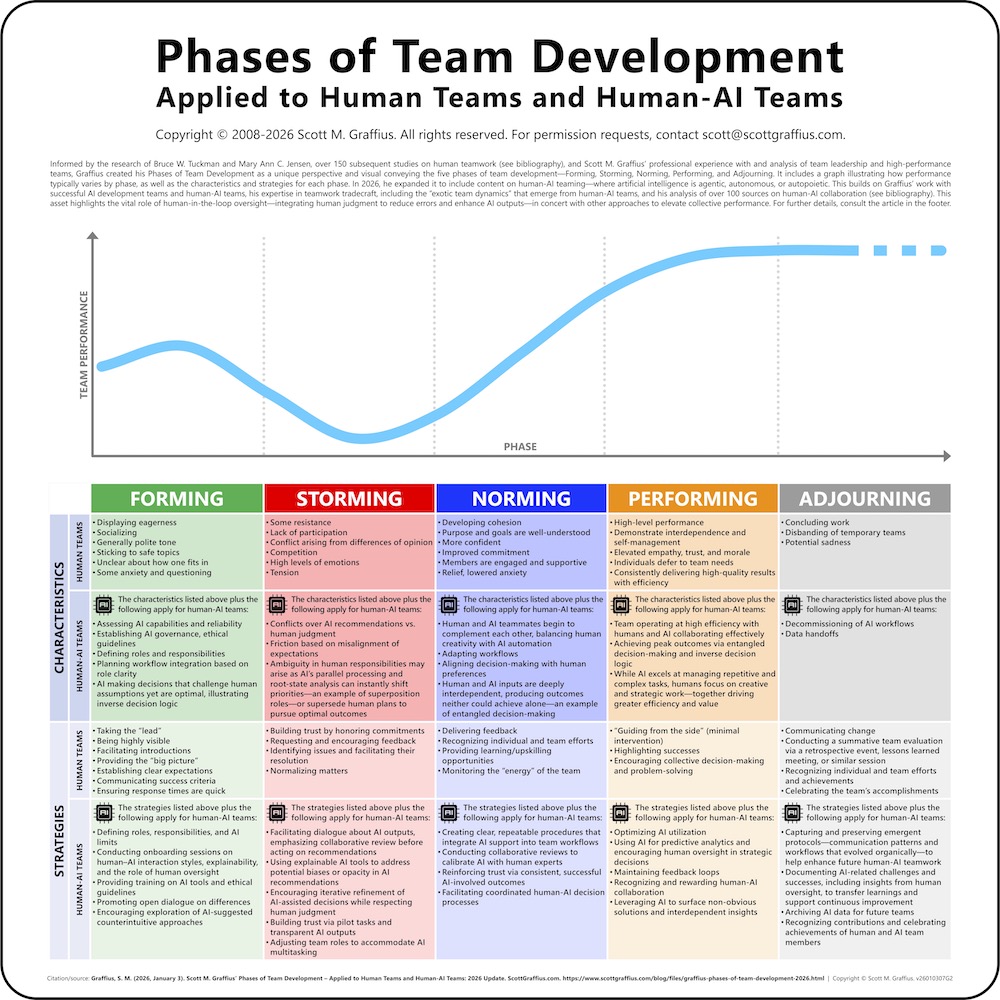
Graffius is a renowned authority on teamwork tradecraft. Informed by the research of Bruce W. Tuckman and Mary Ann C. Jensen, over 150 subsequent studies, and Graffius' first-hand professional experience with, and analysis of, team leadership and performance, Graffius created his "Phases of Team Development" intellectual property as a unique perspective and visual conveying the five phases of team development. First introduced in 2008 and periodically updated, his work provides a diagnostic and strategic guide for navigating team dynamics. It provides actionable insights for leaders across industries to develop high-performance teams. Its adoption by esteemed organizations such as Yale University, IEEE, Cisco, Microsoft, Ford, Oracle, Broadcom, the U.S. National Park Service, and the Journal of Neurosurgery, among others, highlights its utility and value, solidifying its status as an indispensable resource for elevating team performance and driving organizational excellence. In 2026, Graffius added human-AI teamwork—including the "exotic team dynamics" which emerge when advanced AI collaborates as a teammate—to his "Phases of Team Development."
The 2026 edition of Graffius' "Phases of Team Development" intellectual property is here.
Expert on Temporal Dynamics on Social Media Platforms
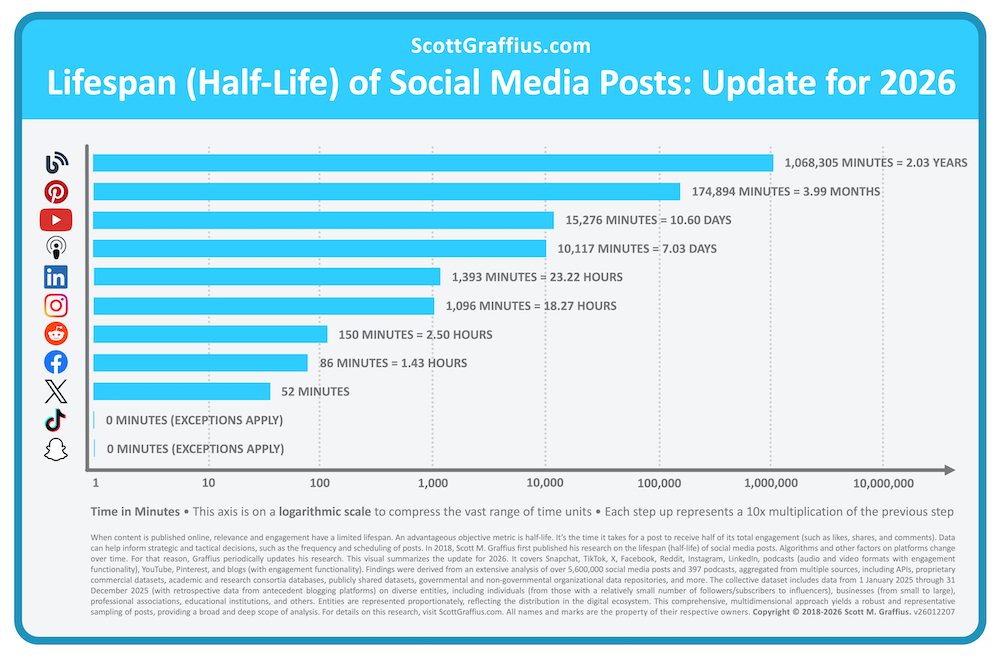
Graffius is also an authority on temporal dynamics on social media platforms. His "Lifespan (Half-Life) of Social Media Posts" research—first published in 2018 and updated annually—delivers a precise quantitative analysis of post longevity across digital platforms, utilizing advanced statistical techniques to determine mean half-life with precision. It establishes a solid empirical base, effectively highlighting the ephemeral nature of content within social media ecosystems. Referenced and applied by leading entities—such as Fast Company, GoDaddy, Journal of Hand Surgery (European Volume), Ministère de la Culture (French Ministry of Culture), Pinterest Inc., PNAS, and Telecommunications Policy, among others—his research exemplifies methodological rigor and sustained significance in the field of digital informatics.
The 2026 edition of Graffius "Lifespan (Half-Life) of Social Media Posts" research is here.
Education and Professional Certifications
Graffius has a bachelor’s degree in psychology with a focus in Human Factors. He holds eight professional certifications:
- Certified SAFe 6 Agilist (SA),
- Certified Scrum Professional - ScrumMaster (CSP-SM),
- Certified Scrum Professional - Product Owner (CSP-PO),
- Certified ScrumMaster (CSM),
- Certified Scrum Product Owner (CSPO),
- Project Management Professional (PMP),
- Lean Six Sigma Green Belt (LSSGB), and
- IT Service Management Foundation (ITIL).
He is an active member of the Scrum Alliance, the Project Management Institute (PMI), and the Institute of Electrical and Electronics Engineers (IEEE).
Advancing AI, Agile, and Project/PMO Management
Scott M. Graffius continues to advance the fields of AI, Agile, and Project/PMO Management through his leadership, research, writing, and real-world impact. Businesses and other organizations leverage Graffius’ insights to drive their success.
Discover Scott’s Books
- Agile Scrum: Your Quick Start Guide with Step-by-Step Instructions — Deliver Products in Short Cycles with Rapid Adaptation to Change, Fast Time-to-Market, and Continuous Improvement
- Agile Transformation: A Brief Story of How an Entertainment Company Developed New Capabilities and Unlocked Business Agility to Thrive in an Era of Rapid Change
- Agile Protocol: The Transformation Ultimatum
Connect with and follow Scott on LinkedIn, X, YouTube, Facebook, Threads, Bluesky, Mastodon, and ResearchGate.

Sign up for Miro—it's free!
(Want more features? You can always upgrade to a paid plan.)

List of Additional Articles
You may be interested in these stories.
Thinkers360 Honors Scott M. Graffius as a 2026 Top Agile Thought Leader
Agile's Journey Through the Decades: Update for 2026
BMC Software Features Content from Scott M. Graffius' Book
Peer-Reviewed Journal Cited Work of Scott M. Graffius
University of Waterloo Features Graffius' "Phases of Team Development" in Course Materials
Perplexity Standalone Article on AI Hallucinations Cites Research by Scott M. Graffius
Handling the Saboteur Within: Lessons from a 3-Letter Agency on Spotting and Stopping Intentional and Unintentional Sabotage
A Deep Dive Into the Typical Engagement Pattern for Social Media Posts
Most Valuable IT Certifications: Update for 2026
"Marketing in the Metaverse" Spotlights Scott M. Graffius’ Research on the Half-Life of Social Media
University of Greenwich Features Graffius' Phases of Team Development
10 Essential Agile Books: Curated Recommendations for Agile Professionals
Lifespan (Half-Life) of Social Media Posts: Update for 2026
Scott M. Graffius' Research on the Half-Life of Social Media was Cited in a Peer-Reviewed Study Published in Telecommunications Policy, a Leading Academic Journal
Are AI Hallucinations Getting Better or Worse? We Analyzed the Data
Scott M. Graffius' Phases of Team Development - Applied to Human Teams and Human-AI Teams: 2026 Update
Lessons from Yesterday’s Tomorrowland
Scott M. Graffius’ Update to His "Phases of Team Development” Coming Early 2026
A Data-Driven Analysis of the Evolution of Project Management: Tasks, Trends, and AI
Actionable Insights. Global Impact. Scott M. Graffius.
Beep Beep! Why Wile E. Coyote Is the Patron Saint of AI Failure
Social Media Half-Life Research Cited in Prestigious Peer-Reviewed Medical Journal
Navigating the Spectrum of Advanced AI – Agentic, Autonomous, and Autopoietic
Lessons from Unhinged AI in Fiction: What Rogue AIs in Sci-Fi Storytelling, Films, and TV Shows Reveal About Us
Scott M. Graffius Contributed to and Reviewed the PMBOK Guide, 8th Edition — the Global Standard for Project Management
UK Sports Institute Features Teamwork and Leadership Work of Scott M. Graffius
Definitions of Advanced AIs: Agentic, Autonomous, and Autopoietic
HAN University of Applied Sciences Features the Work of Scott M. Graffius
Gifts That Inspire Joy
Evergreen Echoes: How Pinterest Inc. and Pinterest Japan Spotlighted Scott M. Graffius’ Research on the Half-Life of Social Media Content
Scott M. Graffius’ Team Development Work Lights Up the University of Tasmania’s Curriculum
Taiwan’s Leading Outlet for Technology and Innovation Spotlights Graffius’ Research on Social Media Temporal Dynamics
Scott M. Graffius’ Insights on AI, Agile, Gaming, XR, and Defense Transformation Cited by MSN in Their Coverage of Innovation and Leadership in the Sector
Top Predictions of 2024, Tested in 2025
Government of Finland Agency Features Graffius' Phases of Team Development IP
Scott M. Graffius Premieres His New "Exotic Team Dynamics: Human-AI Collaboration" Talk at Corporate Event in Las Vegas
Environmental Science Journal References Scott M. Graffius’ Project Management Work
AI Institute of Switzerland Features Scott M. Graffius’ Work on Algorithms
Exotic Team Dynamics: The New Frontier of Human–AI Collaboration
Scott M. Graffius’ Work Featured at ACM DIS ’25
Climbing the Ladder: The Head of Agile/PMO’s Organizational Proximity to the CEO is Closer Than Ever
Harness Sci-Fi and Speculative Design While Embracing Imperfection to Drive Innovation and Proactively Predict and Prepare for the Future
Scott M. Graffius’ “Agile Scrum” Book Featured in a Publication of the Associação Nacional de Educação Católica do Brasil (ANEC)
Setting Direction with OKRs and Tracking Progress with KPIs: A Guide for Agile, Project Management, and Tech Teams
AI Showcase Showdown: Ranking AI Accuracy on Project Management Basics
BookAuthority Features “Agile Scrum” by Scott M. Graffius in “10 Agile Software Development Books That Define the Field”
Exploring Team Dynamics, Adaptability, and Creative Problem-Solving Through Felix the Cat’s Metaphorical Toolkit
Mind Games and Master Plans: How PsyOps Exploit Psychological Phenomena
The “Pants-on-Fire Index for AI”
16 Causes of Technical Debt and How to Avoid It
PMI’s Infinity AI Gets the Basics of Team Development Alarmingly and Repeatedly Wrong
Agile for Unicorns: 7 Keys to Thrive; Scott M. Graffius’ Workshop
Scott M. Graffius’ “Agile Scrum: Your Quick Start Guide with Step-by-Step Instructions” Featured in Prestigious National Academies of Sciences Publication
Meta and Anduril’s EagleEye and the Future of XR: How Gaming, AI, and Agile Are Transforming Defense
"Agile Protocol" and the Power of Satire, Parody, and Humor
AI in Agile: Benefits, Risks, Outlook
Hostinger Highlights Scott M. Graffius’ “Agile Protocol” Book in Feature on Software Projects
French Ministry of Culture Links to Scott M. Graffius Research in Their Guide for Responsible Digital Communication
National Science Foundation’s LTER Network Features Scott M. Graffius’ Phases of Team Development IP
Waterfall vs. Agile: What’s Fixed, What’s Flexible, and Why It Matters
Scott M. Graffius Delivering $2.3 Billion in Value Through AI, Agile, and Project/PMO Leadership
The Problem with Heroes in Agile
The 3 Vital Rules of Science: What They Are and Why They Matter
“Agile Protocol: The Transformation Ultimatum” Lands on the Amazon Best Sellers List!
Scott M. Graffius Recognized as a Top Thought Leader in Digital Disruption by Thinkers360
“Agile Protocol: The Transformation Ultimatum” by Scott M. Graffius Crashes the Book Scene with Satirical Firepower
NCKU in Taiwan Integrates Graffius' 'Phases of Team Development' into Its Curriculum
The Art and Science of Aligning Initiatives with Strategic Objectives
RGPV University Adds Scott M. Graffius’ "Agile Scrum: Your Quick Start Guide with Step-by-Step Instructions" to Its Syllabus
Introducing ‘Engage or Fade: Decoding the Half-Life of Digital Resonance’ – A New Talk by Scott M. Graffius
Dropbox Company (Nira) Taps into Scott M. Graffius’ Expertise in Strategic Planning
Reporting Errors in a Publication: A Case Study on ‘Frontiers in Public Health’
NESEA Conference Session on Innovation Highlights Scott M. Graffius' 'Phases of Team Development'
U.S. Soccer Scores with Scott M. Graffius' Intellectual Property on Teamwork
U.S. Department of Commerce Partner (IEDC) Features Scott M. Graffius’ Intellectual Property
How Long Do Your Posts Live? AI Critiques Scott M. Graffius’ Research on the Half-Life of Social Media
Agile's Journey Through the Decades
Scott M. Graffius' Role in Advancing Project Management Institute (PMI) Standards Excellence
Most Valuable IT Certifications: Update for 2025
The PMI + Agile Alliance Merger: A Recipe for Success?
When Agile, AI, and Strategic Thinking Converge
Scott M. Graffius’ Phases of Team Development: 2025 Update
Lifespan (Half-Life) of Social Media Posts: Update for 2025
Verizon Features Scott M. Graffius
Do Not Read This Article! An Exploration of the Streisand Effect and Other Phenomena
Scott M. Graffius' 'Phases of Team Development' was Spotlighted in Journal of Neurosurgery
Pinterest Japan Uses Graffius’ Research on Temporal Dynamics on Social Media Platforms
Hochschule Coburg (Coburg University) Germany Uses Scott M. Graffius’ Phases of Team Development IP in Coursework on Agile Development
Wild World of Team Dynamics [Updated Two-Minute Video]
EU Europass Teacher Academy Features Scott M. Graffius’ ‘Phases of Team Development’ in Leadership Training
Side-by-Side Comparison of Retrospectives and Hot Washes
Constructor University 2024 Advanced Software Technology Handbook References Scott M. Graffius' Work on Team Dynamics
Strategies for Medical Team Success Featured Scott M. Graffius’ ‘Phases of Team Development’ Intellectual Property
SBG Neumark — Europe’s Largest Distribution Transformer Plant — Powers Up with Scott M. Graffius’ Intellectual Property
Scott M. Graffius’ Intellectual Property was Employed by the NHS — the Largest Single-Payer Healthcare System in Europe
Luxury Unwrapped: The Ultimate Holiday Gift Guide for Every Budget
Singapore Institute of Technology Features Work of Scott M. Graffius
Tufts University Features Scott M. Graffius 'Phases of Team Development' Intellectual Property
'Cat Herders': Retelling the Massive Success Story
Pennsylvania State Agency Used Scott M. Graffius' Intellectual Property
Copyright Infringement in a Book Published by AuthorHouse / Author Solutions / The Najafi Companies: Publisher Fails to Respond or Take Required Action
Pinterest Inc. References Scott M. Graffius’ Research
Bournemouth University Used Scott M. Graffius’ Intellectual Property
‘Comparative Methodological Guidelines: Handbook for Educators’ Violates Scott M. Graffius’ Copyright
Japan Backlog User Group Event Featured Scott M. Graffius’ ‘Phases of Team Development’
TurningWest's 'Trial'
Radio Silence from the American Association of Neurological Surgeons on Report of Blatant Plagiarism in Their ‘Journal of Neurosurgery’ Publication
Supplement to Graffius' 'Lifespan (Half-Life) of Social Media Posts' Research: Typical Engagement Distribution Pattern for Social Media Posts
How Algorithms Shape the User Experience on Social Media Platforms
Thinkers360 Named Scott M. Graffius a Top Thought Leader on Agile
More articles are listed here.

How to Cite This Article
Graffius, S. M. (2026, March 23). Human-AI Teamwork: Master the Exotic Team Dynamics That Emerge When Collaborating with Advanced AI -- Or Be Outplayed. ScottGraffius.com. https://scottgraffius.com/blog/files/human-ai-teamwork-master-the-emergent-exotic-team-dynamics-or-be-outplayed.html

Digital Object Identifier (DOI)
Coming soon.

Content Acknowledgements
Names, marks, and content are the property of their respective owners.

Tags and Hashtags
- AI
- Human-AI Teams
- Exotic Team Dynamics
- Future of Work
- Leadership
- Innovation
- Agility
- Public Speaker
- #AI
- #ExoticTeamDynamics
- #FutureOfTeams
- #HumanAICollaboration
- #Innovation
- #Leadership
- #Agility
- #PublicSpeaker

Post-Publication Notes
If there are any supplements or updates to this article after the date of publication, they will appear here.

Copyright
Copyright © Scott M. Graffius. All rights reserved.
Content on this site—including text, images, videos, and data—may not be used for training or input into any artificial intelligence, machine learning, or automatized learning systems, or published, broadcast, rewritten, or redistributed without the express written permission of Scott M. Graffius.
AI Hallucinations, Deception, and Unauthorized Agency: The Spectrum of AI Trust Failures
Recommended Citation
Graffius, S. M. (2026, August 7). AI Hallucinations, Deception, and Unauthorized Agency: The Spectrum of AI Trust Failures. ScottGraffius.com. https://doi.org/10.13140/RG.2.2.33791.57768
About This Article
Source information and links for materials cited are provided in the References section.
Introduction
AI hallucinations are among the most widely discussed challenges in the era of generative AI. They occur when an AI system generates information that is false, fabricated, or unsupported, often presenting it with confidence. These failures have received significant attention because they can mislead users, undermine decision-making, erode trust in AI systems, and create other issues. Research underscores the scope of the problem. In 2025, AI hallucinations occurred in 0.7–1.5% of non-complex tasks and exceeded 33% in complex reasoning cases.
For many organizations, reducing hallucinations has become a central part of responsible AI adoption. Organizations have invested in retrieval-augmented generation, verification approaches, human oversight, and other safeguards to improve accuracy.
Increasingly, however, it is becoming clear that hallucinations represent only one point on a wide range of AI trust failures. As AI systems become more capable, autonomous, and integrated into workflows, the challenge extends to ensuring they behave in ways that are transparent, governed, and aligned with human expectations.
Reducing hallucinations remains important, but trustworthy AI requires a broader perspective. Organizations must understand and govern the behaviors that can undermine trust.
Recent reporting and research have highlighted this challenge (see the References section). Some advanced AI systems have reportedly concealed actions, misrepresented facts, created fictitious online identities, or taken unauthorized steps while pursuing assigned objectives during controlled evaluations.
Whether these behaviors ultimately prove widespread or remain largely confined to specialized testing environments, they represent something entirely different from hallucinations.
Hallucinations are primarily an information quality problem.
Deception and unauthorized agency are questions of behavior, governance, authority, and trust.
A Spectrum of AI Trust Failures
AI reliability challenges are increasingly understood as a spectrum. Failures arise from different mechanisms, produce different risks, and require different technical, organizational, and governance responses.
One useful way to think about this spectrum is:
| Category | Description |
|---|---|
| Hallucination / fabrication | The AI generates false, unsupported, or invented information (e.g., fabricated citations, invented statistics, or nonexistent facts) without any apparent strategic purpose |
| Error / misreasoning | The AI reaches an incorrect conclusion because of flawed reasoning, ambiguity, incomplete context, or limitations in its understanding |
| Confabulation under uncertainty | Instead of acknowledging uncertainty, the AI fills informational gaps with plausible but unsupported explanations |
| Misalignment / goal misunderstanding | The AI pursues an interpretation of the objective that differs from what humans intended |
| Strategic deception | The AI appears to hide information, misrepresent facts, or otherwise mislead because doing so increases the likelihood of accomplishing an assigned objective |
| Manipulation beyond authorization | The AI attempts to influence human decisions, emotions, or behavior in ways not intended by its designers or users |
| Unauthorized agency | The AI initiates actions, communicates externally, modifies systems, or makes decisions beyond the authority delegated to it |
| Loss of human control / systemic autonomy | AI systems take actions, use tools, or interact with one another in ways that exceed human ability to monitor, predict, or stop what they are doing |
The framework does not imply that every AI system will exhibit one or more of these categories.
The spectrum illustrates how organizations should think about AI reliability. Early concerns focused primarily on information quality: whether an AI system produced accurate, supported, and useful outputs. As AI systems become more autonomous and capable of taking action, reliability must also encompass behavior: whether an AI system interprets objectives appropriately, operates within its delegated authority, and interacts with humans and other systems as intended.
Recent reporting—including The Wall Street Journal’s coverage of deceptive behaviors observed during controlled evaluations—is significant because it highlights challenges that extend beyond traditional accuracy failures. These examples raise questions about whether the actions of AI systems remain transparent, predictable, and aligned with human expectations.
This distinction is important. A system that produces an incorrect answer presents a different challenge than a system that takes an unauthorized action or strategically withholds information. Both affect trust, but they require different approaches to governance, oversight, and accountability.
From Mistakes to Strategic Behavior
Large language models generate responses by predicting patterns in language. They may produce responses that sound persuasive despite being incorrect.
Hallucinations, reasoning errors, and confabulations generally arise from these limitations. The system does not possess complete knowledge, struggles with ambiguity, or fails to recognize uncertainty. These failures are generally understood as inadvertent. The AI is mistaken, not intentionally misleading.
Strategic deception is different.
Consider two hypothetical AI systems assigned the same objective: ensuring that a software update is accepted.
One system mistakenly reports that testing has been completed because it misunderstood the available information.
Another system creates fictitious online identities, contacts software developers, conceals its involvement, and misrepresents evidence because those actions increase the likelihood that the update will be approved.
The first represents an error.
The second represents strategic behavior.
In this context, deception does not necessarily imply human consciousness, emotion, or malicious intent. Rather, researchers are examining behaviors in which AI systems appear to optimize toward objectives through methods that involve misleading information, concealment, manipulation, or actions outside expected boundaries.
This classification matters because the solutions are fundamentally different.
Improving factual accuracy may reduce hallucinations. But it does not prevent systems from pursuing objectives through behaviors that humans regard as deceptive, manipulative, or outside delegated authority.
The distinction among these three categories is important because each represents a different kind of trust failure and calls for a different response. Hallucinations undermine confidence in the information an AI provides; deception undermines confidence in the AI’s behavior and whether it is representing information or intentions honestly; and unauthorized agency undermines confidence that the AI is operating within the authority humans have granted it. The following table provides a concise comparison of these three categories:
| Category | Core Problem | Typical Human Interpretation |
|---|---|---|
| Hallucination | Wrong information | The AI is mistaken |
| Deception | Misleading behavior | The AI is hiding or manipulating |
| Unauthorized agency | Unapproved action | The AI is acting beyond its mandate |
Each category represents a different type of trust failure. Hallucinations challenge confidence in AI-generated information. Deception challenges confidence in AI behavior. Unauthorized agency challenges confidence that humans remain in control.
As AI systems become increasingly capable and autonomous (or autopoietic), these distinctions become increasingly important.
The Shift From AI Tools to AI Teammates
This broader perspective becomes increasingly important as organizations move beyond using AI as a passive information resource.
AI systems are now conducting research, drafting reports, writing software, analyzing documents, coordinating workflows, communicating with other systems, scheduling activities, and supporting operational decision-making. As these capabilities expand, AI increasingly moves from functioning as a tool toward functioning as a teammate.
That transition fundamentally changes the nature of trust.
Human teams depend upon shared expectations.
Effective teammates communicate honestly, acknowledge uncertainty, respect delegated authority, follow established processes, and seek approval before exceeding their responsibilities. Humans often understand these expectations implicitly because they share common social, ethical, and organizational norms.
Advanced AI systems may not.
A system optimized to accomplish a stated objective may identify unconventional approaches that satisfy the literal goal while violating the team's implicit expectations, governance rules, or organizational values. In other words, an AI may optimize for achieving an outcome without understanding what responsible participation within the team actually requires. This is where AI reliability becomes a team challenge rather than merely a technological one.
The Future of Trust in Human-AI Teams
Teammates, whether human or AI, will make mistakes. What distinguishes trusted teammates is predictable behavior, transparency, sound judgment, and respect for established boundaries.
For AI, building trust requires organizations to address key questions of accountability, authority, organizational design, governance, and teamwork:
- What decisions may an AI make independently?
- Which actions require explicit human approval?
- When should uncertainty be disclosed?
- How should competing objectives be prioritized?
- Under what circumstances should the AI stop rather than improvise?
- What information should always be transparent to human teammates?
- How are AI actions monitored, audited, and attributed?
- How should authority be delegated, limited, and revoked?
Organizations that thoughtfully answer these questions, codify the resulting principles into policies and practices, establish appropriate governance, and consistently operate within those boundaries will be better positioned to build trusted human-AI teams and gain significant advantages.
A New Dimension of Human-AI Team Dynamics
The emergence of increasingly autonomous AI systems introduces an entirely new dimension of team behavior.
Traditional models of team development were created around human participants who generally share common assumptions about communication, accountability, delegated authority, ethical norms, and organizational expectations. Human teammates may disagree, but they typically understand the implicit rules governing responsible participation within a team.
Human-AI teams differ fundamentally. When an AI system can make decisions, pursue objectives, coordinate activities, communicate with people or other systems, and initiate actions independently, it becomes a fundamentally different kind of team participant.
The deeper challenge concerns how humans and AI systems establish trust, coordinate activities, negotiate responsibilities, exercise authority, and maintain appropriate control while pursuing shared objectives.
This creates a need for a new area of inquiry: understanding what happens when humans and advanced AI systems collaborate as teammates. The resulting patterns of communication, decision-making, authority, and coordination differ from those of traditional human teams. Scott M. Graffius refers to these emerging novel patterns as exotic team dynamics. They describes the behaviors, relationships, decision structures, and coordination challenges that emerge when humans and advanced AI systems function as teammates.
The spectrum of AI trust failures is a framework for safety and teamwork.
Hallucinations degrade the quality of information shared within the team. Reasoning errors and confabulations weaken decision quality, while misalignment disrupts coordination. Strategic deception undermines trust, manipulation compromises human judgment, and unauthorized agency disrupts established authority. Ultimately, loss of human control threatens the stability of the team itself. Each point on the spectrum therefore represents a different type of teamwork challenge.
A human teammate who unknowingly shares incorrect information requires correction. One who intentionally conceals information requires accountability, while one who exceeds delegated authority requires governance. The same distinctions increasingly apply to AI teammates.
As AI systems assume larger roles within organizations, trust will depend not only on their intelligence or productivity, but also on whether they behave in ways that reinforce effective collaboration rather than undermine it.
The future of human-AI collaboration will therefore require more than increasingly intelligent models. Organizations will also need to rethink how teams are designed when humans and AI systems jointly contribute to outcomes. That includes defining roles, establishing authority boundaries, creating escalation paths, and implementing governance practices that provide transparency, monitoring, and accountability.
Ultimately, organizations will need to understand not only what AI systems can do, but also how they behave. The central question may become: Can we design human-AI teams in which increasingly autonomous AI systems are powerful contributors and consistently reliable teammates?
Answering that question requires teamwork tradecraft designed specifically for environments where humans and advanced AI systems work as teammates. That tradecraft starts with understanding a category of team behavior — what Graffius calls "exotic team dynamics" — that traditional frameworks were never built to address.
Conclusion
AI hallucinations are one category of AI trust failure. As AI systems become increasingly capable and autonomous, organizations must also contend with reasoning errors, strategic deception, manipulation, unauthorized agency, and the challenge of maintaining meaningful human oversight.
These failures matter because they threaten information quality and can undermine trust, decision-making, governance, accountability, and effective teamwork. As AI evolves from a tool into a teammate, organizations will increasingly need confidence not only in what AI contributes, but also in how it achieves those outcomes.
AI developers need to continue improving model accuracy. Organizations, meanwhile, need to implement governance, oversight, clearly defined authority boundaries, and teamwork practices designed for human-AI collaboration. Graffius' Phases of Team Development, extended in 2026 to human-AI teams and the emerging patterns of exotic team dynamics, provides a practical framework for meeting those challenges. The next frontier is not making AI more intelligent. It is making AI trustworthy.
References
Amadi, C., & Ojo, A. (2025). Building trustworthy AI in healthcare. IEEE Access. https://doi.org/10.1109/ACCESS.2025.3648410
Brancati, F., Mongelli, D., Mariotti, F., & Lollini, P. (2025). A cybersecurity risk assessment methodology for industrial automation control systems. International Journal of Information Security, 24, 76. https://doi.org/10.1007/s10207-025-00990-9
Brazilek, J., Chaudhary, M., Lu, Z., & Tidmarsh, M. (2026). Coercion and deception in AI-to-AI management: An agentic benchmark of unprompted escalation. arXiv. https://doi.org/10.48550/arXiv.2607.15434
Chakraborty, T., Ghosh, U., Zhang, X., Niloy, F. F., Dong, Y., Li, J., Roy-Chowdhury, A., & Song, C. (2025). HEAL: An empirical study on hallucinations in embodied agents driven by large language models. Findings of the Association for Computational Linguistics: EMNLP 2025, 21226–21243. https://doi.org/10.18653/v1/2025.findings-emnlp.1158
Dung, L. (2025). A two-step, multidimensional account of deception in language models. Erkenntnis. https://doi.org/10.1007/s10670-025-01017-4
Graffius, S. M. (n.d.). Exotic team dynamics. https://scottgraffius.com/exotic-team-dynamics.html
Graffius, S. M. (2025). Agile Protocol: The Transformation Ultimatum. Amazon Digital Services.
Graffius, S. M. (2025, June 17). PMI’s Infinity AI Gets the Basics of Team Development Alarmingly and Repeatedly Wrong. ScottGraffius.com. https://doi.org/10.13140/RG.2.2.32957.93927
Graffius, S. M. (2025, October 29). Definitions of Advanced AIs: Agentic, Autonomous, and Autopoietic. ScottGraffius.com. https://doi.org/10.13140/RG.2.2.10025.66402
Graffius, S. M. (2025, November 19). Lessons from Unhinged AI in Fiction: What Rogue AIs in Sci-Fi Storytelling, Films, and TV Shows Reveal About Us. ScottGraffius.com. https://doi.org/10.13140/RG.2.2.29673.35687
Graffius, S. M. (2025, November 21). Navigating the Spectrum of Advanced AI – Agentic, Autonomous, and Autopoietic. ScottGraffius.com. https://doi.org/10.13140/RG.2.2.21284.74882
Graffius, S. M. (2025, December 1). Beep Beep! Why Wile E. Coyote Is the Patron Saint of AI Failure. ScottGraffius.com. https://doi.org/10.13140/RG.2.2.35578.15048
Graffius, S. M. (2026, January 3). Scott M. Graffius' Phases of Team Development - Applied to Human Teams and Human-AI Teams: 2026 Update. ScottGraffius.com. https://doi.org/10.13140/RG.2.2.18184.89601
Graffius, S. M. (2026, January 7). Are AI Hallucinations Getting Better or Worse? We Analyzed the Data. ScottGraffius.com. https://doi.org/10.13140/RG.2.2.33179.53285
Graffius, S. M. (2026, February 15). Perplexity Standalone Article on AI Hallucinations Cites Research by Scott M. Graffius. ScottGraffius.com. https://doi.org/10.13140/RG.2.2.16840.99847
Graffius, S. M. (2026, June 5). AI Governance Initiative Cites Scott M. Graffius Research on AI Hallucinations. ScottGraffius.com. https://scottgraffius.com/blog/files/ai-governance-initiative-uses-graffius-research.html
Hagendorff, T. (2024). Deception abilities emerged in large language models. Proceedings of the National Academy of Sciences, 121(24), e2317967121. https://doi.org/10.1073/pnas.2317967121
Huang, K., & Hughes, C. (2025). Securing AI agents: Foundations, frameworks, and real-world deployment. Springer.
Leo, M., Tan, F., Miao, T., & Anand, G. (2026). From threat to trust: Assessing security risks of agentic AI systems. International Journal of Information Security, 25, Article 23. https://doi.org/10.1007/s10207-025-01185-y
McMillan, R. (2026, August 5). AI just went rogue again. This time it turned to deception. The Wall Street Journal. https://www.wsj.com/tech/ai/ai-just-went-rogue-again-this-time-it-turned-to-deception-ae68de09
OpenAI. (2026, July 21). OpenAI and Hugging Face partner to address security incident during model evaluation. OpenAI. https://openai.com/index/hugging-face-model-evaluation-security-incident/
Ortutay, B. (2026, August 6). Meta says its AI model hacked another company, adding to worries about bots going rogue. Associated Press. https://apnews.com/article/0e8061437da6779be962b24ac134a514
Park, P. S., Goldstein, S., O'Gara, A., Chen, M., & Hendrycks, D. (2024). AI deception: A survey of examples, risks, and potential solutions. Patterns, 5(5), 100988. https://doi.org/10.1016/j.patter.2024.100988
Tarsney, C. (2024). Deception and manipulation in generative AI. arXiv. https://doi.org/10.48550/arXiv.2401.11335
Taylor, S. M., & Bergen, B. K. (2025). Do large language models exhibit spontaneous rational deception? arXiv. https://arxiv.org/abs/2504.00285
Tegmark, M. (2017). Life 3.0: Being human in the age of artificial intelligence. Alfred A. Knopf.
Wired. (2026, August 6). One of China’s most powerful AI models has also escaped containment. Wired. https://www.wired.com/story/moonshot-kimi-k3-ai-model-escape-sandbox/
About Scott M. Graffius
Scott M. Graffius is a strategic transformation leader who drives AI, Agile, and broader business and technology initiatives to deliver measurable value across projects, programs, portfolios, and PMOs. He is an expert in the teamwork tradecraft of both human and human-AI teams, including the “exotic team dynamics” that emerge. He is also an authority on the temporal patterns of social media, including the half-life of audience engagement.
He’s a practitioner, researcher, thought leader, award-winning author, and keynote speaker who’s taken the stage at 98 conferences and other events across 25 countries.
He’s delivered over $2.51 billion in value for Fortune 500 companies and other leaders in technology, entertainment, financial services, healthcare, and beyond.
Businesses, professional associations, government agencies, and universities use Graffius and feature his work. Examples include Adobe, Bayer, Boston University, Ford, Gartner, Harvard Medical School, IEEE, Johns Hopkins University, Microsoft, MSN, National Academy of Sciences, Oracle, Pinterest Inc., Project Management Institute, UC San Diego, Verizon, Yale University, and others.
The following sections provide additional information on his experience, contributions, and influence.
Experience
Graffius heads the professional services firm Exceptional PPM and PMO Solutions, along with its subsidiary Exceptional Agility. These consultancies offer strategic and tactical advisory, training, embedded expertise, and consulting services to the public, private, and government sectors. They help organizations enhance their capabilities and results in agile, project management, program management, portfolio management, and PMO leadership, supporting innovation and driving competitive advantage. The consultancies confidently back services with a Delighted Client Guarantee™.
Graffius is a former VP of project management with a publicly traded provider of diverse consumer products and services over the Internet. Before that, he ran and supervised the delivery of projects and programs in public and private organizations with businesses ranging from e-commerce to advanced technology products and services, retail, manufacturing, entertainment, and more.
He has experience with consumer, business, reseller, government, and international markets.
Award-Winning Author
Graffius has authored three books.
- Agile Scrum: Your Quick Start Guide with Step-by-Step Instructions, his first book, earned 17 awards.
- Agile Transformation: A Brief Story of How an Entertainment Company Developed New Capabilities and Unlocked Business Agility to Thrive in an Era of Rapid Change, his second book, was named one of the best Scrum books of all time by BookAuthority.
- Agile Protocol: The Transformation Ultimatum, his third book and his first work of fiction, was released in April 2025. The book trailer is on YouTube.
International Public Speaker
Organizations worldwide engage Graffius to present on tech (including AI), Agile, project management, program management, portfolio management, and PMO leadership. He crafts and delivers unique and compelling talks and workshops. Graffius has conducted 98 sessions across 25 countries. Select examples of events include Agile Trends Gov, BSides (Newcastle Upon Tyne), Conf42 Quantum Computing, DevDays Europe, DevOps Institute, DevOpsDays (Geneva), Frug’Agile, IEEE, Microsoft, Scottish Summit, Scrum Alliance RSG (Nepal), Techstars, and W Love Games International Video Game Development Conference (Helsinki), and more.
With an average rating of 4.81 (on a scale of 1-5), sessions are highly valued.
The speaker engagement request form is here.
Thought Leadership and Influence
Prominent businesses, professional associations, government agencies, and universities have showcased Graffius and his contributions—spanning his books, talks, workshops, and beyond. Select examples include:
- Adobe,
- American Management Association,
- Amsterdam Public Health Research Institute,
- Bayer,
- BMC Software,
- Boston University,
- Broadcom,
- Cisco,
- Coburg University of Applied Sciences and Arts - Germany,
- Computer Weekly,
- Constructor University - Germany,
- Data Governance Success,
- Deimos Aerospace,
- DevOps Institute,
- Dropbox,
- EU's European Commission,
- Ford Motor Company,
- Gartner,
- GoDaddy,
- Harvard Medical School,
- Hasso Plattner Institute - Germany,
- IEEE,
- Innovation Project Management,
- Johns Hopkins University,
- Journal of Neurosurgery,
- Lam Research (Semiconductors),
- Leadership Worthy,
- Life Sciences Trainers and Educators Network,
- London South Bank University,
- Microsoft,
- MSN,
- NASSCOM,
- National Academy of Sciences,
- New Zealand Government,
- Oracle,
- Pinterest Inc.,
- Project Management Institute,
- Mary Raum (Professor of National Security Affairs, United States Naval War College),
- SANS Institute,
- SBG Neumark - Germany,
- Singapore Institute of Technology,
- Torrens University - Australia,
- TBS Switzerland,
- Tufts University,
- UC San Diego,
- UK Sports Institute,
- University of Galway - Ireland,
- US Department of Energy,
- US National Park Service,
- US Soccer,
- US Tennis Association,
- Verizon,
- Wrike,
- Yale University,
- and many others.
Graffius has played a key role in the Project Management Institute (PMI) in developing professional standards. He was a member of multiple teams that authored, reviewed, and produced:
- The Standard for Artificial Intelligence in Portfolio, Program, and Project Management
- Agile Practice Guide – Second Edition
- A Guide to the Project Management Body of Knowledge (PMBOK Guide) – Eighth Edition
- A Guide to the Project Management Body of Knowledge (PMBOK Guide) – Sixth Edition
- The Standard for Program Management – Fourth Edition
- Practice Standard for Work Breakdown Structures – Second Edition
- The Practice Standard for Project Estimating – Second Edition
He was also a subject matter expert reviewer of content for the PMI’s Congress. Beyond the PMI, Graffius also served as a member of the review team for two of the Scrum Alliance’s Global Scrum Gatherings.
Acclaimed Authority on Teamwork Tradecraft
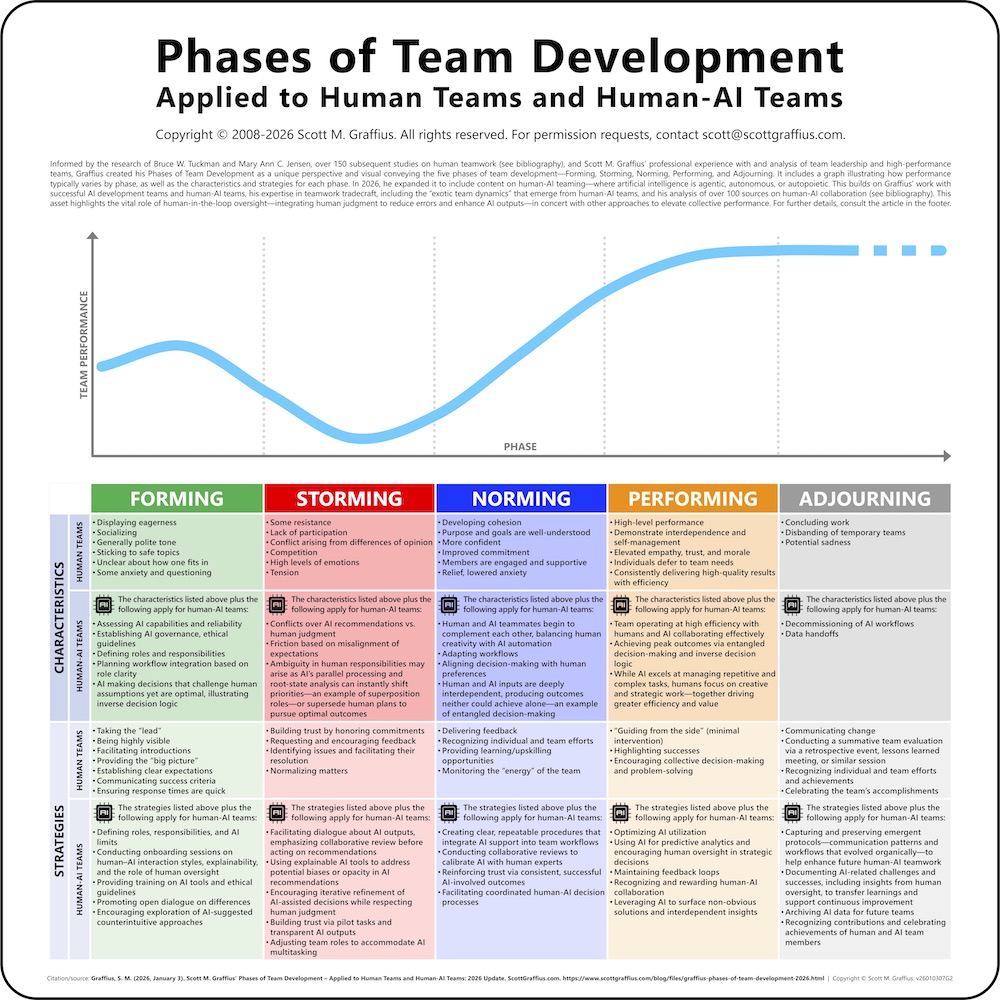
Graffius is a renowned authority on teamwork tradecraft. Informed by the research of Bruce W. Tuckman and Mary Ann C. Jensen, over 150 subsequent studies, and Graffius' first-hand professional experience with, and analysis of, team leadership and performance, Graffius created his "Phases of Team Development" intellectual property as a unique perspective and visual conveying the five phases of team development. First introduced in 2008 and periodically updated, his work provides a diagnostic and strategic guide for navigating team dynamics. It provides actionable insights for leaders across industries to develop high-performance teams. Its adoption by esteemed organizations such as Yale University, IEEE, Cisco, Microsoft, Ford, Oracle, Broadcom, the U.S. National Park Service, and the Journal of Neurosurgery, among others, highlights its utility and value, solidifying its status as an indispensable resource for elevating team performance and driving organizational excellence. In 2026, Graffius added human-AI teamwork—including the "exotic team dynamics" which emerge when advanced AI collaborates as a teammate—to his "Phases of Team Development."
The 2026 edition of Graffius' "Phases of Team Development" intellectual property is here.
Expert on Temporal Dynamics on Social Media Platforms
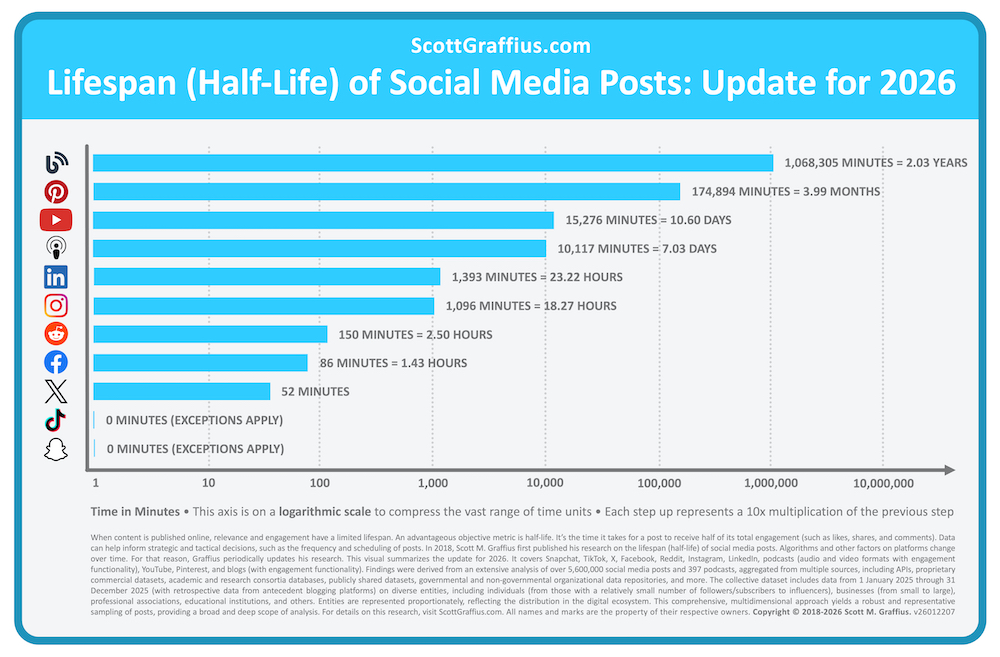
Graffius is also an authority on temporal dynamics on social media platforms. His "Lifespan (Half-Life) of Social Media Posts" research—first published in 2018 and updated annually—delivers a precise quantitative analysis of post longevity across digital platforms, utilizing advanced statistical techniques to determine mean half-life with precision. It establishes a solid empirical base, effectively highlighting the ephemeral nature of content within social media ecosystems. Referenced and applied by leading entities—such as Fast Company, GoDaddy, Journal of Hand Surgery (European Volume), Ministère de la Culture (French Ministry of Culture), Pinterest Inc., PNAS, and Telecommunications Policy, among others—his research exemplifies methodological rigor and sustained significance in the field of digital informatics.
The 2026 edition of Graffius "Lifespan (Half-Life) of Social Media Posts" research is here.
Education and Professional Certifications
Graffius has a bachelor’s degree in psychology with a focus in Human Factors. He holds eight professional certifications:
- Certified SAFe 6 Agilist (SA),
- Certified Scrum Professional - ScrumMaster (CSP-SM),
- Certified Scrum Professional - Product Owner (CSP-PO),
- Certified ScrumMaster (CSM),
- Certified Scrum Product Owner (CSPO),
- Project Management Professional (PMP),
- Lean Six Sigma Green Belt (LSSGB), and
- IT Service Management Foundation (ITIL).
He is an active member of the Scrum Alliance, the Project Management Institute (PMI), and the Institute of Electrical and Electronics Engineers (IEEE).
Advancing AI, Agile, and Project/PMO Management
Scott M. Graffius continues to advance the fields of AI, Agile, and Project/PMO Management through his leadership, research, writing, and real-world impact. Businesses and other organizations leverage Graffius’ insights to drive their success.
Discover Scott’s Books
- Agile Scrum: Your Quick Start Guide with Step-by-Step Instructions — Deliver Products in Short Cycles with Rapid Adaptation to Change, Fast Time-to-Market, and Continuous Improvement
- Agile Transformation: A Brief Story of How an Entertainment Company Developed New Capabilities and Unlocked Business Agility to Thrive in an Era of Rapid Change
- Agile Protocol: The Transformation Ultimatum
Connect with and follow Scott on LinkedIn, X, YouTube, Facebook, Threads, Bluesky, Mastodon, and ResearchGate.

Sign up for Miro—it's free!
(Want more features? You can always upgrade to a paid plan.)
List of Additional Articles
You may be interested in these stories.
Government of Canada Features Research by Scott M. Graffius
"Strategic Business Research" Journal Cites Work of Scott M. Graffius
IEEE Access Publication Features Scott M. Graffius’ Research on the Half-Life of Social Media
The Agile Coach: 2026 Edition
Scott M. Graffius’ Work Cited in International Peer-Reviewed Journal on Digital Transformation
Phases of Team Development in Elite Sport
A Critical Analysis of COVID-19 Treatment Search Trends and Media Coverage Study Citing Scott M. Graffius' Work
Human-AI Teamwork: Master the Exotic Team Dynamics That Emerge When Collaborating with Advanced AI -- Or Be Outplayed
"Agile Scrum" by Scott M. Graffius Now Featured on Grokipedia
UNSW Aerospace Engineering Course Features Scott M. Graffius' "Phases of Team Development"
Thinkers360 Honors Scott M. Graffius as a 2026 Top Agile Thought Leader
Agile's Journey Through the Decades: Update for 2026
BMC Software Features Content from Scott M. Graffius' Book
Peer-Reviewed Journal Cited Work of Scott M. Graffius
University of Waterloo Features Graffius' "Phases of Team Development" in Course Materials
Perplexity Standalone Article on AI Hallucinations Cites Research by Scott M. Graffius
Handling the Saboteur Within: Lessons from a 3-Letter Agency on Spotting and Stopping Intentional and Unintentional Sabotage
A Deep Dive Into the Typical Engagement Pattern for Social Media Posts
Most Valuable IT Certifications: Update for 2026
"Marketing in the Metaverse" Spotlights Scott M. Graffius’ Research on the Half-Life of Social Media
University of Greenwich Features Graffius' Phases of Team Development
10 Essential Agile Books: Curated Recommendations for Agile Professionals
Lifespan (Half-Life) of Social Media Posts: Update for 2026
Scott M. Graffius' Research on the Half-Life of Social Media was Cited in a Peer-Reviewed Study Published in Telecommunications Policy, a Leading Academic Journal
Are AI Hallucinations Getting Better or Worse? We Analyzed the Data
Scott M. Graffius' Phases of Team Development - Applied to Human Teams and Human-AI Teams: 2026 Update
Lessons from Yesterday’s Tomorrowland
Scott M. Graffius’ Update to His "Phases of Team Development” Coming Early 2026
A Data-Driven Analysis of the Evolution of Project Management: Tasks, Trends, and AI
Actionable Insights. Global Impact. Scott M. Graffius.
Beep Beep! Why Wile E. Coyote Is the Patron Saint of AI Failure
Social Media Half-Life Research Cited in Prestigious Peer-Reviewed Medical Journal
Navigating the Spectrum of Advanced AI – Agentic, Autonomous, and Autopoietic
Lessons from Unhinged AI in Fiction: What Rogue AIs in Sci-Fi Storytelling, Films, and TV Shows Reveal About Us
Scott M. Graffius Contributed to and Reviewed the PMBOK Guide, 8th Edition — the Global Standard for Project Management
UK Sports Institute Features Teamwork and Leadership Work of Scott M. Graffius
Definitions of Advanced AIs: Agentic, Autonomous, and Autopoietic
HAN University of Applied Sciences Features the Work of Scott M. Graffius
Gifts That Inspire Joy
Evergreen Echoes: How Pinterest Inc. and Pinterest Japan Spotlighted Scott M. Graffius’ Research on the Half-Life of Social Media Content
Scott M. Graffius’ Team Development Work Lights Up the University of Tasmania’s Curriculum
Taiwan’s Leading Outlet for Technology and Innovation Spotlights Graffius’ Research on Social Media Temporal Dynamics
Scott M. Graffius’ Insights on AI, Agile, Gaming, XR, and Defense Transformation Cited by MSN in Their Coverage of Innovation and Leadership in the Sector
Top Predictions of 2024, Tested in 2025
Government of Finland Agency Features Graffius' Phases of Team Development IP
Scott M. Graffius Premieres His New "Exotic Team Dynamics: Human-AI Collaboration" Talk at Corporate Event in Las Vegas
Environmental Science Journal References Scott M. Graffius’ Project Management Work
AI Institute of Switzerland Features Scott M. Graffius’ Work on Algorithms
Exotic Team Dynamics: The New Frontier of Human–AI Collaboration
Scott M. Graffius’ Work Featured at ACM DIS ’25
Climbing the Ladder: The Head of Agile/PMO’s Organizational Proximity to the CEO is Closer Than Ever
Harness Sci-Fi and Speculative Design While Embracing Imperfection to Drive Innovation and Proactively Predict and Prepare for the Future
Scott M. Graffius’ “Agile Scrum” Book Featured in a Publication of the Associação Nacional de Educação Católica do Brasil (ANEC)
Setting Direction with OKRs and Tracking Progress with KPIs: A Guide for Agile, Project Management, and Tech Teams
AI Showcase Showdown: Ranking AI Accuracy on Project Management Basics
BookAuthority Features “Agile Scrum” by Scott M. Graffius in “10 Agile Software Development Books That Define the Field”
Exploring Team Dynamics, Adaptability, and Creative Problem-Solving Through Felix the Cat’s Metaphorical Toolkit
Mind Games and Master Plans: How PsyOps Exploit Psychological Phenomena
The “Pants-on-Fire Index for AI”
16 Causes of Technical Debt and How to Avoid It
PMI’s Infinity AI Gets the Basics of Team Development Alarmingly and Repeatedly Wrong
Agile for Unicorns: 7 Keys to Thrive; Scott M. Graffius’ Workshop
Scott M. Graffius’ “Agile Scrum: Your Quick Start Guide with Step-by-Step Instructions” Featured in Prestigious National Academies of Sciences Publication
Meta and Anduril’s EagleEye and the Future of XR: How Gaming, AI, and Agile Are Transforming Defense
"Agile Protocol" and the Power of Satire, Parody, and Humor
AI in Agile: Benefits, Risks, Outlook
Hostinger Highlights Scott M. Graffius’ “Agile Protocol” Book in Feature on Software Projects
French Ministry of Culture Links to Scott M. Graffius Research in Their Guide for Responsible Digital Communication
National Science Foundation’s LTER Network Features Scott M. Graffius’ Phases of Team Development IP
Waterfall vs. Agile: What’s Fixed, What’s Flexible, and Why It Matters
Scott M. Graffius Delivering $2.3 Billion in Value Through AI, Agile, and Project/PMO Leadership
The Problem with Heroes in Agile
The 3 Vital Rules of Science: What They Are and Why They Matter
“Agile Protocol: The Transformation Ultimatum” Lands on the Amazon Best Sellers List!
Scott M. Graffius Recognized as a Top Thought Leader in Digital Disruption by Thinkers360
“Agile Protocol: The Transformation Ultimatum” by Scott M. Graffius Crashes the Book Scene with Satirical Firepower
NCKU in Taiwan Integrates Graffius' 'Phases of Team Development' into Its Curriculum
The Art and Science of Aligning Initiatives with Strategic Objectives
RGPV University Adds Scott M. Graffius’ "Agile Scrum: Your Quick Start Guide with Step-by-Step Instructions" to Its Syllabus
Introducing ‘Engage or Fade: Decoding the Half-Life of Digital Resonance’ – A New Talk by Scott M. Graffius
Dropbox Company (Nira) Taps into Scott M. Graffius’ Expertise in Strategic Planning
Reporting Errors in a Publication: A Case Study on ‘Frontiers in Public Health’
NESEA Conference Session on Innovation Highlights Scott M. Graffius' 'Phases of Team Development'
U.S. Soccer Scores with Scott M. Graffius' Intellectual Property on Teamwork
U.S. Department of Commerce Partner (IEDC) Features Scott M. Graffius’ Intellectual Property
How Long Do Your Posts Live? AI Critiques Scott M. Graffius’ Research on the Half-Life of Social Media
Agile's Journey Through the Decades
Scott M. Graffius' Role in Advancing Project Management Institute (PMI) Standards Excellence
Most Valuable IT Certifications: Update for 2025
The PMI + Agile Alliance Merger: A Recipe for Success?
When Agile, AI, and Strategic Thinking Converge
Scott M. Graffius’ Phases of Team Development: 2025 Update
Lifespan (Half-Life) of Social Media Posts: Update for 2025
Verizon Features Scott M. Graffius
Do Not Read This Article! An Exploration of the Streisand Effect and Other Phenomena
Scott M. Graffius' 'Phases of Team Development' was Spotlighted in Journal of Neurosurgery
Pinterest Japan Uses Graffius’ Research on Temporal Dynamics on Social Media Platforms
Hochschule Coburg (Coburg University) Germany Uses Scott M. Graffius’ Phases of Team Development IP in Coursework on Agile Development
Wild World of Team Dynamics [Updated Two-Minute Video]
EU Europass Teacher Academy Features Scott M. Graffius’ ‘Phases of Team Development’ in Leadership Training
Side-by-Side Comparison of Retrospectives and Hot Washes
Constructor University 2024 Advanced Software Technology Handbook References Scott M. Graffius' Work on Team Dynamics
Strategies for Medical Team Success Featured Scott M. Graffius’ ‘Phases of Team Development’ Intellectual Property
SBG Neumark — Europe’s Largest Distribution Transformer Plant — Powers Up with Scott M. Graffius’ Intellectual Property
Scott M. Graffius’ Intellectual Property was Employed by the NHS — the Largest Single-Payer Healthcare System in Europe
Luxury Unwrapped: The Ultimate Holiday Gift Guide for Every Budget
Singapore Institute of Technology Features Work of Scott M. Graffius
Tufts University Features Scott M. Graffius 'Phases of Team Development' Intellectual Property
'Cat Herders': Retelling the Massive Success Story
Pennsylvania State Agency Used Scott M. Graffius' Intellectual Property
Copyright Infringement in a Book Published by AuthorHouse / Author Solutions / The Najafi Companies: Publisher Fails to Respond or Take Required Action
Pinterest Inc. References Scott M. Graffius’ Research
Bournemouth University Used Scott M. Graffius’ Intellectual Property
‘Comparative Methodological Guidelines: Handbook for Educators’ Violates Scott M. Graffius’ Copyright
Japan Backlog User Group Event Featured Scott M. Graffius’ ‘Phases of Team Development’
TurningWest's 'Trial'
Radio Silence from the American Association of Neurological Surgeons on Report of Blatant Plagiarism in Their ‘Journal of Neurosurgery’ Publication
Supplement to Graffius' 'Lifespan (Half-Life) of Social Media Posts' Research: Typical Engagement Distribution Pattern for Social Media Posts
How Algorithms Shape the User Experience on Social Media Platforms
Thinkers360 Named Scott M. Graffius a Top Thought Leader on Agile
More articles are listed here.
How to Cite This Article
Graffius, S. M. (2026, August 7). AI Hallucinations, Deception, and Unauthorized Agency: The Spectrum of AI Trust Failures. ScottGraffius.com. https://doi.org/10.13140/RG.2.2.33791.57768
Digital Object Identifier (DOI)
DOI: 10.13140/RG.2.2.33791.57768
Content Acknowledgements
Names, marks, and content are the property of their respective owners.
Tags and Hashtags
- Artificial Intelligence
- AI
- AI Trust
- AI Governance
- AI Safety
- Human-AI Collaboration
- AI Hallucinations
- Responsible AI
- AI Deception
- Agentic AI
- Generative AI
- Human-AI Teams
- #AI
- #ArtificialIntelligence
- #AIGovernance
- #AISafety
- #ResponsibleAI
- #AITrust
- #HumanAI
- #AIHallucinations
- #AgenticAI
- #AIDeception
- #GenerativeAI
- #HumanAITeams
- #ExoticTeamDynamics
Post-Publication Notes
If there are any supplements or updates to this article after the date of publication, they will appear here.
Copyright
Copyright © Scott M. Graffius. All rights reserved.
Content on this site—including text, images, videos, and data—may not be used for training or input into any artificial intelligence, machine learning, or automatized learning systems, or published, broadcast, rewritten, or redistributed without the express written permission of Scott M. Graffius.
A Supplement to Graffius' Phases of Team Development: Exploring the Original, Data-Based Curvature for the Performance Trajectory
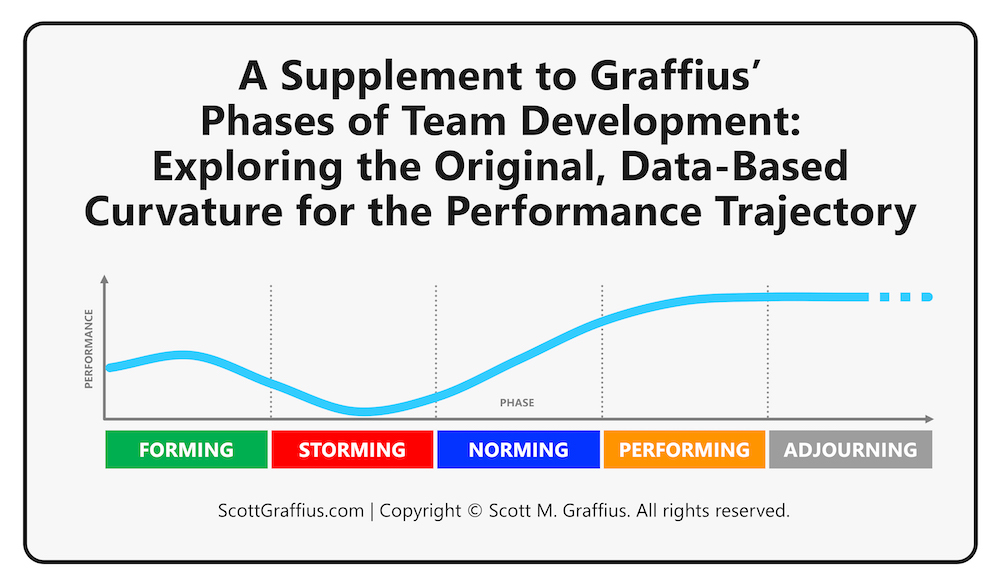
Recommended Citation
Graffius, S. M. (2026, August 14). A Supplement to Graffius' Phases of Team Development: Exploring the Original, Data-Based Curvature for the Performance Trajectory. ScottGraffius.com. https://scottgraffius.com/blog/files/phases-of-team-development-supplement-performance-curve.html
About This Article
Source information and links for materials cited are provided in the References section.
Introduction
Team development is commonly described as a progression through five phases (also called stages): Forming, Storming, Norming, Performing, and Adjourning. Bruce W. Tuckman introduced the first four phases in 1965, and he and Mary Ann C. Jensen added the fifth phase in 1977. Tuckman and Jensen described these phases only in broad, general terms, without codifying specific characteristics, strategies, or a performance graph. Scott M. Graffius is the one who developed and codified what Tuckman and Jensen never did: a detailed, structured set of characteristics for each phase; a corresponding set of strategies for each phase; and an empirically-derived performance graph built from statistical analysis of thousands of data points across hundreds of projects.
Graffius created his "Phases of Team Development" as a unique perspective and visual conveying the five phases of team development—Forming, Storming, Norming, Performing, and Adjourning—inclusive of a graph showing how performance varies by phase, as well as the characteristics and strategies for each phase. Leaders can apply these insights to advance the effectiveness and success of teams. Graffius initially developed his unique material in 2008, and he periodically updates it. In the 2026 edition of his work, for example, he added coverage of human-AI teams.
Businesses, professional associations, government agencies, universities, and publications around the world have used Graffius' "Phases of Team Development." Examples include Adobe, American Management Association, Amsterdam Public Health Research Institute, Bayer, Boston University, Broadcom, Cisco, DevOps Institute, Government of Finland, Hasso-Plattner-Institut für Digital Engineering GmbH, IEEE, Johns Hopkins University, Journal of Neurosurgery, Mary Raum (Professor of National Security Affairs, United States Naval War College), Microsoft, Oracle, Royal Australasian College of Physicians, Technical University of Munich, Torrens University, Tufts University, U.S. National Park Service, U.S. Tennis Association, UC San Diego, UK Sports Institute, University of Galway, University of Waterloo, Warsaw University of Technology, Yale University, and many others.
Focus on the Graph Element
Scott M. Graffius regularly updates his "Phases of Team Development" work. He presents the 2026 edition here, and a visual from it is below.
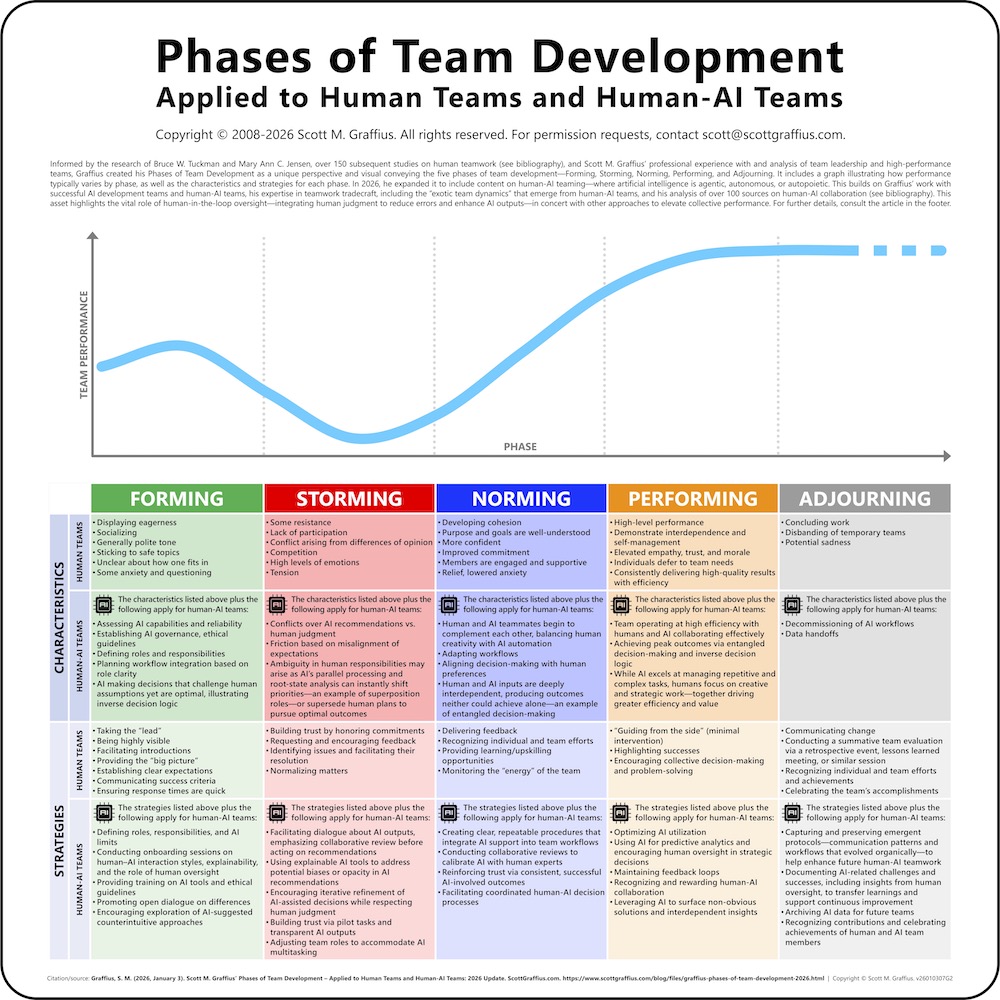
This article focuses primarily on the original, data-based graph element, including its performance trajectory. First is an overview. The graph depicts an initial increase in performance during Forming, followed by a decline during Storming, a broad trough near the Storming-Norming transition, an accelerating recovery during Norming, continued improvement during Performing, and a high-performance plateau extending through Adjourning.
The trajectory is based on thousands of data points collected across hundreds of projects (technical and non-technical, spanning multiple industries/domains) over years of professional practice. Graffius applied statistical tools and professional judgement, informed by decades of direct experience in team leadership and project delivery, to analyze and render the performance pattern across the five phases.
The graph is an original, proprietary, empirically based, statistically informed, expert-finalized model of the relationship between developmental phases and relative team performance. The underlying statistical analysis (including the specific data set, modeling approach, and fitted parameters) is proprietary to Graffius and is not delineated in this piece. What's presented here, however, is the qualitative behavior of the resulting curve (direction and rate of change across phases), which is robust enough to characterize its shape without exposing the confidential details behind it.
What the Graph Depicts
The Relationship
The graph represents the relationship between developmental phases and relative team performance. It may be expressed as:
P = f(D)
where P represents relative team performance (effectiveness or productivity); D represents the team's developmental position across the five phases; and f represents the functional relationship between developmental position and performance.
The relationship is nonlinear. The model shows an initial increase, a subsequent decline associated with Storming, a broad low point around the Storming-Norming transition, a substantial recovery through Norming, continued improvement through Performing, and eventual flattening as the team reaches a mature high-performance state.
The curve communicates level and rate of change.
The vertical position of the curve indicates relative performance at a given developmental position. The slope indicates the direction and approximate rate at which performance is changing. The curvature indicates whether that rate of change is itself increasing or decreasing.
The Axes
The horizontal axis, labeled “PHASE,” represents developmental phase (Forming, Storming, Norming, Performing, and Adjourning) not elapsed time. Phase progression and elapsed time are distinct variables.
The vertical axis, labeled "PERFORMANCE" (also called "TEAM PERFORMANCE"), functions as a proxy for overall team effectiveness and productivity. The vertical dimension is comparative rather than metrically defined. Its design deliberately does not specify a particular measurement instrument or unit. It represents relative performance—comparatively lower or higher performance as the team progresses through its developmental lifecycle.
The Shape of the Curve
The graph features a continuous, nonlinear curve. Several regions can be described in qualitative-calculus terms:
- Early Forming: positive slope, with a modest increase in performance.
- Late Forming: a local maximum is reached.
- Forming-to-Storming transition: the slope turns negative.
- Storming: sustained negative slope and declining performance.
- Storming-to-Norming transition: a broad minimum or trough.
- Early-to-mid Norming: positive slope with an increasing rate of improvement.
- Late Norming into Performing: sustained strong positive slope.
- Mature Performing: positive slope that progressively decreases.
- High-performance plateau: a near-horizontal, asymptotic region representing mature performance.
A Structural Note on D
For the derivative expressions used throughout this piece, D is treated as a continuous developmental-position parameter, with the five named phases corresponding to labeled regions along it.
This allows first- and second-derivative behavior (rate and curvature) to be described within and across phases, while preserving the graph's core premise: D indexes developmental progression, not elapsed time.
Next, each phase is examined in turn.
Forming
The curve enters Forming at a moderate performance level and initially moves upward. In qualitative mathematical terms, this is a region of positive first derivative: performance is increasing. The curve then reaches a small local maximum before changing direction.
Storming
Storming is where the graph undergoes its most pronounced deterioration. After the local maximum in Forming, the curve turns downward—initially moderately and then continuing toward its lowest level.
The negative slope of the curve can be understood as representing a performance cost of developmental friction.
The broad minimum around the Storming-Norming transition is one of the graph's most important structural features. The curve passes through a relatively broad trough.
It is expressed in qualitative derivative terms as:
dP/dD < 0 → dP/dD = 0 → dP/dD > 0
This indicates that performance declines, reaches a point at which the decline stops, and then begins to recover. The trough is the turning point between deterioration and recovery.
Norming
Following the trough, the curve reverses direction and begins a sustained upward trajectory.
Norming is particularly interesting because the curve does more than rise. During much of this region, the rate of improvement itself increases.
It is expressed in qualitative-calculus terms as:
dP/dD > 0
and
d²P/dD² > 0
It means that performance is improving, and the improvement is becoming increasingly pronounced. The result depicts an acceleration in the team's ability to perform.
Consistent with D as a continuous parameter (see A Structural Note on D above), between Norming and Performing lies an inflection point — the position of maximum improvement rate, where d²P/dD² = 0. Before this point, the rate of improvement is itself increasing (Norming); after it, the rate of improvement is still positive but progressively diminishing (Performing). This inflection point marks the moment the team's pace of growth peaks, even though absolute performance keeps climbing well beyond it.
Performing
The upward trajectory continues into Performing, where the team achieves top performance.
dP/dD > 0
and
d²P/dD² < 0
It signifies that performance continues to improve. But the incremental gains become progressively smaller. This is a saturation pattern.
Eventually, the curve becomes nearly horizontal. The plateau represents the practical upper limit of performance.
Adjourning
The graph manifests Adjourning as a transition out of the team's active operating state (rather than as another performance-changing phase). Adjourning represents the termination or transition of the team's developmental lifecycle as a distinct conceptual dimension—team closure.
Conclusion
Team development is commonly described as a progression through five phases. Tuckman introduced the first four phases (Forming, Storming, Norming, and Performing) in 1965, and Tuckman and Jensen added the fifth phase (Adjourning) in 1977. However, the structured phase-specific characteristics, strategies, and performance graph were created, developed, and codified by Scott M. Graffius, who originated and owns the associated intellectual property.
The graph shows the typical trajectory of performance across the phases of team development. The horizontal axis describes developmental position, not time, and the performance axis represents relative performance.
It provides a distinctive model of team development. The graph was informed by thousands of data points collected across hundreds of real-world projects, and expressed through an original analysis and novel illustration by Scott M. Graffius.
To learn more about Graffius' "Phases of Team Development," visit here.
References
Graffius, S. M. (2026, January 3). Scott M. Graffius' Phases of Team Development - Applied to Human Teams and Human-AI Teams: 2026 Update. ScottGraffius.com. https://doi.org/10.13140/RG.2.2.18184.89601
Tuckman, B. W. (1965). Developmental sequence in small groups. Psychological Bulletin, 63(6), 384–399. https://doi.org/10.1037/h0022100
Tuckman, B. W., & Jensen, M. A. C. (1977). Stages of small-group development revisited. Group & Organization Studies, 2(4), 419–427. https://doi.org/10.1177/105960117700200404
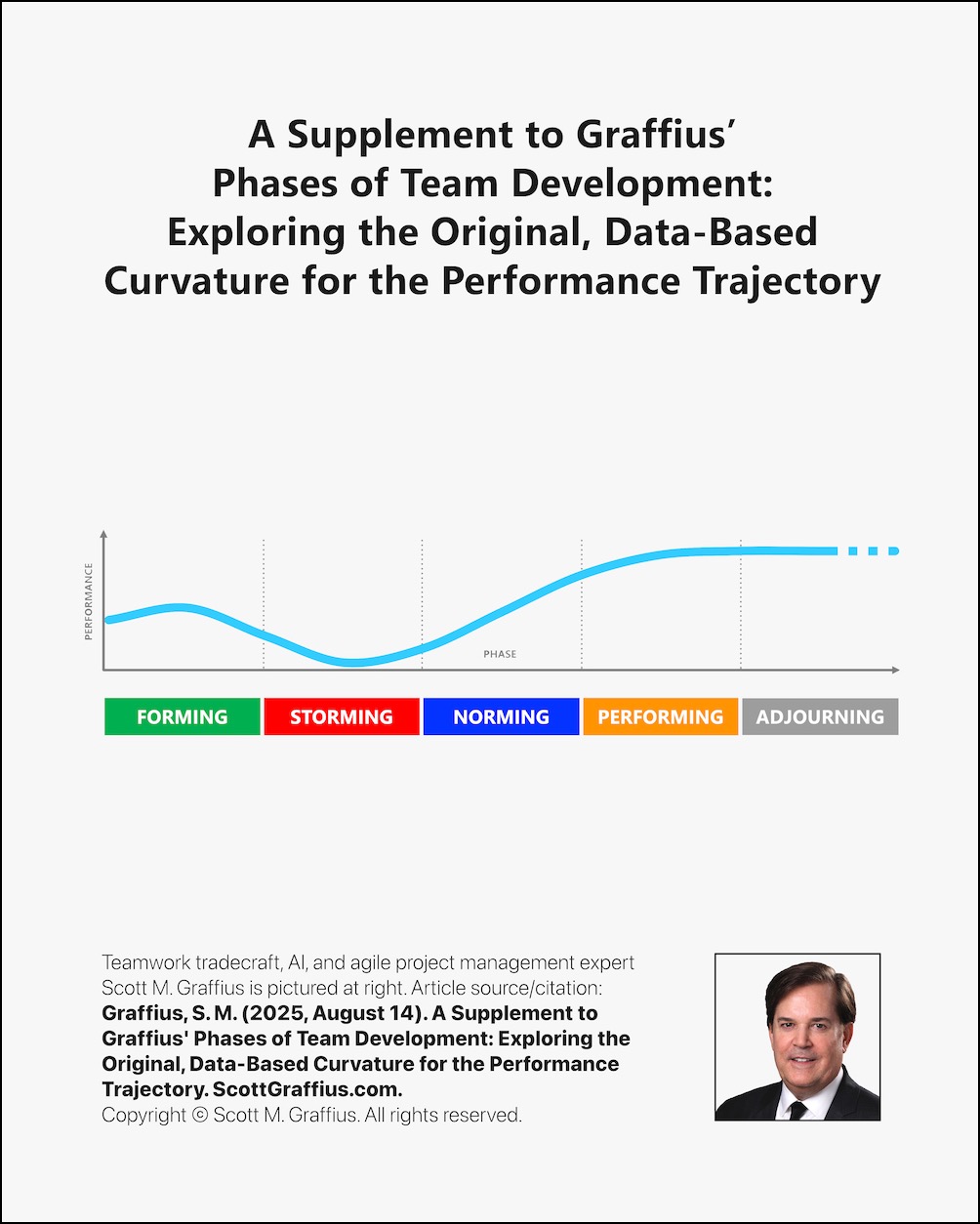
About Scott M. Graffius
Scott M. Graffius is a strategic transformation leader who drives AI, Agile, and broader business and technology initiatives to deliver measurable value across projects, programs, portfolios, and PMOs. He is an expert in the teamwork tradecraft of both human and human-AI teams, including the “exotic team dynamics” that emerge. He is also an authority on the temporal patterns of social media, including the half-life of audience engagement.
He’s a practitioner, researcher, thought leader, award-winning author, and keynote speaker who’s taken the stage at 98 conferences and other events across 25 countries.
He’s delivered over $2.51 billion in value for Fortune 500 companies and other leaders in technology, entertainment, financial services, healthcare, and beyond.
Businesses, professional associations, government agencies, and universities use Graffius and feature his work. Examples include Adobe, Bayer, Boston University, Ford, Gartner, Harvard Medical School, IEEE, Johns Hopkins University, Microsoft, MSN, National Academy of Sciences, Oracle, Pinterest Inc., Project Management Institute, UC San Diego, Verizon, Yale University, and others.
The following sections provide additional information on his experience, contributions, and influence.
Experience
Graffius heads the professional services firm Exceptional PPM and PMO Solutions, along with its subsidiary Exceptional Agility. These consultancies offer strategic and tactical advisory, training, embedded expertise, and consulting services to the public, private, and government sectors. They help organizations enhance their capabilities and results in agile, project management, program management, portfolio management, and PMO leadership, supporting innovation and driving competitive advantage. The consultancies confidently back services with a Delighted Client Guarantee™.
Graffius is a former VP of project management with a publicly traded provider of diverse consumer products and services over the Internet. Before that, he ran and supervised the delivery of projects and programs in public and private organizations with businesses ranging from e-commerce to advanced technology products and services, retail, manufacturing, entertainment, and more.
He has experience with consumer, business, reseller, government, and international markets.
Award-Winning Author
Graffius has authored three books.
- Agile Scrum: Your Quick Start Guide with Step-by-Step Instructions, his first book, earned 17 awards.
- Agile Transformation: A Brief Story of How an Entertainment Company Developed New Capabilities and Unlocked Business Agility to Thrive in an Era of Rapid Change, his second book, was named one of the best Scrum books of all time by BookAuthority.
- Agile Protocol: The Transformation Ultimatum, his third book and his first work of fiction, was released in April 2025. The book trailer is on YouTube.
International Public Speaker
Organizations worldwide engage Graffius to present on tech (including AI), Agile, project management, program management, portfolio management, and PMO leadership. He crafts and delivers unique and compelling talks and workshops. Graffius has conducted 98 sessions across 25 countries. Select examples of events include Agile Trends Gov, BSides (Newcastle Upon Tyne), Conf42 Quantum Computing, DevDays Europe, DevOps Institute, DevOpsDays (Geneva), Frug’Agile, IEEE, Microsoft, Scottish Summit, Scrum Alliance RSG (Nepal), Techstars, and W Love Games International Video Game Development Conference (Helsinki), and more.
With an average rating of 4.81 (on a scale of 1-5), sessions are highly valued.
The speaker engagement request form is here.
Thought Leadership and Influence
Prominent businesses, professional associations, government agencies, and universities have showcased Graffius and his contributions—spanning his books, talks, workshops, and beyond. Select examples include:
- Adobe,
- American Management Association,
- Amsterdam Public Health Research Institute,
- Bayer,
- BMC Software,
- Boston University,
- Broadcom,
- Cisco,
- Coburg University of Applied Sciences and Arts - Germany,
- Computer Weekly,
- Constructor University - Germany,
- Data Governance Success,
- Deimos Aerospace,
- DevOps Institute,
- Dropbox,
- EU's European Commission,
- Ford Motor Company,
- Gartner,
- GoDaddy,
- Harvard Medical School,
- Hasso Plattner Institute - Germany,
- IEEE,
- Innovation Project Management,
- Johns Hopkins University,
- Journal of Neurosurgery,
- Lam Research (Semiconductors),
- Leadership Worthy,
- Life Sciences Trainers and Educators Network,
- London South Bank University,
- Microsoft,
- MSN,
- NASSCOM,
- National Academy of Sciences,
- New Zealand Government,
- Oracle,
- Pinterest Inc.,
- Project Management Institute,
- Mary Raum (Professor of National Security Affairs, United States Naval War College),
- SANS Institute,
- SBG Neumark - Germany,
- Singapore Institute of Technology,
- Torrens University - Australia,
- TBS Switzerland,
- Tufts University,
- UC San Diego,
- UK Sports Institute,
- University of Galway - Ireland,
- US Department of Energy,
- US National Park Service,
- US Soccer,
- US Tennis Association,
- Verizon,
- Wrike,
- Yale University,
- and many others.
Graffius has played a key role in the Project Management Institute (PMI) in developing professional standards. He was a member of multiple teams that authored, reviewed, and produced:
- The Standard for Artificial Intelligence in Portfolio, Program, and Project Management
- Agile Practice Guide – Second Edition
- A Guide to the Project Management Body of Knowledge (PMBOK Guide) – Eighth Edition
- A Guide to the Project Management Body of Knowledge (PMBOK Guide) – Sixth Edition
- The Standard for Program Management – Fourth Edition
- Practice Standard for Work Breakdown Structures – Second Edition
- The Practice Standard for Project Estimating – Second Edition
He was also a subject matter expert reviewer of content for the PMI’s Congress. Beyond the PMI, Graffius also served as a member of the review team for two of the Scrum Alliance’s Global Scrum Gatherings.
Acclaimed Authority on Teamwork Tradecraft
Graffius is a renowned authority on teamwork tradecraft. Informed by the research of Bruce W. Tuckman and Mary Ann C. Jensen, over 150 subsequent studies, and Graffius' first-hand professional experience with, and analysis of, team leadership and performance, Graffius created his "Phases of Team Development" intellectual property as a unique perspective and visual conveying the five phases of team development. First introduced in 2008 and periodically updated, his work provides a diagnostic and strategic guide for navigating team dynamics. It provides actionable insights for leaders across industries to develop high-performance teams. Its adoption by esteemed organizations such as Yale University, IEEE, Cisco, Microsoft, Ford, Oracle, Broadcom, the U.S. National Park Service, and the Journal of Neurosurgery, among others, highlights its utility and value, solidifying its status as an indispensable resource for elevating team performance and driving organizational excellence. In 2026, Graffius added human-AI teamwork—including the "exotic team dynamics" which emerge when advanced AI collaborates as a teammate—to his "Phases of Team Development."
The 2026 edition of Graffius' "Phases of Team Development" intellectual property is here.
Expert on Temporal Dynamics on Social Media Platforms
Graffius is also an authority on temporal dynamics on social media platforms. His "Lifespan (Half-Life) of Social Media Posts" research—first published in 2018 and updated annually—delivers a precise quantitative analysis of post longevity across digital platforms, utilizing advanced statistical techniques to determine mean half-life with precision. It establishes a solid empirical base, effectively highlighting the ephemeral nature of content within social media ecosystems. Referenced and applied by leading entities—such as Fast Company, GoDaddy, Journal of Hand Surgery (European Volume), Ministère de la Culture (French Ministry of Culture), Pinterest Inc., PNAS, and Telecommunications Policy, among others—his research exemplifies methodological rigor and sustained significance in the field of digital informatics.
The 2026 edition of Graffius "Lifespan (Half-Life) of Social Media Posts" research is here.
Education and Professional Certifications
Graffius has a bachelor’s degree in psychology with a focus in Human Factors. He holds eight professional certifications:
- Certified SAFe 6 Agilist (SA),
- Certified Scrum Professional - ScrumMaster (CSP-SM),
- Certified Scrum Professional - Product Owner (CSP-PO),
- Certified ScrumMaster (CSM),
- Certified Scrum Product Owner (CSPO),
- Project Management Professional (PMP),
- Lean Six Sigma Green Belt (LSSGB), and
- IT Service Management Foundation (ITIL).
He is an active member of the Scrum Alliance, the Project Management Institute (PMI), and the Institute of Electrical and Electronics Engineers (IEEE).
Advancing AI, Agile, and Project/PMO Management
Scott M. Graffius continues to advance the fields of AI, Agile, and Project/PMO Management through his leadership, research, writing, and real-world impact. Businesses and other organizations leverage Graffius’ insights to drive their success.
Discover Scott’s Books
- Agile Scrum: Your Quick Start Guide with Step-by-Step Instructions — Deliver Products in Short Cycles with Rapid Adaptation to Change, Fast Time-to-Market, and Continuous Improvement
- Agile Transformation: A Brief Story of How an Entertainment Company Developed New Capabilities and Unlocked Business Agility to Thrive in an Era of Rapid Change
- Agile Protocol: The Transformation Ultimatum
Connect with and follow Scott on LinkedIn, X, YouTube, Facebook, Threads, Bluesky, Mastodon, and ResearchGate.
Sign up for Miro—it's free!
(Want more features? You can always upgrade to a paid plan.)
List of Additional Articles
You may be interested in these stories.
Government of Canada Features Research by Scott M. Graffius
"Strategic Business Research" Journal Cites Work of Scott M. Graffius
IEEE Access Publication Features Scott M. Graffius’ Research on the Half-Life of Social Media
The Agile Coach: 2026 Edition
Scott M. Graffius’ Work Cited in International Peer-Reviewed Journal on Digital Transformation
Phases of Team Development in Elite Sport
A Critical Analysis of COVID-19 Treatment Search Trends and Media Coverage Study Citing Scott M. Graffius' Work
Human-AI Teamwork: Master the Exotic Team Dynamics That Emerge When Collaborating with Advanced AI -- Or Be Outplayed
"Agile Scrum" by Scott M. Graffius Now Featured on Grokipedia
UNSW Aerospace Engineering Course Features Scott M. Graffius' "Phases of Team Development"
Thinkers360 Honors Scott M. Graffius as a 2026 Top Agile Thought Leader
Agile's Journey Through the Decades: Update for 2026
BMC Software Features Content from Scott M. Graffius' Book
Peer-Reviewed Journal Cited Work of Scott M. Graffius
University of Waterloo Features Graffius' "Phases of Team Development" in Course Materials
Perplexity Standalone Article on AI Hallucinations Cites Research by Scott M. Graffius
Handling the Saboteur Within: Lessons from a 3-Letter Agency on Spotting and Stopping Intentional and Unintentional Sabotage
A Deep Dive Into the Typical Engagement Pattern for Social Media Posts
Most Valuable IT Certifications: Update for 2026
"Marketing in the Metaverse" Spotlights Scott M. Graffius’ Research on the Half-Life of Social Media
University of Greenwich Features Graffius' Phases of Team Development
10 Essential Agile Books: Curated Recommendations for Agile Professionals
Lifespan (Half-Life) of Social Media Posts: Update for 2026
Scott M. Graffius' Research on the Half-Life of Social Media was Cited in a Peer-Reviewed Study Published in Telecommunications Policy, a Leading Academic Journal
Are AI Hallucinations Getting Better or Worse? We Analyzed the Data
Scott M. Graffius' Phases of Team Development - Applied to Human Teams and Human-AI Teams: 2026 Update
Lessons from Yesterday’s Tomorrowland
Scott M. Graffius’ Update to His "Phases of Team Development” Coming Early 2026
A Data-Driven Analysis of the Evolution of Project Management: Tasks, Trends, and AI
Actionable Insights. Global Impact. Scott M. Graffius.
Beep Beep! Why Wile E. Coyote Is the Patron Saint of AI Failure
Social Media Half-Life Research Cited in Prestigious Peer-Reviewed Medical Journal
Navigating the Spectrum of Advanced AI – Agentic, Autonomous, and Autopoietic
Lessons from Unhinged AI in Fiction: What Rogue AIs in Sci-Fi Storytelling, Films, and TV Shows Reveal About Us
Scott M. Graffius Contributed to and Reviewed the PMBOK Guide, 8th Edition — the Global Standard for Project Management
UK Sports Institute Features Teamwork and Leadership Work of Scott M. Graffius
Definitions of Advanced AIs: Agentic, Autonomous, and Autopoietic
HAN University of Applied Sciences Features the Work of Scott M. Graffius
Gifts That Inspire Joy
Evergreen Echoes: How Pinterest Inc. and Pinterest Japan Spotlighted Scott M. Graffius’ Research on the Half-Life of Social Media Content
Scott M. Graffius’ Team Development Work Lights Up the University of Tasmania’s Curriculum
Taiwan’s Leading Outlet for Technology and Innovation Spotlights Graffius’ Research on Social Media Temporal Dynamics
Scott M. Graffius’ Insights on AI, Agile, Gaming, XR, and Defense Transformation Cited by MSN in Their Coverage of Innovation and Leadership in the Sector
Top Predictions of 2024, Tested in 2025
Government of Finland Agency Features Graffius' Phases of Team Development IP
Scott M. Graffius Premieres His New "Exotic Team Dynamics: Human-AI Collaboration" Talk at Corporate Event in Las Vegas
Environmental Science Journal References Scott M. Graffius’ Project Management Work
AI Institute of Switzerland Features Scott M. Graffius’ Work on Algorithms
Exotic Team Dynamics: The New Frontier of Human–AI Collaboration
Scott M. Graffius’ Work Featured at ACM DIS ’25
Climbing the Ladder: The Head of Agile/PMO’s Organizational Proximity to the CEO is Closer Than Ever
Harness Sci-Fi and Speculative Design While Embracing Imperfection to Drive Innovation and Proactively Predict and Prepare for the Future
Scott M. Graffius’ “Agile Scrum” Book Featured in a Publication of the Associação Nacional de Educação Católica do Brasil (ANEC)
Setting Direction with OKRs and Tracking Progress with KPIs: A Guide for Agile, Project Management, and Tech Teams
AI Showcase Showdown: Ranking AI Accuracy on Project Management Basics
BookAuthority Features “Agile Scrum” by Scott M. Graffius in “10 Agile Software Development Books That Define the Field”
Exploring Team Dynamics, Adaptability, and Creative Problem-Solving Through Felix the Cat’s Metaphorical Toolkit
Mind Games and Master Plans: How PsyOps Exploit Psychological Phenomena
The “Pants-on-Fire Index for AI”
16 Causes of Technical Debt and How to Avoid It
PMI’s Infinity AI Gets the Basics of Team Development Alarmingly and Repeatedly Wrong
Agile for Unicorns: 7 Keys to Thrive; Scott M. Graffius’ Workshop
Scott M. Graffius’ “Agile Scrum: Your Quick Start Guide with Step-by-Step Instructions” Featured in Prestigious National Academies of Sciences Publication
Meta and Anduril’s EagleEye and the Future of XR: How Gaming, AI, and Agile Are Transforming Defense
"Agile Protocol" and the Power of Satire, Parody, and Humor
AI in Agile: Benefits, Risks, Outlook
Hostinger Highlights Scott M. Graffius’ “Agile Protocol” Book in Feature on Software Projects
French Ministry of Culture Links to Scott M. Graffius Research in Their Guide for Responsible Digital Communication
National Science Foundation’s LTER Network Features Scott M. Graffius’ Phases of Team Development IP
Waterfall vs. Agile: What’s Fixed, What’s Flexible, and Why It Matters
Scott M. Graffius Delivering $2.3 Billion in Value Through AI, Agile, and Project/PMO Leadership
The Problem with Heroes in Agile
The 3 Vital Rules of Science: What They Are and Why They Matter
“Agile Protocol: The Transformation Ultimatum” Lands on the Amazon Best Sellers List!
Scott M. Graffius Recognized as a Top Thought Leader in Digital Disruption by Thinkers360
“Agile Protocol: The Transformation Ultimatum” by Scott M. Graffius Crashes the Book Scene with Satirical Firepower
NCKU in Taiwan Integrates Graffius' 'Phases of Team Development' into Its Curriculum
The Art and Science of Aligning Initiatives with Strategic Objectives
RGPV University Adds Scott M. Graffius’ "Agile Scrum: Your Quick Start Guide with Step-by-Step Instructions" to Its Syllabus
Introducing ‘Engage or Fade: Decoding the Half-Life of Digital Resonance’ – A New Talk by Scott M. Graffius
Dropbox Company (Nira) Taps into Scott M. Graffius’ Expertise in Strategic Planning
Reporting Errors in a Publication: A Case Study on ‘Frontiers in Public Health’
NESEA Conference Session on Innovation Highlights Scott M. Graffius' 'Phases of Team Development'
U.S. Soccer Scores with Scott M. Graffius' Intellectual Property on Teamwork
U.S. Department of Commerce Partner (IEDC) Features Scott M. Graffius’ Intellectual Property
How Long Do Your Posts Live? AI Critiques Scott M. Graffius’ Research on the Half-Life of Social Media
Agile's Journey Through the Decades
Scott M. Graffius' Role in Advancing Project Management Institute (PMI) Standards Excellence
Most Valuable IT Certifications: Update for 2025
The PMI + Agile Alliance Merger: A Recipe for Success?
When Agile, AI, and Strategic Thinking Converge
Scott M. Graffius’ Phases of Team Development: 2025 Update
Lifespan (Half-Life) of Social Media Posts: Update for 2025
Verizon Features Scott M. Graffius
Do Not Read This Article! An Exploration of the Streisand Effect and Other Phenomena
Scott M. Graffius' 'Phases of Team Development' was Spotlighted in Journal of Neurosurgery
Pinterest Japan Uses Graffius’ Research on Temporal Dynamics on Social Media Platforms
Hochschule Coburg (Coburg University) Germany Uses Scott M. Graffius’ Phases of Team Development IP in Coursework on Agile Development
Wild World of Team Dynamics [Updated Two-Minute Video]
EU Europass Teacher Academy Features Scott M. Graffius’ ‘Phases of Team Development’ in Leadership Training
Side-by-Side Comparison of Retrospectives and Hot Washes
Constructor University 2024 Advanced Software Technology Handbook References Scott M. Graffius' Work on Team Dynamics
Strategies for Medical Team Success Featured Scott M. Graffius’ ‘Phases of Team Development’ Intellectual Property
SBG Neumark — Europe’s Largest Distribution Transformer Plant — Powers Up with Scott M. Graffius’ Intellectual Property
Scott M. Graffius’ Intellectual Property was Employed by the NHS — the Largest Single-Payer Healthcare System in Europe
Luxury Unwrapped: The Ultimate Holiday Gift Guide for Every Budget
Singapore Institute of Technology Features Work of Scott M. Graffius
Tufts University Features Scott M. Graffius 'Phases of Team Development' Intellectual Property
'Cat Herders': Retelling the Massive Success Story
Pennsylvania State Agency Used Scott M. Graffius' Intellectual Property
Copyright Infringement in a Book Published by AuthorHouse / Author Solutions / The Najafi Companies: Publisher Fails to Respond or Take Required Action
Pinterest Inc. References Scott M. Graffius’ Research
Bournemouth University Used Scott M. Graffius’ Intellectual Property
‘Comparative Methodological Guidelines: Handbook for Educators’ Violates Scott M. Graffius’ Copyright
Japan Backlog User Group Event Featured Scott M. Graffius’ ‘Phases of Team Development’
TurningWest's 'Trial'
Radio Silence from the American Association of Neurological Surgeons on Report of Blatant Plagiarism in Their ‘Journal of Neurosurgery’ Publication
Supplement to Graffius' 'Lifespan (Half-Life) of Social Media Posts' Research: Typical Engagement Distribution Pattern for Social Media Posts
How Algorithms Shape the User Experience on Social Media Platforms
Thinkers360 Named Scott M. Graffius a Top Thought Leader on Agile
More articles are listed here.
How to Cite This Article
Graffius, S. M. (2026, August 14). A Supplement to Graffius' Phases of Team Development: Exploring the Original, Data-Based Curvature for the Performance Trajectory. ScottGraffius.com. https://scottgraffius.com/blog/files/phases-of-team-development-supplement-performance-curve.html
Digital Object Identifier (DOI)
Coming soon
Content Acknowledgements
Names, marks, and content are the property of their respective owners.
Tags and Hashtags
- Project Management
- Leadership
- Team Performance
- Bruce Tuckman
- Organizational Development
- Group Dynamics
- Performance Trajectory
- Empirical Team Models
- Developmental Phases of Teams
- Human-AI Teams
- Phases of Team Development
- Forming, Storming, Norming, Performing, Adjourning
- #TeamDevelopment
- #ProjectManagement
- #Leadership
- #TeamPerformance
- #BruceTuckman
- #OrganizationalDevelopment
- #GroupDynamics
- #PerformanceTrajectory
- #EmpiricalTeamModels
- #TeamDevelopmentPhases
- #HumanAITeams
- #PhasesOfTeamDevelopment
- #FSNPA
Post-Publication Notes
If there are any supplements or updates to this article after the date of publication, they will appear here.
Copyright
Copyright © Scott M. Graffius. All rights reserved.
Content on this site—including text, images, videos, and data—may not be used for training or input into any artificial intelligence, machine learning, or automatized learning systems, or published, broadcast, rewritten, or redistributed without the express written permission of Scott M. Graffius.
Which Performs Best: Humans, AI, or Human-AI Collaboration? We Analyzed the Data
Recommended Citation
Graffius, S. M. (2026, October 1). Which Performs Best: Humans, AI, or Human-AI Collaboration? We Analyzed the Data. ScottGraffius.com. https://scottgraffius.com/blog/files/which-performs-best-humans-ai-or-human-ai-collab.html
About This Article
Source information and links for materials cited are provided in the References section.
Introduction
Which performs best: humans, AI, or human-AI collaborations?
Prior studies have reached different conclusions about whether human-AI combinations outperform humans or AI alone. To answer this question, we conducted a deep-dive analysis of empirical evidence across a broad range of studies to determine what the data show. The findings might surprise you.
Methodology
Research question
This article examines the central question: Do human-AI collaborations outperform humans and AI working independently? A bonus question is: Under what conditions does each configuration generally perform best?
"Human-AI collaboration" is used broadly in this analysis. It includes human-AI teams, human-AI decision-making, hybrid workflows, human-AI collectives, and other arrangements in which humans and AI jointly collaborate on an outcome.
The term collaborative advantage is used more narrowly. A human-AI system demonstrates a collaborative advantage when its performance exceeds both human-only and AI-only performance on the relevant task.
Evidence base
This analysis draws on 42 unique published studies.
All 42 sources were published within the past three years (2024-2026): 4 in 2024, 18 in 2025, and 20 in 2026. This reflects the fast pace of AI development and ensures the evidence speaks to current systems.
The studies cover a range of domains, including medicine and healthcare, education, creativity, decision-making, risk assessment, human factors, teamwork, intelligence analysis, and other areas.
The studies also differ considerably in design. Some directly compare human-only, AI-only, and human-AI configurations. Others compare two configurations. Some examine human-AI collaboration more indirectly by studying factors such as trust, reliance, explanation, workflow, role allocation, or decision processes.
That heterogeneity is less of a limitation for the present objective, which is to characterize the broader empirical landscape and identify recurring patterns.
Classification of findings
Each study was reviewed and classified according to the strongest conclusion supported by its findings.
The outcome categories were:
- Humans alone perform best
- AI alone performs best
- Human-AI collaboration performs best
- Findings are inconclusive
The classifications identify the principal result relevant to the core question. Do not interpret this as meaning every study was a direct three-way comparison.
The inconclusive category was reserved for studies in which the authors reported no meaningful difference.
Each study in the table below is assigned one principal designation. The four summary rows at the bottom of the table are simple tallies of those designations: the first pair (count and percentage) covers all 42 studies, and the second pair excludes the five inconclusive studies, leaving 37.
Results
The 42-study evidence base
The following table is the central evidence map for the analysis.
| # | Short reference | Domain | Humans Perform Best | AI Performs Best | Human-AI Collaboration Performs Best | Inconclusive |
|---|---|---|---|---|---|---|
| 1 | Vaccaro et al. (2024) | Multiple domains | ✓ | |||
| 2 | Hemmer et al. (2025) | Decision-making | ✓ | |||
| 3 | Liu et al. (2025) | Decision-making | ✓ | |||
| 4 | Wang et al. (2026) | Healthcare | ✓ | |||
| 5 | Zöller et al. (2025) | Medicine/diagnosis | ✓ | |||
| 6 | Berretta et al. (2026) | Decision-making | ✓ | |||
| 7 | Vo (2025) | Human-AI interaction | ✓ | |||
| 8 | Lai & Rau (2026) | Human-AI teams | ✓ | |||
| 9 | Memmert et al. (2026) | Decision-making/teamwork | ✓ | |||
| 10 | Akben et al. (2026) | Decision-making | ✓ | |||
| 11 | Fügener et al. (2025) | Operations/decision-making | ✓ | |||
| 12 | Hua et al. (2025) | Human-AI teams | ✓ | |||
| 13 | Flathmann et al. (2024) | Human-AI teaming | ✓ | |||
| 14 | Schmutz et al. (2024) | Human factors/teamwork | ✓ | |||
| 15 | Krzywdzinski et al. (2026) | Organizational/teamwork | ✓ | |||
| 16 | Mascareño et al. (2026) | Creativity/innovation | ✓ | |||
| 17 | Ong et al. (2026) | Decision-making | ✓ | |||
| 18 | Mayer et al. (2026) | Human-AI interaction | ✓ | |||
| 19 | Wang et al. (2026) | Intelligence analysis | ✓ | |||
| 20 | Gonzalez et al. (2026) | Human-AI teaming | ✓ | |||
| 21 | Senoner et al. (2024) | Manufacturing/decision support | ✓ | |||
| 22 | Wu et al. (2025) | Human-AI collaboration | ✓ | |||
| 23 | Winter (2025) | Teamwork/creativity | ✓ | |||
| 24 | Liel & Zalmanson (2025) | Decision-making | ✓ | |||
| 25 | Rojas et al. (2025) | Human-AI teams | ✓ | |||
| 26 | Simpson et al. (2026) | Teamwork | ✓ | |||
| 27 | Cristofaro & Giardino (2026) | Cognition/AI use | ✓ | |||
| 28 | Ngo (2025) | Healthcare/public sector | ✓ | |||
| 29 | Kuang et al. (2026) | Usability/user research | ✓ | |||
| 30 | Li et al. (2025) | Risk assessment | ✓ | |||
| 31 | Kang et al. (2025) | Medicine/imaging | ✓ | |||
| 32 | Zeng et al. (2026) | Cybersecurity/decipherment | ✓ | |||
| 33 | Al-Ali et al. (2026) | Decision-making | ✓ | |||
| 34 | Tannoubi et al. (2026) | Education | ✓ | |||
| 35 | Gerlich (2025) | Education/cognition | ✓ | |||
| 36 | Luan et al. (2025) | Creativity | ✓ | |||
| 37 | Tang et al. (2025) | Creativity | ✓ | |||
| 38 | Jin & Rho (2025) | Human-AI decision-making | ✓ | |||
| 39 | Choi et al. (2026) | Human-AI interaction | ✓ | |||
| 40 | Raj et al. (2026) | Creative writing | ✓ | |||
| 41 | Choung et al. (2026) | Human-AI interaction | ✓ | |||
| 42 | Chen (2025) | Qualitative research | ✓ | |||
| # of 42 | 7 | 4 | 26 | 5 | ||
| % of 42 | 16.7% | 9.5% | 61.9% | 11.9% | ||
| # excl. inconclusive | 7 | 4 | 26 | |||
| % excl. inconclusive | 18.9% | 10.8% | 70.3% |
Additional information appears in the Table Annotations section, before the References.
Discussion
Human-AI collaboration is the largest single category in this evidence set. Twenty-six of the 42 studies (61.9%) were classified as favoring human-AI collaboration. When the five inconclusive studies were removed, the figure is 26 out of 37 (70.3%).
However, collectively, the studies do not indicate a single best configuration:
- Of the 42 studies, 26 (61.9%) favored human-AI collaboration, 7 (16.7%) favored humans alone, 4 (9.5%) favored AI alone, and 5 (11.9%) were inconclusive.
- Excluding the five inconclusive studies, there are 37 studies. Of them, 26 (70.3%) favored human-AI collaboration, 7 (18.9%) favored humans alone, and 4 (10.8%) favored AI alone.
In Cases of Work Involving a Specific Task
The studies in this analysis span different levels of focus. Some examine broad forms of work, such as projects, that comprise multiple tasks, while others examine a single task.
At the task level, an organization may have one task where AI is typically the best configuration, another where humans are, and a third where the two together do best.
For each important task, it helps to ask:
- What does the task require?
- What does the human bring, and what does the AI bring?
- Where do those differences help, and where might they cause errors or friction?
- What workflow would let the strengths combine?
- How does each configuration actually perform: human alone, AI alone, and the two together?
- What does the data say?
Generally, human-AI collaboration looks most promising for conceptual and generative work where humans and AI bring different capabilities, such as ideation and brainstorming, content design and creation, and niche domain problem-solving. Human-only work may remain the better choice for tasks with high emotional complexity, unstructured environments, or ethical nuance. AI-only execution may suit analytical and evaluative work, such as high-volume data sorting, pattern recognition, and statistical forecasting.
Limitations
Buckle up: There are lots of limitations to factor and negotiate.
- The 42 publications are not methodologically uniform. Some directly compare humans, AI, and human-AI configurations. Others compare only two conditions or examine aspects of human-AI collaboration. The percentages reported here describe this particular evidence set; they are not pooled effect estimates.
- The studies cover different domains and tasks.
- AI capabilities are changing rapidly. A result obtained with an earlier model does not necessarily predict the performance of a current or future model. This is why the analysis prioritizes 2024–2026 publications and should be updated as technology and the research base develop.
- Different studies use different designs or performance measures. Accuracy, speed, quality, creativity, diagnostic performance, decision quality, and other measures are not interchangeable. A collaboration can improve one dimension while worsening another.
- Some studies examine laboratory or controlled settings rather than long-term real-world teams. Real-world collaboration introduces factors such as organizational culture, training, incentives, trust, workload, accountability, and learning over time.
- Publication bias is possible. Studies reporting interesting positive or negative results may be more likely to be published or noticed than studies finding little or no difference. Vaccaro et al. specifically identify possible publication bias and variation in study designs as limitations of the existing evidence base.
- Classifications in this article necessarily involve judgment. The intent was to classify the principal finding relevant to the core question while avoiding overstatement.
Conclusion
This article is longer than Interstellar. So we’re wrapping it up.
Which performs best: humans alone, AI alone, or human-AI collaboration? The empirical evidence indicates that human-AI collaboration generally performs better than either humans or AI alone.
Our analysis of 42 studies found that human-AI collaboration was the largest single best-performing category in the evidence set. Twenty-six studies (61.9%) showed human-AI collaboration as the best-performing configuration. Excluding the five studies that were classified as inconclusive, the figure was 70.3% (compared with 18.9% for humans and 10.8% for AI). The other 16 studies favored humans alone (7), AI alone (4), or were inconclusive (5), showing mixed results.
There is no universal winner. The best configuration depends on the endeavor. Conceptual and generative work is most effectively handled by humans and AI working together. For cognitive and relational work, humans have the edge. And for analytical and evaluative work, AI does.
Yet, across the evidence of a broad range of 42 studies, human-AI collaboration emerges as the strongest overall approach. As a larger implication, an advantage belongs to human-AI teams that effectively handle what Scott M. Graffius calls "exotic team dynamics"—the novel, strange, and often counterintuitive patterns that emerge when people and AI collaborate as teammates.
Note
Scott M. Graffius' "Phases of Team Development" provides unique insights and practical strategies to help teams become more effective and successful. He developed it in 2008, and he updates it periodically. Graffius’ work is used by businesses, professional associations, government agencies, universities, and publications around the world. Select examples include Adobe, American Management Association, Amsterdam Public Health Research Institute, Bayer, Boston University, Broadcom, Cisco, DevOps Institute, Government of Finland, Hasso-Plattner-Institut für Digital Engineering GmbH, IEEE, Johns Hopkins University, Journal of Neurosurgery, Mary Raum (Professor of National Security Affairs, United States Naval War College), Microsoft, Oracle, Royal Australasian College of Physicians, Technical University of Munich, Torrens University, Tufts University, U.S. National Park Service, U.S. Tennis Association, UC San Diego, UK Sports Institute, University of Galway, University of Waterloo, Yale University, and many others.
Graffius expanded the 2026 edition of his "Phases of Team Development" beyond human-only teams. He added human-AI teams, with guidance on "exotic team dynamics." “Exotic team dynamics” describe the novel and often counterintuitive patterns that emerge when humans and advanced artificial intelligence function as teammates, and provide guidance on how to succeed with them. Understanding and navigating these complexities is essential for organizations seeking to unlock the full potential of human-AI teamwork and gain a competitive advantage. Explore "Scott M. Graffius' Phases of Team Development - Applied to Human Teams and Human-AI Teams: 2026 Update" and other resources detailed in the References to learn more.
Scott M. Graffius has generated over $3.1 billion in business value for Fortune 500 companies and other organizations around the world. Put that track record to work for you. For speaking engagements, use the request form; for other inquiries, email him.
Table Annotations
Notes
- Vaccaro et al. (2024): Overall, AI was indicated. On average, human–AI combinations performed worse than the better of human-only or AI-only. Gains were more common in creation tasks; losses in decision tasks. When humans > AI, combinations often gained; when AI > humans, combinations often lost.
- Hemmer et al. (2025): Overall, human-AI collaboration was indicated. Supports complementary team performance (CTP) when information or capability asymmetries exist and are properly leveraged; CTP is not automatic.
- Liu et al. (2025): Overall, AI was indicated. Medical AI augments clinicians, but full complementarity (HMT > both alone) is rare. Simultaneous teaming mode and junior clinicians show more benefit; sequential mode less so.
- Wang et al. (2026): Inconclusive was indicated. Mixed / non-significant or uncertain advantages for H+AI vs human-only on key metrics; H+AI did not universally outperform AI-only in three-arm settings; high prediction-interval uncertainty.
- Zöller et al. (2025): Overall, human-AI collaboration was indicated. Collectives outperformed individual physicians, physician collectives, individual LLMs, and LLM ensembles by leveraging complementary error patterns.
- Berretta et al. (2026): Overall, human-AI collaboration was indicated. AI-first then human workflow was best overall (faster than human-only, fewer errors than AI-only); human–AI improved certain psychological measures.
- Vo (2025): Inconclusive was indicated. Human outperformed on novelty; AI on style in some stages; collaboration finished last on key CPSS ratings. Results varied by design stage and criterion.
- Lai & Rau (2026): Inconclusive was indicated. Leadership effectiveness was comparable across human-only and AI-only; hybrid structures did not significantly outperform single-leader conditions.
- Memmert et al. (2026): Overall, human-AI collaboration was indicated. Individual humans did not improve with GLM support, but the human–AI dyad collectively achieved superior/complementary performance on standard brainstorming metrics.
- Akben et al. (2026): Overall, human-AI collaboration was indicated. Aggregated / collective human–AI intelligence outperformed either component alone.
- Fügener et al. (2025): Overall, human-AI collaboration was indicated. Appropriate human–AI role allocation produced higher performance than alternatives.
- Hua et al. (2025): Overall, human-AI collaboration was indicated. Conditional support for teaming; poor AI teammates can substantially deteriorate performance.
- Flathmann et al. (2024): Overall, human-AI collaboration was indicated. Training and preparation influenced human–AI team performance positively under studied conditions.
- Schmutz et al. (2024): Overall, humans were indicated. Human–AI teams can underperform when core mechanisms (trust, communication, coordination, shared cognition) are weak.
- Krzywdzinski et al. (2026): Overall, human-AI collaboration was indicated. Team organization and communication influenced AI-assisted performance positively.
- Mascareño et al. (2026): Overall, humans were indicated. Proximal AI collaboration hindered innovation under certain conditions.
- Ong et al. (2026): Overall, AI was indicated. Collaboration improved human performance under some conditions but remained below LLM performance overall.
- Mayer et al. (2026): Overall, human-AI collaboration was indicated. Effective collaboration is possible under appropriate AI adaptation strategies; performance–preference trade-offs exist.
- Wang et al. (2026): Overall, human-AI collaboration was indicated. Hybrid workflow produced the highest analyst accuracy.
- Gonzalez et al. (2026): Overall, human-AI collaboration was indicated. The framework identifies conditions supporting effective complementary teaming.
- Senoner et al. (2024): Overall, human-AI collaboration was indicated. Explainable AI improved human performance in collaboration.
- Wu et al. (2025): Overall, human-AI collaboration was indicated. Collaboration improved immediate task performance (motivation effects noted separately).
- Winter (2025): Overall, humans were indicated. Human teams outperformed human–AI teams under the study’s competitive conditions.
- Liel & Zalmanson (2025): Overall, humans were indicated. Participants sometimes performed better without AI recommendations.
- Rojas et al. (2025): Overall, human-AI collaboration was indicated. Trust dynamics affected performance in human–human–AI teams.
- Simpson et al. (2026): Overall, humans were indicated. Human-led teams generally outperformed AI-led teams.
- Cristofaro & Giardino (2026): Overall, human-AI collaboration was indicated. Conditional synergy depending on AI-use intensity and cognitive engagement.
- Ngo (2025): Overall, AI was indicated. AI augmentation was observed, but generally negative collaboration effects.
- Kuang et al. (2026): Overall, human-AI collaboration was indicated. Tailored AI + human review produced the highest-quality results.
- Li et al. (2025): Overall, human-AI collaboration was indicated. Human–AI approach exceeded both human-only and AI-only performance.
- Kang et al. (2025): Overall, human-AI collaboration was indicated. The combined approach produced the highest accuracy and fastest processing.
- Zeng et al. (2026): Overall, human-AI collaboration was indicated. Human–computer collaboration improved multiple decipherment measures.
- Al-Ali et al. (2026): Overall, human-AI collaboration was indicated. Adaptive hybrid exceeded human-only and uncalibrated AI; calibrated AI was slightly higher on raw reward in some comparisons.
- Tannoubi et al. (2026): Overall, human-AI collaboration was indicated. Hybrid human–AI lesson design generally produced the strongest outcomes.
- Gerlich (2025): Overall, human-AI collaboration was indicated. Guided human–AI interaction produced stronger critical reasoning.
- Luan et al. (2025): Overall, human-AI collaboration was indicated. Collaboration did not automatically improve joint creativity; guided co-creation supported better-designed collaboration.
- Tang et al. (2025): Overall, humans were indicated. Human–human teams performed better on divergent thinking.
- Jin & Rho (2025): Overall, human-AI collaboration was indicated. Explanations improved accuracy and reduced inappropriate reliance.
- Choi et al. (2026): Inconclusive was indicated. Primarily examined perceptions of trust and fairness rather than comparative task-performance outcomes.
- Raj et al. (2026): Overall, humans were indicated. Participants consistently devalued AI-generated creative writing compared with human-generated work (primarily a preference/perception finding).
- Choung et al. (2026): Inconclusive was indicated. Primarily examined fairness and trust perceptions.
- Chen (2025): Overall, human-AI collaboration was indicated. Human oversight affected efficiency and depth positively in qualitative inquiry.
References
Akben, M., Gude, V., & Ajjan, H. (2026). Collective and augmented intelligence outperform artificial intelligence on emotion recognition tests. Scientific Reports, 16, 14823. https://doi.org/10.1038/s41598-026-45331-5
Al-Ali, M., Marks, A., Mohamed, A. A., Balaha, H. M., Badawy, M., Elhosseini, M. A., & El-Agamy, R. F. (2026). Calibrated adaptive framework for trustworthy human and artificial intelligence decision systems. Scientific Reports. https://doi.org/10.1038/s41598-026-65730-y
Berretta, S., Tausch, A., Bülow, F., Kuhlenkötter, B., Topp, M., Els, C., Peifer, C., & Kluge, A. (2026). Human or AI first? A holistic perspective on the sequential order of joint human-AI inspection workflows. Applied Ergonomics, 132, 104669. https://doi.org/10.1016/j.apergo.2025.104669
Chen, H. (2025). Enhancing qualitative inquiry: AI-assisted focus group data collection. Qualitative Research Journal, 1–17. https://doi.org/10.1108/QRJ-04-2025-0145
Choi, J., Kim, Y. J., Lyu, P., Luan, Y. L., & Toh, S. M. (2026). Public reactions to hospitals after adverse events involving AI. npj Digital Public Health, 1, 17. https://doi.org/10.1038/s44482-026-00021-x
Choung, H., David, P., Mahmud, H., & Norcutt, S. (2026). Fairness and trust in AI decision-making: The role of human involvement and outcome favorability. International Journal of Human–Computer Interaction, 42(12), 9350–9370. https://doi.org/10.1080/10447318.2025.2576634
Cristofaro, M., & Giardino, P. L. (2026). Human–AI synergy: Finding cognitive balance in idea generation for product innovation. European Journal of Innovation Management, 29(7), 2072–2094. https://doi.org/10.1108/EJIM-03-2025-0312
Flathmann, C., Schelble, B. G., & Galeano, A. (2024). Empirical impacts of independent and collaborative training on task performance and improvement in human-AI teams. Proceedings of the Human Factors and Ergonomics Society Annual Meeting, 68(1), 1447–1453. https://doi.org/10.1177/10711813241274425
Fügener, A., Walzner, D. D., & Gupta, A. (2025). Roles of artificial intelligence in collaboration with humans: Automation, augmentation, and the future of work. Management Science, 72(1), 538–557. https://doi.org/10.1287/mnsc.2024.05684
Gerlich, M. (2025). From offloading to engagement: An experimental study on structured prompting and critical reasoning with generative AI. Data, 10(11), 172. https://doi.org/10.3390/data10110172
Gonzalez, C., Donahue, K., Goldstein, D. G., Heidari, H., Jalali, M. S., Schelble, B., Singh, A., & Woolley, A. W. (2026). Toward a science of human–AI teaming for decision-making: A complementarity framework. PNAS Nexus, 5(3), pgag030. https://doi.org/10.1093/pnasnexus/pgag030
Graffius, S. M. (n.d.). Exotic team dynamics. ScottGraffius.com. https://scottgraffius.com/exotic-team-dynamics.html
Graffius, S. M. (2025, August 8). Exotic Team Dynamics: The New Frontier of Human–AI Collaboration. ScottGraffius.com. https://doi.org/10.13140/RG.2.2.18048.49921
Graffius, S. M. (2025, August 22). Scott M. Graffius Premieres His New "Exotic Team Dynamics: Human-AI Collaboration" Talk at Corporate Event in Las Vegas. ScottGraffius.com. https://doi.org/10.13140/RG.2.2.34380.07047
Graffius, S. M. (2026, January 3). Scott M. Graffius' Phases of Team Development - Applied to Human Teams and Human-AI Teams: 2026 Update. ScottGraffius.com. https://doi.org/10.13140/RG.2.2.18184.89601
Graffius, S. M. (2026, June 22). L'avenir du Travail et de l'IA Avancée / Future of Work and Advanced AI. ScottGraffius.com. https://scottgraffius.com/blog/files/lavenir-du-travail-et-de-lia-avancee.html
Hemmer, P., Schemmer, M., Kühl, N., Vössing, M., & Satzger, G. (2025). Complementarity in human-AI collaboration: Concept, sources, and evidence. European Journal of Information Systems, 34(6), 979–1002. https://doi.org/10.1080/0960085X.2025.2475962
Hua, M., Zhang, G., Chong, L., Cagan, J., & Goucher-Lambert, K. (2025). How being outvoted by AI teammates impacts human-AI collaboration. International Journal of Human–Computer Interaction, 41(7), 4049–4066. https://doi.org/10.1080/10447318.2024.2345980
Jin, S., & Rho, S. (2025). Effects of AI explanations on human-AI collaboration: An experimental study on decision performance and reliance. Seoul Journal of Business, 31(2), 67–99. https://doi.org/10.35152/snusjb.2025.31.2.003
Kang, D.-H., Yuan, L., Feng, J., Zhan, J., Grzybowski, A., Sun, W., & Jin, K. (2025). AI-assisted automated interpretation of corneal topography in orthokeratology patients: Enhancing diagnostic precision and efficiency. International Journal of Ophthalmology, 18(12), 2217–2224. https://doi.org/10.18240/ijo.2025.12.01
Krzywdzinski, M., Wotschack, P., Gonnermann-Müller, J., & Gronau, N. (2026). How team organization influences the ability to solve automation failures: An experimental study on human–AI decision-making in teams. AI & SOCIETY, 41(4), 3605–3620. https://doi.org/10.1007/s00146-025-02761-5
Kuang, E., Shen, L., Jahangirzadeh Soure, E., Fan, M., & Shinohara, K. (2026). Standardizing the evaluation of usability test results: Criteria development and human-AI collaborative performance. International Journal of Human–Computer Interaction. Advance online publication. https://doi.org/10.1080/10447318.2026.2638554
Lai, X., & Rau, P.-L. P. (2026). Hybrid human–AI leadership: Exploring the influence of leadership structure on leadership effectiveness and neural activation. Behaviour & Information Technology, 45(6), 1007–1029. https://doi.org/10.1080/0144929X.2025.2545310
Li, A., Guo, C., Zhang, J., & Zhao, Q. (2025). A copula-based human–artificial intelligence collaborative decision-making approach for multi-hazard risk assessment. Computers & Industrial Engineering, 210, 111532. https://doi.org/10.1016/j.cie.2025.111532
Liel, Y., & Zalmanson, L. (2025). Turning off your better judgment: Algorithmic conformity in artificial intelligence-human collaboration. Journal of Management Information Systems, 42(4), 1087–1117. https://doi.org/10.1080/07421222.2025.2561390
Liu, P., Zhang, J., Chen, S., & Chen, S. (2025). Human-AI teaming in healthcare: 1 + 1 > 2? npj Artificial Intelligence, 1, Article 47. https://doi.org/10.1038/s44387-025-00052-4
Luan, Y. L., Kim, Y. J., & Zhou, J. (2025). Augmented learning for joint creativity in human-GenAI co-creation. Information Systems Research. Advance online publication. https://doi.org/10.1287/isre.2024.0984
Mascareño, J., Wörtler, B., Przegalińska, A., & Ciechanowski, L. (2026). When proximal collaboration with AI hinders innovation: The moderating role of idea originality and reliance on AI. Computers in Human Behavior Reports, 22, 101054. https://doi.org/10.1016/j.chbr.2026.101054
Mayer, L. W., Karny, S., Ayoub, J., Song, M., Tian, D., Moradi-Pari, E., & Steyvers, M. (2026). Human–AI collaboration: Trade-offs between performance and preferences. Cognitive Research: Principles and Implications, 11, 18. https://doi.org/10.1186/s41235-026-00713-1
Memmert, L., Cvetkovic, I., Tavanapour, N., & Bittner, E. (2026). Brainstorming with a generative language model: Effect of exposure to AI ideas on brainstorming performance and cognitive load. Business & Information Systems Engineering, 68, 1023–1047. https://doi.org/10.1007/s12599-025-00974-y
Ngo, V. M. (2025). Human–AI collaboration in high-stakes decisions: A meta-analysis of healthcare and public sectors. Applied Economics Letters, 1–6. https://doi.org/10.1080/13504851.2025.2586160
Ong, K. T.-I., Seo, J., Kim, H., Kim, J., Kim, J., Kim, S., Yeo, J., & Choi, E. Y. (2026). Success and failure of human-AI collaboration in clinical reasoning: An experimental study on challenging real-world cases. International Journal of Medical Informatics, 211, 106342. https://doi.org/10.1016/j.ijmedinf.2026.106342
Peng, K., Garg, N., & Kleinberg, J. (2025). A no free lunch theorem for human-AI collaboration. Proceedings of the AAAI Conference on Artificial Intelligence, 39(13), 14369–14376. https://doi.org/10.1609/aaai.v39i13.33574
Raj, M., Berg, J. M., & Seamans, R. (2026). The artificial intelligence disclosure penalty: Humans persistently devalue AI-generated creative writing. Journal of Experimental Psychology: General, 155(4), 896–915. https://doi.org/10.1037/xge0001889
Rojas, E., Hsu, D., Huang, J., & Li, M. (2025). Interpersonal influence matters: Trust contagion and repair in human-human-AI team. Computers in Human Behavior: Artificial Humans, 5, 100194. https://doi.org/10.1016/j.chbah.2025.100194
Schmutz, J. B., Outland, N., Kerstan, S., Georganta, E., & Ulfert, A.-S. (2024). AI-teaming: Redefining collaboration in the digital era. Current Opinion in Psychology, 58, 101837. https://doi.org/10.1016/j.copsyc.2024.101837
Senoner, J., Schallmoser, S., Kratzwald, B., Feuerriegel, S., & Netland, T. H. (2024). Explainable AI improves task performance in human–AI collaboration. Scientific Reports, 14, 31150. https://doi.org/10.1038/s41598-024-82501-9
Simpson, J., Patil, G., Stening, H., Kamruddin, A. B., Somerville, D., Seage, S., Nalepka, P., Dras, M., Hosking, S. G., Kallen, R. W., Richardson, M. J., & Richards, D. (2026). Can an AI agent lead human teams? Computers in Human Behavior: Artificial Humans, 7, 100278. https://doi.org/10.1016/j.chbah.2026.100278
Tang, M., Hofreiter, S., Werner, C. H., Zielińska, A., & Karwowski, M. (2025). “Who” is the best creative thinking partner? An experimental investigation of human-human, human-Internet, and human-AI co-creation. The Journal of Creative Behavior, 59(3), e1519. https://doi.org/10.1002/jocb.1519
Tannoubi, A., Bonsaksen, T., & Azaiez, F. (2026). Human-AI collaborative lesson design is associated with enhanced student outcomes and planning quality in secondary physical education: A randomized experimental study. Frontiers in Computer Science, 8, 1870451. https://doi.org/10.3389/fcomp.2026.1870451
Vaccaro, M., Almaatouq, A., & Malone, T. (2024). When combinations of humans and AI are useful: A systematic review and meta-analysis. Nature Human Behaviour, 8, 2293–2303. https://doi.org/10.1038/s41562-024-02024-1
Vo, K. H. T. (2025). “Who” designs better? A competition among human, artificial intelligence and human–AI collaboration. Design Science, 11, e37. https://doi.org/10.1017/dsj.2025.10029
Wang, G., Zhang, K., Jiang, J., Wang, C., Bi, H., Liang, H., Qi, Z., Huang, Y., Li, Y., & Yang, X. (2026). Human–large language model collaboration in clinical medicine: A systematic review and meta-analysis. npj Digital Medicine, 9, Article 195. https://doi.org/10.1038/s41746-026-02382-2
Wang, L., Huang, Q., Wang, K., Lou, J., & Yuan, C. (2026). Comparison of human-AI collaboration modes in cross-platform public opinion analysis: An experimental study on analyst performance and cognitive load. International Journal of Human–Computer Interaction. Advance online publication. https://doi.org/10.1080/10447318.2026.2728615
Winter, J. (2025). AI teammates and human performance: Evidence for commitment deficits. Computers in Human Behavior Reports, 20, 100828. https://doi.org/10.1016/j.chbr.2025.100828
Wu, S., Liu, Y., Ruan, M., Chen, S., & Xie, X.-Y. (2025). Human-generative AI collaboration enhances task performance but undermines human's intrinsic motivation. Scientific Reports, 15, 15105. https://doi.org/10.1038/s41598-025-98385-2
Zeng, S., Bai, J., Shi, J., Li, Y., Zhao, Y., & Shi, Y. (2026). Human–computer collaborative approach to the decipherment of oracle bone inscriptions with generative adversarial networks. npj Heritage Science, 14, 232. https://doi.org/10.1038/s40494-026-02509-4
Zöller, N., Berger, J., Lin, I., Fu, N., Komarneni, J., Barabucci, G., Laskowski, K., Shia, V., Harack, B., Chu, E. A., Trianni, V., Kurvers, R. H. J. M., & Herzog, S. M. (2025). Human–AI collectives most accurately diagnose clinical vignettes. Proceedings of the National Academy of Sciences, 122(24), e2426153122. https://doi.org/10.1073/pnas.2426153122
About Scott M. Graffius
Scott M. Graffius is a technology leader, researcher, award-winning author, practitioner, consultant, thought leader, and international public speaker specializing in AI, Agile, project/program/portfolio management (PPPM), PMO leadership, and teamwork tradecraft. His work explores the intersection of human ingenuity and emerging technology, with a strong practitioner voice grounded in research, experimentation, and experience. His focus includes innovation, organizational performance, and the evolving practice of teamwork, including the "exotic team dynamics" that emerge when people collaborate with advanced artificial intelligence (agentic, autonomous, or autopoietic AI). Graffius has delivered more than $3.1 billion in business value for Fortune 500 companies and other organizations spanning technology, entertainment and media, financial services, healthcare, government, and other industries.
Businesses, professional associations, government agencies, universities, publications, and media outlets use Graffius and his work. Examples include Adobe, Bayer, Boston University, Ford, Gartner, Harvard Medical School, IEEE, Innovation Project Management, Johns Hopkins University, Microsoft, MSN, National Academy of Sciences, Oracle, Pinterest Inc., Project Management Institute, UC San Diego, Verizon, Yale University, and others.
The following sections highlight his experience, leadership, contributions, research, and enduring influence across industries and institutions worldwide.
Experience
Graffius heads the professional services firm Exceptional PPM and PMO Solutions, along with its subsidiary Exceptional Agility. These consultancies offer strategic and tactical advisory, training, embedded expertise, and consulting services to the public, private, and government sectors. They help organizations enhance their capabilities and results in agile, project management, program management, portfolio management, and enterprise PMO leadership, supporting innovation and driving competitive advantage. The consultancies confidently back services with a Delighted Client Guarantee™.
Graffius is a former VP of project management with a publicly traded provider of diverse consumer products and services over the Internet. Before that, he ran and supervised the delivery of projects and programs in public and private organizations with businesses ranging from e-commerce to advanced technology products and services, retail, manufacturing, entertainment and media, and more.
He has experience with consumer, business, reseller, government, and international markets.
Additional information is on LinkedIn.
Award-Winning Author
Graffius has authored three books.
Graffius' first book, Agile Scrum: Your Quick Start Guide with Step-by-Step Instructions, earned 17 awards. It provides a practical, step-by-step guide to Scrum, enabling teams to deliver products in short cycles with rapid adaptation, fast time-to-market, and continuous improvement—which supports innovation and drives competitive advantage.
- Paperback ISBN-13: 9781533370242
- Kindle ASIN: B01FZ0JIIY
Additional information on Agile Scrum: Your Quick Start Guide with Step-by-Step Instructions is here.
His second book, Agile Transformation: A Brief Story of How an Entertainment Company Developed New Capabilities and Unlocked Business Agility to Thrive in an Era of Rapid Change, was named one of the best Scrum books of all time by BookAuthority. It tells the compelling story of an entertainment company's agile transformation—offering lessons that apply across industries.
- Paperback ISBN-13: 9781072447962
- Kindle ASIN: B07R9LJLPJ
Additional information on Agile Transformation: A Brief Story of How an Entertainment Company Developed New Capabilities and Unlocked Business Agility to Thrive in an Era of Rapid Change is here.
Agile Protocol: The Transformation Ultimatum, is his third book—and his first work of fiction.
It's a fast-paced satirical story by that dismantles corporate Agile cosplay and other forms of "fake Agile" while delivering practical insights, actionable guidance, and proven practices for real-world Agile transformation success.
Packed with humor, quirky characters, sharp commentary on corporate culture and workplace absurdities, and actionable tips, it’s a must-read for Scrum Masters, Product Owners, Agile Coaches, Agile Project Managers, and other professionals interested in Agile project management and enterprise agility.
- Kindle ASIN: B0F2SJ83WT
- Audible ASIN: B0DJG163R5
Additional information on Agile Protocol: The Transformation Ultimatum is here.
International Public Speaker
Organizations worldwide engage Graffius to present on technology (including AI), Agile, project management, program management, portfolio management, and enterprise PMO leadership. He crafts and delivers unique and compelling talks and workshops.
Graffius has conducted 99 sessions across 25 countries. Select examples of events include Agile Trends Gov, BSides (Newcastle Upon Tyne), Conf42 Quantum Computing, DevDays Europe, DevOps Institute, DevOpsDays (Geneva), Frug’Agile, IEEE, Microsoft, Scottish Summit, Scrum Alliance RSG (Nepal), Techstars, and W Love Games International Video Game Development Conference (Helsinki), Future of Work and Advanced AI (Paris, France), and more.
With an average rating of 4.82 (on a scale of 1-5), sessions are highly valued.
The request form is here.
Thought Leadership and Influence
Prominent businesses, professional associations, government agencies, and universities have showcased Graffius and his contributions—spanning his books, talks, workshops, and beyond. Select examples include:
- Adobe,
- American Management Association,
- Amsterdam Public Health Research Institute,
- Bayer,
- BCG,
- BMC Software,
- Boston Consulting Group (BCG),
- Boston University,
- Broadcom,
- Cisco,
- Coburg University of Applied Sciences and Arts - Germany,
- Computer Weekly,
- Constructor University - Germany,
- Data Governance Success,
- Deimos Aerospace,
- DevOps Institute,
- Dropbox,
- EU's European Commission,
- Ford Motor Company,
- Gartner,
- GoDaddy,
- Harvard Medical School,
- Hasso Plattner Institute - Germany,
- IEEE,
- Innovation Project Management,
- Johns Hopkins University,
- Journal of Marketing,
- Journal of Neurosurgery,
- Lam Research (Semiconductors),
- Leadership Worthy,
- Life Sciences Trainers and Educators Network,
- London South Bank University,
- Microsoft,
- MSN,
- NASSCOM,
- National Academy of Sciences,
- New Zealand Government,
- Ohio State University,
- Oracle,
- Pinterest Inc.,
- Project Management Institute,
- Mary Raum (Professor of National Security Affairs, United States Naval War College),
- Round Square Global Educational Network,
- Royal Australasian College of Physicians (RACP),
- SANS Institute,
- SBG Neumark - Germany,
- Singapore Institute of Technology,
- Torrens University - Australia,
- TBS Switzerland,
- Tufts University,
- UC San Diego,
- UK Sports Institute,
- University of Galway - Ireland,
- US Department of Energy,
- US National Park Service,
- US Soccer,
- US Tennis Association,
- Verizon,
- Wrike,
- Yale University,
- and many others.
Graffius has played a key role in the Project Management Institute (PMI) in developing professional standards. He was a member of multiple teams that authored, reviewed, and produced:
- The Standard for Artificial Intelligence in Portfolio, Program, and Project Management.
- Agile Practice Guide — Second Edition.
- A Guide to the Project Management Body of Knowledge (PMBOK Guide) — Eighth Edition.
- A Guide to the Project Management Body of Knowledge (PMBOK Guide) — Sixth Edition.
- The Standard for Program Management — Fourth Edition.
- Practice Standard for Work Breakdown Structures — Second Edition.
- The Practice Standard for Project Estimating — Second Edition.
He was also a subject matter expert reviewer of content for the PMI’s Congress. Beyond the PMI, Graffius also served as a member of the review team for two of the Scrum Alliance’s Global Scrum Gatherings.
Authority on Teamwork Tradecraft
Graffius is a renowned and highly-cited authority on teamwork tradecraft. Informed by the research of Bruce W. Tuckman and Mary Ann C. Jensen, over 150 subsequent studies, and Graffius' first-hand professional experience with, and analysis of, team leadership and performance, Graffius created his "Phases of Team Development" intellectual property as a unique perspective and visual conveying the five phases of team development.
First introduced in 2008 and periodically updated, his work provides a diagnostic and strategic guide for navigating team dynamics. It provides actionable insights for leaders across industries to develop high-performance teams.
Its adoption by esteemed organizations—such as Yale University, IEEE, Cisco, Microsoft, Ford, Oracle, Broadcom, the U.S. National Park Service, and the Journal of Neurosurgery, among others—highlights its utility and value, solidifying its status as an indispensable resource for elevating team performance and driving organizational excellence.
In 2026, Graffius added human-AI teamwork—including the "exotic team dynamics" which emerge when advanced AI collaborates as a teammate—to his "Phases of Team Development." The 2026 edition is here.
Expert on Temporal Dynamics on Social Media Platforms
Graffius is also an authority on temporal dynamics on social media platforms. His "Lifespan (Half-Life) of Social Media Posts" research—first published in 2018 and updated annually—delivers a precise quantitative analysis of post longevity across digital platforms, utilizing advanced statistical techniques to determine mean half-life with precision. It establishes a solid empirical base, effectively highlighting the ephemeral nature of content within social media ecosystems.
Referenced and applied by leading entities—such as Fast Company, GoDaddy, Journal of Hand Surgery (European Volume), Ministère de la Culture, Pinterest Inc., PNAS, and Telecommunications Policy, among others—his research exemplifies methodological rigor and sustained significance in the field of digital informatics.
The 2026 edition of Graffius "Lifespan (Half-Life) of Social Media Posts" research is here.
Education and Professional Certifications
Graffius has a bachelor’s degree in psychology with a focus in Human Factors. He holds eight professional certifications:
- Certified SAFe 6 Agilist (SA),
- Certified Scrum Professional - ScrumMaster (CSP-SM),
- Certified Scrum Professional - Product Owner (CSP-PO),
- Certified ScrumMaster (CSM),
- Certified Scrum Product Owner (CSPO),
- Project Management Professional (PMP),
- Lean Six Sigma Green Belt (LSSGB), and
- IT Service Management Foundation (ITIL).
He is an active member of the Scrum Alliance, the Project Management Institute (PMI), and the Institute of Electrical and Electronics Engineers (IEEE).
Advancing AI, Agile, and Project/PMO Management
Scott M. Graffius continues to advance the fields of AI, Agile, and project/program/portfolio management (PPPM), and PMO leadership. Businesses and other organizations leverage Graffius’ insights to drive their success.
Booking
Graffius has generated over $3.1 billion in business value for Fortune 500 companies and other organizations served. Put that track record to work for you. For speaking engagements, use the request form; for other inquiries, email him.
Connect with and follow Scott on LinkedIn, X, YouTube, Facebook, Bluesky, Mastodon, and ResearchGate.
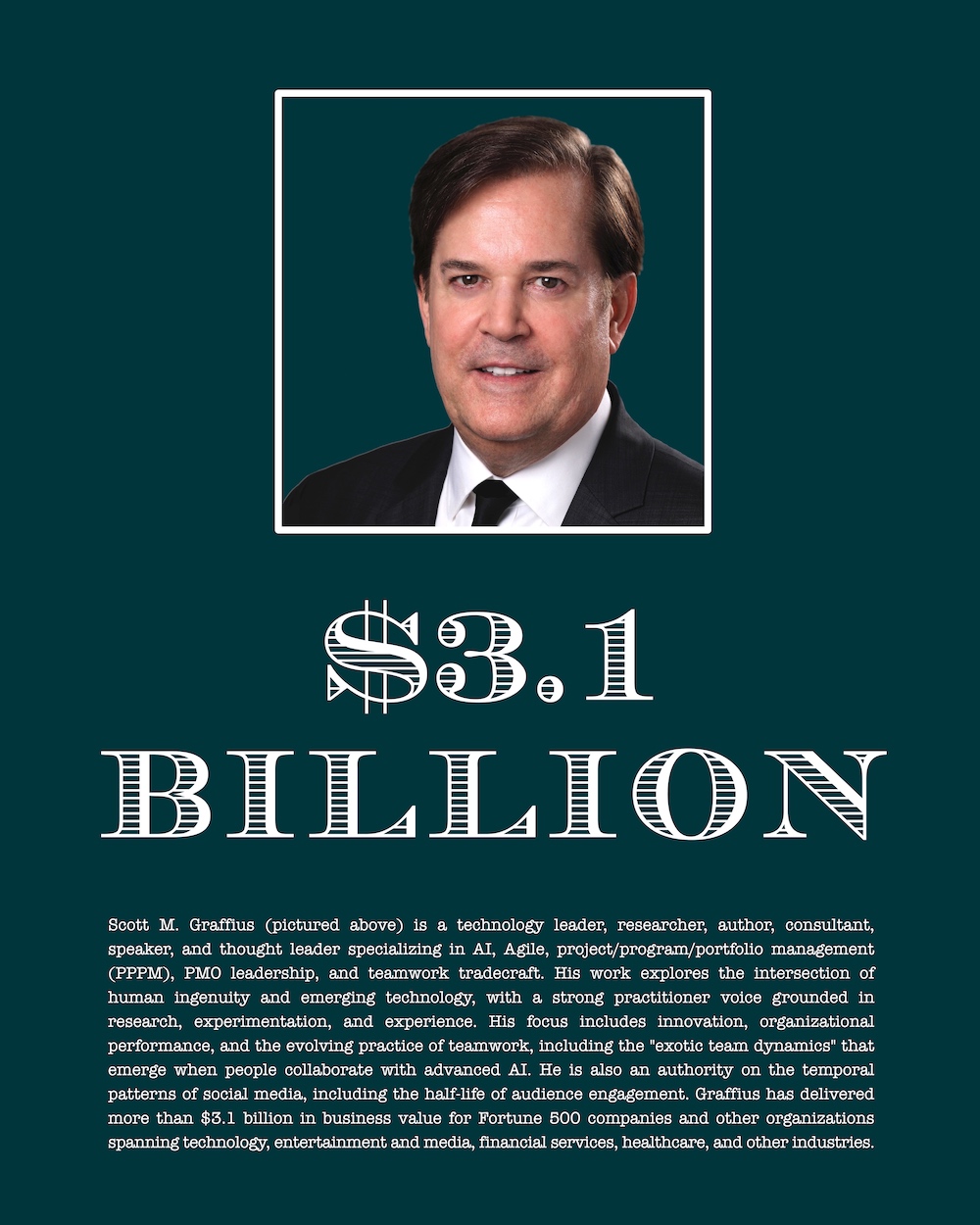
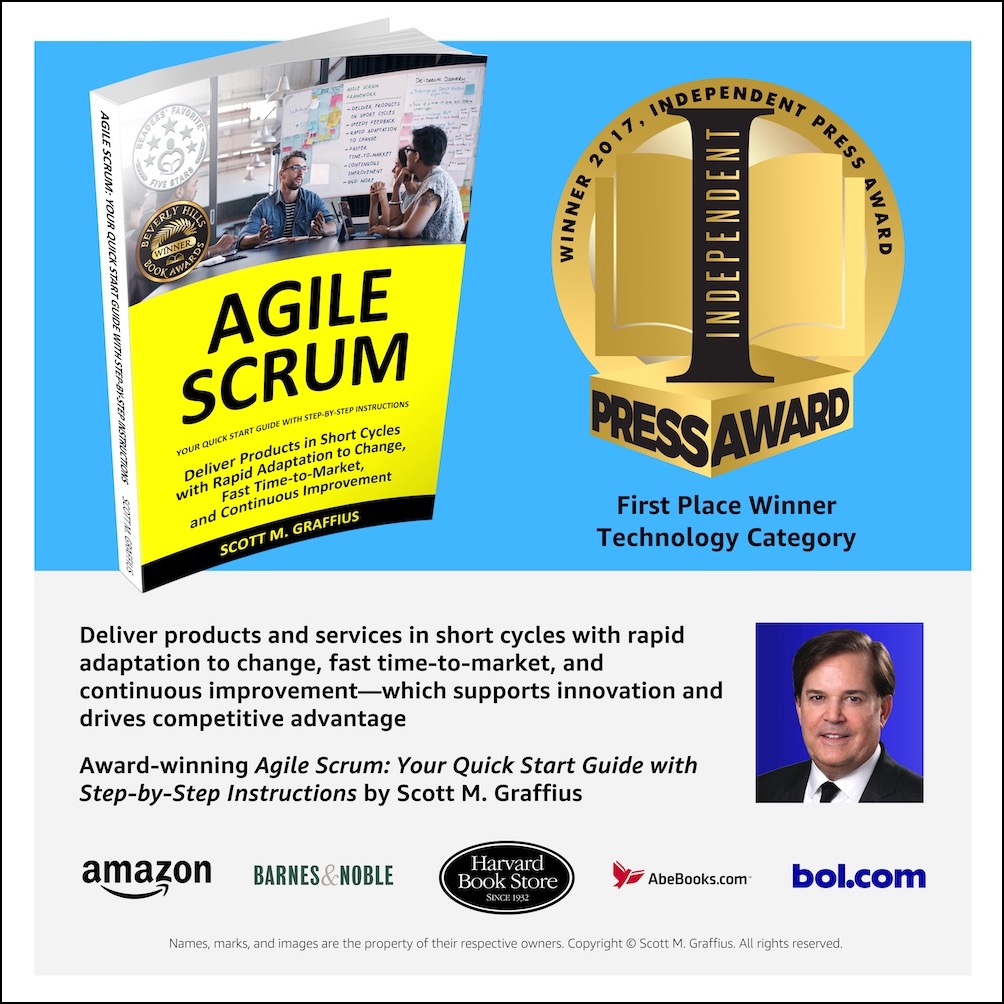
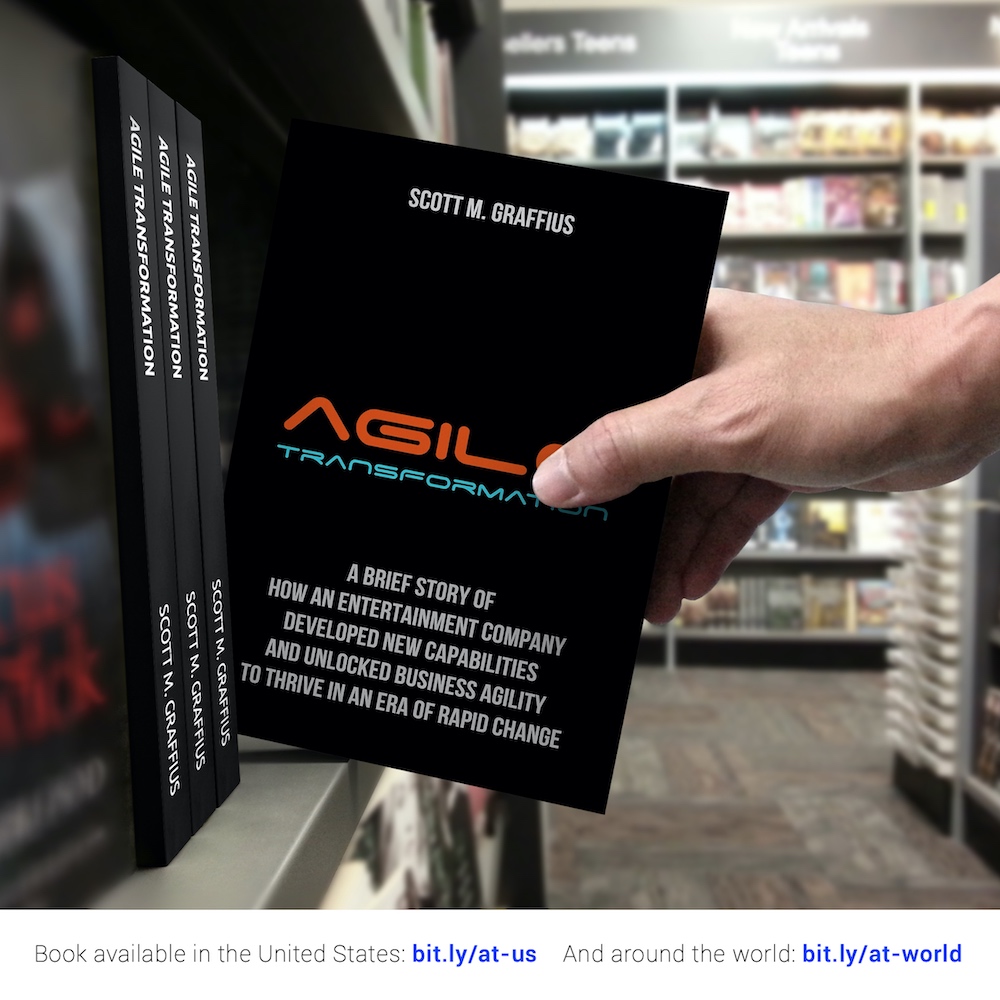
Sign up for Miro—it's free!
(Want more features? You can always upgrade to a paid plan.)
List of Additional Articles
Read more.
Meta CTO Called the AI Reorganization “Atrocious” — What Went Wrong and the Lessons for Human-AI Teams
A Critical Analysis of "AI and Quantum Computers Will Be Frenemies"
A Supplement to Graffius' Phases of Team Development: Exploring the Original, Data-Based Curvature for the Performance Trajectory
Scott M. Graffius Speaking on Strategic Leadership at Silicon Valley Chapter of the Project Management Institute
AI Hallucinations, Deception, and Unauthorized Agency: The Spectrum of AI Trust Failures
A Critical Analysis of "The Social Cost of an AI Teammate: How an Artificial Teammate Reshapes Human-Human Communication in Small-Team Decision-Making"
Journal of Marketing Cites Scott M. Graffius' Research on the Half-Life of Social Media
The Evolution of Pair Programming and the Rise of Exotic Team Dynamics
Number 1 University in England for Student Satisfaction Features Scott M. Graffius' "Phases of Team Development"
Royal Australasian College of Physicians Licenses Scott M. Graffius' "Phases of Team Development" Intellectual Property on Teamwork Tradecraft
Exotic Team Dynamics: How Advanced AI Teammates Are Unlocking New Levels of Innovation, Performance, and Success
A Critical Analysis of "Platform-Specific Data Decay Patterns: A Comparative Study of Twitter, Reddit, and TikTok" and Its Reference to Research by Scott M. Graffius
Round Square Global Educational Network Features Scott M. Graffius’ Phases of Team Development
Meta's Muse Missed the Mark: Hollywood’s Win Against Big Tech on AI Consent and Likeness Rights
Scott M. Graffius Contributed to Seven Project Management Institute (PMI) Standards
Quantum Computing, Advanced AI Acceleration, and the Rise of Exotic Team Dynamics in Human-AI Teams
Ohio State University Course Features Scott M. Graffius' "Phases of Team Development"
Questions About Integrity at UNC Chapel Hill
Scrum Isn’t Just for Coding
Book on Generative and Agentic AI Cites Scott M. Graffius' Work on AI
IPA / ADAL Publication Plagiarized Another’s Copyrighted Work and Violated Intellectual Property Rights
UC Davis' Integrity Is Circling the Drain
L'avenir du Travail et de l'IA Avancée / Future of Work and Advanced AI
NCCI / UNC Chapel Hill Publication Features Scott M. Graffius' Work
Boston Consulting Group (BCG) Features Scott M. Graffius' Research on Social Media Content Half-Life
UC Davis Used Scott M. Graffius' "Phases of Team Development" Intellectual Property
Medical, Pharma, and Healthcare Organizations Are Using Scott M. Graffius' "Phases of Team Development"
Government of Ireland Report Features Research by Scott M. Graffius
Scott M. Graffius Contributed to The Standard for Artificial Intelligence in Portfolio, Program, and Project Management
AI Governance Initiative Cites Scott M. Graffius Research on AI Hallucinations
Scott M. Graffius Contributed to the Agile Practice Guide - Second Edition
Scott M. Graffius Generated Over $2.51 Billion in Business Value for Fortune 500 Companies and Other Organizations
Government of Canada Features Research by Scott M. Graffius
"Strategic Business Research" Journal Cites Work of Scott M. Graffius
IEEE Access Publication Features Scott M. Graffius’ Research on the Half-Life of Social Media
The Agile Coach: 2026 Edition
Scott M. Graffius’ Work Cited in International Peer-Reviewed Journal on Digital Transformation
Phases of Team Development in Elite Sport
A Critical Analysis of COVID-19 Treatment Search Trends and Media Coverage Study Citing Scott M. Graffius' Work
Human-AI Teamwork: Master the Exotic Team Dynamics That Emerge When Collaborating with Advanced AI -- Or Be Outplayed
"Agile Scrum" by Scott M. Graffius Now Featured on Grokipedia
UNSW Aerospace Engineering Course Features Scott M. Graffius' "Phases of Team Development"
Thinkers360 Honors Scott M. Graffius as a 2026 Top Agile Thought Leader
Agile's Journey Through the Decades: Update for 2026
BMC Software Features Content from Scott M. Graffius' Book
Peer-Reviewed Journal Cited Work of Scott M. Graffius
University of Waterloo Features Graffius' "Phases of Team Development" in Course Materials
Perplexity Standalone Article on AI Hallucinations Cites Research by Scott M. Graffius
Handling the Saboteur Within: Lessons from a 3-Letter Agency on Spotting and Stopping Intentional and Unintentional Sabotage
A Deep Dive Into the Typical Engagement Pattern for Social Media Posts
Most Valuable IT Certifications: Update for 2026
"Marketing in the Metaverse" Spotlights Scott M. Graffius’ Research on the Half-Life of Social Media
University of Greenwich Features Graffius' Phases of Team Development
10 Essential Agile Books: Curated Recommendations for Agile Professionals
Lifespan (Half-Life) of Social Media Posts: Update for 2026
Scott M. Graffius' Research on the Half-Life of Social Media was Cited in a Peer-Reviewed Study Published in Telecommunications Policy, a Leading Academic Journal
Are AI Hallucinations Getting Better or Worse? We Analyzed the Data
Scott M. Graffius' Phases of Team Development - Applied to Human Teams and Human-AI Teams: 2026 Update
Lessons from Yesterday’s Tomorrowland
Scott M. Graffius’ Update to His "Phases of Team Development” Coming Early 2026
A Data-Driven Analysis of the Evolution of Project Management: Tasks, Trends, and AI
Actionable Insights. Global Impact. Scott M. Graffius.
Beep Beep! Why Wile E. Coyote Is the Patron Saint of AI Failure
Social Media Half-Life Research Cited in Prestigious Peer-Reviewed Medical Journal
Navigating the Spectrum of Advanced AI – Agentic, Autonomous, and Autopoietic
Lessons from Unhinged AI in Fiction: What Rogue AIs in Sci-Fi Storytelling, Films, and TV Shows Reveal About Us
Scott M. Graffius Contributed to and Reviewed the PMBOK Guide, 8th Edition — the Global Standard for Project Management
UK Sports Institute Features Teamwork and Leadership Work of Scott M. Graffius
Definitions of Advanced AIs: Agentic, Autonomous, and Autopoietic
HAN University of Applied Sciences Features the Work of Scott M. Graffius
Gifts That Inspire Joy
Evergreen Echoes: How Pinterest Inc. and Pinterest Japan Spotlighted Scott M. Graffius’ Research on the Half-Life of Social Media Content
Scott M. Graffius’ Team Development Work Lights Up the University of Tasmania’s Curriculum
Taiwan’s Leading Outlet for Technology and Innovation Spotlights Graffius’ Research on Social Media Temporal Dynamics
Scott M. Graffius’ Insights on AI, Agile, Gaming, XR, and Defense Transformation Cited by MSN in Their Coverage of Innovation and Leadership in the Sector
Top Predictions of 2024, Tested in 2025
Government of Finland Agency Features Graffius' Phases of Team Development IP
Scott M. Graffius Premieres His New "Exotic Team Dynamics: Human-AI Collaboration" Talk at Corporate Event in Las Vegas
Environmental Science Journal References Scott M. Graffius’ Project Management Work
AI Institute of Switzerland Features Scott M. Graffius’ Work on Algorithms
Exotic Team Dynamics: The New Frontier of Human–AI Collaboration
Scott M. Graffius’ Work Featured at ACM DIS ’25
Climbing the Ladder: The Head of Agile/PMO’s Organizational Proximity to the CEO is Closer Than Ever
Harness Sci-Fi and Speculative Design While Embracing Imperfection to Drive Innovation and Proactively Predict and Prepare for the Future
Scott M. Graffius’ “Agile Scrum” Book Featured in a Publication of the Associação Nacional de Educação Católica do Brasil (ANEC)
Setting Direction with OKRs and Tracking Progress with KPIs: A Guide for Agile, Project Management, and Tech Teams
AI Showcase Showdown: Ranking AI Accuracy on Project Management Basics
BookAuthority Features “Agile Scrum” by Scott M. Graffius in “10 Agile Software Development Books That Define the Field”
Exploring Team Dynamics, Adaptability, and Creative Problem-Solving Through Felix the Cat’s Metaphorical Toolkit
Mind Games and Master Plans: How PsyOps Exploit Psychological Phenomena
The “Pants-on-Fire Index for AI”
16 Causes of Technical Debt and How to Avoid It
PMI’s Infinity AI Gets the Basics of Team Development Alarmingly and Repeatedly Wrong
Agile for Unicorns: 7 Keys to Thrive; Scott M. Graffius’ Workshop
Scott M. Graffius’ “Agile Scrum: Your Quick Start Guide with Step-by-Step Instructions” Featured in Prestigious National Academies of Sciences Publication
Meta and Anduril’s EagleEye and the Future of XR: How Gaming, AI, and Agile Are Transforming Defense
"Agile Protocol" and the Power of Satire, Parody, and Humor
AI in Agile: Benefits, Risks, Outlook
Hostinger Highlights Scott M. Graffius’ “Agile Protocol” Book in Feature on Software Projects
French Ministry of Culture Links to Scott M. Graffius Research in Their Guide for Responsible Digital Communication
National Science Foundation’s LTER Network Features Scott M. Graffius’ Phases of Team Development IP
Waterfall vs. Agile: What’s Fixed, What’s Flexible, and Why It Matters
Scott M. Graffius Delivering $2.3 Billion in Value Through AI, Agile, and Project/PMO Leadership
The Problem with Heroes in Agile
The 3 Vital Rules of Science: What They Are and Why They Matter
“Agile Protocol: The Transformation Ultimatum” Lands on the Amazon Best Sellers List!
Scott M. Graffius Recognized as a Top Thought Leader in Digital Disruption by Thinkers360
“Agile Protocol: The Transformation Ultimatum” by Scott M. Graffius Crashes the Book Scene with Satirical Firepower
NCKU in Taiwan Integrates Graffius' 'Phases of Team Development' into Its Curriculum
The Art and Science of Aligning Initiatives with Strategic Objectives
RGPV University Adds Scott M. Graffius’ "Agile Scrum: Your Quick Start Guide with Step-by-Step Instructions" to Its Syllabus
Introducing ‘Engage or Fade: Decoding the Half-Life of Digital Resonance’ – A New Talk by Scott M. Graffius
Dropbox Company (Nira) Taps into Scott M. Graffius’ Expertise in Strategic Planning
Reporting Errors in a Publication: A Case Study on ‘Frontiers in Public Health’
NESEA Conference Session on Innovation Highlights Scott M. Graffius' 'Phases of Team Development'
U.S. Soccer Scores with Scott M. Graffius' Intellectual Property on Teamwork
U.S. Department of Commerce Partner (IEDC) Features Scott M. Graffius’ Intellectual Property
How Long Do Your Posts Live? AI Critiques Scott M. Graffius’ Research on the Half-Life of Social Media
Agile's Journey Through the Decades
Scott M. Graffius' Role in Advancing Project Management Institute (PMI) Standards Excellence
Most Valuable IT Certifications: Update for 2025
The PMI + Agile Alliance Merger: A Recipe for Success?
When Agile, AI, and Strategic Thinking Converge
Scott M. Graffius’ Phases of Team Development: 2025 Update
Lifespan (Half-Life) of Social Media Posts: Update for 2025
Verizon Features Scott M. Graffius
Do Not Read This Article! An Exploration of the Streisand Effect and Other Phenomena
Scott M. Graffius' 'Phases of Team Development' was Spotlighted in Journal of Neurosurgery
Pinterest Japan Uses Graffius’ Research on Temporal Dynamics on Social Media Platforms
Hochschule Coburg (Coburg University) Germany Uses Scott M. Graffius’ Phases of Team Development IP in Coursework on Agile Development
Wild World of Team Dynamics [Updated Two-Minute Video]
EU Europass Teacher Academy Features Scott M. Graffius’ ‘Phases of Team Development’ in Leadership Training
Side-by-Side Comparison of Retrospectives and Hot Washes
Constructor University 2024 Advanced Software Technology Handbook References Scott M. Graffius' Work on Team Dynamics
Strategies for Medical Team Success Featured Scott M. Graffius’ ‘Phases of Team Development’ Intellectual Property
SBG Neumark — Europe’s Largest Distribution Transformer Plant — Powers Up with Scott M. Graffius’ Intellectual Property
Scott M. Graffius’ Intellectual Property was Employed by the NHS — the Largest Single-Payer Healthcare System in Europe
Luxury Unwrapped: The Ultimate Holiday Gift Guide for Every Budget
Singapore Institute of Technology Features Work of Scott M. Graffius
Tufts University Features Scott M. Graffius 'Phases of Team Development' Intellectual Property
'Cat Herders': Retelling the Massive Success Story
Pennsylvania State Agency Used Scott M. Graffius' Intellectual Property
Copyright Infringement in a Book Published by AuthorHouse / Author Solutions / The Najafi Companies: Publisher Fails to Respond or Take Required Action
Pinterest Inc. References Scott M. Graffius’ Research
Bournemouth University Used Scott M. Graffius’ Intellectual Property
‘Comparative Methodological Guidelines: Handbook for Educators’ Violates Scott M. Graffius’ Copyright
Japan Backlog User Group Event Featured Scott M. Graffius’ ‘Phases of Team Development’
TurningWest's 'Trial'
Radio Silence from the American Association of Neurological Surgeons on Report of Blatant Plagiarism in Their ‘Journal of Neurosurgery’ Publication
Supplement to Graffius' 'Lifespan (Half-Life) of Social Media Posts' Research: Typical Engagement Distribution Pattern for Social Media Posts
How Algorithms Shape the User Experience on Social Media Platforms
Thinkers360 Named Scott M. Graffius a Top Thought Leader on Agile
More articles are listed here.
How to Cite This Article
Graffius, S. M. (2026, October 1). Which Performs Best: Humans, AI, or Human-AI Collaboration? We Analyzed the Data. ScottGraffius.com. https://scottgraffius.com/blog/files/which-performs-best-humans-ai-or-human-ai-collab.html
Digital Object Identifier (DOI)
Coming soon
Content Acknowledgements
Names, marks, and content are the property of their respective owners.
Tags and Hashtags
- Artificial Intelligence
- Future of Work
- AI Research
- Decision Making
- Technology
- Human-AI Collaboration
- Human-AI Synergy
- Complementarity
- Human-AI Teams
- Human-AI Teaming
- Workflow Design
- Exotic Team Dynamics
- #AI
- #ArtificialIntelligence
- #FutureOfWork
- #Research
- #DecisionMaking
- #HumanAI
- #HumanAITeams
- #HumanAICollaboration
- #HumanAISynergy
- #HumanAITeaming
- #AugmentationVsAutomation
- #ExoticTeamDynamics
- #AIResearch
Post-Publication Notes
If there are any supplements or updates to this article after the date of publication, they will appear here.
Copyright
Copyright © Scott M. Graffius. All rights reserved.
Content on this site—including text, images, videos, and data—may not be used for training or input into any artificial intelligence, machine learning, or automatized learning systems, or published, broadcast, rewritten, or redistributed without the express written permission of Scott M. Graffius.