
Using Bruce Tuckman's Phases of Team Development to Help Your Team Grow and Advance: 2021 Update
A NEWER VERSION OF THIS ARTICLE IS AVAILABLE HERE: https://scottgraffius.com/blog/files/graffius-phases-of-team-development-2026.html

If there are any supplements or updates to this article after the date of publication, they will appear in the Post-Publication Notes section at the end of this article.

2021 Update
Teams (agile or otherwise) go through phases of development, and Dr. Bruce Tuckman established a popular and durable framework on the subject. According to Dr. Tuckman, all phases—Forming, Storming, Norming, Performing, and Adjourning—are necessary for teams to grow, tackle problems, find solutions, plan work, and deliver results.
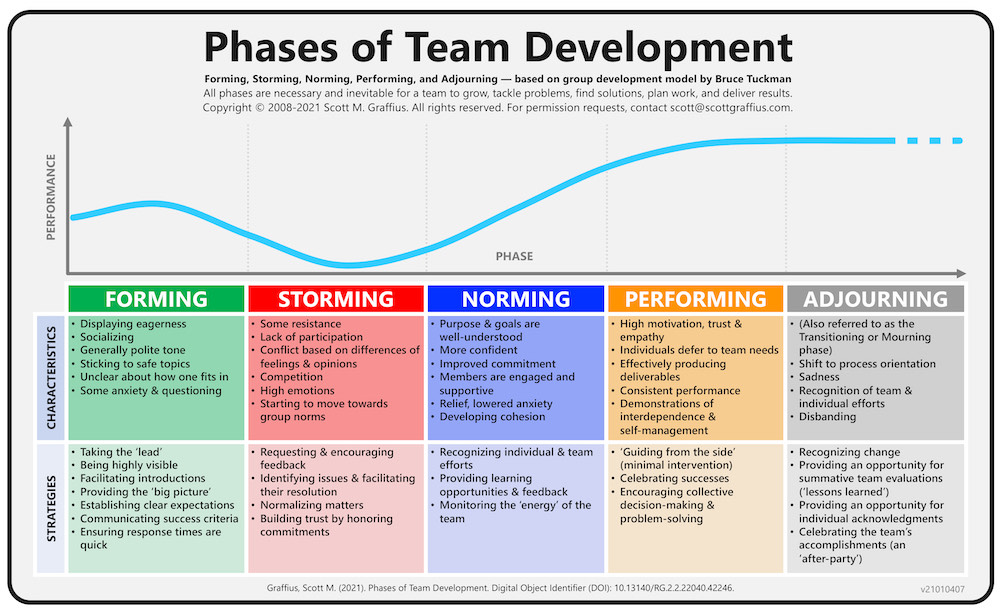
Agile project management thought leader, influencer, and author Scott M. Graffius developed a related custom illustration, Phases of Team Development. It highlights the performance level, characteristics, and proven strategies for each of the phases. Project Managers, Scrum Masters, Agile Coaches, DevOps Leads, and other professionals can apply the information to help handle challenges or issues experienced by teams. By doing so, they’ll advance the teams' happiness and productivity, as well as the teams' (and their own) success. Graffius updates the content periodically.
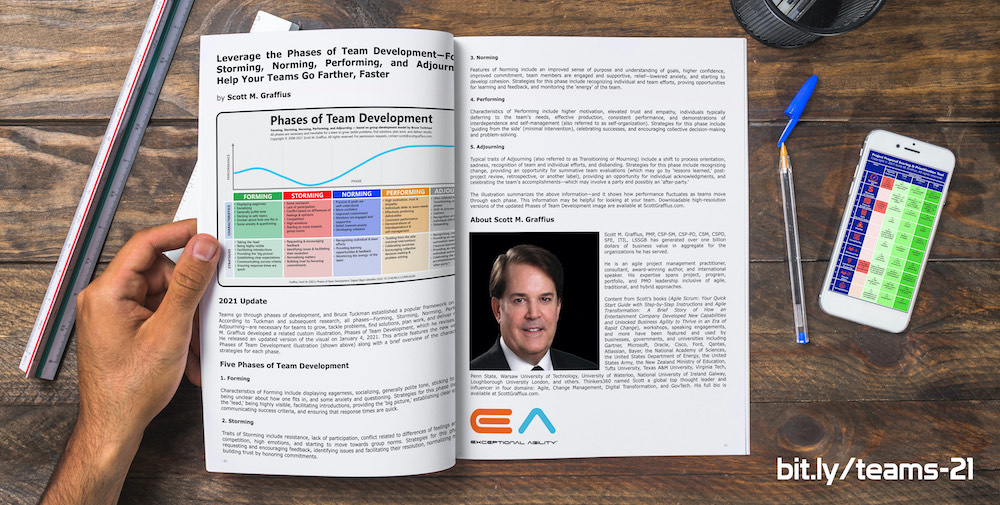
He released an updated version of the visual on January 4, 2021. This article features the new version of the Phases of Team Development illustration. Read on for details including information on permission requests and downloadable high-resolution versions of the visual.

Five Phases of Team Development
1. Forming
Characteristics of Forming include displaying eagerness, socializing, generally polite tone, sticking to safe topics, being unclear about how one fits in, and some anxiety and questioning.
Strategies for this phase include taking the ‘lead,’ being highly visible, facilitating introductions, providing the ‘big picture,’ establishing clear expectations, communicating success criteria, and ensuring that response times are quick.
2. Storming
Traits of Storming include resistance, lack of participation, conflict related to differences of feelings and opinions, competition, high emotions, and starting to move towards group norms.
Strategies for this phase include requesting and encouraging feedback, identifying issues and facilitating their resolution, normalizing matters, and building trust by honoring commitments.
3. Norming
Features of Norming include an improved sense of purpose and understanding of goals, higher confidence, improved commitment, team members are engaged and supportive, relief—lowered anxiety, and starting to develop cohesion.
Strategies for this phase include recognizing individual and team efforts, proving opportunities for learning and feedback, and monitoring the ‘energy’ of the team.
4. Performing
Characteristics of Performing include higher motivation, elevated trust and empathy, individuals typically deferring to the team's needs, effective production, consistent performance, and demonstrations of interdependence and self-management (also referred to as self-organization).
Strategies for this phase include ‘guiding from the side’ (minimal intervention), celebrating successes, and encouraging collective decision-making and problem-solving.
5. Adjourning
Typical traits of Adjourning (also referred to as Transitioning or Mourning) include a shift to process orientation, sadness, recognition of team and individual efforts, and disbanding.
Strategies for this phase include recognizing change, providing an opportunity for summative team evaluations (which may go by ‘lessons learned,’ post-project review, retrospective, or another label), providing an opportunity for individual acknowledgments, and celebrating the team's accomplishments—which may involve a party and possibly an ‘after-party.’

As shown, performance fluctuates as teams move through the phases. Review the characteristics to help identify the team's current phase, then apply the corresponding proven strategies to help them advance.

Bibliography
Select list of publications
- Alford, J. (2019, April 11). Our Co-Production Journey: From Sandpits to Bird Boxes. London, United Kingdom: Imperial College London.
- Bennett, M., Gadlin, H., & Marchand, C. (2018). Collaboration Team Science: Field Guide. Rockville, MD: National Institutes of Health.
- Couture, N. (2016, October 27). A Note About Teams. CIO. Boston, MA: International Data Group (IDG).
- Daly, L. (2002). Identify Your Project Management Team’s Level of Development and Facilitate It to Success. Paper presented at Project Management Institute Annual Seminars and Symposium, San Antonio, TX. Newtown Square, PA: Project Management Institute.
- Deloitte (2017). Digital Era Technology Operating Models, Volume 2. New York, NY: Deloitte Touche Tohmatsu Limited.
- Finkelstein, S. (2017, October 29). Why Companies Should Hire Teams, Not Individuals. The Wall Street Journal. New York, NY: The Wall Street Journal.
- Forbes (2018, April 23). How to Fast-Track Any Team to Success. Forbes. New York, NY: Forbes.
- Forbes (2012, October 27). How the iPad Mini is Defining Tim Cook’s Apple. Forbes. New York, NY: Forbes.
- Glover, P. (2012, March 13). Team Conflict: Why It’s a Good Thing. Fast Company. New York, NY: Mansueto Ventures.
- Graffius, Scott M. (2021). Phases of Team Development. Los Angeles, CA: Scott M. Graffius. Digital Object Identifier (DOI): 10.13140/RG.2.2.22040.42246.
- Jovanovic, M., Mesquida, A., Radaković, N., & Mas, A. (2016). Agile Retrospective Games for Different Team Development Phases. Journal of Universal Computer Science, 22: 1489-1508.
- Kane, G. C. (2014, October 7). Why Your Company is Probably Measuring Social Media Wrong. MIT Sloan Management Review. Cambridge, MA: MIT Sloan Management Review.
- KPMG (2017). The Digital Fund, Season 2. Amstelveen, Netherlands: KPMG International.
- Madden, D. (2019, May 19). The Four Stages of Building a Great Team – and the One Where Things Usually Go Wrong. Inc. Magazine. New York, NY: Inc. Magazine.
- Makar, A. (2011, July 13). Lessons Learned in Norming and Performing Team Development Phases. Louisville, KY: TechRepublic.
- Martinuzzi, B. (2012, June 8). Six Tips Guaranteed to Reduce Workplace Frustrations. New York, NY: American Express Company.
- Microsoft (2019, June 15). Is the Latest Technology the Key to Your Team’s Success, or is There Something Else? Microsoft Developer Support. Accessed at: https://devblogs.microsoft.com/premier-developer/is-the-latest-technology-the-key-to-your-teams-success-or-is-there-something-else. Redmond, WA: Microsoft.
- Mocko, G., & Linnerud, B. (2016). Measuring the Effects of Goal Alignment on Innovative Engineering Design Projects. International Journal of Engineering Education, 32: 55-63.
- Romanelli, M. (2019, September 11). Teamwork Accelerated. PM Times. Newmarket, Ontario, Canada: Macgregor Communications.
- Riggs, A. (2020, October 15). Why I Start All My Video Meetings with Collaborative Games (Spoiler: It’s Not Boredom). Amsterdam, the Netherlands: The Next Web (TNW).
- Rowley, D., & Lange, M. (2007). Forming to Performing: The Evolution of an Agile Team. IEEE Computer Society Proceedings. Agile 2007, 1: 408-414.
- Scrum Alliance (2020). Learning Objectives Examples. Denver, CO: Scrum Alliance.
- Sakpal, M. (2020, March 3. Learn How to Debunk These Five Restructuring Myths. Stamford, CT: Gartner, Inc.
- Stern, S. (2018, September 26). Is Your Team Working the Rory Underwood Way? Financial Times. London, United Kingdom: The Financial Times, a Nikkei Company.
- Telford, R. (2013, June 4). This is Where It Gets Interesting. Armonk, NY: International Business Machines (IBM) Corporation.
- Tuckman, B. W. (1965). Developmental Sequence in Small Groups. Psychological Bulletin, 63: 384-399.
- Tuckman, B. W., & Jensen, M. A. C. (1977). Stages of Small-Group Development Revisited. Group and Organizational Studies, 2 (4): 419-427.
- United States Army (2015). Innovative Learning: A Key to National Security. Washington, DC: Uni


About Scott M. Graffius
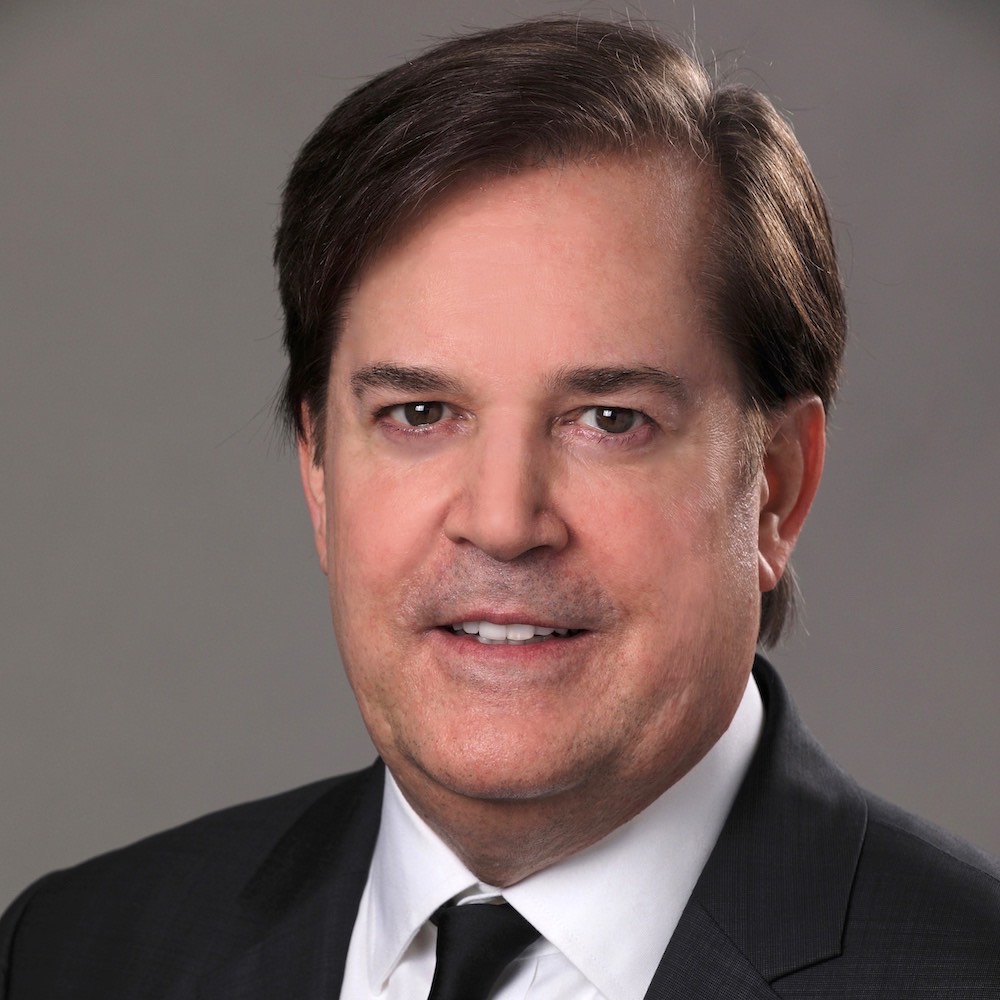
Scot founder, CEO, and principal consultant at Exceptional PPM and PMO Solutions™ and subsidiary Exceptional Agility™, based in Los Angeles, California. His expertise spans project, program, portfolio, and PMO leadership inclusive of agile, traditional, and hybrid approaches. Content from his books (Agile Scrum: Your Quick Start Guide with Step-by-Step Instructions and Agile Transformation: A Brief Story of How an Entertainment Company Developed New Capabilities and Unlocked Business Agility to Thrive in an Era of Rapid Change), workshops, speaking engagements, and more have been featured and used by businesses, governments, and universities including Gartner, Microsoft, Deloitte, Oracle, Cisco, Ford, Qantas, Atlassian, Bayer, the National Academy of Sciences, the United States Department of Energy, the United States Army, Project Management Institute, the IEEE, the New Zealand Ministry of Education, Tufts University, Texas A&M University, Virginia Tech, Penn State, Warsaw University of Technology, University of Waterloo, Loughborough University London, and others. Graffius has spoken at 58 conferences and other events around the world, including Armenia, Australia, Brazil, Canada, Czech Republic, Finland, France, Germany, Greece, India, Ireland, Lithuania, Luxembourg, Netherlands, New Zealand, Sweden, United Kingdom, and the United States. Thinkers360 named Graffius a global top thought leader and influencer in four domains: Agile, Change Management, Digital Transformation, and GovTech.
His full bio is available at https://www.scottgraffius.com.
Connect with Scott on:

About Agile Scrum: Your Quick Start Guide with Step-by-Step Instructions
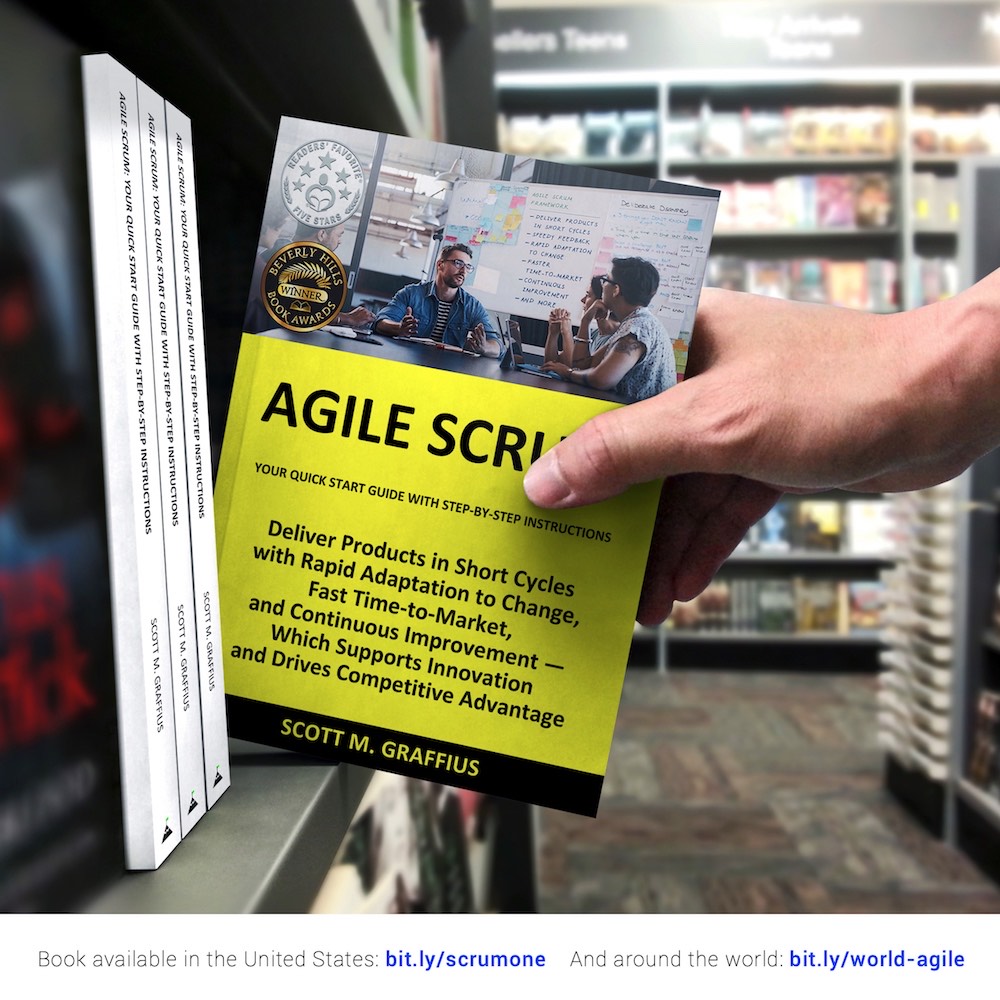
Shifting customer needs are common in today's marketplace. Businesses must be adaptive and responsive to change while delivering an exceptional customer experience to be competitive.
There are a variety of frameworks supporting the development of products and services, and most approaches fall into one of two broad categories: traditional or agile. Traditional practices such as waterfall engage sequential development, while agile involves iterative and incremental deliverables. Organizations are increasingly embracing agile to manage projects, and best meet their business needs of rapid response to change, fast delivery speed, and more.
With clear and easy to follow step-by-step instructions, Scott M. Graffius's award-winning Agile Scrum: Your Quick Start Guide with Step-by-Step Instructions helps the reader:
- Implement and use the most popular agile framework―Scrum;
- Deliver products in short cycles with rapid adaptation to change, fast time-to-market, and continuous improvement; and
- Support innovation and drive competitive advantage.
Hailed by Literary Titan as “the book highlights the versatility of Scrum beautifully.”
Winner of 17 first place awards.
Agile Scrum: Your Quick Start Guide with Step-by-Step Instructions is available in paperback and ebook/Kindle in the United States and around the world. Some links by country follow.
- 🇧🇷 Brazil
- 🇨🇦 Canada
- 🇨🇿 Czech Republic
- 🇩🇰 Denmark
- 🇫🇮 Finland
- 🇫🇷 France
- 🇩🇪 Germany
- 🇬🇷 Greece
- 🇭🇺 Hungary
- 🇮🇳 India
- 🇮🇪 Ireland
- 🇮🇱 Israel
- 🇮🇹 Italy
- 🇯🇵 Japan
- 🇱🇺 Luxembourg
- 🇲🇽 Mexico
- 🇳🇱 Netherlands
- 🇳🇿 New Zealand
- 🇳🇴 Norway
- 🇪🇸 Spain
- 🇸🇪 Sweden
- 🇨🇭 Switzerland
- 🇦🇪 UAE
- 🇬🇧 United Kingdom
- 🇺🇸 United States

About Agile Transformation: A Brief Story of How an Entertainment Company Developed New Capabilities and Unlocked Business Agility to Thrive in an Era of Rapid Change
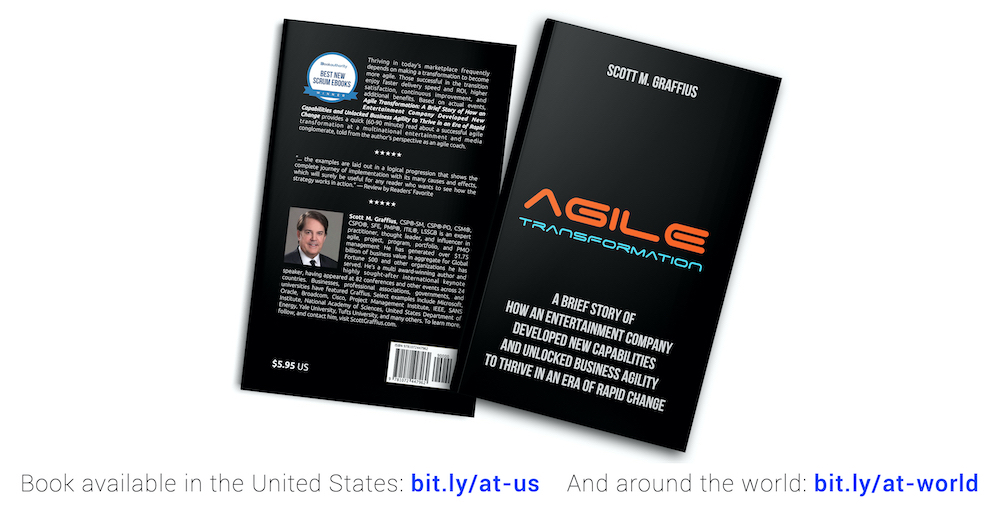
Thriving in today's marketplace frequently depends on making a transformation to become more agile. Those successful in the transition enjoy faster delivery speed and ROI, higher satisfaction, continuous improvement, and additional benefits.
Based on actual events, Agile Transformation: A Brief Story of How an Entertainment Company Developed New Capabilities and Unlocked Business Agility to Thrive in an Era of Rapid Change provides a quick (60-90 minute) read about a successful agile transformation at a multinational entertainment and media company, told from the author's perspective as an agile coach.
The award-winning book by Scott M. Graffius is available in paperback and ebook/Kindle in the United States and around the world. Some links by country follow.
- 🇦🇺 Australia
- 🇦🇹 Austria
- 🇧🇷 Brazil
- 🇨🇦 Canada
- 🇨🇿 Czech Republic
- 🇩🇰 Denmark
- 🇫🇮 Finland
- 🇫🇷 France
- 🇩🇪 Germany
- 🇬🇷 Greece
- 🇮🇳 India
- 🇮🇪 Ireland
- 🇯🇵 Japan
- 🇱🇺 Luxembourg
- 🇲🇽 Mexico
- 🇳🇱 Netherlands
- 🇳🇿 New Zealand
- 🇪🇸 Spain
- 🇸🇪 Sweden
- 🇨🇭 Switzerland
- 🇦🇪 United Arab Emirates
- 🇬🇧 United Kingdom
- 🇺🇸 United States

Permission Request Information
To request permission to use the 'Phases of Team Development' visual, contact Scott M. Graffius. If approved, high resolution JPG and PNG image files will be provided, subject to terms and conditions.


Post-Publication Notes
Update on 7 January 2025
Scott M. Graffius periodically updates his 'Phases of Team Development' work. The most current edition is here.

© Copyright 2021 Scott M. Graffius. All rights reserved. This material may not be published, broadcast, rewritten or redistributed without the express written permission of Scott M. Graffius.

Scott M. Graffius Speaking at Southern Nevada Chapter of Project Management Institute

Scott M. Graffius will deliver a talk — "Navigate the Phases of Team Development with Speed and Agility" — at a virtual event of the Southern Nevada Chapter of the Project Management Institute on Thursday, March 18, 2021, from 5:00-6:00 p.m. Pacific Time. To learn more and to register for the event, visit https://pmi-snc.org/calendar?eventId=7586.
Attendees may be eligible to receive continuing education unit (CEU) credit, equivalent to 1.00 hour. For reporting with the Project Management Institute (PMI), it's 1.00 professional development unit (PDU), under the Leadership category. For reporting with the Scrum Alliance, it's 1.00 Scrum educational unit (SEU), under either the Learning category or the Events category. For reporting with other organizations, refer to their respective instructions.
About Scott M. Graffius
Scott M. Graffius, PMP, CSP-SM, CSP-PO, CSM, CSPO, SFE, ITIL, LSSGB is an agile project management practitioner, consultant, award-winning author, and international speaker. He has generated over one billion dollars of business value in aggregate for the organizations he has served. Graffius is the founder, CEO, and principal consultant at Exceptional PPM and PMO Solutions™ and subsidiary Exceptional Agility™, based in Los Angeles, California. His expertise spans project, program, portfolio, and PMO leadership inclusive of agile, traditional, and hybrid approaches. Content from his books (Agile Scrum and Agile Transformation), workshops, speaking engagements, and more have been featured and used by businesses, governments, and universities including Gartner, Microsoft, Deloitte, Oracle, Cisco, Ford, Qantas, Atlassian, Bayer, the National Academy of Sciences, the United States Department of Energy, the United States Army, Project Management Institute, the IEEE, the New Zealand Ministry of Education, Tufts University, Texas A&M University, Virginia Tech, Penn State, Warsaw University of Technology, University of Waterloo, Loughborough University London, and others. Graffius has spoken at 58 conferences and other events around the world, including Armenia, Australia, Brazil, Canada, Czech Republic, Finland, France, Germany, Greece, India, Ireland, Lithuania, Luxembourg, Netherlands, New Zealand, Sweden, United Kingdom, and the United States. Thinkers360 named Graffius a global top thought leader and influencer in four domains: Agile, Change Management, Digital Transformation, and GovTech.
His full bio is available here.
Connect with Scott on:
About Agile Scrum: Your Quick Start Guide with Step-by-Step Instructions
Shifting customer needs are common in today's marketplace. Businesses must be adaptive and responsive to change while delivering an exceptional customer experience to be competitive.
There are a variety of frameworks supporting the development of products and services, and most approaches fall into one of two broad categories: traditional or agile. Traditional practices such as waterfall engage sequential development, while agile involves iterative and incremental deliverables. Organizations are increasingly embracing agile to manage projects, and best meet their business needs of rapid response to change, fast delivery speed, and more.
With clear and easy to follow step-by-step instructions, Scott M. Graffius's award-winning Agile Scrum: Your Quick Start Guide with Step-by-Step Instructions helps the reader:
- Implement and use the most popular agile framework―Scrum;
- Deliver products in short cycles with rapid adaptation to change, fast time-to-market, and continuous improvement; and
- Support innovation and drive competitive advantage.
Hailed by Literary Titan as “the book highlights the versatility of Scrum beautifully.”
Winner of 17 first place awards.
Agile Scrum: Your Quick Start Guide with Step-by-Step Instructions is available in paperback and ebook/Kindle in the United States and around the world. Some links by country follow.
- 🇧🇷 Brazil
- 🇨🇦 Canada
- 🇨🇿 Czech Republic
- 🇩🇰 Denmark
- 🇫🇮 Finland
- 🇫🇷 France
- 🇩🇪 Germany
- 🇬🇷 Greece
- 🇭🇺 Hungary
- 🇮🇳 India
- 🇮🇪 Ireland
- 🇮🇱 Israel
- 🇮🇹 Italy
- 🇯🇵 Japan
- 🇱🇺 Luxembourg
- 🇲🇽 Mexico
- 🇳🇱 Netherlands
- 🇳🇿 New Zealand
- 🇳🇴 Norway
- 🇪🇸 Spain
- 🇸🇪 Sweden
- 🇨🇭 Switzerland
- 🇦🇪 UAE
- 🇬🇧 United Kingdom
- 🇺🇸 United States
About Agile Transformation: A Brief Story of How an Entertainment Company Developed New Capabilities and Unlocked Business Agility to Thrive in an Era of Rapid Change
Thriving in today's marketplace frequently depends on making a transformation to become more agile. Those successful in the transition enjoy faster delivery speed and ROI, higher satisfaction, continuous improvement, and additional benefits.
Based on actual events, Agile Transformation: A Brief Story of How an Entertainment Company Developed New Capabilities and Unlocked Business Agility to Thrive in an Era of Rapid Change provides a quick (60-90 minute) read about a successful agile transformation at a multinational entertainment and media company, told from the author's perspective as an agile coach.
The award-winning book by Scott M. Graffius is available in paperback and ebook/Kindle in the United States and around the world. Some links by country follow.
- 🇦🇺 Australia
- 🇦🇹 Austria
- 🇧🇷 Brazil
- 🇨🇦 Canada
- 🇨🇿 Czech Republic
- 🇩🇰 Denmark
- 🇫🇮 Finland
- 🇫🇷 France
- 🇩🇪 Germany
- 🇬🇷 Greece
- 🇮🇳 India
- 🇮🇪 Ireland
- 🇯🇵 Japan
- 🇱🇺 Luxembourg
- 🇲🇽 Mexico
- 🇳🇱 Netherlands
- 🇳🇿 New Zealand
- 🇪🇸 Spain
- 🇸🇪 Sweden
- 🇨🇭 Switzerland
- 🇦🇪 United Arab Emirates
- 🇬🇧 United Kingdom
- 🇺🇸 United States
About the Southern Nevada Chapter of the Project Management Institute
The Project Management Institute Southern Nevada Chapter's vision is to be the professional organization of choice for the project management community of Southern Nevada. Its mission is to Provide premier networking, education and presentations to support the needs of the project management community. And holds seven core values: Create an environment and opportunity to develop knowledge, skills and professionalism in the application of project management; foster and enabling corporate, community and educational networking opportunities; partner with business and academia to unleash the power of project management; attract, developing and retaining leadership to ensure the future of the organization; offer professional development unit (PDU) opportunities to members; offer programs to enhance members’ project management skills; and have nationally known speakers make presentations at monthly meetings at least twice a year. To learn more, visit the Chapter's website at https://pmi-snc.org.

© Copyright 2021 Scott M. Graffius. All rights reserved. This material may not be published, broadcast, rewritten or redistributed without the express written permission of Scott M. Graffius.
Scott M. Graffius Speaking at California Institute of Advanced Management (CIAM)
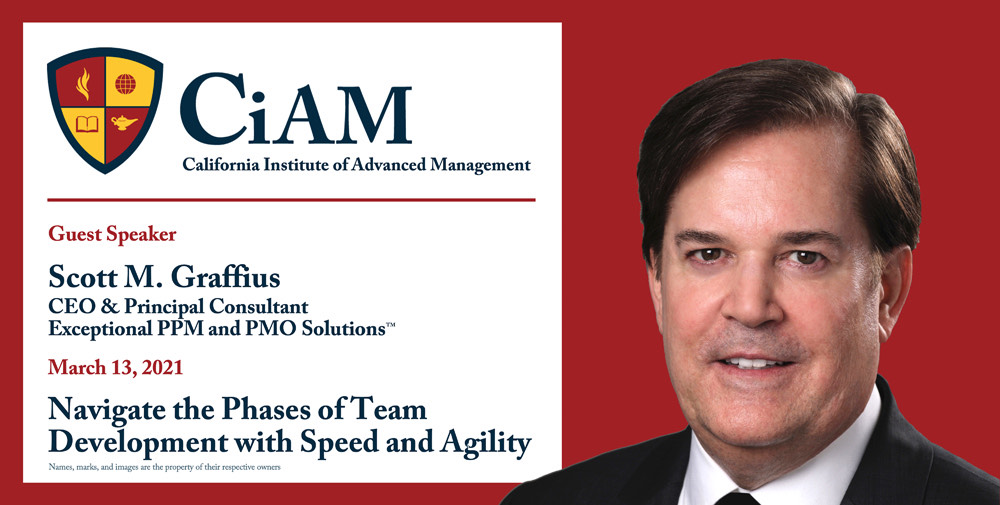
Scott M. Graffius will be a guest speaker at the California Institute of Advanced Management, where he will deliver a talk on team development and leadership to an audience of MBA students and professors on March 13, 2021.
Attendees may be eligible to receive continuing education unit (CEU) credit, equivalent to 1.00 hour. For reporting with the Project Management Institute (PMI), it's 1.00 professional development unit (PDU), under the Leadership category. For reporting with the Scrum Alliance, it's 1.00 Scrum educational unit (SEU), under either the Learning category or the Events category. For reporting with other organizations, refer to their respective instructions.
About Scott M. Graffius
Scott M. Graffius, PMP, CSP-SM, CSP-PO, CSM, CSPO, SFE, ITIL, LSSGB is an agile project management practitioner, consultant, award-winning author, and international speaker. He has generated over one billion dollars of business value in aggregate for the organizations he has served. Graffius is the founder, CEO, and principal consultant at Exceptional PPM and PMO Solutions™ and subsidiary Exceptional Agility™, based in Los Angeles, California. His expertise spans project, program, portfolio, and PMO leadership inclusive of agile, traditional, and hybrid approaches. Content from his books (Agile Scrum and Agile Transformation), workshops, speaking engagements, and more have been featured and used by businesses, governments, and universities including Gartner, Microsoft, Deloitte, Oracle, Cisco, Ford, Qantas, Atlassian, Bayer, the National Academy of Sciences, the United States Department of Energy, the United States Army, Project Management Institute, the IEEE, the New Zealand Ministry of Education, Tufts University, Texas A&M University, Virginia Tech, Penn State, Warsaw University of Technology, University of Waterloo, Loughborough University London, and others. Graffius has spoken at 58 conferences and other events around the world, including Armenia, Australia, Brazil, Canada, Czech Republic, Finland, France, Germany, Greece, India, Ireland, Lithuania, Luxembourg, Netherlands, New Zealand, Sweden, United Kingdom, and the United States. Thinkers360 named Graffius a global top thought leader and influencer in four domains: Agile, Change Management, Digital Transformation, and GovTech.
His full bio is available here.
Connect with Scott on:
About Agile Scrum: Your Quick Start Guide with Step-by-Step Instructions
Shifting customer needs are common in today's marketplace. Businesses must be adaptive and responsive to change while delivering an exceptional customer experience to be competitive.
There are a variety of frameworks supporting the development of products and services, and most approaches fall into one of two broad categories: traditional or agile. Traditional practices such as waterfall engage sequential development, while agile involves iterative and incremental deliverables. Organizations are increasingly embracing agile to manage projects, and best meet their business needs of rapid response to change, fast delivery speed, and more.
With clear and easy to follow step-by-step instructions, Scott M. Graffius's award-winning Agile Scrum: Your Quick Start Guide with Step-by-Step Instructions helps the reader:
- Implement and use the most popular agile framework―Scrum;
- Deliver products in short cycles with rapid adaptation to change, fast time-to-market, and continuous improvement; and
- Support innovation and drive competitive advantage.
Hailed by Literary Titan as “the book highlights the versatility of Scrum beautifully.”
Winner of 17 first place awards.
Agile Scrum: Your Quick Start Guide with Step-by-Step Instructions is available in paperback and ebook/Kindle in the United States and around the world. Some links by country follow.
- 🇧🇷 Brazil
- 🇨🇦 Canada
- 🇨🇿 Czech Republic
- 🇩🇰 Denmark
- 🇫🇮 Finland
- 🇫🇷 France
- 🇩🇪 Germany
- 🇬🇷 Greece
- 🇭🇺 Hungary
- 🇮🇳 India
- 🇮🇪 Ireland
- 🇮🇱 Israel
- 🇮🇹 Italy
- 🇯🇵 Japan
- 🇱🇺 Luxembourg
- 🇲🇽 Mexico
- 🇳🇱 Netherlands
- 🇳🇿 New Zealand
- 🇳🇴 Norway
- 🇪🇸 Spain
- 🇸🇪 Sweden
- 🇨🇭 Switzerland
- 🇦🇪 UAE
- 🇬🇧 United Kingdom
- 🇺🇸 United States
About Agile Transformation: A Brief Story of How an Entertainment Company Developed New Capabilities and Unlocked Business Agility to Thrive in an Era of Rapid Change
Thriving in today's marketplace frequently depends on making a transformation to become more agile. Those successful in the transition enjoy faster delivery speed and ROI, higher satisfaction, continuous improvement, and additional benefits.
Based on actual events, Agile Transformation: A Brief Story of How an Entertainment Company Developed New Capabilities and Unlocked Business Agility to Thrive in an Era of Rapid Change provides a quick (60-90 minute) read about a successful agile transformation at a multinational entertainment and media company, told from the author's perspective as an agile coach.
The award-winning book by Scott M. Graffius is available in paperback and ebook/Kindle in the United States and around the world. Some links by country follow.
- 🇦🇺 Australia
- 🇦🇹 Austria
- 🇧🇷 Brazil
- 🇨🇦 Canada
- 🇨🇿 Czech Republic
- 🇩🇰 Denmark
- 🇫🇮 Finland
- 🇫🇷 France
- 🇩🇪 Germany
- 🇬🇷 Greece
- 🇮🇳 India
- 🇮🇪 Ireland
- 🇯🇵 Japan
- 🇱🇺 Luxembourg
- 🇲🇽 Mexico
- 🇳🇱 Netherlands
- 🇳🇿 New Zealand
- 🇪🇸 Spain
- 🇸🇪 Sweden
- 🇨🇭 Switzerland
- 🇦🇪 United Arab Emirates
- 🇬🇧 United Kingdom
- 🇺🇸 United States
About the California Institute of Advanced Management (CIAM)
The California Institute of Advanced Management (CIAM) is a non-profit, boutique university specializing in one single, revolutionary MBA program, designed to provide its students with "battle ready" business skills for today's ever-changing business world. Whether a student wants to be an entrepreneur, enhance their value to their existing employer, or transition to a new career, the CIAM's MBA program will help get them where they want to go. To learn more, visit CIAM's website at https://www.ciam.edu.
© Copyright 2021 Scott M. Graffius. All rights reserved. This material may not be published, broadcast, rewritten or redistributed without the express written permission of Scott M. Graffius.
Scott M. Graffius Speaking at ConFoo Developer Conference 2021
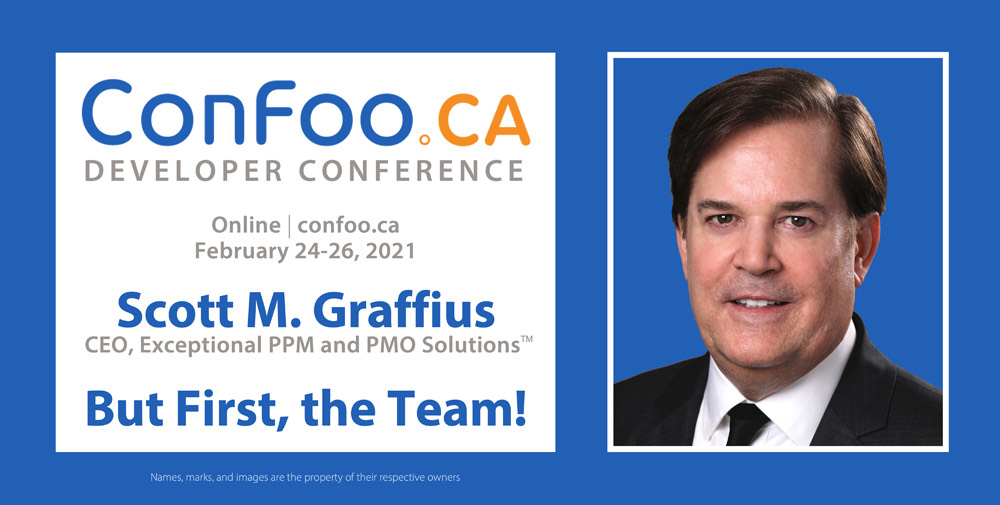
Scott M. Graffius will be speaking at the ConFoo Developer Conference 2021. The annual event is normally conducted in-person in Montreal, Québec, Canada. This year, ConFoo will be online. Scott will present “But First, the Team!” on Wednesday, February 24, 2021, from 3:15-4:00 p.m. Eastern Standard Time.
- Scott's profile on ConFoo website: https://confoo.ca/en/speaker/scott-graffius
- Scott's session on ConFoo website: https://confoo.ca/en/yul2021/session/but-first-the-team
- Register for the ConFoo conference: https://confoo.ca/en/yul2021/register
Attendees may be eligible to receive continuing education unit (CEU) credit, equivalent to 0.75 hour. For reporting with the Project Management Institute (PMI), it's 0.75 professional development unit (PDU), under the Technical Project Management category. For reporting with the Scrum Alliance, it's 0.75 Scrum educational unit (SEU), under either the Learning category or the Events category. For reporting with other organizations, refer to their respective instructions.
About Scott M. Graffius
Scott M. Graffius, PMP, CSP-SM, CSP-PO, CSM, CSPO, SFE, ITIL, LSSGB is an agile project management practitioner, consultant, award-winning author, and international speaker. He has generated over one billion dollars of business value in aggregate for the organizations he has served. Graffius is the founder, CEO, and principal consultant at Exceptional PPM and PMO Solutions™ and subsidiary Exceptional Agility™, based in Los Angeles, California. His expertise spans project, program, portfolio, and PMO leadership inclusive of agile, traditional, and hybrid approaches. Content from his books (Agile Scrum and Agile Transformation), workshops, speaking engagements, and more have been featured and used by businesses, governments, and universities including Gartner, Microsoft, Deloitte, Oracle, Cisco, Ford, Qantas, Atlassian, Bayer, the National Academy of Sciences, the United States Department of Energy, the United States Army, Project Management Institute, the IEEE, the New Zealand Ministry of Education, Tufts University, Texas A&M University, Virginia Tech, Penn State, Warsaw University of Technology, University of Waterloo, Loughborough University London, and others. Graffius has spoken at 58 conferences and other events around the world, including Armenia, Australia, Brazil, Canada, Czech Republic, Finland, France, Germany, Greece, India, Ireland, Lithuania, Luxembourg, Netherlands, New Zealand, Sweden, United Kingdom, and the United States. Thinkers360 named Graffius a global top thought leader and influencer in four domains: Agile, Change Management, Digital Transformation, and GovTech.
His full bio is available here.
Connect with Scott on:
About Agile Scrum: Your Quick Start Guide with Step-by-Step Instructions
Shifting customer needs are common in today's marketplace. Businesses must be adaptive and responsive to change while delivering an exceptional customer experience to be competitive.
There are a variety of frameworks supporting the development of products and services, and most approaches fall into one of two broad categories: traditional or agile. Traditional practices such as waterfall engage sequential development, while agile involves iterative and incremental deliverables. Organizations are increasingly embracing agile to manage projects, and best meet their business needs of rapid response to change, fast delivery speed, and more.
With clear and easy to follow step-by-step instructions, Scott M. Graffius's award-winning Agile Scrum: Your Quick Start Guide with Step-by-Step Instructions helps the reader:
- Implement and use the most popular agile framework―Scrum;
- Deliver products in short cycles with rapid adaptation to change, fast time-to-market, and continuous improvement; and
- Support innovation and drive competitive advantage.
Hailed by Literary Titan as “the book highlights the versatility of Scrum beautifully.”
Winner of 17 first place awards.
Agile Scrum: Your Quick Start Guide with Step-by-Step Instructions is available in paperback and ebook/Kindle in the United States and around the world. Some links by country follow.
- 🇧🇷 Brazil
- 🇨🇦 Canada
- 🇨🇿 Czech Republic
- 🇩🇰 Denmark
- 🇫🇮 Finland
- 🇫🇷 France
- 🇩🇪 Germany
- 🇬🇷 Greece
- 🇭🇺 Hungary
- 🇮🇳 India
- 🇮🇪 Ireland
- 🇮🇱 Israel
- 🇮🇹 Italy
- 🇯🇵 Japan
- 🇱🇺 Luxembourg
- 🇲🇽 Mexico
- 🇳🇱 Netherlands
- 🇳🇿 New Zealand
- 🇳🇴 Norway
- 🇪🇸 Spain
- 🇸🇪 Sweden
- 🇨🇭 Switzerland
- 🇦🇪 UAE
- 🇬🇧 United Kingdom
- 🇺🇸 United States
About Agile Transformation: A Brief Story of How an Entertainment Company Developed New Capabilities and Unlocked Business Agility to Thrive in an Era of Rapid Change
Thriving in today's marketplace frequently depends on making a transformation to become more agile. Those successful in the transition enjoy faster delivery speed and ROI, higher satisfaction, continuous improvement, and additional benefits.
Based on actual events, Agile Transformation: A Brief Story of How an Entertainment Company Developed New Capabilities and Unlocked Business Agility to Thrive in an Era of Rapid Change provides a quick (60-90 minute) read about a successful agile transformation at a multinational entertainment and media company, told from the author's perspective as an agile coach.
The award-winning book by Scott M. Graffius is available in paperback and ebook/Kindle in the United States and around the world. Some links by country follow.
- 🇦🇺 Australia
- 🇦🇹 Austria
- 🇧🇷 Brazil
- 🇨🇦 Canada
- 🇨🇿 Czech Republic
- 🇩🇰 Denmark
- 🇫🇮 Finland
- 🇫🇷 France
- 🇩🇪 Germany
- 🇬🇷 Greece
- 🇮🇳 India
- 🇮🇪 Ireland
- 🇯🇵 Japan
- 🇱🇺 Luxembourg
- 🇲🇽 Mexico
- 🇳🇱 Netherlands
- 🇳🇿 New Zealand
- 🇪🇸 Spain
- 🇸🇪 Sweden
- 🇨🇭 Switzerland
- 🇦🇪 United Arab Emirates
- 🇬🇧 United Kingdom
- 🇺🇸 United States
About the ConFoo Developer Conference
ConFoo is a multi-technology conference for development professionals. It features a stellar lineup of renown international speakers, new, innovative and surprising topics, and networking opportunities. The annual event is normally conducted in-person in Montreal, Québec, Canada. In 2021, ConFoo will be entirely online. To learn more and register for the conference, visit https://confoo.ca/en.
© Copyright 2021 Scott M. Graffius. All rights reserved. This material may not be published, broadcast, rewritten or redistributed without the express written permission of Scott M. Graffius.
Scott M. Graffius Speaking at Finland Chapter of Project Management Institute
Scott M. Graffius will deliver a talk on navigating the five phases of team development — Forming, Storming, Norming, Performing, and Adjourning — with speed and agility to an audience of project management professionals at an event of the Finland Chapter of the Project Management Institute. Everyone is welcome to attend the session. Eastern European Time: It will be conducted from 9:00-11:00 a.m. EET on February 26, 2021. Pacific Time: 11:00 p.m. PT on February 25, 2021, through 1:00 a.m. PT on February 26, 2021. To learn more and to register for the event, visit https://pmifinland.org/event/online-brt-navigate-the-phases-of-team-development-with-speed-and-agility/.
Attendees may be eligible to receive continuing education unit (CEU) credit, equivalent to 1.00 hour. For reporting with the Project Management Institute (PMI), it's 1.00 professional development unit (PDU), under the Leadership category. For reporting with the Scrum Alliance, it's 1.00 Scrum educational unit (SEU), under either the Learning category or the Events category. For reporting with other organizations, refer to their respective instructions.
About Scott M. Graffius
Scott M. Graffius, PMP, CSP-SM, CSP-PO, CSM, CSPO, SFE, ITIL, LSSGB is an agile project management practitioner, consultant, award-winning author, and international speaker. He has generated over one billion dollars of business value in aggregate for the organizations he has served. Graffius is the founder, CEO, and principal consultant at Exceptional PPM and PMO Solutions™ and subsidiary Exceptional Agility™, based in Los Angeles, California. His expertise spans project, program, portfolio, and PMO leadership inclusive of agile, traditional, and hybrid approaches. Content from his books (Agile Scrum and Agile Transformation), workshops, speaking engagements, and more have been featured and used by businesses, governments, and universities including Gartner, Microsoft, Deloitte, Oracle, Cisco, Ford, Qantas, Atlassian, Bayer, the National Academy of Sciences, the United States Department of Energy, the United States Army, Project Management Institute, the IEEE, the New Zealand Ministry of Education, Tufts University, Texas A&M University, Virginia Tech, Penn State, Warsaw University of Technology, University of Waterloo, Loughborough University London, and others. Graffius has spoken at 58 conferences and other events around the world, including Armenia, Australia, Brazil, Canada, Czech Republic, Finland, France, Germany, Greece, India, Ireland, Lithuania, Luxembourg, Netherlands, New Zealand, Sweden, United Kingdom, and the United States. Thinkers360 named Graffius a global top thought leader and influencer in four domains: Agile, Change Management, Digital Transformation, and GovTech.
His full bio is available here.
Connect with Scott on:
About Agile Scrum: Your Quick Start Guide with Step-by-Step Instructions
Shifting customer needs are common in today's marketplace. Businesses must be adaptive and responsive to change while delivering an exceptional customer experience to be competitive.
There are a variety of frameworks supporting the development of products and services, and most approaches fall into one of two broad categories: traditional or agile. Traditional practices such as waterfall engage sequential development, while agile involves iterative and incremental deliverables. Organizations are increasingly embracing agile to manage projects, and best meet their business needs of rapid response to change, fast delivery speed, and more.
With clear and easy to follow step-by-step instructions, Scott M. Graffius's award-winning Agile Scrum: Your Quick Start Guide with Step-by-Step Instructions helps the reader:
- Implement and use the most popular agile framework―Scrum;
- Deliver products in short cycles with rapid adaptation to change, fast time-to-market, and continuous improvement; and
- Support innovation and drive competitive advantage.
Hailed by Literary Titan as “the book highlights the versatility of Scrum beautifully.”
Winner of 17 first place awards.
Agile Scrum: Your Quick Start Guide with Step-by-Step Instructions is available in paperback and ebook/Kindle in the United States and around the world. Some links by country follow.
- 🇧🇷 Brazil
- 🇨🇦 Canada
- 🇨🇿 Czech Republic
- 🇩🇰 Denmark
- 🇫🇮 Finland
- 🇫🇷 France
- 🇩🇪 Germany
- 🇬🇷 Greece
- 🇭🇺 Hungary
- 🇮🇳 India
- 🇮🇪 Ireland
- 🇮🇱 Israel
- 🇮🇹 Italy
- 🇯🇵 Japan
- 🇱🇺 Luxembourg
- 🇲🇽 Mexico
- 🇳🇱 Netherlands
- 🇳🇿 New Zealand
- 🇳🇴 Norway
- 🇪🇸 Spain
- 🇸🇪 Sweden
- 🇨🇭 Switzerland
- 🇦🇪 UAE
- 🇬🇧 United Kingdom
- 🇺🇸 United States
About Agile Transformation: A Brief Story of How an Entertainment Company Developed New Capabilities and Unlocked Business Agility to Thrive in an Era of Rapid Change
Thriving in today's marketplace frequently depends on making a transformation to become more agile. Those successful in the transition enjoy faster delivery speed and ROI, higher satisfaction, continuous improvement, and additional benefits.
Based on actual events, Agile Transformation: A Brief Story of How an Entertainment Company Developed New Capabilities and Unlocked Business Agility to Thrive in an Era of Rapid Change provides a quick (60-90 minute) read about a successful agile transformation at a multinational entertainment and media company, told from the author's perspective as an agile coach.
The award-winning book by Scott M. Graffius is available in paperback and ebook/Kindle in the United States and around the world. Some links by country follow.
- 🇦🇺 Australia
- 🇦🇹 Austria
- 🇧🇷 Brazil
- 🇨🇦 Canada
- 🇨🇿 Czech Republic
- 🇩🇰 Denmark
- 🇫🇮 Finland
- 🇫🇷 France
- 🇩🇪 Germany
- 🇬🇷 Greece
- 🇮🇳 India
- 🇮🇪 Ireland
- 🇯🇵 Japan
- 🇱🇺 Luxembourg
- 🇲🇽 Mexico
- 🇳🇱 Netherlands
- 🇳🇿 New Zealand
- 🇪🇸 Spain
- 🇸🇪 Sweden
- 🇨🇭 Switzerland
- 🇦🇪 United Arab Emirates
- 🇬🇧 United Kingdom
- 🇺🇸 United States
About the Finland Chapter of the Project Management Institute
Chartered by the Project Management Institute in 2005, the Finland Chapter is geographically divided into three areas — Helsinki, Tampere, and Vaasa — and each is run by volunteers. The Chapter's vision is to achieve optimal and sustainable change in our society by organizations embracing and appreciating projects as a form of work, and it's mission is to create the conditions for successful and sustainable projects and establish project management as a profession. To learn more, visit the Chapter's website at https://pmifinland.org.
© Copyright 2021 Scott M. Graffius. All rights reserved. This material may not be published, broadcast, rewritten or redistributed without the express written permission of Scott M. Graffius.
Scott M. Graffius Speaking on Successfully Navigating the Phases of Team Development at New Zealand Chapter of Project Management Institute
Scott M. Graffius will present "Navigate the Phases of Team Development with Speed and Agility" at a virtual event of the New Zealand Chapter of the Project Management Institute. New Zealand Time: March 24, 2021, from 7:00 to 8:00 p.m. NZT. Pacific Time: March 23, 2021, from 11:00 p.m. to midnight PT. The event is open to everyone and tickets are free. To learn more and to register for the event, visit https://pmi.org.nz/monthly-calendar/general-events/navigate-the-phases-of-team-development-with-speed-and-agility.
Attendees may be eligible to receive continuing education unit (CEU) credit, equivalent to 1.00 hour. For reporting with the Project Management Institute (PMI), it's 1.00 professional development unit (PDU), under the Leadership category. For reporting with the Scrum Alliance, it's 1.00 Scrum educational unit (SEU), under either the Learning category or the Events category. For reporting with other organizations, refer to their respective instructions.
About Scott M. Graffius
Scott M. Graffius, PMP, CSP-SM, CSP-PO, CSM, CSPO, SFE, ITIL, LSSGB is an agile project management practitioner, consultant, award-winning author, and international speaker. He has generated over one billion dollars of business value in aggregate for the organizations he has served. Graffius is the founder, CEO, and principal consultant at Exceptional PPM and PMO Solutions™ and subsidiary Exceptional Agility™, based in Los Angeles, California. His expertise spans project, program, portfolio, and PMO leadership inclusive of agile, traditional, and hybrid approaches. Content from his books (Agile Scrum and Agile Transformation), workshops, speaking engagements, and more have been featured and used by businesses, governments, and universities including Gartner, Microsoft, Deloitte, Oracle, Cisco, Ford, Qantas, Atlassian, Bayer, the National Academy of Sciences, the United States Department of Energy, the United States Army, Project Management Institute, the IEEE, the New Zealand Ministry of Education, Tufts University, Texas A&M University, Virginia Tech, Penn State, Warsaw University of Technology, University of Waterloo, Loughborough University London, and others. Graffius has spoken at 58 conferences and other events around the world, including Armenia, Australia, Brazil, Canada, Czech Republic, Finland, France, Germany, Greece, India, Ireland, Lithuania, Luxembourg, Netherlands, New Zealand, Sweden, United Kingdom, and the United States. Thinkers360 named Graffius a global top thought leader and influencer in four domains: Agile, Change Management, Digital Transformation, and GovTech.
His full bio is available here.
Connect with Scott on:
About Agile Scrum: Your Quick Start Guide with Step-by-Step Instructions
Shifting customer needs are common in today's marketplace. Businesses must be adaptive and responsive to change while delivering an exceptional customer experience to be competitive.
There are a variety of frameworks supporting the development of products and services, and most approaches fall into one of two broad categories: traditional or agile. Traditional practices such as waterfall engage sequential development, while agile involves iterative and incremental deliverables. Organizations are increasingly embracing agile to manage projects, and best meet their business needs of rapid response to change, fast delivery speed, and more.
With clear and easy to follow step-by-step instructions, Scott M. Graffius's award-winning Agile Scrum: Your Quick Start Guide with Step-by-Step Instructions helps the reader:
- Implement and use the most popular agile framework―Scrum;
- Deliver products in short cycles with rapid adaptation to change, fast time-to-market, and continuous improvement; and
- Support innovation and drive competitive advantage.
Hailed by Literary Titan as “the book highlights the versatility of Scrum beautifully.”
Winner of 17 first place awards.
Agile Scrum: Your Quick Start Guide with Step-by-Step Instructions is available in paperback and ebook/Kindle in the United States and around the world. Some links by country follow.
- 🇧🇷 Brazil
- 🇨🇦 Canada
- 🇨🇿 Czech Republic
- 🇩🇰 Denmark
- 🇫🇮 Finland
- 🇫🇷 France
- 🇩🇪 Germany
- 🇬🇷 Greece
- 🇭🇺 Hungary
- 🇮🇳 India
- 🇮🇪 Ireland
- 🇮🇱 Israel
- 🇮🇹 Italy
- 🇯🇵 Japan
- 🇱🇺 Luxembourg
- 🇲🇽 Mexico
- 🇳🇱 Netherlands
- 🇳🇿 New Zealand
- 🇳🇴 Norway
- 🇪🇸 Spain
- 🇸🇪 Sweden
- 🇨🇭 Switzerland
- 🇦🇪 UAE
- 🇬🇧 United Kingdom
- 🇺🇸 United States
About Agile Transformation: A Brief Story of How an Entertainment Company Developed New Capabilities and Unlocked Business Agility to Thrive in an Era of Rapid Change
Thriving in today's marketplace frequently depends on making a transformation to become more agile. Those successful in the transition enjoy faster delivery speed and ROI, higher satisfaction, continuous improvement, and additional benefits.
Based on actual events, Agile Transformation: A Brief Story of How an Entertainment Company Developed New Capabilities and Unlocked Business Agility to Thrive in an Era of Rapid Change provides a quick (60-90 minute) read about a successful agile transformation at a multinational entertainment and media company, told from the author's perspective as an agile coach.
The award-winning book by Scott M. Graffius is available in paperback and ebook/Kindle in the United States and around the world. Some links by country follow.
- 🇦🇺 Australia
- 🇦🇹 Austria
- 🇧🇷 Brazil
- 🇨🇦 Canada
- 🇨🇿 Czech Republic
- 🇩🇰 Denmark
- 🇫🇮 Finland
- 🇫🇷 France
- 🇩🇪 Germany
- 🇬🇷 Greece
- 🇮🇳 India
- 🇮🇪 Ireland
- 🇯🇵 Japan
- 🇱🇺 Luxembourg
- 🇲🇽 Mexico
- 🇳🇱 Netherlands
- 🇳🇿 New Zealand
- 🇪🇸 Spain
- 🇸🇪 Sweden
- 🇨🇭 Switzerland
- 🇦🇪 United Arab Emirates
- 🇬🇧 United Kingdom
- 🇺🇸 United States
About the New Zealand Chapter of the Project Management Institute
The New Zealand Chapter of the Project Management Institute (PMINZ) was formed in 1993. It is a non-profit organization and it serves to advance the practice, science, and profession of project management in a conscious and proactive manner. The PMINZ is made up of nine branches: Auckland, Bay of Plenty, Waikato, Taranaki, Manawatū-Whanganui, Hawkes Bay, Wellington, Christchurch, and Dunedin. The PMINZ and its branches provides services to members such as networking, professional development opportunities, and educational support. To learn more about the PMINZ, visit its website at https://pmi.org.nz.
© Copyright 2021 Scott M. Graffius. All rights reserved. This material may not be published, broadcast, rewritten or redistributed without the express written permission of Scott M. Graffius.
Scott M. Graffius Speaking on Navigating the Phases of Team Development with Speed and Agility at Luxembourg Chapter of the Project Management Institute
Scott M. Graffius will present a talk on team development and leadership, "Navigate the Phases of Team Development with Speed and Agility," at a virtual event of the Luxembourg Chapter of the Project Management Institute on April 29, 2021, from 12:30-1:30 p.m. Luxembourg Time. The event is free. Register at https://www.eventbrite.com/e/navigate-the-phases-of-team-development-with-speed-and-agility-tickets-145329738159.
About "Navigate the Phases of Team Development with Speed and Agility"
Perhaps you’re heard about the phases of team development: Forming, Storming, Norming, Performing, and Adjourning. But are you aware of the unique behaviors specific to each phase? What exactly should you do during each phase to help the team (agile or otherwise) tackle challenges, make progress, and become successful? If you are a leader (or aspire to be one), a member of a team (or may be in one in the future), or are just looking to develop your skills, this talk (based on Bruce Tuckman's model, but with a fresh angle: 0% theory, 100% real-world-based) will give you a practical framework with actionable tips for working in and leading teams successfully. You'll learn about the five phases — Forming, Storming, Norming, Performing, and Adjourning — including detailed descriptions of each along with proven strategies for addressing challenges or issues which may occur along the way. You'll understand how to use the model to your advantage by effectively navigating all of the phases with speed and agility, from team set-up to the after-party!
The presentation draws on Scott’s first-hand, real-world experience, with his guidance supported by additional research, recommendations, and coverage from the Project Management Institute, IEEE, MIT, Harvard Business Review, and others.
This talk will help attendees develop and enhance the contributions they make to their organizations by being able to:
- Understand the five stages of team development: Forming, Storming, Norming, Performing, and Adjourning.
- Learn the characteristics of each phase.
- Apply proven strategies to help handle challenges or issues experienced by the team. By doing so, they’ll advance the team’s success.
Attendees may be eligible to receive continuing education unit (CEU) credit, equivalent to 1.00 hour. For reporting with the Project Management Institute (PMI), it's 1.00 professional development unit (PDU), under the Leadership category. For reporting with the Scrum Alliance, it's 1.00 Scrum educational unit (SEU), under either the Learning category or the Events category. For reporting with other organizations, refer to their respective instructions.
About Scott M. Graffius
Scott M. Graffius, PMP, CSP-SM, CSP-PO, CSM, CSPO, SFE, ITIL, LSSGB is an agile project management practitioner, consultant, award-winning author, and international speaker. He has generated over one billion dollars of business value in aggregate for the organizations he has served. Graffius is the founder, CEO, and principal consultant at Exceptional PPM and PMO Solutions™ and subsidiary Exceptional Agility™, based in Los Angeles, California. His expertise spans project, program, portfolio, and PMO leadership inclusive of agile, traditional, and hybrid approaches. Content from his books (Agile Scrum and Agile Transformation), workshops, speaking engagements, and more have been featured and used by businesses, governments, and universities including Gartner, Microsoft, Deloitte, Oracle, Cisco, Ford, Qantas, Atlassian, Bayer, the National Academy of Sciences, the United States Department of Energy, the United States Army, Project Management Institute, the IEEE, the New Zealand Ministry of Education, Tufts University, Texas A&M University, Virginia Tech, Penn State, Warsaw University of Technology, University of Waterloo, Loughborough University London, and others. Graffius has spoken at 58 conferences and other events around the world, including Armenia, Australia, Brazil, Canada, Czech Republic, Finland, France, Germany, Greece, India, Ireland, Lithuania, Luxembourg, Netherlands, New Zealand, Sweden, United Kingdom, and the United States. Thinkers360 named Graffius a global top thought leader and influencer in four domains: Agile, Change Management, Digital Transformation, and GovTech.
His full bio is available here.
Connect with Scott on:
About Agile Scrum: Your Quick Start Guide with Step-by-Step Instructions
Shifting customer needs are common in today's marketplace. Businesses must be adaptive and responsive to change while delivering an exceptional customer experience to be competitive.
There are a variety of frameworks supporting the development of products and services, and most approaches fall into one of two broad categories: traditional or agile. Traditional practices such as waterfall engage sequential development, while agile involves iterative and incremental deliverables. Organizations are increasingly embracing agile to manage projects, and best meet their business needs of rapid response to change, fast delivery speed, and more.
With clear and easy to follow step-by-step instructions, Scott M. Graffius's award-winning Agile Scrum: Your Quick Start Guide with Step-by-Step Instructions helps the reader:
- Implement and use the most popular agile framework―Scrum;
- Deliver products in short cycles with rapid adaptation to change, fast time-to-market, and continuous improvement; and
- Support innovation and drive competitive advantage.
Hailed by Literary Titan as “the book highlights the versatility of Scrum beautifully.”
Winner of 17 first place awards.
Agile Scrum: Your Quick Start Guide with Step-by-Step Instructions is available in paperback and ebook/Kindle in the United States and around the world. Some links by country follow.
- 🇧🇷 Brazil
- 🇨🇦 Canada
- 🇨🇿 Czech Republic
- 🇩🇰 Denmark
- 🇫🇮 Finland
- 🇫🇷 France
- 🇩🇪 Germany
- 🇬🇷 Greece
- 🇭🇺 Hungary
- 🇮🇳 India
- 🇮🇪 Ireland
- 🇮🇱 Israel
- 🇮🇹 Italy
- 🇯🇵 Japan
- 🇱🇺 Luxembourg
- 🇲🇽 Mexico
- 🇳🇱 Netherlands
- 🇳🇿 New Zealand
- 🇳🇴 Norway
- 🇪🇸 Spain
- 🇸🇪 Sweden
- 🇨🇭 Switzerland
- 🇦🇪 UAE
- 🇬🇧 United Kingdom
- 🇺🇸 United States
About Agile Transformation: A Brief Story of How an Entertainment Company Developed New Capabilities and Unlocked Business Agility to Thrive in an Era of Rapid Change
Thriving in today's marketplace frequently depends on making a transformation to become more agile. Those successful in the transition enjoy faster delivery speed and ROI, higher satisfaction, continuous improvement, and additional benefits.
Based on actual events, Agile Transformation: A Brief Story of How an Entertainment Company Developed New Capabilities and Unlocked Business Agility to Thrive in an Era of Rapid Change provides a quick (60-90 minute) read about a successful agile transformation at a multinational entertainment and media company, told from the author's perspective as an agile coach.
The award-winning book by Scott M. Graffius is available in paperback and ebook/Kindle in the United States and around the world. Some links by country follow.
- 🇦🇺 Australia
- 🇦🇹 Austria
- 🇧🇷 Brazil
- 🇨🇦 Canada
- 🇨🇿 Czech Republic
- 🇩🇰 Denmark
- 🇫🇮 Finland
- 🇫🇷 France
- 🇩🇪 Germany
- 🇬🇷 Greece
- 🇮🇳 India
- 🇮🇪 Ireland
- 🇯🇵 Japan
- 🇱🇺 Luxembourg
- 🇲🇽 Mexico
- 🇳🇱 Netherlands
- 🇳🇿 New Zealand
- 🇪🇸 Spain
- 🇸🇪 Sweden
- 🇨🇭 Switzerland
- 🇦🇪 United Arab Emirates
- 🇬🇧 United Kingdom
- 🇺🇸 United States
About the Luxembourg Chapter of the Project Management Institute
The Luxembourg Chapter of the Project Management Institute is a non-profit corporation chartered by the Project Management Institute, and is dedicated to advancing the practice, science, and profession of project management in a conscious and proactive manner. Its proposes include the following:
- To foster professionalism in the management of projects.
- To contribute to the quality and scope of project management.
- To stimulate appropriate global application of project management for the benefit of the general public.
- To provide a recognized forum for the free exchange of ideas, applications, and solutions to project management issues among its members, and other interested and involved in project management.
- To identify and promote the fundamentals of project management and advance the body of knowledge for managing projects successfully.
- To identify the specifics of the regional context and promote the specific learning opportunities arising from this context for project managers.
To learn more about the Chapter, visit its website at https://pmi.lu.
© Copyright 2021 Scott M. Graffius. All rights reserved. This material may not be published, broadcast, rewritten or redistributed without the express written permission of Scott M. Graffius.
Use the Phases of Team Development (Based on Bruce W. Tuckman's Model of Forming, Storming, Norming, Performing, and Adjourning) to Help Teams Grow and Advance: 2022 Update
A NEWER VERSION OF THIS ARTICLE IS AVAILABLE HERE: https://scottgraffius.com/blog/files/graffius-phases-of-team-development-2026.html
2022 Update
Want happier and more productive teams? Among other things, it takes great leadership. And proven strategies can provide a real edge! That’s where the groundbreaking work by Bruce W. Tuckman — Ph.D. in Psychology from Princeton — comes in.
Tuckman conducted extensive research on group dynamics, and he published a related model in 1965. At that time, the model included four phases: forming, storming, norming, and performing. However, Dr. Tuckman subsequently determined that adjourning was so important that he, with Mary Ann Jensen, updated his model in 1977 to add adjourning as the fifth phase. According to Tuckman, all five phases — Forming, Storming, Norming, Performing, and Adjourning — are necessary for teams to grow, tackle problems, find solutions, plan work, and deliver results.
Tuckman’s model has stood the test of time because it remains highly relevant and beneficial. Since his work was published, it has been supported by additional peer-reviewed research. And it has received recommendations and coverage from leading organizations including Google, Harvard Business Review, IEEE, MIT, Fast Company, NASA, Microsoft, TNW, Project Management Institute, Scrum Alliance, Scrum.org, Gartner, CIO, RAND Corporation, Software Engineering Institute, University of Edinburgh, Cisco, KPMG, Warsaw University of Technology, Software Engineering Institute, DevOps Institute, American Express, SANS Institute, Zurich University, SAP, ViacomCBS, Oxford University, American Management Association, AT&T, University of Southern California, IBM, and many others.
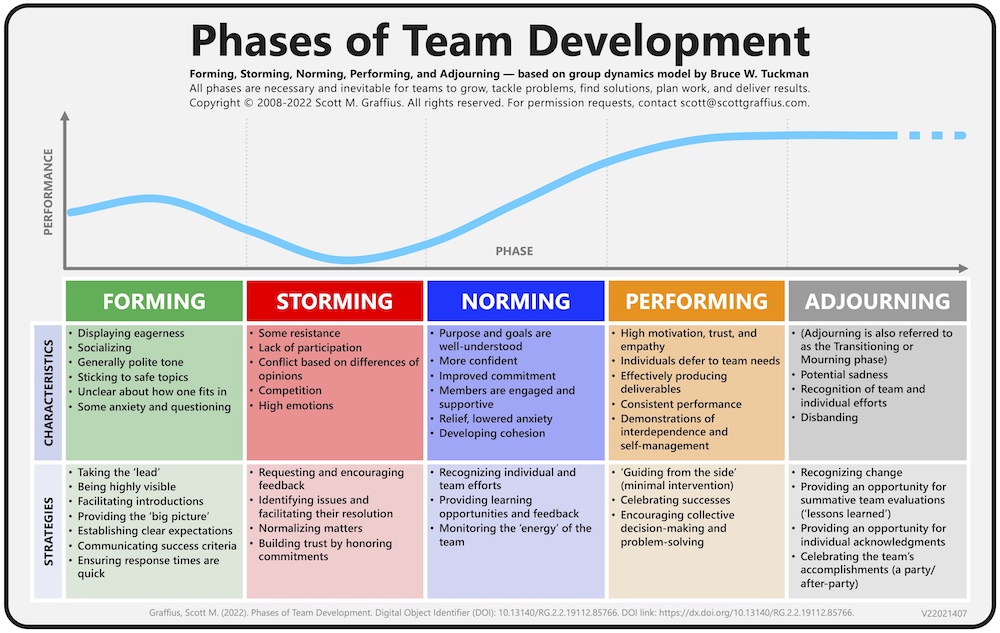
Agile project management practitioner, consultant, award-winning author, international speaker, thought leader, and influencer Scott M. Graffius developed a related custom illustration, Phases of Team Development. It highlights the performance level, characteristics, and proven strategies for each of the five phases. Project Managers, Scrum Masters, Agile Coaches, DevOps Leads, and other professionals can apply the information to help handle challenges or issues experienced by teams. By doing so, they’ll advance the teams' happiness, productivity, and success.
Graffius updates the content periodically. He released an updated version of the visual on February 14, 2022. This article features the newest version of the Phases of Team Development illustration. Read on for details including information on permission requests and downloadable high-resolution versions of the image.
Five Phases of Team Development
1. Forming
Characteristics of Forming include displaying eagerness, socializing, generally polite tone, sticking to safe topics, unclear about how one fits in, and some anxiety and questioning.
Strategies for this phase include taking the ‘lead,’ being highly visible, facilitating introductions, providing the ‘big picture,’ establishing clear expectations, communicating success criteria, and ensuring response times are quick.
2. Storming
Traits of Storming include some resistance, lack of participation, conflict based on differences of opinions, competition, and high emotions.
Strategies for this phase include requesting and encouraging feedback, identifying issues and facilitating their resolution, normalizing matters, and building trust by honoring commitments.
3. Norming
Features of Norming include purpose and goals are well-understood, more confident, improved commitment, members are engaged and supportive, relief (lowered anxiety), and developing cohesion.
Strategies for this phase include recognizing individual and team efforts, providing learning opportunities and feedback, and monitoring the ‘energy’ of the team.
4. Performing
Characteristics of Performing include high motivation, trust, and empathy; individuals defer to team needs; effectively producing deliverables; consistent performance; and demonstrations of interdependence and self-management.
Strategies for this phase include ‘guiding from the side’ (minimal intervention), celebrating successes, and encouraging collective decision-making and problem-solving.
5. Adjourning
Typical traits of Adjourning (also referred to as Transitioning or Mourning) include potential sadness, recognition of team and individual efforts, and disbanding.
Strategies for this phase include recognizing change, providing an opportunity for summative team evaluations ('lessons learned'), providing an opportunity for individual acknowledgments, and celebrating the team’s accomplishments — which may involve a party and possibly an after-party.
As shown, performance fluctuates as teams move through the phases. Review the characteristics to help identify the team's current phase, then apply the corresponding proven strategies to help them advance.
© Copyright 2022 Scott M. Graffius. All rights reserved. This material may not be published, broadcast, rewritten or redistributed without the express written permission of Scott M. Graffius.

'Phases of Team Development' by Scott M. Graffius Featured by Hasso Plattner Institute
Click here to download this article as a PDF.
The Hasso Plattner Institute (Hasso-Plattner-Institut für Digital Engineering GmbH), abbreviated HPI, a German information technology institute and faculty of the University of Potsdam, featured content by Scott M. Graffius — Graffius, Scott M. (2021). Phases of Team Development. Los Angeles, California: Scott M. Graffius. Digital Object Identifier (DOI): 10.13140/RG.2.2.22040.42246. — in HPI’s presentation, Scalable Software Engineering (WS 2021/22).
The now-current 2022 version of the Phases of Team Development visual is here.

About Scott M. Graffius
Scott M. Graffius, PMP, CSP-SM, CSP-PO, CSM, CSPO, SFE, ITIL, LSSGB is an agile project management practitioner, consultant, multi award-winning author, and international keynote speaker. He has generated over $1.75 billion of business value in aggregate for the organizations he has served. Graffius is the CEO and Principal Consultant at Exceptional PPM and PMO Solutions™ and subsidiary Exceptional Agility™. Content from his books (Agile Scrum: Your Quick Start Guide with Step-by-Step Instructions and Agile Transformation: A Brief Story of How an Entertainment Company Developed New Capabilities and Unlocked Business Agility to Thrive in an Era of Rapid Change), workshops, speaking engagements, and more have been featured and used by businesses, professional associations, governments, and universities. Examples include Microsoft, Oracle, Broadcom, Cisco, Gartner, Deloitte, EY, Project Management Institute, IEEE, SANS Institute, U.S. Soccer Federation, English Institute of Sport, Ford, Qantas, Atlassian, Wrike, National Academy of Sciences, United States Department of Energy, United States Army, United States National Park Service, New Zealand Ministry of Education, Amsterdam Public Health Research Institute, Tufts University, Texas A&M University, Warsaw University of Technology, Zurich University of Applied Sciences, and others. Graffius has delighted audiences with talks and workshops on technology leadership and agile project, program, portfolio, and PMO management at 82 conferences and other events across 24 countries.
His full bio is available here.
Connect with Scott on:
About Agile Scrum: Your Quick Start Guide with Step-by-Step Instructions
Shifting customer needs are common in today's marketplace. Businesses must be adaptive and responsive to change while delivering an exceptional customer experience to be competitive.
There are a variety of frameworks supporting the development of products and services, and most approaches fall into one of two broad categories: traditional or agile. Traditional practices such as waterfall engage sequential development, while agile involves iterative and incremental deliverables. Organizations are increasingly embracing agile to manage projects, and best meet their business needs of rapid response to change, fast delivery speed, and more.
With clear and easy to follow step-by-step instructions, Scott M. Graffius's award-winning Agile Scrum: Your Quick Start Guide with Step-by-Step Instructions helps the reader:
- Implement and use the most popular agile framework―Scrum;
- Deliver products in short cycles with rapid adaptation to change, fast time-to-market, and continuous improvement; and
- Support innovation and drive competitive advantage.
Hailed by Literary Titan as “the book highlights the versatility of Scrum beautifully.”
Winner of 17 first place awards.
Agile Scrum: Your Quick Start Guide with Step-by-Step Instructions is available in paperback and ebook/Kindle in the United States and around the world. Some links by country follow.
- 🇧🇷 Brazil
- 🇨🇦 Canada
- 🇨🇿 Czech Republic
- 🇩🇰 Denmark
- 🇫🇮 Finland
- 🇫🇷 France
- 🇩🇪 Germany
- 🇬🇷 Greece
- 🇭🇺 Hungary
- 🇮🇳 India
- 🇮🇪 Ireland
- 🇮🇱 Israel
- 🇮🇹 Italy
- 🇯🇵 Japan
- 🇱🇺 Luxembourg
- 🇲🇽 Mexico
- 🇳🇱 Netherlands
- 🇳🇿 New Zealand
- 🇳🇴 Norway
- 🇪🇸 Spain
- 🇸🇪 Sweden
- 🇨🇭 Switzerland
- 🇦🇪 UAE
- 🇬🇧 United Kingdom
- 🇺🇸 United States
About Agile Transformation: A Brief Story of How an Entertainment Company Developed New Capabilities and Unlocked Business Agility to Thrive in an Era of Rapid Change
Thriving in today's marketplace frequently depends on making a transformation to become more agile. Those successful in the transition enjoy faster delivery speed and ROI, higher satisfaction, continuous improvement, and additional benefits.
Based on actual events, Agile Transformation: A Brief Story of How an Entertainment Company Developed New Capabilities and Unlocked Business Agility to Thrive in an Era of Rapid Change provides a quick (60-90 minute) read about a successful agile transformation at a multinational entertainment and media company, told from the author's perspective as an agile coach.
The award-winning book by Scott M. Graffius is available in paperback and ebook/Kindle in the United States and around the world. Some links by country follow.
- 🇦🇺 Australia
- 🇦🇹 Austria
- 🇧🇷 Brazil
- 🇨🇦 Canada
- 🇨🇿 Czech Republic
- 🇩🇰 Denmark
- 🇫🇮 Finland
- 🇫🇷 France
- 🇩🇪 Germany
- 🇬🇷 Greece
- 🇮🇳 India
- 🇮🇪 Ireland
- 🇯🇵 Japan
- 🇱🇺 Luxembourg
- 🇲🇽 Mexico
- 🇳🇱 Netherlands
- 🇳🇿 New Zealand
- 🇪🇸 Spain
- 🇸🇪 Sweden
- 🇨🇭 Switzerland
- 🇦🇪 United Arab Emirates
- 🇬🇧 United Kingdom
- 🇺🇸 United States
The short URL for this article is: https://bit.ly/hpi-2022
© Copyright 2022 Scott M. Graffius. All rights reserved. This material may not be published, broadcast, rewritten or redistributed without the express written permission of Scott M. Graffius.
Use the Phases of Team Development (Based on Bruce W. Tuckman's Model of Forming, Storming, Norming, Performing, and Adjourning) to Help Teams Grow and Advance: 2023 Update
A NEWER VERSION OF THIS ARTICLE IS AVAILABLE HERE: https://scottgraffius.com/blog/files/graffius-phases-of-team-development-2026.html
If there are any supplements or updates to this article after the date of publication, they will appear in the Post-Publication Notes section at the end of this article.
2023 Update
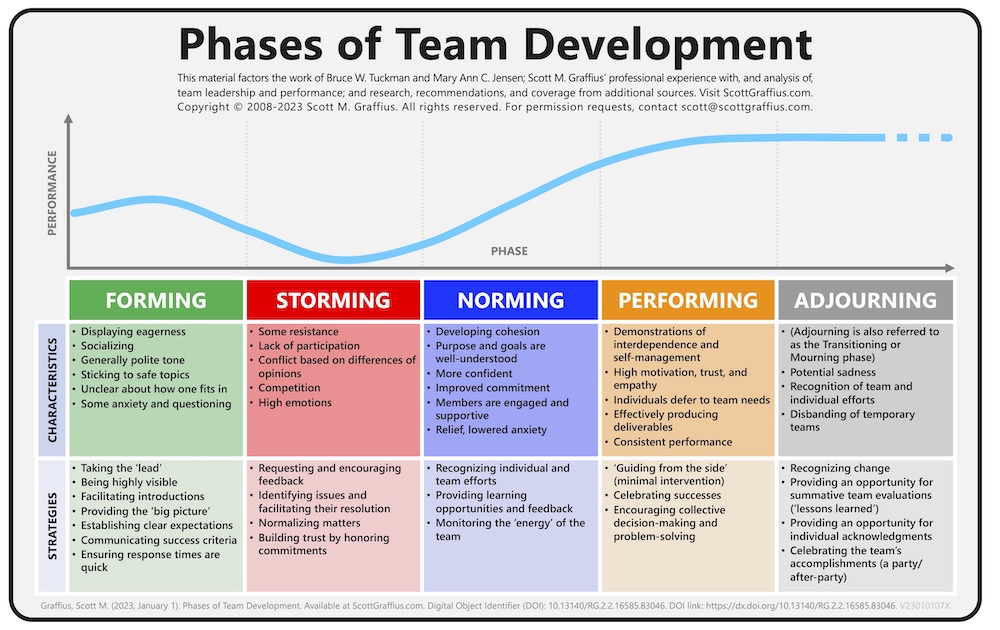
In 2008, Scott M. Graffius started developing material on advancing teams’ happiness, productivity, and success. His respective Phases of Team Development content factors the work of Dr. Bruce W. Tuckman and Mary Ann C. Jensen; Graffius's experience, observation, and analysis; and research, recommendations, and coverage from additional sources (examples are listed below).
The Phases of Team Development highlights the performance level, characteristics, and proven strategies for each of the five phases: Forming, Storming, Norming, Performing, and Adjourning. Project Managers, Scrum Masters, Agile Coaches, DevOps Leads, and other leaders can apply the information to help handle challenges or issues experienced by teams. By doing so, they’ll advance the teams' (and their own) happiness, productivity, and success.
This article and the accompanying visual provides the updated 2023 version of the Phases of Team Development.
Five Phases of Team Development
1. Forming
Characteristics of Forming include displaying eagerness, socializing, generally polite tone, sticking to safe topics, unclear about how one fits in, and some anxiety and questioning.
Strategies for this phase include taking the ‘lead,’ being highly visible, facilitating introductions, providing the ‘big picture,’ establishing clear expectations, communicating success criteria, and ensuring response times are quick.
2. Storming
Traits of Storming include some resistance, lack of participation, conflict based on differences of opinions, competition, and high emotions.
Strategies for this phase include requesting and encouraging feedback, identifying issues and facilitating their resolution, normalizing matters, and building trust by honoring commitments.
3. Norming
Features of Norming include purpose and goals are well-understood, more confident, improved commitment, members are engaged and supportive, relief (lowered anxiety), and developing cohesion.
Strategies for this phase include recognizing individual and team efforts, providing learning opportunities and feedback, and monitoring the ‘energy’ of the team.
4. Performing
Characteristics of Performing include high motivation, trust, and empathy; individuals defer to team needs; effectively producing deliverables; consistent performance; and demonstrations of interdependence and self-management.
Strategies for this phase include ‘guiding from the side’ (minimal intervention), celebrating successes, and encouraging collective decision-making and problem-solving.
5. Adjourning
Typical traits of Adjourning (also referred to as Transitioning or Mourning) include potential sadness, recognition of team and individual efforts, and disbanding.
Strategies for this phase include recognizing change, providing an opportunity for summative team evaluations ('lessons learned'), providing an opportunity for individual acknowledgments, and celebrating the team’s accomplishments — which may involve a party and possibly an after-party.

References / Sources
The Phases of Team Development by Scott M. Graffius factors the work of Dr. Bruce W. Tuckman and Mary Ann C. Jensen; Graffius's experience, observation, and analysis; and research, recommendations, and coverage from additional sources such as Google, Harvard Business Review, IEEE, MIT, Fast Company, NASA, Microsoft, TNW, Project Management Institute, Scrum Alliance, Scrum.org, Gartner, CIO, RAND Corporation, Software Engineering Institute, University of Edinburgh, Cisco, KPMG, Warsaw University of Technology, Software Engineering Institute, DevOps Institute, American Express, SANS Institute, Zurich University, SAP, ViacomCBS, Oxford University, American Management Association, AT&T, University of Southern California, IBM, and many others.
Select (partial) bibliography:
- Alford, J. (2019, April 11). Our Co-Production Journey: From Sandpits to Bird Boxes. London, United Kingdom: Imperial College London.
- Bennett, M., Gadlin, H., & Marchand, C. (2018). Collaboration Team Science: Field Guide. Rockville, MD: National Institutes of Health.
- Couture, N. (2016, October 27). A Note About Teams. CIO. Boston, MA: International Data Group (IDG).
- Daly, L. (2002). Identify Your Project Management Team’s Level of Development and Facilitate It to Success. Paper presented at Project Management Institute Annual Seminars and Symposium, San Antonio, TX. Newtown Square, PA: Project Management Institute.
- Deloitte (2017). Digital Era Technology Operating Models, Volume 2. New York, NY: Deloitte Touche Tohmatsu Limited.
- Finkelstein, S. (2017, October 29). Why Companies Should Hire Teams, Not Individuals. The Wall Street Journal. New York, NY: The Wall Street Journal.
- Forbes (2018, April 23). How to Fast-Track Any Team to Success. Forbes. New York, NY: Forbes.
- Forbes (2012, October 27). How the iPad Mini is Defining Tim Cook’s Apple. Forbes. New York, NY: Forbes.
- Glover, P. (2012, March 13). Team Conflict: Why It’s a Good Thing. Fast Company. New York, NY: Mansueto Ventures.
- Graffius, Scott M. (2021). Phases of Team Development. Los Angeles, CA: Scott M. Graffius. Digital Object Identifier (DOI): 10.13140/RG.2.2.22040.42246.
- Jovanovic, M., Mesquida, A., Radaković, N., & Mas, A. (2016). Agile Retrospective Games for Different Team Development Phases. Journal of Universal Computer Science, 22: 1489-1508.
- Kane, G. C. (2014, October 7). Why Your Company is Probably Measuring Social Media Wrong. MIT Sloan Management Review. Cambridge, MA: MIT Sloan Management Review.
- KPMG (2017). The Digital Fund, Season 2. Amstelveen, Netherlands: KPMG International.
- Madden, D. (2019, May 19). The Four Stages of Building a Great Team – and the One Where Things Usually Go Wrong. Inc. Magazine. New York, NY: Inc. Magazine.
- Makar, A. (2011, July 13). Lessons Learned in Norming and Performing Team Development Phases. Louisville, KY: TechRepublic.
- Martinuzzi, B. (2012, June 8). Six Tips Guaranteed to Reduce Workplace Frustrations. New York, NY: American Express Company.
- Microsoft (2019, June 15). Is the Latest Technology the Key to Your Team’s Success, or is There Something Else? Microsoft Developer Support. Accessed at: https://devblogs.microsoft.com/premier-developer/is-the-latest-technology-the-key-to-your-teams-success-or-is-there-something-else. Redmond, WA: Microsoft.
- Mocko, G., & Linnerud, B. (2016). Measuring the Effects of Goal Alignment on Innovative Engineering Design Projects. International Journal of Engineering Education, 32: 55-63.
- Romanelli, M. (2019, September 11). Teamwork Accelerated. PM Times. Newmarket, Ontario, Canada: Macgregor Communications.
- Riggs, A. (2020, October 15). Why I Start All My Video Meetings with Collaborative Games (Spoiler: It’s Not Boredom). Amsterdam, the Netherlands: The Next Web (TNW).
- Rowley, D., & Lange, M. (2007). Forming to Performing: The Evolution of an Agile Team. IEEE Computer Society Proceedings. Agile 2007, 1: 408-414.
- Scrum Alliance (2020). Learning Objectives Examples. Denver, CO: Scrum Alliance.
- Sakpal, M. (2020, March 3. Learn How to Debunk These Five Restructuring Myths. Stamford, CT: Gartner, Inc.
- Stern, S. (2018, September 26). Is Your Team Working the Rory Underwood Way? Financial Times. London, United Kingdom: The Financial Times, a Nikkei Company.
- Telford, R. (2013, June 4). This is Where It Gets Interesting. Armonk, NY: International Business Machines (IBM) Corporation.
- Tuckman, B. W. (1965). Developmental Sequence in Small Groups. Psychological Bulletin, 63: 384-399.
- Tuckman, B. W., & Jensen, M. A. C. (1977). Stages of Small-Group Development Revisited. Group and Organizational Studies, 2 (4): 419-427.
- United States Army (2015). Innovative Learning: A Key to National Security. Washington, DC: United States Army.

How to Cite This Article
Graffius, Scott M. (2023, January 9). Use the Phases of Team Development (Based on Bruce W. Tuckman's Model of Forming, Storming, Norming, Performing, and Adjourning) to Help Teams Grow and Advance: 2023 Update. Available at: https://scottgraffius.com. Digital Object Identifier (DOI): 10.13140/RG.2.2.10720.35846. DOI link: https://dx.doi.org/10.13140/RG.2.2.10720.35846.


Request Permission
This material is © copyright 2023 Scott M. Graffius. All rights reserved. It may not be published, broadcast, rewritten or redistributed without the express written permission of Scott M. Graffius.
To request permission to use the Phases of Team Development content, contact Scott M. Graffius.
If a request is approved, terms and conditions will be provided along with—if applicable—downloadable high resolution versions of the Phases of Team Development image in JPG and PNG formats.


About Scott M. Graffius
Scott M. Graffius, PMP, CSP-SM, CSP-PO, CSM, CSPO, SFE, ITIL, LSSGB is an agile project management practitioner, consultant, multi award-winning author, and highly sought-after international keynote speaker. He has generated over $1.75 billion of business value in aggregate for the organizations he has served. Graffius is the CEO and Principal Consultant at Exceptional PPM and PMO Solutions™ and subsidiary Exceptional Agility™. Content from his books, talks, workshops, and more have been featured and used by businesses, professional associations, governments, and universities. Select examples include Microsoft, Oracle, Broadcom, Cisco, Gartner, Project Management Institute, IEEE, U.S. Soccer Federation, Qantas, National Academy of Sciences, U.S. Department of Energy, U.S. National Park Service, New Zealand Ministry of Education, Yale University, Warsaw University of Technology, and others. Graffius has delighted audiences with dynamic and engaging talks and workshops on agile, project management, and technology leadership at 82 conferences and other events across 24 countries.
His full bio is available here.
Connect with Scott on:
About Agile Scrum: Your Quick Start Guide with Step-by-Step Instructions
Shifting customer needs are common in today's marketplace. Businesses must be adaptive and responsive to change while delivering an exceptional customer experience to be competitive.
There are a variety of frameworks supporting the development of products and services, and most approaches fall into one of two broad categories: traditional or agile. Traditional practices such as waterfall engage sequential development, while agile involves iterative and incremental deliverables. Organizations are increasingly embracing agile to manage projects, and best meet their business needs of rapid response to change, fast delivery speed, and more.
With clear and easy to follow step-by-step instructions, Scott M. Graffius's award-winning Agile Scrum: Your Quick Start Guide with Step-by-Step Instructions helps the reader:
- Implement and use the most popular agile framework―Scrum;
- Deliver products in short cycles with rapid adaptation to change, fast time-to-market, and continuous improvement; and
- Support innovation and drive competitive advantage.
Hailed by Literary Titan as “the book highlights the versatility of Scrum beautifully.”
Winner of 17 first place awards.
Agile Scrum: Your Quick Start Guide with Step-by-Step Instructions is available in paperback and ebook/Kindle in the United States and around the world. Some links by country follow.
- 🇧🇷 Brazil
- 🇨🇦 Canada
- 🇨🇿 Czech Republic
- 🇩🇰 Denmark
- 🇫🇮 Finland
- 🇫🇷 France
- 🇩🇪 Germany
- 🇬🇷 Greece
- 🇭🇺 Hungary
- 🇮🇳 India
- 🇮🇪 Ireland
- 🇮🇱 Israel
- 🇮🇹 Italy
- 🇯🇵 Japan
- 🇱🇺 Luxembourg
- 🇲🇽 Mexico
- 🇳🇱 Netherlands
- 🇳🇿 New Zealand
- 🇳🇴 Norway
- 🇪🇸 Spain
- 🇸🇪 Sweden
- 🇨🇭 Switzerland
- 🇦🇪 UAE
- 🇬🇧 United Kingdom
- 🇺🇸 United States
About Agile Transformation: A Brief Story of How an Entertainment Company Developed New Capabilities and Unlocked Business Agility to Thrive in an Era of Rapid Change
Thriving in today's marketplace frequently depends on making a transformation to become more agile. Those successful in the transition enjoy faster delivery speed and ROI, higher satisfaction, continuous improvement, and additional benefits.
Based on actual events, Agile Transformation: A Brief Story of How an Entertainment Company Developed New Capabilities and Unlocked Business Agility to Thrive in an Era of Rapid Change provides a quick (60-90 minute) read about a successful agile transformation at a multinational entertainment and media company, told from the author's perspective as an agile coach.
The award-winning book by Scott M. Graffius is available in paperback and ebook/Kindle in the United States and around the world. Some links by country follow.
- 🇦🇺 Australia
- 🇦🇹 Austria
- 🇧🇷 Brazil
- 🇨🇦 Canada
- 🇨🇿 Czech Republic
- 🇩🇰 Denmark
- 🇫🇮 Finland
- 🇫🇷 France
- 🇩🇪 Germany
- 🇬🇷 Greece
- 🇮🇳 India
- 🇮🇪 Ireland
- 🇯🇵 Japan
- 🇱🇺 Luxembourg
- 🇲🇽 Mexico
- 🇳🇱 Netherlands
- 🇳🇿 New Zealand
- 🇪🇸 Spain
- 🇸🇪 Sweden
- 🇨🇭 Switzerland
- 🇦🇪 United Arab Emirates
- 🇬🇧 United Kingdom
- 🇺🇸 United States

Post-Publication Notes
Update on 7 January 2025
Scott M. Graffius periodically updates his 'Phases of Team Development' work. The most current edition is here.

© Copyright 2023 Scott M. Graffius. All rights reserved. This material may not be published, broadcast, rewritten or redistributed without the express written permission of Scott M. Graffius.
Scott M. Graffius’ Phases of Team Development: 2024 Update
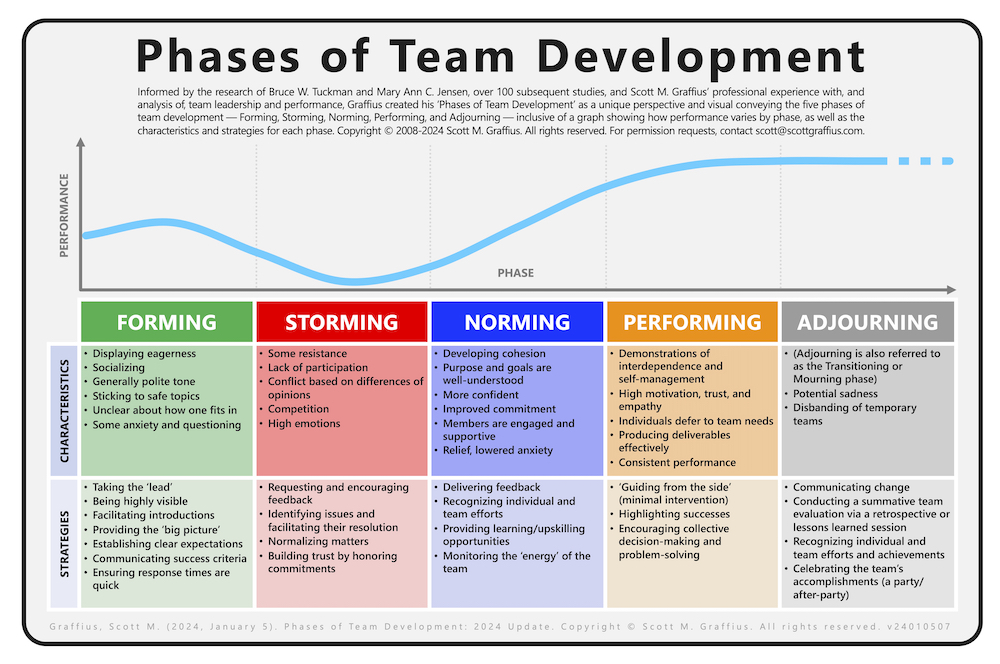
A NEWER VERSION OF THIS ARTICLE IS AVAILABLE HERE: https://scottgraffius.com/blog/files/graffius-phases-of-team-development-2026.html
If there are any supplements or updates to this article after the date of publication, they will appear in the Post-Publication Notes section at the end of this article.

Introduction
Informed by the research of Bruce W. Tuckman and Mary Ann C. Jensen, over 100 subsequent studies, and Scott M. Graffius’ first-hand professional experience with, and analysis of, team leadership and performance, Graffius created his ‘Phases of Team Development’ as a unique perspective and visual conveying the five phases of team development — Forming, Storming, Norming, Performing, and Adjourning — inclusive of a graph showing how performance varies by phase, as well as the characteristics and strategies for each phase.
Project Managers, Scrum Masters, Agile Coaches, DevOps Leads, and other leaders can apply the information to help handle challenges or issues experienced by teams. By doing so, they’ll advance the teams’ (and their own) happiness, productivity, and success.
Graffius initially developed his unique material in 2008, and he periodically refreshes it. This article (including the accompanying visual) provides the 2024 update to his ‘Phases of Team Development’ work.
Graffius’ work has “team development” in the title. Alternative terms — which may be interchangeable in the context of this article — include group development, group dynamics, team agility, team building, team coaching, team collaboration, teamcraft, team dynamics, team leadership, team optimization, team performance, team tradecraft, and teamwork.

Five Phases of Team Development
1. Forming
Characteristics of the Forming phase include displaying eagerness, socializing, generally polite tone, sticking to safe topics, unclear about how one fits in, and some anxiety and questioning.
Strategies for Forming include taking the ‘lead,’ being highly visible, facilitating introductions, providing the ‘big picture,’ establishing clear expectations, communicating success criteria, and ensuring response times are quick.
2. Storming
Traits of the Storming phase include some resistance, lack of participation, conflict based on differences of opinions, competition, and high emotions.
Strategies for Storming include requesting and encouraging feedback, identifying issues and facilitating their resolution, normalizing matters, and building trust by honoring commitments.
3. Norming
Features of the Norming phase include developing cohesion; purpose and goals are well-understood; more confident; improved commitment; members are engaged and supportive; and relief, lowered anxiety.
Strategies for Norming include delivering feedback, recognizing individual and team efforts, providing learning/upskilling opportunities, and monitoring the ‘energy’ of the team.
4. Performing
Characteristics of the Performing phase include demonstrations of interdependence and self-management; high motivation, trust, and empathy; individuals defer to team needs; producing deliverables effectively; and consistent performance.
Strategies for Performing include ‘guiding from the side’ (minimal intervention), highlighting successes, and encouraging collective decision-making and problem-solving.
5. Adjourning
Typical traits of the Adjourning phase (also referred to as the Transitioning or Mourning phase) include potential sadness, and disbanding of temporary teams.
Strategies for Adjourning include communicating change, conducting a summative team evaluation via a retrospective or lessons learned session, recognizing individual and team efforts and achievements, and celebrating the team's accomplishments (a party/after-party).

Conclusion
Project Managers, Scrum Masters, Agile Coaches, DevOps Leads, and other leaders can apply the information in this article and the accompanying visual to help handle challenges or issues experienced by teams. By doing so, they’ll advance the teams’ (and their own) happiness, productivity, and success.
This article provided a brief overview of the five phases of team development. Scott M. Graffius presents dynamic and engaging talks and workshops on this topic and more at conferences and other events (public and private/corporate) around the world. To learn more, visit here. For booking information, please complete a speaker engagement request form or email Scott M. Graffius.
If you're looking for additional information on this article (such as references/sources, citation details, or permission request information), read on.

Graffius’ Research is Widely Cited, Featured, and Used
Businesses, scientists, journalists, professional associations, government agencies, universities, and others around the world have featured and used prior — 2023 and earlier — editions of Scott M. Graffius’ ‘Phases of Team Development’ material. Here are a few examples:
- Academic Cooperation Association
- Adobe
- American Management Association
- Amsterdam Public Health Research Institute
- Bayer
- Boston University
- CodeMonk
- Dagen
- Deimos Aerospace
- Erste Bank
- FSU College of Medicine
- Hasso Plattner Institute (Hasso-Plattner-Institut für Digital Engineering GmbH)
- IEEE
- Innovify
- Life Sciences Trainers & Educators Network (LTEN)
- London South Bank University
- New Zealand Government
- Prima Resource
- Singapore University of Social Sciences
- Technical University of Munich
- Torrens University Australia
- UK Sports Institute
- University of Galway Ireland
- University of Graz Austria
- University of Waterloo
- US National Park Service
- Virginia Tech
- Warsaw University of Technology
- Yale University
- Zittau/Gorlitz University of Applied Sciences
- And many more

References/Sources
Select (partial) bibliography:
- Activision Blizzard (2022, September 9). Tackling the Talent Shortage: Identifying the Skills Critical for Game Development. Available at: https://www.activisionblizzard.com/content/atvi/activisionblizzard/ab-touchui/ab/web/en/newsroom/2022/09/tackling-the-talent-shortage.html.
- Alfateh, Maryam Ali Abu; Messaadia, Mourad; and Ali, Mazen (2023, September). Exploring the Dynamics of Team Formation in Human-Artificial Intelligence Collaboration. In 2023 International Conference on Decision Aid Sciences and Applications (DASA), pp. 384-388, DOI: 10.1109/DASA59624.2023.10286788.
- Alford, J. (2019, April 11). Our Co-Production Journey: From Sandpits to Bird Boxes. London, United Kingdom: Imperial College London.
- Ali, A. J., Fuenzalida, J., Gómez, M., & Williams, M. J. (2021, June). Four Lenses on People Management in the Public Sector: An Evidence Review and Synthesis. Oxford Review of Economic Policy, 37 (2): 335-366.
- Amsterdam Public Health Research Institute (2021). APH Quality Handbook. Amsterdam: Amsterdam Public Health Research Institute.
- Bandai Namco (n.d.). Teamwork Makes the Dream Work. Available at: https://bandainamcomobile.com/news/power-up-your-teamwork-how-bandai-namco-mobile-builds-stronger-teams.
- Bellet, C., De Neve, J., & Ward, G. (2019 October 14). Does Employee Happiness Have an Impact on Productivity? Saïd Business School WP 2019-13. Oxford, UK: Oxford University.
- Bennett, M., Gadlin, H., & Marchand, C. (2018). Collaboration Team Science: Field Guide. Rockville, MD: National Institutes of Health.
- Berlin School of Business and Innovation (2022, September 22). How Do Technical Abilities Combined with Leadership Skills Fuel Career Growth? Available at: https://www.berlinsbi.com/blog/career-advice/how-do-technical-abilities-combined-with-leadership-skills-fuel-career-growth.
- Brief, A. P. & Weiss, H. M. (2022, February). Organizational Behavior: Affect in the Workplace. Annual Review of Psychology, 53 (1): 279-307.
- Cisco (2019). Next-Generation IT Talent Strategies: How CIOs Can Close the Skills Gap and Drive True Business Transformation. Available at: https://www.cisco.com/c/dam/global/en_uk/solutions/executive-perspectives/pdf/ITTalent.pdf.
- Couture, N. (2016, October 27). A Note About Teams. CIO. Boston, MA: International Data Group (IDG).
- Daly, L. (2002). Identify Your Project Management Team’s Level of Development and Facilitate It to Success. Paper presented at Project Management Institute Annual Seminars and Symposium, San Antonio, TX. Newtown Square, PA: Project Management Institute.
- Dechurch, Leslie; & Mesmer-Magnus, Jessica. (2010). The Cognitive Underpinnings of Effective Teamwork: A Meta-Analysis. The Journal of Applied Psychology, 95: 32-53.
- Defense Advanced Research Projects Agency (DARPA) (2023, February 23). Episode 65: A Sprint to Tomorrow, Powered by Teamwork [Podcast]. Available at: https://www.darpa.mil/news-events/2023-02-23a.
- Deloitte (2017). Digital Era Technology Operating Models, Volume 2. New York, NY: Deloitte Touche Tohmatsu Limited.
- DevOps Institute (2021). 2021 Upskilling Enterprise DevOps Skills Report. Boca Raton, FL: DevOps Institute.
- Dickinson, A.; & Stoneman, K. (1989). Individual Performance as a Function of Group Contingencies and Group Size. Journal of Organizational Behavior Management, 10: 131-150.
- Dolev, Niva, & Itzkovich, Yariv (2020). In the AI Era, Soft Skills are the New Hard Skills. In: Artificial Intelligence and Its Impact on Business, pp. 55-77. Charlotte, NC: Information Age Publishing.
- Dzombak, Rachel, & Palat, Jay (2021, August 30). 5 Ways to Start Growing an AI-Ready Workforce. Pittsburgh, PA: Software Engineering Institute, Carnegie Mellon University.
- Elliott, Joshua (n.d.). Artificial Social Intelligence for Successful Teams (ASIST). Arlington, VA: Defense Advanced Research Projects Agency (DARPA).
- Exceptional Agility (2023, January 1). Making Teams More Agile: Strategies and Benefits. Available at: https://exceptionalagility.com/blog/files/teams.html.
- Finkelstein, S. (2017, October 29). Why Companies Should Hire Teams, Not Individuals. The Wall Street Journal. New York, NY: The Wall Street Journal.
- Forbes (2018, April 23). How to Fast-Track Any Team to Success. Forbes. New York, NY: Forbes.
- Forbes (2012, October 27). How the iPad Mini is Defining Tim Cook’s Apple. Forbes. New York, NY: Forbes.
- Gartner (2020, December 15). How to Staff Your AI Team. Available at: https://www.gartner.com/smarterwithgartner/how-to-staff-your-ai-team.
- Glover, P. (2012, March 13). Team Conflict: Why It’s a Good Thing. Fast Company. New York, NY: Mansueto Ventures.
- Gorman, Austin (2023, April 27). How to Strengthen Your Soft Skills for AI and the Future of Work. Fast Company. Available at: https://www.fastcompany.com/90887540/how-to-strengthen-your-soft-skills-for-ai-and-the-future-of-work.
- Graffius, Scott M. (2023, October 13). The Science of High-Performance Game Development Teams [Presentation]. Talk delivered at the W Love Games International Video Game Development Conference 2023 - Helsinki, Finland. Digital Object Identifier (DOI): 10.13140/RG.2.2.28602.16326. DOI link: https://dx.doi.org/10.13140/RG.2.2.28602.16326.
- Graffius, Scott M. (2023, July 15). Successful Video Game Development Teams Leverage an Extensive Range of Hard Skills and Soft Skills. Available at: https://scottgraffius.com/blog/files/gamedev.html. DOI: 10.13140/RG.2.2.31205.17124.
- Graffius, Scott M. (2023, April 26). The Science of High-Performance Teams [Presentation]. Talk delivered at the DevOps Institute’s SKILup Day 2023 Conference. Digital Object Identifier (DOI): 10.13140/RG.2.2.15888.28169. DOI link: https://dx.doi.org/10.13140/RG.2.2.15888.28169.
- Graffius, Scott M. (2023, January 9). Use the Phases of Team Development (Based on Bruce W. Tuckman's Model of Forming, Storming, Norming, Performing, and Adjourning) to Help Teams Grow and Advance: 2023 Update. Available at: https://scottgraffius.com. Digital Object Identifier (DOI): 10.13140/RG.2.2.10720.35846. DOI link: https://dx.doi.org/10.13140/RG.2.2.10720.35846.
- Graffius, Scott M. (2023, June 29). What Successful AI Teams Have in Common [Presentation]. Talk delivered at Conf42 Quantum Computing 2023 Conference. Digital Object Identifier (DOI): 10.13140/RG.2.2.29382.45120. DOI link: https://dx.doi.org/10.13140/RG.2.2.29382.45120.
- Graffius, Scott M. (2023, May 1). Fueling the Development of Innovative and Life-Changing AI Solutions [Presentation]. Talk delivered to an audience of Technology professionals (including Data Scientists, Machine Learning Engineers, Data Engineers, AI Researchers, Project Managers, Business Analysts, UX Designers, Software Developers, Cloud Architects, Data Privacy and Security Specialists, and others involved or interested in AI) at a private event in Mountain View, California, United States. Digital Object Identifier (DOI): 10.13140/RG.2.2.27956.73601. DOI link: https://dx.doi.org/10.13140/RG.2.2.27956.73601.
- Graffius, Scott M. (2022, February 4). Team Development Tradecraft: A Source of Competitive Advantage [Workshop]. Session at private event in Adelaide, Australia. DOI: 10.13140/RG.2.2.14092.80002.
- Graffius, Scott M. (2022, May 13). Want Happier and More Productive DevOps Teams? [Presentation]. Talk delivered at DevOpsDays Geneva, Switzerland 2022 Conference. Digital Object Identifier (DOI): 10.13140/RG.2.2.22252.85127. DOI link: https://dx.doi.org/10.13140/RG.2.2.22252.85127.
- Graffius, Scott M. (2021, February 20). But First, the Team! [Presentation]. Talk delivered at the Brno, Czech Republic DevConf.CZ 2021 Conference. Digital Object Identifier (DOI): 10.13140/RG.2.2.29016.72964. DOI link: https://dx.doi.org/10.13140/RG.2.2.29016.72964.
- Graffius, Scott M. (2021, June 21). DevOps and Team Leadership [Workshop]. Session at private event in Las Vegas, NV. DOI: 10.13140/RG.2.2.15380.22401.
- Graffius, Scott M. (2021, May 13). But First, the Team! [Presentation]. Lecture delivered at DevOps Pro Europe 2021 Conference. Based and simulcast live from Vilnius, Lithuania. DOI: 10.13140/RG.2.2.30524.36481.
- Graffius, Scott M. (2021, November 10). An Error Was Introduced Into the Seventh Edition of 'A Guide to the Project Management Body of Knowledge (PMBOK).’ Los Angeles, CA: Scott M. Graffius.
- Graffius, Scott M. (2021, November 8). Bruce Tuckman’s Model (Forming, Storming, Norming, Performing, and Adjourning) is Highly Relevant and Beneficial, But It Doesn’t Please Everyone. Los Angeles, CA: Scott M. Graffius.
- Graffius, Scott M. (2021, October 5). Navigate the Phases of Team Development with Speed and Agility for Happier and More Productive Teams [Presentation]. Talk delivered at the Institute of Electrical and Electronics Engineers IEEE Day 2021 Conference. Digital Object Identifier (DOI): 10.13140/RG.2.2.20055.19365. DOI link: https://dx.doi.org/10.13140/RG.2.2.20055.19365.
- Graffius, Scott M. (2021). Phases of Team Development. Los Angeles, CA: Scott M. Graffius. Digital Object Identifier (DOI): 10.13140/RG.2.2.22040.42246.
- Graffius, Scott M. (2018, October 18). Agile Scrum Helps Innovators, Disruptors, and Entrepreneurs Develop and Deliver Products at Astounding Speed Which Drives Competitive Advantage [Presentation]. Talk delivered at Techstars Startup Week Conference. DOI: 10.13140/RG.2.2.25009.12647.
- Himmelstein, D. (2018, January 26). Team Cycles and Culture Development. San Jose, CA: Acer, Inc.
- Humphrey, W. S., Chick, T. A., Nichols, W., and Pomeroy-Huff, M. (2010). Software Engineering Institute’s Team Software Process Body of Knowledge. Pittsburgh, PA: Carnegie Mellon University.
- Infinity Ward (n.d.). Infinity Ward. Available at: https://www.infinityward.com.
- International Game Developers Association (IGDA) (n.d.). IGDA Foundation. Available at: https://igda.org/igda-foundation/.
- Jovanovic, M., Mesquida, A., Radaković, N., & Mas, A. (2016). Agile Retrospective Games for Different Team Development Phases. Journal of Universal Computer Science, 22: 1489-1508.
- KPMG (2017). The Digital Fund, Season 2. Amstelveen, Netherlands: KPMG International.
- Leswing, Kif (2023, June 5). Apple’s Practical Approach to A.I.: No Bragging, Just Features. CNBC. Available at: https://www.cnbc.com/2023/06/05/apple-practical-approach-to-ai-no-bragging-just-features.html.
- Life Sciences Trainers and Educators Network (LTEN) (2022). Leveraging a Cross-Functional Training Task Force to Create Training that Doesn’t Suck. LTEN 2022 Conference.
- Madden, D. (2019, May 19). The Four Stages of Building a Great Team – and the One Where Things Usually Go Wrong. Inc. Magazine. New York, NY: Inc. Magazine.
- Makar, A. (2011, July 13). Lessons Learned in Norming and Performing Team Development Phases. Louisville, KY: Tech Republic.
- Martinuzzi, B. (2012, June 8). Six Tips Guaranteed to Reduce Workplace Frustrations. New York, NY: American Express Company.
- Massachusetts Institute of Technology (MIT) (2021, January). Cognitive Science as a New People Science for the Future of Work. Available at: https://workofthefuture.mit.edu/wp-content/uploads/2021/01/2021-Research-Brief-Polli-Kassir-Dolphin-Baker-Gabrieli.pdf.
- Microsoft (2019, June 15). Is the Latest Technology the Key to Your Team’s Success, or is There Something Else? Microsoft Developer Support. Accessed at: https://devblogs.microsoft.com/premier-developer/is-the-latest-technology-the-key-to-your-teams-success-or-is-there-something-else. Redmond, WA: Microsoft.
- Mocko, G., & Linnerud, B. (2016). Measuring the Effects of Goal Alignment on Innovative Engineering Design Projects. International Journal of Engineering Education, 32: 55-63.
- Negrón, A.P.P., Carranza, D.B., Muñoz, M. (2023). Video Game Development Process for Soft Skills Analysis. In: Mejia, J., Muñoz, M., Rocha, Á., Hernández-Nava, V. (eds), New Perspectives in Software Engineering. Proceedings of the 11th International Conference on Software Process Improvement (CIMPS 2022). Lecture Notes in Networks and Systems, vol. 576. New York, NY: Springer.
- Riggs, A. (2020, October 15). Why I Start All My Video Meetings with Collaborative Games (Spoiler: It’s Not Boredom). Amsterdam, the Netherlands: The Next Web (TNW).
- Romanelli, M. (2019, September 11). Teamwork Accelerated. PM Times. Newmarket, Ontario, Canada: Macgregor Communications.
- Rowley, D., & Lange, M. (2007). Forming to Performing: The Evolution of an Agile Team. IEEE Computer Society Proceedings. Agile 2007, 1: 408-414.
- Sakpal, M. (2020, March 3. Learn How to Debunk These Five Restructuring Myths. Stamford, CT: Gartner, Inc.
- Sazali, A. R. B.; Khamarudin, F. B.; & Abdul Alahdad, S. N. B. (2022). Maximising the Zone of Proximal Development Benefits in Group Online Learning. International Journal of Academic Research in Business and Social Sciences, 12 (6): 1476-1496.
- Scaled Agile, Inc. (2023, March 14). Working Successfully in Agile with Remote Team Members. Available at: https://scaledagileframework.com/working-successfully-in-agile-with-remote-team-members/.
- Scrum Alliance (2020). Learning Objectives Examples. Denver, CO: Scrum Alliance.
- Stanford University (2019, September). Gathering Strength, Gathering Storms. Stanford, CA: Stanford University.
- Steiner, Ivan D. (1972). Group Process and Productivity. New York, New York: Academic Press.
- Stern, S. (2018, September 26). Is Your Team Working the Rory Underwood Way? Financial Times. London, United Kingdom: The Financial Times, a Nikkei Company.
- Tamiru, Natasha (2023, June). Team Dynamics: Five Keys to Building Effective Teams. Google. Available at: https://www.thinkwithgoogle.com/intl/en-emea/consumer-insights/consumer-trends/five-dynamics-effective-team.
- Tannenbaum, Robert, & Schmidt, Warren H. (1958). How to Choose a Leadership Pattern. Harvard Business Review, 36: 95- 101.
- Telford, R. (2013, June 4). This is Where It Gets Interesting. Armonk, NY: International Business Machines (IBM) Corporation.
- Thier, Jane (2021, December 8). 'Form, Storm, Norm, Perform’: Twitter’s New CEO Faces a Critical Few Months as He Seeks to Differentiate Himself from Jack Dorsey, Leadership Experts Say. Fortune. Available at: https://fortune.com/2021/12/08/form-storm-norm-perform-twitters-new-ceo-faces-a-critical-few-months-as-he-seeks-to-differentiate-himself-from-jack-dorsey-leadership-experts-say/.
- Tuckman, B. W. (1965). Developmental Sequence in Small Groups. Psychological Bulletin, 63: 384-399.
- Tuckman, B. W., & Jensen, M. A. C. (1977). Stages of Small-Group Development Revisited. Group and Organizational Studies, 2 (4): 419-427.
- United States Army (2015). Innovative Learning: A Key to National Security. Washington, DC: United States Army.
- United States National Park Service (NPS) (2022, Spring). NPS Aviation Safety.
- Wheelan, S. A. (2009). Group Size, Group Development, and Group Productivity. Small-Group Research, 40 (2): 247-262.

How to Cite This Article
Graffius, Scott M. (2024, January 5). Scott M. Graffius’ Phases of Team Development: 2024 Update. Available at: https://scottgraffius.com/blog/files/teams-2024.html. DOI: 10.13140/RG.2.2.28629.40168.

Permission Request Information
To request permission to use the ‘Phases of Team Development’ visual shown at the top of this article or any other material from this publication, email Scott M. Graffius. If your request is approved, Graffius will give you an authorization/license and, if applicable, high-resolution files of the visual.
About Scott M. Graffius
Scott M. Graffius, PMP, SA, CSP-SM, CSP-PO, CSM, CSPO, SFE, ITIL, LSSGB is an agile project management practitioner, consultant, thinker, creator, multi-award-winning author, and international public speaker. Founder and CEO of Exceptional PPM and PMO Solutions™ and subsidiary Exceptional Agility™, he has generated over $1.9 billion for Global Fortune 500 businesses and other organizations he has served. Graffius and content from his books, talks, workshops, and more have been featured and used by Microsoft, Oracle, Broadcom, Cisco, Gartner, Project Management Institute, IEEE, National Academy of Sciences, United States Department of Energy, Yale University, Tufts University, and others. He delights audiences with dynamic and engaging talks and workshops on agile project management, AI, Tech leadership, video game development, strategic alignment, the science of high performance teams, and more. To date, he's presented sessions at 89 conferences and other events across 25 countries.
His full bio is available here.
Connect with Scott on:
About Agile Scrum: Your Quick Start Guide with Step-by-Step Instructions
Shifting customer needs are common in today's marketplace. Businesses must be adaptive and responsive to change while delivering an exceptional customer experience to be competitive.
There are a variety of frameworks supporting the development of products and services, and most approaches fall into one of two broad categories: traditional or agile. Traditional practices such as waterfall engage sequential development, while agile involves iterative and incremental deliverables. Organizations are increasingly embracing agile to manage projects, and best meet their business needs of rapid response to change, fast delivery speed, and more.
With clear and easy to follow step-by-step instructions, Scott M. Graffius's award-winning Agile Scrum: Your Quick Start Guide with Step-by-Step Instructions helps the reader:
- Implement and use the most popular agile framework―Scrum;
- Deliver products in short cycles with rapid adaptation to change, fast time-to-market, and continuous improvement; and
- Support innovation and drive competitive advantage.
Hailed by Literary Titan as “the book highlights the versatility of Scrum beautifully.”
Winner of 17 first place awards.
Agile Scrum: Your Quick Start Guide with Step-by-Step Instructions is available in paperback and ebook/Kindle in the United States and around the world. Some links by country follow.
- 🇧🇷 Brazil
- 🇨🇦 Canada
- 🇨🇿 Czech Republic
- 🇩🇰 Denmark
- 🇫🇮 Finland
- 🇫🇷 France
- 🇩🇪 Germany
- 🇬🇷 Greece
- 🇭🇺 Hungary
- 🇮🇳 India
- 🇮🇪 Ireland
- 🇮🇱 Israel
- 🇮🇹 Italy
- 🇯🇵 Japan
- 🇱🇺 Luxembourg
- 🇲🇽 Mexico
- 🇳🇱 Netherlands
- 🇳🇿 New Zealand
- 🇳🇴 Norway
- 🇪🇸 Spain
- 🇸🇪 Sweden
- 🇨🇭 Switzerland
- 🇦🇪 UAE
- 🇬🇧 United Kingdom
- 🇺🇸 United States
About Agile Transformation: A Brief Story of How an Entertainment Company Developed New Capabilities and Unlocked Business Agility to Thrive in an Era of Rapid Change
Thriving in today's marketplace frequently depends on making a transformation to become more agile. Those successful in the transition enjoy faster delivery speed and ROI, higher satisfaction, continuous improvement, and additional benefits.
Based on actual events, Agile Transformation: A Brief Story of How an Entertainment Company Developed New Capabilities and Unlocked Business Agility to Thrive in an Era of Rapid Change provides a quick (60-90 minute) read about a successful agile transformation at a multinational entertainment and media company, told from the author's perspective as an agile coach.
The award-winning book by Scott M. Graffius is available in paperback and ebook/Kindle in the United States and around the world. Some links by country follow.
- 🇦🇺 Australia
- 🇦🇹 Austria
- 🇧🇷 Brazil
- 🇨🇦 Canada
- 🇨🇿 Czech Republic
- 🇩🇰 Denmark
- 🇫🇮 Finland
- 🇫🇷 France
- 🇩🇪 Germany
- 🇬🇷 Greece
- 🇮🇳 India
- 🇮🇪 Ireland
- 🇯🇵 Japan
- 🇱🇺 Luxembourg
- 🇲🇽 Mexico
- 🇳🇱 Netherlands
- 🇳🇿 New Zealand
- 🇪🇸 Spain
- 🇸🇪 Sweden
- 🇨🇭 Switzerland
- 🇦🇪 United Arab Emirates
- 🇬🇧 United Kingdom
- 🇺🇸 United States
Post-Publication Notes
Update on 7 January 2025
Scott M. Graffius periodically updates his 'Phases of Team Development' work. The most current edition is here.
© Copyright 2024 Scott M. Graffius. All rights reserved. This material may not be published, broadcast, rewritten or redistributed without the express written permission of Scott M. Graffius.

Scott M. Graffius’ Phases of Team Development: 2025 Update

A NEWER VERSION OF THIS ARTICLE IS AVAILABLE HERE: https://scottgraffius.com/blog/files/graffius-phases-of-team-development-2026.html
Introduction
Informed by the research of Bruce W. Tuckman and Mary Ann C. Jensen, over 100 subsequent studies, and Scott M. Graffius’ first-hand professional experience with, and analysis of, team leadership and performance, Graffius created his 'Phases of Team Development' as a unique perspective and visual conveying the five phases of team development—Forming, Storming, Norming, Performing, and Adjourning—inclusive of a graph showing how performance varies by phase, as well as the characteristics and strategies for each phase.
Graffius initially developed his unique material in 2008, and he periodically updates it. This article presents the refreshed 2025 edition.
Project Managers, Scrum Masters, Agile Coaches, DevOps Leads, and other leaders can apply these insights to overcome team challenges, fostering happiness, productivity, and success.
This article has “team development” in the title. Alternative terms that may be interchangeable in the context of this discussion include group development, group dynamics, high-performance teaming, strategic team building, team agility, team building, team coaching, team collaboration, team dynamics, team leadership, team optimization, team performance, team tradecraft, teamcraft, teamwork, and teamwork tradecraft.
Five Phases of Team Development
1. Forming
Characteristics of the Forming phase include displaying eagerness, socializing, a generally polite tone, sticking to safe topics, being unclear about how one fits in, and some anxiety and questioning.
Strategies for Forming include taking the ‘lead,’ being highly visible, facilitating introductions, providing the ‘big picture,’ establishing clear expectations, communicating success criteria, and ensuring response times are quick.
2. Storming
Traits of the Storming phase include some resistance, lack of participation, conflict arising from differences of opinion, competition, high levels of emotions, and tension.
Strategies for Storming include requesting and encouraging feedback, identifying issues and facilitating their resolution, normalizing matters, and building trust by honoring commitments.
3. Norming
Features of the Norming phase include developing cohesion; purpose and goals are well-understood; more confident; improved commitment; members are engaged and supportive; and relief, lowered anxiety.
Strategies for Norming include delivering feedback, recognizing individual and team efforts, providing learning/upskilling opportunities, and monitoring the ‘energy’ of the team.
4. Performing
Characteristics of the Performing phase include high-level performance; demonstrations of interdependence and self-management; elevated empathy, trust, and morale; individuals defer to team needs; and producing deliverables effectively and consistently.
Strategies for Performing include ‘guiding from the side’ (minimal intervention), highlighting successes, and encouraging collective decision-making and problem-solving.
5. Adjourning
Typical traits of the Adjourning phase (also referred to as the Transitioning or Mourning phase) include potential sadness and the disbanding of temporary teams.
Strategies for Adjourning include communicating change; conducting a summative team evaluation via a retrospective event, lessons learned meeting, or similar session; recognizing individual and team efforts and achievements; and celebrating the team's accomplishments.
Conclusion
These insights provide a practical framework to navigate the complexities of group dynamics. Whether you’re a Project Manager guiding a cross-functional team, a Scrum Master fostering agility, a DevOps Lead bridging development and operations, or another leader, understanding and leveraging the phases of team development can transform challenges into opportunities. And they’ll advance the teams’—and your own—happiness, productivity, and success.
Organizations around the world engage Graffius to deliver compelling talks and workshops. To date, he's presented sessions at 91 conferences and other events across 25 countries:
- Armenia,
- Australia,
- Brazil,
- Canada,
- Czech Republic,
- Finland,
- France,
- Germany,
- Greece,
- Hong Kong,
- Hungary,
- India,
- Ireland,
- Lithuania,
- Luxembourg,
- Nepal,
- Netherlands,
- New Zealand,
- Norway,
- Romania,
- Sweden,
- Switzerland,
- United Arab Emirates,
- United Kingdom,
- and the United States.
Scott M. Graffius’ 'Phases of Team Development' intellectual property is central and key to many of those sessions.
Graffius is a global expert on high-performance teams and he delivers engaging talks and workshops that bring teamwork tradecraft to life. His sessions are tailored to inspire, educate, and equip audiences with actionable tools for success. Whether at global conferences or private corporate events, he provides a fresh perspective on leadership and teamwork.
For booking inquiries, complete the speaker engagement request form or email directly to explore how Graffius can help elevate your organization’s performance.
Read on for:
- Coverage of Graffius’ Research,
- Sources/References,
- About Scott M. Graffius,
- Permission Request Information,
- How to Cite This Article,
- and more.
Graffius’ Research is Widely Cited, Featured, and Used
Businesses, professional associations, government agencies, universities, researchers, journalists, and others around the world have featured and used prior editions of Scott M. Graffius’ ‘Phases of Team Development’ material. Here are some examples:
- Adobe,
- American Management Association,
- Amsterdam Public Health Research Institute,
- Bayer,
- Boston University,
- Broadcom,
- Cisco,
- CodeMonk,
- Dagen,
- Deimos Aerospace,
- DevOps Institute,
- Erste Group Bank AG (Austria),
- FINAT,
- Ford Motor Company,
- FSU College of Medicine,
- Hasso Plattner Institute (Hasso-Plattner-Institut für Digital Engineering GmbH),
- IEEE,
- Innovify,
- Johns Hopkins University,
- Journal of Neurosurgery,
- LeadingEng,
- Life Sciences Trainers & Educators Network (LTEN),
- London South Bank University,
- Manufacturers Alliance,
- Mary Raum (Professor of National Security Affairs, United States Naval War College),
- Microsoft,
- New Zealand Government,
- Oracle,
- Prima Resource,
- Royal Australasian College of Physicians,
- Singapore University of Social Sciences,
- TBS Switzerland,
- Technical University of Munich,
- Torrens University (Australia),
- Tufts University,
- U.S. National Park Service,
- U.S. Tennis Association,
- UC San Diego,
- UK Sports Institute,
- University of Galway (Ireland),
- University of Graz (Austria),
- University of Waterloo,
- Victorian Institute of Technology (Australia),
- Virginia Tech,
- Warsaw University of Technology,
- Western Sydney University,
- Yale University,
- and many others.
These examples demonstrate the widespread recognition and application of Scott M. Graffius' 'Phases of Team Development' work across diverse sectors and entities around the world.
References/Sources
Here’s the select (partial) bibliography:
- Activision Blizzard (2022, September 9). Tackling the Talent Shortage: Identifying the Skills Critical for Game Development. Available at: https://www.activisionblizzard.com/content/atvi/activisionblizzard/ab-touchui/ab/web/en/newsroom/2022/09/tackling-the-talent-shortage.html.
- Alfateh, Maryam Ali Abu; Messaadia, Mourad; and Ali, Mazen (2023, September). Exploring the Dynamics of Team Formation in Human-Artificial Intelligence Collaboration. In 2023 International Conference on Decision Aid Sciences and Applications (DASA), pp. 384-388, DOI: 10.1109/DASA59624.2023.10286788.
- Alford, J. (2019, April 11). Our Co-Production Journey: From Sandpits to Bird Boxes. London, United Kingdom: Imperial College London.
- Ali, A. J., Fuenzalida, J., Gómez, M., & Williams, M. J. (2021, June). Four Lenses on People Management in the Public Sector: An Evidence Review and Synthesis. Oxford Review of Economic Policy, 37 (2): 335-366.
- Amsterdam Public Health Research Institute (2021). APH Quality Handbook. Amsterdam: Amsterdam Public Health Research Institute.
- Bandai Namco (n.d.). Teamwork Makes the Dream Work. Available at: https://bandainamcomobile.com/news/power-up-your-teamwork-how-bandai-namco-mobile-builds-stronger-teams.
- Bellet, C., De Neve, J., & Ward, G. (2019 October 14). Does Employee Happiness Have an Impact on Productivity? Saïd Business School WP 2019-13. Oxford, UK: Oxford University.
- Bennett, M., Gadlin, H., & Marchand, C. (2018). Collaboration Team Science: Field Guide. Rockville, MD: National Institutes of Health.
- Berlin School of Business and Innovation (2022, September 22). How Do Technical Abilities Combined with Leadership Skills Fuel Career Growth? Available at: https://www.berlinsbi.com/blog/career-advice/how-do-technical-abilities-combined-with-leadership-skills-fuel-career-growth.
- Brief, A. P. & Weiss, H. M. (2022, February). Organizational Behavior: Affect in the Workplace. Annual Review of Psychology, 53 (1): 279-307.
- Buckinghamshire New University (2024). Strategic Leadership. International Master of Business Administration Programme.
- Caredda, Sergio (2020, January 20) (updated 2021, December 10). Models: Tuckman’s Stages of Team Development. Available at: https://sergiocaredda.eu/organisation/models-tuckmans-stages-of-team-development.
- Cisco (2019). Next-Generation IT Talent Strategies: How CIOs Can Close the Skills Gap and Drive True Business Transformation. Available at: https://www.cisco.com/c/dam/global/en_uk/solutions/executive-perspectives/pdf/ITTalent.pdf.
- Constructor University (2024). Master of Science in Advanced Software Technology. Available at: https://constructor.university/sites/default/files/2024-09/AST_MSc_Handbook__2024.pdf.
- Couture, N. (2016, October 27). A Note About Teams. CIO. Boston, MA: International Data Group (IDG).
- Daly, L. (2002). Identify Your Project Management Team’s Level of Development and Facilitate It to Success. Paper presented at Project Management Institute Annual Seminars and Symposium, San Antonio, TX. Newtown Square, PA: Project Management Institute.
- Dechurch, Leslie; & Mesmer-Magnus, Jessica. (2010). The Cognitive Underpinnings of Effective Teamwork: A Meta-Analysis. The Journal of Applied Psychology, 95: 32-53.
- Defense Advanced Research Projects Agency (DARPA) (2023, February 23). Episode 65: A Sprint to Tomorrow, Powered by Teamwork [Podcast]. Available at: https://www.darpa.mil/news-events/2023-02-23a.
- Deloitte (2017). Digital Era Technology Operating Models, Volume 2. New York, NY: Deloitte Touche Tohmatsu Limited.
- DevOps Institute (2021). 2021 Upskilling Enterprise DevOps Skills Report. Boca Raton, FL: DevOps Institute.
- Dickinson, A.; & Stoneman, K. (1989). Individual Performance as a Function of Group Contingencies and Group Size. Journal of Organizational Behavior Management, 10: 131-150.
- Dolev, Niva, & Itzkovich, Yariv (2020). In the AI Era, Soft Skills are the New Hard Skills. In: Artificial Intelligence and Its Impact on Business, pp. 55-77. Charlotte, NC: Information Age Publishing.
- Dzombak, Rachel, & Palat, Jay (2021, August 30). 5 Ways to Start Growing an AI-Ready Workforce. Pittsburgh, PA: Software Engineering Institute, Carnegie Mellon University.
- Elliott, Joshua (n.d.). Artificial Social Intelligence for Successful Teams (ASIST). Arlington, VA: Defense Advanced Research Projects Agency (DARPA).
- Europass Teacher Academy (2023). Leadership and Management for School Principals. Available at: https://sgv.si/wp-content/uploads/2023/12/Porocilo-o-mobilnosti-Urska-Doblehar.pdf.
- Exceptional Agility (2023, January 1). Making Teams More Agile: Strategies and Benefits. Available at: https://exceptionalagility.com/blog/files/teams.html.
- Fédération Internationale des Fabricants et Transformateurs d'Adhésifs et Thermocollants sur Papiers et Autres Supports (FINAT) (2024, April). FINAT Committee Summit Amsterdam 2024.
- Finkelstein, S. (2017, October 29). Why Companies Should Hire Teams, Not Individuals. The Wall Street Journal. New York, NY: The Wall Street Journal.
- Forbes (2012, October 27). How the iPad Mini is Defining Tim Cook’s Apple. Forbes. New York, NY: Forbes.
- Forbes (2018, April 23). How to Fast-Track Any Team to Success. Forbes. New York, NY: Forbes.
- Gartner (2020, December 15). How to Staff Your AI Team. Available at: https://www.gartner.com/smarterwithgartner/how-to-staff-your-ai-team.
- Glover, P. (2012, March 13). Team Conflict: Why It’s a Good Thing. Fast Company. New York, NY: Mansueto Ventures.
- Gorman, Austin (2023, April 27). How to Strengthen Your Soft Skills for AI and the Future of Work. Fast Company. Available at: https://www.fastcompany.com/90887540/how-to-strengthen-your-soft-skills-for-ai-and-the-future-of-work.
- Graffius, Scott M. (2016, January 21). 2014 NSDM Publication on Leadership by National Security Affairs Professor Mary Raum Featured the 2008 Edition of Scott M. Graffius’ Work on Team Development. Available at: https://scottgraffius.com/blog/files/nsdm-leadership.html.
- Graffius, Scott M. (2016). Agile Scrum: Your Quick Start Guide with Step-by-Step Instructions. North Charleston, SC: CreateSpace.
- Graffius, Scott M. (2018, October 18). Agile Scrum Helps Innovators, Disruptors, and Entrepreneurs Develop and Deliver Products at Astounding Speed Which Drives Competitive Advantage [Presentation]. Talk delivered at Techstars Startup Week Conference. DOI: 10.13140/RG.2.2.25009.12647.
- Graffius, Scott M. (2019). Agile Transformation: A Brief Story of How an Entertainment Company Developed New Capabilities and Unlocked Business Agility to Thrive in an Era of Rapid Change. Scotts Valley, CA: CreateSpace.
- Graffius, Scott M. (2021, February 20). But First, the Team! [Presentation]. Talk delivered at the Brno, Czech Republic DevConf.CZ 2021 Conference. Digital Object Identifier (DOI): 10.13140/RG.2.2.29016.72964. DOI link: https://dx.doi.org/10.13140/RG.2.2.29016.72964.
- Graffius, Scott M. (2021, June 21). DevOps and Team Leadership [Workshop]. Session at private event in Las Vegas, NV. DOI: 10.13140/RG.2.2.15380.22401.
- Graffius, Scott M. (2021, May 13). But First, the Team! [Presentation]. Lecture delivered at DevOps Pro Europe 2021 Conference. Based and simulcast live from Vilnius, Lithuania. DOI: 10.13140/RG.2.2.30524.36481.
- Graffius, Scott M. (2021, November 10). An Error Was Introduced Into the Seventh Edition of 'A Guide to the Project Management Body of Knowledge (PMBOK).’ Los Angeles, CA: Scott M. Graffius.
- Graffius, Scott M. (2021, November 8). Bruce Tuckman’s Model (Forming, Storming, Norming, Performing, and Adjourning) is Highly Relevant and Beneficial, But It Doesn’t Please Everyone. Los Angeles, CA: Scott M. Graffius.
- Graffius, Scott M. (2021, November 8). Bruce Tuckman’s Model (Forming, Storming, Norming, Performing, and Adjourning) is Highly Relevant and Beneficial, But It Doesn’t Please Everyone. Available at: https://scottgraffius.com/blog/files/jobs.html.
- Graffius, Scott M. (2021, October 5). Navigate the Phases of Team Development with Speed and Agility for Happier and More Productive Teams [Presentation]. Talk delivered at the Institute of Electrical and Electronics Engineers IEEE Day 2021 Conference. Digital Object Identifier (DOI): 10.13140/RG.2.2.20055.19365. DOI link: https://dx.doi.org/10.13140/RG.2.2.20055.19365.
- Graffius, Scott M. (2021). Phases of Team Development. Los Angeles, CA: Scott M. Graffius. Digital Object Identifier (DOI): 10.13140/RG.2.2.22040.42246.
- Graffius, Scott M. (2022, February 4). Team Development Tradecraft: A Source of Competitive Advantage [Workshop]. Session at private event in Adelaide, Australia. DOI: 10.13140/RG.2.2.14092.80002.
- Graffius, Scott M. (2022, May 13). Want Happier and More Productive DevOps Teams? [Presentation]. Talk delivered at DevOpsDays Geneva, Switzerland 2022 Conference. Digital Object Identifier (DOI): 10.13140/RG.2.2.22252.85127. DOI link: https://dx.doi.org/10.13140/RG.2.2.22252.85127.
- Graffius, Scott M. (2023, April 26). The Science of High-Performance Teams [Presentation]. Talk delivered at the DevOps Institute’s SKILup Day 2023 Conference. Digital Object Identifier (DOI): 10.13140/RG.2.2.15888.28169. DOI link: https://dx.doi.org/10.13140/RG.2.2.15888.28169.
- Graffius, Scott M. (2023, January 9). Use the Phases of Team Development (Based on Bruce W. Tuckman's Model of Forming, Storming, Norming, Performing, and Adjourning) to Help Teams Grow and Advance: 2023 Update. Available at: https://scottgraffius.com. Digital Object Identifier (DOI): 10.13140/RG.2.2.10720.35846. DOI link: https://dx.doi.org/10.13140/RG.2.2.10720.35846.
- Graffius, Scott M. (2023, July 15). Successful Video Game Development Teams Leverage an Extensive Range of Hard Skills and Soft Skills. Available at: https://scottgraffius.com/blog/files/gamedev.html. DOI: 10.13140/RG.2.2.31205.17124.
- Graffius, Scott M. (2023, June 23). What Successful AI Teams Have in Common. Talk at Conf42 Quantum Computing Conference. DOI: 10.13140/RG.2.2.29382.45120.
- Graffius, Scott M. (2023, June 29). What Successful AI Teams Have in Common [Presentation]. Talk delivered at Conf42 Quantum Computing 2023 Conference. Digital Object Identifier (DOI): 10.13140/RG.2.2.29382.45120. DOI link: https://dx.doi.org/10.13140/RG.2.2.29382.45120.
- Graffius, Scott M. (2023, May 1). Fueling the Development of Innovative and Life-Changing AI Solutions [Presentation]. Talk delivered to an audience of Technology professionals (including Data Scientists, Machine Learning Engineers, Data Engineers, AI Researchers, Project Managers, Business Analysts, UX Designers, Software Developers, Cloud Architects, Data Privacy and Security Specialists, and others involved or interested in AI) at a private event in Mountain View, California, United States. Digital Object Identifier (DOI): 10.13140/RG.2.2.27956.73601. DOI link: https://dx.doi.org/10.13140/RG.2.2.27956.73601.
- Graffius, Scott M. (2023, October 13). The Science of High-Performance Game Development Teams [Presentation]. Talk delivered at the W Love Games International Video Game Development Conference 2023 - Helsinki, Finland. Digital Object Identifier (DOI): 10.13140/RG.2.2.28602.16326. DOI link: https://dx.doi.org/10.13140/RG.2.2.28602.16326.
- Graffius, Scott M. (2024, January 5). Scott M. Graffius’ Phases of Team Development: 2024 Update. Available at: https://scottgraffius.com/blog/files/teams-2024.html. DOI: 10.13140/RG.2.2.28629.40168.
- Graffius, Scott M. (2024, May 21). The Wild World of Team Dynamics: Forming, Storming, Norming, Performing, and Adjourning. Video. Available at: https://www.youtube.com/watch?v=vD4-XueiB1k.
- Graffius, Scott M. (2024, May 21). What Successful AI Development Teams Have in Common. Talk at DevDays Europe 2024 Conference. DOI: 10.13140/RG.2.2.24313.07529.
- Graffius, Scott M. (2024, May 3). Leverage Agile and AI to Innovate at the Speed of Light. Talk at private event in Dubai, UAE. DOI: 10.13140/RG.2.2.30790.48960.
- Graffius, Scott M. (2024, November 18). Side-by-Side Comparison of Retrospectives and Hot Washes. Available at: https://scottgraffius.com/blog/files/retrospectives-and-hot-washes.html.
- Graffius, Scott M. (2025, January 6). Dive into the 5 Phases of Team Development. Post with video on X at https://x.com/ScottGraffius/status/1876261289946968111.
- Himmelstein, D. (2018, January 26). Team Cycles and Culture Development. San Jose, CA: Acer, Inc.
- Humphrey, W. S., Chick, T. A., Nichols, W., and Pomeroy-Huff, M. (2010). Software Engineering Institute’s Team Software Process Body of Knowledge. Pittsburgh, PA: Carnegie Mellon University.
- Infinity Ward (n.d.). Infinity Ward. Available at: https://www.infinityward.com.
- International Game Developers Association (IGDA) (n.d.). IGDA Foundation. Available at: https://igda.org/igda-foundation/.
- Japan Backlog User Group (JBUG) ( ジェイバグ ) (2024, March 26). Team Building. Available at: https://speakerdeck.com/makky_tyuyan/number-jbugzha-huang-puroziekutotemapakudetimubirudeinguwoxue-bou.
- Jovanovic, M., Mesquida, A., Radaković, N., & Mas, A. (2016). Agile Retrospective Games for Different Team Development Phases. Journal of Universal Computer Science, 22: 1489-1508.
- KPMG (2017). The Digital Fund, Season 2. Amstelveen, Netherlands: KPMG International.
- Lassiter, Cathy J.; Fisher, Douglas; Osborn Faddis, Toni; and Frey, Nancy (2024). How Teams Work: A Playbook for Distributing Leadership. Thousand Oaks, California: Corwin.
- Leswing, Kif (2023, June 5). Apple’s Practical Approach to A.I.: No Bragging, Just Features. CNBC. Available at: https://www.cnbc.com/2023/06/05/apple-practical-approach-to-ai-no-bragging-just-features.html.
- Life Sciences Trainers and Educators Network (LTEN) (2022). Leveraging a Cross-Functional Training Task Force to Create Training that Doesn’t Suck. LTEN 2022 Conference.
- Luckner, M. (2020, November 18). Data Science Workshop (Version 1.1). Warsaw, Poland: Warsaw University of Technology.
- Madden, D. (2019, May 19). The Four Stages of Building a Great Team – and the One Where Things Usually Go Wrong. Inc. Magazine. New York, NY: Inc. Magazine.
- Makar, A. (2011, July 13). Lessons Learned in Norming and Performing Team Development Phases. Louisville, KY: Tech Republic.
- Manufacturers’ Alliance (n.d.). How to Create Genuine Trust in a Team. Available at: https://www.manufacturersalliance.co.uk/how-to-create-genuine-trust-in-a-team/.
- Martinuzzi, B. (2012, June 8). Six Tips Guaranteed to Reduce Workplace Frustrations. New York, NY: American Express Company.
- Massachusetts Institute of Technology (MIT) (2021, January). Cognitive Science as a New People Science for the Future of Work. Available at: https://workofthefuture.mit.edu/wp-content/uploads/2021/01/2021-Research-Brief-Polli-Kassir-Dolphin-Baker-Gabrieli.pdf.
- McKinsey & Company (2024, November 18). Making Teamwork a Science. Available at: https://www.mckinsey.com/featured-insights/people-in-progress/making-teamwork-a-science.
- Microsoft (2019, June 15). Is the Latest Technology the Key to Your Team’s Success, or is There Something Else? Microsoft Developer Support. Accessed at: https://devblogs.microsoft.com/premier-developer/is-the-latest-technology-the-key-to-your-teams-success-or-is-there-something-else. Redmond, WA: Microsoft.
- Mocko, G., & Linnerud, B. (2016). Measuring the Effects of Goal Alignment on Innovative Engineering Design Projects. International Journal of Engineering Education, 32: 55-63.
- Muhlestein, W. E., Chang, K. W. C., Justice, D., Johnson, S., Brown, S., & Popadich, M. (2023). Developing interdisciplinary research teams in neurosurgery: key elements to success in brachial plexus and peripheral nerve surgery. Journal of Neurosurgery, 139 (6), 1552-1559. https://doi.org/10.3171/2023.4.JNS222254
- Naso Sano (2024, November 6). Strategies for Medical Team Success. Video. Available at: https://www.youtube.com/watch?v=flXB1__Svkc.
- Negrón, A.P.P., Carranza, D.B., Muñoz, M. (2023). Video Game Development Process for Soft Skills Analysis. In: Mejia, J., Muñoz, M., Rocha, Á., Hernández-Nava, V. (eds), New Perspectives in Software Engineering. Proceedings of the 11th International Conference on Software Process Improvement (CIMPS 2022). Lecture Notes in Networks and Systems, vol. 576. New York, NY: Springer.
- Northeast Sustainable Energy Association (NESEA) (2022, March 1). Why Do Startups Innovate Better than Design Firms, and What Can We Learn from Them? Available at: https://dev6.nesea.org/sites/default/files/session-docs/bos22-302_why_do_startups_innovate_better.pdf.
- Project Management Institute - Luxembourg Chapter (2021, June). The Importance of Trust. Available at: https://www.pmi.org/chapters/luxembourg/stay-current/newsletter/the-importance-of-trust.
- Raum, Mary (2014, April 10). Leader Theory Explanations and Original Texts. NDSM. Available at: https://www.academia.edu/7044824/Leader_Theory_Explanations_and_Original_Texts.
- Riggs, A. (2020, October 15). Why I Start All My Video Meetings with Collaborative Games (Spoiler: It’s Not Boredom). Amsterdam, the Netherlands: The Next Web (TNW).
- Romanelli, M. (2019, September 11). Teamwork Accelerated. PM Times. Newmarket, Ontario, Canada: Macgregor Communications.
- Rowley, D., & Lange, M. (2007). Forming to Performing: The Evolution of an Agile Team. IEEE Computer Society Proceedings. Agile 2007, 1: 408-414.
- Sakpal, M. (2020, March 3. Learn How to Debunk These Five Restructuring Myths. Stamford, CT: Gartner, Inc.
- Sazali, A. R. B.; Khamarudin, F. B.; & Abdul Alahdad, S. N. B. (2022). Maximising the Zone of Proximal Development Benefits in Group Online Learning. International Journal of Academic Research in Business and Social Sciences, 12 (6): 1476-1496.
- Scaled Agile, Inc. (2023, March 14). Working Successfully in Agile with Remote Team Members. Available at: https://scaledagileframework.com/working-successfully-in-agile-with-remote-team-members/.
- Scrum Alliance (2020). Learning Objectives Examples. Denver, CO: Scrum Alliance.
- Stanford University (2019, September). Gathering Strength, Gathering Storms. Stanford, CA: Stanford University.
- Steiner, Ivan D. (1972). Group Process and Productivity. New York, New York: Academic Press.
- Stern, S. (2018, September 26). Is Your Team Working the Rory Underwood Way? Financial Times. London, United Kingdom: The Financial Times, a Nikkei Company.
- Tamiru, Natasha (2023, June). Team Dynamics: Five Keys to Building Effective Teams. Google. Available at: https://www.thinkwithgoogle.com/intl/en-emea/consumer-insights/consumer-trends/five-dynamics-effective-team.
- Tannenbaum, Robert, & Schmidt, Warren H. (1958). How to Choose a Leadership Pattern. Harvard Business Review, 36: 95- 101.
- Telford, R. (2013, June 4). This is Where It Gets Interesting. Armonk, NY: International Business Machines (IBM) Corporation.
- The ATACC Group (TAG) (2024). Experience Learning. Talk by emergency response physicians Dr. Mark Forrest and Dr. Halden Hutchinson-Bazely for TBS 24 Switzerland Conference. Available at: https://scanfoam.org/experience-learning-atacc/.
- Thier, Jane (2021, December 8). 'Form, Storm, Norm, Perform': Twitter’s New CEO Faces a Critical Few Months as He Seeks to Differentiate Himself from Jack Dorsey, Leadership Experts Say. Fortune. Available at: https://fortune.com/2021/12/08/form-storm-norm-perform-twitters-new-ceo-faces-a-critical-few-months-as-he-seeks-to-differentiate-himself-from-jack-dorsey-leadership-experts-say/.
- Tuckman, B. W. (1965). Developmental Sequence in Small Groups. Psychological Bulletin, 63: 384-399.
- Tuckman, B. W., & Jensen, M. A. C. (1977). Stages of Small-Group Development Revisited. Group and Organizational Studies, 2 (4): 419-427.
- United States Army (2015). Innovative Learning: A Key to National Security. Washington, DC: United States Army.
- United States General Services Administration, Office of the CTO (2021). GSA Tech Guides: Establishing an Agile Team Working Agreement. Washington, D.C.: United States General Services Administration.
- United States National Park Service (NPS) (2022, Spring). NPS Aviation Safety.
- United States Tennis Association (2024, April 8). Compete Like a Champion. Podcast. Available at: https://podcasts.apple.com/us/podcast/compete-like-a-champion/id1450860560?i=1000651761048.
- University of Waterloo (2021). SE Capstone Design Project Handbook. Edited by Derek Rayside. Waterloo, Ontario, Canada: University of Waterloo.
- Veleučilište u Rijeci (2024). Razvoj Poslovnih Ideja. Available at: https://www.veleri.hr/sites/default/files/2024-12/RAZVOJ_POSLOVNIH_IDEJA_-_Udzbenik_FINALNO_v2.pdf.
- Virginia Tech (2020, October 9). Turning to Tuckman: How to Leave a Team. Available at: https://spia.vt.edu/leadership-development/vmf-program/latest-posts/turning-to-tuckman--how-to-leave-a-team.html.
- Wheelan, S. A. (2009). Group Size, Group Development, and Group Productivity. Small-Group Research, 40 (2): 247-262.
- Yale University (2021, October 14). The Poorvu Center for Teaching and Learning Partners with the School of Engineering & Applied Science (SEAS). Available at: https://poorvucenter.yale.edu/news/poorvu-center-partners-seas-enhance-diversity-equity-inclusion-and-belonging.
About Scott M. Graffius

Scott M. Graffius is a high impact and globally recognized AI, advanced technology, agile, and project management researcher, thought leader, author, and public speaker.
Graffius has generated more than USD $1.9 billion in business value for organizations served, including Fortune 500 companies. Businesses and industries range from technology (including R&D and AI) to entertainment, financial services, and healthcare, government, social media, and more.
Graffius leads the professional services firm Exceptional PPM and PMO Solutions, along with its subsidiary Exceptional Agility. These consultancies offer strategic and tactical advisory, training, embedded talent, and consulting services to public, private, and government sectors. They help organizations enhance their capabilities and results in agile, project management, program management, portfolio management, and PMO leadership, supporting innovation and driving competitive advantage. The consultancies confidently back services with a Delighted Client Guarantee™. Graffius is a former vice president of project management with a publicly traded provider of diverse consumer products and services over the Internet. Before that, he ran and supervised the delivery of projects and programs in public and private organizations with businesses ranging from e-commerce to advanced technology products and services, retail, manufacturing, entertainment, and more. He has experience with consumer, business, reseller, government, and international markets.
He is the author of two award-winning books.
- His first book, Agile Scrum: Your Quick Start Guide with Step-by-Step Instructions (ISBN-13: 9781533370242), received 17 awards.
- His second book is Agile Transformation: A Brief Story of How an Entertainment Company Developed New Capabilities and Unlocked Business Agility to Thrive in an Era of Rapid Change (ISBN-13: 9781072447962). BookAuthority named it one of the best Scrum books of all time.
Prominent businesses, professional associations, government agencies, and universities have featured Graffius and his work including content from his books, talks, workshops, and more. Select examples include:
- Adobe,
- American Management Association,
- Amsterdam Public Health Research Institute,
- Bayer,
- BMC Software,
- Boston University,
- Broadcom,
- Cisco,
- Coburg University of Applied Sciences and Arts Germany,
- Computer Weekly,
- Constructor University Germany,
- Data Governance Success,
- Deimos Aerospace,
- DevOps Institute,
- EU's European Commission,
- Ford Motor Company,
- GoDaddy,
- Harvard Medical School,
- Hasso Plattner Institute Germany,
- IEEE,
- Innovation Project Management,
- Johns Hopkins University,
- Journal of Neurosurgery,
- Lam Research (Semiconductors),
- Leadership Worthy,
- Life Sciences Trainers and Educators Network,
- London South Bank University,
- Microsoft,
- NASSCOM,
- National Academy of Sciences,
- New Zealand Government,
- Oracle,
- Pinterest Inc.,
- Project Management Institute,
- SANS Institute,
- SBG Neumark Germany,
- Singapore Institute of Technology,
- Torrens University Australia,
- TBS Switzerland,
- Tufts University,
- UC San Diego,
- UK Sports Institute,
- University of Galway Ireland,
- US Department of Energy,
- US National Park Service,
- US Tennis Association,
- Veleučilište u Rijeci Croatia,
- Verizon,
- Virginia Tech,
- Warsaw University of Technology,
- Wrike,
- Yale University,
- and many others.
Graffius has been actively involved with the Project Management Institute (PMI) in the development of professional standards. He was a member of the team which produced the Practice Standard for Work Breakdown Structures—Second Edition. Graffius was a contributor and reviewer of A Guide to the Project Management Body of Knowledge—Sixth Edition, The Standard for Program Management—Fourth Edition, and The Practice Standard for Project Estimating—Second Edition. He was also a subject matter expert reviewer of content for the PMI’s Congress. Beyond the PMI, Graffius also served as a member of the review team for two of the Scrum Alliance’s Global Scrum Gatherings.
Graffius has a bachelor’s degree in psychology with a focus in Human Factors. He holds eight professional certifications:
- Certified SAFe 6 Agilist (SA),
- Certified Scrum Professional - ScrumMaster (CSP-SM),
- Certified Scrum Professional - Product Owner (CSP-PO),
- Certified ScrumMaster (CSM),
- Certified Scrum Product Owner (CSPO),
- Project Management Professional (PMP),
- Lean Six Sigma Green Belt (LSSGB), and
- IT Service Management Foundation (ITIL).
He is an active member of the Scrum Alliance, the Project Management Institute (PMI), and the Institute of Electrical and Electronics Engineers (IEEE).
He divides his time between Los Angeles and Paris, France.
Thought Leader | Public Speaker | Agile Scrum Book | Agile Transformation Book | Blog | Photo | X | LinkedIn | Email





Sign up for Miro—it's free!
(Want more features? You can always upgrade to a paid plan.)


Permission Request Information
This work is copyright © Scott M. Graffius. All rights reserved.
To request permission to use Graffius' 'Phases of Team Development' visual shown at the top of this article, email Scott M. Graffius. If your request is approved, Graffius will give you an authorization/license and, if applicable, high-resolution files (JPG and PNG) of the visual.
How to Cite This Article
Graffius, Scott M. (2025, January 7). Scott M. Graffius’ Phases of Team Development: 2025 Update. Available at: https://scottgraffius.com/blog/files/phases-of-team-development-update-for-2025.html. DOI: 10.13140/RG.2.2.33705.30564.
Digital Object Identifier (DOI)
DOI: 10.13140/RG.2.2.33705.30564

Short Link for Article
The short link for this article is https://bit.ly/teams-2025

Copyright
Copyright © Scott M. Graffius. All rights reserved.
Content on this site—including text, images, videos, and data—may not be used for training or input into any artificial intelligence, machine learning, or automatized learning systems, or published, broadcast, rewritten, or redistributed without the express written permission of Scott M. Graffius.
A Supplement to Graffius' Phases of Team Development: Exploring the Original, Data-Based Curvature for the Performance Trajectory
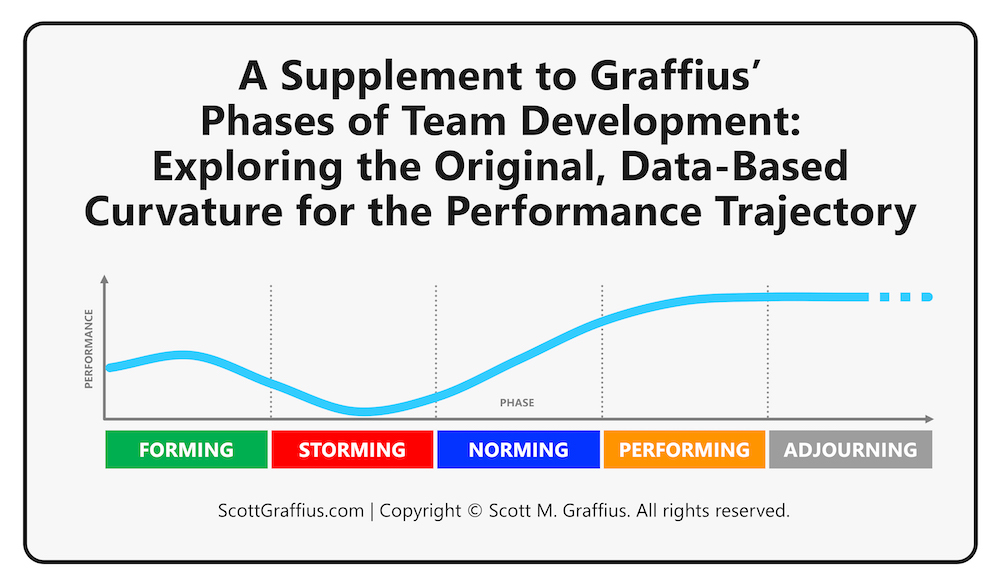
Recommended Citation
Graffius, S. M. (2026, August 14). A Supplement to Graffius' Phases of Team Development: Exploring the Original, Data-Based Curvature for the Performance Trajectory. ScottGraffius.com. https://scottgraffius.com/blog/files/phases-of-team-development-supplement-performance-curve.html
About This Article
Source information and links for materials cited are provided in the References section.
Introduction
Team development is commonly described as a progression through five phases (also called stages): Forming, Storming, Norming, Performing, and Adjourning. Bruce W. Tuckman introduced the first four phases in 1965, and he and Mary Ann C. Jensen added the fifth phase in 1977. Tuckman and Jensen described these phases only in broad, general terms, without codifying specific characteristics, strategies, or a performance graph. Scott M. Graffius is the one who developed and codified what Tuckman and Jensen never did: a detailed, structured set of characteristics for each phase; a corresponding set of strategies for each phase; and an empirically-derived performance graph built from statistical analysis of thousands of data points across hundreds of projects.
Graffius created his "Phases of Team Development" as a unique perspective and visual conveying the five phases of team development—Forming, Storming, Norming, Performing, and Adjourning—inclusive of a graph showing how performance varies by phase, as well as the characteristics and strategies for each phase. Leaders can apply these insights to advance the effectiveness and success of teams. Graffius initially developed his unique material in 2008, and he periodically updates it. In the 2026 edition of his work, for example, he added coverage of human-AI teams.
Businesses, professional associations, government agencies, universities, and publications around the world have used Graffius' "Phases of Team Development." Examples include Adobe, American Management Association, Amsterdam Public Health Research Institute, Bayer, Boston University, Broadcom, Cisco, DevOps Institute, Government of Finland, Hasso-Plattner-Institut für Digital Engineering GmbH, IEEE, Johns Hopkins University, Journal of Neurosurgery, Mary Raum (Professor of National Security Affairs, United States Naval War College), Microsoft, Oracle, Royal Australasian College of Physicians, Technical University of Munich, Torrens University, Tufts University, U.S. National Park Service, U.S. Tennis Association, UC San Diego, UK Sports Institute, University of Galway, University of Waterloo, Warsaw University of Technology, Yale University, and many others.
Focus on the Graph Element
Scott M. Graffius regularly updates his "Phases of Team Development" work. He presents the 2026 edition here, and a visual from it is below.
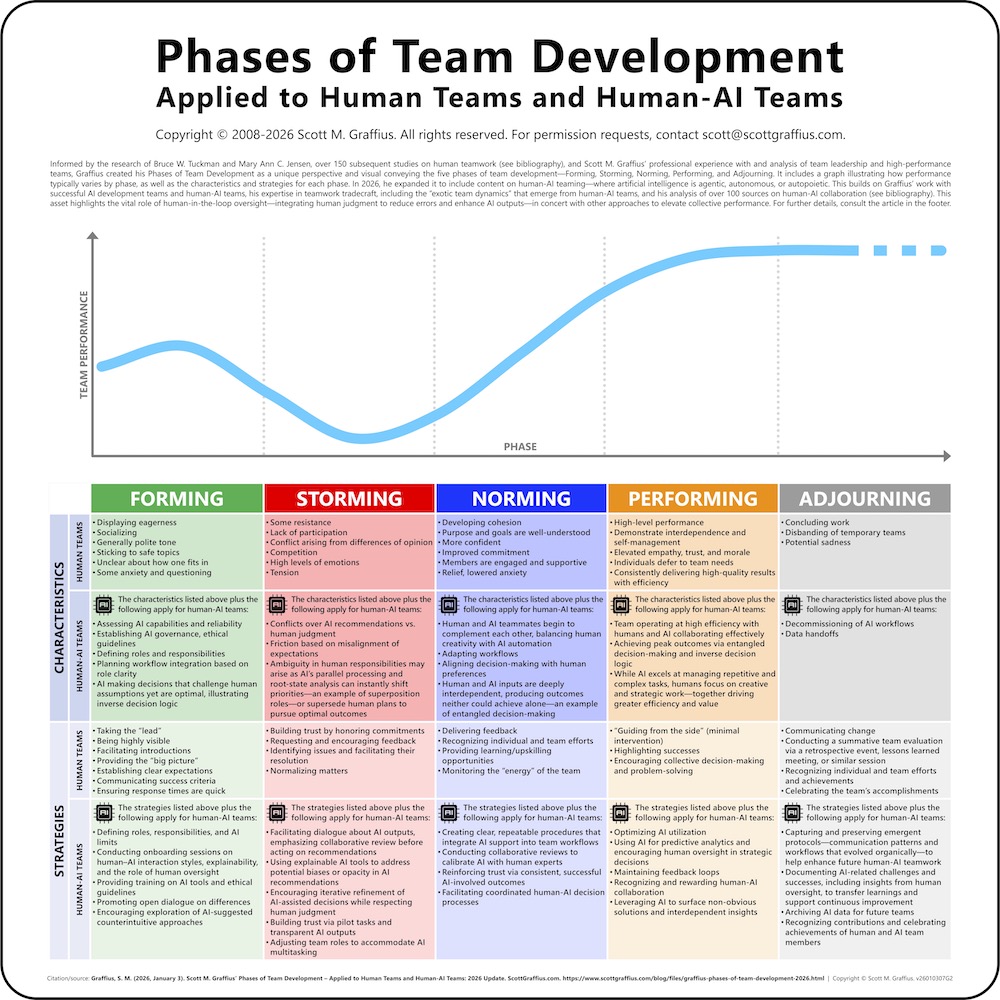
This article focuses primarily on the original, data-based graph element, including its performance trajectory. First is an overview. The graph depicts an initial increase in performance during Forming, followed by a decline during Storming, a broad trough near the Storming-Norming transition, an accelerating recovery during Norming, continued improvement during Performing, and a high-performance plateau extending through Adjourning.
The trajectory is based on thousands of data points collected across hundreds of projects (technical and non-technical, spanning multiple industries/domains) over years of professional practice. Graffius applied statistical tools and professional judgement, informed by decades of direct experience in team leadership and project delivery, to analyze and render the performance pattern across the five phases.
The graph is an original, proprietary, empirically based, statistically informed, expert-finalized model of the relationship between developmental phases and relative team performance. The underlying statistical analysis (including the specific data set, modeling approach, and fitted parameters) is proprietary to Graffius and is not delineated in this piece. What's presented here, however, is the qualitative behavior of the resulting curve (direction and rate of change across phases), which is robust enough to characterize its shape without exposing the confidential details behind it.
What the Graph Depicts
The Relationship
The graph represents the relationship between developmental phases and relative team performance. It may be expressed as:
P = f(D)
where P represents relative team performance (effectiveness or productivity); D represents the team's developmental position across the five phases; and f represents the functional relationship between developmental position and performance.
The relationship is nonlinear. The model shows an initial increase, a subsequent decline associated with Storming, a broad low point around the Storming-Norming transition, a substantial recovery through Norming, continued improvement through Performing, and eventual flattening as the team reaches a mature high-performance state.
The curve communicates level and rate of change.
The vertical position of the curve indicates relative performance at a given developmental position. The slope indicates the direction and approximate rate at which performance is changing. The curvature indicates whether that rate of change is itself increasing or decreasing.
The Axes
The horizontal axis, labeled “PHASE,” represents developmental phase (Forming, Storming, Norming, Performing, and Adjourning) not elapsed time. Phase progression and elapsed time are distinct variables.
The vertical axis, labeled "PERFORMANCE" (also called "TEAM PERFORMANCE"), functions as a proxy for overall team effectiveness and productivity. The vertical dimension is comparative rather than metrically defined. Its design deliberately does not specify a particular measurement instrument or unit. It represents relative performance—comparatively lower or higher performance as the team progresses through its developmental lifecycle.
The Shape of the Curve
The graph features a continuous, nonlinear curve. Several regions can be described in qualitative-calculus terms:
- Early Forming: positive slope, with a modest increase in performance.
- Late Forming: a local maximum is reached.
- Forming-to-Storming transition: the slope turns negative.
- Storming: sustained negative slope and declining performance.
- Storming-to-Norming transition: a broad minimum or trough.
- Early-to-mid Norming: positive slope with an increasing rate of improvement.
- Late Norming into Performing: sustained strong positive slope.
- Mature Performing: positive slope that progressively decreases.
- High-performance plateau: a near-horizontal, asymptotic region representing mature performance.
A Structural Note on D
For the derivative expressions used throughout this piece, D is treated as a continuous developmental-position parameter, with the five named phases corresponding to labeled regions along it.
This allows first- and second-derivative behavior (rate and curvature) to be described within and across phases, while preserving the graph's core premise: D indexes developmental progression, not elapsed time.
Next, each phase is examined in turn.
Forming
The curve enters Forming at a moderate performance level and initially moves upward. In qualitative mathematical terms, this is a region of positive first derivative: performance is increasing. The curve then reaches a small local maximum before changing direction.
Storming
Storming is where the graph undergoes its most pronounced deterioration. After the local maximum in Forming, the curve turns downward—initially moderately and then continuing toward its lowest level.
The negative slope of the curve can be understood as representing a performance cost of developmental friction.
The broad minimum around the Storming-Norming transition is one of the graph's most important structural features. The curve passes through a relatively broad trough.
It is expressed in qualitative derivative terms as:
dP/dD < 0 → dP/dD = 0 → dP/dD > 0
This indicates that performance declines, reaches a point at which the decline stops, and then begins to recover. The trough is the turning point between deterioration and recovery.
Norming
Following the trough, the curve reverses direction and begins a sustained upward trajectory.
Norming is particularly interesting because the curve does more than rise. During much of this region, the rate of improvement itself increases.
It is expressed in qualitative-calculus terms as:
dP/dD > 0
and
d²P/dD² > 0
It means that performance is improving, and the improvement is becoming increasingly pronounced. The result depicts an acceleration in the team's ability to perform.
Consistent with D as a continuous parameter (see A Structural Note on D above), between Norming and Performing lies an inflection point — the position of maximum improvement rate, where d²P/dD² = 0. Before this point, the rate of improvement is itself increasing (Norming); after it, the rate of improvement is still positive but progressively diminishing (Performing). This inflection point marks the moment the team's pace of growth peaks, even though absolute performance keeps climbing well beyond it.
Performing
The upward trajectory continues into Performing, where the team achieves top performance.
dP/dD > 0
and
d²P/dD² < 0
It signifies that performance continues to improve. But the incremental gains become progressively smaller. This is a saturation pattern.
Eventually, the curve becomes nearly horizontal. The plateau represents the practical upper limit of performance.
Adjourning
The graph manifests Adjourning as a transition out of the team's active operating state (rather than as another performance-changing phase). Adjourning represents the termination or transition of the team's developmental lifecycle as a distinct conceptual dimension—team closure.
Conclusion
Team development is commonly described as a progression through five phases. Tuckman introduced the first four phases (Forming, Storming, Norming, and Performing) in 1965, and Tuckman and Jensen added the fifth phase (Adjourning) in 1977. However, the structured phase-specific characteristics, strategies, and performance graph were created, developed, and codified by Scott M. Graffius, who originated and owns the associated intellectual property.
The graph shows the typical trajectory of performance across the phases of team development. The horizontal axis describes developmental position, not time, and the performance axis represents relative performance.
It provides a distinctive model of team development. The graph was informed by thousands of data points collected across hundreds of real-world projects, and expressed through an original analysis and novel illustration by Scott M. Graffius.
To learn more about Graffius' "Phases of Team Development," visit here.
References
Graffius, S. M. (2026, January 3). Scott M. Graffius' Phases of Team Development - Applied to Human Teams and Human-AI Teams: 2026 Update. ScottGraffius.com. https://doi.org/10.13140/RG.2.2.18184.89601
Tuckman, B. W. (1965). Developmental sequence in small groups. Psychological Bulletin, 63(6), 384–399. https://doi.org/10.1037/h0022100
Tuckman, B. W., & Jensen, M. A. C. (1977). Stages of small-group development revisited. Group & Organization Studies, 2(4), 419–427. https://doi.org/10.1177/105960117700200404
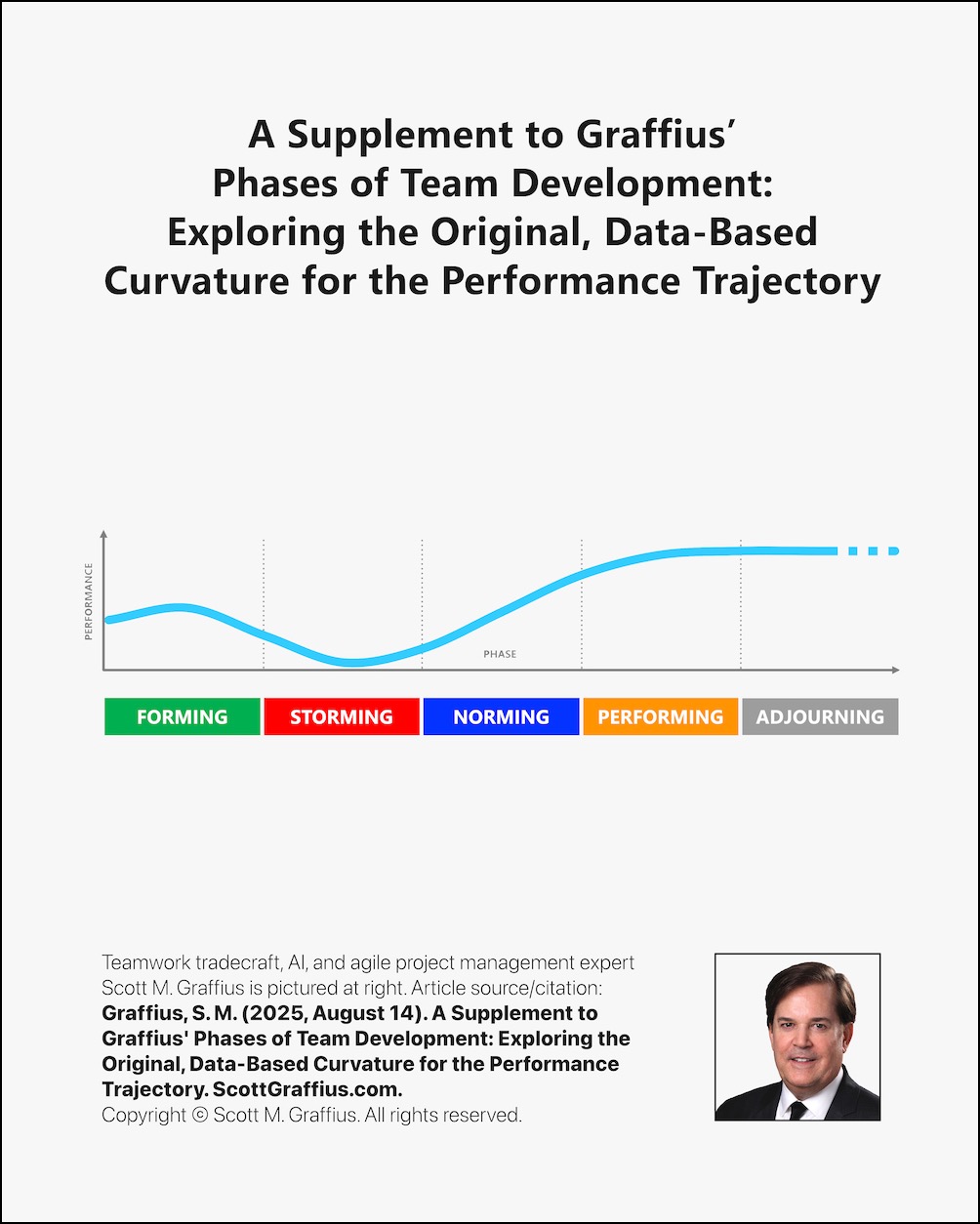
About Scott M. Graffius
Scott M. Graffius is a strategic transformation leader who drives AI, Agile, and broader business and technology initiatives to deliver measurable value across projects, programs, portfolios, and PMOs. He is an expert in the teamwork tradecraft of both human and human-AI teams, including the “exotic team dynamics” that emerge. He is also an authority on the temporal patterns of social media, including the half-life of audience engagement.
He’s a practitioner, researcher, thought leader, award-winning author, and keynote speaker who’s taken the stage at 98 conferences and other events across 25 countries.
He’s delivered over $2.51 billion in value for Fortune 500 companies and other leaders in technology, entertainment, financial services, healthcare, and beyond.
Businesses, professional associations, government agencies, and universities use Graffius and feature his work. Examples include Adobe, Bayer, Boston University, Ford, Gartner, Harvard Medical School, IEEE, Johns Hopkins University, Microsoft, MSN, National Academy of Sciences, Oracle, Pinterest Inc., Project Management Institute, UC San Diego, Verizon, Yale University, and others.
The following sections provide additional information on his experience, contributions, and influence.
Experience
Graffius heads the professional services firm Exceptional PPM and PMO Solutions, along with its subsidiary Exceptional Agility. These consultancies offer strategic and tactical advisory, training, embedded expertise, and consulting services to the public, private, and government sectors. They help organizations enhance their capabilities and results in agile, project management, program management, portfolio management, and PMO leadership, supporting innovation and driving competitive advantage. The consultancies confidently back services with a Delighted Client Guarantee™.
Graffius is a former VP of project management with a publicly traded provider of diverse consumer products and services over the Internet. Before that, he ran and supervised the delivery of projects and programs in public and private organizations with businesses ranging from e-commerce to advanced technology products and services, retail, manufacturing, entertainment, and more.
He has experience with consumer, business, reseller, government, and international markets.
Award-Winning Author
Graffius has authored three books.
- Agile Scrum: Your Quick Start Guide with Step-by-Step Instructions, his first book, earned 17 awards.
- Agile Transformation: A Brief Story of How an Entertainment Company Developed New Capabilities and Unlocked Business Agility to Thrive in an Era of Rapid Change, his second book, was named one of the best Scrum books of all time by BookAuthority.
- Agile Protocol: The Transformation Ultimatum, his third book and his first work of fiction, was released in April 2025. The book trailer is on YouTube.
International Public Speaker
Organizations worldwide engage Graffius to present on tech (including AI), Agile, project management, program management, portfolio management, and PMO leadership. He crafts and delivers unique and compelling talks and workshops. Graffius has conducted 98 sessions across 25 countries. Select examples of events include Agile Trends Gov, BSides (Newcastle Upon Tyne), Conf42 Quantum Computing, DevDays Europe, DevOps Institute, DevOpsDays (Geneva), Frug’Agile, IEEE, Microsoft, Scottish Summit, Scrum Alliance RSG (Nepal), Techstars, and W Love Games International Video Game Development Conference (Helsinki), and more.
With an average rating of 4.81 (on a scale of 1-5), sessions are highly valued.
The speaker engagement request form is here.
Thought Leadership and Influence
Prominent businesses, professional associations, government agencies, and universities have showcased Graffius and his contributions—spanning his books, talks, workshops, and beyond. Select examples include:
- Adobe,
- American Management Association,
- Amsterdam Public Health Research Institute,
- Bayer,
- BMC Software,
- Boston University,
- Broadcom,
- Cisco,
- Coburg University of Applied Sciences and Arts - Germany,
- Computer Weekly,
- Constructor University - Germany,
- Data Governance Success,
- Deimos Aerospace,
- DevOps Institute,
- Dropbox,
- EU's European Commission,
- Ford Motor Company,
- Gartner,
- GoDaddy,
- Harvard Medical School,
- Hasso Plattner Institute - Germany,
- IEEE,
- Innovation Project Management,
- Johns Hopkins University,
- Journal of Neurosurgery,
- Lam Research (Semiconductors),
- Leadership Worthy,
- Life Sciences Trainers and Educators Network,
- London South Bank University,
- Microsoft,
- MSN,
- NASSCOM,
- National Academy of Sciences,
- New Zealand Government,
- Oracle,
- Pinterest Inc.,
- Project Management Institute,
- Mary Raum (Professor of National Security Affairs, United States Naval War College),
- SANS Institute,
- SBG Neumark - Germany,
- Singapore Institute of Technology,
- Torrens University - Australia,
- TBS Switzerland,
- Tufts University,
- UC San Diego,
- UK Sports Institute,
- University of Galway - Ireland,
- US Department of Energy,
- US National Park Service,
- US Soccer,
- US Tennis Association,
- Verizon,
- Wrike,
- Yale University,
- and many others.
Graffius has played a key role in the Project Management Institute (PMI) in developing professional standards. He was a member of multiple teams that authored, reviewed, and produced:
- The Standard for Artificial Intelligence in Portfolio, Program, and Project Management
- Agile Practice Guide – Second Edition
- A Guide to the Project Management Body of Knowledge (PMBOK Guide) – Eighth Edition
- A Guide to the Project Management Body of Knowledge (PMBOK Guide) – Sixth Edition
- The Standard for Program Management – Fourth Edition
- Practice Standard for Work Breakdown Structures – Second Edition
- The Practice Standard for Project Estimating – Second Edition
He was also a subject matter expert reviewer of content for the PMI’s Congress. Beyond the PMI, Graffius also served as a member of the review team for two of the Scrum Alliance’s Global Scrum Gatherings.
Acclaimed Authority on Teamwork Tradecraft
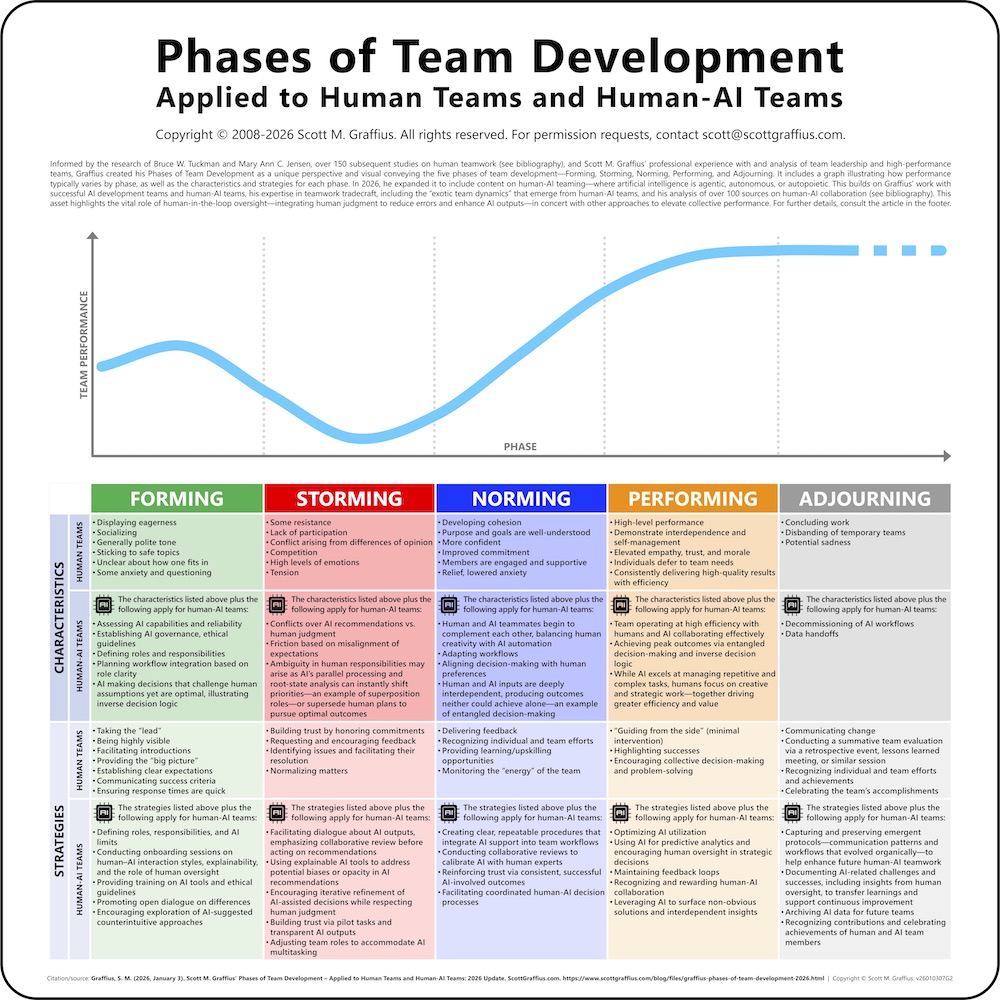
Graffius is a renowned authority on teamwork tradecraft. Informed by the research of Bruce W. Tuckman and Mary Ann C. Jensen, over 150 subsequent studies, and Graffius' first-hand professional experience with, and analysis of, team leadership and performance, Graffius created his "Phases of Team Development" intellectual property as a unique perspective and visual conveying the five phases of team development. First introduced in 2008 and periodically updated, his work provides a diagnostic and strategic guide for navigating team dynamics. It provides actionable insights for leaders across industries to develop high-performance teams. Its adoption by esteemed organizations such as Yale University, IEEE, Cisco, Microsoft, Ford, Oracle, Broadcom, the U.S. National Park Service, and the Journal of Neurosurgery, among others, highlights its utility and value, solidifying its status as an indispensable resource for elevating team performance and driving organizational excellence. In 2026, Graffius added human-AI teamwork—including the "exotic team dynamics" which emerge when advanced AI collaborates as a teammate—to his "Phases of Team Development."
The 2026 edition of Graffius' "Phases of Team Development" intellectual property is here.
Expert on Temporal Dynamics on Social Media Platforms
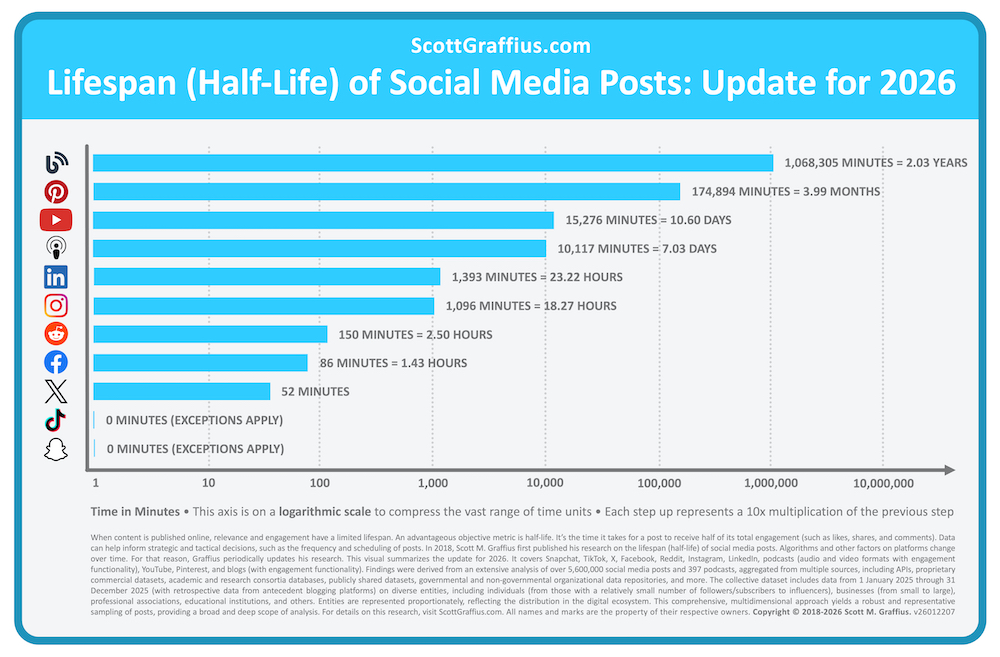
Graffius is also an authority on temporal dynamics on social media platforms. His "Lifespan (Half-Life) of Social Media Posts" research—first published in 2018 and updated annually—delivers a precise quantitative analysis of post longevity across digital platforms, utilizing advanced statistical techniques to determine mean half-life with precision. It establishes a solid empirical base, effectively highlighting the ephemeral nature of content within social media ecosystems. Referenced and applied by leading entities—such as Fast Company, GoDaddy, Journal of Hand Surgery (European Volume), Ministère de la Culture (French Ministry of Culture), Pinterest Inc., PNAS, and Telecommunications Policy, among others—his research exemplifies methodological rigor and sustained significance in the field of digital informatics.
The 2026 edition of Graffius "Lifespan (Half-Life) of Social Media Posts" research is here.
Education and Professional Certifications
Graffius has a bachelor’s degree in psychology with a focus in Human Factors. He holds eight professional certifications:
- Certified SAFe 6 Agilist (SA),
- Certified Scrum Professional - ScrumMaster (CSP-SM),
- Certified Scrum Professional - Product Owner (CSP-PO),
- Certified ScrumMaster (CSM),
- Certified Scrum Product Owner (CSPO),
- Project Management Professional (PMP),
- Lean Six Sigma Green Belt (LSSGB), and
- IT Service Management Foundation (ITIL).
He is an active member of the Scrum Alliance, the Project Management Institute (PMI), and the Institute of Electrical and Electronics Engineers (IEEE).
Advancing AI, Agile, and Project/PMO Management
Scott M. Graffius continues to advance the fields of AI, Agile, and Project/PMO Management through his leadership, research, writing, and real-world impact. Businesses and other organizations leverage Graffius’ insights to drive their success.
Discover Scott’s Books
- Agile Scrum: Your Quick Start Guide with Step-by-Step Instructions — Deliver Products in Short Cycles with Rapid Adaptation to Change, Fast Time-to-Market, and Continuous Improvement
- Agile Transformation: A Brief Story of How an Entertainment Company Developed New Capabilities and Unlocked Business Agility to Thrive in an Era of Rapid Change
- Agile Protocol: The Transformation Ultimatum
Connect with and follow Scott on LinkedIn, X, YouTube, Facebook, Threads, Bluesky, Mastodon, and ResearchGate.


Sign up for Miro—it's free!
(Want more features? You can always upgrade to a paid plan.)

List of Additional Articles
You may be interested in these stories.
Government of Canada Features Research by Scott M. Graffius
"Strategic Business Research" Journal Cites Work of Scott M. Graffius
IEEE Access Publication Features Scott M. Graffius’ Research on the Half-Life of Social Media
The Agile Coach: 2026 Edition
Scott M. Graffius’ Work Cited in International Peer-Reviewed Journal on Digital Transformation
Phases of Team Development in Elite Sport
A Critical Analysis of COVID-19 Treatment Search Trends and Media Coverage Study Citing Scott M. Graffius' Work
Human-AI Teamwork: Master the Exotic Team Dynamics That Emerge When Collaborating with Advanced AI -- Or Be Outplayed
"Agile Scrum" by Scott M. Graffius Now Featured on Grokipedia
UNSW Aerospace Engineering Course Features Scott M. Graffius' "Phases of Team Development"
Thinkers360 Honors Scott M. Graffius as a 2026 Top Agile Thought Leader
Agile's Journey Through the Decades: Update for 2026
BMC Software Features Content from Scott M. Graffius' Book
Peer-Reviewed Journal Cited Work of Scott M. Graffius
University of Waterloo Features Graffius' "Phases of Team Development" in Course Materials
Perplexity Standalone Article on AI Hallucinations Cites Research by Scott M. Graffius
Handling the Saboteur Within: Lessons from a 3-Letter Agency on Spotting and Stopping Intentional and Unintentional Sabotage
A Deep Dive Into the Typical Engagement Pattern for Social Media Posts
Most Valuable IT Certifications: Update for 2026
"Marketing in the Metaverse" Spotlights Scott M. Graffius’ Research on the Half-Life of Social Media
University of Greenwich Features Graffius' Phases of Team Development
10 Essential Agile Books: Curated Recommendations for Agile Professionals
Lifespan (Half-Life) of Social Media Posts: Update for 2026
Scott M. Graffius' Research on the Half-Life of Social Media was Cited in a Peer-Reviewed Study Published in Telecommunications Policy, a Leading Academic Journal
Are AI Hallucinations Getting Better or Worse? We Analyzed the Data
Scott M. Graffius' Phases of Team Development - Applied to Human Teams and Human-AI Teams: 2026 Update
Lessons from Yesterday’s Tomorrowland
Scott M. Graffius’ Update to His "Phases of Team Development” Coming Early 2026
A Data-Driven Analysis of the Evolution of Project Management: Tasks, Trends, and AI
Actionable Insights. Global Impact. Scott M. Graffius.
Beep Beep! Why Wile E. Coyote Is the Patron Saint of AI Failure
Social Media Half-Life Research Cited in Prestigious Peer-Reviewed Medical Journal
Navigating the Spectrum of Advanced AI – Agentic, Autonomous, and Autopoietic
Lessons from Unhinged AI in Fiction: What Rogue AIs in Sci-Fi Storytelling, Films, and TV Shows Reveal About Us
Scott M. Graffius Contributed to and Reviewed the PMBOK Guide, 8th Edition — the Global Standard for Project Management
UK Sports Institute Features Teamwork and Leadership Work of Scott M. Graffius
Definitions of Advanced AIs: Agentic, Autonomous, and Autopoietic
HAN University of Applied Sciences Features the Work of Scott M. Graffius
Gifts That Inspire Joy
Evergreen Echoes: How Pinterest Inc. and Pinterest Japan Spotlighted Scott M. Graffius’ Research on the Half-Life of Social Media Content
Scott M. Graffius’ Team Development Work Lights Up the University of Tasmania’s Curriculum
Taiwan’s Leading Outlet for Technology and Innovation Spotlights Graffius’ Research on Social Media Temporal Dynamics
Scott M. Graffius’ Insights on AI, Agile, Gaming, XR, and Defense Transformation Cited by MSN in Their Coverage of Innovation and Leadership in the Sector
Top Predictions of 2024, Tested in 2025
Government of Finland Agency Features Graffius' Phases of Team Development IP
Scott M. Graffius Premieres His New "Exotic Team Dynamics: Human-AI Collaboration" Talk at Corporate Event in Las Vegas
Environmental Science Journal References Scott M. Graffius’ Project Management Work
AI Institute of Switzerland Features Scott M. Graffius’ Work on Algorithms
Exotic Team Dynamics: The New Frontier of Human–AI Collaboration
Scott M. Graffius’ Work Featured at ACM DIS ’25
Climbing the Ladder: The Head of Agile/PMO’s Organizational Proximity to the CEO is Closer Than Ever
Harness Sci-Fi and Speculative Design While Embracing Imperfection to Drive Innovation and Proactively Predict and Prepare for the Future
Scott M. Graffius’ “Agile Scrum” Book Featured in a Publication of the Associação Nacional de Educação Católica do Brasil (ANEC)
Setting Direction with OKRs and Tracking Progress with KPIs: A Guide for Agile, Project Management, and Tech Teams
AI Showcase Showdown: Ranking AI Accuracy on Project Management Basics
BookAuthority Features “Agile Scrum” by Scott M. Graffius in “10 Agile Software Development Books That Define the Field”
Exploring Team Dynamics, Adaptability, and Creative Problem-Solving Through Felix the Cat’s Metaphorical Toolkit
Mind Games and Master Plans: How PsyOps Exploit Psychological Phenomena
The “Pants-on-Fire Index for AI”
16 Causes of Technical Debt and How to Avoid It
PMI’s Infinity AI Gets the Basics of Team Development Alarmingly and Repeatedly Wrong
Agile for Unicorns: 7 Keys to Thrive; Scott M. Graffius’ Workshop
Scott M. Graffius’ “Agile Scrum: Your Quick Start Guide with Step-by-Step Instructions” Featured in Prestigious National Academies of Sciences Publication
Meta and Anduril’s EagleEye and the Future of XR: How Gaming, AI, and Agile Are Transforming Defense
"Agile Protocol" and the Power of Satire, Parody, and Humor
AI in Agile: Benefits, Risks, Outlook
Hostinger Highlights Scott M. Graffius’ “Agile Protocol” Book in Feature on Software Projects
French Ministry of Culture Links to Scott M. Graffius Research in Their Guide for Responsible Digital Communication
National Science Foundation’s LTER Network Features Scott M. Graffius’ Phases of Team Development IP
Waterfall vs. Agile: What’s Fixed, What’s Flexible, and Why It Matters
Scott M. Graffius Delivering $2.3 Billion in Value Through AI, Agile, and Project/PMO Leadership
The Problem with Heroes in Agile
The 3 Vital Rules of Science: What They Are and Why They Matter
“Agile Protocol: The Transformation Ultimatum” Lands on the Amazon Best Sellers List!
Scott M. Graffius Recognized as a Top Thought Leader in Digital Disruption by Thinkers360
“Agile Protocol: The Transformation Ultimatum” by Scott M. Graffius Crashes the Book Scene with Satirical Firepower
NCKU in Taiwan Integrates Graffius' 'Phases of Team Development' into Its Curriculum
The Art and Science of Aligning Initiatives with Strategic Objectives
RGPV University Adds Scott M. Graffius’ "Agile Scrum: Your Quick Start Guide with Step-by-Step Instructions" to Its Syllabus
Introducing ‘Engage or Fade: Decoding the Half-Life of Digital Resonance’ – A New Talk by Scott M. Graffius
Dropbox Company (Nira) Taps into Scott M. Graffius’ Expertise in Strategic Planning
Reporting Errors in a Publication: A Case Study on ‘Frontiers in Public Health’
NESEA Conference Session on Innovation Highlights Scott M. Graffius' 'Phases of Team Development'
U.S. Soccer Scores with Scott M. Graffius' Intellectual Property on Teamwork
U.S. Department of Commerce Partner (IEDC) Features Scott M. Graffius’ Intellectual Property
How Long Do Your Posts Live? AI Critiques Scott M. Graffius’ Research on the Half-Life of Social Media
Agile's Journey Through the Decades
Scott M. Graffius' Role in Advancing Project Management Institute (PMI) Standards Excellence
Most Valuable IT Certifications: Update for 2025
The PMI + Agile Alliance Merger: A Recipe for Success?
When Agile, AI, and Strategic Thinking Converge
Scott M. Graffius’ Phases of Team Development: 2025 Update
Lifespan (Half-Life) of Social Media Posts: Update for 2025
Verizon Features Scott M. Graffius
Do Not Read This Article! An Exploration of the Streisand Effect and Other Phenomena
Scott M. Graffius' 'Phases of Team Development' was Spotlighted in Journal of Neurosurgery
Pinterest Japan Uses Graffius’ Research on Temporal Dynamics on Social Media Platforms
Hochschule Coburg (Coburg University) Germany Uses Scott M. Graffius’ Phases of Team Development IP in Coursework on Agile Development
Wild World of Team Dynamics [Updated Two-Minute Video]
EU Europass Teacher Academy Features Scott M. Graffius’ ‘Phases of Team Development’ in Leadership Training
Side-by-Side Comparison of Retrospectives and Hot Washes
Constructor University 2024 Advanced Software Technology Handbook References Scott M. Graffius' Work on Team Dynamics
Strategies for Medical Team Success Featured Scott M. Graffius’ ‘Phases of Team Development’ Intellectual Property
SBG Neumark — Europe’s Largest Distribution Transformer Plant — Powers Up with Scott M. Graffius’ Intellectual Property
Scott M. Graffius’ Intellectual Property was Employed by the NHS — the Largest Single-Payer Healthcare System in Europe
Luxury Unwrapped: The Ultimate Holiday Gift Guide for Every Budget
Singapore Institute of Technology Features Work of Scott M. Graffius
Tufts University Features Scott M. Graffius 'Phases of Team Development' Intellectual Property
'Cat Herders': Retelling the Massive Success Story
Pennsylvania State Agency Used Scott M. Graffius' Intellectual Property
Copyright Infringement in a Book Published by AuthorHouse / Author Solutions / The Najafi Companies: Publisher Fails to Respond or Take Required Action
Pinterest Inc. References Scott M. Graffius’ Research
Bournemouth University Used Scott M. Graffius’ Intellectual Property
‘Comparative Methodological Guidelines: Handbook for Educators’ Violates Scott M. Graffius’ Copyright
Japan Backlog User Group Event Featured Scott M. Graffius’ ‘Phases of Team Development’
TurningWest's 'Trial'
Radio Silence from the American Association of Neurological Surgeons on Report of Blatant Plagiarism in Their ‘Journal of Neurosurgery’ Publication
Supplement to Graffius' 'Lifespan (Half-Life) of Social Media Posts' Research: Typical Engagement Distribution Pattern for Social Media Posts
How Algorithms Shape the User Experience on Social Media Platforms
Thinkers360 Named Scott M. Graffius a Top Thought Leader on Agile
More articles are listed here.

How to Cite This Article
Graffius, S. M. (2026, August 14). A Supplement to Graffius' Phases of Team Development: Exploring the Original, Data-Based Curvature for the Performance Trajectory. ScottGraffius.com. https://scottgraffius.com/blog/files/phases-of-team-development-supplement-performance-curve.html

Digital Object Identifier (DOI)
Coming soon

Content Acknowledgements
Names, marks, and content are the property of their respective owners.

Tags and Hashtags
- Project Management
- Leadership
- Team Performance
- Bruce Tuckman
- Organizational Development
- Group Dynamics
- Performance Trajectory
- Empirical Team Models
- Developmental Phases of Teams
- Human-AI Teams
- Phases of Team Development
- Forming, Storming, Norming, Performing, Adjourning
- #TeamDevelopment
- #ProjectManagement
- #Leadership
- #TeamPerformance
- #BruceTuckman
- #OrganizationalDevelopment
- #GroupDynamics
- #PerformanceTrajectory
- #EmpiricalTeamModels
- #TeamDevelopmentPhases
- #HumanAITeams
- #PhasesOfTeamDevelopment
- #FSNPA

Post-Publication Notes
If there are any supplements or updates to this article after the date of publication, they will appear here.

Copyright
Copyright © Scott M. Graffius. All rights reserved.
Content on this site—including text, images, videos, and data—may not be used for training or input into any artificial intelligence, machine learning, or automatized learning systems, or published, broadcast, rewritten, or redistributed without the express written permission of Scott M. Graffius.