
Use the Phases of Team Development (Based on Bruce W. Tuckman's Model of Forming, Storming, Norming, Performing, and Adjourning) to Help Teams Grow and Advance: 2022 Update
14 February 2022
BY SCOTT M. GRAFFIUS | ScottGraffius.com
A NEWER VERSION OF THIS ARTICLE IS AVAILABLE HERE: https://scottgraffius.com/blog/files/graffius-phases-of-team-development-2026.html

2022 Update
Want happier and more productive teams? Among other things, it takes great leadership. And proven strategies can provide a real edge! That’s where the groundbreaking work by Bruce W. Tuckman — Ph.D. in Psychology from Princeton — comes in.
Tuckman conducted extensive research on group dynamics, and he published a related model in 1965. At that time, the model included four phases: forming, storming, norming, and performing. However, Dr. Tuckman subsequently determined that adjourning was so important that he, with Mary Ann Jensen, updated his model in 1977 to add adjourning as the fifth phase. According to Tuckman, all five phases — Forming, Storming, Norming, Performing, and Adjourning — are necessary for teams to grow, tackle problems, find solutions, plan work, and deliver results.
Tuckman’s model has stood the test of time because it remains highly relevant and beneficial. Since his work was published, it has been supported by additional peer-reviewed research. And it has received recommendations and coverage from leading organizations including Google, Harvard Business Review, IEEE, MIT, Fast Company, NASA, Microsoft, TNW, Project Management Institute, Scrum Alliance, Scrum.org, Gartner, CIO, RAND Corporation, Software Engineering Institute, University of Edinburgh, Cisco, KPMG, Warsaw University of Technology, Software Engineering Institute, DevOps Institute, American Express, SANS Institute, Zurich University, SAP, ViacomCBS, Oxford University, American Management Association, AT&T, University of Southern California, IBM, and many others.
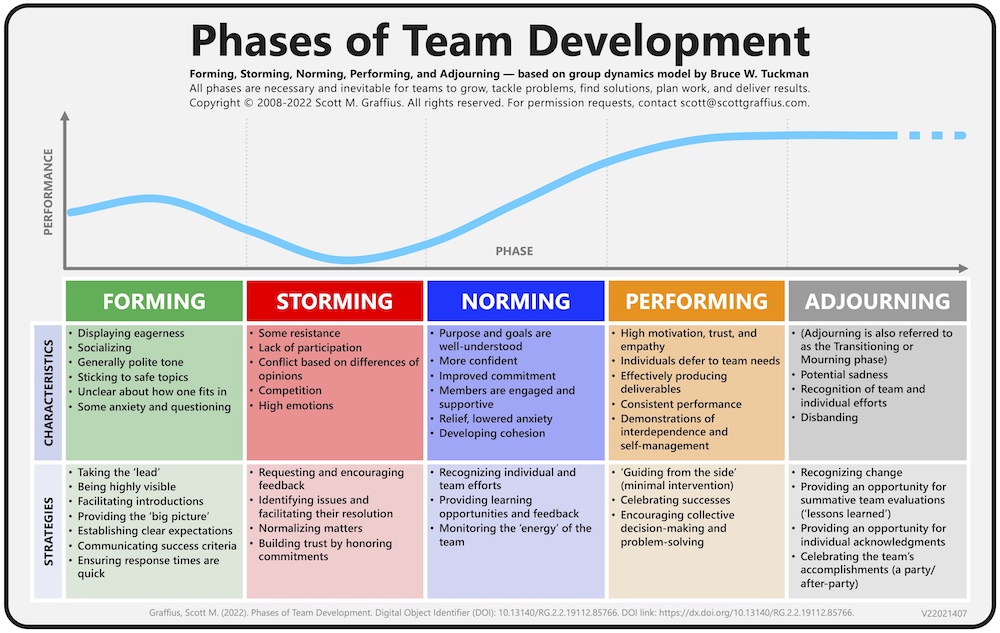
Agile project management practitioner, consultant, award-winning author, international speaker, thought leader, and influencer Scott M. Graffius developed a related custom illustration, Phases of Team Development. It highlights the performance level, characteristics, and proven strategies for each of the five phases. Project Managers, Scrum Masters, Agile Coaches, DevOps Leads, and other professionals can apply the information to help handle challenges or issues experienced by teams. By doing so, they’ll advance the teams' happiness, productivity, and success.
Graffius updates the content periodically. He released an updated version of the visual on February 14, 2022. This article features the newest version of the Phases of Team Development illustration. Read on for details including information on permission requests and downloadable high-resolution versions of the image.

Five Phases of Team Development
1. Forming
Characteristics of Forming include displaying eagerness, socializing, generally polite tone, sticking to safe topics, unclear about how one fits in, and some anxiety and questioning.
Strategies for this phase include taking the ‘lead,’ being highly visible, facilitating introductions, providing the ‘big picture,’ establishing clear expectations, communicating success criteria, and ensuring response times are quick.
2. Storming
Traits of Storming include some resistance, lack of participation, conflict based on differences of opinions, competition, and high emotions.
Strategies for this phase include requesting and encouraging feedback, identifying issues and facilitating their resolution, normalizing matters, and building trust by honoring commitments.
3. Norming
Features of Norming include purpose and goals are well-understood, more confident, improved commitment, members are engaged and supportive, relief (lowered anxiety), and developing cohesion.
Strategies for this phase include recognizing individual and team efforts, providing learning opportunities and feedback, and monitoring the ‘energy’ of the team.
4. Performing
Characteristics of Performing include high motivation, trust, and empathy; individuals defer to team needs; effectively producing deliverables; consistent performance; and demonstrations of interdependence and self-management.
Strategies for this phase include ‘guiding from the side’ (minimal intervention), celebrating successes, and encouraging collective decision-making and problem-solving.
5. Adjourning
Typical traits of Adjourning (also referred to as Transitioning or Mourning) include potential sadness, recognition of team and individual efforts, and disbanding.
Strategies for this phase include recognizing change, providing an opportunity for summative team evaluations ('lessons learned'), providing an opportunity for individual acknowledgments, and celebrating the team’s accomplishments — which may involve a party and possibly an after-party.

As shown, performance fluctuates as teams move through the phases. Review the characteristics to help identify the team's current phase, then apply the corresponding proven strategies to help them advance.

© Copyright 2022 Scott M. Graffius. All rights reserved. This material may not be published, broadcast, rewritten or redistributed without the express written permission of Scott M. Graffius.

A NEWER VERSION OF THIS ARTICLE IS AVAILABLE HERE: https://scottgraffius.com/blog/files/graffius-phases-of-team-development-2026.html
2022 Update
Want happier and more productive teams? Among other things, it takes great leadership. And proven strategies can provide a real edge! That’s where the groundbreaking work by Bruce W. Tuckman — Ph.D. in Psychology from Princeton — comes in.
Tuckman conducted extensive research on group dynamics, and he published a related model in 1965. At that time, the model included four phases: forming, storming, norming, and performing. However, Dr. Tuckman subsequently determined that adjourning was so important that he, with Mary Ann Jensen, updated his model in 1977 to add adjourning as the fifth phase. According to Tuckman, all five phases — Forming, Storming, Norming, Performing, and Adjourning — are necessary for teams to grow, tackle problems, find solutions, plan work, and deliver results.
Tuckman’s model has stood the test of time because it remains highly relevant and beneficial. Since his work was published, it has been supported by additional peer-reviewed research. And it has received recommendations and coverage from leading organizations including Google, Harvard Business Review, IEEE, MIT, Fast Company, NASA, Microsoft, TNW, Project Management Institute, Scrum Alliance, Scrum.org, Gartner, CIO, RAND Corporation, Software Engineering Institute, University of Edinburgh, Cisco, KPMG, Warsaw University of Technology, Software Engineering Institute, DevOps Institute, American Express, SANS Institute, Zurich University, SAP, ViacomCBS, Oxford University, American Management Association, AT&T, University of Southern California, IBM, and many others.
Agile project management practitioner, consultant, award-winning author, international speaker, thought leader, and influencer Scott M. Graffius developed a related custom illustration, Phases of Team Development. It highlights the performance level, characteristics, and proven strategies for each of the five phases. Project Managers, Scrum Masters, Agile Coaches, DevOps Leads, and other professionals can apply the information to help handle challenges or issues experienced by teams. By doing so, they’ll advance the teams' happiness, productivity, and success.
Graffius updates the content periodically. He released an updated version of the visual on February 14, 2022. This article features the newest version of the Phases of Team Development illustration. Read on for details including information on permission requests and downloadable high-resolution versions of the image.
Five Phases of Team Development
1. Forming
Characteristics of Forming include displaying eagerness, socializing, generally polite tone, sticking to safe topics, unclear about how one fits in, and some anxiety and questioning.
Strategies for this phase include taking the ‘lead,’ being highly visible, facilitating introductions, providing the ‘big picture,’ establishing clear expectations, communicating success criteria, and ensuring response times are quick.
2. Storming
Traits of Storming include some resistance, lack of participation, conflict based on differences of opinions, competition, and high emotions.
Strategies for this phase include requesting and encouraging feedback, identifying issues and facilitating their resolution, normalizing matters, and building trust by honoring commitments.
3. Norming
Features of Norming include purpose and goals are well-understood, more confident, improved commitment, members are engaged and supportive, relief (lowered anxiety), and developing cohesion.
Strategies for this phase include recognizing individual and team efforts, providing learning opportunities and feedback, and monitoring the ‘energy’ of the team.
4. Performing
Characteristics of Performing include high motivation, trust, and empathy; individuals defer to team needs; effectively producing deliverables; consistent performance; and demonstrations of interdependence and self-management.
Strategies for this phase include ‘guiding from the side’ (minimal intervention), celebrating successes, and encouraging collective decision-making and problem-solving.
5. Adjourning
Typical traits of Adjourning (also referred to as Transitioning or Mourning) include potential sadness, recognition of team and individual efforts, and disbanding.
Strategies for this phase include recognizing change, providing an opportunity for summative team evaluations ('lessons learned'), providing an opportunity for individual acknowledgments, and celebrating the team’s accomplishments — which may involve a party and possibly an after-party.
As shown, performance fluctuates as teams move through the phases. Review the characteristics to help identify the team's current phase, then apply the corresponding proven strategies to help them advance.
© Copyright 2022 Scott M. Graffius. All rights reserved. This material may not be published, broadcast, rewritten or redistributed without the express written permission of Scott M. Graffius.