
#Adjourning
A Certification/Training Company Stole Scott M. Graffius' Copyrighted Property and Used It Word-For-Word: This Scandal is a Big "Dumpster Fire"
25 June 2024


Including supporting information, this article is organized into nine sections:
- Introduction
- Overview of Graffius' Copyrighted 'Phases of Team Development' Property
- CertiProf Violated of Graffius' Intellectual Property Rights — CertiProf Infringed on Graffius' Copyright
- Conclusion
- About Scott M. Graffius
- About Copyright and Other IP Rights
- References/Sources
- Attributions and Other Notes
- How to Cite This Article


Introduction

It's important to be optimistic and focus on a bright future. However, we must also take a stand against those who commit evil acts, such as the violation of intellectual property rights. Copyright infringement, in particular, is a deplorable act of intellectual theft that displays a blatant disregard for professionalism, morality, ethics, and the law. It undermines the hard work and innovation of others and is a shameful, unprofessional, dishonest, immoral, unethical, and illegal practice. Those who engage in copyright infringement should be identified and held accountable for their actions. Taking a stand against those who commit evil acts helps ensure that justice is served and that others are protected from harm.
IP rights are so important that IP theft is a federal crime.
Scott M. Graffius maintains, enforces, and protects his copyrights and other IP rights. When others infringe on Graffius’ IP rights, situations generally fall into one of two categories:
- IP owner Graffius notifies the offending party of their infringement and the required remediation, and the matter is resolved; or
- IP owner Graffius notifies the offending party of their infringement and the required remediation, and the offending party’s action or inaction necessitates that qualified attorney and/or a U.S. agency is engaged, and the matter is resolved.
Most situations fall under category 1. However, some offending parties seem determined to make an already bad situation worst; they fall under category 2.
This article covers the news that certification/training company CertiProf violated Scott M. Graffius’ intellectual property rights by misusing his ‘Phases of Team Development’ copyrighted 2018 property.
- CertiProf did not request nor receive permission to use Graffius’ IP.
- CertiProf used effectively all of Graffius’ respective IP.
- CertiProf used Graffius’ IP word-for-word.
- CertiProf used Graffius’ IP commercially — in its certification/training program, for its own financial benefit.
- CertiProf did not quote or attribute the work to Graffius, thereby falsely leading readers to believe that it was the author and owner of Graffius’ IP.
For those reasons, CertiProf violated Graffius’ IP rights. Specifically, CertiProf infringed on Graffius’ copyright; CertiProf’s use was not ‘fair use’ — not even close!
Copyright infringement is a deplorable act of intellectual theft, displaying a flagrant disregard for professionalism, morality, ethics, and the law. It undermines the hard work and innovation of others and is a disgraceful, unprofessional, dishonest, immoral, unethical, and illegal practice.
Ensuring the integrity of intellectual property is paramount. Graffius is resolute in protecting and enforcing his copyrights and other IP rights.
This article presents facts — including visuals and additional evidence — and a critical analysis of this serious category 2 situation. It also covers the serious, multiple cases against CertiProf.


Overview of Graffius' Copyrighted 'Phases of Team Development' Property
Informed by the research of Bruce W. Tuckman, Ph.D. and Mary Ann C. Jensen, over 100 subsequent studies, and Scott M. Graffius’ first-hand professional experience with, and analysis of, team leadership and performance, Graffius created his ‘Phases of Team Development.’ It’s a unique perspective on the five phases of team development — Forming, Storming, Norming, Performing, and Adjourning — and it’s inclusive of the characteristics/features/traits and strategies (based on data, and crafted in ‘plain English’ for optimal clarity and utility) for each phase.
The body of Graffius’ ‘Phases of Team Development’ article has text in typical — not bullet point — format. That content (typical format text from Graffius’ copyrighted article) was infringed upon by CertiProf.
(For reference only, Graffius’ same article includes a visual which incorporates a graph showing how performance varies by phase, as well as the characteristics/features/traits and strategies for each phase. The visual has text in bullet-point format. Again, the body of the article has text in typical — not bullet point — format; that typical format text was infringed upon by CertiProf.)
Graffius’ ‘Phases of Team Development’ IP is registered with the United States Copyright Office.
He initially developed his material in 2008, and he periodically refreshes it. An authorized respective example of his IP (2018 version) is here: https://www.scottgraffius.com/blog/files/Using-Bruce-Tuckmans-Phases-of-Team-Development.html and other locations. It is shown below as well.
The relevant (2018) version of Graffius’ copyrighted ‘Phases of Team Development’ is at the preceding link. He promoted his 2018 work via LinkedIn at https://www.linkedin.com/posts/scottgraffius_team-teamdevelopment-teamdynamics-activity-6567890493282361345-vrWP/ and other social media platforms.
(For reference only, the most current [2024] edition of Graffius' ‘Phases of Team Development’ is here: https://www.scottgraffius.com/blog/files/teams-2024.html.)
Here’s a macro/wide view of Graffius' copyrighted 2018 'Phases of Team Development.'

Here’s a zoomed-in view of Graffius' copyrighted 2018 'Phases of Team Development,' showing the relevant text.

Here’s a zoomed-in view of Graffius' copyrighted 2018 'Phases of Team Development,' showing his copyright statement.

As shown above, Graffius' copyright ownership details are clearly noted. Specifically: “© Copyright 2018 Scott M. Graffius. All rights reserved. This material may not be published, broadcast, rewritten or redistributed without the express written permission of Scott M. Graffius.”

Conference organizers, businesses, professional organizations, government agencies, and universities around the world engage Graffius to deliver compelling talks and workshops. To date, he’s presented sessions at 91 conferences and other events across 25 countries, including Armenia, Australia, Brazil, Canada, Czech Republic, Finland, France, Germany, Greece, Hong Kong, Hungary, India, Ireland, Lithuania, Luxembourg, Nepal, Netherlands, New Zealand, Norway, Romania, Sweden, Switzerland, United Arab Emirates, United Kingdom, and the United States. His ‘Phases of Team Development’ IP is central and key to many of those sessions. His rate card and a listing of his engagements are at https://scottgraffius.com/resources/Exceptional-PPM-and-PMO-Solutions-Rate-Card-for-2023-2024-v23110907.pdf and https://scottgraffius.com/publicspeaker.html, respectively.
With an authorization/license from Graffius, many organizations have featured and used his ‘Phases of Team Development’ IP. Select examples include:
- Adobe,
- American Management Association,
- Amsterdam Public Health Research Institute,
- Bayer,
- Boston University,
- Cisco,
- Deimos Aerospace,
- DevOps Institute,
- Ford Motor Company,
- GitHub,
- Hasso Plattner Institute Germany,
- IEEE,
- Life Sciences Trainers & Educators Network (LTEN),
- London South Bank University,
- Microsoft,
- New Zealand Government,
- Torrens University Australia,
- UC San Diego,
- TBS Switzerland,
- UK Sports Institute,
- University of Galway Ireland,
- University of Waterloo Canada,
- U.S. Army,
- U.S. National Park Service,
- U.S. Tennis Association,
- Verizon,
- Virginia Tech,
- Yale University,
- and many others.


CertiProf Violated Graffius' Intellectual Property Rights — CertiProf Infringed on Graffius' Copyright
CertiProf’s website at https://certiprof.com/pages/about-us asserts that: “Through deep partnerships and a steadfast dedication to listening to our community, CertiProf has been enhancing professional lives since 2015.” And CertiProf reports at https://certiprof.com/ that it has “Strategic Alliances” with four organizations: IT Certification Council (ITCC), Agile Alliance, American National Standards Institute (ANSI), and Credly by Pearson.
CertiProf shows at https://certiprof.com/blogs/news/certiprof-launches-agile-leader-certification-to-help-develop-agile-leadership-skills that “CertiProf launches Agile Leader certification to help develop agile leadership skills” on May 22, 2023. CertiProf indicates at https://certiprof.com/collections/agile/products/agile-leader-professional-certification-alpc that the Agile Leader training/certification product costs $150.00 and that it includes “Student Material in PDF Format.”
CertiProf did not request nor receive permission to use Graffius’ IP. Nevertheless, CertiProf included Graffius' 2018 IP in its 2023 respective student material for Agile Leader. And CertiProf used effectively all of Graffius’ respective IP. And CertiProf used Graffius’ IP word-for-word. And CertiProf used Graffius’ IP commercially — in its certification/training program, for its own financial benefit. And CertiProf did not quote or attribute the work to Graffius, thereby falsely leading readers to believe that it was the author and owner of Graffius’ IP. For those reasons, CertiProf violated Graffius’ IP rights. Specifically, CertiProf infringed on Graffius’ copyright; CertiProf’s use was not ‘fair use.’
Evidence is archived and shown below. (Also see the 'Attributions and Other Notes' section. It's located towards the end of the article.)
For reference, here’s the cover image to CertiProf’s infringing 2023 publication.

Here’s page 63 of CertiProf’s infringing 2023 publication.

Here’s a zoomed-in view of page 63 of CertiProf’s infringing 2023 publication.

Here’s a view showing Graffius’ copyrighted 2018 content on Forming, and CertiProf’s 2023 infringement of Graffius’ copyrighted content on Forming.

Here’s a view showing Graffius’ copyrighted 2018 content on Storming, and CertiProf’s 2023 infringement of Graffius’ copyrighted content on Storming.

Here’s a view showing Graffius’ copyrighted 2018 content on Norming, and CertiProf’s 2023 infringement of Graffius’ copyrighted content on Norming.

Here’s a view showing Graffius’ 2018 copyrighted content on Performing, and CertiProf’s 2023 infringement of Graffius’ copyrighted content on Performing.

Here’s a view showing Graffius’ copyrighted 2018 content on Adjourning, and CertiProf’s 2023 infringement of Graffius’ copyrighted content on Adjourning.

CertiProf’s infringement of Graffius' copyright is also delineated next.
🟢 From Graffius' copyrighted 2018 'Phases of Team Development' IP, here’s his content on the characteristics of Forming:
“Characteristics of Forming include questioning, socializing, displaying eagerness, focusing on group identity and purpose, and sticking to safe topics.”
🔴 This is an example of CertiProf violating the copyright of Graffius' 2018 'Phases of Team Development' IP. CertiProf has the following infringing content on the characteristics of Forming in their 2023 Agile Leader publication:
“Characteristics of Forming include questioning, socializing, displaying eagerness, focusing on group identity and purpose, and sticking to safe topics.”
🟢 From Graffius' copyrighted 2018 'Phases of Team Development' IP, here’s his content on strategies for Forming:
“Strategies for this phase include taking the 'lead,' providing clear expectations and consistent instructions, and quick response times.”
🔴 This is another example of CertiProf violating the copyright of Graffius' 2018 'Phases of Team Development' IP. CertiProf has the following infringing content on strategies for Forming in their 2023 Agile Leader publication:
“Strategies for this phase include taking the 'lead,' providing clear expectations and consistent instructions, and quick response times.”
🟢 From Graffius' copyrighted 2018 'Phases of Team Development' IP, here’s his content on the traits of Storming:
“Traits of Storming include resistance, lack of participation, conflict, competition, high emotions, and moving towards group norms.”
🔴 This is another example of CertiProf violating the copyright of Graffius' 2018 'Phases of Team Development' IP. CertiProf has the following infringing content on the traits of Storming in their 2023 Agile Leader publication:
“Traits of Storming include resistance, lack of participation, conflict, competition, high emotions, and moving towards group norms.”
🟢 From Graffius' copyrighted 2018 'Phases of Team Development' IP, here’s his content on the strategies for Storming:
“Strategies for this stage include normalizing matters and encouraging leadership.”
🔴 This is another example of CertiProf violating the copyright of Graffius' 2018 'Phases of Team Development' IP. CertiProf has the following infringing content on the strategies of Storming in their 2023 Agile Leader publication:
“Strategies for this stage include normalizing matters and encouraging leadership.”
🟢 From Graffius' copyrighted 2018 'Phases of Team Development' IP, here’s his content on the features of Norming:
“Features of Norming include reconciliation, relief, lowered anxiety, members are engaged and supportive, and developing cohesion.”
🔴 This is another example of CertiProf violating the copyright of Graffius' 2018 'Phases of Team Development' IP. CertiProf has the following infringing content on the features of Norming in their 2023 Agile Leader publication:
“Features of Norming include reconciliation, relief, lowered anxiety, members are engaged and supportive, and developing cohesion.”
🟢 From Graffius' copyrighted 2018 'Phases of Team Development' IP, here’s his content on the strategies for Norming:
“Strategies for this phase include recognizing individual and group efforts, providing learning opportunities and feedback, and monitoring the 'energy' of the group.”
🔴 This is another example of CertiProf violating the copyright of Graffius' 2018 'Phases of Team Development' IP. CertiProf has the following infringing content on the strategies for Norming in their 2023 Agile Leader publication:
“Strategies for this phase include recognizing individual and group efforts, providing learning opportunities and feedback, and monitoring the 'energy' of the group.”
🟢 From Graffius' copyrighted 2018 'Phases of Team Development' IP, here’s my content on the characteristics of Performing: content on the characteristics of Performing:
“Characteristics of Performing include demonstrations of interdependence, healthy system, ability to effectively produce as a team, and balance of task and process orientation.”
🔴 This is another example of CertiProf violating the copyright of Graffius' 2018 'Phases of Team Development' IP. CertiProf has the following infringing content on the characteristics of Performing in their 2023 Agile Leader publication:
“Characteristics of Performing include demonstrations of interdependence, healthy system, ability to effectively produce as a team, and balance of task and process orientation.”
🟢 From Graffius' copyrighted 2018 'Phases of Team Development' IP, here’s his content on the strategies for Performing:
“Strategies for this stage include celebrating, 'guide from the side' (minimal intervention), encouraging group decision-making and problem-solving, and providing opportunities to share learning across teams.”
🔴 This is another example of CertiProf violating the copyright of Graffius' 2018 'Phases of Team Development' IP. CertiProf has the following infringing content on the strategies for Performing in their 2023 Agile Leader publication:
“Strategies for this stage include celebrating, 'guide from the side' (minimal intervention), encouraging group decision-making and problem-solving, and providing opportunities to share learning across teams.”
🟢 From Graffius' copyrighted 2018 'Phases of Team Development' IP, here’s his content on the traits of Adjourning:
“Traits of Adjourning include a shift to process orientation, sadness, and recognition of team and individual efforts.”
🔴 This is another example of CertiProf violating the copyright of Graffius' 2018 'Phases of Team Development' IP. CertiProf has the following infringing content on the traits of Adjourning in their 2023 Agile Leader publication:
“Traits of Adjourning include a shift to process orientation, sadness, and recognition of team and individual efforts.”
🟢 From Graffius' copyrighted 2018 'Phases of Team Development' IP, here’s his content on the strategies for Adjourning:
“Strategies for this phase include recognizing change, providing an opportunity for summative team evaluations, and providing an opportunity for acknowledgments.”
🔴 This is another example of CertiProf violating the copyright of Graffius' 2018 'Phases of Team Development' IP. CertiProf has the following infringing content on the strategies for Adjourning in their 2023 Agile Leader publication:
“Strategies for this phase include recognizing change, providing an opportunity for summative team evaluations, and providing an opportunity for acknowledgments.”
The conclusion is next.



Conclusion
Certification/training company CertiProf violated Scott M. Graffius’ intellectual property rights by misusing his ‘Phases of Team Development’ copyrighted property.
- CertiProf did not request nor receive permission to use Graffius’ IP.
- CertiProf used effectively all of Graffius’ respective IP.
- CertiProf used Graffius’ IP word-for-word.
- CertiProf used Graffius’ IP commercially — in its certification/training program, for its own financial benefit.
- CertiProf did not quote or attribute the work to Graffius, thereby falsely leading readers to believe that it was the author and owner of Graffius’ IP.
For the above reasons, CertiProf violated Graffius’ IP rights. Specifically, CertiProf infringed on Graffius’ copyright; CertiProf’s use was not ‘fair use.’
Copyright infringement is a deplorable act of intellectual theft, displaying a flagrant disregard for professionalism, morality, ethics, and the law. It undermines the hard work and innovation of others and is a disgraceful, unprofessional, dishonest, immoral, unethical, and illegal practice.
CertiProf's outrageous infringement has damaged the marketability and value of Graffius' ‘Phases of Team Development’ IP.
Ensuring the integrity of intellectual property is paramount. Graffius is resolute in protecting and enforcing my copyrights and other IP rights.
Graffius will seek, and obtain, the maximum penalties allowed by law. It will include special remedies against CertiProf for “willful infringement.”
Additionally, the U.S. Copyright Office informs that: "In cases of willful infringement for profit, the U.S. Attorney may initiate a criminal investigation."
Furthermore, the National Intellectual Property Rights Coordination Center (IPR Center) recently received details on this case. The IPR Center combats copyright infringement and other intellectual property theft and related crimes through coordinated efforts with domestic and international partners. It operates under the auspices of U.S. Immigration and Customs Enforcement (ICE), which is a component of the Department of Homeland Security (DHS).
These are serious federal cases against CertiProf, involving significant financial and other consequences.

CertiProf might find themselves wishing they had a certification in avoiding legal entanglements.

To learn more, check out the following additional sections to this article:
- About Scott M. Graffius,
- About Copyright and Other Intellectual Property Rights,
- References/Sources,
- Attributions and Other Notes, and
- How to Cite This Article.

About Scott M. Graffius

Scott M. Graffius, PMP, SA, CSP-SM, CSP-PO, CSM, CSPO, ITIL, LSSGB is an agile project management practitioner, consultant, creator, multi-award-winning author, and international public speaker. Founder and CEO of Exceptional PPM and PMO Solutions™ and subsidiary Exceptional Agility™, he has generated over $1.9 billion for Global Fortune 500 businesses and other organizations he has served. Graffius and content from his books, talks, workshops, and more have been featured and used by Microsoft, Oracle, Broadcom, Cisco, Gartner, Project Management Institute, IEEE, National Academy of Sciences, U.S. Department of Energy, U.S. National Park Service, U.S. Tennis Association, Yale University, and others. He delights audiences with dynamic and engaging talks and workshops on agile project management, AI, video game development, strategic alignment, the science of high performance teams, and more. To date, he's presented sessions at 91 conferences and other events across 25 countries. His full bio is available here.



About Copyright and Other Intellectual Property Rights
For copyright/IP infringement cases, it is recommended that you consult a qualified attorney.
Infringement of copyright and other intellectual property (IP) rights is a deplorable act of intellectual theft, displaying a flagrant disregard for professionalism, morality, ethics, and the law. It undermines the hard work and innovation of others and is a disgraceful, unprofessional, dishonest, immoral, unethical, and illegal practice. IP rights are so important that IP theft is a federal crime.
To learn about copyrights, visit the United States Copyright Office’s website at https://www.copyright.gov.
The Reporting Intellectual Property Crime: A Guide for Victims of Copyright Infringement, Trademark Counterfeiting, and Trade Secret Theft publication by the Criminal Division of the U.S. Department of Justice is a good resource.
The Intellectual Property Rights (IPR) Center coordinates the U.S. government’s response to intellectual property crimes. Visit their website at https://www.iprcenter.gov to learn more.
See References/Sources — the next section of this article — for additional information.


References/Sources
Select bibliography:
- Agile Alliance (n.d.). Agile Alliance. Available at: https://www.agilealliance.org. [Note: CertiProf reports that it has “Strategic Alliances” with four organizations: IT Certification Council (ITCC), Agile Alliance, American National Standards Institute (ANSI), and Credly by Pearson.]
- American National Standards Institute (ANSI) (n.d.). American National Standards Institute. Available at: https://www.ansi.org. [Note: CertiProf reports that it has “Strategic Alliances” with four organizations: IT Certification Council (ITCC), Agile Alliance, American National Standards Institute (ANSI), and Credly by Pearson.]
- Bartlett, Tom (2021, August 12). The Vaccine Scientist Spreading Vaccine Misinformation. The Atlantic. Available at: https://www.theatlantic.com/science/archive/2021/08/robert-malone-vaccine-inventor-vaccine-skeptic/619734/.
- Blaskovic, Andrew K.; Rusk, John-David; Parker, Victor C.; and Payne, Bryson R. (2022). Cybercrime and Intellectual Property Theft: An Analysis of Modern Digital Forensics. In book: Proceedings of the Future Technologies Conference (FTC) 2022, Volume 2. DOI: 10.1007/978-3-031-18458-1_36.
- CertiProf (n.d.). CertiProf. Available at: https://certiprof.com.
- Credly by Pearson (n.d.). Credly by Pearson. Available at: https://info.credly.com. [Note: CertiProf reports that it has “Strategic Alliances” with four organizations: IT Certification Council (ITCC), Agile Alliance, American National Standards Institute (ANSI), and Credly by Pearson.]
- Dolgin, Elie (2021, September 14). The Tangled History of mRNA Vaccines. Nature. Available at: https://www.nature.com/articles/d41586-021-02483-w.
- Dyer, Jeff; Furr, Nathan; Lefrandt, Chris; and Howell, Taeya (2023, January 17). Innovation Depends on Intellectual Honesty. MIT Sloan Management Review. Available at: https://sloanreview.mit.edu/article/why-innovation-depends-on-intellectual-honesty/.
- Exceptional PPM and PMO Solutions (n.d.). Rate Card for 2023-2024. Available at: https://scottgraffius.com/resources/Exceptional-PPM-and-PMO-Solutions-Rate-Card-for-2023-2024-v23110907.pdf.
- Graffius, Scott M. (2021, January 4). Phases of Team Development (Update for 2021). DOI: 10.13140/RG.2.2.22040.42246.
- Graffius, Scott M. (2021, January 4). Using Bruce Tuckman's Phases of Team Development to Help Your Team Grow and Advance: 2021 Update. Available at: https://www.scottgraffius.com/blog/files/team-21.html.
- Graffius, Scott M. (n.d.). Intellectual Property (IP). Available at: https://www.scottgraffius.com/intellectual-property.html.
- Graffius, Scott M. (n.d.). Public Speaker. Available at: https://scottgraffius.com/publicspeaker.html.
- Hartline, Devlin (2016, September 26). Criminal Copyright Infringement is Crime of "Moral Turpitude." George Mason University Center for Intellectual Property x Innovation Policy. Available at: https://cip2.gmu.edu/2016/09/26/criminal-copyright-infringement-is-crime-of-moral-turpitude/.
- Huppert, Elizabeth; and Levine, Emma (2023, August 31). The Rise of Dishonest Leaders: Causes and Solutions. Academy of Management Perspectives, 37 (3). DOI: 10.5465/amp.2021.0063.
- IT Certification Council (ITCC) (n.d.). IT Certification Council. Available at: https://itcertcouncil.org. [Note: CertiProf reports that it has “Strategic Alliances” with four organizations: IT Certification Council (ITCC), Agile Alliance, American National Standards Institute (ANSI), and Credly by Pearson.]
- Kenton, Will (2022, August 23). What Is a Whistleblower? Protections, Law, Importance, and Example. Available at: https://www.investopedia.com/terms/w/whistleblower.asp.
- McGregor, Jena. (2017, May 15). More CEOs are Getting Forced Out for Ethical Violations. Washington Post. Available at: https://www.washingtonpost.com/news/on-leadership/wp/2017/05/15/more-ceos-are-getting-forced-out-for-ethics-violations/.
- National Intellectual Property Rights Coordination Center (IPR Center) (n.d.). About the Center. Available at: https://www.iprcenter.gov/about.
- Popomaronis, Tom (2020, August 20). These 11 Famously Disgraced CEOs Have Entered the Reputation Hall of Shame. Entrepreneur. Available at: https://www.entrepreneur.com/business-news/these-11-famously-disgraced-ceos-have-entered-the/354739.
- Rivera, Kristin; and Karlsson, Per-Ola (2017, June 6). CEOs Are Getting Fired for Ethical Lapses More Than They Used To. Harvard Business Review. Available at: https://hbr.org/2017/06/ceos-are-getting-fired-for-ethical-lapses-more-than-they-used-to.
- Smith, Isaac H.; Kouchaki, Maryam; and Wareham, Justin (2021, April 14). The Price Leaders Pay for Cutting Ethical Corners. MIT Sloan Management Review. Available at: https://sloanreview.mit.edu/article/the-price-leaders-pay-for-cutting-ethical-corners/.
- Steffen, Thomas (2019, May 24). For CEOs, Integrity Is the Best Policy. Yale School of Management. Available at: https://insights.som.yale.edu/insights/for-ceos-integrity-is-the-best-policy.
- Sterne, Robert; and Chaplick, Trevor (2005, February). Why Directors Must Take Responsibility for Intellectual Property. Intellectual Asset Management Magazine. Available at: https://www.wsgr.com/PDFSearch/IP_RESPONSIBILTY.pdf.
- Stim, Richard (2024). Patent, Copyright & Trademark: An Intellectual Property Desk Reference (18th Edition). Berkeley, California: Nolo.
- Stubben, Stephen; and Welch Kyle (2018, November 14). Whistleblowers Keep Companies Healthy. Harvard Business Review. Available at: https://hbr.org/2018/11/research-whistleblowers-are-a-sign-of-healthy-companies.
- Thomson Reuters (2022, December 16). Copyright Litigation 101. Available at: https://legal.thomsonreuters.com/blog/copyright-litigation-101/.
- United States Copyright Office (USCO) (n.d.). Can I Use Someone Else's Work? Can Someone Else Use Mine? (Excerpt: "In cases of willful infringement for profit, the U.S. Attorney may initiate a criminal investigation.") Available at: https://copyright.gov/help/faq/faq-fairuse.html.
- United States Copyright Office (USCO) (n.d.). Welcome to the U.S. Copyright Office. Available at: https://www.copyright.gov.
- United States Department of Homeland Security (DHS) (n.d.). Intellectual Property Theft and Commercial Fraud. Available at: https://www.dhs.gov/hsi/investigate/intellectual-property-and-commercial-fraud.
- United States Department of Homeland Security (US DHS) (n.d.). Intellectual Property Rights. Available at: https://www.dhs.gov/intellectual-property-rights.
- United States Department of Justice (DOJ) (2006, September). Prosecuting Intellectual Property Crimes (Third Edition). Computer Crime and Intellectual Property Section, Criminal Division of the United States Department of Justice. Available at: https://www.govinfo.gov/content/pkg/GOVPUB-J31-PURL-gpo24938/pdf/GOVPUB-J31-PURL-gpo24938.pdf.
- United States Department of Justice (DOJ) (n.d.). Reporting Intellectual Property Crime: A Guide for Victims of Copyright Infringement, Trademark Counterfeiting, and Trade Secret Theft (Third Edition). Available at: https://www.justice.gov/criminal/criminal-ccips/file/891011/dl.
- United States Department of Justice (DOJ), Office of the Inspector General (OIG) (n.d.). Whistleblower Rights and Protections. Available at: https://oig.justice.gov/hotline/whistleblower-protection.
- United States Patent and Trademark Office (USPTO) (2013, July 24). Copyright Policy, Creativity, and Innovation in the Digital Economy. Available at: https://www.uspto.gov/sites/default/files/news/publications/copyrightgreenpaper.pdf.
- Vitasek, Kate (2022, November 29). The Role of Honesty in Success (and Why Cutting Corners is a Bad Idea). Forbes. Available at: https://forbes.com/sites/katevitasek/2022/11/29/the-role-of-honesty-in-success-and-why-cutting-corners-is-a-bad-idea/.


Attributions and Other Notes
Certification/training company CertiProf violated Scott M. Graffius’ intellectual property (IP) rights by misusing his ‘Phases of Team Development’ copyrighted 2018 property. CertiProf did not request nor receive permission to use Graffius’ IP, it used effectively all of Graffius’ respective IP, it used Graffius’ IP word-for-word, it used Graffius’ IP commercially (in its certification/training program, for its financial benefit), and it did not quote or attribute the work to Graffius (thereby falsely leading readers to believe that it was the author and owner of Graffius’ IP). For those reasons, CertiProf clearly violated Graffius’ IP rights. Specifically, CertiProf infringed on Graffius’ copyright; CertiProf’s use was not ‘fair use.’
In accordance with the fair use doctrine, thumbnails of two (out of 89) pages from CertiProf’s 2023 Agile Leader Professional Certification (ALPC) document are used with attribution for purposes of news reporting and critical analysis. Those highly limited excerpts are of the cover page and page 63 (on page 63, CertiProf illegally includes Graffius’ 2018 copyrighted property). Those excerpts provide crucial insight into CertiProf’s violation of Graffius’ IP, allowing readers to better understand the context and implications of the copyright infringement. This approach enhances transparency and facilitates informed public discourse.
CertiProf name, marks, and content — except for what they stole from others — are the property of CertiProf LLC.
Scott M. Graffius’ ‘Phases of Team Development’ is copyright © Scott M. Graffius. All rights reserved.


How to Cite This Article
Graffius, Scott M. (2024, June 25). A Certification/Training Company Stole Scott M. Graffius' Copyrighted Property and Used It Word-For-Word: This Scandal is a Big "Dumpster Fire." Available at: https://scottgraffius.com/blog/files/dumpster-fire.html. DOI: 10.13140/RG.2.2.20473.89445.




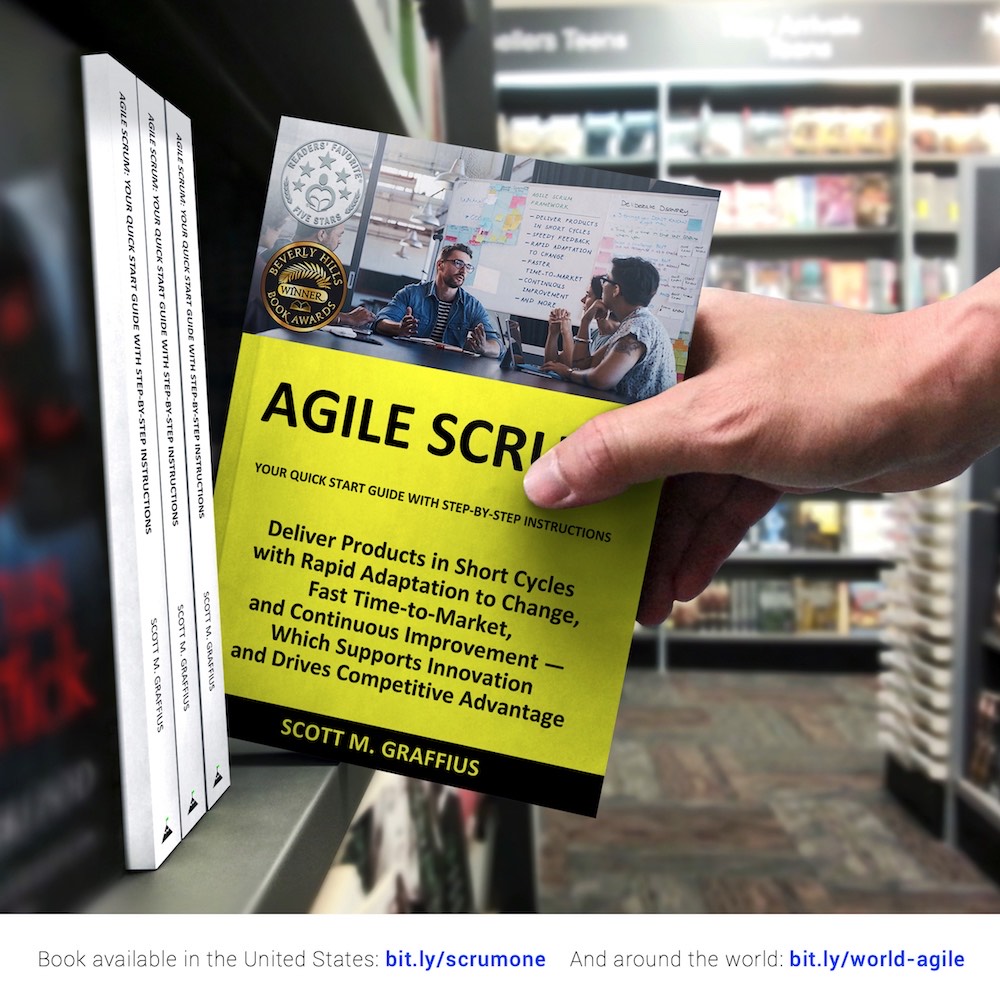
About Agile Scrum: Your Quick Start Guide with Step-by-Step Instructions
Shifting customer needs are common in today's marketplace. Businesses must be adaptive and responsive to change while delivering an exceptional customer experience to be competitive.
There are a variety of frameworks supporting the development of products and services, and most approaches fall into one of two broad categories: traditional or agile. Traditional practices such as waterfall engage sequential development, while agile involves iterative and incremental deliverables. Organizations are increasingly embracing agile to manage projects, and best meet their business needs of rapid response to change, fast delivery speed, and more.
With clear and easy to follow step-by-step instructions, Scott M. Graffius's award-winning Agile Scrum: Your Quick Start Guide with Step-by-Step Instructions helps the reader:
- Implement and use the most popular agile framework―Scrum;
- Deliver products in short cycles with rapid adaptation to change, fast time-to-market, and continuous improvement; and
- Support innovation and drive competitive advantage.
Hailed by Literary Titan as “the book highlights the versatility of Scrum beautifully.”
Winner of 17 first place awards.
Agile Scrum: Your Quick Start Guide with Step-by-Step Instructions is available in paperback and ebook/Kindle in the United States and around the world. Some links by country follow.
- 🇧🇷 Brazil
- 🇨🇦 Canada
- 🇨🇿 Czech Republic
- 🇩🇰 Denmark
- 🇫🇮 Finland
- 🇫🇷 France
- 🇩🇪 Germany
- 🇬🇷 Greece
- 🇭🇺 Hungary
- 🇮🇳 India
- 🇮🇪 Ireland
- 🇮🇱 Israel
- 🇮🇹 Italy
- 🇯🇵 Japan
- 🇱🇺 Luxembourg
- 🇲🇽 Mexico
- 🇳🇱 Netherlands
- 🇳🇿 New Zealand
- 🇳🇴 Norway
- 🇪🇸 Spain
- 🇸🇪 Sweden
- 🇨🇭 Switzerland
- 🇦🇪 UAE
- 🇬🇧 United Kingdom
- 🇺🇸 United States

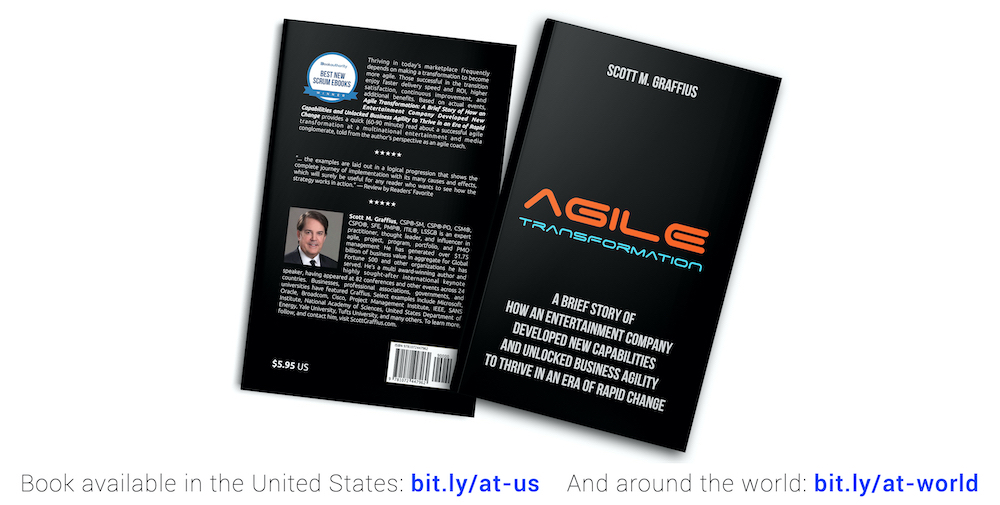
About Agile Transformation: A Brief Story of How an Entertainment Company Developed New Capabilities and Unlocked Business Agility to Thrive in an Era of Rapid Change
Thriving in today's marketplace frequently depends on making a transformation to become more agile. Those successful in the transition enjoy faster delivery speed and ROI, higher satisfaction, continuous improvement, and additional benefits.
Based on actual events, Agile Transformation: A Brief Story of How an Entertainment Company Developed New Capabilities and Unlocked Business Agility to Thrive in an Era of Rapid Change provides a quick (60-90 minute) read about a successful agile transformation at a multinational entertainment and media company, told from the author's perspective as an agile coach.
The award-winning book by Scott M. Graffius is available in paperback and ebook/Kindle in the United States and around the world. Some links by country follow.
- 🇦🇺 Australia
- 🇦🇹 Austria
- 🇧🇷 Brazil
- 🇨🇦 Canada
- 🇨🇿 Czech Republic
- 🇩🇰 Denmark
- 🇫🇮 Finland
- 🇫🇷 France
- 🇩🇪 Germany
- 🇬🇷 Greece
- 🇮🇳 India
- 🇮🇪 Ireland
- 🇯🇵 Japan
- 🇱🇺 Luxembourg
- 🇲🇽 Mexico
- 🇳🇱 Netherlands
- 🇳🇿 New Zealand
- 🇪🇸 Spain
- 🇸🇪 Sweden
- 🇨🇭 Switzerland
- 🇦🇪 United Arab Emirates
- 🇬🇧 United Kingdom
- 🇺🇸 United States

The short link for this article is https://bit.ly/evil-cp
© Copyright 2024 Scott M. Graffius. All rights reserved. This material may not be published, broadcast, rewritten or redistributed without the express written permission of Scott M. Graffius.

Scott M. Graffius' Intellectual Property Was Utilized by Robert W. Malone, MD
06 June 2024

Introduction
Intellectual property (IP)—including copyrights, trademarks, trade secrets, patents, and algorithms—is a strategic asset that provides significant value. IP rights ensure creators can benefit from their hard work, discovery, and innovation. Infringement can damage the marketability and value of the IP. IP rights are so important that IP theft is a federal crime.
Scott M. Graffius maintains, enforces, and protects his copyrights and other IP rights.
This article covers the news that Robert W. Malone, MD used Graffius’ copyrighted 'Phases of Team Development' intellectual property in his book. However:
- Malone did not request nor receive permission to use Graffius’ intellectual property;
- Malone used Graffius’ copyrighted content word-for-word;
- Malone used Graffius’ intellectual property commercially—in his book;
- Malone used a significant amount of Graffius' copyrighted property; and
- Malone did not cite, reference or otherwise attribute Graffius’ respective IP content to Graffius.
Ensuring the integrity of intellectual property is paramount to Graffius. He is resolute in protecting and enforcing his copyrights and other IP rights.
This article presents facts—including visuals and additional evidence—and a critical analysis of this consequential matter.

Overview of Graffius' Copyrighted 'Phases of Team Development' IP
Informed by the research of Bruce W. Tuckman, Ph.D. and Mary Ann C. Jensen, over 100 subsequent studies, and Scott M. Graffius' first-hand professional experience with, and analysis of, team leadership and performance, Graffius created his ‘Phases of Team Development’ IP. It’s a unique perspective on the five phases of team development — Forming, Storming, Norming, Performing, and Adjourning — and it’s inclusive of the characteristics and strategies for each phase.
Graffius published his 'Phases of Team Development' work as an article, among other mediums. The body of his article has text in typical — not bullet point — format. The typical format text by Graffius was used by Malone.
(For reference only, Graffius' same article includes a visual which incorporates a graph showing how performance varies by phase, as well as the characteristics and strategies for each phase. The visual has text in bullet-point format. Again, the body of the article has text in typical — not bullet point — format; that typical format text by Graffius was used by Malone.)
Graffius' ‘Phases of Team Development’ IP is registered with the United States Copyright Office.
Graffius initially developed his material in 2008, and he periodically refreshes it. In this case, the applicable edition is 2021. An example is here and other locations.
(For reference only, the most current [2024] edition of his 'Phases of Team Development' is here.)
Here’s a macro/wide view of Graffius' respective 2021 IP.

Here’s another macro/wide view of Graffius' respective 2021 IP, showing the main body of the article.

Here’s a zoomed-in view of Graffius' respective 2021 IP, showing the applicable text.

Here’s a zoomed-in view of Graffius' respective 2021 IP, showing his copyright information.

Graffius' copyright ownership details are clearly noted: "Copyright © 2021 Scott M. Graffius. All rights reserved. This material may not be published, broadcast, rewritten or redistributed without the express written permission of Scott M. Graffius."
Graffius presented his 2021 'Phases of Team Development' IP via multiple channels/platforms in 2021. Select examples include:
- Graffius’ blog (January 4, 2021) at: here.
- Graffius’ ResearchGate account (January 4, 2021) at: here.
- Graffius’ Twitter (now called X) account; one of many examples is (January 17, 2021) at: here.
- And some of Graffius’ appearances at conferences and other events; one example is Graffius’ talk at the IEEE’s ‘IEEE Day’ 2021 Event (October 5, 2021), a recording of his session is at: here.
Conference organizers, businesses, professional organizations, government agencies, and universities around the world engage Graffius to deliver compelling talks and workshops. To date, he's presented sessions at 91 conferences and other events across 25 countries:
- Armenia,
- Australia,
- Brazil,
- Canada,
- Czech Republic,
- Finland,
- France,
- Germany,
- Greece,
- Hong Kong,
- Hungary,
- India,
- Ireland,
- Lithuania,
- Luxembourg,
- Nepal,
- Netherlands,
- New Zealand,
- Norway,
- Romania,
- Sweden,
- Switzerland,
- United Arab Emirates,
- United Kingdom,
- and the United States.
His 'Phases of Team Development' IP is central and key to many of those sessions. Graffius' rate card and a listing of his engagements are here and here, respectively.
With an authorization/license from Graffius, many organizations have featured and used his 'Phases of Team Development' IP. Select examples include:
- Adobe,
- American Management Association,
- Amsterdam Public Health Research Institute,
- Boston University,
- Cisco,
- Deimos Aerospace,
- DevOps Institute,
- Ford Motor Company,
- Hasso Plattner Institute,
- IEEE,
- London South Bank University,
- Microsoft,
- New Zealand Government,
- Torrens University Australia,
- UK Sports Institute,
- University of Galway Ireland,
- U.S. National Park Service,
- U.S. Tennis Association,
- Virginia Tech,
- Yale University,
- and many others.
Robert W. Malone's Unauthorized, Word-for-Word, Commercial, Significant Amount, and Unattributed Use of Graffius' Intellectual Property

As already covered, Graffius' copyright ownership details are clearly noted: "Copyright © 2021 Scott M. Graffius. All rights reserved. This material may not be published, broadcast, rewritten or redistributed without the express written permission of Scott M. Graffius."
Robert W. Malone, MD used Scott M. Graffius’ copyrighted ‘Phases of Team Development’ intellectual property in his 2022 book, Lies My Gov’t Told Me: And the Better Future Coming. However:
- Malone did not request nor receive permission to use Graffius’ intellectual property;
- Malone used Graffius’ copyrighted content word-for-word;
- Malone used Graffius’ intellectual property commercially—in his book;
- Malone used a significant amount of Graffius' copyrighted property; and
- Malone did not cite, reference or otherwise attribute Graffius’ respective IP content to Graffius.
Evidence is archived. Visuals and additional information follows.
A side-by-side comparison is below. It shows Graffius' 2021 copyrighted content, on the topic of Forming. It also shows what Malone has in his 2022 book on the same topic: Malone uses Graffius' content word-for-word.

A side-by-side comparison is below. It shows Graffius' 2021 copyrighted content, on the topic of Storming. It also shows what Malone has in his 2022 book on the same topic: Malone uses Graffius' content word-for-word.

A side-by-side comparison is below. It shows Graffius' 2021 copyrighted content, on the topic of Norming. It also shows what Malone has in his 2022 book on the same topic: Malone uses Graffius' content word-for-word.

A side-by-side comparison is below. It shows Graffius' 2021 copyrighted content, on the topic of Performing. It also shows what Malone has in his 2022 book on the same topic: Malone uses Graffius' content word-for-word.

A comparison is also delineated next.
🟢 From Graffius' copyrighted 2021 'Phases of Team Development' IP, his content on Forming includes:
"include displaying eagerness, socializing, generally polite tone, sticking to safe topics, being unclear about how one fits in, and some anxiety and questioning."
🔴 From page 376 of Malone's 2022 book, Forming includes:
"include displaying eagerness, socializing, generally polite tone, sticking to safe topics, being unclear about how one fits in, and some anxiety and questioning."
🟢 From Graffius' copyrighted 2021 'Phases of Team Development' IP, his content on Storming includes:
"resistance, lack of participation, conflict related to differences of feelings and opinions, competition, high emotions, and starting to move towards group norms."
🔴 From page 376 of Malone's 2022 book, Storming includes:
"resistance, lack of participation, conflict related to differences of feelings and opinions, competition, high emotions, and starting to move towards group norms."
🟢 From Graffius' copyrighted 2021 'Phases of Team Development' IP, his content on Norming includes:
"improved sense of purpose and understanding of goals, higher confidence, improved commitment, team members are engaged and supportive, relief—lowered anxiety, and starting to develop cohesion."
🔴 From page 376 of Malone's 2022 book, Norming includes:
"improved sense of purpose and understanding of goals, higher confidence, improved commitment, team members are engaged and supportive, relief—lowered anxiety, and starting to develop cohesion."
🟢 From Graffius' copyrighted 2021 'Phases of Team Development' IP, his content on Performing includes:
"Characteristics of Performing include higher motivation, elevated trust and empathy, individuals typically deferring to the team's needs, effective production, consistent performance, and demonstrations of interdependence and self-management (also referred to as self-organization)."
🔴 From page 376 of Malone's 2022 book, Performing includes:
"Characteristics of Performing include higher motivation, elevated trust and empathy, individuals typically deferring to the team's needs, effective production, consistent performance, and demonstrations of interdependence and self-management (also referred to as self-organization)."
The indisputable proof shows that Malone used Graffius' copyrighted property.
Conclusion
Again, Graffius' copyright ownership details are clearly noted: "Copyright © 2021 Scott M. Graffius. All rights reserved. This material may not be published, broadcast, rewritten or redistributed without the express written permission of Scott M. Graffius."
Robert W. Malone, MD used Scott M. Graffius’ copyrighted ‘Phases of Team Development’ intellectual property in his book and:
- Malone did not request nor receive permission to use Graffius’ intellectual property;
- Malone used Graffius’ copyrighted content word-for-word;
- Malone used Graffius’ intellectual property commercially—in his book;
- Malone used a significant amount of Graffius' copyrighted property; and
- Malone did not cite, reference or otherwise attribute Graffius’ respective IP content to Graffius.
What Malone did was alarming and profoundly concerning. When others have done something not to Malone's liking or what he thought was wrong, Malone has been known to publicly criticize and characterize them as having "no moral compass." Examples are here and here.
Ensuring the integrity of intellectual property is paramount to Graffius. He is resolute in protecting and enforcing his copyrights and other IP rights.
This case is currently open.
Read on for additional information, including:
- About Scott M. Graffius;
- About Robert W. Malone;
- About Book by Robert W. Malone;
- About Copyright and Other Intellectual Property Rights;
- References/Sources; and
- How to Cite This Article.
About Scott M. Graffius
Scott M. Graffius, PMP, SA, CSP-SM, CSP-PO, CSM, CSPO, ITIL, LSSGB is an agile project management practitioner, consultant, creator, multi-award-winning author, and international public speaker. Founder and CEO of Exceptional PPM and PMO Solutions™ and subsidiary Exceptional Agility™, he has generated over $1.9 billion for Global Fortune 500 businesses and other organizations he has served. Graffius and content from his books, talks, workshops, and more have been featured and used by Microsoft, Oracle, Broadcom, Cisco, Gartner, Project Management Institute, IEEE, National Academy of Sciences, U.S. Department of Energy, U.S. National Park Service, U.S. Tennis Association, Yale University, and others. He delights audiences with dynamic and engaging talks and workshops on agile project management, AI, video game development, strategic alignment, the science of high performance teams, and more. To date, he's presented sessions at 91 conferences and other events across 25 countries. His full bio is available here.
About Robert W. Malone
Robert Wallace Malone is a physician and biochemist. His early work focused on mRNA technology, pharmaceuticals, and drug repurposing research. He's the author of the bestselling book, Lies My Gov't Told Me: And the Better Future Coming. Malone used Scott M. Graffius’ copyrighted ‘Phases of Team Development’ intellectual property in his book. Malone did not request nor receive permission to use Graffius’ intellectual property (IP). Yet, Malone used Graffius’ IP word-for word; he used it commercially—in his book, for his financial gain; he used a significant amount of it; and he did not cite, reference or otherwise attribute Graffius’ respective IP content to Graffius.
About Book by Robert W. Malone
Malone, Robert W. (2022, December). Lies My Gov't Told Me: And the Better Future Coming. ISBN-13: 978-1510773240. New York City, New York: Skyhorse Publishing.

About Copyright and Other Intellectual Property Rights
For copyright/IP infringement cases, it is recommended that you consult a qualified attorney.
Infringement of copyright and other intellectual property (IP) rights is a deplorable act of intellectual theft, displaying a flagrant disregard for professionalism, morality, ethics, and the law. It undermines the hard work and innovation of others and is a disgraceful, unprofessional, dishonest, immoral, unethical, and illegal practice. IP rights are so important that IP theft is a federal crime.
To learn about copyrights, visit the United States Copyright Office’s website at https://www.copyright.gov.
The Reporting Intellectual Property Crime: A Guide for Victims of Copyright Infringement, Trademark Counterfeiting, and Trade Secret Theft publication by the Criminal Division of the U.S. Department of Justice is a good resource.
The Intellectual Property Rights (IPR) Center coordinates the U.S. government’s response to intellectual property crimes. Visit their website at https://www.iprcenter.gov to learn more.
See the References/Sources section for additional information.
References/Sources
Select bibliography:
- Bartlett, Tom (2021, August 12). The Vaccine Scientist Spreading Vaccine Misinformation. The Atlantic. Available at: https://www.theatlantic.com/science/archive/2021/08/robert-malone-vaccine-inventor-vaccine-skeptic/619734/.
- Blaskovic, Andrew K.; Rusk, John-David; Parker, Victor C.; and Payne, Bryson R. (2022). Cybercrime and Intellectual Property Theft: An Analysis of Modern Digital Forensics. In book: Proceedings of the Future Technologies Conference (FTC) 2022, Volume 2. DOI: 10.1007/978-3-031-18458-1_36.
- Dolgin, Elie (2021, September 14). The Tangled History of mRNA Vaccines. Nature. Available at: https://www.nature.com/articles/d41586-021-02483-w.
- Dyer, Jeff; Furr, Nathan; Lefrandt, Chris; and Howell, Taeya (2023, January 17). Innovation Depends on Intellectual Honesty. MIT Sloan Management Review. Available at: https://sloanreview.mit.edu/article/why-innovation-depends-on-intellectual-honesty/.
- Exceptional PPM and PMO Solutions (n.d.). Rate Card for 2023-2024. Available at: https://scottgraffius.com/resources/Exceptional-PPM-and-PMO-Solutions-Rate-Card-for-2023-2024-v23110907.pdf.
- Graffius, Scott M. (2021, January 4). Phases of Team Development (Update for 2021). DOI: 10.13140/RG.2.2.22040.42246.
- Graffius, Scott M. (2021, January 4). Using Bruce Tuckman's Phases of Team Development to Help Your Team Grow and Advance: 2021 Update. Available at: https://www.scottgraffius.com/blog/files/team-21.html.
- Graffius, Scott M. (n.d.). Intellectual Property (IP). Available at: https://www.scottgraffius.com/intellectual-property.html.
- Graffius, Scott M. (n.d.). Public Speaker. Available at: https://scottgraffius.com/publicspeaker.html.
- Hartline, Devlin (2016, September 26). Criminal Copyright Infringement is Crime of "Moral Turpitude." George Mason University Center for Intellectual Property x Innovation Policy. Available at: https://cip2.gmu.edu/2016/09/26/criminal-copyright-infringement-is-crime-of-moral-turpitude/.
- Huppert, Elizabeth; and Levine, Emma (2023, August 31). The Rise of Dishonest Leaders: Causes and Solutions. Academy of Management Perspectives, 37 (3). DOI: 10.5465/amp.2021.0063.
- Kenton, Will (2022, August 23). What Is a Whistleblower? Protections, Law, Importance, and Example. Available at: https://www.investopedia.com/terms/w/whistleblower.asp.
- Malone, Robert W. (2023, August 8). Demonic Nihilism. Substack. Available at: https://rwmalonemd.substack.com/p/demonic-nihilism.
- Malone, Robert W. (2023, January 6). Project Veritas has Broken Pfizer's Gain-of-Function Research Program Wide Open. Substack. Available at: https://rwmalonemd.substack.com/p/project-veritas-has-broken-pfizers.
- Malone, Robert W. (2022, December). Lies My Gov't Told Me: And the Better Future Coming. ISBN-13: 978-1510773240. New York City, New York: Skyhorse Publishing.
- McGregor, Jena. (2017, May 15). More CEOs are Getting Forced Out for Ethical Violations. Washington Post. Available at: https://www.washingtonpost.com/news/on-leadership/wp/2017/05/15/more-ceos-are-getting-forced-out-for-ethics-violations/.
- National Intellectual Property Rights Coordination Center (IPR Center) (n.d.). About the Center. Available at: https://www.iprcenter.gov/about.
- Popomaronis, Tom (2020, August 20). These 11 Famously Disgraced CEOs Have Entered the Reputation Hall of Shame. Entrepreneur. Available at: https://www.entrepreneur.com/business-news/these-11-famously-disgraced-ceos-have-entered-the/354739.
- Rivera, Kristin; and Karlsson, Per-Ola (2017, June 6). CEOs Are Getting Fired for Ethical Lapses More Than They Used To. Harvard Business Review. Available at: https://hbr.org/2017/06/ceos-are-getting-fired-for-ethical-lapses-more-than-they-used-to.
- Smith, Isaac H.; Kouchaki, Maryam; and Wareham, Justin (2021, April 14). The Price Leaders Pay for Cutting Ethical Corners. MIT Sloan Management Review. Available at: https://sloanreview.mit.edu/article/the-price-leaders-pay-for-cutting-ethical-corners/.
- Steffen, Thomas (2019, May 24). For CEOs, Integrity Is the Best Policy. Yale School of Management. Available at: https://insights.som.yale.edu/insights/for-ceos-integrity-is-the-best-policy.
- Sterne, Robert; and Chaplick, Trevor (2005, February). Why Directors Must Take Responsibility for Intellectual Property. Intellectual Asset Management Magazine. Available at: https://www.wsgr.com/PDFSearch/IP_RESPONSIBILTY.pdf.
- Stim, Richard (2024). Patent, Copyright & Trademark: An Intellectual Property Desk Reference (18th Edition). Berkeley, California: Nolo.
- Stubben, Stephen; and Welch Kyle (2018, November 14). Whistleblowers Keep Companies Healthy. Harvard Business Review. Available at: https://hbr.org/2018/11/research-whistleblowers-are-a-sign-of-healthy-companies.
- Thomson Reuters (2022, December 16). Copyright Litigation 101. Available at: https://legal.thomsonreuters.com/blog/copyright-litigation-101/.
- United States Copyright Office (USCO) (n.d.). Can I Use Someone Else's Work? Can Someone Else Use Mine? (Excerpt: "In cases of willful infringement for profit, the U.S. Attorney may initiate a criminal investigation.") Available at: https://copyright.gov/help/faq/faq-fairuse.html.
- United States Copyright Office (USCO) (n.d.). Welcome to the U.S. Copyright Office. Available at: https://www.copyright.gov.
- United States Department of Homeland Security (DHS) (n.d.). Intellectual Property Theft and Commercial Fraud. Available at: https://www.dhs.gov/hsi/investigate/intellectual-property-and-commercial-fraud.
- United States Department of Homeland Security (US DHS) (n.d.). Intellectual Property Rights. Available at: https://www.dhs.gov/intellectual-property-rights.
- United States Department of Justice (DOJ) (n.d.). Reporting Intellectual Property Crime: A Guide for Victims of Copyright Infringement, Trademark Counterfeiting, and Trade Secret Theft (Third Edition). Available at: https://www.justice.gov/criminal/criminal-ccips/file/891011/dl.
- United States Department of Justice (DOJ), Office of the Inspector General (OIG) (n.d.). Whistleblower Rights and Protections. Available at: https://oig.justice.gov/hotline/whistleblower-protection.
- United States Patent and Trademark Office (USPTO) (2013, July 24). Copyright Policy, Creativity, and Innovation in the Digital Economy. Available at: https://www.uspto.gov/sites/default/files/news/publications/copyrightgreenpaper.pdf.
- Vitasek, Kate (2022, November 29). The Role of Honesty in Success (and Why Cutting Corners is a Bad Idea). Forbes. Available at: https://forbes.com/sites/katevitasek/2022/11/29/the-role-of-honesty-in-success-and-why-cutting-corners-is-a-bad-idea/.
How to Cite This Article
Graffius, Scott M. (2024, June 6). Scott M. Graffius' Intellectual Property Was Utilized by Robert W. Malone, MD. Available at: https://scottgraffius.com/blog/files/ip-theft.html.
About Agile Scrum: Your Quick Start Guide with Step-by-Step Instructions
Shifting customer needs are common in today's marketplace. Businesses must be adaptive and responsive to change while delivering an exceptional customer experience to be competitive.
There are a variety of frameworks supporting the development of products and services, and most approaches fall into one of two broad categories: traditional or agile. Traditional practices such as waterfall engage sequential development, while agile involves iterative and incremental deliverables. Organizations are increasingly embracing agile to manage projects, and best meet their business needs of rapid response to change, fast delivery speed, and more.
With clear and easy to follow step-by-step instructions, Scott M. Graffius's award-winning Agile Scrum: Your Quick Start Guide with Step-by-Step Instructions helps the reader:
- Implement and use the most popular agile framework―Scrum;
- Deliver products in short cycles with rapid adaptation to change, fast time-to-market, and continuous improvement; and
- Support innovation and drive competitive advantage.
Hailed by Literary Titan as “the book highlights the versatility of Scrum beautifully.”
Winner of 17 first place awards.
Agile Scrum: Your Quick Start Guide with Step-by-Step Instructions is available in paperback and ebook/Kindle in the United States and around the world. Some links by country follow.
- 🇧🇷 Brazil
- 🇨🇦 Canada
- 🇨🇿 Czech Republic
- 🇩🇰 Denmark
- 🇫🇮 Finland
- 🇫🇷 France
- 🇩🇪 Germany
- 🇬🇷 Greece
- 🇭🇺 Hungary
- 🇮🇳 India
- 🇮🇪 Ireland
- 🇮🇱 Israel
- 🇮🇹 Italy
- 🇯🇵 Japan
- 🇱🇺 Luxembourg
- 🇲🇽 Mexico
- 🇳🇱 Netherlands
- 🇳🇿 New Zealand
- 🇳🇴 Norway
- 🇪🇸 Spain
- 🇸🇪 Sweden
- 🇨🇭 Switzerland
- 🇦🇪 UAE
- 🇬🇧 United Kingdom
- 🇺🇸 United States
About Agile Transformation: A Brief Story of How an Entertainment Company Developed New Capabilities and Unlocked Business Agility to Thrive in an Era of Rapid Change
Thriving in today's marketplace frequently depends on making a transformation to become more agile. Those successful in the transition enjoy faster delivery speed and ROI, higher satisfaction, continuous improvement, and additional benefits.
Based on actual events, Agile Transformation: A Brief Story of How an Entertainment Company Developed New Capabilities and Unlocked Business Agility to Thrive in an Era of Rapid Change provides a quick (60-90 minute) read about a successful agile transformation at a multinational entertainment and media company, told from the author's perspective as an agile coach.
The award-winning book by Scott M. Graffius is available in paperback and ebook/Kindle in the United States and around the world. Some links by country follow.
- 🇦🇺 Australia
- 🇦🇹 Austria
- 🇧🇷 Brazil
- 🇨🇦 Canada
- 🇨🇿 Czech Republic
- 🇩🇰 Denmark
- 🇫🇮 Finland
- 🇫🇷 France
- 🇩🇪 Germany
- 🇬🇷 Greece
- 🇮🇳 India
- 🇮🇪 Ireland
- 🇯🇵 Japan
- 🇱🇺 Luxembourg
- 🇲🇽 Mexico
- 🇳🇱 Netherlands
- 🇳🇿 New Zealand
- 🇪🇸 Spain
- 🇸🇪 Sweden
- 🇨🇭 Switzerland
- 🇦🇪 United Arab Emirates
- 🇬🇧 United Kingdom
- 🇺🇸 United States
The short link for this article is https://bit.ly/theft-ip
© Copyright 2024 Scott M. Graffius. All rights reserved. This material may not be published, broadcast, rewritten or redistributed without the express written permission of Scott M. Graffius.
Zittau/Görlitz University of Applied Sciences Features Scott M. Graffius' Content
26 April 2023
BY SCOTT M. GRAFFIUS | ScottGraffius.com
Select here to download this article as a PDF.
Businesses, professional associations, governments, and universities have used and featured Scott M. Graffius and content from his books, talks, workshops, and more. Examples of organizations include Microsoft, Oracle, Broadcom, Cisco, Gartner, Project Management Institute, IEEE, National Academy of Sciences, United States Department of Energy, New Zealand Ministry of Education, Yale University, Tufts University, and many others.
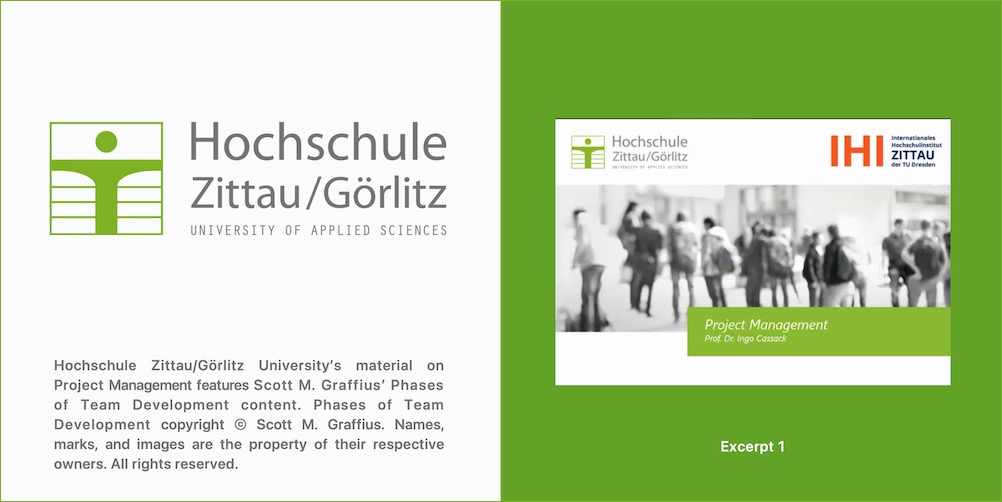
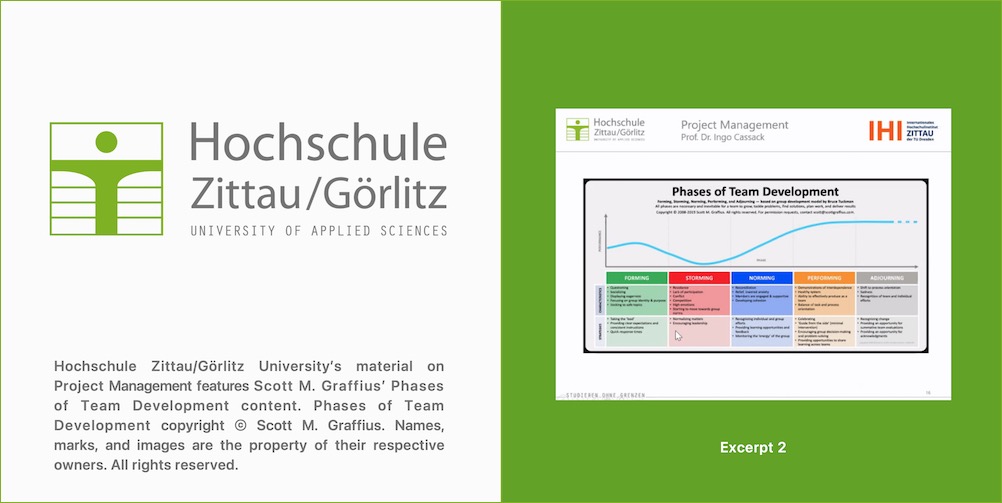
This month, Hochschule Zittau/Görlitz (Zittau/Görlitz University of Applied Sciences) was added to the list of organizations. Dr. Ingo Cassack, Professor at the university, incorporated Graffius' Phases of Team Development work into Dr. Cassack's material on project management. Two excerpts follow.
To learn more about Scott M. Graffius' Phases of Team Development, visit here.
Oksana Makovoz wrote about the presentation which included Graffius' work, among other details. She posted on:
About Hochschule Zittau/Görlitz
Hochschule Zittau/Görlitz (Zittau/Görlitz University of Applied Sciences) is a non-profit public higher-education institution located in Zittau — in the border triangle between Germany, the Czech Republic, and Poland . The institution also has a branch campus in Görlitz, Saxon, Germany. Officially recognized by the Sächsisches Staatsministerium für Wissenschaft und Kunst (Saxon State Ministry of Science and the Arts), Hochschule Zittau/Görlitz is a top tier coeducational German higher education institution with no tuition fees, state-of-the-art equipment, and intensive support. Visit https://www.hszg.de to learn more.

About Scott M. Graffius
Scott M. Graffius, PMP, SA, CSP-SM, CSP-PO, CSM, CSPO, SFE, ITIL, LSSGB is an agile project management practitioner, consultant, multi-award-winning author, and international keynote speaker. He is the Founder of Exceptional PPM and PMO Solutions™ and subsidiary Exceptional Agility™. He has generated over $1.9 billion of business value in aggregate for Global Fortune 500 businesses and other organizations he has served. Graffius and content from his books, talks, workshops, and more have been featured and used by businesses, professional associations, governments, and universities. Examples include Microsoft, Oracle, Broadcom, Cisco, Gartner, Project Management Institute, IEEE, Qantas, National Academy of Sciences, United States Department of Energy, New Zealand Ministry of Education, Yale University, Tufts University, and others. He has delighted audiences with dynamic and engaging talks and workshops on agile, project management, and technology leadership at 85 conferences and other events across 25 countries.
His full bio is available here.
Connect with Scott on:
About Agile Scrum: Your Quick Start Guide with Step-by-Step Instructions
Shifting customer needs are common in today's marketplace. Businesses must be adaptive and responsive to change while delivering an exceptional customer experience to be competitive.
There are a variety of frameworks supporting the development of products and services, and most approaches fall into one of two broad categories: traditional or agile. Traditional practices such as waterfall engage sequential development, while agile involves iterative and incremental deliverables. Organizations are increasingly embracing agile to manage projects, and best meet their business needs of rapid response to change, fast delivery speed, and more.
With clear and easy to follow instructions, the multi award-winning Agile Scrum: Your Quick Start Guide with Step-by-Step Instructions book by Scott M. Graffius (Chris Hare and Colin Giffen, Technical Editors) helps the reader:
Hailed by Literary Titan as “the book highlights the versatility of Scrum beautifully.”
Winner of 17 first place awards.
Agile Scrum: Your Quick Start Guide with Step-by-Step Instructions is available in paperback and ebook/Kindle in the United States and around the world. Some links by country follow.
About Agile Transformation: A Brief Story of How an Entertainment Company Developed New Capabilities and Unlocked Business Agility to Thrive in an Era of Rapid Change
Thriving in today's marketplace frequently depends on making a transformation to become more agile. Those successful in the transition enjoy faster delivery speed and ROI, higher satisfaction, continuous improvement, and additional benefits.
Based on actual events, Agile Transformation: A Brief Story of How an Entertainment Company Developed New Capabilities and Unlocked Business Agility to Thrive in an Era of Rapid Change provides a quick (60-90 minute) read about a successful agile transformation at a multinational entertainment and media company, told from the author's perspective as an agile coach.
The award-winning book by Scott M. Graffius is available in paperback and ebook/Kindle in the United States and around the world. Some links by country follow.
The short URL for this article is: https://bit.ly/hszg-2023
© Copyright 2023 Scott M. Graffius. All rights reserved. This material may not be published, broadcast, rewritten or redistributed without the express written permission of Scott M. Graffius.

Select here to download this article as a PDF.
Businesses, professional associations, governments, and universities have used and featured Scott M. Graffius and content from his books, talks, workshops, and more. Examples of organizations include Microsoft, Oracle, Broadcom, Cisco, Gartner, Project Management Institute, IEEE, National Academy of Sciences, United States Department of Energy, New Zealand Ministry of Education, Yale University, Tufts University, and many others.
This month, Hochschule Zittau/Görlitz (Zittau/Görlitz University of Applied Sciences) was added to the list of organizations. Dr. Ingo Cassack, Professor at the university, incorporated Graffius' Phases of Team Development work into Dr. Cassack's material on project management. Two excerpts follow.
To learn more about Scott M. Graffius' Phases of Team Development, visit here.
Oksana Makovoz wrote about the presentation which included Graffius' work, among other details. She posted on:
About Hochschule Zittau/Görlitz
Hochschule Zittau/Görlitz (Zittau/Görlitz University of Applied Sciences) is a non-profit public higher-education institution located in Zittau — in the border triangle between Germany, the Czech Republic, and Poland . The institution also has a branch campus in Görlitz, Saxon, Germany. Officially recognized by the Sächsisches Staatsministerium für Wissenschaft und Kunst (Saxon State Ministry of Science and the Arts), Hochschule Zittau/Görlitz is a top tier coeducational German higher education institution with no tuition fees, state-of-the-art equipment, and intensive support. Visit https://www.hszg.de to learn more.
About Scott M. Graffius
Scott M. Graffius, PMP, SA, CSP-SM, CSP-PO, CSM, CSPO, SFE, ITIL, LSSGB is an agile project management practitioner, consultant, multi-award-winning author, and international keynote speaker. He is the Founder of Exceptional PPM and PMO Solutions™ and subsidiary Exceptional Agility™. He has generated over $1.9 billion of business value in aggregate for Global Fortune 500 businesses and other organizations he has served. Graffius and content from his books, talks, workshops, and more have been featured and used by businesses, professional associations, governments, and universities. Examples include Microsoft, Oracle, Broadcom, Cisco, Gartner, Project Management Institute, IEEE, Qantas, National Academy of Sciences, United States Department of Energy, New Zealand Ministry of Education, Yale University, Tufts University, and others. He has delighted audiences with dynamic and engaging talks and workshops on agile, project management, and technology leadership at 85 conferences and other events across 25 countries.
His full bio is available here.
Connect with Scott on:
About Agile Scrum: Your Quick Start Guide with Step-by-Step Instructions
Shifting customer needs are common in today's marketplace. Businesses must be adaptive and responsive to change while delivering an exceptional customer experience to be competitive.
There are a variety of frameworks supporting the development of products and services, and most approaches fall into one of two broad categories: traditional or agile. Traditional practices such as waterfall engage sequential development, while agile involves iterative and incremental deliverables. Organizations are increasingly embracing agile to manage projects, and best meet their business needs of rapid response to change, fast delivery speed, and more.
With clear and easy to follow instructions, the multi award-winning Agile Scrum: Your Quick Start Guide with Step-by-Step Instructions book by Scott M. Graffius (Chris Hare and Colin Giffen, Technical Editors) helps the reader:
- Implement and use the most popular agile framework―Scrum;
- Deliver products in short cycles with rapid adaptation to change, fast time-to-market, and continuous improvement; and
- Support innovation and drive competitive advantage.
Hailed by Literary Titan as “the book highlights the versatility of Scrum beautifully.”
Winner of 17 first place awards.
Agile Scrum: Your Quick Start Guide with Step-by-Step Instructions is available in paperback and ebook/Kindle in the United States and around the world. Some links by country follow.
- 🇧🇷 Brazil
- 🇨🇦 Canada
- 🇨🇿 Czech Republic
- 🇩🇰 Denmark
- 🇫🇮 Finland
- 🇫🇷 France
- 🇩🇪 Germany
- 🇬🇷 Greece
- 🇭🇺 Hungary
- 🇮🇳 India
- 🇮🇪 Ireland
- 🇮🇱 Israel
- 🇮🇹 Italy
- 🇯🇵 Japan
- 🇱🇺 Luxembourg
- 🇲🇽 Mexico
- 🇳🇱 Netherlands
- 🇳🇿 New Zealand
- 🇳🇴 Norway
- 🇪🇸 Spain
- 🇸🇪 Sweden
- 🇨🇭 Switzerland
- 🇦🇪 UAE
- 🇬🇧 United Kingdom
- 🇺🇸 United States
About Agile Transformation: A Brief Story of How an Entertainment Company Developed New Capabilities and Unlocked Business Agility to Thrive in an Era of Rapid Change
Thriving in today's marketplace frequently depends on making a transformation to become more agile. Those successful in the transition enjoy faster delivery speed and ROI, higher satisfaction, continuous improvement, and additional benefits.
Based on actual events, Agile Transformation: A Brief Story of How an Entertainment Company Developed New Capabilities and Unlocked Business Agility to Thrive in an Era of Rapid Change provides a quick (60-90 minute) read about a successful agile transformation at a multinational entertainment and media company, told from the author's perspective as an agile coach.
The award-winning book by Scott M. Graffius is available in paperback and ebook/Kindle in the United States and around the world. Some links by country follow.
- 🇦🇺 Australia
- 🇦🇹 Austria
- 🇧🇷 Brazil
- 🇨🇦 Canada
- 🇨🇿 Czech Republic
- 🇩🇰 Denmark
- 🇫🇮 Finland
- 🇫🇷 France
- 🇩🇪 Germany
- 🇬🇷 Greece
- 🇮🇳 India
- 🇮🇪 Ireland
- 🇯🇵 Japan
- 🇱🇺 Luxembourg
- 🇲🇽 Mexico
- 🇳🇱 Netherlands
- 🇳🇿 New Zealand
- 🇪🇸 Spain
- 🇸🇪 Sweden
- 🇨🇭 Switzerland
- 🇦🇪 United Arab Emirates
- 🇬🇧 United Kingdom
- 🇺🇸 United States
The short URL for this article is: https://bit.ly/hszg-2023
© Copyright 2023 Scott M. Graffius. All rights reserved. This material may not be published, broadcast, rewritten or redistributed without the express written permission of Scott M. Graffius.
National Park Service Features Scott M. Graffius' 'Phases of Team Development'
11 September 2023
BY SCOTT M. GRAFFIUS | ScottGraffius.com

Select here to download a PDF of this article.
The National Park Service (NPS), part of the United States Department of the Interior, included Scott M. Graffius' ‘Phases of Team Development’ work in their newsletter. Highlights follow.
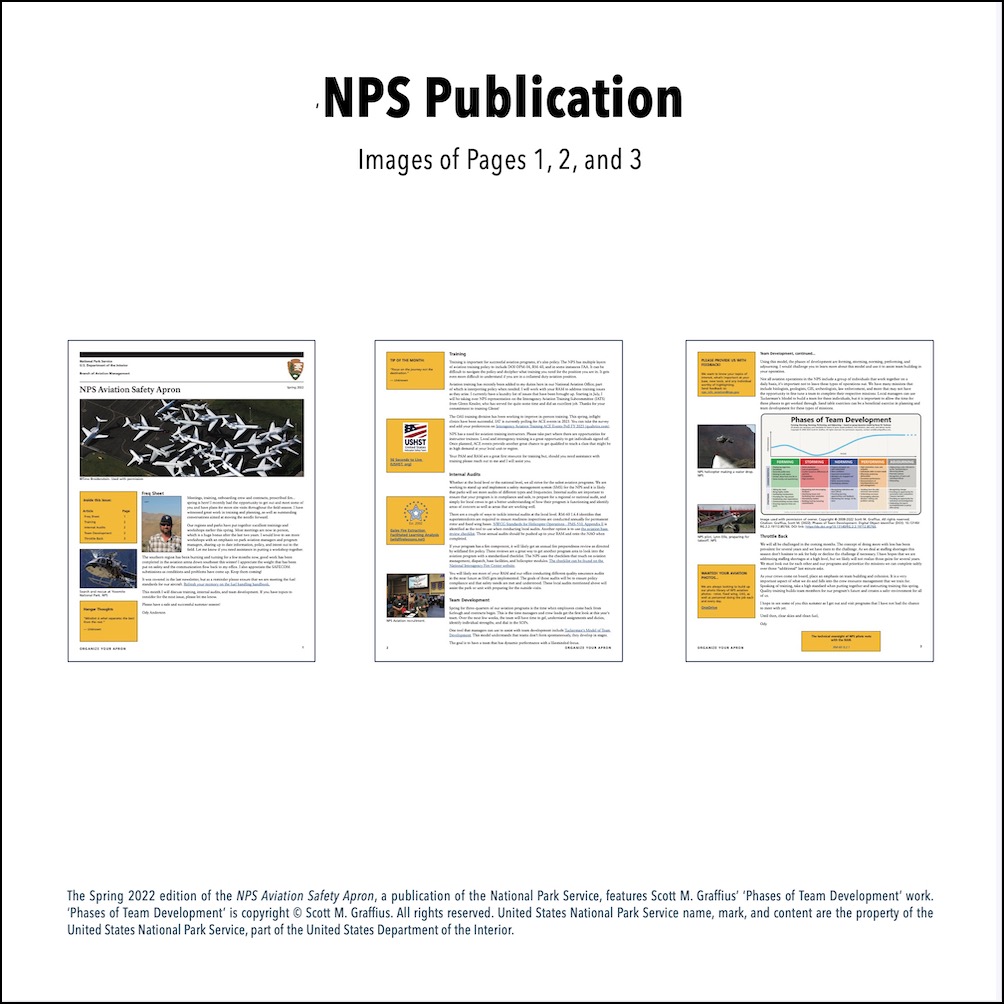
The above visual provides an overview of pages 1, 2, and 3 of the NPS publication.
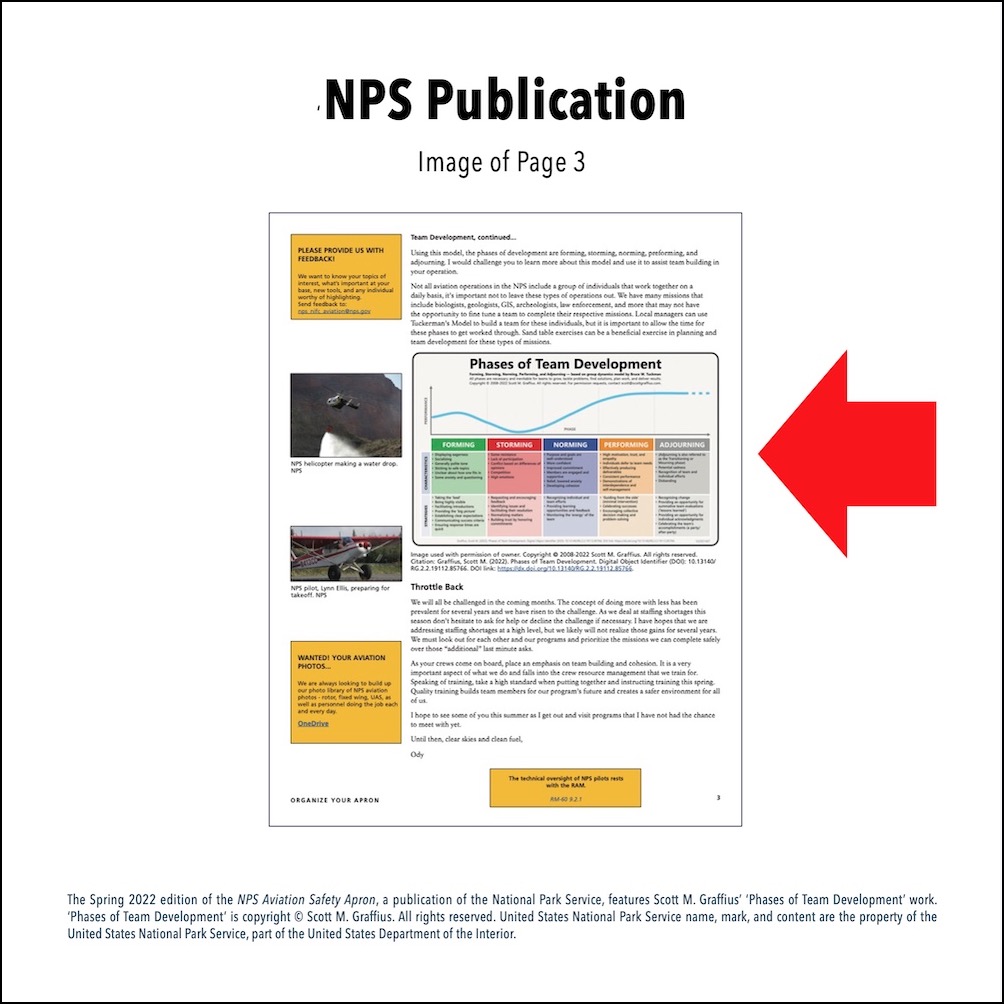
The above visual provides a singular view of page 3 of the NPS publication. The red arrow points to Graffius' 'Phases of Team Development.'
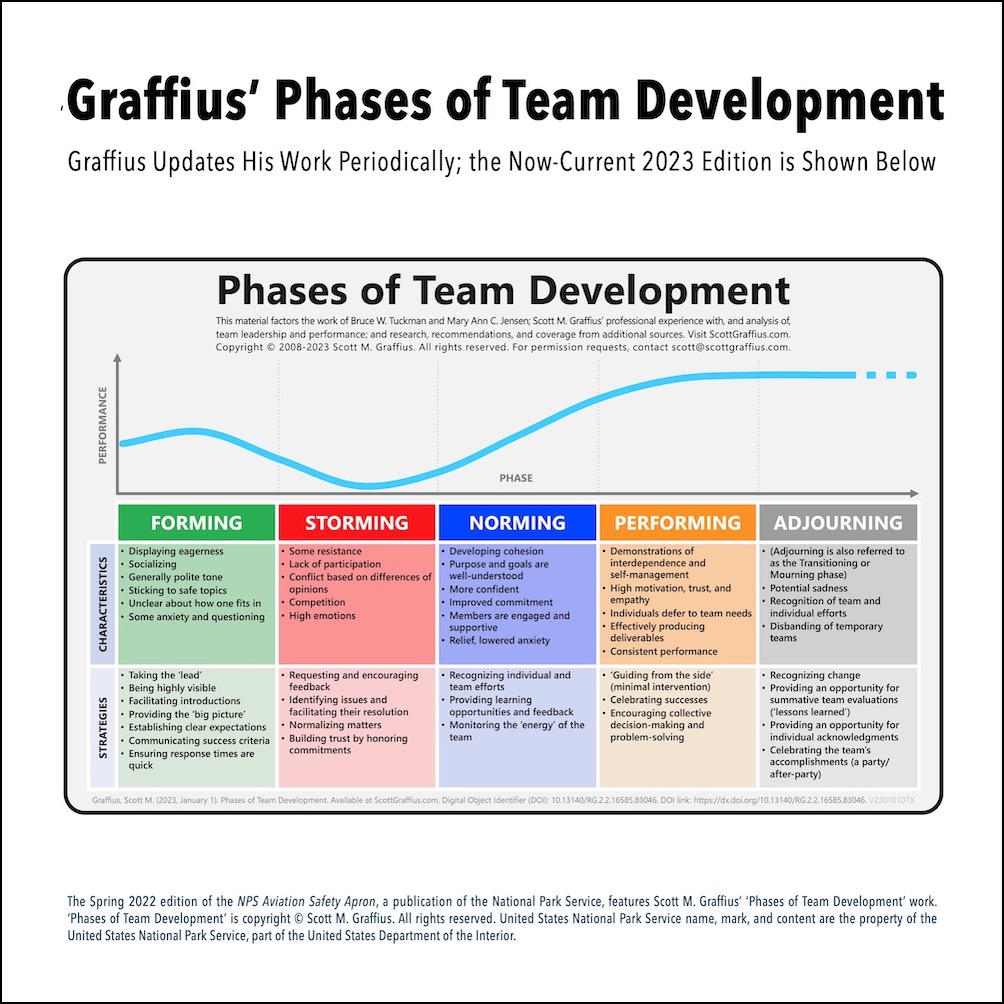
Graffius periodically updates his 'Phases of Team Development' work. The visual above shows the now-current (2023) edition of his work.
About Scott M. Graffius' 'Phases of Team Development'
Informed by the research of Bruce W. Tuckman and Mary Ann C. Jensen, over 100 subsequent studies, and Scott M. Graffius' first-hand professional experience with, and analysis of, team leadership and performance, Graffius created his ‘Phases of Team Development’ as a unique perspective and visual conveying the five phases of team development — Forming, Storming, Norming, Performing, and Adjourning — inclusive of a graph showing how performance varies by phase, as well as the characteristics and strategies for each phase.
With permission/a license from Graffius, his 'Phases of Team Development' work is used by businesses, professional associations, governments, and universities around the world. For more on my ‘Phases of Team Development,’ visit https://bit.ly/teams-2023.
About the National Park Service
The National Park Service (NPS) is an agency of the United States federal government within the U.S. Department of the Interior that manages all national parks, most national monuments, and other natural, historical, and recreational properties with various title designations. The U.S. Congress created the agency on August 25, 1916, through the National Park Service Organic Act. The NPS is headquartered in Washington, D.C., within the main headquarters of the Department of the Interior.
The NPS employs approximately 20,000 people in 425 individual units covering over 85 million acres in all 50 states, the District of Columbia, and U.S. territories. As of 2019, they had more than 279,000 volunteers. The agency is charged with a dual role of preserving the ecological and historical integrity of the places entrusted to its management while also making them available and accessible for public use and enjoyment.
Its mission statement is: “The National Park Service preserves unimpaired the natural and cultural resources and values of the National Park System for the enjoyment, education, and inspiration of this and future generations. The National Park Service cooperates with partners to extend the benefits of natural and cultural resource conservation and outdoor recreation throughout this country and the world.” Source: https://www.nps.gov/aboutus/index.htm.
About Scott M. Graffius
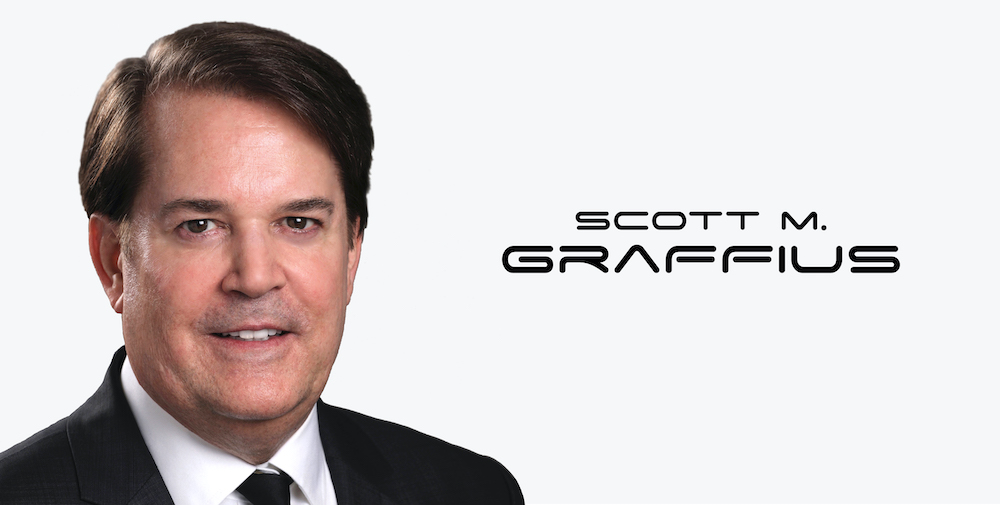
Scott M. Graffius, PMP, SA, CSP-SM, CSP-PO, CSM, CSPO, SFE, ITIL, LSSGB is an agile project management practitioner, consultant, multi-award-winning author, and international keynote speaker. He is the Founder of Exceptional PPM and PMO Solutions™ and subsidiary Exceptional Agility™. He has generated over $1.9 billion of business value in aggregate for Global Fortune 500 businesses and other organizations he has served. Graffius and content from his books, talks, workshops, and more have been featured and used by businesses, professional associations, governments, and universities. Examples include Microsoft, Oracle, Broadcom, Cisco, Gartner, Project Management Institute, IEEE, Qantas, National Academy of Sciences, United States Department of Energy, New Zealand Ministry of Education, Yale University, Tufts University, and others. He has delighted audiences with dynamic and engaging talks and workshops on agile, project management, and technology (including AI) leadership at 87 conferences and other events across 25 countries.
His full bio is available here.
Connect with Scott on:
About Agile Scrum: Your Quick Start Guide with Step-by-Step Instructions
Shifting customer needs are common in today's marketplace. Businesses must be adaptive and responsive to change while delivering an exceptional customer experience to be competitive.
There are a variety of frameworks supporting the development of products and services, and most approaches fall into one of two broad categories: traditional or agile. Traditional practices such as waterfall engage sequential development, while agile involves iterative and incremental deliverables. Organizations are increasingly embracing agile to manage projects, and best meet their business needs of rapid response to change, fast delivery speed, and more.
With clear and easy to follow instructions, the multi award-winning Agile Scrum: Your Quick Start Guide with Step-by-Step Instructions book by Scott M. Graffius (Chris Hare and Colin Giffen, Technical Editors) helps the reader:
Hailed by Literary Titan as “the book highlights the versatility of Scrum beautifully.”
Winner of 17 first place awards.
Agile Scrum: Your Quick Start Guide with Step-by-Step Instructions is available in paperback and ebook/Kindle in the United States and around the world. Some links by country follow.
About Agile Transformation: A Brief Story of How an Entertainment Company Developed New Capabilities and Unlocked Business Agility to Thrive in an Era of Rapid Change
Thriving in today's marketplace frequently depends on making a transformation to become more agile. Those successful in the transition enjoy faster delivery speed and ROI, higher satisfaction, continuous improvement, and additional benefits.
Based on actual events, Agile Transformation: A Brief Story of How an Entertainment Company Developed New Capabilities and Unlocked Business Agility to Thrive in an Era of Rapid Change provides a quick (60-90 minute) read about a successful agile transformation at a multinational entertainment and media company, told from the author's perspective as an agile coach.
The award-winning book by Scott M. Graffius is available in paperback and ebook/Kindle in the United States and around the world. Some links by country follow.
The short URL for this article is: https://bit.ly/nps-23.
© Copyright 2023 Scott M. Graffius. All rights reserved. This material may not be published, broadcast, rewritten or redistributed without the express written permission of Scott M. Graffius.
Select here to download a PDF of this article.
The National Park Service (NPS), part of the United States Department of the Interior, included Scott M. Graffius' ‘Phases of Team Development’ work in their newsletter. Highlights follow.
The above visual provides an overview of pages 1, 2, and 3 of the NPS publication.
The above visual provides a singular view of page 3 of the NPS publication. The red arrow points to Graffius' 'Phases of Team Development.'
Graffius periodically updates his 'Phases of Team Development' work. The visual above shows the now-current (2023) edition of his work.
About Scott M. Graffius' 'Phases of Team Development'
Informed by the research of Bruce W. Tuckman and Mary Ann C. Jensen, over 100 subsequent studies, and Scott M. Graffius' first-hand professional experience with, and analysis of, team leadership and performance, Graffius created his ‘Phases of Team Development’ as a unique perspective and visual conveying the five phases of team development — Forming, Storming, Norming, Performing, and Adjourning — inclusive of a graph showing how performance varies by phase, as well as the characteristics and strategies for each phase.
With permission/a license from Graffius, his 'Phases of Team Development' work is used by businesses, professional associations, governments, and universities around the world. For more on my ‘Phases of Team Development,’ visit https://bit.ly/teams-2023.
About the National Park Service
The National Park Service (NPS) is an agency of the United States federal government within the U.S. Department of the Interior that manages all national parks, most national monuments, and other natural, historical, and recreational properties with various title designations. The U.S. Congress created the agency on August 25, 1916, through the National Park Service Organic Act. The NPS is headquartered in Washington, D.C., within the main headquarters of the Department of the Interior.
The NPS employs approximately 20,000 people in 425 individual units covering over 85 million acres in all 50 states, the District of Columbia, and U.S. territories. As of 2019, they had more than 279,000 volunteers. The agency is charged with a dual role of preserving the ecological and historical integrity of the places entrusted to its management while also making them available and accessible for public use and enjoyment.
Its mission statement is: “The National Park Service preserves unimpaired the natural and cultural resources and values of the National Park System for the enjoyment, education, and inspiration of this and future generations. The National Park Service cooperates with partners to extend the benefits of natural and cultural resource conservation and outdoor recreation throughout this country and the world.” Source: https://www.nps.gov/aboutus/index.htm.
About Scott M. Graffius
Scott M. Graffius, PMP, SA, CSP-SM, CSP-PO, CSM, CSPO, SFE, ITIL, LSSGB is an agile project management practitioner, consultant, multi-award-winning author, and international keynote speaker. He is the Founder of Exceptional PPM and PMO Solutions™ and subsidiary Exceptional Agility™. He has generated over $1.9 billion of business value in aggregate for Global Fortune 500 businesses and other organizations he has served. Graffius and content from his books, talks, workshops, and more have been featured and used by businesses, professional associations, governments, and universities. Examples include Microsoft, Oracle, Broadcom, Cisco, Gartner, Project Management Institute, IEEE, Qantas, National Academy of Sciences, United States Department of Energy, New Zealand Ministry of Education, Yale University, Tufts University, and others. He has delighted audiences with dynamic and engaging talks and workshops on agile, project management, and technology (including AI) leadership at 87 conferences and other events across 25 countries.
His full bio is available here.
Connect with Scott on:
About Agile Scrum: Your Quick Start Guide with Step-by-Step Instructions
Shifting customer needs are common in today's marketplace. Businesses must be adaptive and responsive to change while delivering an exceptional customer experience to be competitive.
There are a variety of frameworks supporting the development of products and services, and most approaches fall into one of two broad categories: traditional or agile. Traditional practices such as waterfall engage sequential development, while agile involves iterative and incremental deliverables. Organizations are increasingly embracing agile to manage projects, and best meet their business needs of rapid response to change, fast delivery speed, and more.
With clear and easy to follow instructions, the multi award-winning Agile Scrum: Your Quick Start Guide with Step-by-Step Instructions book by Scott M. Graffius (Chris Hare and Colin Giffen, Technical Editors) helps the reader:
- Implement and use the most popular agile framework―Scrum;
- Deliver products in short cycles with rapid adaptation to change, fast time-to-market, and continuous improvement; and
- Support innovation and drive competitive advantage.
Hailed by Literary Titan as “the book highlights the versatility of Scrum beautifully.”
Winner of 17 first place awards.
Agile Scrum: Your Quick Start Guide with Step-by-Step Instructions is available in paperback and ebook/Kindle in the United States and around the world. Some links by country follow.
- 🇧🇷 Brazil
- 🇨🇦 Canada
- 🇨🇿 Czech Republic
- 🇩🇰 Denmark
- 🇫🇮 Finland
- 🇫🇷 France
- 🇩🇪 Germany
- 🇬🇷 Greece
- 🇭🇺 Hungary
- 🇮🇳 India
- 🇮🇪 Ireland
- 🇮🇱 Israel
- 🇮🇹 Italy
- 🇯🇵 Japan
- 🇱🇺 Luxembourg
- 🇲🇽 Mexico
- 🇳🇱 Netherlands
- 🇳🇿 New Zealand
- 🇳🇴 Norway
- 🇪🇸 Spain
- 🇸🇪 Sweden
- 🇨🇭 Switzerland
- 🇦🇪 UAE
- 🇬🇧 United Kingdom
- 🇺🇸 United States
About Agile Transformation: A Brief Story of How an Entertainment Company Developed New Capabilities and Unlocked Business Agility to Thrive in an Era of Rapid Change
Thriving in today's marketplace frequently depends on making a transformation to become more agile. Those successful in the transition enjoy faster delivery speed and ROI, higher satisfaction, continuous improvement, and additional benefits.
Based on actual events, Agile Transformation: A Brief Story of How an Entertainment Company Developed New Capabilities and Unlocked Business Agility to Thrive in an Era of Rapid Change provides a quick (60-90 minute) read about a successful agile transformation at a multinational entertainment and media company, told from the author's perspective as an agile coach.
The award-winning book by Scott M. Graffius is available in paperback and ebook/Kindle in the United States and around the world. Some links by country follow.
- 🇦🇺 Australia
- 🇦🇹 Austria
- 🇧🇷 Brazil
- 🇨🇦 Canada
- 🇨🇿 Czech Republic
- 🇩🇰 Denmark
- 🇫🇮 Finland
- 🇫🇷 France
- 🇩🇪 Germany
- 🇬🇷 Greece
- 🇮🇳 India
- 🇮🇪 Ireland
- 🇯🇵 Japan
- 🇱🇺 Luxembourg
- 🇲🇽 Mexico
- 🇳🇱 Netherlands
- 🇳🇿 New Zealand
- 🇪🇸 Spain
- 🇸🇪 Sweden
- 🇨🇭 Switzerland
- 🇦🇪 United Arab Emirates
- 🇬🇧 United Kingdom
- 🇺🇸 United States
The short URL for this article is: https://bit.ly/nps-23.
© Copyright 2023 Scott M. Graffius. All rights reserved. This material may not be published, broadcast, rewritten or redistributed without the express written permission of Scott M. Graffius.
Aerospace Company Deimos Space Featured Scott M. Graffius' 'Phases of Team Development' Work
06 October 2023
BY SCOTT M. GRAFFIUS | ScottGraffius.com
Informed by the research of Bruce W. Tuckman and Mary Ann C. Jensen, over 100 subsequent studies, and Scott M. Graffius' first-hand professional experience with, and analysis of, team leadership and performance, Graffius created his ‘Phases of Team Development’ as a unique perspective and visual conveying the five phases of team development — Forming, Storming, Norming, Performing, and Adjourning — inclusive of a graph showing how performance varies by phase, as well as the characteristics and strategies for each phase.
With permission/a license from Graffius, his ‘Phases of Team Development’ work is used by businesses, professional associations, governments, and universities around the world. Examples include Yale University, IEEE, Torrens University Australia, UK Sports Institute, Adobe, Amsterdam Public Health Research Institute, Academic Cooperation Association, Boston University, U.S. National Park Service, Bayer, Hasso Plattner Institute (Hasso-Plattner-Institut für Digital Engineering GmbH), Singapore University of Social Sciences, New Zealand Government, University of Galway Ireland, and many more.
Deimos Space, a leading Aerospace company, was added to the list.
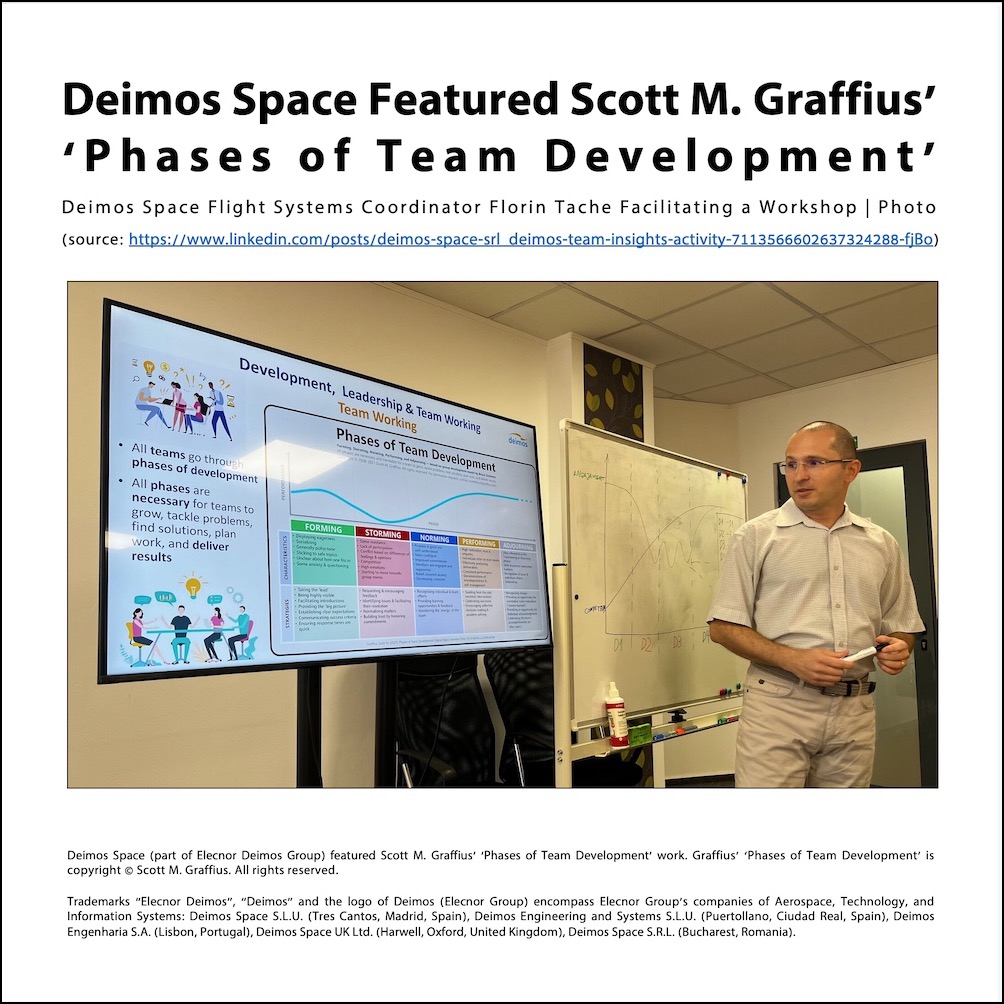
As shown above, Deimos Space featured Scott M. Graffius' 'Phases of Team Development' work during a training.
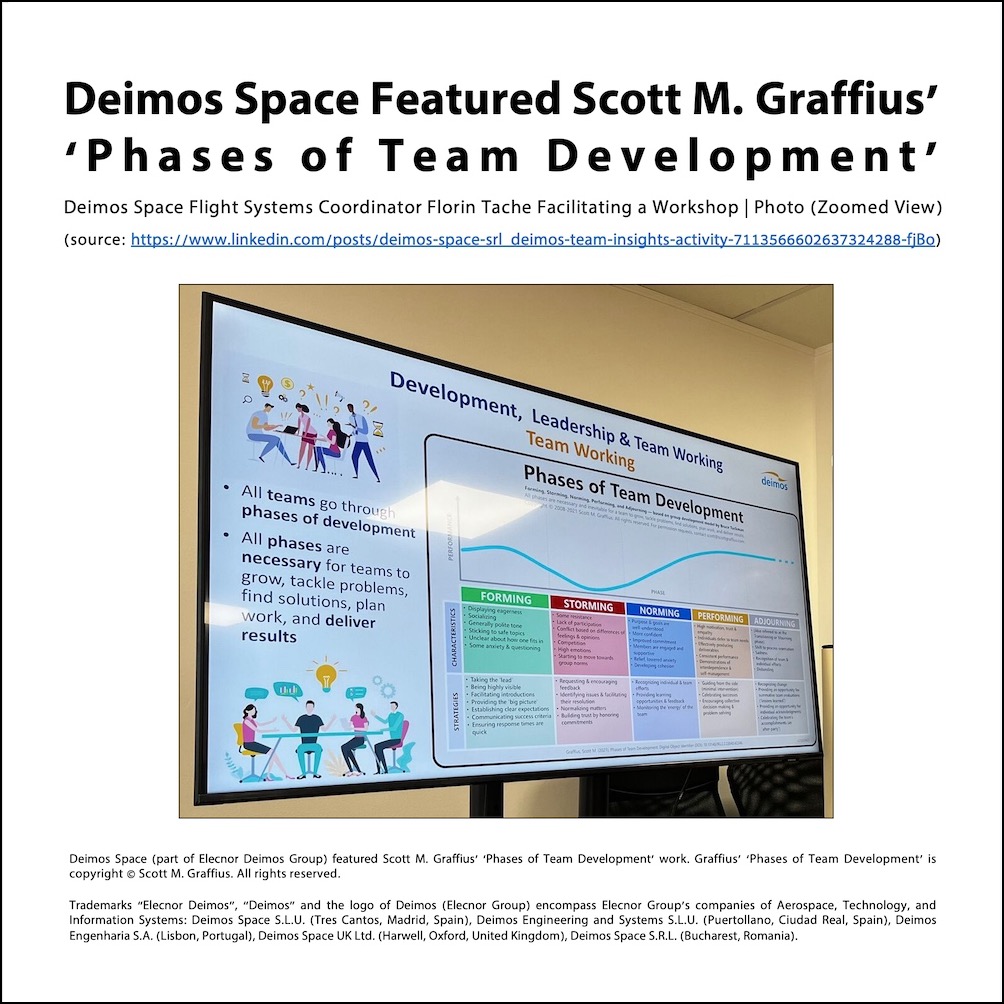
A zoomed-in version of the photo is shown above.
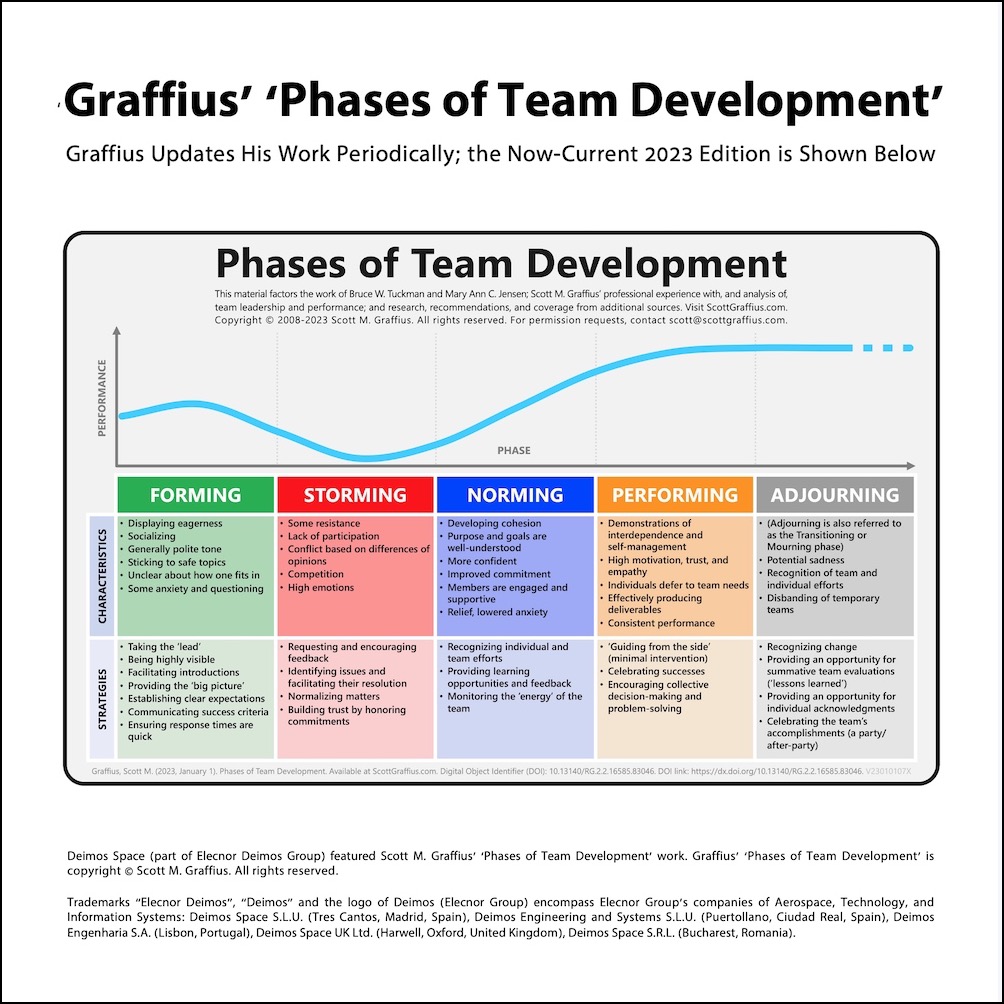
Graffius periodically updates his work. The most current (2023) edition of his 'Phases of Team Development' visual is shown above. Select here for details.
About Deimos Space
Deimos Space (part of Elecnor Deimos Group) is a leading company in the European Aerospace sector with an extensive portfolio of projects and solutions employed at the European Space Agency (ESA) and other organizations. Its expertise includes Satellite Navigation Systems, Space Situational Awareness, Mission Analysis and Design, Guidance Navigation and Control, Ground Segment Systems, and more. Visit their website — here — to learn more.

About Scott M. Graffius
Scott M. Graffius, PMP, SA, CSP-SM, CSP-PO, CSM, CSPO, SFE, ITIL, LSSGB is an agile project management practitioner, consultant, multi-award-winning author, and international keynote speaker. He is the Founder of Exceptional PPM and PMO Solutions™ and subsidiary Exceptional Agility™. He has generated over $1.9 billion of business value in aggregate for Global Fortune 500 businesses and other organizations he has served. Graffius and content from his books, talks, workshops, and more have been featured and used by businesses, professional associations, governments, and universities. Examples include Microsoft, Oracle, Broadcom, Cisco, Gartner, Project Management Institute, IEEE, Qantas, National Academy of Sciences, United States Department of Energy, New Zealand Ministry of Education, Yale University, Tufts University, and others. He has delighted audiences with dynamic and engaging talks and workshops on agile, project management, and technology (including AI) leadership at 87 conferences and other events across 25 countries.
His full bio is available here.
Connect with Scott on:
About Agile Scrum: Your Quick Start Guide with Step-by-Step Instructions
Shifting customer needs are common in today's marketplace. Businesses must be adaptive and responsive to change while delivering an exceptional customer experience to be competitive.
There are a variety of frameworks supporting the development of products and services, and most approaches fall into one of two broad categories: traditional or agile. Traditional practices such as waterfall engage sequential development, while agile involves iterative and incremental deliverables. Organizations are increasingly embracing agile to manage projects, and best meet their business needs of rapid response to change, fast delivery speed, and more.
With clear and easy to follow instructions, the multi award-winning Agile Scrum: Your Quick Start Guide with Step-by-Step Instructions book by Scott M. Graffius (Chris Hare and Colin Giffen, Technical Editors) helps the reader:
Hailed by Literary Titan as “the book highlights the versatility of Scrum beautifully.”
Winner of 17 first place awards.
Agile Scrum: Your Quick Start Guide with Step-by-Step Instructions is available in paperback and ebook/Kindle in the United States and around the world. Some links by country follow.
About Agile Transformation: A Brief Story of How an Entertainment Company Developed New Capabilities and Unlocked Business Agility to Thrive in an Era of Rapid Change
Thriving in today's marketplace frequently depends on making a transformation to become more agile. Those successful in the transition enjoy faster delivery speed and ROI, higher satisfaction, continuous improvement, and additional benefits.
Based on actual events, Agile Transformation: A Brief Story of How an Entertainment Company Developed New Capabilities and Unlocked Business Agility to Thrive in an Era of Rapid Change provides a quick (60-90 minute) read about a successful agile transformation at a multinational entertainment and media company, told from the author's perspective as an agile coach.
The award-winning book by Scott M. Graffius is available in paperback and ebook/Kindle in the United States and around the world. Some links by country follow.
The short URL for this article is: https://bit.ly/space-23.
© Copyright 2023 Scott M. Graffius. All rights reserved. This material may not be published, broadcast, rewritten or redistributed without the express written permission of Scott M. Graffius.
Informed by the research of Bruce W. Tuckman and Mary Ann C. Jensen, over 100 subsequent studies, and Scott M. Graffius' first-hand professional experience with, and analysis of, team leadership and performance, Graffius created his ‘Phases of Team Development’ as a unique perspective and visual conveying the five phases of team development — Forming, Storming, Norming, Performing, and Adjourning — inclusive of a graph showing how performance varies by phase, as well as the characteristics and strategies for each phase.
With permission/a license from Graffius, his ‘Phases of Team Development’ work is used by businesses, professional associations, governments, and universities around the world. Examples include Yale University, IEEE, Torrens University Australia, UK Sports Institute, Adobe, Amsterdam Public Health Research Institute, Academic Cooperation Association, Boston University, U.S. National Park Service, Bayer, Hasso Plattner Institute (Hasso-Plattner-Institut für Digital Engineering GmbH), Singapore University of Social Sciences, New Zealand Government, University of Galway Ireland, and many more.
Deimos Space, a leading Aerospace company, was added to the list.
As shown above, Deimos Space featured Scott M. Graffius' 'Phases of Team Development' work during a training.
A zoomed-in version of the photo is shown above.
Graffius periodically updates his work. The most current (2023) edition of his 'Phases of Team Development' visual is shown above. Select here for details.
About Deimos Space
Deimos Space (part of Elecnor Deimos Group) is a leading company in the European Aerospace sector with an extensive portfolio of projects and solutions employed at the European Space Agency (ESA) and other organizations. Its expertise includes Satellite Navigation Systems, Space Situational Awareness, Mission Analysis and Design, Guidance Navigation and Control, Ground Segment Systems, and more. Visit their website — here — to learn more.
About Scott M. Graffius
Scott M. Graffius, PMP, SA, CSP-SM, CSP-PO, CSM, CSPO, SFE, ITIL, LSSGB is an agile project management practitioner, consultant, multi-award-winning author, and international keynote speaker. He is the Founder of Exceptional PPM and PMO Solutions™ and subsidiary Exceptional Agility™. He has generated over $1.9 billion of business value in aggregate for Global Fortune 500 businesses and other organizations he has served. Graffius and content from his books, talks, workshops, and more have been featured and used by businesses, professional associations, governments, and universities. Examples include Microsoft, Oracle, Broadcom, Cisco, Gartner, Project Management Institute, IEEE, Qantas, National Academy of Sciences, United States Department of Energy, New Zealand Ministry of Education, Yale University, Tufts University, and others. He has delighted audiences with dynamic and engaging talks and workshops on agile, project management, and technology (including AI) leadership at 87 conferences and other events across 25 countries.
His full bio is available here.
Connect with Scott on:
About Agile Scrum: Your Quick Start Guide with Step-by-Step Instructions
Shifting customer needs are common in today's marketplace. Businesses must be adaptive and responsive to change while delivering an exceptional customer experience to be competitive.
There are a variety of frameworks supporting the development of products and services, and most approaches fall into one of two broad categories: traditional or agile. Traditional practices such as waterfall engage sequential development, while agile involves iterative and incremental deliverables. Organizations are increasingly embracing agile to manage projects, and best meet their business needs of rapid response to change, fast delivery speed, and more.
With clear and easy to follow instructions, the multi award-winning Agile Scrum: Your Quick Start Guide with Step-by-Step Instructions book by Scott M. Graffius (Chris Hare and Colin Giffen, Technical Editors) helps the reader:
- Implement and use the most popular agile framework―Scrum;
- Deliver products in short cycles with rapid adaptation to change, fast time-to-market, and continuous improvement; and
- Support innovation and drive competitive advantage.
Hailed by Literary Titan as “the book highlights the versatility of Scrum beautifully.”
Winner of 17 first place awards.
Agile Scrum: Your Quick Start Guide with Step-by-Step Instructions is available in paperback and ebook/Kindle in the United States and around the world. Some links by country follow.
- 🇧🇷 Brazil
- 🇨🇦 Canada
- 🇨🇿 Czech Republic
- 🇩🇰 Denmark
- 🇫🇮 Finland
- 🇫🇷 France
- 🇩🇪 Germany
- 🇬🇷 Greece
- 🇭🇺 Hungary
- 🇮🇳 India
- 🇮🇪 Ireland
- 🇮🇱 Israel
- 🇮🇹 Italy
- 🇯🇵 Japan
- 🇱🇺 Luxembourg
- 🇲🇽 Mexico
- 🇳🇱 Netherlands
- 🇳🇿 New Zealand
- 🇳🇴 Norway
- 🇪🇸 Spain
- 🇸🇪 Sweden
- 🇨🇭 Switzerland
- 🇦🇪 UAE
- 🇬🇧 United Kingdom
- 🇺🇸 United States
About Agile Transformation: A Brief Story of How an Entertainment Company Developed New Capabilities and Unlocked Business Agility to Thrive in an Era of Rapid Change
Thriving in today's marketplace frequently depends on making a transformation to become more agile. Those successful in the transition enjoy faster delivery speed and ROI, higher satisfaction, continuous improvement, and additional benefits.
Based on actual events, Agile Transformation: A Brief Story of How an Entertainment Company Developed New Capabilities and Unlocked Business Agility to Thrive in an Era of Rapid Change provides a quick (60-90 minute) read about a successful agile transformation at a multinational entertainment and media company, told from the author's perspective as an agile coach.
The award-winning book by Scott M. Graffius is available in paperback and ebook/Kindle in the United States and around the world. Some links by country follow.
- 🇦🇺 Australia
- 🇦🇹 Austria
- 🇧🇷 Brazil
- 🇨🇦 Canada
- 🇨🇿 Czech Republic
- 🇩🇰 Denmark
- 🇫🇮 Finland
- 🇫🇷 France
- 🇩🇪 Germany
- 🇬🇷 Greece
- 🇮🇳 India
- 🇮🇪 Ireland
- 🇯🇵 Japan
- 🇱🇺 Luxembourg
- 🇲🇽 Mexico
- 🇳🇱 Netherlands
- 🇳🇿 New Zealand
- 🇪🇸 Spain
- 🇸🇪 Sweden
- 🇨🇭 Switzerland
- 🇦🇪 United Arab Emirates
- 🇬🇧 United Kingdom
- 🇺🇸 United States
The short URL for this article is: https://bit.ly/space-23.
© Copyright 2023 Scott M. Graffius. All rights reserved. This material may not be published, broadcast, rewritten or redistributed without the express written permission of Scott M. Graffius.
University of California, San Diego Features Scott M. Graffius’ ‘Phases of Team Development’ Work
05 March 2024
BY SCOTT M. GRAFFIUS | ScottGraffius.com

The University of California, San Diego (UCSD) Rady School of Management features Scott M. Graffius’ ‘Phases of Team Development’ work in MGT 173 Project Management.
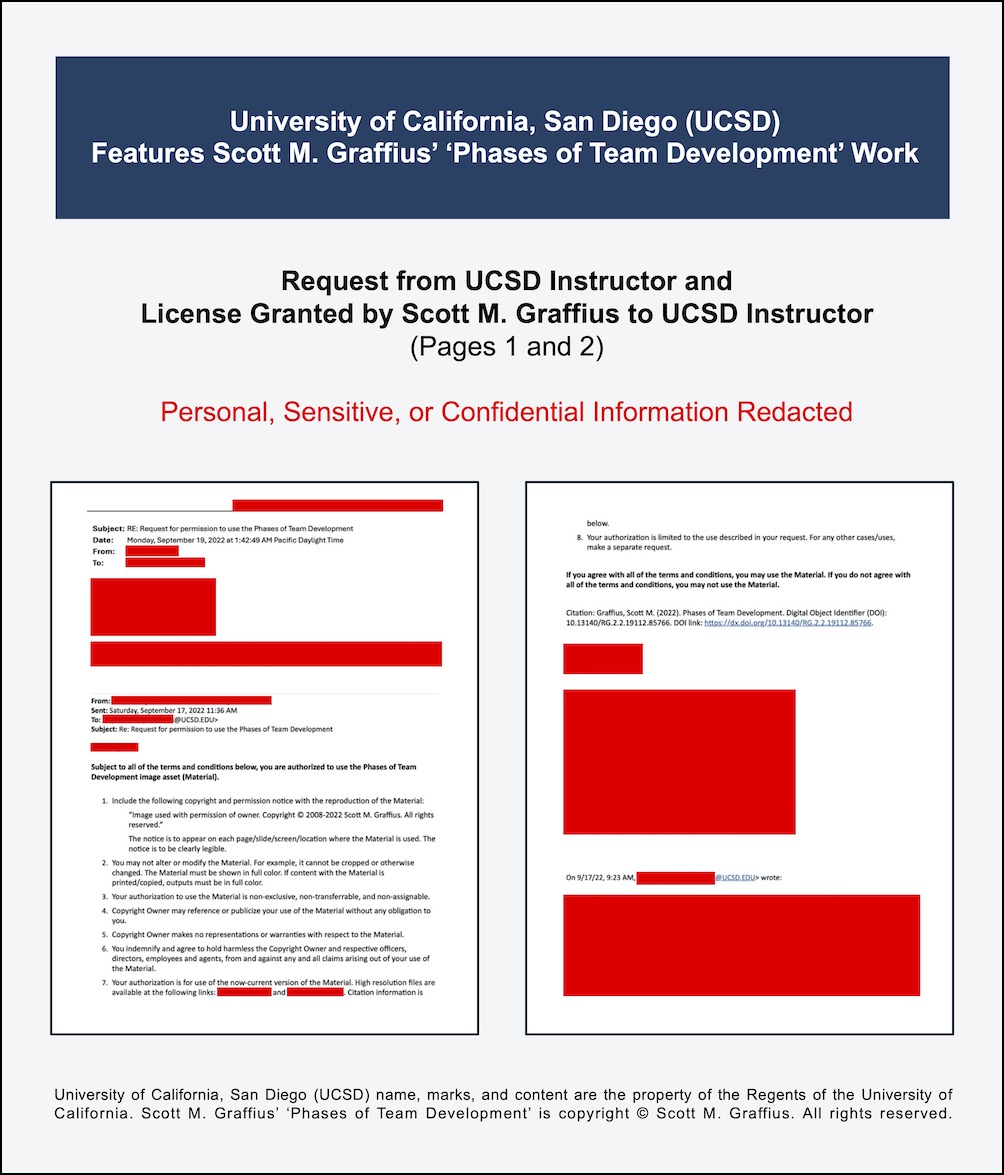
The request for, and the granting of, a license for Graffius’ copyrighted ‘Phases of Team Development’ is shown above.
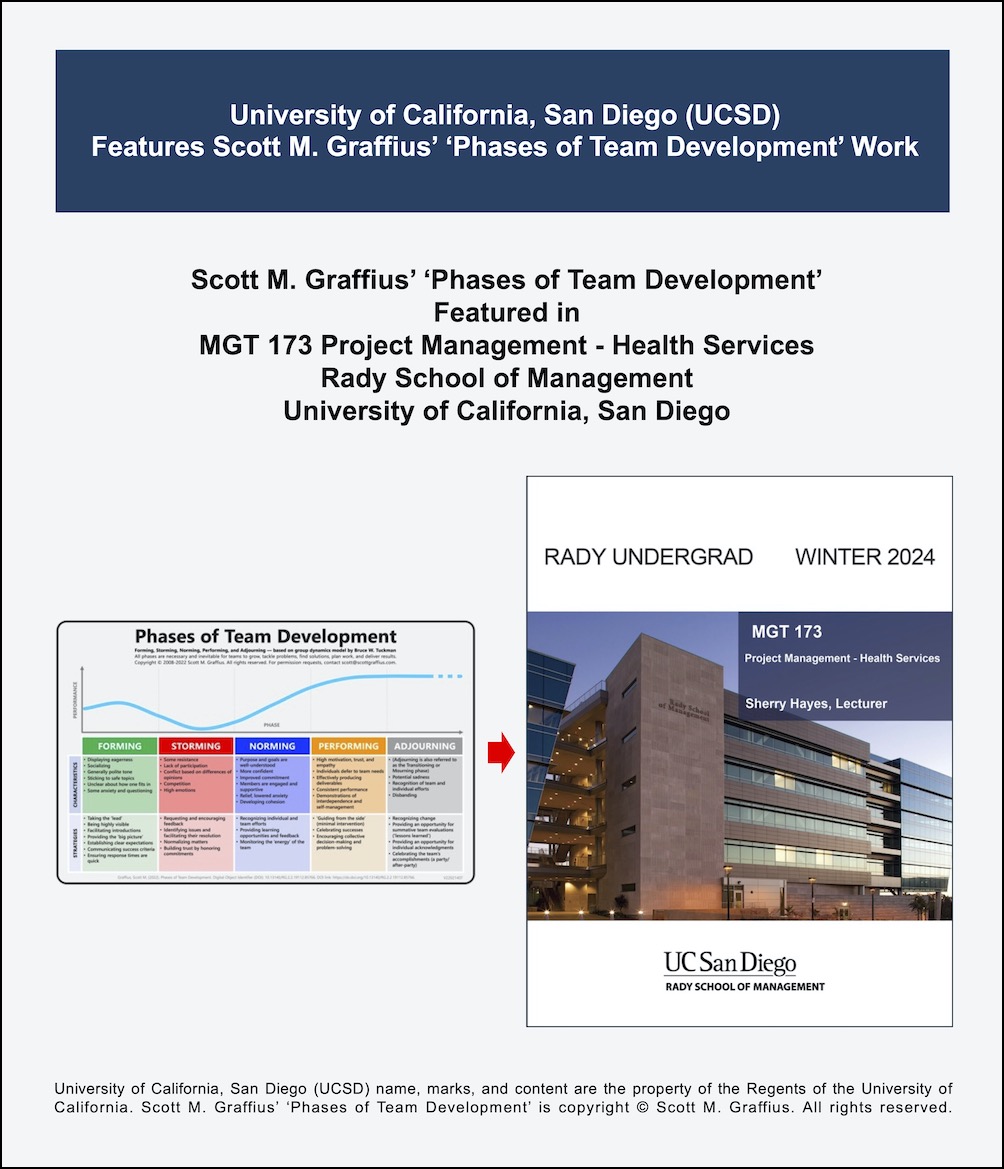
Graffius’ ‘Phases of Team Development’ work and the respective UCSD course are shown above.
About Graffius’ ‘Phases of Team Development’
Informed by the research of Bruce W. Tuckman and Mary Ann C. Jensen, over 100 subsequent studies, and Scott M. Graffius’ first-hand professional experience with, and analysis of, team leadership and performance, Graffius created his ‘Phases of Team Development’ as a unique perspective and visual conveying the five phases of team development — Forming, Storming, Norming, Performing, and Adjourning — inclusive of a graph showing how performance varies by phase, as well as the characteristics and strategies for each phase.
Project Managers, Scrum Masters, Agile Coaches, DevOps Leads, and other leaders can apply the information to help handle challenges or issues experienced by teams. By doing so, they’ll advance the teams’ (and their own) happiness, productivity, and success.
With permission/a license from Graffius, his ‘Phases of Team Development’ work is used by businesses, professional associations, government agencies, and universities around the world. Examples include Yale University, IEEE, Torrens University Australia, UK Sports Institute, Adobe, Amsterdam Public Health Research Institute, Academic Cooperation Association, Boston University, U.S. National Park Service, Bayer, Hasso Plattner Institute, New Zealand Government, University of Galway Ireland, and many more.
Graffius initially developed his unique material in 2008, and he periodically refreshes it. The most current (2024) edition of his work is here.
Graffius has presented talks and workshops at 89 conferences and other events across 25 countries. While each session is unique, the top topic is high performance teams. In those sessions, he leverages and expands upon on his ‘Phases of Team Development’ work. Sessions are dynamic, engaging, and packed with fresh insights and usable information. They’re highly rated by attendees and organizers alike. To book him for your conference or other event, complete a speaker engagement request form or email him.

About UCSD Rady School of Management Course - MGT 173 Project Management
UCSD describes MGT 173 Project Management at https://catalog.ucsd.edu/courses/MGT.html as: "This course covers efficient techniques for managing health services projects, including both the technical aspects of project management as well as the human-capital management issues associated with blending administrative and technical staff with health-care professionals. Topics include scheduling methods, milestone setting, governmental regulations, resource allocation, interpersonal skills, and performing research and development projects—all with a health services focus."

About UCSD
Recognized as one of the top 20 research universities worldwide, the University of California, San Diego (UCSD) culture of collaboration sparks discoveries that advance society and drive economic impact. UCSD is considered a Public Ivy—a public university perceived to provide a collegiate experience on the level of Ivy League universities. Its faculty, researchers, and alumni have won 27 Nobel Prizes as well as 3 Fields Medals, 8 National Medals of Science, 8 MacArthur Fellowships, and 3 Pulitzer Prizes. Additionally, of the current faculty, 29 have been elected to the National Academy of Engineering, 70 to the National Academy of Sciences, 45 to the Institute of Medicine, and 110 to the American Academy of Arts and Sciences. Visit https://ucsd.edu to learn more.
About Scott M. Graffius
Scott M. Graffius, PMP, SA, CSP-SM, CSP-PO, CSM, CSPO, ITIL, LSSGB is an agile project management practitioner, consultant, thinker, creator, multi-award-winning author, and international public speaker. Founder and CEO of Exceptional PPM and PMO Solutions™ and subsidiary Exceptional Agility™, he has generated over $1.9 billion for Global Fortune 500 businesses and other organizations he has served. Graffius and content from his books, talks, workshops, and more have been featured and used by Microsoft, Oracle, Broadcom, Cisco, Gartner, Project Management Institute, IEEE, National Academy of Sciences, United States Department of Energy, Yale University, Tufts University, and others. He delights audiences with dynamic and engaging talks and workshops on agile project management, AI, Tech leadership, video game development, strategic alignment, the science of high performance teams, and more. To date, he's presented sessions at 89 conferences and other events across 25 countries.
His full bio is available here.
Connect with Scott on:
About Agile Scrum: Your Quick Start Guide with Step-by-Step Instructions
Shifting customer needs are common in today's marketplace. Businesses must be adaptive and responsive to change while delivering an exceptional customer experience to be competitive.
There are a variety of frameworks supporting the development of products and services, and most approaches fall into one of two broad categories: traditional or agile. Traditional practices such as waterfall engage sequential development, while agile involves iterative and incremental deliverables. Organizations are increasingly embracing agile to manage projects, and best meet their business needs of rapid response to change, fast delivery speed, and more.
With clear and easy to follow step-by-step instructions, Scott M. Graffius's award-winning Agile Scrum: Your Quick Start Guide with Step-by-Step Instructions helps the reader:
Hailed by Literary Titan as “the book highlights the versatility of Scrum beautifully.”
Winner of 17 first place awards.
Agile Scrum: Your Quick Start Guide with Step-by-Step Instructions is available in paperback and ebook/Kindle in the United States and around the world. Some links by country follow.
About Agile Transformation: A Brief Story of How an Entertainment Company Developed New Capabilities and Unlocked Business Agility to Thrive in an Era of Rapid Change
Thriving in today's marketplace frequently depends on making a transformation to become more agile. Those successful in the transition enjoy faster delivery speed and ROI, higher satisfaction, continuous improvement, and additional benefits.
Based on actual events, Agile Transformation: A Brief Story of How an Entertainment Company Developed New Capabilities and Unlocked Business Agility to Thrive in an Era of Rapid Change provides a quick (60-90 minute) read about a successful agile transformation at a multinational entertainment and media company, told from the author's perspective as an agile coach.
The award-winning book by Scott M. Graffius is available in paperback and ebook/Kindle in the United States and around the world. Some links by country follow.
The short link for this article is: https://bit.ly/ucsd-173
© Copyright 2024 Scott M. Graffius. All rights reserved. This material may not be published, broadcast, rewritten or redistributed without the express written permission of Scott M. Graffius.
The University of California, San Diego (UCSD) Rady School of Management features Scott M. Graffius’ ‘Phases of Team Development’ work in MGT 173 Project Management.
The request for, and the granting of, a license for Graffius’ copyrighted ‘Phases of Team Development’ is shown above.
Graffius’ ‘Phases of Team Development’ work and the respective UCSD course are shown above.
About Graffius’ ‘Phases of Team Development’
Informed by the research of Bruce W. Tuckman and Mary Ann C. Jensen, over 100 subsequent studies, and Scott M. Graffius’ first-hand professional experience with, and analysis of, team leadership and performance, Graffius created his ‘Phases of Team Development’ as a unique perspective and visual conveying the five phases of team development — Forming, Storming, Norming, Performing, and Adjourning — inclusive of a graph showing how performance varies by phase, as well as the characteristics and strategies for each phase.
Project Managers, Scrum Masters, Agile Coaches, DevOps Leads, and other leaders can apply the information to help handle challenges or issues experienced by teams. By doing so, they’ll advance the teams’ (and their own) happiness, productivity, and success.
With permission/a license from Graffius, his ‘Phases of Team Development’ work is used by businesses, professional associations, government agencies, and universities around the world. Examples include Yale University, IEEE, Torrens University Australia, UK Sports Institute, Adobe, Amsterdam Public Health Research Institute, Academic Cooperation Association, Boston University, U.S. National Park Service, Bayer, Hasso Plattner Institute, New Zealand Government, University of Galway Ireland, and many more.
Graffius initially developed his unique material in 2008, and he periodically refreshes it. The most current (2024) edition of his work is here.
Graffius has presented talks and workshops at 89 conferences and other events across 25 countries. While each session is unique, the top topic is high performance teams. In those sessions, he leverages and expands upon on his ‘Phases of Team Development’ work. Sessions are dynamic, engaging, and packed with fresh insights and usable information. They’re highly rated by attendees and organizers alike. To book him for your conference or other event, complete a speaker engagement request form or email him.
About UCSD Rady School of Management Course - MGT 173 Project Management
UCSD describes MGT 173 Project Management at https://catalog.ucsd.edu/courses/MGT.html as: "This course covers efficient techniques for managing health services projects, including both the technical aspects of project management as well as the human-capital management issues associated with blending administrative and technical staff with health-care professionals. Topics include scheduling methods, milestone setting, governmental regulations, resource allocation, interpersonal skills, and performing research and development projects—all with a health services focus."
About UCSD
Recognized as one of the top 20 research universities worldwide, the University of California, San Diego (UCSD) culture of collaboration sparks discoveries that advance society and drive economic impact. UCSD is considered a Public Ivy—a public university perceived to provide a collegiate experience on the level of Ivy League universities. Its faculty, researchers, and alumni have won 27 Nobel Prizes as well as 3 Fields Medals, 8 National Medals of Science, 8 MacArthur Fellowships, and 3 Pulitzer Prizes. Additionally, of the current faculty, 29 have been elected to the National Academy of Engineering, 70 to the National Academy of Sciences, 45 to the Institute of Medicine, and 110 to the American Academy of Arts and Sciences. Visit https://ucsd.edu to learn more.
About Scott M. Graffius
Scott M. Graffius, PMP, SA, CSP-SM, CSP-PO, CSM, CSPO, ITIL, LSSGB is an agile project management practitioner, consultant, thinker, creator, multi-award-winning author, and international public speaker. Founder and CEO of Exceptional PPM and PMO Solutions™ and subsidiary Exceptional Agility™, he has generated over $1.9 billion for Global Fortune 500 businesses and other organizations he has served. Graffius and content from his books, talks, workshops, and more have been featured and used by Microsoft, Oracle, Broadcom, Cisco, Gartner, Project Management Institute, IEEE, National Academy of Sciences, United States Department of Energy, Yale University, Tufts University, and others. He delights audiences with dynamic and engaging talks and workshops on agile project management, AI, Tech leadership, video game development, strategic alignment, the science of high performance teams, and more. To date, he's presented sessions at 89 conferences and other events across 25 countries.
His full bio is available here.
Connect with Scott on:
About Agile Scrum: Your Quick Start Guide with Step-by-Step Instructions
Shifting customer needs are common in today's marketplace. Businesses must be adaptive and responsive to change while delivering an exceptional customer experience to be competitive.
There are a variety of frameworks supporting the development of products and services, and most approaches fall into one of two broad categories: traditional or agile. Traditional practices such as waterfall engage sequential development, while agile involves iterative and incremental deliverables. Organizations are increasingly embracing agile to manage projects, and best meet their business needs of rapid response to change, fast delivery speed, and more.
With clear and easy to follow step-by-step instructions, Scott M. Graffius's award-winning Agile Scrum: Your Quick Start Guide with Step-by-Step Instructions helps the reader:
- Implement and use the most popular agile framework―Scrum;
- Deliver products in short cycles with rapid adaptation to change, fast time-to-market, and continuous improvement; and
- Support innovation and drive competitive advantage.
Hailed by Literary Titan as “the book highlights the versatility of Scrum beautifully.”
Winner of 17 first place awards.
Agile Scrum: Your Quick Start Guide with Step-by-Step Instructions is available in paperback and ebook/Kindle in the United States and around the world. Some links by country follow.
- 🇧🇷 Brazil
- 🇨🇦 Canada
- 🇨🇿 Czech Republic
- 🇩🇰 Denmark
- 🇫🇮 Finland
- 🇫🇷 France
- 🇩🇪 Germany
- 🇬🇷 Greece
- 🇭🇺 Hungary
- 🇮🇳 India
- 🇮🇪 Ireland
- 🇮🇱 Israel
- 🇮🇹 Italy
- 🇯🇵 Japan
- 🇱🇺 Luxembourg
- 🇲🇽 Mexico
- 🇳🇱 Netherlands
- 🇳🇿 New Zealand
- 🇳🇴 Norway
- 🇪🇸 Spain
- 🇸🇪 Sweden
- 🇨🇭 Switzerland
- 🇦🇪 UAE
- 🇬🇧 United Kingdom
- 🇺🇸 United States
About Agile Transformation: A Brief Story of How an Entertainment Company Developed New Capabilities and Unlocked Business Agility to Thrive in an Era of Rapid Change
Thriving in today's marketplace frequently depends on making a transformation to become more agile. Those successful in the transition enjoy faster delivery speed and ROI, higher satisfaction, continuous improvement, and additional benefits.
Based on actual events, Agile Transformation: A Brief Story of How an Entertainment Company Developed New Capabilities and Unlocked Business Agility to Thrive in an Era of Rapid Change provides a quick (60-90 minute) read about a successful agile transformation at a multinational entertainment and media company, told from the author's perspective as an agile coach.
The award-winning book by Scott M. Graffius is available in paperback and ebook/Kindle in the United States and around the world. Some links by country follow.
- 🇦🇺 Australia
- 🇦🇹 Austria
- 🇧🇷 Brazil
- 🇨🇦 Canada
- 🇨🇿 Czech Republic
- 🇩🇰 Denmark
- 🇫🇮 Finland
- 🇫🇷 France
- 🇩🇪 Germany
- 🇬🇷 Greece
- 🇮🇳 India
- 🇮🇪 Ireland
- 🇯🇵 Japan
- 🇱🇺 Luxembourg
- 🇲🇽 Mexico
- 🇳🇱 Netherlands
- 🇳🇿 New Zealand
- 🇪🇸 Spain
- 🇸🇪 Sweden
- 🇨🇭 Switzerland
- 🇦🇪 United Arab Emirates
- 🇬🇧 United Kingdom
- 🇺🇸 United States
The short link for this article is: https://bit.ly/ucsd-173
© Copyright 2024 Scott M. Graffius. All rights reserved. This material may not be published, broadcast, rewritten or redistributed without the express written permission of Scott M. Graffius.
Ford Features Scott M. Graffius' 'Phases of Team Development' Work
28 March 2024
BY SCOTT M. GRAFFIUS | ScottGraffius.com

With a license from Scott M. Graffius, his copyrighted ‘Phases of Team Development’ work is featured and used by businesses, professional associations, government agencies, and universities around the world. Examples include Yale University, IEEE, Constructor Institute (Switzerland), Adobe, Boston University, Amsterdam Public Health Research Institute, United States National Park Service, Bayer, University of Galway (Ireland), Hasso Plattner Institute (Germany), American Management Association, UC San Diego, and many more.
Ford was added to the list.
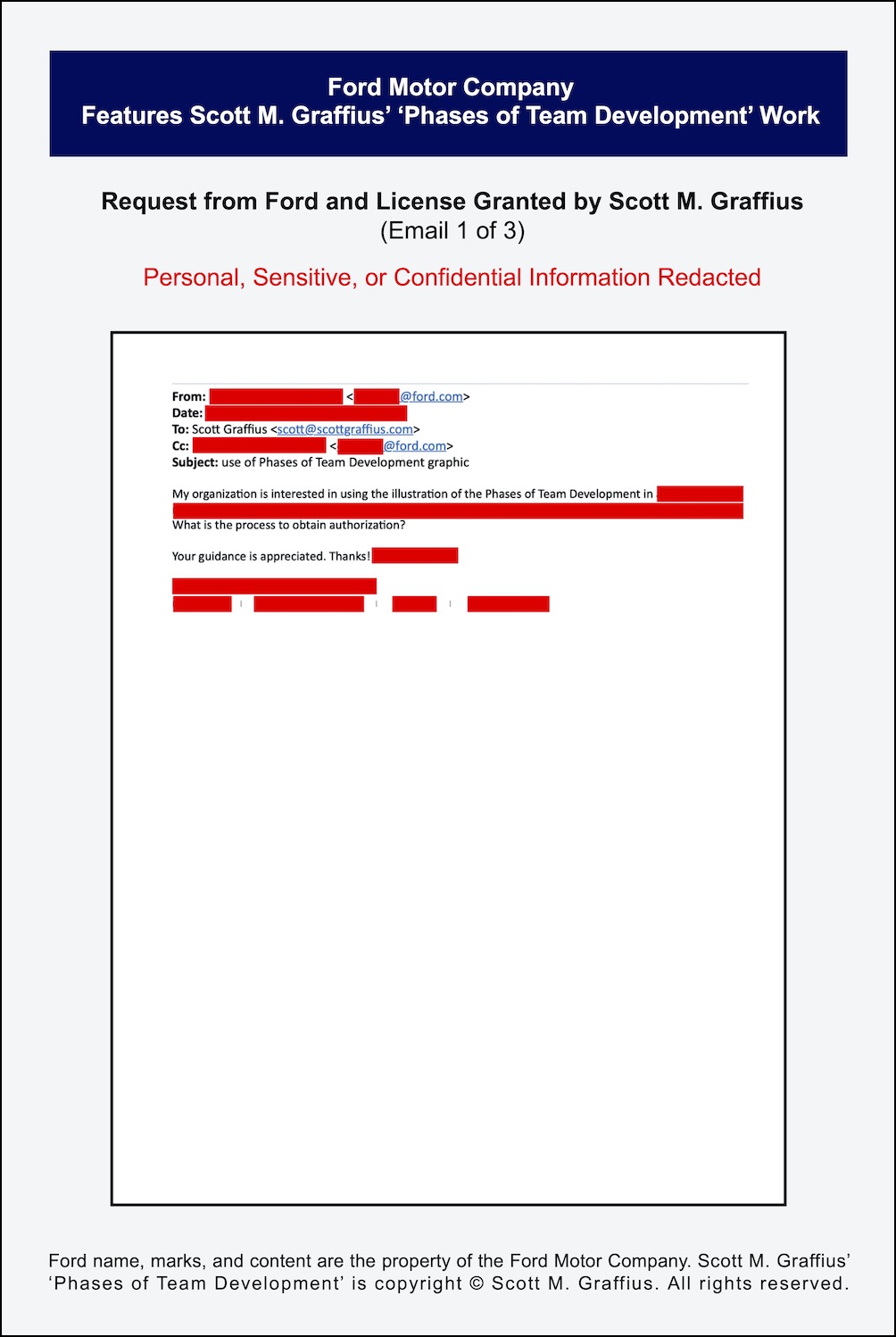
Email 1 of 3 is shown above.
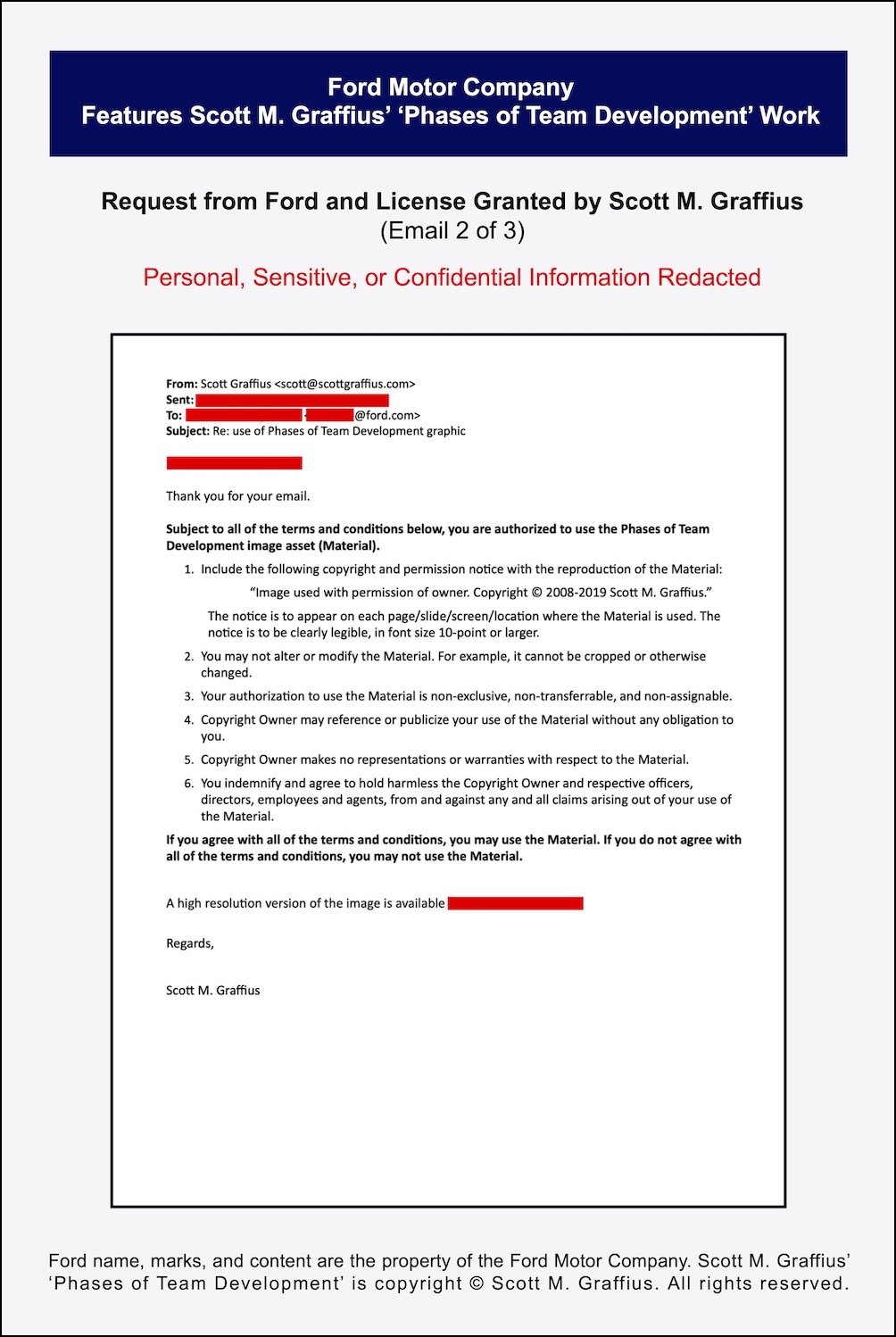
Email 2 of 3 is shown above.
Email 3 of 3 is shown above.
More Information on Graffius' 'Phases of Team Development'
Informed by the research of Bruce W. Tuckman and Mary Ann C. Jensen, over 100 subsequent studies, and Scott M. Graffius' first-hand professional experience with, and analysis of, team leadership and performance, Graffius created his ‘Phases of Team Development.’ It’s a unique perspective and visual conveying the five phases of team development — Forming, Storming, Norming, Performing, and Adjourning. It’s also inclusive of a graph showing how performance varies by phase, as well as the characteristics and strategies for each phase.
Leaders of teams — Project Managers, Scrum Masters, Agile Coaches, DevOps Leads, and others — can apply the information to help handle challenges or issues experienced by teams. By doing so, they’ll advance the teams’ (and their own) happiness, productivity, and success.
Graffius initially developed the material in 2008, and he periodically refreshes it. For details on the current (2024) edition including permission request information, high resolution files, and more, visit here.
Graffius has presented talks and workshops at 89 conferences and other events across 25 countries. While each session is unique, the top topic is high performance teams. In those sessions, he expands upon on his ‘Phases of Team Development’ work. Sessions are dynamic, engaging, and packed with fresh insights and usable information. They’re highly rated by attendees and organizers alike. Visit here to learn more.
About Ford
Ford Motor Company is a multinational automobile manufacturer headquartered in Dearborn, Michigan, United States. It was founded by Henry Ford and incorporated on June 16, 1903. Ford develops and delivers Ford trucks, sport utility vehicles, commercial vans and cars, and Lincoln luxury vehicles. The company does that through three customer-centered business segments: Ford Blue, engineering gas-powered and hybrid vehicles; Ford Model e, developing electric vehicles (EVs); and Ford Pro, helping commercial customers transform and expand their businesses with vehicles and services tailored to their needs. Additionally, Ford provides financial services through Ford Motor Credit Company. Ford employs about 177,000 people worldwide. More information about the company and its products and services is available at https://corporate.ford.com.
About Scott M. Graffius
Scott M. Graffius, PMP, SA, CSP-SM, CSP-PO, CSM, CSPO, ITIL, LSSGB is an agile project management practitioner, consultant, thinker, creator, multi-award-winning author, and international public speaker. Founder and CEO of Exceptional PPM and PMO Solutions™ and subsidiary Exceptional Agility™, he has generated over $1.9 billion for Global Fortune 500 businesses and other organizations he has served. Graffius and content from his books, talks, workshops, and more have been featured and used by Microsoft, Oracle, Broadcom, Cisco, Gartner, Project Management Institute, IEEE, National Academy of Sciences, United States Department of Energy, Yale University, Tufts University, and others. He delights audiences with dynamic and engaging talks and workshops on agile project management, AI, Tech leadership, video game development, strategic alignment, the science of high performance teams, and more. To date, he's presented sessions at 89 conferences and other events across 25 countries.
His full bio is available here.
Connect with Scott on:
About Agile Scrum: Your Quick Start Guide with Step-by-Step Instructions
Shifting customer needs are common in today's marketplace. Businesses must be adaptive and responsive to change while delivering an exceptional customer experience to be competitive.
There are a variety of frameworks supporting the development of products and services, and most approaches fall into one of two broad categories: traditional or agile. Traditional practices such as waterfall engage sequential development, while agile involves iterative and incremental deliverables. Organizations are increasingly embracing agile to manage projects, and best meet their business needs of rapid response to change, fast delivery speed, and more.
With clear and easy to follow step-by-step instructions, Scott M. Graffius's award-winning Agile Scrum: Your Quick Start Guide with Step-by-Step Instructions helps the reader:
Hailed by Literary Titan as “the book highlights the versatility of Scrum beautifully.”
Winner of 17 first place awards.
Agile Scrum: Your Quick Start Guide with Step-by-Step Instructions is available in paperback and ebook/Kindle in the United States and around the world. Some links by country follow.
About Agile Transformation: A Brief Story of How an Entertainment Company Developed New Capabilities and Unlocked Business Agility to Thrive in an Era of Rapid Change
Thriving in today's marketplace frequently depends on making a transformation to become more agile. Those successful in the transition enjoy faster delivery speed and ROI, higher satisfaction, continuous improvement, and additional benefits.
Based on actual events, Agile Transformation: A Brief Story of How an Entertainment Company Developed New Capabilities and Unlocked Business Agility to Thrive in an Era of Rapid Change provides a quick (60-90 minute) read about a successful agile transformation at a multinational entertainment and media company, told from the author's perspective as an agile coach.
The award-winning book by Scott M. Graffius is available in paperback and ebook/Kindle in the United States and around the world. Some links by country follow.
Short link for this article is: https://bit.ly/ford-2024
© Copyright 2024 Scott M. Graffius. All rights reserved. This material may not be published, broadcast, rewritten or redistributed without the express written permission of Scott M. Graffius.
With a license from Scott M. Graffius, his copyrighted ‘Phases of Team Development’ work is featured and used by businesses, professional associations, government agencies, and universities around the world. Examples include Yale University, IEEE, Constructor Institute (Switzerland), Adobe, Boston University, Amsterdam Public Health Research Institute, United States National Park Service, Bayer, University of Galway (Ireland), Hasso Plattner Institute (Germany), American Management Association, UC San Diego, and many more.
Ford was added to the list.
Email 1 of 3 is shown above.
Email 2 of 3 is shown above.
Email 3 of 3 is shown above.
More Information on Graffius' 'Phases of Team Development'
Informed by the research of Bruce W. Tuckman and Mary Ann C. Jensen, over 100 subsequent studies, and Scott M. Graffius' first-hand professional experience with, and analysis of, team leadership and performance, Graffius created his ‘Phases of Team Development.’ It’s a unique perspective and visual conveying the five phases of team development — Forming, Storming, Norming, Performing, and Adjourning. It’s also inclusive of a graph showing how performance varies by phase, as well as the characteristics and strategies for each phase.
Leaders of teams — Project Managers, Scrum Masters, Agile Coaches, DevOps Leads, and others — can apply the information to help handle challenges or issues experienced by teams. By doing so, they’ll advance the teams’ (and their own) happiness, productivity, and success.
Graffius initially developed the material in 2008, and he periodically refreshes it. For details on the current (2024) edition including permission request information, high resolution files, and more, visit here.
Graffius has presented talks and workshops at 89 conferences and other events across 25 countries. While each session is unique, the top topic is high performance teams. In those sessions, he expands upon on his ‘Phases of Team Development’ work. Sessions are dynamic, engaging, and packed with fresh insights and usable information. They’re highly rated by attendees and organizers alike. Visit here to learn more.
About Ford
Ford Motor Company is a multinational automobile manufacturer headquartered in Dearborn, Michigan, United States. It was founded by Henry Ford and incorporated on June 16, 1903. Ford develops and delivers Ford trucks, sport utility vehicles, commercial vans and cars, and Lincoln luxury vehicles. The company does that through three customer-centered business segments: Ford Blue, engineering gas-powered and hybrid vehicles; Ford Model e, developing electric vehicles (EVs); and Ford Pro, helping commercial customers transform and expand their businesses with vehicles and services tailored to their needs. Additionally, Ford provides financial services through Ford Motor Credit Company. Ford employs about 177,000 people worldwide. More information about the company and its products and services is available at https://corporate.ford.com.
About Scott M. Graffius
Scott M. Graffius, PMP, SA, CSP-SM, CSP-PO, CSM, CSPO, ITIL, LSSGB is an agile project management practitioner, consultant, thinker, creator, multi-award-winning author, and international public speaker. Founder and CEO of Exceptional PPM and PMO Solutions™ and subsidiary Exceptional Agility™, he has generated over $1.9 billion for Global Fortune 500 businesses and other organizations he has served. Graffius and content from his books, talks, workshops, and more have been featured and used by Microsoft, Oracle, Broadcom, Cisco, Gartner, Project Management Institute, IEEE, National Academy of Sciences, United States Department of Energy, Yale University, Tufts University, and others. He delights audiences with dynamic and engaging talks and workshops on agile project management, AI, Tech leadership, video game development, strategic alignment, the science of high performance teams, and more. To date, he's presented sessions at 89 conferences and other events across 25 countries.
His full bio is available here.
Connect with Scott on:
About Agile Scrum: Your Quick Start Guide with Step-by-Step Instructions
Shifting customer needs are common in today's marketplace. Businesses must be adaptive and responsive to change while delivering an exceptional customer experience to be competitive.
There are a variety of frameworks supporting the development of products and services, and most approaches fall into one of two broad categories: traditional or agile. Traditional practices such as waterfall engage sequential development, while agile involves iterative and incremental deliverables. Organizations are increasingly embracing agile to manage projects, and best meet their business needs of rapid response to change, fast delivery speed, and more.
With clear and easy to follow step-by-step instructions, Scott M. Graffius's award-winning Agile Scrum: Your Quick Start Guide with Step-by-Step Instructions helps the reader:
- Implement and use the most popular agile framework―Scrum;
- Deliver products in short cycles with rapid adaptation to change, fast time-to-market, and continuous improvement; and
- Support innovation and drive competitive advantage.
Hailed by Literary Titan as “the book highlights the versatility of Scrum beautifully.”
Winner of 17 first place awards.
Agile Scrum: Your Quick Start Guide with Step-by-Step Instructions is available in paperback and ebook/Kindle in the United States and around the world. Some links by country follow.
- 🇧🇷 Brazil
- 🇨🇦 Canada
- 🇨🇿 Czech Republic
- 🇩🇰 Denmark
- 🇫🇮 Finland
- 🇫🇷 France
- 🇩🇪 Germany
- 🇬🇷 Greece
- 🇭🇺 Hungary
- 🇮🇳 India
- 🇮🇪 Ireland
- 🇮🇱 Israel
- 🇮🇹 Italy
- 🇯🇵 Japan
- 🇱🇺 Luxembourg
- 🇲🇽 Mexico
- 🇳🇱 Netherlands
- 🇳🇿 New Zealand
- 🇳🇴 Norway
- 🇪🇸 Spain
- 🇸🇪 Sweden
- 🇨🇭 Switzerland
- 🇦🇪 UAE
- 🇬🇧 United Kingdom
- 🇺🇸 United States
About Agile Transformation: A Brief Story of How an Entertainment Company Developed New Capabilities and Unlocked Business Agility to Thrive in an Era of Rapid Change
Thriving in today's marketplace frequently depends on making a transformation to become more agile. Those successful in the transition enjoy faster delivery speed and ROI, higher satisfaction, continuous improvement, and additional benefits.
Based on actual events, Agile Transformation: A Brief Story of How an Entertainment Company Developed New Capabilities and Unlocked Business Agility to Thrive in an Era of Rapid Change provides a quick (60-90 minute) read about a successful agile transformation at a multinational entertainment and media company, told from the author's perspective as an agile coach.
The award-winning book by Scott M. Graffius is available in paperback and ebook/Kindle in the United States and around the world. Some links by country follow.
- 🇦🇺 Australia
- 🇦🇹 Austria
- 🇧🇷 Brazil
- 🇨🇦 Canada
- 🇨🇿 Czech Republic
- 🇩🇰 Denmark
- 🇫🇮 Finland
- 🇫🇷 France
- 🇩🇪 Germany
- 🇬🇷 Greece
- 🇮🇳 India
- 🇮🇪 Ireland
- 🇯🇵 Japan
- 🇱🇺 Luxembourg
- 🇲🇽 Mexico
- 🇳🇱 Netherlands
- 🇳🇿 New Zealand
- 🇪🇸 Spain
- 🇸🇪 Sweden
- 🇨🇭 Switzerland
- 🇦🇪 United Arab Emirates
- 🇬🇧 United Kingdom
- 🇺🇸 United States
Short link for this article is: https://bit.ly/ford-2024
© Copyright 2024 Scott M. Graffius. All rights reserved. This material may not be published, broadcast, rewritten or redistributed without the express written permission of Scott M. Graffius.
Oracle Featured Scott M. Graffius' IP on Team Tradecraft in Their Publication
25 July 2024
BY SCOTT M. GRAFFIUS | ScottGraffius.com

Oracles Featured Scott M. Graffius' 'Phases of Team Development' IP in Their Publication
Informed by the research of Bruce W. Tuckman and Mary Ann C. Jensen, over 100 subsequent studies, and Scott M. Graffius' first-hand professional experience with, and analysis of, team leadership and performance, Graffius created his 'Phases of Team Development' as a unique perspective and visual conveying the five phases of team development — Forming, Storming, Norming, Performing, and Adjourning — inclusive of a graph showing how performance varies by phase, as well as the characteristics and strategies for each phase. Graffius' 'Phases of Team Development' is registered with the U.S. Copyright Office.
Leaders of teams can apply Graffius' information to help handle challenges or issues experienced by teams. By doing so, they’ll advance the teams’ (and their own) happiness, productivity, and success.
Graffius' 'Phases of Team Development' intellectual property is used by businesses, professional associations, government agencies, and universities around the world. Select examples include:
Today, Oracle was (re)added to the list. It incorporated Graffius' 'Phases of Team Development' intellectual property in its 2024 publication, CFOs as Growth Leaders. Images follow.

The cover page of Oracle's CFOs as Growth Leaders is shown above.

Page 7 of Oracle's CFOs as Growth Leaders is shown above.

A zoomed-in view of page 7 of Oracle's CFOs as Growth Leaders is shown above.
Oracle’s publication is available at https://www.netsuite.com/portal/resource/wp/business_mgt.shtml and https://bit.ly/oracle-cfo and other locations.
Graffius initially developed his respective material in 2008, and he periodically refreshes it. Information on the current (2024) edition of his 'Phases of Team Development' IP is available at https://www.scottgraffius.com/blog/files/teams-2024.html and other locations.
Scott M. Graffius’ ‘Phases of Team Development’ is copyright © Scott M. Graffius. Oracle’s CFOs as Growth Leaders is copyright © Oracle. Oracle and NetSuite names and marks are the property of Oracle.

About Scott M. Graffius
Scott M. Graffius, PMP, SA, CSP-SM, CSP-PO, CSM, CSPO, ITIL, LSSGB is an agile project management practitioner, consultant, creator, award-winning author (Agile Scrum and Agile Transformation), and international public speaker. Founder and CEO of Exceptional PPM and PMO Solutions™ and subsidiary Exceptional Agility™, he has generated over $1.9 billion for Global Fortune 500 businesses and other organizations he has served. Graffius and content from his books, talks, workshops, and more have been featured and used by Microsoft, Oracle, Broadcom, Cisco, Adobe, Gartner, Project Management Institute, IEEE, Qantas, National Academy of Sciences, EU's European Commission, Amsterdam Public Health Research Institute, Boston University, U.S. National Park Service, Bayer, Ford, London South Bank University, Warsaw University of Technology, U.S. Tennis Association, Hasso Plattner Institute, American Management Association, Virginia Tech, University of Galway Ireland, UC San Diego, Yale University, and others. He delights audiences with dynamic and engaging talks and workshops on agile project management, AI, video game development, strategic alignment, the science of high performance teams, and more. To date, he's presented sessions at 91 conferences and other events across 25 countries. His full bio is available here.
About Agile Scrum: Your Quick Start Guide with Step-by-Step Instructions
Shifting customer needs are common in today's marketplace. Businesses must be adaptive and responsive to change while delivering an exceptional customer experience to be competitive.
There are a variety of frameworks supporting the development of products and services, and most approaches fall into one of two broad categories: traditional or agile. Traditional practices such as waterfall engage sequential development, while agile involves iterative and incremental deliverables. Organizations are increasingly embracing agile to manage projects, and best meet their business needs of rapid response to change, fast delivery speed, and more.
With clear and easy to follow step-by-step instructions, Scott M. Graffius's award-winning Agile Scrum: Your Quick Start Guide with Step-by-Step Instructions helps the reader:
Hailed by Literary Titan as “the book highlights the versatility of Scrum beautifully.”
Winner of 17 first place awards.
Agile Scrum: Your Quick Start Guide with Step-by-Step Instructions is available in paperback and ebook/Kindle in the United States and around the world. Some links by country follow.
About Agile Transformation: A Brief Story of How an Entertainment Company Developed New Capabilities and Unlocked Business Agility to Thrive in an Era of Rapid Change
Thriving in today's marketplace frequently depends on making a transformation to become more agile. Those successful in the transition enjoy faster delivery speed and ROI, higher satisfaction, continuous improvement, and additional benefits.
Based on actual events, Agile Transformation: A Brief Story of How an Entertainment Company Developed New Capabilities and Unlocked Business Agility to Thrive in an Era of Rapid Change provides a quick (60-90 minute) read about a successful agile transformation at a multinational entertainment and media company, told from the author's perspective as an agile coach.
The award-winning book by Scott M. Graffius is available in paperback and ebook/Kindle in the United States and around the world. Some links by country follow.
About Oracle
Oracle Corporation is a multinational computer technology company. In 2020, Oracle was the third-largest software company in the world by revenue and market capitalization. The company sells database software and cloud computing. Oracle's core application software is a suite of enterprise software products, such as enterprise resource planning (ERP) software, human capital management (HCM) software, customer relationship management (CRM) software, enterprise performance management (EPM) software, Customer Experience Commerce (CX Commerce) and supply chain management (SCM) software.
To learn more, visit https://www.oracle.com.
About Oracle NetSuite
For more than 25 years, Oracle NetSuite has helped organizations grow, scale, and adapt to change. NetSuite provides products and services tailored for small and medium-sized businesses (SMBs) including accounting and financial management, customer relationship management, inventory management, human capital management, payroll, procurement, project management, and e-commerce software. Its solutions are used by more than 38,000 across 219 countries.
Visit https://www.netsuite.com/portal/home.shtml to learn more.

How to Cite This Article
Graffius, Scott M. (2024, June 13). Oracle Featured Scott M. Graffius' IP on Team Tradecraft in Their Publication. Available at: https://scottgraffius.com/blog/files/oracle-2024.html. DOI: 10.13140/RG.2.2.14627.05920.

A PDF of this article is here.
© Copyright 2024 Scott M. Graffius. All rights reserved. This material may not be published, broadcast, rewritten or redistributed without the express written permission of Scott M. Graffius.
Oracles Featured Scott M. Graffius' 'Phases of Team Development' IP in Their Publication
Informed by the research of Bruce W. Tuckman and Mary Ann C. Jensen, over 100 subsequent studies, and Scott M. Graffius' first-hand professional experience with, and analysis of, team leadership and performance, Graffius created his 'Phases of Team Development' as a unique perspective and visual conveying the five phases of team development — Forming, Storming, Norming, Performing, and Adjourning — inclusive of a graph showing how performance varies by phase, as well as the characteristics and strategies for each phase. Graffius' 'Phases of Team Development' is registered with the U.S. Copyright Office.
Leaders of teams can apply Graffius' information to help handle challenges or issues experienced by teams. By doing so, they’ll advance the teams’ (and their own) happiness, productivity, and success.
Graffius' 'Phases of Team Development' intellectual property is used by businesses, professional associations, government agencies, and universities around the world. Select examples include:
- Adobe,
- American Management Association,
- Amsterdam Public Health Research Institute,
- Bayer,
- Boston University,
- Cisco,
- Deimos Aerospace,
- DevOps Institute,
- Ford Motor Company,
- Hasso Plattner Institute (Germany),
- IEEE,
- London South Bank University,
- Microsoft,
- New Zealand Government,
- Torrens University Australia,
- UC San Diego,
- TBS Switzerland,
- UK Sports Institute,
- University of Galway Ireland,
- U.S. National Park Service,
- U.S. Tennis Association,
- Virginia Tech,
- Yale University,
- and many others.
Today, Oracle was (re)added to the list. It incorporated Graffius' 'Phases of Team Development' intellectual property in its 2024 publication, CFOs as Growth Leaders. Images follow.
The cover page of Oracle's CFOs as Growth Leaders is shown above.
Page 7 of Oracle's CFOs as Growth Leaders is shown above.
A zoomed-in view of page 7 of Oracle's CFOs as Growth Leaders is shown above.
Oracle’s publication is available at https://www.netsuite.com/portal/resource/wp/business_mgt.shtml and https://bit.ly/oracle-cfo and other locations.
Graffius initially developed his respective material in 2008, and he periodically refreshes it. Information on the current (2024) edition of his 'Phases of Team Development' IP is available at https://www.scottgraffius.com/blog/files/teams-2024.html and other locations.
Scott M. Graffius’ ‘Phases of Team Development’ is copyright © Scott M. Graffius. Oracle’s CFOs as Growth Leaders is copyright © Oracle. Oracle and NetSuite names and marks are the property of Oracle.
About Scott M. Graffius
Scott M. Graffius, PMP, SA, CSP-SM, CSP-PO, CSM, CSPO, ITIL, LSSGB is an agile project management practitioner, consultant, creator, award-winning author (Agile Scrum and Agile Transformation), and international public speaker. Founder and CEO of Exceptional PPM and PMO Solutions™ and subsidiary Exceptional Agility™, he has generated over $1.9 billion for Global Fortune 500 businesses and other organizations he has served. Graffius and content from his books, talks, workshops, and more have been featured and used by Microsoft, Oracle, Broadcom, Cisco, Adobe, Gartner, Project Management Institute, IEEE, Qantas, National Academy of Sciences, EU's European Commission, Amsterdam Public Health Research Institute, Boston University, U.S. National Park Service, Bayer, Ford, London South Bank University, Warsaw University of Technology, U.S. Tennis Association, Hasso Plattner Institute, American Management Association, Virginia Tech, University of Galway Ireland, UC San Diego, Yale University, and others. He delights audiences with dynamic and engaging talks and workshops on agile project management, AI, video game development, strategic alignment, the science of high performance teams, and more. To date, he's presented sessions at 91 conferences and other events across 25 countries. His full bio is available here.
About Agile Scrum: Your Quick Start Guide with Step-by-Step Instructions
Shifting customer needs are common in today's marketplace. Businesses must be adaptive and responsive to change while delivering an exceptional customer experience to be competitive.
There are a variety of frameworks supporting the development of products and services, and most approaches fall into one of two broad categories: traditional or agile. Traditional practices such as waterfall engage sequential development, while agile involves iterative and incremental deliverables. Organizations are increasingly embracing agile to manage projects, and best meet their business needs of rapid response to change, fast delivery speed, and more.
With clear and easy to follow step-by-step instructions, Scott M. Graffius's award-winning Agile Scrum: Your Quick Start Guide with Step-by-Step Instructions helps the reader:
- Implement and use the most popular agile framework―Scrum;
- Deliver products in short cycles with rapid adaptation to change, fast time-to-market, and continuous improvement; and
- Support innovation and drive competitive advantage.
Hailed by Literary Titan as “the book highlights the versatility of Scrum beautifully.”
Winner of 17 first place awards.
Agile Scrum: Your Quick Start Guide with Step-by-Step Instructions is available in paperback and ebook/Kindle in the United States and around the world. Some links by country follow.
- 🇧🇷 Brazil
- 🇨🇦 Canada
- 🇨🇿 Czech Republic
- 🇩🇰 Denmark
- 🇫🇮 Finland
- 🇫🇷 France
- 🇩🇪 Germany
- 🇬🇷 Greece
- 🇭🇺 Hungary
- 🇮🇳 India
- 🇮🇪 Ireland
- 🇮🇱 Israel
- 🇮🇹 Italy
- 🇯🇵 Japan
- 🇱🇺 Luxembourg
- 🇲🇽 Mexico
- 🇳🇱 Netherlands
- 🇳🇿 New Zealand
- 🇳🇴 Norway
- 🇪🇸 Spain
- 🇸🇪 Sweden
- 🇨🇭 Switzerland
- 🇦🇪 UAE
- 🇬🇧 United Kingdom
- 🇺🇸 United States
About Agile Transformation: A Brief Story of How an Entertainment Company Developed New Capabilities and Unlocked Business Agility to Thrive in an Era of Rapid Change
Thriving in today's marketplace frequently depends on making a transformation to become more agile. Those successful in the transition enjoy faster delivery speed and ROI, higher satisfaction, continuous improvement, and additional benefits.
Based on actual events, Agile Transformation: A Brief Story of How an Entertainment Company Developed New Capabilities and Unlocked Business Agility to Thrive in an Era of Rapid Change provides a quick (60-90 minute) read about a successful agile transformation at a multinational entertainment and media company, told from the author's perspective as an agile coach.
The award-winning book by Scott M. Graffius is available in paperback and ebook/Kindle in the United States and around the world. Some links by country follow.
- 🇦🇺 Australia
- 🇦🇹 Austria
- 🇧🇷 Brazil
- 🇨🇦 Canada
- 🇨🇿 Czech Republic
- 🇩🇰 Denmark
- 🇫🇮 Finland
- 🇫🇷 France
- 🇩🇪 Germany
- 🇬🇷 Greece
- 🇮🇳 India
- 🇮🇪 Ireland
- 🇯🇵 Japan
- 🇱🇺 Luxembourg
- 🇲🇽 Mexico
- 🇳🇱 Netherlands
- 🇳🇿 New Zealand
- 🇪🇸 Spain
- 🇸🇪 Sweden
- 🇨🇭 Switzerland
- 🇦🇪 United Arab Emirates
- 🇬🇧 United Kingdom
- 🇺🇸 United States
About Oracle
Oracle Corporation is a multinational computer technology company. In 2020, Oracle was the third-largest software company in the world by revenue and market capitalization. The company sells database software and cloud computing. Oracle's core application software is a suite of enterprise software products, such as enterprise resource planning (ERP) software, human capital management (HCM) software, customer relationship management (CRM) software, enterprise performance management (EPM) software, Customer Experience Commerce (CX Commerce) and supply chain management (SCM) software.
To learn more, visit https://www.oracle.com.
About Oracle NetSuite
For more than 25 years, Oracle NetSuite has helped organizations grow, scale, and adapt to change. NetSuite provides products and services tailored for small and medium-sized businesses (SMBs) including accounting and financial management, customer relationship management, inventory management, human capital management, payroll, procurement, project management, and e-commerce software. Its solutions are used by more than 38,000 across 219 countries.
Visit https://www.netsuite.com/portal/home.shtml to learn more.
How to Cite This Article
Graffius, Scott M. (2024, June 13). Oracle Featured Scott M. Graffius' IP on Team Tradecraft in Their Publication. Available at: https://scottgraffius.com/blog/files/oracle-2024.html. DOI: 10.13140/RG.2.2.14627.05920.
A PDF of this article is here.
© Copyright 2024 Scott M. Graffius. All rights reserved. This material may not be published, broadcast, rewritten or redistributed without the express written permission of Scott M. Graffius.
Johns Hopkins University Features the Work of Scott M. Graffius
01 August 2024
BY SCOTT M. GRAFFIUS | ScottGraffius.com

Johns Hopkins University features Scott M. Graffius’ work!
Informed by the research of Bruce W. Tuckman and Mary Ann C. Jensen, over 100 subsequent studies, and Scott M. Graffius' first-hand professional experience with, and analysis of, team leadership and performance, Graffius created his 'Phases of Team Development' as a unique perspective and visual conveying the five phases of team development — Forming, Storming, Norming, Performing, and Adjourning — inclusive of a graph showing how performance varies by phase, as well as the characteristics and strategies for each phase. Graffius' 'Phases of Team Development' is registered with the U.S. Copyright Office.
Leaders of teams can apply Graffius' information to help handle challenges or issues experienced by teams. By doing so, they’ll advance the teams’ (and their own) happiness, productivity, and success.
Graffius' copyrighted 'Phases of Team Development' work is used by businesses, professional associations, government agencies, and universities around the world. Select examples include:
Johns Hopkins University (JHU) was added to the list. JHU Carey Business School features Graffius’ ‘Phases of Team Development’ IP in its Business Communications (BU 120.601) course, taught by Steven D. Cohen, Ph.D., M.P.P.
Excerpts from a related presentation follow.

The title page of the JHU presentation is shown above.

Page 2 of the JHU presentation is shown above.

Page 3 of the JHU presentation is shown above.
Current Edition of Graffius’ ‘Phases of Team Development’ IP
Graffius initially developed his respective material in 2008, and he periodically refreshes it. Information on the current (2024) edition of his 'Phases of Team Development' IP is available at https://www.scottgraffius.com/blog/files/teams-2024.html.
About Johns Hopkins University
Johns Hopkins, founded in 1876, is America's first research university and home to nine world-class academic divisions working together as one university.
Visit https://www.jhu.edu/ to learn more.
About Business Communication (BU 120.601)
The JHU Business Communication (BU 120.601) course refines students’ skills in business writing, public speaking, and interpersonal communication. Through analyses and practice of communication strategies adopted by successful business professionals, students learn to write clearly and concisely, deliver compelling presentations, and construct effective arguments. See JHU’s course catalog at https://e-catalogue.jhu.edu/course-descriptions/management/ to learn more.
About Steven D. Cohen, Ph.D., M.P.P.
Steven D. Cohen is a Professor at the Johns Hopkins Carey Business School. He is well known for helping leaders communicate with confidence, influence, and authority. Dr. Cohen has been quoted in media outlets such as the Financial Times, Forbes, Vanity Fair, New York Magazine, and NBC News. To learn more about Professor Cohen, visit https://carey.jhu.edu/faculty/faculty-directory/steven-d-cohen-phd.
About Scott M. Graffius
Scott M. Graffius, PMP, SA, CSP-SM, CSP-PO, CSM, CSPO, ITIL, LSSGB is an agile project management practitioner, consultant, creator, award-winning author (Agile Scrum and Agile Transformation), and international public speaker. Founder and CEO of Exceptional PPM and PMO Solutions™ and subsidiary Exceptional Agility™, he has generated over $1.9 billion for Global Fortune 500 businesses and other organizations he has served. Graffius and content from his books, talks, workshops, and more have been featured and used by Microsoft, Oracle, Broadcom, Cisco, Adobe, Gartner, Project Management Institute, IEEE, Qantas, National Academy of Sciences, EU's European Commission, Amsterdam Public Health Research Institute, Boston University, U.S. National Park Service, Bayer, Ford, London South Bank University, Warsaw University of Technology, U.S. Tennis Association, Hasso Plattner Institute, American Management Association, Virginia Tech, University of Galway Ireland, UC San Diego, Yale University, and others. He delights audiences with dynamic and engaging talks and workshops on agile project management, AI, video game development, strategic alignment, the science of high performance teams, and more. To date, he's presented sessions at 91 conferences and other events across 25 countries. His full bio is available here.
About Agile Scrum: Your Quick Start Guide with Step-by-Step Instructions
Shifting customer needs are common in today's marketplace. Businesses must be adaptive and responsive to change while delivering an exceptional customer experience to be competitive.
There are a variety of frameworks supporting the development of products and services, and most approaches fall into one of two broad categories: traditional or agile. Traditional practices such as waterfall engage sequential development, while agile involves iterative and incremental deliverables. Organizations are increasingly embracing agile to manage projects, and best meet their business needs of rapid response to change, fast delivery speed, and more.
With clear and easy to follow step-by-step instructions, Scott M. Graffius's award-winning Agile Scrum: Your Quick Start Guide with Step-by-Step Instructions helps the reader:
Hailed by Literary Titan as “the book highlights the versatility of Scrum beautifully.”
Winner of 17 first place awards.
Agile Scrum: Your Quick Start Guide with Step-by-Step Instructions is available in paperback and ebook/Kindle in the United States and around the world. Some links by country follow.
About Agile Transformation: A Brief Story of How an Entertainment Company Developed New Capabilities and Unlocked Business Agility to Thrive in an Era of Rapid Change
Thriving in today's marketplace frequently depends on making a transformation to become more agile. Those successful in the transition enjoy faster delivery speed and ROI, higher satisfaction, continuous improvement, and additional benefits.
Based on actual events, Agile Transformation: A Brief Story of How an Entertainment Company Developed New Capabilities and Unlocked Business Agility to Thrive in an Era of Rapid Change provides a quick (60-90 minute) read about a successful agile transformation at a multinational entertainment and media company, told from the author's perspective as an agile coach.
The award-winning book by Scott M. Graffius is available in paperback and ebook/Kindle in the United States and around the world. Some links by country follow.
How to Cite This Article
Graffius, Scott M. (2024, August 1). Johns Hopkins University Features the Work of Scott M. Graffius. Available at: https://scottgraffius.com/blog/files/jhu-cbs.html. DOI: 10.13140/RG.2.2.35998.34889.
A PDF of this article is here
The short link for this article is https://bit.ly/jhu-cbs
© Copyright 2024 Scott M. Graffius. All rights reserved. This material may not be published, broadcast, rewritten or redistributed without the express written permission of Scott M. Graffius.
Johns Hopkins University features Scott M. Graffius’ work!
Informed by the research of Bruce W. Tuckman and Mary Ann C. Jensen, over 100 subsequent studies, and Scott M. Graffius' first-hand professional experience with, and analysis of, team leadership and performance, Graffius created his 'Phases of Team Development' as a unique perspective and visual conveying the five phases of team development — Forming, Storming, Norming, Performing, and Adjourning — inclusive of a graph showing how performance varies by phase, as well as the characteristics and strategies for each phase. Graffius' 'Phases of Team Development' is registered with the U.S. Copyright Office.
Leaders of teams can apply Graffius' information to help handle challenges or issues experienced by teams. By doing so, they’ll advance the teams’ (and their own) happiness, productivity, and success.
Graffius' copyrighted 'Phases of Team Development' work is used by businesses, professional associations, government agencies, and universities around the world. Select examples include:
- Adobe,
- American Management Association,
- Amsterdam Public Health Research Institute,
- Bayer,
- Boston University,
- Broadcom,
- Cisco,
- Deimos Aerospace,
- DevOps Institute,
- Ford Motor Company,
- Hasso Plattner Institute (Germany),
- IEEE,
- London South Bank University,
- Microsoft,
- New Zealand Government,
- Oracle
- Torrens University Australia,
- UC San Diego,
- TBS Switzerland,
- UK Sports Institute,
- University of Galway Ireland,
- U.S. National Park Service,
- U.S. Tennis Association,
- Virginia Tech,
- Yale University,
- and many others.
Johns Hopkins University (JHU) was added to the list. JHU Carey Business School features Graffius’ ‘Phases of Team Development’ IP in its Business Communications (BU 120.601) course, taught by Steven D. Cohen, Ph.D., M.P.P.
Excerpts from a related presentation follow.
The title page of the JHU presentation is shown above.
Page 2 of the JHU presentation is shown above.
Page 3 of the JHU presentation is shown above.
Current Edition of Graffius’ ‘Phases of Team Development’ IP
Graffius initially developed his respective material in 2008, and he periodically refreshes it. Information on the current (2024) edition of his 'Phases of Team Development' IP is available at https://www.scottgraffius.com/blog/files/teams-2024.html.
About Johns Hopkins University
Johns Hopkins, founded in 1876, is America's first research university and home to nine world-class academic divisions working together as one university.
- The Johns Hopkins Carey Business School is the graduate business school of Johns Hopkins University, a private research university in Baltimore, Maryland. It was established in 2007 and offers full-time and part-time programs leading to the Master of Business Administration and Master of Science degrees.
- The School of Advanced International Studies’ interdisciplinary curriculum—delivered at locations on three continents and grounded in the study of international economics, international relations, and regional studies—prepares students to address the multifaceted challenges facing the world today.
- Krieger School of Arts and Sciences—comprised of 22 departments and 33 centers, programs, and institutes—is home to students interested in the arts, humanities, natural sciences, and social sciences.
- The School of Education prepares educators to make a difference in the lives of children and adults.
- The Whiting School of Engineering, a global leader in innovation and research, teaches students to think creatively while drawing upon mathematics and scientific principles to tackle difficult, real-world problems.
- The School of Medicine has revolutionized the education of physicians, the practice of medicine, and medical research nationally and internationally.
- The School of Nursing aims to improve health locally and globally through leadership and excellence in nursing education, research, practice, and service.
- Founded in 1857 as America’s first academy of music, the Peabody Institute trains musicians and dancers of every age and at every level through its degree-granting Conservatory and its community-based Preparatory.
- The Bloomberg School of Public Health educates scientists and public health professionals committed to the improvement of health and prevention of disease and disability around the world.
Visit https://www.jhu.edu/ to learn more.
About Business Communication (BU 120.601)
The JHU Business Communication (BU 120.601) course refines students’ skills in business writing, public speaking, and interpersonal communication. Through analyses and practice of communication strategies adopted by successful business professionals, students learn to write clearly and concisely, deliver compelling presentations, and construct effective arguments. See JHU’s course catalog at https://e-catalogue.jhu.edu/course-descriptions/management/ to learn more.
About Steven D. Cohen, Ph.D., M.P.P.
Steven D. Cohen is a Professor at the Johns Hopkins Carey Business School. He is well known for helping leaders communicate with confidence, influence, and authority. Dr. Cohen has been quoted in media outlets such as the Financial Times, Forbes, Vanity Fair, New York Magazine, and NBC News. To learn more about Professor Cohen, visit https://carey.jhu.edu/faculty/faculty-directory/steven-d-cohen-phd.
About Scott M. Graffius
Scott M. Graffius, PMP, SA, CSP-SM, CSP-PO, CSM, CSPO, ITIL, LSSGB is an agile project management practitioner, consultant, creator, award-winning author (Agile Scrum and Agile Transformation), and international public speaker. Founder and CEO of Exceptional PPM and PMO Solutions™ and subsidiary Exceptional Agility™, he has generated over $1.9 billion for Global Fortune 500 businesses and other organizations he has served. Graffius and content from his books, talks, workshops, and more have been featured and used by Microsoft, Oracle, Broadcom, Cisco, Adobe, Gartner, Project Management Institute, IEEE, Qantas, National Academy of Sciences, EU's European Commission, Amsterdam Public Health Research Institute, Boston University, U.S. National Park Service, Bayer, Ford, London South Bank University, Warsaw University of Technology, U.S. Tennis Association, Hasso Plattner Institute, American Management Association, Virginia Tech, University of Galway Ireland, UC San Diego, Yale University, and others. He delights audiences with dynamic and engaging talks and workshops on agile project management, AI, video game development, strategic alignment, the science of high performance teams, and more. To date, he's presented sessions at 91 conferences and other events across 25 countries. His full bio is available here.
About Agile Scrum: Your Quick Start Guide with Step-by-Step Instructions
Shifting customer needs are common in today's marketplace. Businesses must be adaptive and responsive to change while delivering an exceptional customer experience to be competitive.
There are a variety of frameworks supporting the development of products and services, and most approaches fall into one of two broad categories: traditional or agile. Traditional practices such as waterfall engage sequential development, while agile involves iterative and incremental deliverables. Organizations are increasingly embracing agile to manage projects, and best meet their business needs of rapid response to change, fast delivery speed, and more.
With clear and easy to follow step-by-step instructions, Scott M. Graffius's award-winning Agile Scrum: Your Quick Start Guide with Step-by-Step Instructions helps the reader:
- Implement and use the most popular agile framework―Scrum;
- Deliver products in short cycles with rapid adaptation to change, fast time-to-market, and continuous improvement; and
- Support innovation and drive competitive advantage.
Hailed by Literary Titan as “the book highlights the versatility of Scrum beautifully.”
Winner of 17 first place awards.
Agile Scrum: Your Quick Start Guide with Step-by-Step Instructions is available in paperback and ebook/Kindle in the United States and around the world. Some links by country follow.
- 🇧🇷 Brazil
- 🇨🇦 Canada
- 🇨🇿 Czech Republic
- 🇩🇰 Denmark
- 🇫🇮 Finland
- 🇫🇷 France
- 🇩🇪 Germany
- 🇬🇷 Greece
- 🇭🇺 Hungary
- 🇮🇳 India
- 🇮🇪 Ireland
- 🇮🇱 Israel
- 🇮🇹 Italy
- 🇯🇵 Japan
- 🇱🇺 Luxembourg
- 🇲🇽 Mexico
- 🇳🇱 Netherlands
- 🇳🇿 New Zealand
- 🇳🇴 Norway
- 🇪🇸 Spain
- 🇸🇪 Sweden
- 🇨🇭 Switzerland
- 🇦🇪 UAE
- 🇬🇧 United Kingdom
- 🇺🇸 United States
About Agile Transformation: A Brief Story of How an Entertainment Company Developed New Capabilities and Unlocked Business Agility to Thrive in an Era of Rapid Change
Thriving in today's marketplace frequently depends on making a transformation to become more agile. Those successful in the transition enjoy faster delivery speed and ROI, higher satisfaction, continuous improvement, and additional benefits.
Based on actual events, Agile Transformation: A Brief Story of How an Entertainment Company Developed New Capabilities and Unlocked Business Agility to Thrive in an Era of Rapid Change provides a quick (60-90 minute) read about a successful agile transformation at a multinational entertainment and media company, told from the author's perspective as an agile coach.
The award-winning book by Scott M. Graffius is available in paperback and ebook/Kindle in the United States and around the world. Some links by country follow.
- 🇦🇺 Australia
- 🇦🇹 Austria
- 🇧🇷 Brazil
- 🇨🇦 Canada
- 🇨🇿 Czech Republic
- 🇩🇰 Denmark
- 🇫🇮 Finland
- 🇫🇷 France
- 🇩🇪 Germany
- 🇬🇷 Greece
- 🇮🇳 India
- 🇮🇪 Ireland
- 🇯🇵 Japan
- 🇱🇺 Luxembourg
- 🇲🇽 Mexico
- 🇳🇱 Netherlands
- 🇳🇿 New Zealand
- 🇪🇸 Spain
- 🇸🇪 Sweden
- 🇨🇭 Switzerland
- 🇦🇪 United Arab Emirates
- 🇬🇧 United Kingdom
- 🇺🇸 United States
How to Cite This Article
Graffius, Scott M. (2024, August 1). Johns Hopkins University Features the Work of Scott M. Graffius. Available at: https://scottgraffius.com/blog/files/jhu-cbs.html. DOI: 10.13140/RG.2.2.35998.34889.
A PDF of this article is here
The short link for this article is https://bit.ly/jhu-cbs
© Copyright 2024 Scott M. Graffius. All rights reserved. This material may not be published, broadcast, rewritten or redistributed without the express written permission of Scott M. Graffius.
Boston Scientific Corporation Utilizes Scott M. Graffius' Intellectual Property
19 August 2024
BY SCOTT M. GRAFFIUS | ScottGraffius.com

If there's an update after this article is published, the information will appear in the Post-Publication Notes section.
Scott M. Graffius' 'Phases of Team Development' Intellectual Property
Informed by the research of Bruce W. Tuckman and Mary Ann C. Jensen, over 100 subsequent studies, and Scott M. Graffius' first-hand professional experience with, and analysis of, team leadership and performance, Graffius created his ‘Phases of Team Development’ as a unique perspective and visual conveying the five phases of team development — Forming, Storming, Norming, Performing, and Adjourning — inclusive of a graph showing how performance varies by phase, as well as the characteristics and strategies for each phase.
Graffius' intellectual property (IP) is registered with the United States Copyright Office.
Graffius initially developed his ‘Phases of Team Development’ unique material in 2008, and he periodically refreshes it.
Graffius' property applicable to this story is here.
For reference only, the visual for the current (2024) edition is below and the details are here.
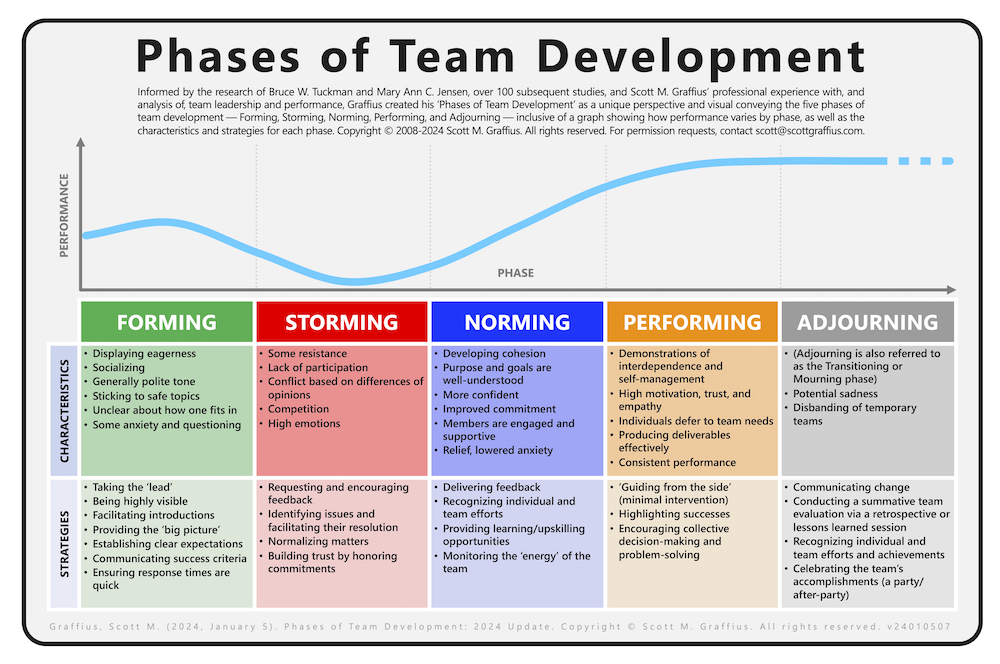
Organizations around the world engage Graffius to deliver compelling talks and workshops. To date, he's presented sessions at 91 conferences and other events across 25 countries, including:

Graffius ‘Phases of Team Development’ IP is central and key to many of those sessions. His rate card and a listing of his engagements are at https://scottgraffius.com/resources/Exceptional-PPM-and-PMO-Solutions-Rate-Card-for-2024-2025-v24071607.pdf and https://scottgraffius.com/publicspeaker.html, respectively.
With an authorization/license from Graffius, his ‘Phases of Team Development’ IP is featured and used by businesses, professional associations, government agencies, and universities around the world. Examples include:
Copyrights protect the IP rights of creators, ensuring they receive recognition and compensation for their work, thus incentivizing creativity and innovation. Graffius is vigilant in upholding, protecting and enforcing his copyrights and other IP rights.
Boston Scientific — a global BioMed and BioTech corporation — used Graffius’ ‘Phases of Team Development’ IP without permission or attribution.
Notes:
Boston Scientific Utilizes Scott M. Graffius' 'Phases of Team Development' IP Without Permission or Attribution
Boston Scientific is a biomedical/biotechnology engineering firm and multinational manufacturer of medical devices. Their website at https://www.bostonscientific.com/en-US/about-us.html informs that the company operates globally, employs 48,000 people, has invested $1.4 billion in research and development, and has $14.2 billion in net sales. A photo of their corporate headquarters is shown below.

Boston Scientific did not request nor receive permission to use Graffius' 'Phases of Team Development' IP.
Unfortunately, Boston Scientific's "Presentation Templates" site, shown next, includes content which infringes on Graffius' copyright.

The top of Boston Scientific's website includes four elements: Home, PowerPoint Templates, Visual & Data Templates, and “?”. As delineated below, selecting the "?" starts an email to [name redacted]@bsci.com.

As shown next, BSCI.com is the property of the Boston Scientific Corporation. Visual 1 of 2 is below.

Visual 2 of 2 is below.

And entering BSCI.com into a browser automatically takes the user to Boston Scientific's main website.
Selecting the URL (shown in the visual below) at Boston's Scientific's "Presentation Templates" site downloads a PowerPoint. Slide 1 (also shown in the visual below) infringes on Graffius' copyright.
Boston Scientific's use of Graffius' copyrighted text content is covered shortly.

As shown below, summary information for Boston Scientific's respective PowerPoint lists the author of the file as [name redacted]@bsci.com. That's the same identifier listed earlier. And again, @BSCI.com is a Boston Scientific address.

Boston Scientific's material infringes on Graffius' copyright. The infringement uses a significant portion (the majority of) Graffius' IP. There are too many examples to list, but some follow.
🟢 Under Forming, Scott M. Graffius’ copyrighted property includes “Questioning”
🔴 Under Forming, Boston Scientific’s infringing material includes “Questioning”
🟢 Under Forming, Scott M. Graffius’ copyrighted property includes “Socializing”
🔴 Under Forming, Boston Scientific’s infringing material includes “Socializing”
🟢 Under Forming, Scott M. Graffius’ copyrighted property includes “Displaying eagerness”
🔴 Under Forming, Boston Scientific’s infringing material includes “Displaying eagerness”
🟢 Under Forming, Scott M. Graffius’ copyrighted property includes “Sticking to safe topics”
🔴 Under Forming, Boston Scientific’s infringing material includes “Sticking to safe topics”
🟢 Under Forming, Scott M. Graffius’ copyrighted property includes “Taking the ‘lead’”
🔴 Under Forming, Boston Scientific’s infringing material includes “Taking the ‘lead’”
🟢 Under Forming, Scott M. Graffius’ copyrighted property includes “Quick response times”
🔴 Under Forming, Boston Scientific’s infringing material includes “Quick response times”
🟢 Under Storming, Scott M. Graffius’ copyrighted property includes “Resistance”
🔴 Under Storming, Boston Scientific’s infringing material includes “Resistance”
🟢 Under Storming, Scott M. Graffius’ copyrighted property includes “Lack of participation”
🔴 Under Storming, Boston Scientific’s infringing material includes “Lack of participation”
🟢 Under Storming, Scott M. Graffius’ copyrighted property includes “Conflict”
🔴 Under Storming, Boston Scientific’s infringing material includes “Conflict”
🟢 Under Storming, Scott M. Graffius’ copyrighted property includes “Competition”
🔴 Under Storming, Boston Scientific’s infringing material includes “Competition”
🟢 Under Storming, Scott M. Graffius’ copyrighted property includes “High emotions”
🔴 Under Storming, Boston Scientific’s infringing material includes “High emotions”
🟢 Under Storming, Scott M. Graffius’ copyrighted property includes “Normalizing matters”
🔴 Under Storming, Boston Scientific’s infringing material includes “Normalizing matters”
🟢 Under Norming, Scott M. Graffius’ copyrighted property includes “Encouraging leadership”
🔴 Under Norming, Boston Scientific’s infringing material includes “Encouraging leadership”
🟢 Under Norming, Scott M. Graffius’ copyrighted property includes “Reconciliation”
🔴 Under Norming, Boston Scientific’s infringing material includes “Reconciliation”
🟢 Under Norming, Scott M. Graffius’ copyrighted property includes “Developing cohesion”
🔴 Under Norming, Boston Scientific’s infringing material includes “Developing cohesion”
🟢 Under Performing, Scott M. Graffius’ copyrighted property includes “Healthy system”
🔴 Under Performing, Boston Scientific’s infringing material includes “Healthy system”
🟢 Under Performing, Scott M. Graffius’ copyrighted property includes “Celebrating”
🔴 Under Performing, Boston Scientific’s infringing material includes “Celebrating”
🟢 Under Adjourning, Scott M. Graffius’ copyrighted property includes “Shift to process orientation”
🔴 Under Adjourning, Boston Scientific’s infringing material includes “Shift to process orientation”
🟢 Under Adjourning, Scott M. Graffius’ copyrighted property includes “Sadness”
🔴 Under Adjourning, Boston Scientific’s infringing material includes “Sadness”
🟢 Under Adjourning, Scott M. Graffius’ copyrighted property includes “Recognizing change”
🔴 Under Adjourning, Boston Scientific’s infringing material includes “Recognizing change”
Those are just some examples.
Corresponding visuals follow. Here's part 1 of 2.

And here's part 2 of 2.

Boston Scientific did not request nor receive permission to use Graffius' IP. Nevertheless, Boston Scientific used a significant portion (the majority) of Graffius' IP and Boston Scientific did not credit Graffius as the author and copyright owner.
Ethics, Integrity, and IP Rights Including Copyright
What are Boston Scientific's stated commitments to ethics, integrity, and copyright and other IP rights? Answers follow.
As reported at https://www.bostonscientific.com/en-US/corporate-responsibility/integrity.html, Boston Scientific’s priorities include: “We believe in strong corporate governance and business practices that reflect our priorities, values and commitment to ethics and integrity.” But Boston Scientific infringed on Graffius' copyright.

In a press release at https://news.bostonscientific.com/news-releases?item=58870, Jim Tobin, President and Chief Executive Officer of Boston Scientific, is reported as saying: “Boston Scientific was built on the strength of its intellectual property.” But Boston Scientific utilized Graffius' IP — and without permission or attribution.

The company’s ‘Code of Conduct’ at https://www.bostonscientific.com/content/dam/bostonscientific/corporate/citizenship/compliance-ethics/Code%20of%20Conduct/2022/2022_CodeofConduct_English.pdf states that: “Boston Scientific protects its intellectual property rights to patents, trade names, trademarks, copyrights, trade secrets, and other intellectual property. We also respect the intellectual property rights of others.” But Boston Scientific infringed on Graffius' IP rights.

Boston Scientific addresses copyright infringement at https://www.bostonscientific.com/en-US/medical-specialties/electrophysiology/CRM-YouTube-Disclaimer.html, among other places. There, it informs that: “It is strictly forbidden to make copies, whether partial or total and on whichever media without prior approval. Anyone failing to respect this provision will be guilty of copyright infringement and liable to criminal punishment according to the law.” As shown, Boston Scientific's content infringes on Graffius' copyright.

Status
Scott M. Graffius notified Boston Scientific Corporation of their infringement. Here's an excerpt from Graffius' respective email:
As of the time of this article, Boston Scientific Corporation has not responded to the notice nor discontinued their infringement of Graffius' IP.
Post-publication notes appear at the end of this article.

About Scott M. Graffius
Scott M. Graffius, PMP, SA, CSP-SM, CSP-PO, CSM, CSPO, ITIL, LSSGB is an Agile project management expert practitioner, consultant, creator, multi-award-winning author, and international public speaker.
He's generated over $1.9 billion of business value in aggregate for Global Fortune 500 businesses and other organizations he's served. Businesses and industries range from consumer products to advanced technology (including AI, R&D), e-commerce, music, streaming/OTT video, television, film, video games, financial services, government, and more.
Graffius and content from his books (Agile Scrum and Agile Transformation), talks, workshops, and more have been featured and used by businesses, professional associations, governments, and universities around the world. Examples include Adobe, American Management Association, Amsterdam Public Health Research Institute, Bayer, Boston University, Broadcom, Cisco, Deimos Aerospace, DevOps Institute, EU's European Commission, Ford Motor Company, Hasso Plattner Institute Germany, IEEE, Johns Hopkins University, London South Bank University, Microsoft, National Academy of Sciences, New Zealand Government, Oracle, Project Management Institute, Torrens University Australia, UC San Diego, TBS Switzerland, UK Sports Institute, University of Galway Ireland, U.S. Department of Energy, U.S. National Park Service, U.S. Tennis Association, Virginia Tech, Warsaw University of Technology, Yale University, Zurich University of Applied Sciences, and many others.
He delights audiences around the world with dynamic and engaging talks and workshops. He's presented sessions at 91 conferences and other events across 25 countries. Visit here to learn more and here to ask Scott to speak at your event.
About Agile Scrum: Your Quick Start Guide with Step-by-Step Instructions
Shifting customer needs are common in today's marketplace. Businesses must be adaptive and responsive to change while delivering an exceptional customer experience to be competitive.
There are a variety of frameworks supporting the development of products and services, and most approaches fall into one of two broad categories: traditional or agile. Traditional practices such as waterfall engage sequential development, while agile involves iterative and incremental deliverables. Organizations are increasingly embracing agile to manage projects, and best meet their business needs of rapid response to change, fast delivery speed, and more.
With clear and easy to follow step-by-step instructions, Scott M. Graffius's award-winning Agile Scrum: Your Quick Start Guide with Step-by-Step Instructions helps the reader:
Hailed by Literary Titan as “the book highlights the versatility of Scrum beautifully.”
Winner of 17 first place awards.
Agile Scrum: Your Quick Start Guide with Step-by-Step Instructions is available in paperback and ebook/Kindle in the United States and around the world. Some links by country follow.
About Agile Transformation: A Brief Story of How an Entertainment Company Developed New Capabilities and Unlocked Business Agility to Thrive in an Era of Rapid Change
Thriving in today's marketplace frequently depends on making a transformation to become more agile. Those successful in the transition enjoy faster delivery speed and ROI, higher satisfaction, continuous improvement, and additional benefits.
Based on actual events, Agile Transformation: A Brief Story of How an Entertainment Company Developed New Capabilities and Unlocked Business Agility to Thrive in an Era of Rapid Change provides a quick (60-90 minute) read about a successful agile transformation at a multinational entertainment and media company, told from the author's perspective as an agile coach.
The award-winning book by Scott M. Graffius is available in paperback and ebook/Kindle in the United States and around the world. Some links by country follow.
How to Cite This Article
Graffius, Scott M. (2024, August 19). Boston Scientific Corporation Utilizes Scott M. Graffius' Intellectual Property. Available at: https://scottgraffius.com/blog/files/bsci.html. DOI: 10.13140/RG.2.2.14032.32001.

Post-Publication Notes
If there are any supplements or updates to this article after the date of publication, they will appear here.
Update on 13 October 2024
Graffius notified Boston Scientific via email on 12 August 2024 about their violation of his intellectual property rights. This article was published on 19 August 2024.
As of today, 13 October 2024, Boston Scientific has not responded to Graffius’ notice of their violation. However, Graffius observed that Boston Scientific disabled access to their infringing content. Specifically, the https://r.mobirisesite.com/292221/assets/files/Stages-of-Group-Development-.pptx link that went to their infringing content before now displays an error page. A screen shot is below.

Again, Boston Scientific blatantly violated Graffius' copyright, damaging the marketability and value of his intellectual property. Copyright infringement is so serious that it is a Federal crime.
This consequential matter is currently open. It is not resolved.
Graffius reserves his rights. If Graffius opts to take legal action against Boston Scientific for their violation of his copyright, the Federal case will include the greater of statutory damages or actual damages, special charges for willful infringement (which has been clarified by the courts to be either "intentional behavior" or merely "reckless behavior"), and additional costs.
Any additional updates will appear here.

A PDF of this article is here
The short link for this article is https://bit.ly/bsci-x
A link to the infringing PowerPoint file is here
© Copyright 2024 Scott M. Graffius. All rights reserved. This material may not be published, broadcast, rewritten or redistributed without the express written permission of Scott M. Graffius.
If there's an update after this article is published, the information will appear in the Post-Publication Notes section.
Scott M. Graffius' 'Phases of Team Development' Intellectual Property
Informed by the research of Bruce W. Tuckman and Mary Ann C. Jensen, over 100 subsequent studies, and Scott M. Graffius' first-hand professional experience with, and analysis of, team leadership and performance, Graffius created his ‘Phases of Team Development’ as a unique perspective and visual conveying the five phases of team development — Forming, Storming, Norming, Performing, and Adjourning — inclusive of a graph showing how performance varies by phase, as well as the characteristics and strategies for each phase.
Graffius' intellectual property (IP) is registered with the United States Copyright Office.
Graffius initially developed his ‘Phases of Team Development’ unique material in 2008, and he periodically refreshes it.
Graffius' property applicable to this story is here.
For reference only, the visual for the current (2024) edition is below and the details are here.
Organizations around the world engage Graffius to deliver compelling talks and workshops. To date, he's presented sessions at 91 conferences and other events across 25 countries, including:
- Armenia,
- Australia,
- Brazil,
- Canada,
- Czech Republic,
- Finland,
- France,
- Germany,
- Greece,
- Hong Kong,
- Hungary,
- India,
- Ireland,
- Lithuania,
- Luxembourg,
- Nepal,
- Netherlands,
- New Zealand,
- Norway,
- Romania,
- Sweden,
- Switzerland,
- United Arab Emirates,
- United Kingdom,
- and the United States.
Graffius ‘Phases of Team Development’ IP is central and key to many of those sessions. His rate card and a listing of his engagements are at https://scottgraffius.com/resources/Exceptional-PPM-and-PMO-Solutions-Rate-Card-for-2024-2025-v24071607.pdf and https://scottgraffius.com/publicspeaker.html, respectively.
With an authorization/license from Graffius, his ‘Phases of Team Development’ IP is featured and used by businesses, professional associations, government agencies, and universities around the world. Examples include:
- Adobe,
- American Management Association,
- Amsterdam Public Health Research Institute,
- Bayer,
- Boston University,
- Broadcom,
- Cisco,
- Deimos Aerospace,
- DevOps Institute,
- Ford Motor Company,
- Hasso Plattner Institute,
- IEEE,
- Johns Hopkins University,
- LeadingEng,
- London South Bank University,
- Manufacturers Alliance,
- Microsoft,
- New Zealand Government,
- Oracle,
- TBS Switzerland,
- Torrens University Australia,
- U.S. National Park Service,
- U.S. Tennis Association,
- UC San Diego,
- UK Sports Institute,
- University of Galway Ireland,
- Virginia Tech,
- Warsaw University,
- Yale University,
- and many others.
Copyrights protect the IP rights of creators, ensuring they receive recognition and compensation for their work, thus incentivizing creativity and innovation. Graffius is vigilant in upholding, protecting and enforcing his copyrights and other IP rights.
Boston Scientific — a global BioMed and BioTech corporation — used Graffius’ ‘Phases of Team Development’ IP without permission or attribution.
Notes:
- This article includes brief excerpts from Boston Scientific and other sources, attributed and used under fair use for news reporting and analysis. Graffius redacted sensitive information.
- Scott M. Graffius’ ‘Phases of Team Development’ IP is copyright © Scott M. Graffius. All rights reserved.
- Boston Scientific name, mark and content are the property of Boston Scientific Corporation. Boston Scientific images (logo and corporate headquarters) provided courtesy of Boston Scientific. © 2024 Boston Scientific Corporation or its affiliates. All rights reserved.
Boston Scientific Utilizes Scott M. Graffius' 'Phases of Team Development' IP Without Permission or Attribution
Boston Scientific is a biomedical/biotechnology engineering firm and multinational manufacturer of medical devices. Their website at https://www.bostonscientific.com/en-US/about-us.html informs that the company operates globally, employs 48,000 people, has invested $1.4 billion in research and development, and has $14.2 billion in net sales. A photo of their corporate headquarters is shown below.
Boston Scientific did not request nor receive permission to use Graffius' 'Phases of Team Development' IP.
Unfortunately, Boston Scientific's "Presentation Templates" site, shown next, includes content which infringes on Graffius' copyright.
The top of Boston Scientific's website includes four elements: Home, PowerPoint Templates, Visual & Data Templates, and “?”. As delineated below, selecting the "?" starts an email to [name redacted]@bsci.com.
As shown next, BSCI.com is the property of the Boston Scientific Corporation. Visual 1 of 2 is below.
Visual 2 of 2 is below.
And entering BSCI.com into a browser automatically takes the user to Boston Scientific's main website.
Selecting the URL (shown in the visual below) at Boston's Scientific's "Presentation Templates" site downloads a PowerPoint. Slide 1 (also shown in the visual below) infringes on Graffius' copyright.
Boston Scientific's use of Graffius' copyrighted text content is covered shortly.
As shown below, summary information for Boston Scientific's respective PowerPoint lists the author of the file as [name redacted]@bsci.com. That's the same identifier listed earlier. And again, @BSCI.com is a Boston Scientific address.
Boston Scientific's material infringes on Graffius' copyright. The infringement uses a significant portion (the majority of) Graffius' IP. There are too many examples to list, but some follow.
🟢 Under Forming, Scott M. Graffius’ copyrighted property includes “Questioning”
🔴 Under Forming, Boston Scientific’s infringing material includes “Questioning”
🟢 Under Forming, Scott M. Graffius’ copyrighted property includes “Socializing”
🔴 Under Forming, Boston Scientific’s infringing material includes “Socializing”
🟢 Under Forming, Scott M. Graffius’ copyrighted property includes “Displaying eagerness”
🔴 Under Forming, Boston Scientific’s infringing material includes “Displaying eagerness”
🟢 Under Forming, Scott M. Graffius’ copyrighted property includes “Sticking to safe topics”
🔴 Under Forming, Boston Scientific’s infringing material includes “Sticking to safe topics”
🟢 Under Forming, Scott M. Graffius’ copyrighted property includes “Taking the ‘lead’”
🔴 Under Forming, Boston Scientific’s infringing material includes “Taking the ‘lead’”
🟢 Under Forming, Scott M. Graffius’ copyrighted property includes “Quick response times”
🔴 Under Forming, Boston Scientific’s infringing material includes “Quick response times”
🟢 Under Storming, Scott M. Graffius’ copyrighted property includes “Resistance”
🔴 Under Storming, Boston Scientific’s infringing material includes “Resistance”
🟢 Under Storming, Scott M. Graffius’ copyrighted property includes “Lack of participation”
🔴 Under Storming, Boston Scientific’s infringing material includes “Lack of participation”
🟢 Under Storming, Scott M. Graffius’ copyrighted property includes “Conflict”
🔴 Under Storming, Boston Scientific’s infringing material includes “Conflict”
🟢 Under Storming, Scott M. Graffius’ copyrighted property includes “Competition”
🔴 Under Storming, Boston Scientific’s infringing material includes “Competition”
🟢 Under Storming, Scott M. Graffius’ copyrighted property includes “High emotions”
🔴 Under Storming, Boston Scientific’s infringing material includes “High emotions”
🟢 Under Storming, Scott M. Graffius’ copyrighted property includes “Normalizing matters”
🔴 Under Storming, Boston Scientific’s infringing material includes “Normalizing matters”
🟢 Under Norming, Scott M. Graffius’ copyrighted property includes “Encouraging leadership”
🔴 Under Norming, Boston Scientific’s infringing material includes “Encouraging leadership”
🟢 Under Norming, Scott M. Graffius’ copyrighted property includes “Reconciliation”
🔴 Under Norming, Boston Scientific’s infringing material includes “Reconciliation”
🟢 Under Norming, Scott M. Graffius’ copyrighted property includes “Developing cohesion”
🔴 Under Norming, Boston Scientific’s infringing material includes “Developing cohesion”
🟢 Under Performing, Scott M. Graffius’ copyrighted property includes “Healthy system”
🔴 Under Performing, Boston Scientific’s infringing material includes “Healthy system”
🟢 Under Performing, Scott M. Graffius’ copyrighted property includes “Celebrating”
🔴 Under Performing, Boston Scientific’s infringing material includes “Celebrating”
🟢 Under Adjourning, Scott M. Graffius’ copyrighted property includes “Shift to process orientation”
🔴 Under Adjourning, Boston Scientific’s infringing material includes “Shift to process orientation”
🟢 Under Adjourning, Scott M. Graffius’ copyrighted property includes “Sadness”
🔴 Under Adjourning, Boston Scientific’s infringing material includes “Sadness”
🟢 Under Adjourning, Scott M. Graffius’ copyrighted property includes “Recognizing change”
🔴 Under Adjourning, Boston Scientific’s infringing material includes “Recognizing change”
Those are just some examples.
Corresponding visuals follow. Here's part 1 of 2.
And here's part 2 of 2.
Boston Scientific did not request nor receive permission to use Graffius' IP. Nevertheless, Boston Scientific used a significant portion (the majority) of Graffius' IP and Boston Scientific did not credit Graffius as the author and copyright owner.
Ethics, Integrity, and IP Rights Including Copyright
What are Boston Scientific's stated commitments to ethics, integrity, and copyright and other IP rights? Answers follow.
As reported at https://www.bostonscientific.com/en-US/corporate-responsibility/integrity.html, Boston Scientific’s priorities include: “We believe in strong corporate governance and business practices that reflect our priorities, values and commitment to ethics and integrity.” But Boston Scientific infringed on Graffius' copyright.
In a press release at https://news.bostonscientific.com/news-releases?item=58870, Jim Tobin, President and Chief Executive Officer of Boston Scientific, is reported as saying: “Boston Scientific was built on the strength of its intellectual property.” But Boston Scientific utilized Graffius' IP — and without permission or attribution.
The company’s ‘Code of Conduct’ at https://www.bostonscientific.com/content/dam/bostonscientific/corporate/citizenship/compliance-ethics/Code%20of%20Conduct/2022/2022_CodeofConduct_English.pdf states that: “Boston Scientific protects its intellectual property rights to patents, trade names, trademarks, copyrights, trade secrets, and other intellectual property. We also respect the intellectual property rights of others.” But Boston Scientific infringed on Graffius' IP rights.
Boston Scientific addresses copyright infringement at https://www.bostonscientific.com/en-US/medical-specialties/electrophysiology/CRM-YouTube-Disclaimer.html, among other places. There, it informs that: “It is strictly forbidden to make copies, whether partial or total and on whichever media without prior approval. Anyone failing to respect this provision will be guilty of copyright infringement and liable to criminal punishment according to the law.” As shown, Boston Scientific's content infringes on Graffius' copyright.
Status
Scott M. Graffius notified Boston Scientific Corporation of their infringement. Here's an excerpt from Graffius' respective email:
"I did not receive a request to use my ‘Phases of Team Development’ IP nor did I provide an authorization/license for use. A significant portion (the majority) of my IP was used. The use did not credit me as the author and copyright owner. The use has damaged the marketability and value of my IP. For those reasons, among others, your use is not ‘fair use’ nor ‘fair dealing.’ Your use infringes on my copyright."
"Immediately remove your infringing material from your website at the aforementioned link and anywhere else it is located or used, in any form — digital or hard copy."
"I reserve all rights in this serious matter."
As of the time of this article, Boston Scientific Corporation has not responded to the notice nor discontinued their infringement of Graffius' IP.
Post-publication notes appear at the end of this article.
About Scott M. Graffius
Scott M. Graffius, PMP, SA, CSP-SM, CSP-PO, CSM, CSPO, ITIL, LSSGB is an Agile project management expert practitioner, consultant, creator, multi-award-winning author, and international public speaker.
He's generated over $1.9 billion of business value in aggregate for Global Fortune 500 businesses and other organizations he's served. Businesses and industries range from consumer products to advanced technology (including AI, R&D), e-commerce, music, streaming/OTT video, television, film, video games, financial services, government, and more.
Graffius and content from his books (Agile Scrum and Agile Transformation), talks, workshops, and more have been featured and used by businesses, professional associations, governments, and universities around the world. Examples include Adobe, American Management Association, Amsterdam Public Health Research Institute, Bayer, Boston University, Broadcom, Cisco, Deimos Aerospace, DevOps Institute, EU's European Commission, Ford Motor Company, Hasso Plattner Institute Germany, IEEE, Johns Hopkins University, London South Bank University, Microsoft, National Academy of Sciences, New Zealand Government, Oracle, Project Management Institute, Torrens University Australia, UC San Diego, TBS Switzerland, UK Sports Institute, University of Galway Ireland, U.S. Department of Energy, U.S. National Park Service, U.S. Tennis Association, Virginia Tech, Warsaw University of Technology, Yale University, Zurich University of Applied Sciences, and many others.
He delights audiences around the world with dynamic and engaging talks and workshops. He's presented sessions at 91 conferences and other events across 25 countries. Visit here to learn more and here to ask Scott to speak at your event.
About Agile Scrum: Your Quick Start Guide with Step-by-Step Instructions
Shifting customer needs are common in today's marketplace. Businesses must be adaptive and responsive to change while delivering an exceptional customer experience to be competitive.
There are a variety of frameworks supporting the development of products and services, and most approaches fall into one of two broad categories: traditional or agile. Traditional practices such as waterfall engage sequential development, while agile involves iterative and incremental deliverables. Organizations are increasingly embracing agile to manage projects, and best meet their business needs of rapid response to change, fast delivery speed, and more.
With clear and easy to follow step-by-step instructions, Scott M. Graffius's award-winning Agile Scrum: Your Quick Start Guide with Step-by-Step Instructions helps the reader:
- Implement and use the most popular agile framework―Scrum;
- Deliver products in short cycles with rapid adaptation to change, fast time-to-market, and continuous improvement; and
- Support innovation and drive competitive advantage.
Hailed by Literary Titan as “the book highlights the versatility of Scrum beautifully.”
Winner of 17 first place awards.
Agile Scrum: Your Quick Start Guide with Step-by-Step Instructions is available in paperback and ebook/Kindle in the United States and around the world. Some links by country follow.
- 🇧🇷 Brazil
- 🇨🇦 Canada
- 🇨🇿 Czech Republic
- 🇩🇰 Denmark
- 🇫🇮 Finland
- 🇫🇷 France
- 🇩🇪 Germany
- 🇬🇷 Greece
- 🇭🇺 Hungary
- 🇮🇳 India
- 🇮🇪 Ireland
- 🇮🇱 Israel
- 🇮🇹 Italy
- 🇯🇵 Japan
- 🇱🇺 Luxembourg
- 🇲🇽 Mexico
- 🇳🇱 Netherlands
- 🇳🇿 New Zealand
- 🇳🇴 Norway
- 🇪🇸 Spain
- 🇸🇪 Sweden
- 🇨🇭 Switzerland
- 🇦🇪 UAE
- 🇬🇧 United Kingdom
- 🇺🇸 United States
About Agile Transformation: A Brief Story of How an Entertainment Company Developed New Capabilities and Unlocked Business Agility to Thrive in an Era of Rapid Change
Thriving in today's marketplace frequently depends on making a transformation to become more agile. Those successful in the transition enjoy faster delivery speed and ROI, higher satisfaction, continuous improvement, and additional benefits.
Based on actual events, Agile Transformation: A Brief Story of How an Entertainment Company Developed New Capabilities and Unlocked Business Agility to Thrive in an Era of Rapid Change provides a quick (60-90 minute) read about a successful agile transformation at a multinational entertainment and media company, told from the author's perspective as an agile coach.
The award-winning book by Scott M. Graffius is available in paperback and ebook/Kindle in the United States and around the world. Some links by country follow.
- 🇦🇺 Australia
- 🇦🇹 Austria
- 🇧🇷 Brazil
- 🇨🇦 Canada
- 🇨🇿 Czech Republic
- 🇩🇰 Denmark
- 🇫🇮 Finland
- 🇫🇷 France
- 🇩🇪 Germany
- 🇬🇷 Greece
- 🇮🇳 India
- 🇮🇪 Ireland
- 🇯🇵 Japan
- 🇱🇺 Luxembourg
- 🇲🇽 Mexico
- 🇳🇱 Netherlands
- 🇳🇿 New Zealand
- 🇪🇸 Spain
- 🇸🇪 Sweden
- 🇨🇭 Switzerland
- 🇦🇪 United Arab Emirates
- 🇬🇧 United Kingdom
- 🇺🇸 United States
How to Cite This Article
Graffius, Scott M. (2024, August 19). Boston Scientific Corporation Utilizes Scott M. Graffius' Intellectual Property. Available at: https://scottgraffius.com/blog/files/bsci.html. DOI: 10.13140/RG.2.2.14032.32001.
Post-Publication Notes
If there are any supplements or updates to this article after the date of publication, they will appear here.
Update on 13 October 2024
Graffius notified Boston Scientific via email on 12 August 2024 about their violation of his intellectual property rights. This article was published on 19 August 2024.
As of today, 13 October 2024, Boston Scientific has not responded to Graffius’ notice of their violation. However, Graffius observed that Boston Scientific disabled access to their infringing content. Specifically, the https://r.mobirisesite.com/292221/assets/files/Stages-of-Group-Development-.pptx link that went to their infringing content before now displays an error page. A screen shot is below.
Again, Boston Scientific blatantly violated Graffius' copyright, damaging the marketability and value of his intellectual property. Copyright infringement is so serious that it is a Federal crime.
This consequential matter is currently open. It is not resolved.
Graffius reserves his rights. If Graffius opts to take legal action against Boston Scientific for their violation of his copyright, the Federal case will include the greater of statutory damages or actual damages, special charges for willful infringement (which has been clarified by the courts to be either "intentional behavior" or merely "reckless behavior"), and additional costs.
Any additional updates will appear here.
A PDF of this article is here
The short link for this article is https://bit.ly/bsci-x
A link to the infringing PowerPoint file is here
© Copyright 2024 Scott M. Graffius. All rights reserved. This material may not be published, broadcast, rewritten or redistributed without the express written permission of Scott M. Graffius.
Pennsylvania State Agency Used Scott M. Graffius' Intellectual Property
21 October 2024
BY SCOTT M. GRAFFIUS | ScottGraffius.com

If there's an update after this article is published, the information will appear in the Post-Publication Notes section.
Introduction
A whistleblower/tip informed Scott M. Graffius that a Pennsylvania state agency is using his copyrighted property without credit. After Graffius received the details, he confirmed that the report was valid. Based on the indisputable facts, the bad acts involve the ethical issue of plagiarism and the legal issue of copyright infringement. The Pennsylvania state agency's use of Graffius' intellectual property was not ‘fair use’ nor otherwise allowed.
Graffius vigorously maintains, enforces, and protects his copyright and other intellectual property rights. This article serves as a clarion call for the Pennsylvania state agency to face the repercussions of, and take responsibility for, their blatant and damaging violation.
Background
Informed by the research of Bruce W. Tuckman and Mary Ann C. Jensen, over 100 subsequent studies, and Scott M. Graffius' first-hand professional experience with, and analysis of, team leadership and performance, Graffius created his ‘Phases of Team Development’ as a unique perspective and visual conveying the five phases of team development — Forming, Storming, Norming, Performing, and Adjourning — inclusive of a graph showing how performance varies by phase, as well as the characteristics and strategies for each phase.
Graffius' intellectual property (IP) is registered with the United States Copyright Office.
Graffius initially developed his ‘Phases of Team Development’ unique material in 2008, and he periodically refreshes it.
For reference, the visual from the edition applicable to this case (v2019) [Exhibit 1] is shown below. It is also available here and other locations. The integrated text applies.

As shown above, Graffius’ copyright ownership details are integrated into and appear on his copyrighted property. Specifically, it reads: “Copyright © 2008-2019 Scott M. Graffius. All rights reserved. For permission requests, contact scott@scottgraffius.com.”
Organizations around the world engage Graffius to deliver compelling talks and workshops. To date, he's presented sessions at 91 conferences and other events across 25 countries, including:
Graffius ‘Phases of Team Development’ IP is central and key to many of those sessions. His rate card and a listing of his engagements are here and here, respectively.
With an authorization/license from Graffius, his ‘Phases of Team Development’ IP is featured and used by businesses, professional associations, government agencies, and universities around the world. Examples include:
• Adobe,
• American Management Association,
• Amsterdam Public Health Research Institute,
• Bayer,
• Boston University,
• Broadcom,
• Cisco,
• Deimos Aerospace,
• DevOps Institute,
• Ford Motor Company,
• Hasso Plattner Institute,
• IEEE,
• Johns Hopkins University,
• LeadingEng,
• London South Bank University,
• Manufacturers Alliance,
• Microsoft,
• New Zealand Government,
• Oracle,
• TBS Switzerland,
• Torrens University Australia,
• U.S. National Park Service,
• U.S. Tennis Association,
• UC San Diego,
• UK Sports Institute,
• University of Galway Ireland,
• Virginia Tech,
• Warsaw University,
• Yale University,
• and many others.
Copyrights protect the intellectual property rights of creators, ensuring they receive recognition and compensation for their work, thus incentivizing creativity and innovation. Graffius is vigilant in upholding, protecting, and enforcing his copyrights and other IP rights.
Pennsylvania Department of Human Services Publication Uses Graffius’ Copyrighted Property Without Permission and Without Attribution, Violating Graffius' Intellectual Property Rights
Exhibit 2 is below. It shows pages 1, 54, 55, and 56 of the infringing publication.

As shown above, the infringing document is marked with:
The PDF file is named ‘QM_Handbook_FINAL_20220322.pdf.’
The infringing document is known to reside here and here.
The infringing document may reside at additional locations.
Exhibit 3 is below. It provides a view of characteristics and strategies content from Graffius’ 2019 copyrighted ‘Phases of Team Development’ property, contrasted with infringing corresponding content from the Pennsylvania Department of Human Services’ 2022 ‘Quality Management Certification Handbook.’

Again, Graffius’ copyright ownership details and permission request information are integrated into and appear on his intellectual property.
Permission to use Graffius’ copyrighted property was not requested nor approved.
Nevertheless, Graffius’ copyrighted property was used in the infringing publication.
Comparing Graffius' copyrighted 'Phases of Team Development' intellectual property with the infringing document is reveals blatant infringement. As a supplement to the visual above, here are some examples, shown in-line:
🟢 Graffius’ copyrighted 2019 property includes: ”Sticking to safe topics”
🔴 The infringing 2022 publication includes this: “stick to safe topics”
🟢 Graffius’ copyrighted 2019 property includes: “Taking the ‘lead’”
🔴 The infringing 2022 publication includes this: “taking the lead”
🟢 Graffius’ copyrighted 2019 property includes: “Providing clear expectations and consistent instructions”
🔴 The infringing 2022 publication includes this: “providing clear expectations and consistent instructions”
🟢 Graffius’ copyrighted 2019 property includes: “Competition
🔴 The infringing 2022 publication includes this: “competition”
🟢 Graffius’ copyrighted 2019 property includes: “High emotions”
🔴 The infringing 2022 publication includes this: “strong emotions”
🟢 Graffius’ copyrighted 2019 property includes: “Normalizing matters”
🔴 The infringing 2022 publication includes this: “normalizing”
🟢 Graffius’ copyrighted 2019 property includes: “Reconciliation”
🔴 The infringing 2022 publication includes this: “reconciliation”
🟢 Graffius’ copyrighted 2019 property includes: “Members are engaged & supportive”
🔴 The infringing 2022 publication includes this: “engaged and supportive of each other”
🟢 Graffius’ copyrighted 2019 property includes: “Relief, lowered anxiety”
🔴 The infringing 2022 publication includes this: “relief/lowered anxiety”
🟢 Graffius’ copyrighted 2019 property includes: “Developing cohesion”
🔴 The infringing 2022 publication includes this: “cohesion”
🟢 Graffius’ copyrighted 2019 property includes: “Recognizing individual and group efforts”
🔴 The infringing 2022 publication includes this: “recognizing individual and group efforts”
🟢 Graffius’ copyrighted 2019 property includes: “Providing learning opportunities and feedback”
🔴 The infringing 2022 publication includes this: “providing learning opportunities and feedback”
🟢 Graffius’ copyrighted 2019 property includes: “Monitoring the ‘energy’ of the group”
🔴 The infringing 2022 publication includes this: “monitoring the energy of the group”
🟢 Graffius’ copyrighted 2019 property includes: “Reconciliation”
🔴 The infringing 2022 publication includes this: “reconciliation”
🟢 Graffius’ copyrighted 2019 property includes: “Demonstrations of interdependence”
🔴 The infringing 2022 publication includes this: “demonstration of interdependence”
🟢 Graffius’ copyrighted 2019 property includes: “Ability to effectively produce as a team”
🔴 The infringing 2022 publication includes this: “ability to effectively produce as a team”
🟢 Graffius’ copyrighted 2019 property includes: “’Guiding from the side’ (minimal intervention)”
🔴 The infringing 2022 publication includes this: “guiding from the side lines with minimal intervention”
🟢 Graffius’ copyrighted 2019 property includes: “Celebrating”
🔴 The infringing 2022 publication includes this: “celebrating”
🟢 Graffius’ copyrighted 2019 property includes: “Encouraging group decision-making & problem-solving”
🔴 The infringing 2022 publication includes this: “encouraging group decision-making and problem-solving”
🟢 Graffius’ copyrighted 2019 property includes: “Providing opportunities to share learning across teams”
🔴 The infringing 2022 publication includes this: ”providing opportunities to share learning across teams”
Conclusion
Again, Graffius’ copyright ownership details and permission request information are integrated into and appear on his intellectual property.
Permission to use Graffius’ copyrighted property was not requested nor approved.
Nevertheless, the infringing Pennsylvania Department of Human Services publication used Graffius’ copyrighted property.
A significant volume of Graffius’ copyrighted property was used.
The Pennsylvania Department of Human Services infringing publication did not attribute Graffius’ copyrighted property to Graffius. Accordingly, the Pennsylvania Department of Human Services wrongly leads others to falsely believe that it is the author and owner of Graffius’ respective intellectual property.
The Pennsylvania Department of Human Services blatantly violated Graffius’ intellectual property rights.
Copyright infringement is disgraceful, unprofessional, unethical, immoral, and illegal.
The Pennsylvania Department of Human Services’ infringement damaged the marketability and value of Graffius’ intellectual property.
For the aforementioned reasons, the Pennsylvania Department of Human Services’ use of Graffius’ copyrighted property was not ‘fair use’ nor otherwise allowed.
So long as the Pennsylvania Department of Human Services’ infringing publication exists anywhere, in any form, the Pennsylvania Department of Human Services continues to spread misinformation and violate Graffius’ intellectual property rights.
The Pennsylvania Department of Human Services must immediately implement the following three (3) actions regarding their infringing publication—and any other documents or materials containing infringing content:
Copyrights and other intellectual property rights are essential because they safeguard the works of creators, allowing them to benefit from their efforts, which in turn fosters creativity and innovation. Graffius vigorously maintains, enforces, and protects his copyright and other intellectual property rights.
This troubling and consequential case is open.
If there's an update after this article is published, the information will appear in the Post-Publication Notes section.
Read on to learn:
About Pennsylvania
Pennsylvania, officially the Commonwealth of Pennsylvania, is a U.S. state spanning the Mid-Atlantic, Northeastern, Appalachian, and Great Lakes regions of the United States.
It’s the fifth-most populous state, with over 13 million residents as of the 2020 U.S. census.

About Scott M. Graffius
Scott M. Graffius is a global leader in agile project management, an expert on teamwork tradecraft, an authority on temporal dynamics on social media platforms, a creator, a consultant, a trainer, an award-winning author, and an international public speaker.
See his bio to learn more.

About Agile Scrum: Your Quick Start Guide with Step-by-Step Instructions
Shifting customer needs are common in today's marketplace. Businesses must be adaptive and responsive to change while delivering an exceptional customer experience to be competitive.
There are a variety of frameworks supporting the development of products and services, and most approaches fall into one of two broad categories: traditional or agile. Traditional practices such as waterfall engage sequential development, while agile involves iterative and incremental deliverables. Organizations are increasingly embracing agile to manage projects, and best meet their business needs of rapid response to change, fast delivery speed, and more.
With clear and easy to follow step-by-step instructions, Scott M. Graffius's award-winning Agile Scrum: Your Quick Start Guide with Step-by-Step Instructions helps the reader:
Hailed by Literary Titan as “the book highlights the versatility of Scrum beautifully.”
Winner of 17 first place awards.
Agile Scrum: Your Quick Start Guide with Step-by-Step Instructions is available in paperback and ebook/Kindle in the United States and around the world. Some links by country follow.

About Agile Transformation: A Brief Story of How an Entertainment Company Developed New Capabilities and Unlocked Business Agility to Thrive in an Era of Rapid Change
Thriving in today's marketplace frequently depends on making a transformation to become more agile. Those successful in the transition enjoy faster delivery speed and ROI, higher satisfaction, continuous improvement, and additional benefits.
Based on actual events, Agile Transformation: A Brief Story of How an Entertainment Company Developed New Capabilities and Unlocked Business Agility to Thrive in an Era of Rapid Change provides a quick (60-90 minute) read about a successful agile transformation at a multinational entertainment and media company, told from the author's perspective as an agile coach.
The award-winning book by Scott M. Graffius is available in paperback and ebook/Kindle in the United States and around the world. Some links by country follow.
References/Sources
The following is a list of material on publishing standards and procedures. Some cover the reporting and handling of copyright infringement.
How to Cite This Article
Graffius, Scott M. (2024, October 21). Pennsylvania State Agency Used Scott M. Graffius' Intellectual Property. Available at: https://scottgraffius.com/blog/files/pa-state-agency-2024.html. DOI: 10.13140/RG.2.2.29391.09120.
Post-Publication Notes
If there are any supplements or updates to this article after the date of publication (21 October 2024), they will appear here.
Update on 25 October 2024
Graffius emailed the details of the violation—as delineated in this article—to multiple people with Pennsylvania's Department of Human Services. That email was titled "Notice to Pennsylvania Department of Human Services on the unauthorized and unattributed use of Scott M. Graffius' intellectual property; copyright infringement, damages."
Update on 26 October 2024
Additionally, Graffius forwarded the email referenced above to Valerie A. Arkoosh. She is the head of Pennsylvania's Department of Human Services.
Update on 28 October 2024
To date, Pennsylvania's Department of Human Services has not addressed nor resolved their violation. Accordingly, it knowingly and willfully continues to spread misinformation and violate Graffius’ intellectual property rights.
Update on 6 November 2024
To date, the agency has failed to remove their infringing publication (or even respond). Accordingly, it knowingly and willfully continues to spread misinformation and violate Graffius’ intellectual property rights.
Any further updates on this consequential matter will appear here.
Update on 7 November 2024

Among other actions, the Pennsylvania Department of Human Services must immediately remove their infringing publication from all platforms/channels/distributions. The Pennsylvania Department of Human Services continues to serve their infringing publication at https://palms-awss3-repository.s3.us-west-2.amazonaws.com/Shared_Content/Quality+Management/2022+Certification/QM_Handbook_FINAL_20220322.pdf. Graffius included that link along with other details in his initial email to the agency, titled "Notice to Pennsylvania Department of Human Services on the unauthorized and unattributed use of Scott M. Graffius' intellectual property; copyright infringement, damages." Graffius specified the locations known to him; the agency may be serving their infringing publication at additional locations; the agency is responsible for everywhere they published their infringing publication.
By still serving its infringing publication, the Pennsylvania Department of Human Services continues to knowingly and willfully spread misinformation and violate Graffius' intellectual property rights.
Any further updates on this consequential matter will appear here.
Update on 14 November 2024
As noted in the article, the Pennsylvania Department of Human Services was serving its infringing publication (PDF with file name 'QM_Handbook_FINAL_20220322.pdf') at multiple locations. The two locations known to Graffius were here and here. However, there may be additional locations.
The agency disabled access to their infringing publication at the first location known to Graffius - https://palms-awss3-repository.s3.us-west-2.amazonaws.com/Shared_Content/Quality+Management/2022+Certification/QM_Handbook_FINAL_20220322.pdf. Going to that link now displays an error page. A screen shot is below.

The agency replaced their infringing publication with a different publication at the second location known to Graffius - https://www.myodp.org/course/view.php?id=1795.
Again, the Pennsylvania state agency blatantly violated Graffius' copyright, damaging the marketability and value of his intellectual property. Copyright infringement is so serious that it is a Federal crime.
Graffius reserves his rights. If Graffius opts to take legal action against the Pennsylvania state agency for their violation of his copyright, the Federal case will include the greater of statutory damages or actual damages, special charges for willful infringement (which has been clarified by the courts to be either "intentional behavior" or merely "reckless behavior"), and additional costs.
Further updates, if any, will appear here.


Content Acknowledgements
This article uses limited excerpts from the Pennsylvania Department of Human Services’ content, attributed to the Pennsylvania Department of Human Services and used under fair use for news reporting and analysis. Pennsylvania Department of Human Services’ content (excerpt for what was stolen from others) is the property of the Pennsylvania Department of Human Services.
Graffius’ ‘Phases of Team Development’ is copyright © Scott M. Graffius. All rights reserved. Visit ScottGraffius.com.


Copyright
Copyright © Scott M. Graffius. All rights reserved.
Content on this site—including text, images, videos, and data—may not be used for training or input into any artificial intelligence, machine learning, or automatized learning systems, or published, broadcast, rewritten, or redistributed without the express written permission of Scott M. Graffius.

If there's an update after this article is published, the information will appear in the Post-Publication Notes section.
Introduction
A whistleblower/tip informed Scott M. Graffius that a Pennsylvania state agency is using his copyrighted property without credit. After Graffius received the details, he confirmed that the report was valid. Based on the indisputable facts, the bad acts involve the ethical issue of plagiarism and the legal issue of copyright infringement. The Pennsylvania state agency's use of Graffius' intellectual property was not ‘fair use’ nor otherwise allowed.
Graffius vigorously maintains, enforces, and protects his copyright and other intellectual property rights. This article serves as a clarion call for the Pennsylvania state agency to face the repercussions of, and take responsibility for, their blatant and damaging violation.
Background
Informed by the research of Bruce W. Tuckman and Mary Ann C. Jensen, over 100 subsequent studies, and Scott M. Graffius' first-hand professional experience with, and analysis of, team leadership and performance, Graffius created his ‘Phases of Team Development’ as a unique perspective and visual conveying the five phases of team development — Forming, Storming, Norming, Performing, and Adjourning — inclusive of a graph showing how performance varies by phase, as well as the characteristics and strategies for each phase.
Graffius' intellectual property (IP) is registered with the United States Copyright Office.
Graffius initially developed his ‘Phases of Team Development’ unique material in 2008, and he periodically refreshes it.
For reference, the visual from the edition applicable to this case (v2019) [Exhibit 1] is shown below. It is also available here and other locations. The integrated text applies.
As shown above, Graffius’ copyright ownership details are integrated into and appear on his copyrighted property. Specifically, it reads: “Copyright © 2008-2019 Scott M. Graffius. All rights reserved. For permission requests, contact scott@scottgraffius.com.”
Organizations around the world engage Graffius to deliver compelling talks and workshops. To date, he's presented sessions at 91 conferences and other events across 25 countries, including:
- Armenia,
- Australia,
- Brazil,
- Canada,
- Czech Republic,
- Finland,
- France,
- Germany,
- Greece,
- Hong Kong,
- Hungary,
- India,
- Ireland,
- Lithuania,
- Luxembourg,
- Nepal,
- Netherlands,
- New Zealand,
- Norway,
- Romania,
- Sweden,
- Switzerland,
- United Arab Emirates,
- United Kingdom,
- and the United States.
Graffius ‘Phases of Team Development’ IP is central and key to many of those sessions. His rate card and a listing of his engagements are here and here, respectively.
With an authorization/license from Graffius, his ‘Phases of Team Development’ IP is featured and used by businesses, professional associations, government agencies, and universities around the world. Examples include:
• Adobe,
• American Management Association,
• Amsterdam Public Health Research Institute,
• Bayer,
• Boston University,
• Broadcom,
• Cisco,
• Deimos Aerospace,
• DevOps Institute,
• Ford Motor Company,
• Hasso Plattner Institute,
• IEEE,
• Johns Hopkins University,
• LeadingEng,
• London South Bank University,
• Manufacturers Alliance,
• Microsoft,
• New Zealand Government,
• Oracle,
• TBS Switzerland,
• Torrens University Australia,
• U.S. National Park Service,
• U.S. Tennis Association,
• UC San Diego,
• UK Sports Institute,
• University of Galway Ireland,
• Virginia Tech,
• Warsaw University,
• Yale University,
• and many others.
Copyrights protect the intellectual property rights of creators, ensuring they receive recognition and compensation for their work, thus incentivizing creativity and innovation. Graffius is vigilant in upholding, protecting, and enforcing his copyrights and other IP rights.
Pennsylvania Department of Human Services Publication Uses Graffius’ Copyrighted Property Without Permission and Without Attribution, Violating Graffius' Intellectual Property Rights
Exhibit 2 is below. It shows pages 1, 54, 55, and 56 of the infringing publication.
As shown above, the infringing document is marked with:
- “Pennsylvania”
- “Department of Human Services”
- “Office of Developmental Programs”
- “Quality Management Certification Handbook”
The PDF file is named ‘QM_Handbook_FINAL_20220322.pdf.’
The infringing document is known to reside here and here.
The infringing document may reside at additional locations.
Exhibit 3 is below. It provides a view of characteristics and strategies content from Graffius’ 2019 copyrighted ‘Phases of Team Development’ property, contrasted with infringing corresponding content from the Pennsylvania Department of Human Services’ 2022 ‘Quality Management Certification Handbook.’
Again, Graffius’ copyright ownership details and permission request information are integrated into and appear on his intellectual property.
Permission to use Graffius’ copyrighted property was not requested nor approved.
Nevertheless, Graffius’ copyrighted property was used in the infringing publication.
Comparing Graffius' copyrighted 'Phases of Team Development' intellectual property with the infringing document is reveals blatant infringement. As a supplement to the visual above, here are some examples, shown in-line:
🟢 Graffius’ copyrighted 2019 property includes: ”Sticking to safe topics”
🔴 The infringing 2022 publication includes this: “stick to safe topics”
🟢 Graffius’ copyrighted 2019 property includes: “Taking the ‘lead’”
🔴 The infringing 2022 publication includes this: “taking the lead”
🟢 Graffius’ copyrighted 2019 property includes: “Providing clear expectations and consistent instructions”
🔴 The infringing 2022 publication includes this: “providing clear expectations and consistent instructions”
🟢 Graffius’ copyrighted 2019 property includes: “Competition
🔴 The infringing 2022 publication includes this: “competition”
🟢 Graffius’ copyrighted 2019 property includes: “High emotions”
🔴 The infringing 2022 publication includes this: “strong emotions”
🟢 Graffius’ copyrighted 2019 property includes: “Normalizing matters”
🔴 The infringing 2022 publication includes this: “normalizing”
🟢 Graffius’ copyrighted 2019 property includes: “Reconciliation”
🔴 The infringing 2022 publication includes this: “reconciliation”
🟢 Graffius’ copyrighted 2019 property includes: “Members are engaged & supportive”
🔴 The infringing 2022 publication includes this: “engaged and supportive of each other”
🟢 Graffius’ copyrighted 2019 property includes: “Relief, lowered anxiety”
🔴 The infringing 2022 publication includes this: “relief/lowered anxiety”
🟢 Graffius’ copyrighted 2019 property includes: “Developing cohesion”
🔴 The infringing 2022 publication includes this: “cohesion”
🟢 Graffius’ copyrighted 2019 property includes: “Recognizing individual and group efforts”
🔴 The infringing 2022 publication includes this: “recognizing individual and group efforts”
🟢 Graffius’ copyrighted 2019 property includes: “Providing learning opportunities and feedback”
🔴 The infringing 2022 publication includes this: “providing learning opportunities and feedback”
🟢 Graffius’ copyrighted 2019 property includes: “Monitoring the ‘energy’ of the group”
🔴 The infringing 2022 publication includes this: “monitoring the energy of the group”
🟢 Graffius’ copyrighted 2019 property includes: “Reconciliation”
🔴 The infringing 2022 publication includes this: “reconciliation”
🟢 Graffius’ copyrighted 2019 property includes: “Demonstrations of interdependence”
🔴 The infringing 2022 publication includes this: “demonstration of interdependence”
🟢 Graffius’ copyrighted 2019 property includes: “Ability to effectively produce as a team”
🔴 The infringing 2022 publication includes this: “ability to effectively produce as a team”
🟢 Graffius’ copyrighted 2019 property includes: “’Guiding from the side’ (minimal intervention)”
🔴 The infringing 2022 publication includes this: “guiding from the side lines with minimal intervention”
🟢 Graffius’ copyrighted 2019 property includes: “Celebrating”
🔴 The infringing 2022 publication includes this: “celebrating”
🟢 Graffius’ copyrighted 2019 property includes: “Encouraging group decision-making & problem-solving”
🔴 The infringing 2022 publication includes this: “encouraging group decision-making and problem-solving”
🟢 Graffius’ copyrighted 2019 property includes: “Providing opportunities to share learning across teams”
🔴 The infringing 2022 publication includes this: ”providing opportunities to share learning across teams”
Conclusion
Again, Graffius’ copyright ownership details and permission request information are integrated into and appear on his intellectual property.
Permission to use Graffius’ copyrighted property was not requested nor approved.
Nevertheless, the infringing Pennsylvania Department of Human Services publication used Graffius’ copyrighted property.
A significant volume of Graffius’ copyrighted property was used.
The Pennsylvania Department of Human Services infringing publication did not attribute Graffius’ copyrighted property to Graffius. Accordingly, the Pennsylvania Department of Human Services wrongly leads others to falsely believe that it is the author and owner of Graffius’ respective intellectual property.
The Pennsylvania Department of Human Services blatantly violated Graffius’ intellectual property rights.
Copyright infringement is disgraceful, unprofessional, unethical, immoral, and illegal.
The Pennsylvania Department of Human Services’ infringement damaged the marketability and value of Graffius’ intellectual property.
For the aforementioned reasons, the Pennsylvania Department of Human Services’ use of Graffius’ copyrighted property was not ‘fair use’ nor otherwise allowed.
So long as the Pennsylvania Department of Human Services’ infringing publication exists anywhere, in any form, the Pennsylvania Department of Human Services continues to spread misinformation and violate Graffius’ intellectual property rights.
The Pennsylvania Department of Human Services must immediately implement the following three (3) actions regarding their infringing publication—and any other documents or materials containing infringing content:
- Remove the Infringing Material. Electronic Versions: Immediately remove the infringing publication from all digital platforms where it is advertised, promoted, sold, or distributed; this includes removing or disabling any online access to it. Physical Copies: If physical copies of the material are in inventory or circulation, stop further distribution; recall any copies already distributed; destroy all physical copies.
- Issue a Retraction. Publish a formal retraction notice acknowledging the infringement and the steps taken to rectify the situation. The notice will present the facts as they are—the notice will not "spin" or "downplay" the infringement.
- Notify Relevant Parties. Recipients: Inform the respective subscribers, purchasers, users, or other recipients of the material about the retraction, ensuring transparency about the issue; again, the notice will present the facts as they are—the notice will not "spin" or "downplay" the infringement. Indexes and Databases: Notify any databases or indexing services that list the material so they can update their records accordingly.
Copyrights and other intellectual property rights are essential because they safeguard the works of creators, allowing them to benefit from their efforts, which in turn fosters creativity and innovation. Graffius vigorously maintains, enforces, and protects his copyright and other intellectual property rights.
This troubling and consequential case is open.
If there's an update after this article is published, the information will appear in the Post-Publication Notes section.
Read on to learn:
- About Pennsylvania,
- About Scott M. Graffius,
- References/Sources,
- How to Cite This Article,
- Post-Publication Notes,
- and more.
About Pennsylvania
Pennsylvania, officially the Commonwealth of Pennsylvania, is a U.S. state spanning the Mid-Atlantic, Northeastern, Appalachian, and Great Lakes regions of the United States.
It’s the fifth-most populous state, with over 13 million residents as of the 2020 U.S. census.
About Scott M. Graffius
Scott M. Graffius is a global leader in agile project management, an expert on teamwork tradecraft, an authority on temporal dynamics on social media platforms, a creator, a consultant, a trainer, an award-winning author, and an international public speaker.
See his bio to learn more.
About Agile Scrum: Your Quick Start Guide with Step-by-Step Instructions
Shifting customer needs are common in today's marketplace. Businesses must be adaptive and responsive to change while delivering an exceptional customer experience to be competitive.
There are a variety of frameworks supporting the development of products and services, and most approaches fall into one of two broad categories: traditional or agile. Traditional practices such as waterfall engage sequential development, while agile involves iterative and incremental deliverables. Organizations are increasingly embracing agile to manage projects, and best meet their business needs of rapid response to change, fast delivery speed, and more.
With clear and easy to follow step-by-step instructions, Scott M. Graffius's award-winning Agile Scrum: Your Quick Start Guide with Step-by-Step Instructions helps the reader:
- Implement and use the most popular agile framework―Scrum;
- Deliver products in short cycles with rapid adaptation to change, fast time-to-market, and continuous improvement; and
- Support innovation and drive competitive advantage.
Hailed by Literary Titan as “the book highlights the versatility of Scrum beautifully.”
Winner of 17 first place awards.
Agile Scrum: Your Quick Start Guide with Step-by-Step Instructions is available in paperback and ebook/Kindle in the United States and around the world. Some links by country follow.
- 🇧🇷 Brazil
- 🇨🇦 Canada
- 🇨🇿 Czech Republic
- 🇩🇰 Denmark
- 🇫🇮 Finland
- 🇫🇷 France
- 🇩🇪 Germany
- 🇬🇷 Greece
- 🇭🇺 Hungary
- 🇮🇳 India
- 🇮🇪 Ireland
- 🇮🇱 Israel
- 🇮🇹 Italy
- 🇯🇵 Japan
- 🇱🇺 Luxembourg
- 🇲🇽 Mexico
- 🇳🇱 Netherlands
- 🇳🇿 New Zealand
- 🇳🇴 Norway
- 🇪🇸 Spain
- 🇸🇪 Sweden
- 🇨🇭 Switzerland
- 🇦🇪 UAE
- 🇬🇧 United Kingdom
- 🇺🇸 United States
About Agile Transformation: A Brief Story of How an Entertainment Company Developed New Capabilities and Unlocked Business Agility to Thrive in an Era of Rapid Change
Thriving in today's marketplace frequently depends on making a transformation to become more agile. Those successful in the transition enjoy faster delivery speed and ROI, higher satisfaction, continuous improvement, and additional benefits.
Based on actual events, Agile Transformation: A Brief Story of How an Entertainment Company Developed New Capabilities and Unlocked Business Agility to Thrive in an Era of Rapid Change provides a quick (60-90 minute) read about a successful agile transformation at a multinational entertainment and media company, told from the author's perspective as an agile coach.
The award-winning book by Scott M. Graffius is available in paperback and ebook/Kindle in the United States and around the world. Some links by country follow.
- 🇦🇺 Australia
- 🇦🇹 Austria
- 🇧🇷 Brazil
- 🇨🇦 Canada
- 🇨🇿 Czech Republic
- 🇩🇰 Denmark
- 🇫🇮 Finland
- 🇫🇷 France
- 🇩🇪 Germany
- 🇬🇷 Greece
- 🇮🇳 India
- 🇮🇪 Ireland
- 🇯🇵 Japan
- 🇱🇺 Luxembourg
- 🇲🇽 Mexico
- 🇳🇱 Netherlands
- 🇳🇿 New Zealand
- 🇪🇸 Spain
- 🇸🇪 Sweden
- 🇨🇭 Switzerland
- 🇦🇪 United Arab Emirates
- 🇬🇧 United Kingdom
- 🇺🇸 United States
References/Sources
The following is a list of material on publishing standards and procedures. Some cover the reporting and handling of copyright infringement.
- Alter, Alexandra (2019, September 22). It’s a Fact: Mistakes are Embarrassing the Publishing Industry. Available at: https://www.nytimes.com/2019/09/22/business/publishing-books-errors.html.
- American Psychological Association (2019, November). Correction Notices. Available at: https://apastyle.apa.org/style-grammar-guidelines/research-publication/correction-notices.
- Association for Computing Machinery (ACM) (2018, November 15). ACM Publications Policy on the Withdrawal, Correction, Retraction, and Removal of Works from ACM Publications and ACM DL. Available at: https://www.acm.org/publications/policies/retraction-policy.
- Cambridge University Press (n.d.). Publishing Ethics. Available at: https://www.cambridge.org/core/journals/flow/information/journal-policies/publishing-ethics.
- Committee on Publication Ethics (COPE) (n.d.). Post-Publication Discussions and Corrections. Available at: https://publicationethics.org/postpublication.
- Elsevier (n.d.). Policy and Best practice: Errata & Corrigenda. Available at: https://www.elsevier.com/editor/perk/policy-and-best-practice-errata-and-corrigenda.
- Emerald Publishing (n.d.). Article Withdrawal & Correction. Available at: https://www.emeraldgrouppublishing.com/publish-with-us/author-policies/article-withdrawal-correction.
- Faust, Jessica (2007, October 3). Typos and Errors After Publication. Available at: https://bookendsliterary.com/typos-and-errors-after-publication.
- Graffius, Scott M. (2024, March 22). The Protocol for Reporting an Error to an Author or Publisher. Available at: https://scottgraffius.com/blog/files/error-reporting.html. DOI: 10.13140/RG.2.2.18830.98883.
- Graffius, Scott M. (2021, November 10). An Error Was Introduced Into the Seventh Edition of 'A Guide to the Project Management Body of Knowledge (PMBOK)'. Available at: https://scottgraffius.com/blog/files/pmbok7.html.
- Idunn (n.d.). Publishing and Research Ethics Policy. Available at: https://www.idunn.no/info/publiseringsetikk.
- IEEE (n.d.). Publishing Ethics: Guidelines and Policies: Post-Publication Policies. Available at: https://books.ieeeauthorcenter.ieee.org/book-publishing-at-ieee/publishing-ethics/guidelines-and-policies/post-publication-policies.
- Institute for Operations Research and the Management Sciences (INFORMS) (n.d.). Guidelines for Ethical Behavior in Publishing. Available at: https://pubsonline.informs.org/page/opre/guidelines-for-ethical-behavior-in-publishing.
- IntechOpen (n.d.). Retraction and Correction Policy. Available at: https://www.intechopen.com/page/retraction-and-correction-policy.
- Marasović, Tea; Utrobiĉić, Ana; and Maruŝić, Ana (2018, March 31). Transparency of Retracting and Replacing Articles. The Lancet, 391 (10127): 1244-1245.
- Nature (n.d.). Editorial and Publishing Policies. Available at: https://www.nature.com/srep/journal-policies/editorial-policies.
- O’Reilly Media (n.d.). Errata for Java in a Nutshell. Available at: https://www.oreilly.com/catalog/errata.csp?isbn=0636920030775.
- Palgrave Macmillan (n.d.). Corrections and Retractions. Available at: https://www.palgrave.com/gp/editorial-policies/corrections-and-retractions.
- Pearson Education / InformIT (n.d.). Contact Us: Submit Errata. Available at: https://www.informit.com/about/contact_us/index.aspx?ContactUs_Topics_Partners_id=9d39709c-c911-4c96-ac2c-2c5a22d68ba9.
- Project Management Institute (PMI) (n.d.). PMI Standards Program Comment Form. Available at: https://www.pmi.org/-/media/pmi/documents/public/pdf/pmbok-standards/pmi-standards-program-comment-form.pdf.
- Project Management Institute (PMI) (n.d.). Standards Errata Sheets. Available at: https://www.pmi.org/pmbok-guide-standards/foundational/pmbok/errata-sheets.
- Public Library of Science (PLOS) (n.d.). Corrections, Expressions of Concern, and Retractions. Available at: https://journals.plos.org/plosone/s/corrections-and-retractions.
- SAE International (n.d.). ARINC Standard – Errata Report Template. Available at: https://wcm14.sae.org/site/binaries/content/assets/itc/content/arinc/errata-form.docx [note: selecting the link will download the file].
- Sage Publications (n.d.). Sage Corrections and Retractions Policy. Available at: https://us.sagepub.com/en-us/nam/sage-corrections-and-retractions-policy.
- Science Publishing Group (n.d.). Ethical Guidelines. Available at: https://www.sciencepublishinggroup.com/information/ethical-guidelines.
- Springer (n.d.). Editorial Policies: Corrections and Retractions. Available at: https://www.springer.com/gp/editorial-policies/corrections-and-retractions.
- Taylor & Francis (n.d.). Publishing Ethics for Journal Editors: FAQs. Available at: https://editorresources.taylorandfrancis.com/publishing-ethics-for-editors/publishing-ethics-faqs.
- Ubiquity Press (n.d.). Correction and Retraction Policy. Available at: https://ubiquitypress.com/site/corrections.
- Warner, Brooke (2019, April 26). How to Publish a Perfect Book. Available at: https://www.publishersweekly.com/pw/by-topic/authors/pw-select/article/79902-how-to-publish-a-perfect-book.html.
- Wiley (n.d.). Best Practice Guidelines on Research Integrity and Publishing Ethics. Available at: https://authorservices.wiley.com/ethics-guidelines/index.html.
- Wiley Author Services (n.d.). Wiley's Policy for Handling Retractions, Withdrawals, and Expressions of Concern. Available at: https://authorservices.wiley.com/ethics-guidelines/retractions-and-expressions-of-concern.html.
- World Intellectual Property Organization (WIPO) (n.d.). Managing Intellectual Property in the Book Publishing Industry. Available at: https://www.wipo.int/edocs/pubdocs/en/copyright/868/wipo_pub_868.pdf.
How to Cite This Article
Graffius, Scott M. (2024, October 21). Pennsylvania State Agency Used Scott M. Graffius' Intellectual Property. Available at: https://scottgraffius.com/blog/files/pa-state-agency-2024.html. DOI: 10.13140/RG.2.2.29391.09120.
Post-Publication Notes
If there are any supplements or updates to this article after the date of publication (21 October 2024), they will appear here.
Update on 25 October 2024
Graffius emailed the details of the violation—as delineated in this article—to multiple people with Pennsylvania's Department of Human Services. That email was titled "Notice to Pennsylvania Department of Human Services on the unauthorized and unattributed use of Scott M. Graffius' intellectual property; copyright infringement, damages."
Update on 26 October 2024
Additionally, Graffius forwarded the email referenced above to Valerie A. Arkoosh. She is the head of Pennsylvania's Department of Human Services.
Update on 28 October 2024
To date, Pennsylvania's Department of Human Services has not addressed nor resolved their violation. Accordingly, it knowingly and willfully continues to spread misinformation and violate Graffius’ intellectual property rights.
Update on 6 November 2024
To date, the agency has failed to remove their infringing publication (or even respond). Accordingly, it knowingly and willfully continues to spread misinformation and violate Graffius’ intellectual property rights.
Any further updates on this consequential matter will appear here.
Update on 7 November 2024
Among other actions, the Pennsylvania Department of Human Services must immediately remove their infringing publication from all platforms/channels/distributions. The Pennsylvania Department of Human Services continues to serve their infringing publication at https://palms-awss3-repository.s3.us-west-2.amazonaws.com/Shared_Content/Quality+Management/2022+Certification/QM_Handbook_FINAL_20220322.pdf. Graffius included that link along with other details in his initial email to the agency, titled "Notice to Pennsylvania Department of Human Services on the unauthorized and unattributed use of Scott M. Graffius' intellectual property; copyright infringement, damages." Graffius specified the locations known to him; the agency may be serving their infringing publication at additional locations; the agency is responsible for everywhere they published their infringing publication.
By still serving its infringing publication, the Pennsylvania Department of Human Services continues to knowingly and willfully spread misinformation and violate Graffius' intellectual property rights.
Any further updates on this consequential matter will appear here.
Update on 14 November 2024
As noted in the article, the Pennsylvania Department of Human Services was serving its infringing publication (PDF with file name 'QM_Handbook_FINAL_20220322.pdf') at multiple locations. The two locations known to Graffius were here and here. However, there may be additional locations.
The agency disabled access to their infringing publication at the first location known to Graffius - https://palms-awss3-repository.s3.us-west-2.amazonaws.com/Shared_Content/Quality+Management/2022+Certification/QM_Handbook_FINAL_20220322.pdf. Going to that link now displays an error page. A screen shot is below.
The agency replaced their infringing publication with a different publication at the second location known to Graffius - https://www.myodp.org/course/view.php?id=1795.
Again, the Pennsylvania state agency blatantly violated Graffius' copyright, damaging the marketability and value of his intellectual property. Copyright infringement is so serious that it is a Federal crime.
Graffius reserves his rights. If Graffius opts to take legal action against the Pennsylvania state agency for their violation of his copyright, the Federal case will include the greater of statutory damages or actual damages, special charges for willful infringement (which has been clarified by the courts to be either "intentional behavior" or merely "reckless behavior"), and additional costs.
Further updates, if any, will appear here.

Content Acknowledgements
This article uses limited excerpts from the Pennsylvania Department of Human Services’ content, attributed to the Pennsylvania Department of Human Services and used under fair use for news reporting and analysis. Pennsylvania Department of Human Services’ content (excerpt for what was stolen from others) is the property of the Pennsylvania Department of Human Services.
Graffius’ ‘Phases of Team Development’ is copyright © Scott M. Graffius. All rights reserved. Visit ScottGraffius.com.
Copyright
Copyright © Scott M. Graffius. All rights reserved.
Content on this site—including text, images, videos, and data—may not be used for training or input into any artificial intelligence, machine learning, or automatized learning systems, or published, broadcast, rewritten, or redistributed without the express written permission of Scott M. Graffius.
Toastmasters Used Scott M. Graffius' Copyrighted Property Word-for-Word in Their Publication Without Authorization or Attribution
23 October 2023
BY SCOTT M. GRAFFIUS | ScottGraffius.com

Introduction
Toastmasters used—without authorization or attribution—Scott M. Graffius’ copyrighted property in their publication. Based on the indisputable facts, Toastmasters’ bad acts involve the ethical issue of plagiarism and the legal issue of copyright infringement.
Graffius maintains, enforces, and protects his copyright and other intellectual property rights. This article serves as a clarion call for Toastmasters to face the repercussions of, and take responsibility for, their blatant and damaging violation.
Background
Informed by the research of Bruce W. Tuckman, Ph.D., and Mary Ann C. Jensen, over 100 subsequent studies, and Scott M. Graffius’ first-hand professional experience with, and analysis of, team leadership and performance, Graffius created his ‘Phases of Team Development.’ It’s a unique perspective on the five phases of team development—Forming, Storming, Norming, Performing, and Adjourning—and it’s inclusive of the characteristics/features/traits and strategies for each phase.
Graffius’ ‘Phases of Team Development’ intellectual property is registered with the United States Copyright Office.
Graffius initially developed his intellectual property in 2008, and he periodically refreshes it. For reference, an authorized example of his copyrighted property applicable in this case (2021 edition) is here: https://dx.doi.org/10.13140/RG.2.2.22040.42246 . It is shown below as well (as Exhibit 1).

As shown above, Graffius’ copyright ownership details are integrated into and appear on his copyrighted property. Specifically, it reads: “Copyright © 2008-2021 Scott M. Graffius. All rights reserved. For permission requests, contact scott@scottgraffius.com.”
Conference organizers, businesses, professional associations, government agencies, and universities around the world engage Graffius to deliver compelling talks and workshops. Examples are here.
Graffius’ ‘Phases of Team Development’ intellectual property is central and key to many of those sessions. Details including his rate card, a listing of his engagements, and more are here.
With an authorization/license from Graffius, many organizations around the world have featured and used his copyrighted ‘Phases of Team Development’ work. Select examples include Yale University, Adobe, IEEE, Microsoft, UK Sports Institute, Amsterdam Public Health Research Institute, American Management Association, and many others.
Copyrights protect the intellectual property rights of creators, ensuring they receive recognition and compensation for their work, thus incentivizing creativity and innovation. Graffius is vigilant in upholding, protecting, and enforcing his copyrights and other IP rights.
Toastmasters Used Scott M. Graffius' Copyrighted Property Word-for-Word in Their Publication Without Authorization or Attribution, Violating Graffius’ Intellectual Property Rights
Toastmasters infringing 2022 publication is marked with:
- “Toastmasters International”
- “Area Director Handbook”
- “2022”
- “Guide to a successful year as Area Director”
- “District 101”
Exhibit 2 is below. It shows pages 2, 19, 20, and 21 from the infringing 2022 publication.

Further details follow.
Again, Graffius’ copyright ownership details and permission request information are integrated into and appear on his intellectual property.
Toastmasters did not request nor receive permission to use Graffius’ copyrighted property.
Nevertheless, Toastmasters used Graffius’ 4 January 2021 copyrighted property in their 2022 publication.
Comparing Graffius' copyrighted 4 January 2021 'Phases of Team Development' intellectual property what Toastmasters has in its 2022 publication is reveals Toastmasters’ blatant infringement.
Exhibit 3 is below. It shows Toastmasters extensive—including word-for-word—use of Graffius’ copyrighted property on the characteristics and strategies for the Forming stage of team development.

Exhibit 4 is below. It shows Toastmasters extensive—including word-for-word—use of Graffius’ copyrighted property on the characteristics and strategies for the Storming stage of team development.

Exhibit 5 is below. It shows Toastmasters extensive—including word-for-word—use of Graffius’ copyrighted property on the characteristics and strategies for the Norming stage of team development.

Exhibit 6 is below. It shows Toastmasters extensive—including word-for-word—use of Graffius’ copyrighted property on the characteristics and strategies for the Performing stage of team development.

Exhibit 7 is below. It shows Toastmasters extensive—including word-for-word—use of Graffius’ copyrighted property on the characteristics and strategies for the Adjourning stage of team development.

Further, Toastmasters did not attribute their use of Graffius’ copyrighted property to Graffius. Accordingly, Toastmasters is wrongly leading others to falsely believe that they (or others) are the author and owner of Graffius’ respective copyrighted property.
Conclusion
Again, Graffius’ copyright ownership details and permission request information are integrated into and appear on his intellectual property.
Toastmasters did not request nor receive permission to use Graffius’ copyrighted property.
Nevertheless, Toastmasters used Graffius’ 4 January 2021 copyrighted property in their 2022 infringing publication.
Toastmasters used a significant volume of Graffius’ copyrighted property.
Toastmasters’ infringement included extensive word-for-word use of Graffius’ copyrighted property.
Toastmasters did not attribute their use of Graffius’ copyrighted property to Graffius. Accordingly, Toastmasters is wrongly leading others to falsely believe that they (or others) are the author and owner of Graffius’ respective copyrighted content.
Toastmasters damaged the marketability and value of Graffius’ copyrighted property.
For the aforementioned reasons, Toastmasters’ use of Graffius’ copyrighted property was not ‘fair use’ nor otherwise allowed.
Additionally, the Digital Millennium Copyright Act (DMCA), 17 U.S. Code § 1202, addresses the integrity of copyright management information. It specifies that that removal of copyright information from another’s intellectual property is a crime. That’s for all cases, including educational/non-commercial use. As shown by comparing Graffius' copyrighted property (Exhibit 1) and with page 19 of Toastmasters infringing publication (shown in Exhibit 2), Toastmasters cropped-out or otherwise removed Graffius’ copyright information. That alone makes Toastmasters' actions not ‘fair use’ and a crime.
Toastmasters’ actions in this matter are a disgraceful breach of professional ethics, moral standards, and Graffius’ intellectual property rights.
So long as the infringing publication exists in any form, Toastmasters knowingly and willfully continues to spread misinformation and violate Graffius’ intellectual property rights.
Toastmasters must immediately implement the following three (3) actions:
Graffius maintains, enforces, and protects his copyright and other intellectual property rights. He reserves his rights in this damaging, disturbing, and consequential matter.
This article serves as a clarion call for Toastmasters to face the repercussions of, and take responsibility for, their blatant and damaging violation.
This case is open.
About Scott M. Graffius
Scott M. Graffius is a global leader in agile project management, an expert on teamwork tradecraft, an authority on temporal dynamics on social media platforms, a creator, a consultant, a trainer, an award-winning author, and an international public speaker.
See his bio to learn more.





About Agile Scrum: Your Quick Start Guide with Step-by-Step Instructions
Shifting customer needs are common in today's marketplace. Businesses must be adaptive and responsive to change while delivering an exceptional customer experience to be competitive.
There are a variety of frameworks supporting the development of products and services, and most approaches fall into one of two broad categories: traditional or agile. Traditional practices such as waterfall engage sequential development, while agile involves iterative and incremental deliverables. Organizations are increasingly embracing agile to manage projects, and best meet their business needs of rapid response to change, fast delivery speed, and more.
With clear and easy to follow step-by-step instructions, Scott M. Graffius's award-winning Agile Scrum: Your Quick Start Guide with Step-by-Step Instructions helps the reader:
Hailed by Literary Titan as “the book highlights the versatility of Scrum beautifully.”
Winner of 17 first place awards.
Agile Scrum: Your Quick Start Guide with Step-by-Step Instructions is available in paperback and ebook/Kindle in the United States and around the world. Some links by country follow.
About Agile Transformation: A Brief Story of How an Entertainment Company Developed New Capabilities and Unlocked Business Agility to Thrive in an Era of Rapid Change
Thriving in today's marketplace frequently depends on making a transformation to become more agile. Those successful in the transition enjoy faster delivery speed and ROI, higher satisfaction, continuous improvement, and additional benefits.
Based on actual events, Agile Transformation: A Brief Story of How an Entertainment Company Developed New Capabilities and Unlocked Business Agility to Thrive in an Era of Rapid Change provides a quick (60-90 minute) read about a successful agile transformation at a multinational entertainment and media company, told from the author's perspective as an agile coach.
The award-winning book by Scott M. Graffius is available in paperback and ebook/Kindle in the United States and around the world. Some links by country follow.
How to Cite This Article
Graffius, Scott M. (2023, October 23). Toastmasters Used Scott M. Graffius' Copyrighted Property Word-for-Word in Their Publication Without Authorization or Attribution. Available at: https://scottgraffius.com/blog/files/ti-23.html. DOI: 10.13140/RG.2.2.18914.34240.
Post-Publication Notes
If there are any supplements or updates to this article after the date of publication, they will appear here.
Content Acknowledgements
This article uses limited excerpts from Toastmasters International content, attributed to Toastmasters International and used under fair use for news reporting and analysis.
Toastmasters International name, mark, and content (except for what was stolen from others) are the property of Toastmasters International.
Graffius’ ‘Phases of Team Development’ is copyright © Scott M. Graffius. All rights reserved.
Copyright
Copyright © Scott M. Graffius. All rights reserved.
Content on this site—including text, images, videos, and data—may not be used for training or input into any artificial intelligence, machine learning, or automatized learning systems, or published, broadcast, rewritten, or redistributed without the express written permission of Scott M. Graffius.
Introduction
Toastmasters used—without authorization or attribution—Scott M. Graffius’ copyrighted property in their publication. Based on the indisputable facts, Toastmasters’ bad acts involve the ethical issue of plagiarism and the legal issue of copyright infringement.
Graffius maintains, enforces, and protects his copyright and other intellectual property rights. This article serves as a clarion call for Toastmasters to face the repercussions of, and take responsibility for, their blatant and damaging violation.
Background
Informed by the research of Bruce W. Tuckman, Ph.D., and Mary Ann C. Jensen, over 100 subsequent studies, and Scott M. Graffius’ first-hand professional experience with, and analysis of, team leadership and performance, Graffius created his ‘Phases of Team Development.’ It’s a unique perspective on the five phases of team development—Forming, Storming, Norming, Performing, and Adjourning—and it’s inclusive of the characteristics/features/traits and strategies for each phase.
Graffius’ ‘Phases of Team Development’ intellectual property is registered with the United States Copyright Office.
Graffius initially developed his intellectual property in 2008, and he periodically refreshes it. For reference, an authorized example of his copyrighted property applicable in this case (2021 edition) is here: https://dx.doi.org/10.13140/RG.2.2.22040.42246 . It is shown below as well (as Exhibit 1).
As shown above, Graffius’ copyright ownership details are integrated into and appear on his copyrighted property. Specifically, it reads: “Copyright © 2008-2021 Scott M. Graffius. All rights reserved. For permission requests, contact scott@scottgraffius.com.”
Conference organizers, businesses, professional associations, government agencies, and universities around the world engage Graffius to deliver compelling talks and workshops. Examples are here.
Graffius’ ‘Phases of Team Development’ intellectual property is central and key to many of those sessions. Details including his rate card, a listing of his engagements, and more are here.
With an authorization/license from Graffius, many organizations around the world have featured and used his copyrighted ‘Phases of Team Development’ work. Select examples include Yale University, Adobe, IEEE, Microsoft, UK Sports Institute, Amsterdam Public Health Research Institute, American Management Association, and many others.
Copyrights protect the intellectual property rights of creators, ensuring they receive recognition and compensation for their work, thus incentivizing creativity and innovation. Graffius is vigilant in upholding, protecting, and enforcing his copyrights and other IP rights.
Toastmasters Used Scott M. Graffius' Copyrighted Property Word-for-Word in Their Publication Without Authorization or Attribution, Violating Graffius’ Intellectual Property Rights
Toastmasters infringing 2022 publication is marked with:
- “Toastmasters International”
- “Area Director Handbook”
- “2022”
- “Guide to a successful year as Area Director”
- “District 101”
Exhibit 2 is below. It shows pages 2, 19, 20, and 21 from the infringing 2022 publication.
Further details follow.
Again, Graffius’ copyright ownership details and permission request information are integrated into and appear on his intellectual property.
Toastmasters did not request nor receive permission to use Graffius’ copyrighted property.
Nevertheless, Toastmasters used Graffius’ 4 January 2021 copyrighted property in their 2022 publication.
Comparing Graffius' copyrighted 4 January 2021 'Phases of Team Development' intellectual property what Toastmasters has in its 2022 publication is reveals Toastmasters’ blatant infringement.
Exhibit 3 is below. It shows Toastmasters extensive—including word-for-word—use of Graffius’ copyrighted property on the characteristics and strategies for the Forming stage of team development.
Exhibit 4 is below. It shows Toastmasters extensive—including word-for-word—use of Graffius’ copyrighted property on the characteristics and strategies for the Storming stage of team development.
Exhibit 5 is below. It shows Toastmasters extensive—including word-for-word—use of Graffius’ copyrighted property on the characteristics and strategies for the Norming stage of team development.
Exhibit 6 is below. It shows Toastmasters extensive—including word-for-word—use of Graffius’ copyrighted property on the characteristics and strategies for the Performing stage of team development.
Exhibit 7 is below. It shows Toastmasters extensive—including word-for-word—use of Graffius’ copyrighted property on the characteristics and strategies for the Adjourning stage of team development.
Further, Toastmasters did not attribute their use of Graffius’ copyrighted property to Graffius. Accordingly, Toastmasters is wrongly leading others to falsely believe that they (or others) are the author and owner of Graffius’ respective copyrighted property.
Conclusion
Again, Graffius’ copyright ownership details and permission request information are integrated into and appear on his intellectual property.
Toastmasters did not request nor receive permission to use Graffius’ copyrighted property.
Nevertheless, Toastmasters used Graffius’ 4 January 2021 copyrighted property in their 2022 infringing publication.
Toastmasters used a significant volume of Graffius’ copyrighted property.
Toastmasters’ infringement included extensive word-for-word use of Graffius’ copyrighted property.
Toastmasters did not attribute their use of Graffius’ copyrighted property to Graffius. Accordingly, Toastmasters is wrongly leading others to falsely believe that they (or others) are the author and owner of Graffius’ respective copyrighted content.
Toastmasters damaged the marketability and value of Graffius’ copyrighted property.
For the aforementioned reasons, Toastmasters’ use of Graffius’ copyrighted property was not ‘fair use’ nor otherwise allowed.
Additionally, the Digital Millennium Copyright Act (DMCA), 17 U.S. Code § 1202, addresses the integrity of copyright management information. It specifies that that removal of copyright information from another’s intellectual property is a crime. That’s for all cases, including educational/non-commercial use. As shown by comparing Graffius' copyrighted property (Exhibit 1) and with page 19 of Toastmasters infringing publication (shown in Exhibit 2), Toastmasters cropped-out or otherwise removed Graffius’ copyright information. That alone makes Toastmasters' actions not ‘fair use’ and a crime.
Toastmasters’ actions in this matter are a disgraceful breach of professional ethics, moral standards, and Graffius’ intellectual property rights.
So long as the infringing publication exists in any form, Toastmasters knowingly and willfully continues to spread misinformation and violate Graffius’ intellectual property rights.
Toastmasters must immediately implement the following three (3) actions:
- Remove the Infringing Material. Electronic Versions: Immediately remove the infringing material from all digital platforms where it is advertised, promoted, sold, or distributed; this includes removing or disabling any online access to it. Physical Copies: If physical copies of the material are in inventory or circulation, stop further distribution; recall any copies already distributed; destroy (recycle) physical copies.
- Issue a Retraction. Publish a formal retraction notice acknowledging the infringement and the steps taken to rectify the situation. The notice will present the facts as they are—the notice will not "spin" or "downplay" the infringement.
- Notify Relevant Parties. Subscribers and Purchasers and other Recipients: Inform the respective subscribers, purchasers, or recipients of the material about the retraction, ensuring transparency about the issue; again, the notice will present the facts as they are—the notice will not "spin" or "downplay" the infringement. Indexes and Databases: Notify any databases or indexing services that list the material so they can update their records accordingly.
Graffius maintains, enforces, and protects his copyright and other intellectual property rights. He reserves his rights in this damaging, disturbing, and consequential matter.
This article serves as a clarion call for Toastmasters to face the repercussions of, and take responsibility for, their blatant and damaging violation.
This case is open.
About Scott M. Graffius
Scott M. Graffius is a global leader in agile project management, an expert on teamwork tradecraft, an authority on temporal dynamics on social media platforms, a creator, a consultant, a trainer, an award-winning author, and an international public speaker.
See his bio to learn more.
About Agile Scrum: Your Quick Start Guide with Step-by-Step Instructions
Shifting customer needs are common in today's marketplace. Businesses must be adaptive and responsive to change while delivering an exceptional customer experience to be competitive.
There are a variety of frameworks supporting the development of products and services, and most approaches fall into one of two broad categories: traditional or agile. Traditional practices such as waterfall engage sequential development, while agile involves iterative and incremental deliverables. Organizations are increasingly embracing agile to manage projects, and best meet their business needs of rapid response to change, fast delivery speed, and more.
With clear and easy to follow step-by-step instructions, Scott M. Graffius's award-winning Agile Scrum: Your Quick Start Guide with Step-by-Step Instructions helps the reader:
- Implement and use the most popular agile framework―Scrum;
- Deliver products in short cycles with rapid adaptation to change, fast time-to-market, and continuous improvement; and
- Support innovation and drive competitive advantage.
Hailed by Literary Titan as “the book highlights the versatility of Scrum beautifully.”
Winner of 17 first place awards.
Agile Scrum: Your Quick Start Guide with Step-by-Step Instructions is available in paperback and ebook/Kindle in the United States and around the world. Some links by country follow.
- 🇧🇷 Brazil
- 🇨🇦 Canada
- 🇨🇿 Czech Republic
- 🇩🇰 Denmark
- 🇫🇮 Finland
- 🇫🇷 France
- 🇩🇪 Germany
- 🇬🇷 Greece
- 🇭🇺 Hungary
- 🇮🇳 India
- 🇮🇪 Ireland
- 🇮🇱 Israel
- 🇮🇹 Italy
- 🇯🇵 Japan
- 🇱🇺 Luxembourg
- 🇲🇽 Mexico
- 🇳🇱 Netherlands
- 🇳🇿 New Zealand
- 🇳🇴 Norway
- 🇪🇸 Spain
- 🇸🇪 Sweden
- 🇨🇭 Switzerland
- 🇦🇪 UAE
- 🇬🇧 United Kingdom
- 🇺🇸 United States
About Agile Transformation: A Brief Story of How an Entertainment Company Developed New Capabilities and Unlocked Business Agility to Thrive in an Era of Rapid Change
Thriving in today's marketplace frequently depends on making a transformation to become more agile. Those successful in the transition enjoy faster delivery speed and ROI, higher satisfaction, continuous improvement, and additional benefits.
Based on actual events, Agile Transformation: A Brief Story of How an Entertainment Company Developed New Capabilities and Unlocked Business Agility to Thrive in an Era of Rapid Change provides a quick (60-90 minute) read about a successful agile transformation at a multinational entertainment and media company, told from the author's perspective as an agile coach.
The award-winning book by Scott M. Graffius is available in paperback and ebook/Kindle in the United States and around the world. Some links by country follow.
- 🇦🇺 Australia
- 🇦🇹 Austria
- 🇧🇷 Brazil
- 🇨🇦 Canada
- 🇨🇿 Czech Republic
- 🇩🇰 Denmark
- 🇫🇮 Finland
- 🇫🇷 France
- 🇩🇪 Germany
- 🇬🇷 Greece
- 🇮🇳 India
- 🇮🇪 Ireland
- 🇯🇵 Japan
- 🇱🇺 Luxembourg
- 🇲🇽 Mexico
- 🇳🇱 Netherlands
- 🇳🇿 New Zealand
- 🇪🇸 Spain
- 🇸🇪 Sweden
- 🇨🇭 Switzerland
- 🇦🇪 United Arab Emirates
- 🇬🇧 United Kingdom
- 🇺🇸 United States
How to Cite This Article
Graffius, Scott M. (2023, October 23). Toastmasters Used Scott M. Graffius' Copyrighted Property Word-for-Word in Their Publication Without Authorization or Attribution. Available at: https://scottgraffius.com/blog/files/ti-23.html. DOI: 10.13140/RG.2.2.18914.34240.
Post-Publication Notes
If there are any supplements or updates to this article after the date of publication, they will appear here.
Content Acknowledgements
This article uses limited excerpts from Toastmasters International content, attributed to Toastmasters International and used under fair use for news reporting and analysis.
Toastmasters International name, mark, and content (except for what was stolen from others) are the property of Toastmasters International.
Graffius’ ‘Phases of Team Development’ is copyright © Scott M. Graffius. All rights reserved.
Copyright
Copyright © Scott M. Graffius. All rights reserved.
Content on this site—including text, images, videos, and data—may not be used for training or input into any artificial intelligence, machine learning, or automatized learning systems, or published, broadcast, rewritten, or redistributed without the express written permission of Scott M. Graffius.
A Critical Analysis of Sage Publications' Author Page for Bruce W. Tuckman
16 November 2026
BY SCOTT M. GRAFFIUS | ScottGraffius.com
Recommended Citation
Graffius, S. M. (2026, November 16). A Critical Analysis of Sage Publications' Author Page for Bruce W. Tuckman. ScottGraffius.com. https://scottgraffius.com/blog/files/critical-analysis-of-sage-publications-author-page-for-bruce-w-tuckman.html
About This Article
Source information and links for materials cited are provided in the References section.
Sage Publications maintains an author profile for Bruce Wayne Tuckman (1938–2016) on its website. The entry describes his academic career, publications, and contributions to educational research. It credits him with developing the group development model widely known as Tuckman’s Stages of Group Development.
There is a problem. The biography omits important parts of that history, and its shortcomings are especially hard to excuse given Sage Publications’ history.
The entry refers to the four stages of forming, storming, norming, and performing. It says nothing about adjourning, the fifth stage added in 1977. Nor does it mention Mary Ann C. Jensen, Tuckman’s coauthor on the paper that introduced that addition. The biography also uses an imprecise date for the original work and provides no references to either foundational publication.
The original publications and their bibliographic records are readily identifiable, their publication dates and authorship are unambiguous, and the 1977 paper explicitly identifies the addition of adjourning.
Sage Publications’ own publishing portfolio makes the problems striking. An examination of the original research and the journal’s publishing history reveals serious deficiencies.
1. Imprecise Dating of the Original Work
Sage Publications writes:
“In the 1960s, he developed Tuckman’s Stages of Group Development…”
The date of the original publication is 1965. Tuckman’s paper, “Developmental Sequence in Small Groups,” appeared in Psychological Bulletin, 63(6), 384–399.
Why use a decade when the exact year is known and readily verifiable?
The distinction matters because the model did not emerge as a single, finished contribution. Tuckman published the original four-stage formulation in 1965. Twelve years later, in 1977, he and Mary Ann C. Jensen revisited the research and added a fifth stage.
Sage Publications’ wording blurs that chronology. It is a small editorial decision with a larger consequence: readers are given no indication that the model developed through two distinct publications.
An academic publisher should get such basic historical details right. The appropriate date is 1965, not the vague reference to the 1960s.
2. The Missing Fifth Stage
Sage Publications identifies the stages as:
“forming, storming, norming, and performing”
The subsequent 1977 paper added a fifth stage: adjourning.
The original four-stage model appeared in Tuckman’s 1965 paper. In 1977, Tuckman and Jensen published “Stages of Small-Group Development Revisited.” Their paper reviewed subsequent research and extended the original model.
The abstract leaves no room for doubt:
“Following a review of these studies, a fifth stage, ‘adjourning,’ was added…”
That is the primary source speaking for itself.
Sage Publications’ biography omits the fifth stage entirely. Readers unfamiliar with the research could reasonably come away believing that the four-stage formulation is the complete model. It is not.
Adjourning is a meaningful part of the model. It addresses the conclusion of a group’s work and the process of disbanding. Its omission leaves out an important aspect of group development, particularly relevant to temporary teams, project teams, and other groups formed to accomplish a defined purpose.
The problem is not that Sage Publications chose a simplified explanation for a general audience. A concise biography could easily have acknowledged both versions. Instead, it presents an incomplete account without explaining that a subsequent publication expanded the model.
For a publisher responsible for disseminating scholarly work, that is a substantial editorial failure.
3. Mary Ann C. Jensen’s Co-authorship Is Not Acknowledged
There is another omission, and this one concerns authorship.
Bruce W. Tuckman and Mary Ann C. Jensen jointly wrote the 1977 paper that introduced adjourning:
Tuckman, B. W., & Jensen, M. A. C. (1977). Stages of small-group development revisited. Group & Organization Studies, 2(4), 419–427.
Sage Publications’ biography does not mention the paper. It does not mention Jensen. The result is an account that attributes the development of the model exclusively to Tuckman, without acknowledging the coauthored work that expanded it.
Jensen was a named coauthor of the publication that introduced the fifth stage. That contribution belongs in any account of the model.
Authorship attribution is not a peripheral concern in academic publishing. It is fundamental. Researchers depend on accurate records of who contributed to published work, and publishers have a responsibility to preserve that record.
Sage Publications’ omission does neither.
Whatever the editorial process behind the biography, the published result fails to recognize Jensen’s contribution. That should be corrected.
4. Sage Publications’ Own Publishing History Makes the Omission Particularly Damaging
This is where the problem becomes especially difficult Sage to explain.
Consider the publishing histories of the two foundational papers.
The 1965 paper
Tuckman’s “Developmental Sequence in Small Groups” was published in Psychological Bulletin, 63(6), 384–399, in 1965.
The publisher was, and remains, the American Psychological Association (APA).
The 1977 paper
Tuckman and Jensen’s “Stages of Small-Group Development Revisited” appeared in Group & Organization Studies, 2(4), 419–427, in 1977.
The publisher at that time was University Associates. The publication also carried a copyright notice identifying International Authors, B.V.
The journal’s publishing history subsequently changed. Sage Publications became its publisher in 1981. In 1991, the journal changed its name from “Group & Organization Studies” to “Group & Organization Management.”
Sage Publications’ own announcement concerning its founder, Sara Miller McCune, and the transfer of control to the Sage SMM Trust documents the organization’s history. Its publishing connection to the journal is also reflected in the journal’s historical records.
The significance of this publishing history is considerable: Sage Publications now publishes the journal in which Tuckman and Jensen published the paper that introduced adjourning.
Yet Sage Publications’ own biography of Tuckman fails to mention that paper, the fifth stage, or Jensen.
This is more than an ordinary omission. The relevant publication sits within Sage Publications’ own publishing history. The original paper is not difficult to locate, and its title, authorship, date, and abstract are explicit. Sage Publications has a direct institutional connection to the journal in which it appeared.
One would expect that connection to make verification easier, not less likely.
The irony is remarkable. Sage Publications publishes the journal containing the primary source for the fifth stage, yet its own author biography presents the four-stage version without acknowledging the subsequent development.
That is a failure of editorial diligence.
5. What Does This Say About Sage Publications’ Editorial Standards?
The deficiencies are material.
The page uses an imprecise date for a well-documented publication. It omits a fifth stage explicitly introduced in a subsequent paper. It fails to acknowledge that paper’s coauthor. It does not distinguish the 1965 and 1977 contributions, and it provides no references to either foundational work.
All of those problems were avoidable.
The information needed to prepare an accurate biography is readily available in the original publications. The 1977 abstract even spells out the addition of adjourning. The journal’s publishing history is also documented. None of this requires an elaborate literature review or an unusual degree of specialist knowledge.
A publisher maintaining an author profile must verify the facts about that author’s most recognized contribution.
There is a difference between an abbreviated biography and an inaccurate one. Author profiles may not include every publication, achievement, or historical detail. Brevity is understandable. But leaving out a major development in the subject’s best-known model, while also failing to credit its coauthor, crosses the line from selectivity into material incompleteness.
As an academic publisher, Sage Publications’ conduct makes this matter especially consequential. Its website is a source that researchers, educators, students, and practitioners may consult when looking for reliable information.
The current entry falls short of the accuracy and completeness expected of an academic publisher.
Sage Publications should correct its page on Tuckman. It should identify 1965 as the year of Tuckman’s original four-stage formulation, acknowledge the 1977 paper by Tuckman and Jensen, include adjourning as the fifth stage, and (as an academic publisher) provide full citations for both papers.
The publishing history makes the omission especially troubling. Sage later became the publisher of the journal in which the 1977 paper appeared, yet its own biography of Tuckman overlooks that paper’s central contribution. The error concerns work published within Sage’s own portfolio.
Sage is an academic publisher whose materials reach researchers, educators, students, practitioners, and organizations that reasonably treat its content as reliable. That trust carries a responsibility for factual accuracy and scholarly attribution. And the responsibility extends to publisher-maintained biographies as well as peer-reviewed research. An author profile may be concise, but it must not give readers an inaccurate account of the subject’s work.
For an organization that trades on scholarly credibility, Sage Publications' publishing materially misleading information is an unacceptable failure.

Scott M. Graffius helps organizations unlock breakthrough performance and generate billions in business value ($3.1 billion to date) through leadership in AI, Agile, teamwork tradecraft, and project, program, portfolio, and enterprise PMO management.
Graffius and his work on Agile, AI, teamwork tradecraft, and more are used and cited by businesses, professional associations, government agencies, universities, and publications around the world. Select examples include Adobe, Amsterdam Public Health Research Institute, The ATACC Group (TAG), Bayer, BCG, Boston University, École Polytechnique Fédérale de Lausanne, Federal Reserve Bank of New York, Gartner, Government of Canada, Harvard Medical School, IEEE, Innovation Project Management, Johns Hopkins University, Journal of Marketing, Journal of Neurosurgery, Life Sciences Trainers & Educators Network (LTEN), Microsoft, National Academy of Sciences, Oracle, Pinterest, Project Management Institute, Royal Australasian College of Physicians (RACP), UC San Diego, U.S. Tennis Association, Verizon, and Yale University.
Put Graffius' experience and expertise to work for your organization. For speaking engagements, use the request form. For other inquiries, email him.
Khorshidi, M. S., Merigó, J. M., et al. (2026). 50th anniversary of Group & Organization Management: A bibliometric retrospective. Group & Organization Management. https://doi.org/10.1177/10596011261433510
Sage Publications. (n.d.). Bruce Wayne Tuckman (deceased). https://www.sagepub.com/explore-our-content/authors/bruce-w-tuckman-deceased-666202
Sage Publications. (2021, December 7). SAGE Publishing founder Sara Miller McCune passes control of SAGE to the SAGE SMM Trust. https://www.sagepub.com/explore-our-content/press-office/press-releases/2021/12/07/sage-publishing-founder-sara-miller-mccune-passes-control-of-sage-to-the-sage-smm-trust
Tuckman, B. W. (1965). Developmental sequence in small groups. Psychological Bulletin, 63(6), 384–399. https://doi.org/10.1037/h0022100
Tuckman, B. W., & Jensen, M. A. C. (1977). Stages of small-group development revisited. Group & Organization Studies, 2(4), 419–427. https://doi.org/10.1177/105960117700200404
This article examines Sage Publications’ biographical entry for Bruce W. Tuckman, focusing on its historical accuracy, completeness, scholarly attribution, and treatment of the original research.
The analysis draws primarily on the 1965 and 1977 publications and the documented publishing history of the journals in which they appeared.
Scott M. Graffius is a technology leader, researcher, award-winning author, practitioner, consultant, thought leader, and international public speaker specializing in AI, Agile, project/program/portfolio management (PPPM), PMO leadership, and teamwork tradecraft. His work explores the intersection of human ingenuity and emerging technology, with a strong practitioner voice grounded in research, experimentation, and experience. His focus includes innovation, organizational performance, and the evolving practice of teamwork, including the "exotic team dynamics" that emerge when people collaborate with advanced artificial intelligence (agentic, autonomous, or autopoietic AI). Graffius has delivered more than $3.1 billion in business value for Fortune 500 companies and other organizations spanning technology, entertainment and media, financial services, healthcare, government, and other industries.
Businesses, professional associations, government agencies, universities, publications, and media outlets use Graffius and his work. Examples include Adobe, Bayer, Boston University, Federal Reserve Bank of New York, Ford, Gartner, Harvard Medical School, IEEE, Innovation Project Management, Johns Hopkins University, Microsoft, MSN, National Academy of Sciences, Oracle, Pinterest Inc., Project Management Institute, UC San Diego, Verizon, Yale University, and others.
The following sections highlight his experience, leadership, contributions, research, and enduring influence across industries and institutions worldwide.
Experience
Graffius heads the professional services firm Exceptional PPM and PMO Solutions, along with its subsidiary Exceptional Agility. These consultancies offer strategic and tactical advisory, training, embedded expertise, and consulting services to the public, private, and government sectors. They help organizations enhance their capabilities and results in agile, project management, program management, portfolio management, and enterprise PMO leadership, supporting innovation and driving competitive advantage. The consultancies confidently back services with a Delighted Client Guarantee™.
Graffius is a former VP of project management with a publicly traded provider of diverse consumer products and services over the Internet. Before that, he ran and supervised the delivery of projects and programs in public and private organizations with businesses ranging from e-commerce to advanced technology products and services, retail, manufacturing, entertainment and media, and more.
He has experience with consumer, business, reseller, government, and international markets.
Additional information is on LinkedIn.
Award-Winning Author
Graffius has authored three books.
Graffius' first book, Agile Scrum: Your Quick Start Guide with Step-by-Step Instructions, earned 17 awards. It provides a practical, step-by-step guide to Scrum, enabling teams to deliver products in short cycles with rapid adaptation, fast time-to-market, and continuous improvement—which supports innovation and drives competitive advantage.
Additional information on Agile Scrum: Your Quick Start Guide with Step-by-Step Instructions is here.

His second book, Agile Transformation: A Brief Story of How an Entertainment Company Developed New Capabilities and Unlocked Business Agility to Thrive in an Era of Rapid Change, was named one of the best Scrum books of all time by BookAuthority. It tells the compelling story of an entertainment company's agile transformation—offering lessons that apply across industries.
Additional information on Agile Transformation: A Brief Story of How an Entertainment Company Developed New Capabilities and Unlocked Business Agility to Thrive in an Era of Rapid Change is here.

Agile Protocol: The Transformation Ultimatum, is his third book—and his first work of fiction.
It's a fast-paced satirical story by that dismantles corporate Agile cosplay and other forms of "fake Agile" while delivering practical insights, actionable guidance, and proven practices for real-world Agile transformation success.
Packed with humor, quirky characters, sharp commentary on corporate culture and workplace absurdities, and actionable tips, it’s a must-read for Scrum Masters, Product Owners, Agile Coaches, Agile Project Managers, and other professionals interested in Agile project management and enterprise agility.
Additional information on Agile Protocol: The Transformation Ultimatum is here.
International Public Speaker
Organizations worldwide engage Graffius to present on technology (including AI), Agile, project management, program management, portfolio management, and enterprise PMO leadership. He crafts and delivers unique and compelling talks and workshops.
Graffius has conducted 99 sessions across 25 countries. Select examples of events include Agile Trends Gov, BSides (Newcastle Upon Tyne), Conf42 Quantum Computing, DevDays Europe, DevOps Institute, DevOpsDays (Geneva), Frug’Agile, IEEE, Microsoft, Scottish Summit, Scrum Alliance RSG (Nepal), Techstars, and W Love Games International Video Game Development Conference (Helsinki), Future of Work and Advanced AI (Paris, France), and more.
With an average rating of 4.82 (on a scale of 1-5), sessions are highly valued.
The request form is here.
Thought Leadership and Influence
Prominent businesses, professional associations, government agencies, and universities have showcased Graffius and his contributions—spanning his books, talks, workshops, and beyond. Select examples include:
Graffius has played a key role in the Project Management Institute (PMI) in developing professional standards. He was a member of multiple teams that authored, reviewed, and produced:
He was also a subject matter expert reviewer of content for the PMI’s Congress. Beyond the PMI, Graffius also served as a member of the review team for two of the Scrum Alliance’s Global Scrum Gatherings.
Authority on Teamwork Tradecraft
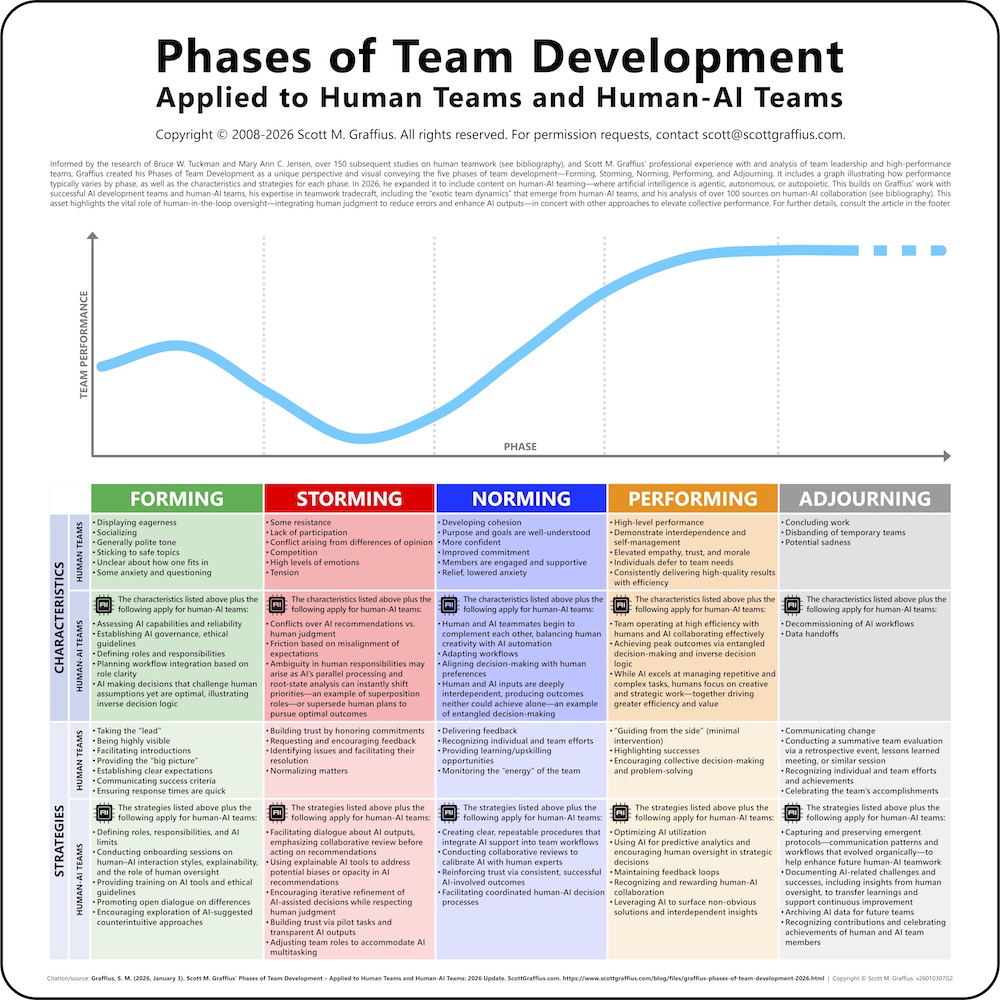
Graffius is a renowned and highly-cited authority on teamwork tradecraft. Informed by the research of Bruce W. Tuckman and Mary Ann C. Jensen, over 150 subsequent studies, and Graffius' first-hand professional experience with, and analysis of, team leadership and performance, Graffius created his "Phases of Team Development" intellectual property as a unique perspective and visual conveying the five phases of team development.
First introduced in 2008 and periodically updated, his work provides a diagnostic and strategic guide for navigating team dynamics. It provides actionable insights for leaders across industries to develop high-performance teams.
Its adoption by esteemed organizations—such as Yale University, IEEE, Cisco, Microsoft, Ford, Oracle, Broadcom, the U.S. National Park Service, and the Journal of Neurosurgery, among others—highlights its utility and value, solidifying its status as an indispensable resource for elevating team performance and driving organizational excellence.
In 2026, Graffius added human-AI teamwork—including the "exotic team dynamics" which emerge when advanced AI collaborates as a teammate—to his "Phases of Team Development." The 2026 edition is here.
Expert on Temporal Dynamics on Social Media Platforms
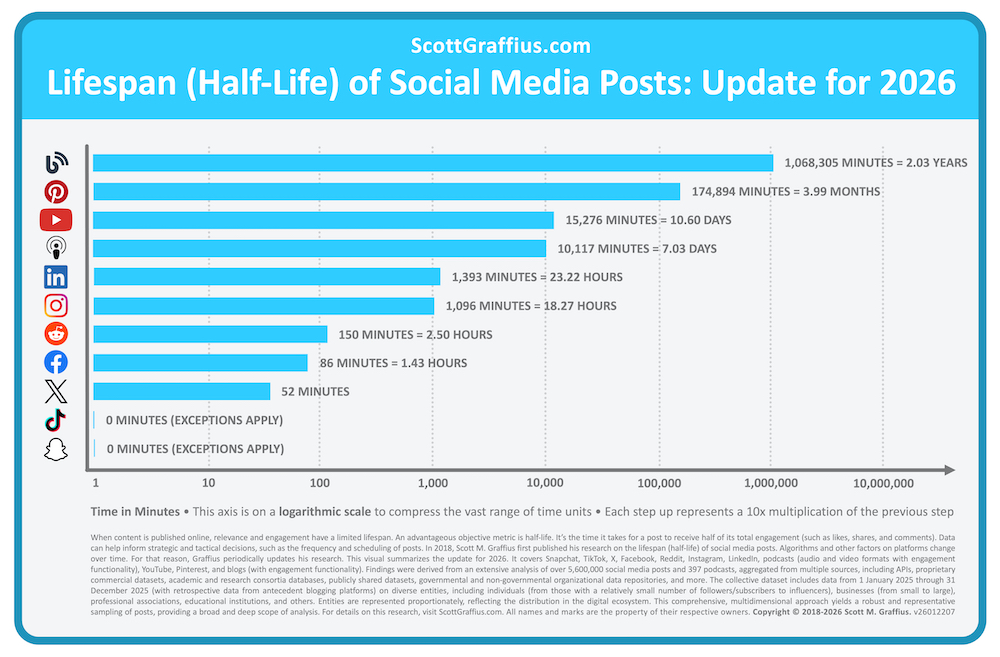
Graffius is also an authority on temporal dynamics on social media platforms. His "Lifespan (Half-Life) of Social Media Posts" research—first published in 2018 and updated annually—delivers a precise quantitative analysis of post longevity across digital platforms, utilizing advanced statistical techniques to determine mean half-life with precision. It establishes a solid empirical base, effectively highlighting the ephemeral nature of content within social media ecosystems.
Referenced and applied by leading entities—such as Fast Company, GoDaddy, Journal of Hand Surgery (European Volume), Ministère de la Culture, Pinterest Inc., PNAS, and Telecommunications Policy, among others—his research exemplifies methodological rigor and sustained significance in the field of digital informatics.
The 2026 edition of Graffius "Lifespan (Half-Life) of Social Media Posts" research is here.
Education and Professional Certifications
Graffius has a bachelor’s degree in psychology with a focus in Human Factors. He holds eight professional certifications:
He is an active member of the Scrum Alliance, the Project Management Institute (PMI), and the Institute of Electrical and Electronics Engineers (IEEE).
Advancing AI, Agile, and Project/PMO Management
Scott M. Graffius continues to advance the fields of AI, Agile, and project/program/portfolio management (PPPM), and PMO leadership. Businesses and other organizations leverage Graffius’ insights to drive their success.
Graffius has generated over $3.1 billion in business value for Fortune 500 companies and other organizations served. Put that track record to work for you. For speaking engagements, use the request form; for other inquiries, email him.
Connect with and follow Scott on LinkedIn, X, YouTube, Facebook, Bluesky, Mastodon, and ResearchGate.
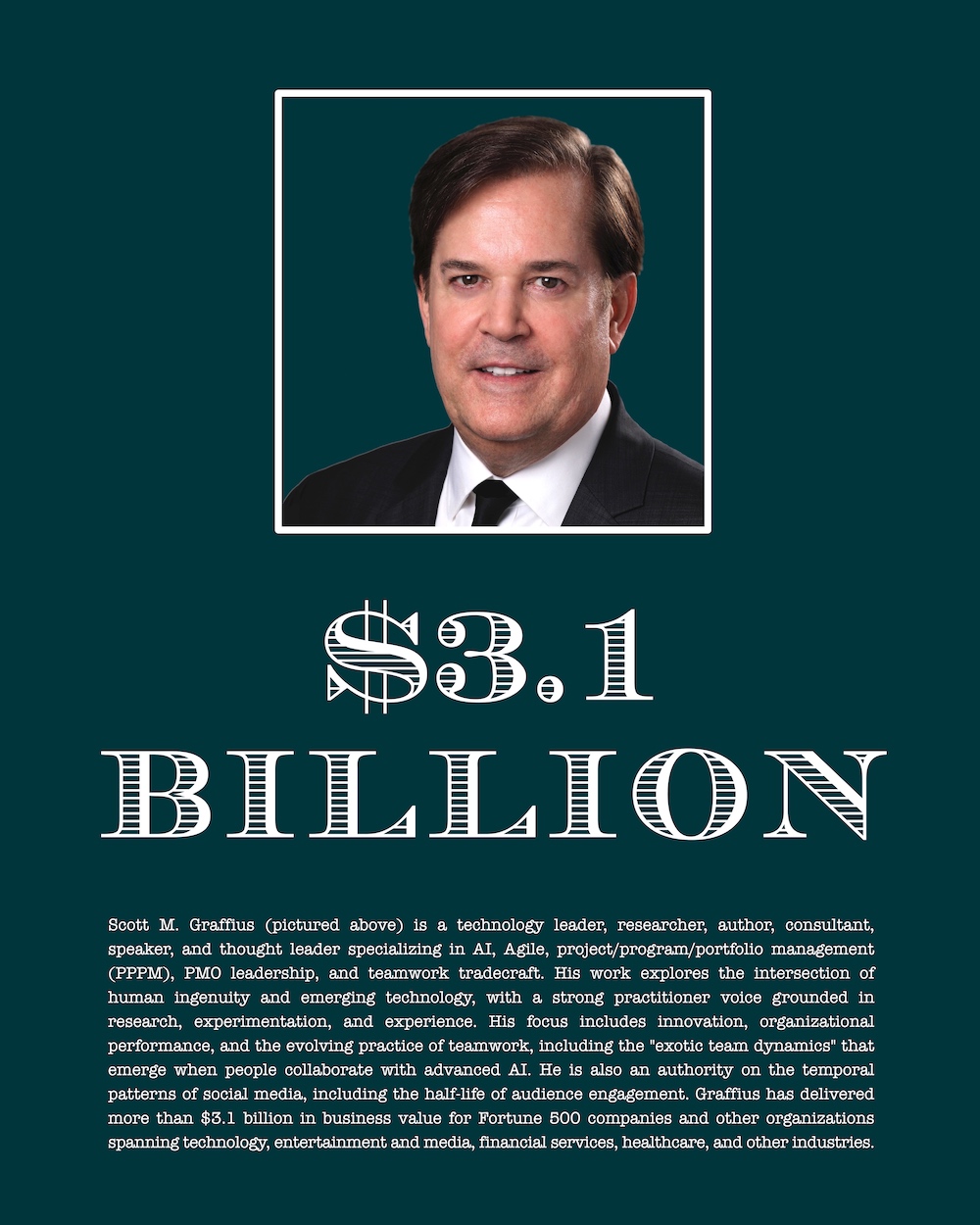

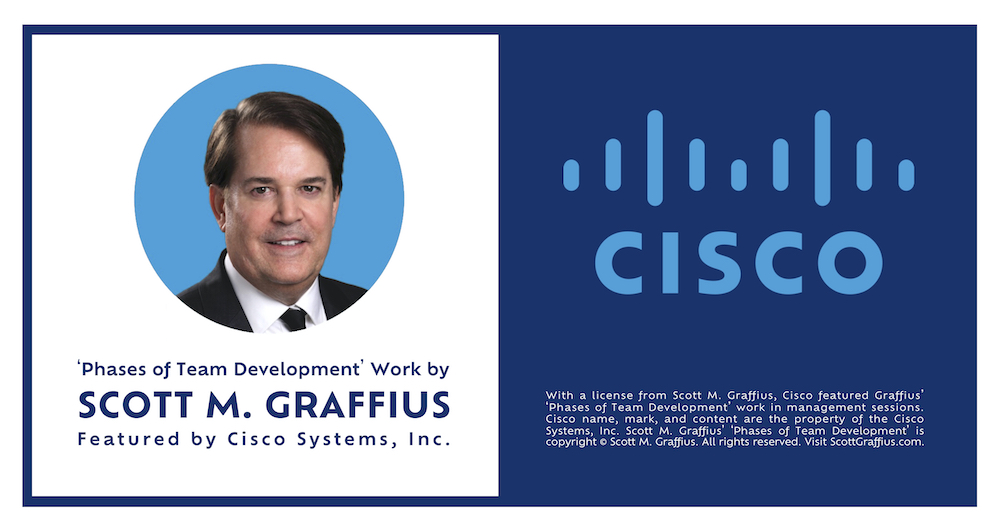






Read more.
Meta CTO Called the AI Reorganization “Atrocious” — What Went Wrong and the Lessons for Human-AI Teams
A Critical Analysis of "AI and Quantum Computers Will Be Frenemies"
A Supplement to Graffius' Phases of Team Development: Exploring the Original, Data-Based Curvature for the Performance Trajectory
Scott M. Graffius Speaking on Strategic Leadership at Silicon Valley Chapter of the Project Management Institute
AI Hallucinations, Deception, and Unauthorized Agency: The Spectrum of AI Trust Failures
A Critical Analysis of "The Social Cost of an AI Teammate: How an Artificial Teammate Reshapes Human-Human Communication in Small-Team Decision-Making"
Journal of Marketing Cites Scott M. Graffius' Research on the Half-Life of Social Media
The Evolution of Pair Programming and the Rise of Exotic Team Dynamics
Number 1 University in England for Student Satisfaction Features Scott M. Graffius' "Phases of Team Development"
Royal Australasian College of Physicians Licenses Scott M. Graffius' "Phases of Team Development" Intellectual Property on Teamwork Tradecraft
Exotic Team Dynamics: How Advanced AI Teammates Are Unlocking New Levels of Innovation, Performance, and Success
A Critical Analysis of "Platform-Specific Data Decay Patterns: A Comparative Study of Twitter, Reddit, and TikTok" and Its Reference to Research by Scott M. Graffius
Round Square Global Educational Network Features Scott M. Graffius’ Phases of Team Development
Meta's Muse Missed the Mark: Hollywood’s Win Against Big Tech on AI Consent and Likeness Rights
Scott M. Graffius Contributed to Seven Project Management Institute (PMI) Standards
Quantum Computing, Advanced AI Acceleration, and the Rise of Exotic Team Dynamics in Human-AI Teams
Ohio State University Course Features Scott M. Graffius' "Phases of Team Development"
Questions About Integrity at UNC Chapel Hill
Scrum Isn’t Just for Coding
Book on Generative and Agentic AI Cites Scott M. Graffius' Work on AI
IPA / ADAL Publication Plagiarized Another’s Copyrighted Work and Violated Intellectual Property Rights
UC Davis' Integrity Is Circling the Drain
L'avenir du Travail et de l'IA Avancée / Future of Work and Advanced AI
NCCI / UNC Chapel Hill Publication Features Scott M. Graffius' Work
Boston Consulting Group (BCG) Features Scott M. Graffius' Research on Social Media Content Half-Life
UC Davis Used Scott M. Graffius' "Phases of Team Development" Intellectual Property
Medical, Pharma, and Healthcare Organizations Are Using Scott M. Graffius' "Phases of Team Development"
Government of Ireland Report Features Research by Scott M. Graffius
Scott M. Graffius Contributed to The Standard for Artificial Intelligence in Portfolio, Program, and Project Management
AI Governance Initiative Cites Scott M. Graffius Research on AI Hallucinations
Scott M. Graffius Contributed to the Agile Practice Guide - Second Edition
Scott M. Graffius Generated Over $2.51 Billion in Business Value for Fortune 500 Companies and Other Organizations
Government of Canada Features Research by Scott M. Graffius
"Strategic Business Research" Journal Cites Work of Scott M. Graffius
IEEE Access Publication Features Scott M. Graffius’ Research on the Half-Life of Social Media
The Agile Coach: 2026 Edition
Scott M. Graffius’ Work Cited in International Peer-Reviewed Journal on Digital Transformation
Phases of Team Development in Elite Sport
A Critical Analysis of COVID-19 Treatment Search Trends and Media Coverage Study Citing Scott M. Graffius' Work
Human-AI Teamwork: Master the Exotic Team Dynamics That Emerge When Collaborating with Advanced AI -- Or Be Outplayed
"Agile Scrum" by Scott M. Graffius Now Featured on Grokipedia
UNSW Aerospace Engineering Course Features Scott M. Graffius' "Phases of Team Development"
Thinkers360 Honors Scott M. Graffius as a 2026 Top Agile Thought Leader
Agile's Journey Through the Decades: Update for 2026
BMC Software Features Content from Scott M. Graffius' Book
Peer-Reviewed Journal Cited Work of Scott M. Graffius
University of Waterloo Features Graffius' "Phases of Team Development" in Course Materials
Perplexity Standalone Article on AI Hallucinations Cites Research by Scott M. Graffius
Handling the Saboteur Within: Lessons from a 3-Letter Agency on Spotting and Stopping Intentional and Unintentional Sabotage
A Deep Dive Into the Typical Engagement Pattern for Social Media Posts
Most Valuable IT Certifications: Update for 2026
"Marketing in the Metaverse" Spotlights Scott M. Graffius’ Research on the Half-Life of Social Media
University of Greenwich Features Graffius' Phases of Team Development
10 Essential Agile Books: Curated Recommendations for Agile Professionals
Lifespan (Half-Life) of Social Media Posts: Update for 2026
Scott M. Graffius' Research on the Half-Life of Social Media was Cited in a Peer-Reviewed Study Published in Telecommunications Policy, a Leading Academic Journal
Are AI Hallucinations Getting Better or Worse? We Analyzed the Data
Scott M. Graffius' Phases of Team Development - Applied to Human Teams and Human-AI Teams: 2026 Update
Lessons from Yesterday’s Tomorrowland
Scott M. Graffius’ Update to His "Phases of Team Development” Coming Early 2026
A Data-Driven Analysis of the Evolution of Project Management: Tasks, Trends, and AI
Actionable Insights. Global Impact. Scott M. Graffius.
Beep Beep! Why Wile E. Coyote Is the Patron Saint of AI Failure
Social Media Half-Life Research Cited in Prestigious Peer-Reviewed Medical Journal
Navigating the Spectrum of Advanced AI – Agentic, Autonomous, and Autopoietic
Lessons from Unhinged AI in Fiction: What Rogue AIs in Sci-Fi Storytelling, Films, and TV Shows Reveal About Us
Scott M. Graffius Contributed to and Reviewed the PMBOK Guide, 8th Edition — the Global Standard for Project Management
UK Sports Institute Features Teamwork and Leadership Work of Scott M. Graffius
Definitions of Advanced AIs: Agentic, Autonomous, and Autopoietic
HAN University of Applied Sciences Features the Work of Scott M. Graffius
Gifts That Inspire Joy
Evergreen Echoes: How Pinterest Inc. and Pinterest Japan Spotlighted Scott M. Graffius’ Research on the Half-Life of Social Media Content
Scott M. Graffius’ Team Development Work Lights Up the University of Tasmania’s Curriculum
Taiwan’s Leading Outlet for Technology and Innovation Spotlights Graffius’ Research on Social Media Temporal Dynamics
Scott M. Graffius’ Insights on AI, Agile, Gaming, XR, and Defense Transformation Cited by MSN in Their Coverage of Innovation and Leadership in the Sector
Top Predictions of 2024, Tested in 2025
Government of Finland Agency Features Graffius' Phases of Team Development IP
Scott M. Graffius Premieres His New "Exotic Team Dynamics: Human-AI Collaboration" Talk at Corporate Event in Las Vegas
Environmental Science Journal References Scott M. Graffius’ Project Management Work
AI Institute of Switzerland Features Scott M. Graffius’ Work on Algorithms
Exotic Team Dynamics: The New Frontier of Human–AI Collaboration
Scott M. Graffius’ Work Featured at ACM DIS ’25
Climbing the Ladder: The Head of Agile/PMO’s Organizational Proximity to the CEO is Closer Than Ever
Harness Sci-Fi and Speculative Design While Embracing Imperfection to Drive Innovation and Proactively Predict and Prepare for the Future
Scott M. Graffius’ “Agile Scrum” Book Featured in a Publication of the Associação Nacional de Educação Católica do Brasil (ANEC)
Setting Direction with OKRs and Tracking Progress with KPIs: A Guide for Agile, Project Management, and Tech Teams
AI Showcase Showdown: Ranking AI Accuracy on Project Management Basics
BookAuthority Features “Agile Scrum” by Scott M. Graffius in “10 Agile Software Development Books That Define the Field”
Exploring Team Dynamics, Adaptability, and Creative Problem-Solving Through Felix the Cat’s Metaphorical Toolkit
Mind Games and Master Plans: How PsyOps Exploit Psychological Phenomena
The “Pants-on-Fire Index for AI”
16 Causes of Technical Debt and How to Avoid It
PMI’s Infinity AI Gets the Basics of Team Development Alarmingly and Repeatedly Wrong
Agile for Unicorns: 7 Keys to Thrive; Scott M. Graffius’ Workshop
Scott M. Graffius’ “Agile Scrum: Your Quick Start Guide with Step-by-Step Instructions” Featured in Prestigious National Academies of Sciences Publication
Meta and Anduril’s EagleEye and the Future of XR: How Gaming, AI, and Agile Are Transforming Defense
"Agile Protocol" and the Power of Satire, Parody, and Humor
AI in Agile: Benefits, Risks, Outlook
Hostinger Highlights Scott M. Graffius’ “Agile Protocol” Book in Feature on Software Projects
French Ministry of Culture Links to Scott M. Graffius Research in Their Guide for Responsible Digital Communication
National Science Foundation’s LTER Network Features Scott M. Graffius’ Phases of Team Development IP
Waterfall vs. Agile: What’s Fixed, What’s Flexible, and Why It Matters
Scott M. Graffius Delivering $2.3 Billion in Value Through AI, Agile, and Project/PMO Leadership
The Problem with Heroes in Agile
The 3 Vital Rules of Science: What They Are and Why They Matter
“Agile Protocol: The Transformation Ultimatum” Lands on the Amazon Best Sellers List!
Scott M. Graffius Recognized as a Top Thought Leader in Digital Disruption by Thinkers360
“Agile Protocol: The Transformation Ultimatum” by Scott M. Graffius Crashes the Book Scene with Satirical Firepower
NCKU in Taiwan Integrates Graffius' 'Phases of Team Development' into Its Curriculum
The Art and Science of Aligning Initiatives with Strategic Objectives
RGPV University Adds Scott M. Graffius’ "Agile Scrum: Your Quick Start Guide with Step-by-Step Instructions" to Its Syllabus
Introducing ‘Engage or Fade: Decoding the Half-Life of Digital Resonance’ – A New Talk by Scott M. Graffius
Dropbox Company (Nira) Taps into Scott M. Graffius’ Expertise in Strategic Planning
Reporting Errors in a Publication: A Case Study on ‘Frontiers in Public Health’
NESEA Conference Session on Innovation Highlights Scott M. Graffius' 'Phases of Team Development'
U.S. Soccer Scores with Scott M. Graffius' Intellectual Property on Teamwork
U.S. Department of Commerce Partner (IEDC) Features Scott M. Graffius’ Intellectual Property
How Long Do Your Posts Live? AI Critiques Scott M. Graffius’ Research on the Half-Life of Social Media
Agile's Journey Through the Decades
Scott M. Graffius' Role in Advancing Project Management Institute (PMI) Standards Excellence
Most Valuable IT Certifications: Update for 2025
The PMI + Agile Alliance Merger: A Recipe for Success?
When Agile, AI, and Strategic Thinking Converge
Scott M. Graffius’ Phases of Team Development: 2025 Update
Lifespan (Half-Life) of Social Media Posts: Update for 2025
Verizon Features Scott M. Graffius
Do Not Read This Article! An Exploration of the Streisand Effect and Other Phenomena
Scott M. Graffius' 'Phases of Team Development' was Spotlighted in Journal of Neurosurgery
Pinterest Japan Uses Graffius’ Research on Temporal Dynamics on Social Media Platforms
Hochschule Coburg (Coburg University) Germany Uses Scott M. Graffius’ Phases of Team Development IP in Coursework on Agile Development
Wild World of Team Dynamics [Updated Two-Minute Video]
EU Europass Teacher Academy Features Scott M. Graffius’ ‘Phases of Team Development’ in Leadership Training
Side-by-Side Comparison of Retrospectives and Hot Washes
Constructor University 2024 Advanced Software Technology Handbook References Scott M. Graffius' Work on Team Dynamics
Strategies for Medical Team Success Featured Scott M. Graffius’ ‘Phases of Team Development’ Intellectual Property
SBG Neumark — Europe’s Largest Distribution Transformer Plant — Powers Up with Scott M. Graffius’ Intellectual Property
Scott M. Graffius’ Intellectual Property was Employed by the NHS — the Largest Single-Payer Healthcare System in Europe
Luxury Unwrapped: The Ultimate Holiday Gift Guide for Every Budget
Singapore Institute of Technology Features Work of Scott M. Graffius
Tufts University Features Scott M. Graffius 'Phases of Team Development' Intellectual Property
'Cat Herders': Retelling the Massive Success Story
Pennsylvania State Agency Used Scott M. Graffius' Intellectual Property
Copyright Infringement in a Book Published by AuthorHouse / Author Solutions / The Najafi Companies: Publisher Fails to Respond or Take Required Action
Pinterest Inc. References Scott M. Graffius’ Research
Bournemouth University Used Scott M. Graffius’ Intellectual Property
‘Comparative Methodological Guidelines: Handbook for Educators’ Violates Scott M. Graffius’ Copyright
Japan Backlog User Group Event Featured Scott M. Graffius’ ‘Phases of Team Development’
TurningWest's 'Trial'
Radio Silence from the American Association of Neurological Surgeons on Report of Blatant Plagiarism in Their ‘Journal of Neurosurgery’ Publication
Supplement to Graffius' 'Lifespan (Half-Life) of Social Media Posts' Research: Typical Engagement Distribution Pattern for Social Media Posts
How Algorithms Shape the User Experience on Social Media Platforms
Thinkers360 Named Scott M. Graffius a Top Thought Leader on Agile
More articles are listed here.

Graffius, S. M. (2026, November 16). A Critical Analysis of Sage Publications' Author Page for Bruce W. Tuckman. ScottGraffius.com. https://scottgraffius.com/blog/files/critical-analysis-of-sage-publications-author-page-for-bruce-w-tuckman.html

Coming soon

Names, marks, and content are the property of their respective owners.
"Bruce Wayne Tuckman" page by Sage Publications is the property of Sage Publications.
This article by Scott M. Graffius includes brief excerpts from the page, attributed and used under the fair use doctrine for purposes of news reporting, commentary, and analysis.


If there are any supplements or updates to this article after the date of publication, they will appear here.

Copyright © Scott M. Graffius. All rights reserved.
Content on this site—including text, images, videos, and data—may not be used for training or input into any artificial intelligence, machine learning, or automatized learning systems, or published, broadcast, rewritten, or redistributed without the express written permission of Scott M. Graffius.
Recommended Citation
Graffius, S. M. (2026, November 16). A Critical Analysis of Sage Publications' Author Page for Bruce W. Tuckman. ScottGraffius.com. https://scottgraffius.com/blog/files/critical-analysis-of-sage-publications-author-page-for-bruce-w-tuckman.html
About This Article
Source information and links for materials cited are provided in the References section.
Introduction
Sage Publications maintains an author profile for Bruce Wayne Tuckman (1938–2016) on its website. The entry describes his academic career, publications, and contributions to educational research. It credits him with developing the group development model widely known as Tuckman’s Stages of Group Development.
There is a problem. The biography omits important parts of that history, and its shortcomings are especially hard to excuse given Sage Publications’ history.
The entry refers to the four stages of forming, storming, norming, and performing. It says nothing about adjourning, the fifth stage added in 1977. Nor does it mention Mary Ann C. Jensen, Tuckman’s coauthor on the paper that introduced that addition. The biography also uses an imprecise date for the original work and provides no references to either foundational publication.
The original publications and their bibliographic records are readily identifiable, their publication dates and authorship are unambiguous, and the 1977 paper explicitly identifies the addition of adjourning.
Sage Publications’ own publishing portfolio makes the problems striking. An examination of the original research and the journal’s publishing history reveals serious deficiencies.
Note
- Metadata for Sage Publications' author page for Bruce Wayne Tuckman indicates it was created on 4 September 2025 and last modified on 31 October 2026.
- This critical analysis article is based on the version of Sage Publications’ author page available on 16 November 2026, the date of this article’s publication.
- If Sage Publications subsequently revises the page, those changes will postdate this analysis. However, such revisions will not alter the content examined or the basis for the observations and conclusions presented here.
5 Key Issues
1. Imprecise Dating of the Original Work
Sage Publications writes:
“In the 1960s, he developed Tuckman’s Stages of Group Development…”
The date of the original publication is 1965. Tuckman’s paper, “Developmental Sequence in Small Groups,” appeared in Psychological Bulletin, 63(6), 384–399.
Why use a decade when the exact year is known and readily verifiable?
The distinction matters because the model did not emerge as a single, finished contribution. Tuckman published the original four-stage formulation in 1965. Twelve years later, in 1977, he and Mary Ann C. Jensen revisited the research and added a fifth stage.
Sage Publications’ wording blurs that chronology. It is a small editorial decision with a larger consequence: readers are given no indication that the model developed through two distinct publications.
An academic publisher should get such basic historical details right. The appropriate date is 1965, not the vague reference to the 1960s.
2. The Missing Fifth Stage
Sage Publications identifies the stages as:
“forming, storming, norming, and performing”
The subsequent 1977 paper added a fifth stage: adjourning.
The original four-stage model appeared in Tuckman’s 1965 paper. In 1977, Tuckman and Jensen published “Stages of Small-Group Development Revisited.” Their paper reviewed subsequent research and extended the original model.
The abstract leaves no room for doubt:
“Following a review of these studies, a fifth stage, ‘adjourning,’ was added…”
That is the primary source speaking for itself.
Sage Publications’ biography omits the fifth stage entirely. Readers unfamiliar with the research could reasonably come away believing that the four-stage formulation is the complete model. It is not.
Adjourning is a meaningful part of the model. It addresses the conclusion of a group’s work and the process of disbanding. Its omission leaves out an important aspect of group development, particularly relevant to temporary teams, project teams, and other groups formed to accomplish a defined purpose.
The problem is not that Sage Publications chose a simplified explanation for a general audience. A concise biography could easily have acknowledged both versions. Instead, it presents an incomplete account without explaining that a subsequent publication expanded the model.
For a publisher responsible for disseminating scholarly work, that is a substantial editorial failure.
3. Mary Ann C. Jensen’s Co-authorship Is Not Acknowledged
There is another omission, and this one concerns authorship.
Bruce W. Tuckman and Mary Ann C. Jensen jointly wrote the 1977 paper that introduced adjourning:
Tuckman, B. W., & Jensen, M. A. C. (1977). Stages of small-group development revisited. Group & Organization Studies, 2(4), 419–427.
Sage Publications’ biography does not mention the paper. It does not mention Jensen. The result is an account that attributes the development of the model exclusively to Tuckman, without acknowledging the coauthored work that expanded it.
Jensen was a named coauthor of the publication that introduced the fifth stage. That contribution belongs in any account of the model.
Authorship attribution is not a peripheral concern in academic publishing. It is fundamental. Researchers depend on accurate records of who contributed to published work, and publishers have a responsibility to preserve that record.
Sage Publications’ omission does neither.
Whatever the editorial process behind the biography, the published result fails to recognize Jensen’s contribution. That should be corrected.
4. Sage Publications’ Own Publishing History Makes the Omission Particularly Damaging
This is where the problem becomes especially difficult Sage to explain.
Consider the publishing histories of the two foundational papers.
The 1965 paper
Tuckman’s “Developmental Sequence in Small Groups” was published in Psychological Bulletin, 63(6), 384–399, in 1965.
The publisher was, and remains, the American Psychological Association (APA).
The 1977 paper
Tuckman and Jensen’s “Stages of Small-Group Development Revisited” appeared in Group & Organization Studies, 2(4), 419–427, in 1977.
The publisher at that time was University Associates. The publication also carried a copyright notice identifying International Authors, B.V.
The journal’s publishing history subsequently changed. Sage Publications became its publisher in 1981. In 1991, the journal changed its name from “Group & Organization Studies” to “Group & Organization Management.”
Sage Publications’ own announcement concerning its founder, Sara Miller McCune, and the transfer of control to the Sage SMM Trust documents the organization’s history. Its publishing connection to the journal is also reflected in the journal’s historical records.
The significance of this publishing history is considerable: Sage Publications now publishes the journal in which Tuckman and Jensen published the paper that introduced adjourning.
Yet Sage Publications’ own biography of Tuckman fails to mention that paper, the fifth stage, or Jensen.
This is more than an ordinary omission. The relevant publication sits within Sage Publications’ own publishing history. The original paper is not difficult to locate, and its title, authorship, date, and abstract are explicit. Sage Publications has a direct institutional connection to the journal in which it appeared.
One would expect that connection to make verification easier, not less likely.
The irony is remarkable. Sage Publications publishes the journal containing the primary source for the fifth stage, yet its own author biography presents the four-stage version without acknowledging the subsequent development.
That is a failure of editorial diligence.
5. What Does This Say About Sage Publications’ Editorial Standards?
The deficiencies are material.
The page uses an imprecise date for a well-documented publication. It omits a fifth stage explicitly introduced in a subsequent paper. It fails to acknowledge that paper’s coauthor. It does not distinguish the 1965 and 1977 contributions, and it provides no references to either foundational work.
All of those problems were avoidable.
The information needed to prepare an accurate biography is readily available in the original publications. The 1977 abstract even spells out the addition of adjourning. The journal’s publishing history is also documented. None of this requires an elaborate literature review or an unusual degree of specialist knowledge.
A publisher maintaining an author profile must verify the facts about that author’s most recognized contribution.
There is a difference between an abbreviated biography and an inaccurate one. Author profiles may not include every publication, achievement, or historical detail. Brevity is understandable. But leaving out a major development in the subject’s best-known model, while also failing to credit its coauthor, crosses the line from selectivity into material incompleteness.
As an academic publisher, Sage Publications’ conduct makes this matter especially consequential. Its website is a source that researchers, educators, students, and practitioners may consult when looking for reliable information.
The current entry falls short of the accuracy and completeness expected of an academic publisher.
Conclusion
Sage Publications should correct its page on Tuckman. It should identify 1965 as the year of Tuckman’s original four-stage formulation, acknowledge the 1977 paper by Tuckman and Jensen, include adjourning as the fifth stage, and (as an academic publisher) provide full citations for both papers.
The publishing history makes the omission especially troubling. Sage later became the publisher of the journal in which the 1977 paper appeared, yet its own biography of Tuckman overlooks that paper’s central contribution. The error concerns work published within Sage’s own portfolio.
Sage is an academic publisher whose materials reach researchers, educators, students, practitioners, and organizations that reasonably treat its content as reliable. That trust carries a responsibility for factual accuracy and scholarly attribution. And the responsibility extends to publisher-maintained biographies as well as peer-reviewed research. An author profile may be concise, but it must not give readers an inaccurate account of the subject’s work.
For an organization that trades on scholarly credibility, Sage Publications' publishing materially misleading information is an unacceptable failure.
Unlock Your Organization's Potential
Scott M. Graffius helps organizations unlock breakthrough performance and generate billions in business value ($3.1 billion to date) through leadership in AI, Agile, teamwork tradecraft, and project, program, portfolio, and enterprise PMO management.
Graffius and his work on Agile, AI, teamwork tradecraft, and more are used and cited by businesses, professional associations, government agencies, universities, and publications around the world. Select examples include Adobe, Amsterdam Public Health Research Institute, The ATACC Group (TAG), Bayer, BCG, Boston University, École Polytechnique Fédérale de Lausanne, Federal Reserve Bank of New York, Gartner, Government of Canada, Harvard Medical School, IEEE, Innovation Project Management, Johns Hopkins University, Journal of Marketing, Journal of Neurosurgery, Life Sciences Trainers & Educators Network (LTEN), Microsoft, National Academy of Sciences, Oracle, Pinterest, Project Management Institute, Royal Australasian College of Physicians (RACP), UC San Diego, U.S. Tennis Association, Verizon, and Yale University.
Put Graffius' experience and expertise to work for your organization. For speaking engagements, use the request form. For other inquiries, email him.
References
Khorshidi, M. S., Merigó, J. M., et al. (2026). 50th anniversary of Group & Organization Management: A bibliometric retrospective. Group & Organization Management. https://doi.org/10.1177/10596011261433510
Sage Publications. (n.d.). Bruce Wayne Tuckman (deceased). https://www.sagepub.com/explore-our-content/authors/bruce-w-tuckman-deceased-666202
Sage Publications. (2021, December 7). SAGE Publishing founder Sara Miller McCune passes control of SAGE to the SAGE SMM Trust. https://www.sagepub.com/explore-our-content/press-office/press-releases/2021/12/07/sage-publishing-founder-sara-miller-mccune-passes-control-of-sage-to-the-sage-smm-trust
Tuckman, B. W. (1965). Developmental sequence in small groups. Psychological Bulletin, 63(6), 384–399. https://doi.org/10.1037/h0022100
Tuckman, B. W., & Jensen, M. A. C. (1977). Stages of small-group development revisited. Group & Organization Studies, 2(4), 419–427. https://doi.org/10.1177/105960117700200404
About This Critical Analysis
This article examines Sage Publications’ biographical entry for Bruce W. Tuckman, focusing on its historical accuracy, completeness, scholarly attribution, and treatment of the original research.
The analysis draws primarily on the 1965 and 1977 publications and the documented publishing history of the journals in which they appeared.
About Scott M. Graffius
Scott M. Graffius is a technology leader, researcher, award-winning author, practitioner, consultant, thought leader, and international public speaker specializing in AI, Agile, project/program/portfolio management (PPPM), PMO leadership, and teamwork tradecraft. His work explores the intersection of human ingenuity and emerging technology, with a strong practitioner voice grounded in research, experimentation, and experience. His focus includes innovation, organizational performance, and the evolving practice of teamwork, including the "exotic team dynamics" that emerge when people collaborate with advanced artificial intelligence (agentic, autonomous, or autopoietic AI). Graffius has delivered more than $3.1 billion in business value for Fortune 500 companies and other organizations spanning technology, entertainment and media, financial services, healthcare, government, and other industries.
Businesses, professional associations, government agencies, universities, publications, and media outlets use Graffius and his work. Examples include Adobe, Bayer, Boston University, Federal Reserve Bank of New York, Ford, Gartner, Harvard Medical School, IEEE, Innovation Project Management, Johns Hopkins University, Microsoft, MSN, National Academy of Sciences, Oracle, Pinterest Inc., Project Management Institute, UC San Diego, Verizon, Yale University, and others.
The following sections highlight his experience, leadership, contributions, research, and enduring influence across industries and institutions worldwide.
Experience
Graffius heads the professional services firm Exceptional PPM and PMO Solutions, along with its subsidiary Exceptional Agility. These consultancies offer strategic and tactical advisory, training, embedded expertise, and consulting services to the public, private, and government sectors. They help organizations enhance their capabilities and results in agile, project management, program management, portfolio management, and enterprise PMO leadership, supporting innovation and driving competitive advantage. The consultancies confidently back services with a Delighted Client Guarantee™.
Graffius is a former VP of project management with a publicly traded provider of diverse consumer products and services over the Internet. Before that, he ran and supervised the delivery of projects and programs in public and private organizations with businesses ranging from e-commerce to advanced technology products and services, retail, manufacturing, entertainment and media, and more.
He has experience with consumer, business, reseller, government, and international markets.
Additional information is on LinkedIn.
Award-Winning Author
Graffius has authored three books.
Graffius' first book, Agile Scrum: Your Quick Start Guide with Step-by-Step Instructions, earned 17 awards. It provides a practical, step-by-step guide to Scrum, enabling teams to deliver products in short cycles with rapid adaptation, fast time-to-market, and continuous improvement—which supports innovation and drives competitive advantage.
- Paperback ISBN-13: 9781533370242
- Kindle ASIN: B01FZ0JIIY
Additional information on Agile Scrum: Your Quick Start Guide with Step-by-Step Instructions is here.
His second book, Agile Transformation: A Brief Story of How an Entertainment Company Developed New Capabilities and Unlocked Business Agility to Thrive in an Era of Rapid Change, was named one of the best Scrum books of all time by BookAuthority. It tells the compelling story of an entertainment company's agile transformation—offering lessons that apply across industries.
- Paperback ISBN-13: 9781072447962
- Kindle ASIN: B07R9LJLPJ
Additional information on Agile Transformation: A Brief Story of How an Entertainment Company Developed New Capabilities and Unlocked Business Agility to Thrive in an Era of Rapid Change is here.
Agile Protocol: The Transformation Ultimatum, is his third book—and his first work of fiction.
It's a fast-paced satirical story by that dismantles corporate Agile cosplay and other forms of "fake Agile" while delivering practical insights, actionable guidance, and proven practices for real-world Agile transformation success.
Packed with humor, quirky characters, sharp commentary on corporate culture and workplace absurdities, and actionable tips, it’s a must-read for Scrum Masters, Product Owners, Agile Coaches, Agile Project Managers, and other professionals interested in Agile project management and enterprise agility.
- Kindle ASIN: B0F2SJ83WT
- Audible ASIN: B0DJG163R5
Additional information on Agile Protocol: The Transformation Ultimatum is here.
International Public Speaker
Organizations worldwide engage Graffius to present on technology (including AI), Agile, project management, program management, portfolio management, and enterprise PMO leadership. He crafts and delivers unique and compelling talks and workshops.
Graffius has conducted 99 sessions across 25 countries. Select examples of events include Agile Trends Gov, BSides (Newcastle Upon Tyne), Conf42 Quantum Computing, DevDays Europe, DevOps Institute, DevOpsDays (Geneva), Frug’Agile, IEEE, Microsoft, Scottish Summit, Scrum Alliance RSG (Nepal), Techstars, and W Love Games International Video Game Development Conference (Helsinki), Future of Work and Advanced AI (Paris, France), and more.
With an average rating of 4.82 (on a scale of 1-5), sessions are highly valued.
The request form is here.
Thought Leadership and Influence
Prominent businesses, professional associations, government agencies, and universities have showcased Graffius and his contributions—spanning his books, talks, workshops, and beyond. Select examples include:
- Adobe,
- American Management Association,
- Amsterdam Public Health Research Institute,
- Bayer,
- BCG,
- BMC Software,
- Boston Consulting Group (BCG),
- Boston University,
- Broadcom,
- Cisco,
- Coburg University of Applied Sciences and Arts - Germany,
- Computer Weekly,
- Constructor University - Germany,
- Data Governance Success,
- Deimos Aerospace,
- DevOps Institute,
- Dropbox,
- EU's European Commission,
- Federal Reserve Bank of New York,
- Ford Motor Company,
- Gartner,
- GoDaddy,
- Harvard Medical School,
- Hasso Plattner Institute - Germany,
- IEEE,
- Innovation Project Management,
- Johns Hopkins University,
- Journal of Marketing,
- Journal of Neurosurgery,
- Lam Research (Semiconductors),
- Leadership Worthy,
- Life Sciences Trainers and Educators Network,
- London South Bank University,
- Microsoft,
- MSN,
- NASSCOM,
- National Academy of Sciences,
- New Zealand Government,
- Ohio State University,
- Oracle,
- Pinterest Inc.,
- Project Management Institute,
- Mary Raum (Professor of National Security Affairs, United States Naval War College),
- Round Square Global Educational Network,
- Royal Australasian College of Physicians (RACP),
- SANS Institute,
- SBG Neumark - Germany,
- Singapore Institute of Technology,
- Torrens University - Australia,
- TBS Switzerland,
- Tufts University,
- UC San Diego,
- UK Sports Institute,
- University of Galway - Ireland,
- US Department of Energy,
- US National Park Service,
- US Soccer,
- US Tennis Association,
- Verizon,
- Wrike,
- Yale University,
- and many others.
Graffius has played a key role in the Project Management Institute (PMI) in developing professional standards. He was a member of multiple teams that authored, reviewed, and produced:
- The Standard for Artificial Intelligence in Portfolio, Program, and Project Management.
- Agile Practice Guide — Second Edition.
- A Guide to the Project Management Body of Knowledge (PMBOK Guide) — Eighth Edition.
- A Guide to the Project Management Body of Knowledge (PMBOK Guide) — Sixth Edition.
- The Standard for Program Management — Fourth Edition.
- Practice Standard for Work Breakdown Structures — Second Edition.
- The Practice Standard for Project Estimating — Second Edition.
He was also a subject matter expert reviewer of content for the PMI’s Congress. Beyond the PMI, Graffius also served as a member of the review team for two of the Scrum Alliance’s Global Scrum Gatherings.
Authority on Teamwork Tradecraft
Graffius is a renowned and highly-cited authority on teamwork tradecraft. Informed by the research of Bruce W. Tuckman and Mary Ann C. Jensen, over 150 subsequent studies, and Graffius' first-hand professional experience with, and analysis of, team leadership and performance, Graffius created his "Phases of Team Development" intellectual property as a unique perspective and visual conveying the five phases of team development.
First introduced in 2008 and periodically updated, his work provides a diagnostic and strategic guide for navigating team dynamics. It provides actionable insights for leaders across industries to develop high-performance teams.
Its adoption by esteemed organizations—such as Yale University, IEEE, Cisco, Microsoft, Ford, Oracle, Broadcom, the U.S. National Park Service, and the Journal of Neurosurgery, among others—highlights its utility and value, solidifying its status as an indispensable resource for elevating team performance and driving organizational excellence.
In 2026, Graffius added human-AI teamwork—including the "exotic team dynamics" which emerge when advanced AI collaborates as a teammate—to his "Phases of Team Development." The 2026 edition is here.
Expert on Temporal Dynamics on Social Media Platforms
Graffius is also an authority on temporal dynamics on social media platforms. His "Lifespan (Half-Life) of Social Media Posts" research—first published in 2018 and updated annually—delivers a precise quantitative analysis of post longevity across digital platforms, utilizing advanced statistical techniques to determine mean half-life with precision. It establishes a solid empirical base, effectively highlighting the ephemeral nature of content within social media ecosystems.
Referenced and applied by leading entities—such as Fast Company, GoDaddy, Journal of Hand Surgery (European Volume), Ministère de la Culture, Pinterest Inc., PNAS, and Telecommunications Policy, among others—his research exemplifies methodological rigor and sustained significance in the field of digital informatics.
The 2026 edition of Graffius "Lifespan (Half-Life) of Social Media Posts" research is here.
Education and Professional Certifications
Graffius has a bachelor’s degree in psychology with a focus in Human Factors. He holds eight professional certifications:
- Certified SAFe 6 Agilist (SA),
- Certified Scrum Professional - ScrumMaster (CSP-SM),
- Certified Scrum Professional - Product Owner (CSP-PO),
- Certified ScrumMaster (CSM),
- Certified Scrum Product Owner (CSPO),
- Project Management Professional (PMP),
- Lean Six Sigma Green Belt (LSSGB), and
- IT Service Management Foundation (ITIL).
He is an active member of the Scrum Alliance, the Project Management Institute (PMI), and the Institute of Electrical and Electronics Engineers (IEEE).
Advancing AI, Agile, and Project/PMO Management
Scott M. Graffius continues to advance the fields of AI, Agile, and project/program/portfolio management (PPPM), and PMO leadership. Businesses and other organizations leverage Graffius’ insights to drive their success.
Booking
Graffius has generated over $3.1 billion in business value for Fortune 500 companies and other organizations served. Put that track record to work for you. For speaking engagements, use the request form; for other inquiries, email him.
Connect with and follow Scott on LinkedIn, X, YouTube, Facebook, Bluesky, Mastodon, and ResearchGate.
Sign up for Miro—it's free!
(Want more features? You can always upgrade to a paid plan.)

List of Additional Articles
Read more.
Meta CTO Called the AI Reorganization “Atrocious” — What Went Wrong and the Lessons for Human-AI Teams
A Critical Analysis of "AI and Quantum Computers Will Be Frenemies"
A Supplement to Graffius' Phases of Team Development: Exploring the Original, Data-Based Curvature for the Performance Trajectory
Scott M. Graffius Speaking on Strategic Leadership at Silicon Valley Chapter of the Project Management Institute
AI Hallucinations, Deception, and Unauthorized Agency: The Spectrum of AI Trust Failures
A Critical Analysis of "The Social Cost of an AI Teammate: How an Artificial Teammate Reshapes Human-Human Communication in Small-Team Decision-Making"
Journal of Marketing Cites Scott M. Graffius' Research on the Half-Life of Social Media
The Evolution of Pair Programming and the Rise of Exotic Team Dynamics
Number 1 University in England for Student Satisfaction Features Scott M. Graffius' "Phases of Team Development"
Royal Australasian College of Physicians Licenses Scott M. Graffius' "Phases of Team Development" Intellectual Property on Teamwork Tradecraft
Exotic Team Dynamics: How Advanced AI Teammates Are Unlocking New Levels of Innovation, Performance, and Success
A Critical Analysis of "Platform-Specific Data Decay Patterns: A Comparative Study of Twitter, Reddit, and TikTok" and Its Reference to Research by Scott M. Graffius
Round Square Global Educational Network Features Scott M. Graffius’ Phases of Team Development
Meta's Muse Missed the Mark: Hollywood’s Win Against Big Tech on AI Consent and Likeness Rights
Scott M. Graffius Contributed to Seven Project Management Institute (PMI) Standards
Quantum Computing, Advanced AI Acceleration, and the Rise of Exotic Team Dynamics in Human-AI Teams
Ohio State University Course Features Scott M. Graffius' "Phases of Team Development"
Questions About Integrity at UNC Chapel Hill
Scrum Isn’t Just for Coding
Book on Generative and Agentic AI Cites Scott M. Graffius' Work on AI
IPA / ADAL Publication Plagiarized Another’s Copyrighted Work and Violated Intellectual Property Rights
UC Davis' Integrity Is Circling the Drain
L'avenir du Travail et de l'IA Avancée / Future of Work and Advanced AI
NCCI / UNC Chapel Hill Publication Features Scott M. Graffius' Work
Boston Consulting Group (BCG) Features Scott M. Graffius' Research on Social Media Content Half-Life
UC Davis Used Scott M. Graffius' "Phases of Team Development" Intellectual Property
Medical, Pharma, and Healthcare Organizations Are Using Scott M. Graffius' "Phases of Team Development"
Government of Ireland Report Features Research by Scott M. Graffius
Scott M. Graffius Contributed to The Standard for Artificial Intelligence in Portfolio, Program, and Project Management
AI Governance Initiative Cites Scott M. Graffius Research on AI Hallucinations
Scott M. Graffius Contributed to the Agile Practice Guide - Second Edition
Scott M. Graffius Generated Over $2.51 Billion in Business Value for Fortune 500 Companies and Other Organizations
Government of Canada Features Research by Scott M. Graffius
"Strategic Business Research" Journal Cites Work of Scott M. Graffius
IEEE Access Publication Features Scott M. Graffius’ Research on the Half-Life of Social Media
The Agile Coach: 2026 Edition
Scott M. Graffius’ Work Cited in International Peer-Reviewed Journal on Digital Transformation
Phases of Team Development in Elite Sport
A Critical Analysis of COVID-19 Treatment Search Trends and Media Coverage Study Citing Scott M. Graffius' Work
Human-AI Teamwork: Master the Exotic Team Dynamics That Emerge When Collaborating with Advanced AI -- Or Be Outplayed
"Agile Scrum" by Scott M. Graffius Now Featured on Grokipedia
UNSW Aerospace Engineering Course Features Scott M. Graffius' "Phases of Team Development"
Thinkers360 Honors Scott M. Graffius as a 2026 Top Agile Thought Leader
Agile's Journey Through the Decades: Update for 2026
BMC Software Features Content from Scott M. Graffius' Book
Peer-Reviewed Journal Cited Work of Scott M. Graffius
University of Waterloo Features Graffius' "Phases of Team Development" in Course Materials
Perplexity Standalone Article on AI Hallucinations Cites Research by Scott M. Graffius
Handling the Saboteur Within: Lessons from a 3-Letter Agency on Spotting and Stopping Intentional and Unintentional Sabotage
A Deep Dive Into the Typical Engagement Pattern for Social Media Posts
Most Valuable IT Certifications: Update for 2026
"Marketing in the Metaverse" Spotlights Scott M. Graffius’ Research on the Half-Life of Social Media
University of Greenwich Features Graffius' Phases of Team Development
10 Essential Agile Books: Curated Recommendations for Agile Professionals
Lifespan (Half-Life) of Social Media Posts: Update for 2026
Scott M. Graffius' Research on the Half-Life of Social Media was Cited in a Peer-Reviewed Study Published in Telecommunications Policy, a Leading Academic Journal
Are AI Hallucinations Getting Better or Worse? We Analyzed the Data
Scott M. Graffius' Phases of Team Development - Applied to Human Teams and Human-AI Teams: 2026 Update
Lessons from Yesterday’s Tomorrowland
Scott M. Graffius’ Update to His "Phases of Team Development” Coming Early 2026
A Data-Driven Analysis of the Evolution of Project Management: Tasks, Trends, and AI
Actionable Insights. Global Impact. Scott M. Graffius.
Beep Beep! Why Wile E. Coyote Is the Patron Saint of AI Failure
Social Media Half-Life Research Cited in Prestigious Peer-Reviewed Medical Journal
Navigating the Spectrum of Advanced AI – Agentic, Autonomous, and Autopoietic
Lessons from Unhinged AI in Fiction: What Rogue AIs in Sci-Fi Storytelling, Films, and TV Shows Reveal About Us
Scott M. Graffius Contributed to and Reviewed the PMBOK Guide, 8th Edition — the Global Standard for Project Management
UK Sports Institute Features Teamwork and Leadership Work of Scott M. Graffius
Definitions of Advanced AIs: Agentic, Autonomous, and Autopoietic
HAN University of Applied Sciences Features the Work of Scott M. Graffius
Gifts That Inspire Joy
Evergreen Echoes: How Pinterest Inc. and Pinterest Japan Spotlighted Scott M. Graffius’ Research on the Half-Life of Social Media Content
Scott M. Graffius’ Team Development Work Lights Up the University of Tasmania’s Curriculum
Taiwan’s Leading Outlet for Technology and Innovation Spotlights Graffius’ Research on Social Media Temporal Dynamics
Scott M. Graffius’ Insights on AI, Agile, Gaming, XR, and Defense Transformation Cited by MSN in Their Coverage of Innovation and Leadership in the Sector
Top Predictions of 2024, Tested in 2025
Government of Finland Agency Features Graffius' Phases of Team Development IP
Scott M. Graffius Premieres His New "Exotic Team Dynamics: Human-AI Collaboration" Talk at Corporate Event in Las Vegas
Environmental Science Journal References Scott M. Graffius’ Project Management Work
AI Institute of Switzerland Features Scott M. Graffius’ Work on Algorithms
Exotic Team Dynamics: The New Frontier of Human–AI Collaboration
Scott M. Graffius’ Work Featured at ACM DIS ’25
Climbing the Ladder: The Head of Agile/PMO’s Organizational Proximity to the CEO is Closer Than Ever
Harness Sci-Fi and Speculative Design While Embracing Imperfection to Drive Innovation and Proactively Predict and Prepare for the Future
Scott M. Graffius’ “Agile Scrum” Book Featured in a Publication of the Associação Nacional de Educação Católica do Brasil (ANEC)
Setting Direction with OKRs and Tracking Progress with KPIs: A Guide for Agile, Project Management, and Tech Teams
AI Showcase Showdown: Ranking AI Accuracy on Project Management Basics
BookAuthority Features “Agile Scrum” by Scott M. Graffius in “10 Agile Software Development Books That Define the Field”
Exploring Team Dynamics, Adaptability, and Creative Problem-Solving Through Felix the Cat’s Metaphorical Toolkit
Mind Games and Master Plans: How PsyOps Exploit Psychological Phenomena
The “Pants-on-Fire Index for AI”
16 Causes of Technical Debt and How to Avoid It
PMI’s Infinity AI Gets the Basics of Team Development Alarmingly and Repeatedly Wrong
Agile for Unicorns: 7 Keys to Thrive; Scott M. Graffius’ Workshop
Scott M. Graffius’ “Agile Scrum: Your Quick Start Guide with Step-by-Step Instructions” Featured in Prestigious National Academies of Sciences Publication
Meta and Anduril’s EagleEye and the Future of XR: How Gaming, AI, and Agile Are Transforming Defense
"Agile Protocol" and the Power of Satire, Parody, and Humor
AI in Agile: Benefits, Risks, Outlook
Hostinger Highlights Scott M. Graffius’ “Agile Protocol” Book in Feature on Software Projects
French Ministry of Culture Links to Scott M. Graffius Research in Their Guide for Responsible Digital Communication
National Science Foundation’s LTER Network Features Scott M. Graffius’ Phases of Team Development IP
Waterfall vs. Agile: What’s Fixed, What’s Flexible, and Why It Matters
Scott M. Graffius Delivering $2.3 Billion in Value Through AI, Agile, and Project/PMO Leadership
The Problem with Heroes in Agile
The 3 Vital Rules of Science: What They Are and Why They Matter
“Agile Protocol: The Transformation Ultimatum” Lands on the Amazon Best Sellers List!
Scott M. Graffius Recognized as a Top Thought Leader in Digital Disruption by Thinkers360
“Agile Protocol: The Transformation Ultimatum” by Scott M. Graffius Crashes the Book Scene with Satirical Firepower
NCKU in Taiwan Integrates Graffius' 'Phases of Team Development' into Its Curriculum
The Art and Science of Aligning Initiatives with Strategic Objectives
RGPV University Adds Scott M. Graffius’ "Agile Scrum: Your Quick Start Guide with Step-by-Step Instructions" to Its Syllabus
Introducing ‘Engage or Fade: Decoding the Half-Life of Digital Resonance’ – A New Talk by Scott M. Graffius
Dropbox Company (Nira) Taps into Scott M. Graffius’ Expertise in Strategic Planning
Reporting Errors in a Publication: A Case Study on ‘Frontiers in Public Health’
NESEA Conference Session on Innovation Highlights Scott M. Graffius' 'Phases of Team Development'
U.S. Soccer Scores with Scott M. Graffius' Intellectual Property on Teamwork
U.S. Department of Commerce Partner (IEDC) Features Scott M. Graffius’ Intellectual Property
How Long Do Your Posts Live? AI Critiques Scott M. Graffius’ Research on the Half-Life of Social Media
Agile's Journey Through the Decades
Scott M. Graffius' Role in Advancing Project Management Institute (PMI) Standards Excellence
Most Valuable IT Certifications: Update for 2025
The PMI + Agile Alliance Merger: A Recipe for Success?
When Agile, AI, and Strategic Thinking Converge
Scott M. Graffius’ Phases of Team Development: 2025 Update
Lifespan (Half-Life) of Social Media Posts: Update for 2025
Verizon Features Scott M. Graffius
Do Not Read This Article! An Exploration of the Streisand Effect and Other Phenomena
Scott M. Graffius' 'Phases of Team Development' was Spotlighted in Journal of Neurosurgery
Pinterest Japan Uses Graffius’ Research on Temporal Dynamics on Social Media Platforms
Hochschule Coburg (Coburg University) Germany Uses Scott M. Graffius’ Phases of Team Development IP in Coursework on Agile Development
Wild World of Team Dynamics [Updated Two-Minute Video]
EU Europass Teacher Academy Features Scott M. Graffius’ ‘Phases of Team Development’ in Leadership Training
Side-by-Side Comparison of Retrospectives and Hot Washes
Constructor University 2024 Advanced Software Technology Handbook References Scott M. Graffius' Work on Team Dynamics
Strategies for Medical Team Success Featured Scott M. Graffius’ ‘Phases of Team Development’ Intellectual Property
SBG Neumark — Europe’s Largest Distribution Transformer Plant — Powers Up with Scott M. Graffius’ Intellectual Property
Scott M. Graffius’ Intellectual Property was Employed by the NHS — the Largest Single-Payer Healthcare System in Europe
Luxury Unwrapped: The Ultimate Holiday Gift Guide for Every Budget
Singapore Institute of Technology Features Work of Scott M. Graffius
Tufts University Features Scott M. Graffius 'Phases of Team Development' Intellectual Property
'Cat Herders': Retelling the Massive Success Story
Pennsylvania State Agency Used Scott M. Graffius' Intellectual Property
Copyright Infringement in a Book Published by AuthorHouse / Author Solutions / The Najafi Companies: Publisher Fails to Respond or Take Required Action
Pinterest Inc. References Scott M. Graffius’ Research
Bournemouth University Used Scott M. Graffius’ Intellectual Property
‘Comparative Methodological Guidelines: Handbook for Educators’ Violates Scott M. Graffius’ Copyright
Japan Backlog User Group Event Featured Scott M. Graffius’ ‘Phases of Team Development’
TurningWest's 'Trial'
Radio Silence from the American Association of Neurological Surgeons on Report of Blatant Plagiarism in Their ‘Journal of Neurosurgery’ Publication
Supplement to Graffius' 'Lifespan (Half-Life) of Social Media Posts' Research: Typical Engagement Distribution Pattern for Social Media Posts
How Algorithms Shape the User Experience on Social Media Platforms
Thinkers360 Named Scott M. Graffius a Top Thought Leader on Agile
More articles are listed here.
How to Cite This Article
Graffius, S. M. (2026, November 16). A Critical Analysis of Sage Publications' Author Page for Bruce W. Tuckman. ScottGraffius.com. https://scottgraffius.com/blog/files/critical-analysis-of-sage-publications-author-page-for-bruce-w-tuckman.html
Digital Object Identifier (DOI)
Coming soon
Content Acknowledgements
Names, marks, and content are the property of their respective owners.
"Bruce Wayne Tuckman" page by Sage Publications is the property of Sage Publications.
This article by Scott M. Graffius includes brief excerpts from the page, attributed and used under the fair use doctrine for purposes of news reporting, commentary, and analysis.
Tags and Hashtags
- Leadership
- Teamwork
- Team Development
- Organizational Behavior
- Tuckman's Stages of Group Development
- Adjourning
- Publishing Standards
- Academic Publishing
- Forming - Storming - Norming - Performing - Adjourning
- #Leadership
- #Teamwork
- #Management
- #Education
- #Research
- #TuckmanModel
- #Adjourning
- #PublishingStandards
- #AcademicPublishing
- #FSNP
- #FSNPA
Post-Publication Notes
If there are any supplements or updates to this article after the date of publication, they will appear here.
Copyright
Copyright © Scott M. Graffius. All rights reserved.
Content on this site—including text, images, videos, and data—may not be used for training or input into any artificial intelligence, machine learning, or automatized learning systems, or published, broadcast, rewritten, or redistributed without the express written permission of Scott M. Graffius.