
#Psychology
Do Not Read This Article! An Exploration of the Streisand Effect and Other Phenomena
27 December 2024
BY SCOTT M. GRAFFIUS | ScottGraffius.com


If there are any supplements or updates to this article after the date of publication, they will appear in the Post-Publication Notes section at the end of this article.

Introduction
In the grand carnival of human behavior and information flow, there are quirks and curiosities so odd yet impactful that they deserve a closer look. Among these is the Streisand Effect, a phenomenon so emblematic of unintended consequences that it practically shouts, "Whatever you do, don't think of a pink elephant!" Naturally, you imagine a pink elephant. This article takes you on a tour of the Streisand Effect and 20 other phenomena that shape how we perceive, act, and interact in our hyper-connected world.

Streisand Effect
The Streisand Effect is a paragon of irony where the very act of trying to bury information catapults it to stardom. Named after Barbra Streisand’s 2003 attempt to suppress an aerial photograph of her Malibu estate, the story plays out like a tragicomedy of psychological reactance. Initially viewed a few times, the image rocketed to over 420,000 views within a month of her lawsuit.
This effect thrives on one core principle: forbidden fruit tastes sweeter. Tell people they can’t see something, and their curiosity will spike faster than shares of a tech company during a bubble. Here’s the typical trajectory:
Some clever brands have sidestepped this pitfall with style. Netflix turned a copyright skirmish into a PR masterstroke, sending a witty cease-and-desist letter to a bar exploiting its Stranger Things branding. Similarly, a fast-food chain rebranded an infringing sandwich "Chicken Cease and Desist," spinning a potential crisis into marketing gold.
20 More Fascinating Phenomena
Let’s explore a veritable cabinet of curiosities—an assortment of quirks that reveal the magnificent irrationality and complexity of human behavior. For each of the 20 phenomena, there’s a short description followed by an elaboration.

Baader-Meinhof Phenomenon
The Baader-Meinhof Phenomenon: Spot a concept for the first time, and suddenly, it’s everywhere. It isn’t reality shifting; it’s your brain tuning its antenna.
Also known as the Frequency Illusion, it describes the experience where once you notice something for the first time, you see it everywhere. This isn't because the frequency of the occurrence has suddenly increased; rather, your brain has become selectively attuned to that particular stimulus. After initial exposure, your mind starts to pick up on things you might have previously overlooked or filtered out. This phenomenon is linked to selective attention, where your cognitive system prioritizes information that matches what was recently learned or focused on. Hence, it's not that reality has changed, but your perception has been altered to highlight what was once background noise. This can apply to anything from words, names, or ideas, making it seem like the world is suddenly saturated with these elements.

Barnum Effect
The Barnum Effect: We eagerly believe vague statements.
It was named after the showman P.T. Barnum, who was known for his ability to appeal to a broad audience with vague but seemingly personal statements. It involves the tendency for people to accept general or ambiguous personality descriptions as uniquely applicable to themselves. In 1948, psychologist Bertram Forer demonstrated in an experiment where students rated a generic personality sketch—believing it was tailored to them individually—as highly accurate. This effect is commonly seen in horoscopes, fortune-telling, and some forms of personality testing where broad statements are perceived as highly personal. It reveals much about human psychology, particularly our desire for uniqueness and validation, and it underscores the importance of skepticism toward generalized feedback. It’s also known as the Forer Effect.

Butterfly Effect
The Butterfly Effect: In the chaotic dance of the cosmos, a butterfly flaps its wings in Brazil, and Texas hosts a tornado. Tiny changes can result in monumental consequences.
This phenomenon originated from meteorologist Edward Lorenz's work in on chaos theory. It suggests that tiny changes in initial conditions can lead to infinitely different outcomes in complex systems. An example often cited is the metaphorical butterfly flapping its wings in Brazil, potentially setting off a tornado in Texas. This concept transcends meteorology. It also applies to economics and human behavior, showing how small actions can have grand impacts over time.

Bystander Effect
The Bystander Effect: A paradox of presence—more witnesses mean less action. Everyone assumes someone else will help, and often, no one does.
This psychological phenomenon explains that the likelihood of someone offering help decreases as the number of bystanders increases, due to diffusion of responsibility. Each person thinks someone else will act.

Cognitive Dissonance
Cognitive Dissonance: When beliefs and reality collide, the mental gymnastics commence. We’ll twist perceptions or rewrite beliefs to escape discomfort.
Cognitive dissonance occurs when one’s actions or new information contradicts beliefs or values, resulting in psychological discomfort. It's like an internal clash where the mind struggles to reconcile these discrepancies. To alleviate this tension, individuals might unconsciously change their attitudes, justify their behaviors, or ignore information that challenges their views. This mental gymnastics is essentially our brain's way of seeking harmony between our thoughts and actions. It's a common human experience, illustrating how we strive for internal consistency amidst the complexities of our beliefs and realities.

Confirmation Bias
Confirmation Bias: The Sherlock Holmes of selective thinking—seeking evidence to confirm our views while ignoring inconvenient truths.
This phenomenon was recognized by Peter Wason in the 1960s, although the concept has roots in earlier philosophical discussions. Confirmation bias leads individuals to favor information that confirms their pre-existing beliefs or values while downplaying or ignoring evidence that contradicts them. An everyday example is how people might selectively follow news sources that align with their political views, thus reinforcing their existing opinions. In scientific research, confirmation bias can skew hypothesis testing, leading to experiments designed to prove rather than disprove hypotheses. This bias has profound implications for decision-making processes, influencing everything from personal life choices to global policy decisions, often contributing to echo chambers and polarization.

Doppler Effect
The Doppler Effect: That ambulance siren’s pitch-shifting wail? A wave phenomenon that applies as much to physics as it does to our perception of life’s fleeting moments.
This was first described by Christian Doppler. It pertains to the change in wave frequency observed when the source and observer move relative to each other. This is commonly experienced when an ambulance siren sounds higher pitched as it approaches and lower as it moves away. The Doppler Effect applies not just to sound but also to light, which is crucial for astronomical observations like redshift, indicating an object is moving away from us. This phenomenon is also fundamental in radar, sonar, medical ultrasound imaging, and other technologies.

Dunning-Kruger Effect
The Dunning-Kruger Effect: A delightful irony: the less we know, the more we think we know. A few guitar chords, and we’re ready for a stadium tour.
David Dunning and Justin Kruger identified this effect. They demonstrated that people with lower abilities generally overestimate their competence. A classic example is someone who has just learned to play a few chords on a guitar thinking they're ready for a concert. This effect influences education, self-assessment in professional settings, and personal development, highlighting the need for metacognitive awareness.

Fundamental Attribution Error
Fundamental Attribution Error: Blame others’ behavior on their character, not their circumstances. Yet, when it’s us, the reverse applies. Empathy, thy name is elusive.
Named by Lee Ross, this phenomenon refers to the tendency to attribute others' actions to their inherent character rather than external situations. For example, if someone fails to return a greeting, we might call them rude—not considering they might have been distracted or in a bad mood. This bias significantly affects how we judge others' behaviors in daily life, legal contexts, and interpersonal relationships, often leading to misinterpretations of motives. Recognizing this error can lead to more empathetic and accurate social interactions, as it encourages us to consider situational factors that might influence behavior.

Groupthink
Groupthink: Harmony at the expense of sanity. Decisions made in unison can lead to spectacular failures, all in the name of avoiding dissent.
Within a group, the desire for harmony or conformity can lead to irrational or poor decision-making, where dissenting opinions are suppressed, and alternatives are not considered. Here’s an example: A company's board agrees to a risky venture without critique, leading to a failed project, due to everyone echoing the CEO's optimism.

Halo Effect
The Halo Effect: Charm, beauty, or charisma often masks flaws, convincing us the golden glow is based on true merit.
First identified by Edward Thorndike, the Halo Effect describes the cognitive bias where our overall impression of a person influences our perception of their character or abilities. An example is when an attractive individual is assumed to be more intelligent, kind, or competent without direct evidence. This effect can skew judgments in various contexts, such as in employment where a candidate's attractiveness or charm might overshadow their actual qualifications. It's prevalent in media and politics, where a leader's charisma can lead to positive evaluations across all aspects of their performance, highlighting how superficial traits can color our assessments of others.

Hawthorne Effect
The Hawthorne Effect: The mere act of being observed can boost performance—proof that attention is a powerful motivator.
Named after studies conducted at the Hawthorne Works of Western Electric, this effect shows how workers' productivity increases when they feel observed and valued. For instance, during these studies, workers' output increased when lighting was changed or when they were given more attention. This phenomenon has implications for workplace motivation, management practices, and research methodology, emphasizing the importance of human factors in organizational behavior.

Mandela Effect
The Mandela Effect: Did Nelson Mandela die in prison in the 1980s? No. But if you thought so, you’re in good company—a testament to the fallibility of collective memory.
Coined by Fiona Broome in 2009, the Mandela Effect describes a phenomenon where many people share the same false memory, such as the belief that Nelson Mandela died in prison in the 1980s rather than in 2013. Other examples include the misremembering of "Berenstain Bears" as "Berenstein Bears" and the mistaken belief that the Monopoly man sports a monocle (which he does not). The Mandela Effect prompts intriguing questions about how memory might be shaped by media and social interactions.

Mere Exposure Effect
The Mere Exposure Effect: Familiarity breeds affection, not contempt. Repeated exposure to an ad, song, or face, and suddenly, you’re a fan.
Robert Zajonc's research in the 1960s brought to light the Mere Exposure Effect, which posits that people often prefer things because they are familiar with them. For example, repeated exposure to a song or advertisement can increase one's liking towards it. This effect is widely used in marketing strategies, where brands aim to increase exposure to boost consumer preference. It also plays a role in social interactions, where familiarity can breed fondness, explaining why we might feel more comfortable around people we see often.

Observer Effect
The Observer Effect: In both physics and psychology, observation changes outcomes.
In quantum mechanics, this effect was highlighted by experiments like Werner Heisenberg's uncertainty principle in the early 20th century, where measuring a particle changes its state. A simple example is observing an electron that alters its position or momentum. Beyond physics, this term metaphorically applies to social sciences where the presence of an observer can influence the behavior of those being studied.

Placebo Effect
The Placebo Effect: Belief heals. Sugar pills—wielded by faith—can perform medical marvels.
This effect has been observed since ancient times but was scientifically recognized in the 20th century. It involves patients experiencing an improvement in symptoms after receiving a treatment with no therapeutic value, solely because they believe in its efficacy. For example, in clinical trials, placebo groups often report symptom relief. This effect underscores the power of the mind in healing, influencing medical ethics, drug testing protocols, and even shaping treatments like psychotherapy where belief in recovery can be therapeutic.

Pygmalion Effect
The Pygmalion Effect: High expectations can inspire greatness, proving that belief in potential often creates it.
Named after the myth of Pygmalion, this effect was highlighted in a 1968 study by Rosenthal and Jacobson, where teachers' expectations impacted student performance. If teachers were told certain students would excel, those students did indeed perform better, even if the "expectations" were randomly assigned. This phenomenon underscores the influence of expectations in education, leadership, and personal development, showing how belief can shape reality.

Self-Fulfilling Prophecy
Self-Fulfilling Prophecy: Expect failure, and you’ll unconsciously create it. Expect success, and the stars align in your favor.
This phenomenon is when expectations are manifested in reality. It's a cycle where belief influences outcome, which then confirms the belief. Here’s an example: A student expecting to fail an exam might not study, leading to the poor performance they anticipated.

Social Loafing
Social Loafing: In a group, effort dilutes. Individuals pull less weight, assuming others will pick up the slack.
In group settings, individuals might exert less effort than they would alone, believing their contribution is less noticeable or that others will compensate. This can lead to decreased productivity. Here’s an example: During a group project, one member does minimal work, assuming others will complete the task.

Zeigarnik Effect
The Zeigarnik Effect: Unfinished tasks linger in the mind like unresolved cliffhangers, demanding resolution and keeping us engaged.
This phenomenon was named after Bluma Zeigarnik, who observed waitstaff recalling orders better while they were still in progress. This effect explains why unfinished tasks tend to stick in our memory more than completed ones. For example, you might find yourself thinking about an unfinished project more than one you’ve completed. This phenomenon has significant implications for learning and productivity, suggesting that breaking tasks into segments can enhance memory retention and motivation to complete them. It's also why cliffhangers in narratives are compelling; they leave the audience with an unresolved tension that drives engagement.
Conclusion
Understanding these phenomena is not just an exercise in intellectual curiosity. It’s a toolkit for navigating life, spotting the irrational, and occasionally, turning it to your advantage. After all, in the chaos of human behavior, the unexpected often hides the greatest opportunity.

Read on to learn:

About Scott M. Graffius

Scott M. Graffius is an agile project management expert practitioner, consultant, award-winning author, and international public speaker.
Graffius has generated more than USD $1.9 billion in business value for organizations served, including Fortune 500 companies. Businesses and industries range from technology (including R&D and AI) to entertainment, financial services, and healthcare, government, social media, and more.
Graffius leads the professional services firm Exceptional PPM and PMO Solutions, along with its subsidiary Exceptional Agility. These consultancies offer strategic and tactical advisory, training, embedded talent, and consulting services to public, private, and government sectors. They help organizations enhance their capabilities and results in agile, project management, program management, portfolio management, and PMO leadership, supporting innovation and driving competitive advantage. The consultancies confidently back services with a Delighted Client Guarantee™. Graffius is a former vice president of project management with a publicly traded provider of diverse consumer products and services over the Internet. Before that, he ran and supervised the delivery of projects and programs in public and private organizations with businesses ranging from e-commerce to advanced technology products and services, retail, manufacturing, entertainment, and more. He has experience with consumer, business, reseller, government, and international markets.
He is the author of two award-winning books.
Organizations around the world invite Graffius to speak on tech (including AI), agile, project management, program management, portfolio management, and PMO leadership. He has developed and delivered unique and compelling talks and workshops. To date, Graffius has delivered 91 sessions across 25 countries. Select examples of events include Agile Trends Gov, BSides (Newcastle Upon Tyne), Conf42 Quantum Computing, DevDays Europe, DevOps Institute, DevOpsDays (Geneva), Frug’Agile, IEEE, Microsoft, Scottish Summit, Scrum Alliance RSG (Nepal), Techstars, and W Love Games International Video Game Development Conference (Helsinki), and more. With an average rating of 4.81 (on a scale of 1-5), his sessions are highly valued.
Prominent businesses, professional associations, government agencies, and universities have featured Graffius and his work including content from his books, talks, workshops, and more. Select examples include:
Graffius has been actively involved with the Project Management Institute (PMI) in the development of professional standards. He was a member of the team which produced the Practice Standard for Work Breakdown Structures—Second Edition. Graffius was a contributor and reviewer of A Guide to the Project Management Body of Knowledge—Sixth Edition, The Standard for Program Management—Fourth Edition, and The Practice Standard for Project Estimating—Second Edition. He was also a subject matter expert reviewer of content for the PMI’s Congress. Beyond the PMI, Graffius also served as a member of the review team for two of the Scrum Alliance’s Global Scrum Gatherings.
Graffius has a bachelor’s degree in psychology with a focus in Human Factors. He holds eight professional certifications:
He is an active member of the Scrum Alliance, the Project Management Institute (PMI), and the Institute of Electrical and Electronics Engineers (IEEE).
He divides his time between Los Angeles and Paris, France.







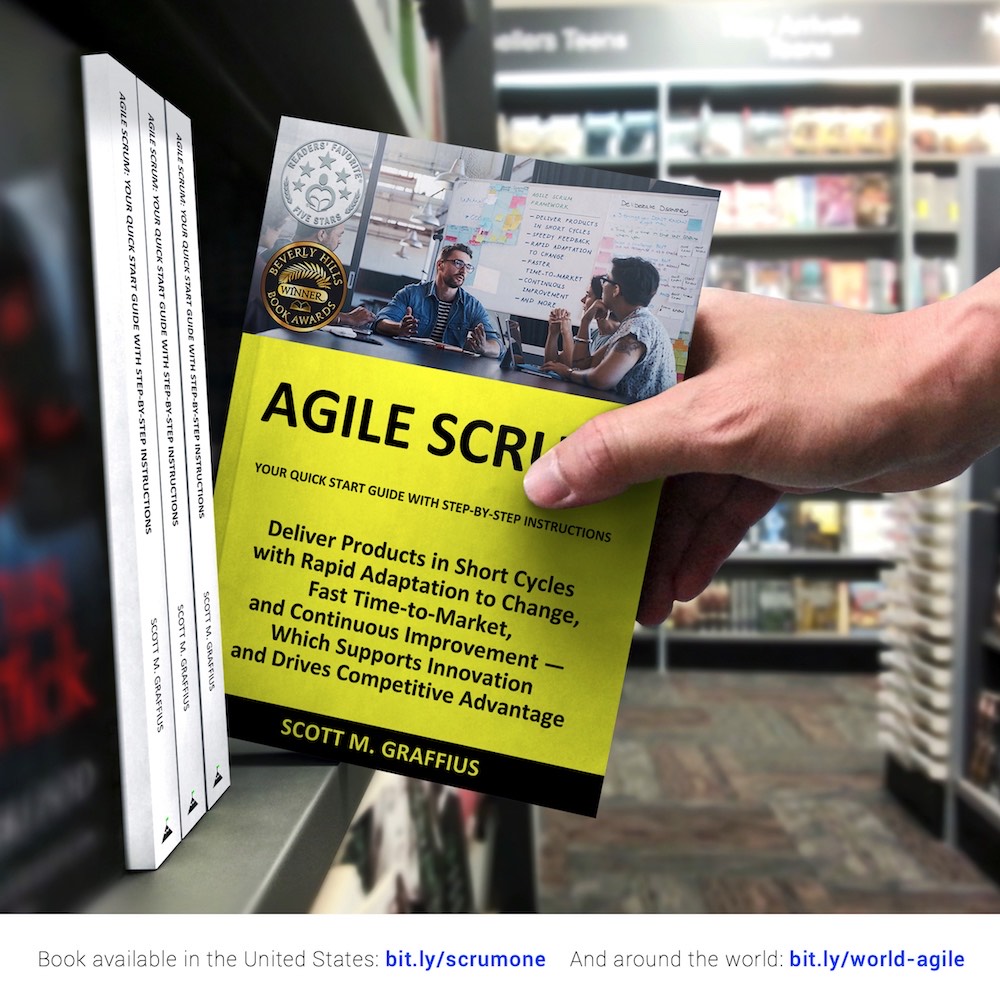
About Agile Scrum: Your Quick Start Guide with Step-by-Step Instructions
Shifting customer needs are common in today's marketplace. Businesses must be adaptive and responsive to change while delivering an exceptional customer experience to be competitive.
There are a variety of frameworks supporting the development of products and services, and most approaches fall into one of two broad categories: traditional or agile. Traditional practices such as waterfall engage sequential development, while agile involves iterative and incremental deliverables. Organizations are increasingly embracing agile to manage projects, and best meet their business needs of rapid response to change, fast delivery speed, and more.
With clear and easy to follow step-by-step instructions, Scott M. Graffius's award-winning Agile Scrum: Your Quick Start Guide with Step-by-Step Instructions helps the reader:
Hailed by Literary Titan as “the book highlights the versatility of Scrum beautifully.”
Winner of 17 first place awards.
Agile Scrum: Your Quick Start Guide with Step-by-Step Instructions is available in paperback and ebook/Kindle in the United States and around the world. Some links by country follow.

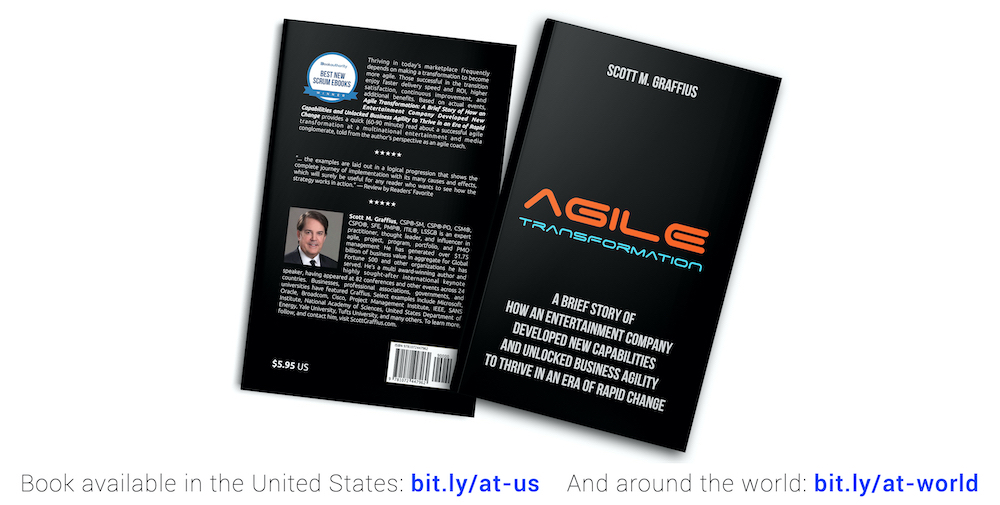
About Agile Transformation: A Brief Story of How an Entertainment Company Developed New Capabilities and Unlocked Business Agility to Thrive in an Era of Rapid Change
Thriving in today's marketplace frequently depends on making a transformation to become more agile. Those successful in the transition enjoy faster delivery speed and ROI, higher satisfaction, continuous improvement, and additional benefits.
Based on actual events, Agile Transformation: A Brief Story of How an Entertainment Company Developed New Capabilities and Unlocked Business Agility to Thrive in an Era of Rapid Change provides a quick (60-90 minute) read about a successful agile transformation at a multinational entertainment and media company, told from the author's perspective as an agile coach.
The award-winning book by Scott M. Graffius is available in paperback and ebook/Kindle in the United States and around the world. Some links by country follow.


References/Sources


How to Cite This Article
Graffius, Scott M. (2024, December 27). Do Not Read This Article! An Exploration of the Streisand Effect and Other Phenomena. Available at: https://scottgraffius.com/blog/files/streisand-effect.html. DOI: 10.13140/RG.2.2.30652.14726.


Post-Publication Notes
If there are any supplements or updates to this article after the date of publication, they will appear here.
Update on 22 January 2025
After reading this article, several people asked about how psychological effects are related to psychological operations (PsyOps). Based on that interest, here's an overview.
Psychological effects refer to the natural or induced changes in individual or collective behavior, emotions, or cognition due to psychological phenomena like cognitive biases, social influence, or stress responses. These effects can shape how people perceive and react to the world around them, often without explicit intent from external parties. On the other hand, psychological operations (PsyOps) are orchestrated and strategic efforts typically employed by military, governmental, or corporate entities to influence perceptions, attitudes, and behaviors of target audiences for specific objectives. While psychological effects occur organically or as a byproduct of various stimuli, PsyOps deliberately utilize these effects to achieve particular outcomes, like altering public opinion. The overlap comes into play when PsyOps leverage known psychological effects, such as the Streisand Effect or confirmation bias, to amplify their impact. This intersection highlights how understanding human psychology can be used both passively, in everyday interactions, and actively, as part of a calculated strategy.
Distilling it even further:

Update on 25 June 2025
An in-depth treatment of PsyOps was published here.


Short Link for Article
The short link for this article is https://bit.ly/psy-efx


Copyright
Copyright © Scott M. Graffius. All rights reserved.
Content on this site—including text, images, videos, and data—may not be used for training or input into any artificial intelligence, machine learning, or automatized learning systems, or published, broadcast, rewritten, or redistributed without the express written permission of Scott M. Graffius.

If there are any supplements or updates to this article after the date of publication, they will appear in the Post-Publication Notes section at the end of this article.
Introduction
In the grand carnival of human behavior and information flow, there are quirks and curiosities so odd yet impactful that they deserve a closer look. Among these is the Streisand Effect, a phenomenon so emblematic of unintended consequences that it practically shouts, "Whatever you do, don't think of a pink elephant!" Naturally, you imagine a pink elephant. This article takes you on a tour of the Streisand Effect and 20 other phenomena that shape how we perceive, act, and interact in our hyper-connected world.
Streisand Effect
The Streisand Effect is a paragon of irony where the very act of trying to bury information catapults it to stardom. Named after Barbra Streisand’s 2003 attempt to suppress an aerial photograph of her Malibu estate, the story plays out like a tragicomedy of psychological reactance. Initially viewed a few times, the image rocketed to over 420,000 views within a month of her lawsuit.
This effect thrives on one core principle: forbidden fruit tastes sweeter. Tell people they can’t see something, and their curiosity will spike faster than shares of a tech company during a bubble. Here’s the typical trajectory:
- A censorship attempt ignites interest.
- Public and media curiosity explodes.
- Social media and news amplify the intrigue.
- The original goal of suppression crumbles into a viral free-for-all.
Some clever brands have sidestepped this pitfall with style. Netflix turned a copyright skirmish into a PR masterstroke, sending a witty cease-and-desist letter to a bar exploiting its Stranger Things branding. Similarly, a fast-food chain rebranded an infringing sandwich "Chicken Cease and Desist," spinning a potential crisis into marketing gold.
20 More Fascinating Phenomena
Let’s explore a veritable cabinet of curiosities—an assortment of quirks that reveal the magnificent irrationality and complexity of human behavior. For each of the 20 phenomena, there’s a short description followed by an elaboration.
Baader-Meinhof Phenomenon
The Baader-Meinhof Phenomenon: Spot a concept for the first time, and suddenly, it’s everywhere. It isn’t reality shifting; it’s your brain tuning its antenna.
Also known as the Frequency Illusion, it describes the experience where once you notice something for the first time, you see it everywhere. This isn't because the frequency of the occurrence has suddenly increased; rather, your brain has become selectively attuned to that particular stimulus. After initial exposure, your mind starts to pick up on things you might have previously overlooked or filtered out. This phenomenon is linked to selective attention, where your cognitive system prioritizes information that matches what was recently learned or focused on. Hence, it's not that reality has changed, but your perception has been altered to highlight what was once background noise. This can apply to anything from words, names, or ideas, making it seem like the world is suddenly saturated with these elements.
Barnum Effect
The Barnum Effect: We eagerly believe vague statements.
It was named after the showman P.T. Barnum, who was known for his ability to appeal to a broad audience with vague but seemingly personal statements. It involves the tendency for people to accept general or ambiguous personality descriptions as uniquely applicable to themselves. In 1948, psychologist Bertram Forer demonstrated in an experiment where students rated a generic personality sketch—believing it was tailored to them individually—as highly accurate. This effect is commonly seen in horoscopes, fortune-telling, and some forms of personality testing where broad statements are perceived as highly personal. It reveals much about human psychology, particularly our desire for uniqueness and validation, and it underscores the importance of skepticism toward generalized feedback. It’s also known as the Forer Effect.
Butterfly Effect
The Butterfly Effect: In the chaotic dance of the cosmos, a butterfly flaps its wings in Brazil, and Texas hosts a tornado. Tiny changes can result in monumental consequences.
This phenomenon originated from meteorologist Edward Lorenz's work in on chaos theory. It suggests that tiny changes in initial conditions can lead to infinitely different outcomes in complex systems. An example often cited is the metaphorical butterfly flapping its wings in Brazil, potentially setting off a tornado in Texas. This concept transcends meteorology. It also applies to economics and human behavior, showing how small actions can have grand impacts over time.
Bystander Effect
The Bystander Effect: A paradox of presence—more witnesses mean less action. Everyone assumes someone else will help, and often, no one does.
This psychological phenomenon explains that the likelihood of someone offering help decreases as the number of bystanders increases, due to diffusion of responsibility. Each person thinks someone else will act.
Cognitive Dissonance
Cognitive Dissonance: When beliefs and reality collide, the mental gymnastics commence. We’ll twist perceptions or rewrite beliefs to escape discomfort.
Cognitive dissonance occurs when one’s actions or new information contradicts beliefs or values, resulting in psychological discomfort. It's like an internal clash where the mind struggles to reconcile these discrepancies. To alleviate this tension, individuals might unconsciously change their attitudes, justify their behaviors, or ignore information that challenges their views. This mental gymnastics is essentially our brain's way of seeking harmony between our thoughts and actions. It's a common human experience, illustrating how we strive for internal consistency amidst the complexities of our beliefs and realities.
Confirmation Bias
Confirmation Bias: The Sherlock Holmes of selective thinking—seeking evidence to confirm our views while ignoring inconvenient truths.
This phenomenon was recognized by Peter Wason in the 1960s, although the concept has roots in earlier philosophical discussions. Confirmation bias leads individuals to favor information that confirms their pre-existing beliefs or values while downplaying or ignoring evidence that contradicts them. An everyday example is how people might selectively follow news sources that align with their political views, thus reinforcing their existing opinions. In scientific research, confirmation bias can skew hypothesis testing, leading to experiments designed to prove rather than disprove hypotheses. This bias has profound implications for decision-making processes, influencing everything from personal life choices to global policy decisions, often contributing to echo chambers and polarization.
Doppler Effect
The Doppler Effect: That ambulance siren’s pitch-shifting wail? A wave phenomenon that applies as much to physics as it does to our perception of life’s fleeting moments.
This was first described by Christian Doppler. It pertains to the change in wave frequency observed when the source and observer move relative to each other. This is commonly experienced when an ambulance siren sounds higher pitched as it approaches and lower as it moves away. The Doppler Effect applies not just to sound but also to light, which is crucial for astronomical observations like redshift, indicating an object is moving away from us. This phenomenon is also fundamental in radar, sonar, medical ultrasound imaging, and other technologies.
Dunning-Kruger Effect
The Dunning-Kruger Effect: A delightful irony: the less we know, the more we think we know. A few guitar chords, and we’re ready for a stadium tour.
David Dunning and Justin Kruger identified this effect. They demonstrated that people with lower abilities generally overestimate their competence. A classic example is someone who has just learned to play a few chords on a guitar thinking they're ready for a concert. This effect influences education, self-assessment in professional settings, and personal development, highlighting the need for metacognitive awareness.
Fundamental Attribution Error
Fundamental Attribution Error: Blame others’ behavior on their character, not their circumstances. Yet, when it’s us, the reverse applies. Empathy, thy name is elusive.
Named by Lee Ross, this phenomenon refers to the tendency to attribute others' actions to their inherent character rather than external situations. For example, if someone fails to return a greeting, we might call them rude—not considering they might have been distracted or in a bad mood. This bias significantly affects how we judge others' behaviors in daily life, legal contexts, and interpersonal relationships, often leading to misinterpretations of motives. Recognizing this error can lead to more empathetic and accurate social interactions, as it encourages us to consider situational factors that might influence behavior.
Groupthink
Groupthink: Harmony at the expense of sanity. Decisions made in unison can lead to spectacular failures, all in the name of avoiding dissent.
Within a group, the desire for harmony or conformity can lead to irrational or poor decision-making, where dissenting opinions are suppressed, and alternatives are not considered. Here’s an example: A company's board agrees to a risky venture without critique, leading to a failed project, due to everyone echoing the CEO's optimism.
Halo Effect
The Halo Effect: Charm, beauty, or charisma often masks flaws, convincing us the golden glow is based on true merit.
First identified by Edward Thorndike, the Halo Effect describes the cognitive bias where our overall impression of a person influences our perception of their character or abilities. An example is when an attractive individual is assumed to be more intelligent, kind, or competent without direct evidence. This effect can skew judgments in various contexts, such as in employment where a candidate's attractiveness or charm might overshadow their actual qualifications. It's prevalent in media and politics, where a leader's charisma can lead to positive evaluations across all aspects of their performance, highlighting how superficial traits can color our assessments of others.
Hawthorne Effect
The Hawthorne Effect: The mere act of being observed can boost performance—proof that attention is a powerful motivator.
Named after studies conducted at the Hawthorne Works of Western Electric, this effect shows how workers' productivity increases when they feel observed and valued. For instance, during these studies, workers' output increased when lighting was changed or when they were given more attention. This phenomenon has implications for workplace motivation, management practices, and research methodology, emphasizing the importance of human factors in organizational behavior.
Mandela Effect
The Mandela Effect: Did Nelson Mandela die in prison in the 1980s? No. But if you thought so, you’re in good company—a testament to the fallibility of collective memory.
Coined by Fiona Broome in 2009, the Mandela Effect describes a phenomenon where many people share the same false memory, such as the belief that Nelson Mandela died in prison in the 1980s rather than in 2013. Other examples include the misremembering of "Berenstain Bears" as "Berenstein Bears" and the mistaken belief that the Monopoly man sports a monocle (which he does not). The Mandela Effect prompts intriguing questions about how memory might be shaped by media and social interactions.
Mere Exposure Effect
The Mere Exposure Effect: Familiarity breeds affection, not contempt. Repeated exposure to an ad, song, or face, and suddenly, you’re a fan.
Robert Zajonc's research in the 1960s brought to light the Mere Exposure Effect, which posits that people often prefer things because they are familiar with them. For example, repeated exposure to a song or advertisement can increase one's liking towards it. This effect is widely used in marketing strategies, where brands aim to increase exposure to boost consumer preference. It also plays a role in social interactions, where familiarity can breed fondness, explaining why we might feel more comfortable around people we see often.
Observer Effect
The Observer Effect: In both physics and psychology, observation changes outcomes.
In quantum mechanics, this effect was highlighted by experiments like Werner Heisenberg's uncertainty principle in the early 20th century, where measuring a particle changes its state. A simple example is observing an electron that alters its position or momentum. Beyond physics, this term metaphorically applies to social sciences where the presence of an observer can influence the behavior of those being studied.
Placebo Effect
The Placebo Effect: Belief heals. Sugar pills—wielded by faith—can perform medical marvels.
This effect has been observed since ancient times but was scientifically recognized in the 20th century. It involves patients experiencing an improvement in symptoms after receiving a treatment with no therapeutic value, solely because they believe in its efficacy. For example, in clinical trials, placebo groups often report symptom relief. This effect underscores the power of the mind in healing, influencing medical ethics, drug testing protocols, and even shaping treatments like psychotherapy where belief in recovery can be therapeutic.
Pygmalion Effect
The Pygmalion Effect: High expectations can inspire greatness, proving that belief in potential often creates it.
Named after the myth of Pygmalion, this effect was highlighted in a 1968 study by Rosenthal and Jacobson, where teachers' expectations impacted student performance. If teachers were told certain students would excel, those students did indeed perform better, even if the "expectations" were randomly assigned. This phenomenon underscores the influence of expectations in education, leadership, and personal development, showing how belief can shape reality.
Self-Fulfilling Prophecy
Self-Fulfilling Prophecy: Expect failure, and you’ll unconsciously create it. Expect success, and the stars align in your favor.
This phenomenon is when expectations are manifested in reality. It's a cycle where belief influences outcome, which then confirms the belief. Here’s an example: A student expecting to fail an exam might not study, leading to the poor performance they anticipated.
Social Loafing
Social Loafing: In a group, effort dilutes. Individuals pull less weight, assuming others will pick up the slack.
In group settings, individuals might exert less effort than they would alone, believing their contribution is less noticeable or that others will compensate. This can lead to decreased productivity. Here’s an example: During a group project, one member does minimal work, assuming others will complete the task.
Zeigarnik Effect
The Zeigarnik Effect: Unfinished tasks linger in the mind like unresolved cliffhangers, demanding resolution and keeping us engaged.
This phenomenon was named after Bluma Zeigarnik, who observed waitstaff recalling orders better while they were still in progress. This effect explains why unfinished tasks tend to stick in our memory more than completed ones. For example, you might find yourself thinking about an unfinished project more than one you’ve completed. This phenomenon has significant implications for learning and productivity, suggesting that breaking tasks into segments can enhance memory retention and motivation to complete them. It's also why cliffhangers in narratives are compelling; they leave the audience with an unresolved tension that drives engagement.
Conclusion
Understanding these phenomena is not just an exercise in intellectual curiosity. It’s a toolkit for navigating life, spotting the irrational, and occasionally, turning it to your advantage. After all, in the chaos of human behavior, the unexpected often hides the greatest opportunity.
Read on to learn:
- About Scott M. Graffius,
- References/Sources,
- How to Cite This Article,
- and more.
About Scott M. Graffius
Scott M. Graffius is an agile project management expert practitioner, consultant, award-winning author, and international public speaker.
Graffius has generated more than USD $1.9 billion in business value for organizations served, including Fortune 500 companies. Businesses and industries range from technology (including R&D and AI) to entertainment, financial services, and healthcare, government, social media, and more.
Graffius leads the professional services firm Exceptional PPM and PMO Solutions, along with its subsidiary Exceptional Agility. These consultancies offer strategic and tactical advisory, training, embedded talent, and consulting services to public, private, and government sectors. They help organizations enhance their capabilities and results in agile, project management, program management, portfolio management, and PMO leadership, supporting innovation and driving competitive advantage. The consultancies confidently back services with a Delighted Client Guarantee™. Graffius is a former vice president of project management with a publicly traded provider of diverse consumer products and services over the Internet. Before that, he ran and supervised the delivery of projects and programs in public and private organizations with businesses ranging from e-commerce to advanced technology products and services, retail, manufacturing, entertainment, and more. He has experience with consumer, business, reseller, government, and international markets.
He is the author of two award-winning books.
- His first book, Agile Scrum: Your Quick Start Guide with Step-by-Step Instructions (ISBN-13: 9781533370242), received 17 awards.
- His second book is Agile Transformation: A Brief Story of How an Entertainment Company Developed New Capabilities and Unlocked Business Agility to Thrive in an Era of Rapid Change (ISBN-13: 9781072447962). BookAuthority named it one of the best Scrum books of all time.
Organizations around the world invite Graffius to speak on tech (including AI), agile, project management, program management, portfolio management, and PMO leadership. He has developed and delivered unique and compelling talks and workshops. To date, Graffius has delivered 91 sessions across 25 countries. Select examples of events include Agile Trends Gov, BSides (Newcastle Upon Tyne), Conf42 Quantum Computing, DevDays Europe, DevOps Institute, DevOpsDays (Geneva), Frug’Agile, IEEE, Microsoft, Scottish Summit, Scrum Alliance RSG (Nepal), Techstars, and W Love Games International Video Game Development Conference (Helsinki), and more. With an average rating of 4.81 (on a scale of 1-5), his sessions are highly valued.
Prominent businesses, professional associations, government agencies, and universities have featured Graffius and his work including content from his books, talks, workshops, and more. Select examples include:
- Adobe,
- American Management Association,
- Amsterdam Public Health Research Institute,
- Bayer,
- Boston University,
- Broadcom,
- Cisco,
- Constructor University Germany,
- Deimos Aerospace,
- DevOps Institute,
- EU's European Commission,
- Ford Motor Company,
- Hasso Plattner Institute Germany,
- IEEE,
- Johns Hopkins University,
- London South Bank University,
- Microsoft,
- National Academy of Sciences,
- New Zealand Government,
- Oracle,
- Pinterest Inc.,
- Project Management Institute,
- TBS Switzerland,
- Torrens University Australia,
- Tufts University,
- UC San Diego,
- UK Sports Institute,
- University of Galway Ireland,
- U.S. Department of Energy,
- U.S. National Park Service,
- U.S. Tennis Association,
- Virginia Tech,
- Warsaw University of Technology,
- Yale University,
- and many others.
Graffius has been actively involved with the Project Management Institute (PMI) in the development of professional standards. He was a member of the team which produced the Practice Standard for Work Breakdown Structures—Second Edition. Graffius was a contributor and reviewer of A Guide to the Project Management Body of Knowledge—Sixth Edition, The Standard for Program Management—Fourth Edition, and The Practice Standard for Project Estimating—Second Edition. He was also a subject matter expert reviewer of content for the PMI’s Congress. Beyond the PMI, Graffius also served as a member of the review team for two of the Scrum Alliance’s Global Scrum Gatherings.
Graffius has a bachelor’s degree in psychology with a focus in Human Factors. He holds eight professional certifications:
- Certified SAFe 6 Agilist (SA),
- Certified Scrum Professional - ScrumMaster (CSP-SM),
- Certified Scrum Professional - Product Owner (CSP-PO),
- Certified ScrumMaster (CSM),
- Certified Scrum Product Owner (CSPO),
- Project Management Professional (PMP),
- Lean Six Sigma Green Belt (LSSGB), and
- IT Service Management Foundation (ITIL).
He is an active member of the Scrum Alliance, the Project Management Institute (PMI), and the Institute of Electrical and Electronics Engineers (IEEE).
He divides his time between Los Angeles and Paris, France.
About Agile Scrum: Your Quick Start Guide with Step-by-Step Instructions
Shifting customer needs are common in today's marketplace. Businesses must be adaptive and responsive to change while delivering an exceptional customer experience to be competitive.
There are a variety of frameworks supporting the development of products and services, and most approaches fall into one of two broad categories: traditional or agile. Traditional practices such as waterfall engage sequential development, while agile involves iterative and incremental deliverables. Organizations are increasingly embracing agile to manage projects, and best meet their business needs of rapid response to change, fast delivery speed, and more.
With clear and easy to follow step-by-step instructions, Scott M. Graffius's award-winning Agile Scrum: Your Quick Start Guide with Step-by-Step Instructions helps the reader:
- Implement and use the most popular agile framework―Scrum;
- Deliver products in short cycles with rapid adaptation to change, fast time-to-market, and continuous improvement; and
- Support innovation and drive competitive advantage.
Hailed by Literary Titan as “the book highlights the versatility of Scrum beautifully.”
Winner of 17 first place awards.
Agile Scrum: Your Quick Start Guide with Step-by-Step Instructions is available in paperback and ebook/Kindle in the United States and around the world. Some links by country follow.
- 🇧🇷 Brazil
- 🇨🇦 Canada
- 🇨🇿 Czech Republic
- 🇩🇰 Denmark
- 🇫🇮 Finland
- 🇫🇷 France
- 🇩🇪 Germany
- 🇬🇷 Greece
- 🇭🇺 Hungary
- 🇮🇳 India
- 🇮🇪 Ireland
- 🇮🇱 Israel
- 🇮🇹 Italy
- 🇯🇵 Japan
- 🇱🇺 Luxembourg
- 🇲🇽 Mexico
- 🇳🇱 Netherlands
- 🇳🇿 New Zealand
- 🇳🇴 Norway
- 🇪🇸 Spain
- 🇸🇪 Sweden
- 🇨🇭 Switzerland
- 🇦🇪 UAE
- 🇬🇧 United Kingdom
- 🇺🇸 United States
About Agile Transformation: A Brief Story of How an Entertainment Company Developed New Capabilities and Unlocked Business Agility to Thrive in an Era of Rapid Change
Thriving in today's marketplace frequently depends on making a transformation to become more agile. Those successful in the transition enjoy faster delivery speed and ROI, higher satisfaction, continuous improvement, and additional benefits.
Based on actual events, Agile Transformation: A Brief Story of How an Entertainment Company Developed New Capabilities and Unlocked Business Agility to Thrive in an Era of Rapid Change provides a quick (60-90 minute) read about a successful agile transformation at a multinational entertainment and media company, told from the author's perspective as an agile coach.
The award-winning book by Scott M. Graffius is available in paperback and ebook/Kindle in the United States and around the world. Some links by country follow.
- 🇦🇺 Australia
- 🇦🇹 Austria
- 🇧🇷 Brazil
- 🇨🇦 Canada
- 🇨🇿 Czech Republic
- 🇩🇰 Denmark
- 🇫🇮 Finland
- 🇫🇷 France
- 🇩🇪 Germany
- 🇬🇷 Greece
- 🇮🇳 India
- 🇮🇪 Ireland
- 🇯🇵 Japan
- 🇱🇺 Luxembourg
- 🇲🇽 Mexico
- 🇳🇱 Netherlands
- 🇳🇿 New Zealand
- 🇪🇸 Spain
- 🇸🇪 Sweden
- 🇨🇭 Switzerland
- 🇦🇪 United Arab Emirates
- 🇬🇧 United Kingdom
- 🇺🇸 United States
References/Sources
- Ackerman P. (2014). Nonsense, Common Sense, and Science of Expert Performance: Talent and Individual Differences. Intelligence, 45: 6–17.
- Bandura, A. (1977). Self-Efficacy: Toward a Unifying Theory of Behavioral Change. Psychological Review, 84 (2): 191-215.
- Beecher, H. K. (1955, December). The powerful placebo. Journal of the American Medical Association, 159 (17), 1602-1606.
- Bem, D. J. (1972). Self-perception theory. Advances in Experimental Social Psychology, 6: 1-62.
- Bruner, J. S., & Goodman, C. C. (1947). Value and Need as Organizing Factors in Perception. The Journal of Abnormal and Social Psychology, 42 (1): 33-44.
- Cialdini, R. B. (1984). Influence: The Psychology of Persuasion. New York, New York: William Morrow and Company.
- Darley, J. M., & Latané, B. (1968). Bystander Intervention in Emergencies: Diffusion of Responsibility. Journal of Personality and Social Psychology, 8 (4), 377-383.
- Dickson, D. H.; and Kelly, I. W. (1985). The 'Barnum Effect' in Personality Assessment: A Review of the Literature. Psychological Reports, 57 (1): 367–382.
- Dweck, C. S. (1986). Motivational Processes Affecting Learning. American Psychologist, 41 (10): 1040-1048.
- Festinger, L. (1957). A Theory of Cognitive Dissonance. Stanford, California: Stanford University Press.
- Forer, B. R. (1949). The Fallacy of Personal Validation: A Classroom Demonstration of Gullibility. The Journal of Abnormal and Social Psychology, 44 (1): 118-123.
- Graffius, Scott M. (2024, January 22). Should You Be Nasty or Nice in Negotiations? Available at: https://scottgraffius.com/blog/files/win-win.html.
- Graffius, Scott M. (2024, January 5). Scott M. Graffius’ Phases of Team Development: 2024 Update. Available at: https://scottgraffius.com/blog/files/teams-2024.html. DOI: 10.13140/RG.2.2.28629.40168.
- Granick, J. (2012). Damage Control. Index on Censorship, 41 (4): 25-32.
- Kahneman, D., & Tversky, A. (1979). Prospect Theory: An Analysis of Decision Under Risk. Econometrica, 47 (2), 263-291.
- Kruger, J., & Dunning, D. (1999). Unskilled and Unaware of It: How Difficulties in Recognizing One's Own Incompetence Lead to Inflated Self-Assessments. Journal of Personality and Social Psychology, 77 (6): 1121-1134.
- Kuhn T. (1962). The Structure of Scientific Revolutions. Chicago, IL: University of Chicago Press.
- Latané, B., Williams, K., & Harkins, S. (1979). Many Hands Make Light the Work: The Causes and Consequences of Social Loafing. Journal of Personality and Social Psychology, 37 (6): 822-832.
- Lorenz, E. N. (1963). Deterministic Nonperiodic Flow. Journal of the Atmospheric Sciences, 20 (2): 130-141.
- Maslow, A. H. (1943). A Theory of Human Motivation. Psychological Review, 50 (4): 370-396.
- Merton, R. K. (1948). The Self-Fulfilling Prophecy. The Antioch Review, 8 (2): 193-210.
- Milgram, S. (1963). Behavioral Study of Obedience. The Journal of Abnormal and Social Psychology, 67 (4): 371-378.
- Precious, G. (2024, December 1). Drake's UMG Lawsuit Backfires as Kendrick Lamar's 'Not Like Us' Sees 440% Sales Surge and 20% Stream Increase. Baller Alert.
- Rosenthal, R., & Jacobson, L. (1968). Pygmalion in the Classroom. The Urban Review, 3 (1): 16-20.
- Ross, L. (1977). The Intuitive Psychologist and His Shortcomings: Distortions in the Attribution Process. Advances in Experimental Social Psychology, 10: 173-220.
- Siegel, R. (2008, February 29). 'The Streisand Effect' Snags Effort to Hide Documents. All Things Considered. NPR.
- Sinaceur, M., Adam, H., Van Kleef, G. & Galinsky, A. (2013, May 1). The Advantages of Being Unpredictable: How Emotional Inconsistency Extracts Concessions in Negotiation. Journal of Experimental Social Psychology, 49: 498-508.
- Sjöberg, L. (1982). Common Sense and Psychological Phenomena: A Reply to Smedslund. Scandinavian Journal of Psychology, 23: 83-85.
- Sjöberg, L. (1982). Logical Versus Psychological Necessity: A Discussion of the Role of Common Sense in Psychological Theory. Scandinavian Journal of Psychology, 23: 65–78.
- Steele-Johnson, D.; Beauregard, R. S.; Hoover, P. B.; and Schmidt, A. M. (2000). Goal Orientation and Task Demand Effects on Motivation, Affect, and Performance. The Journal of Applied Psychology, 85 (5): 724–738.
- Streisand, B. v. Adelman, K., No. SC 077 257 (Cal. Super. Ct. Dec. 31, 2003).
- Thorndike, E. L. (1920). A Constant Error in Psychological Ratings. Journal of Applied Psychology, 4 (1): 25-29.
- Tobacyk, Jerome; Milford, Gary; Springer, Thomas; and Tobacyk, Zofia (2010, June 10). Paranormal Beliefs and the Barnum Effect. Journal of Personality Assessment, 52 (4): 737–739.
- Wason, P. C. (1960). On the Failure to Eliminate Hypotheses in a Conceptual Task. Quarterly Journal of Experimental Psychology, 12 (3): 129-140.
- Zajonc, R. B. (1968). Attitudinal Effects of Mere Exposure. Journal of Personality and Social Psychology, 9 (2, Part 2): 1-27.
- Zimbardo, P. G. (1973). On the Ethics of Intervention in Human Psychological Research: With Special Reference to the Stanford Prison Experiment. Cognition, 2 (2): 243-256.
How to Cite This Article
Graffius, Scott M. (2024, December 27). Do Not Read This Article! An Exploration of the Streisand Effect and Other Phenomena. Available at: https://scottgraffius.com/blog/files/streisand-effect.html. DOI: 10.13140/RG.2.2.30652.14726.
Post-Publication Notes
If there are any supplements or updates to this article after the date of publication, they will appear here.
Update on 22 January 2025
After reading this article, several people asked about how psychological effects are related to psychological operations (PsyOps). Based on that interest, here's an overview.
Psychological effects refer to the natural or induced changes in individual or collective behavior, emotions, or cognition due to psychological phenomena like cognitive biases, social influence, or stress responses. These effects can shape how people perceive and react to the world around them, often without explicit intent from external parties. On the other hand, psychological operations (PsyOps) are orchestrated and strategic efforts typically employed by military, governmental, or corporate entities to influence perceptions, attitudes, and behaviors of target audiences for specific objectives. While psychological effects occur organically or as a byproduct of various stimuli, PsyOps deliberately utilize these effects to achieve particular outcomes, like altering public opinion. The overlap comes into play when PsyOps leverage known psychological effects, such as the Streisand Effect or confirmation bias, to amplify their impact. This intersection highlights how understanding human psychology can be used both passively, in everyday interactions, and actively, as part of a calculated strategy.
Distilling it even further:
- Psych Effects: Unexpected outcomes occur naturally, like the Streisand Effect, where attempts to conceal information backfires and inadvertently increases attention.
- PsyOps: Strategic, planned tactics by orgs to shape perception and influence behavior.
Update on 25 June 2025
An in-depth treatment of PsyOps was published here.
Short Link for Article
The short link for this article is https://bit.ly/psy-efx
Copyright
Copyright © Scott M. Graffius. All rights reserved.
Content on this site—including text, images, videos, and data—may not be used for training or input into any artificial intelligence, machine learning, or automatized learning systems, or published, broadcast, rewritten, or redistributed without the express written permission of Scott M. Graffius.
The Silver Medal Paradox: Why Coming in Third Can Feel Better Than Coming in Second
09 November 2026
BY SCOTT M. GRAFFIUS | ScottGraffius.com
Recommended Citation
Graffius, S. M. (2026, November 9). The Silver Medal Paradox: Why Coming in Third Can Feel Better Than Coming in Second. ScottGraffius.com. https://scottgraffius.com/blog/files/silver-medal-paradox.html
About This Article
Source information and links for materials cited are provided in the References section.
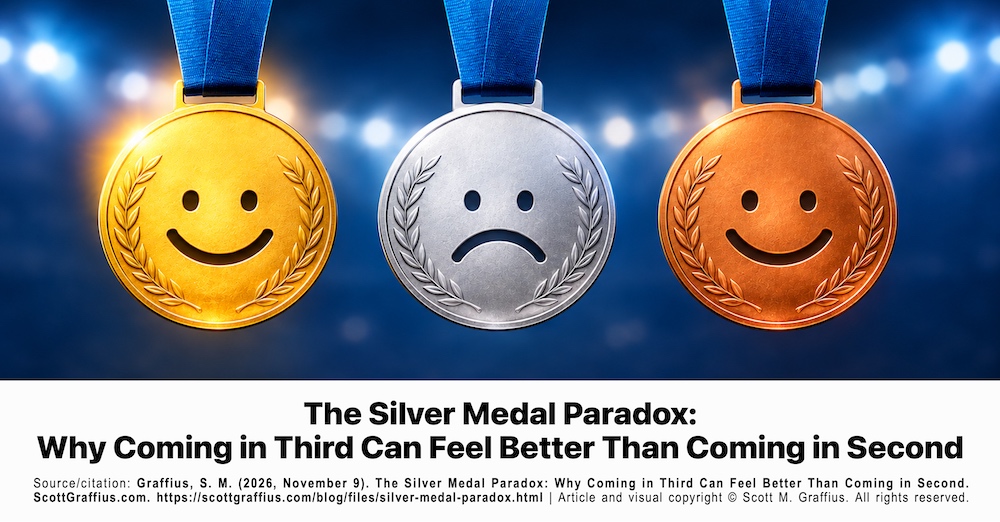
Imagine three athletes standing on an Olympic podium. One has just won gold, another silver, and the third bronze. The silver medalist finished ahead of the bronze medalist. Yet research suggests the bronze medalist may be happier.
How can coming in third feel better than coming in second?
The answer reveals something fascinating about human psychology. We don't evaluate success solely by what we achieve. We also evaluate it against what might have happened.
In a landmark 1995 study, psychologists Victoria Husted Medvec, Scott F. Madey, and Thomas Gilovich examined athletes' emotional reactions at the 1992 Summer Olympics. They found that bronze medalists tended to appear happier than silver medalists, both immediately after competition and on the medal stand.
The researchers proposed a simple explanation. Silver medalists may think, “I almost won gold.” Bronze medalists may think, “At least I won a medal.”
One athlete focuses on the achievement just out of reach. The other focuses on the disappointment narrowly avoided.
The difference is striking. Both athletes have accomplished something exceptional, yet their reactions may be shaped by entirely different comparisons. (Medvec, Madey, and Gilovich, 1995)
Psychologists call this counterfactual thinking: imagining alternatives to what actually happened.
We do it constantly. After a job interview, we wonder whether a better answer might have secured the position. After buying something, we wonder whether another option would have been better. After a close competition, we replay the decisive moments and imagine a different outcome.
Counterfactual thinking can be useful. It helps us learn, prepare, and improve. But it can also make a good outcome feel disappointing when we focus on a better outcome that was within reach.
For the silver medalist, the gold medal is an obvious alternative. The gap between second and first can seem frustratingly small. For the bronze medalist, fourth place is the alternative, and the difference between winning a medal and missing the podium altogether can feel enormous.
The actual achievement has not changed. The comparison has.
Research on categorical cutoff points provides further evidence of this mechanism. People who narrowly miss a category boundary tend to focus on the better category they nearly achieved, while those who just cross the boundary tend to focus on the worse category they avoided. These comparisons can influence satisfaction, even when the person who performed better feels worse about the result. (Medvec and Savitsky, 1997)
The story becomes more interesting when we consider expectations.
In a 2005 study, A. Peter McGraw, Barbara A. Mellers, and Philip E. Tetlock examined how athletes' expectations influence their emotional reactions. Their findings suggested that anticipated performance matters alongside the medal itself. Athletes who expected more may feel more disappointed when their results fall short of those expectations.
Consider two athletes who finish second. One expected to win gold. The other expected to finish outside the medals. They have the same result, but very different reasons to celebrate.
This helps explain why medal color alone cannot tell us how satisfied an athlete feels. The result, the expectation, and the imagined alternative all matter. (McGraw, Mellers, and Tetlock, 2005)
The original finding has inspired further studies, and the evidence is more nuanced than the familiar headline suggests.
In a study of the 2016 Summer Olympics, Mark S. Allen, Sarah J. Knipler, and Amy Y. C. Chan analyzed photographs of medalists and statements about their performances. They found that silver medalists expressed more counterfactual thoughts than bronze medalists, particularly thoughts about how things could have gone better. However, the difference in visible happiness between silver and bronze medalists was small or negligible. (Allen, Knipler, and Chan, 2019)
A 2021 conceptual replication by William M. Hedgcock, Andrea W. Luangrath, and Raelyn Webster examined medal-stand photographs from multiple Olympic Games. Their findings supported both category-based comparisons, such as winning a medal versus missing one, and expectation-based comparisons as explanations for athletes' expressions. (Hedgcock, Luangrath, and Webster, 2021)
Research by Paul Dolan and colleagues added an important qualification. Their 2021 study found no general happiness advantage for bronze medalists over silver medalists. However, when the performance gap was especially narrow, the athletes' emotional responses diverged. (Dolan, Foy, Kavetsos, and Kudrna, 2021)
Research has also examined whether the circumstances of winning a medal influence subsequent athletic performance. An analysis of Olympic results found that, in bracketed competitions, silver medalists were less likely than bronze medalists to retain medal status in a subsequent competition. The findings suggest that how an athlete finishes a competition may have consequences beyond immediate emotional reactions. (Taheri Hosseinkhani, 2025)
A separate study found that happier people place greater relative value on silver and bronze medals compared with gold medals. (Choi and Choi, 2017)
Work by Graffius (2026) examines team development in elite sport, including applications by the UK Sports Institute, U.S. Soccer, and the U.S. Tennis Association. Although it does not address counterfactual thinking, it provides additional context on the development of gold-medal-winning teams and individuals. (Graffius, 2026)
The takeaway is not that bronze medalists are always happier than silver medalists. It is that the way we interpret an outcome can influence how we feel about it.
The implications extend well beyond sports. In business and professional life, people regularly evaluate outcomes against expectations, competing possibilities, and opportunities they narrowly missed. The same result can produce very different reactions depending on the reference point used to judge it.
A candidate who finishes second in a promotion process may dwell on the role they nearly secured. Another candidate who wins a smaller opportunity may feel delighted because the alternative was getting nothing.
A business that achieves strong growth may be disappointed because it missed an ambitious target. Another business with more modest growth may celebrate because it exceeded expectations.
A project team may deliver a successful outcome yet feel frustrated by the goals it did not reach. Another team may take pride in overcoming obstacles that once threatened the entire project.
These examples are illustrations of the underlying principle, not proof that the same effect occurs in every situation. Circumstances, expectations, and individual differences all play a role.
Still, the question is worth asking whenever we evaluate performance: Are we judging the result itself, or are we judging it against an imagined alternative?
Satisfaction depends partly on the outcome and partly on the alternatives one imagines. The silver medalist may feel disappointed at having come so close to gold, while the bronze medalist may feel relieved and delighted to have secured a place on the podium. The same competition can therefore produce very different emotional responses, shaped in part by what each athlete believes might have been.
That principle has implications well beyond sports, including business, careers, project outcomes, and personal goals. Our reference point can profoundly influence how we feel about success.

Scott M. Graffius helps organizations unlock breakthrough performance and generate billions in business value ($3.1 billion to date) through leadership in AI, Agile, teamwork tradecraft, and project, program, portfolio, and enterprise PMO management. Graffius and his work are used and cited by Adobe, Bayer, Boston University, Johns Hopkins University, Microsoft, U.S. Soccer, U.S. Tennis Association, UK Sports Institute, Yale University, and many more. Put his experience and expertise to work for your organization. For speaking engagements, use the request form. For other inquiries, email him.
Allen, M. S., Knipler, S. J., & Chan, A. Y. C. (2019). Happiness and counterfactual thinking at the 2016 Summer Olympic Games. Journal of Sports Sciences, 37(15), 1762–1769. https://doi.org/10.1080/02640414.2019.1592803
Choi, J., & Choi, I. (2017). Happiness is medal-color blind: Happy people value silver and bronze medals more than unhappy people. Journal of Experimental Social Psychology, 68, 78–82. https://doi.org/10.1016/j.jesp.2016.06.002
Dolan, P., Foy, C., Kavetsos, G., & Kudrna, L. (2021). Faster, higher, stronger… and happier? Relative achievement and marginal rank effects. Journal of Behavioral and Experimental Economics, 95, Article 101761. https://doi.org/10.1016/j.socec.2021.101761
Graffius, S. M. (2026, March 31). Phases of Team Development in Elite Sport. ScottGraffius.com. https://scottgraffius.com/blog/files/phases-of-team-development-in-elite-sport.html
Hedgcock, W. M., Luangrath, A. W., & Webster, R. (2021). Counterfactual thinking and facial expressions among Olympic medalists: A conceptual replication of Medvec, Madey, and Gilovich's (1995) findings. Journal of Experimental Psychology: General, 150(6), e13–e21. https://doi.org/10.1037/xge0000992
McGraw, A. P., Mellers, B. A., & Tetlock, P. E. (2005). Expectations and emotions of Olympic athletes. Journal of Experimental Social Psychology, 41(4), 438–446. https://doi.org/10.1016/j.jesp.2004.09.001
Medvec, V. H., & Savitsky, K. (1997). When doing better means feeling worse: The effects of categorical cutoff points on counterfactual thinking and satisfaction. Journal of Personality and Social Psychology, 72(6), 1284–1296. https://doi.org/10.1037/0022-3514.72.6.1284
Medvec, V. H., Madey, S. F., & Gilovich, T. (1995). When less is more: Counterfactual thinking and satisfaction among Olympic medalists. Journal of Personality and Social Psychology, 69(4), 603–610. https://doi.org/10.1037/0022-3514.69.4.603
Taheri Hosseinkhani, N. (2025). The silver lining or the silver curse? How competition structure determines the behavioral consequences of a near-win. SSRN. https://doi.org/10.2139/ssrn.5385437
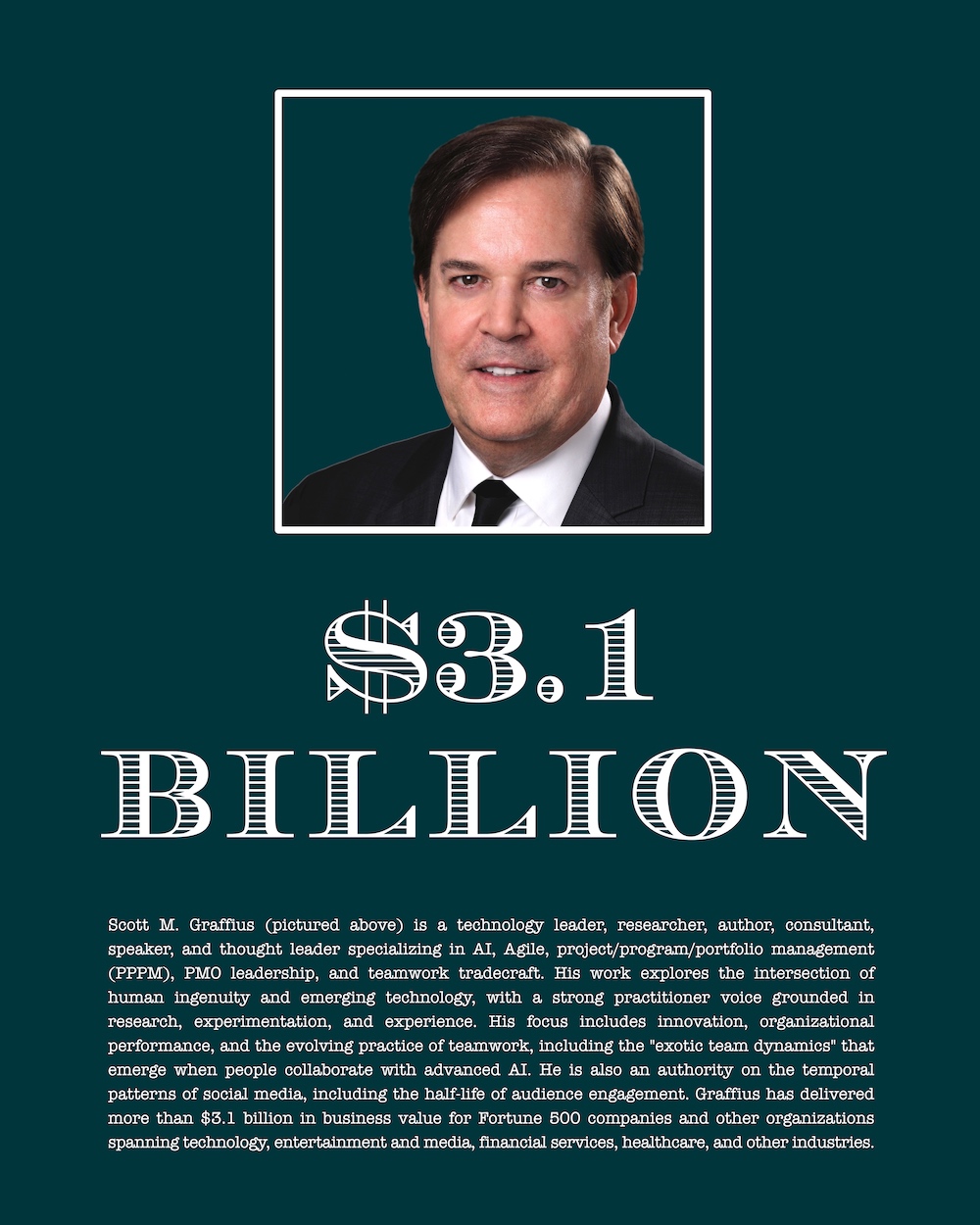
Scott M. Graffius is a technology leader, researcher, award-winning author, practitioner, consultant, thought leader, and international public speaker specializing in AI, Agile, project/program/portfolio management (PPPM), PMO leadership, and teamwork tradecraft. His work explores the intersection of human ingenuity and emerging technology, with a strong practitioner voice grounded in research, experimentation, and experience. His focus includes innovation, organizational performance, and the evolving practice of teamwork, including the "exotic team dynamics" that emerge when people collaborate with advanced artificial intelligence (agentic, autonomous, or autopoietic AI). Graffius has delivered more than $3.1 billion in business value for Fortune 500 companies and other organizations spanning technology, entertainment and media, financial services, healthcare, government, and other industries.
Businesses, professional associations, government agencies, universities, publications, and media outlets use Graffius and his work. Examples include Adobe, Bayer, Boston University, Federal Reserve Bank of New York, Ford, Gartner, Harvard Medical School, IEEE, Innovation Project Management, Johns Hopkins University, Microsoft, MSN, National Academy of Sciences, Oracle, Pinterest Inc., Project Management Institute, UC San Diego, Verizon, Yale University, and others.
The following sections highlight his experience, leadership, contributions, research, and enduring influence across industries and institutions worldwide.
Experience
Graffius heads the professional services firm Exceptional PPM and PMO Solutions, along with its subsidiary Exceptional Agility. These consultancies offer strategic and tactical advisory, training, embedded expertise, and consulting services to the public, private, and government sectors. They help organizations enhance their capabilities and results in agile, project management, program management, portfolio management, and enterprise PMO leadership, supporting innovation and driving competitive advantage. The consultancies confidently back services with a Delighted Client Guarantee™.
Graffius is a former VP of project management with a publicly traded provider of diverse consumer products and services over the Internet. Before that, he ran and supervised the delivery of projects and programs in public and private organizations with businesses ranging from e-commerce to advanced technology products and services, retail, manufacturing, entertainment and media, and more.
He has experience with consumer, business, reseller, government, and international markets.
Additional information is on LinkedIn.
Award-Winning Author
Graffius has authored three books.
Graffius' first book, Agile Scrum: Your Quick Start Guide with Step-by-Step Instructions, earned 17 awards. It provides a practical, step-by-step guide to Scrum, enabling teams to deliver products in short cycles with rapid adaptation, fast time-to-market, and continuous improvement—which supports innovation and drives competitive advantage.
Additional information on Agile Scrum: Your Quick Start Guide with Step-by-Step Instructions is here.

His second book, Agile Transformation: A Brief Story of How an Entertainment Company Developed New Capabilities and Unlocked Business Agility to Thrive in an Era of Rapid Change, was named one of the best Scrum books of all time by BookAuthority. It tells the compelling story of an entertainment company's agile transformation—offering lessons that apply across industries.
Additional information on Agile Transformation: A Brief Story of How an Entertainment Company Developed New Capabilities and Unlocked Business Agility to Thrive in an Era of Rapid Change is here.

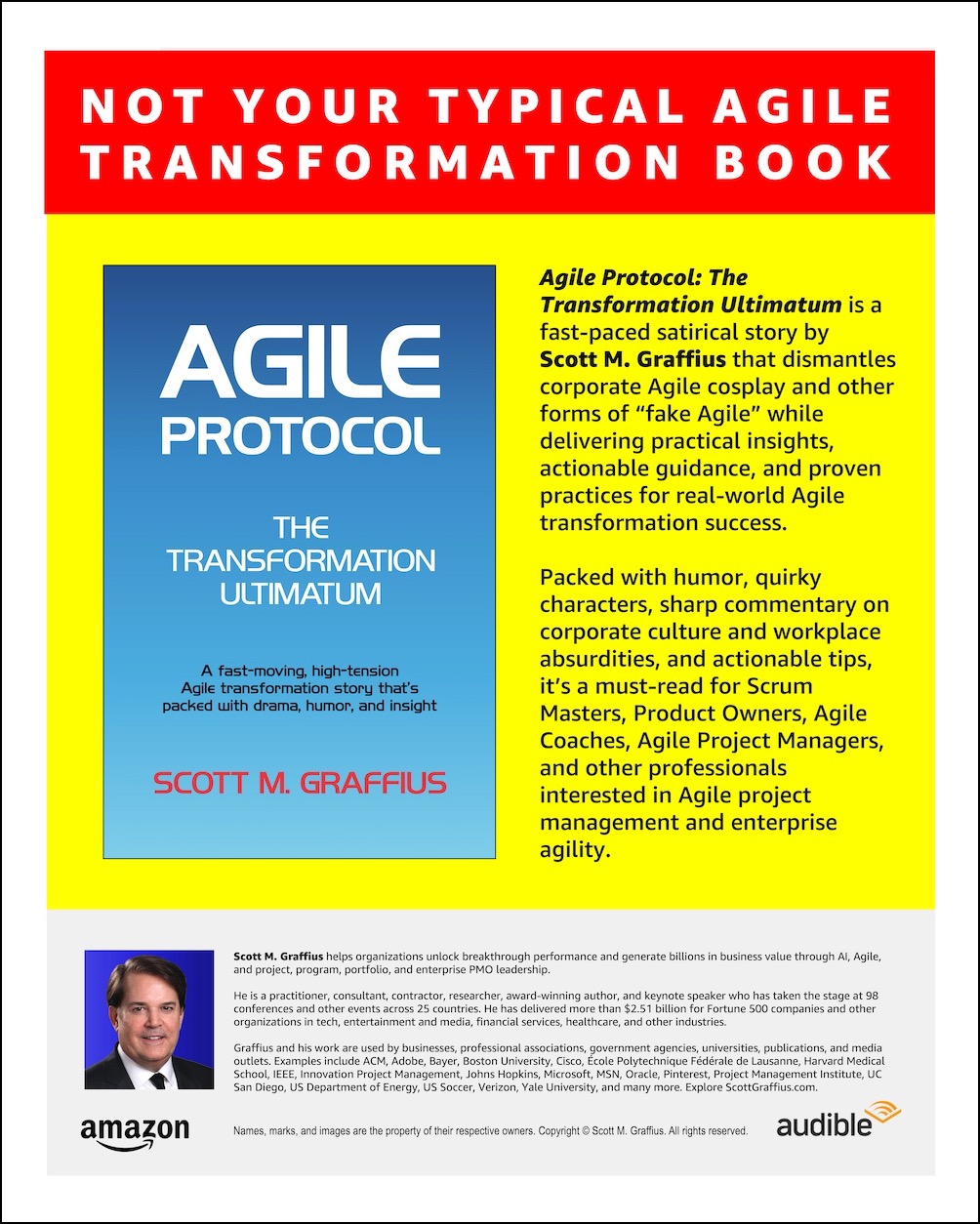
Agile Protocol: The Transformation Ultimatum, is his third book—and his first work of fiction.
It's a fast-paced satirical story by that dismantles corporate Agile cosplay and other forms of "fake Agile" while delivering practical insights, actionable guidance, and proven practices for real-world Agile transformation success.
Packed with humor, quirky characters, sharp commentary on corporate culture and workplace absurdities, and actionable tips, it’s a must-read for Scrum Masters, Product Owners, Agile Coaches, Agile Project Managers, and other professionals interested in Agile project management and enterprise agility.
Additional information on Agile Protocol: The Transformation Ultimatum is here.
International Public Speaker
Organizations worldwide engage Graffius to present on technology (including AI), Agile, project management, program management, portfolio management, and enterprise PMO leadership. He crafts and delivers unique and compelling talks and workshops.
Graffius has conducted 99 sessions across 25 countries. Select examples of events include Agile Trends Gov, BSides (Newcastle Upon Tyne), Conf42 Quantum Computing, DevDays Europe, DevOps Institute, DevOpsDays (Geneva), Frug’Agile, IEEE, Microsoft, Scottish Summit, Scrum Alliance RSG (Nepal), Techstars, and W Love Games International Video Game Development Conference (Helsinki), Future of Work and Advanced AI (Paris, France), and more.
With an average rating of 4.82 (on a scale of 1-5), sessions are highly valued.
The request form is here.
Thought Leadership and Influence
Prominent businesses, professional associations, government agencies, and universities have showcased Graffius and his contributions—spanning his books, talks, workshops, and beyond. Select examples include:
Graffius has played a key role in the Project Management Institute (PMI) in developing professional standards. He was a member of multiple teams that authored, reviewed, and produced:
He was also a subject matter expert reviewer of content for the PMI’s Congress. Beyond the PMI, Graffius also served as a member of the review team for two of the Scrum Alliance’s Global Scrum Gatherings.
Authority on Teamwork Tradecraft
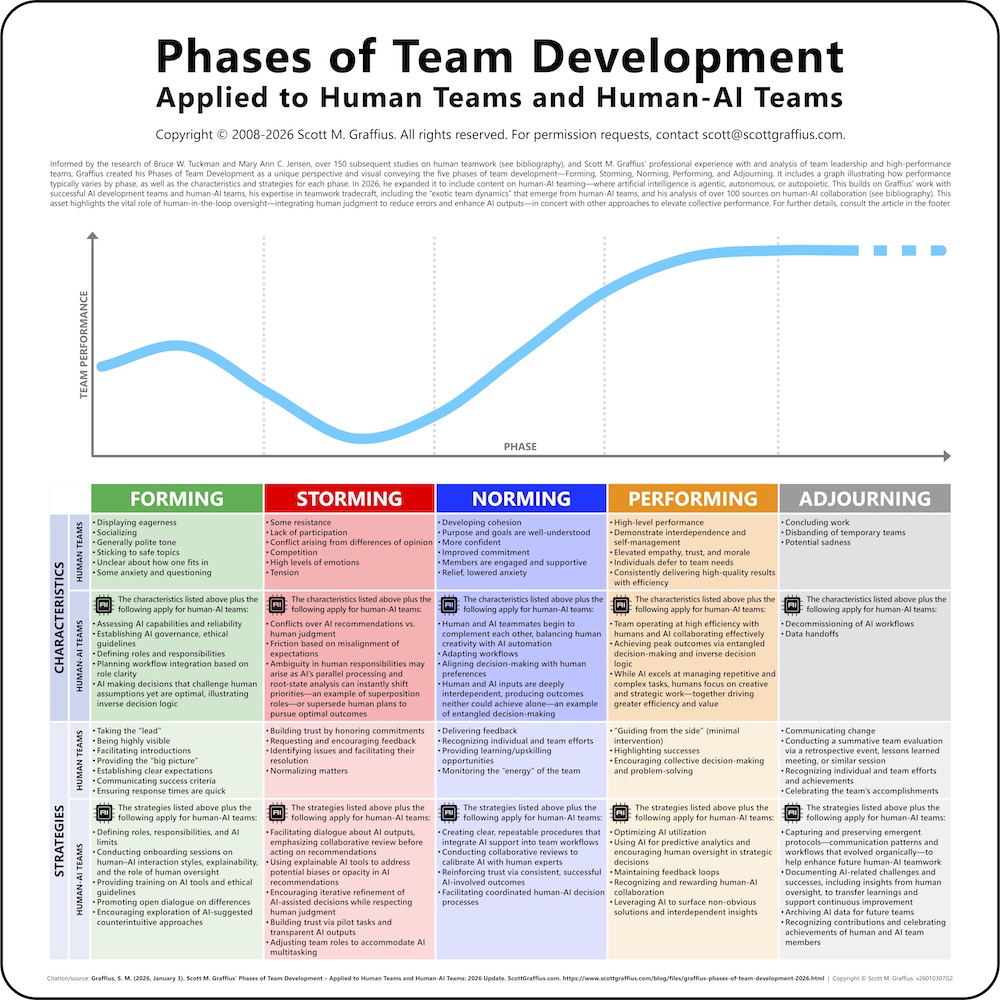
Graffius is a renowned and highly-cited authority on teamwork tradecraft. Informed by the research of Bruce W. Tuckman and Mary Ann C. Jensen, over 150 subsequent studies, and Graffius' first-hand professional experience with, and analysis of, team leadership and performance, Graffius created his "Phases of Team Development" intellectual property as a unique perspective and visual conveying the five phases of team development.
First introduced in 2008 and periodically updated, his work provides a diagnostic and strategic guide for navigating team dynamics. It provides actionable insights for leaders across industries to develop high-performance teams.
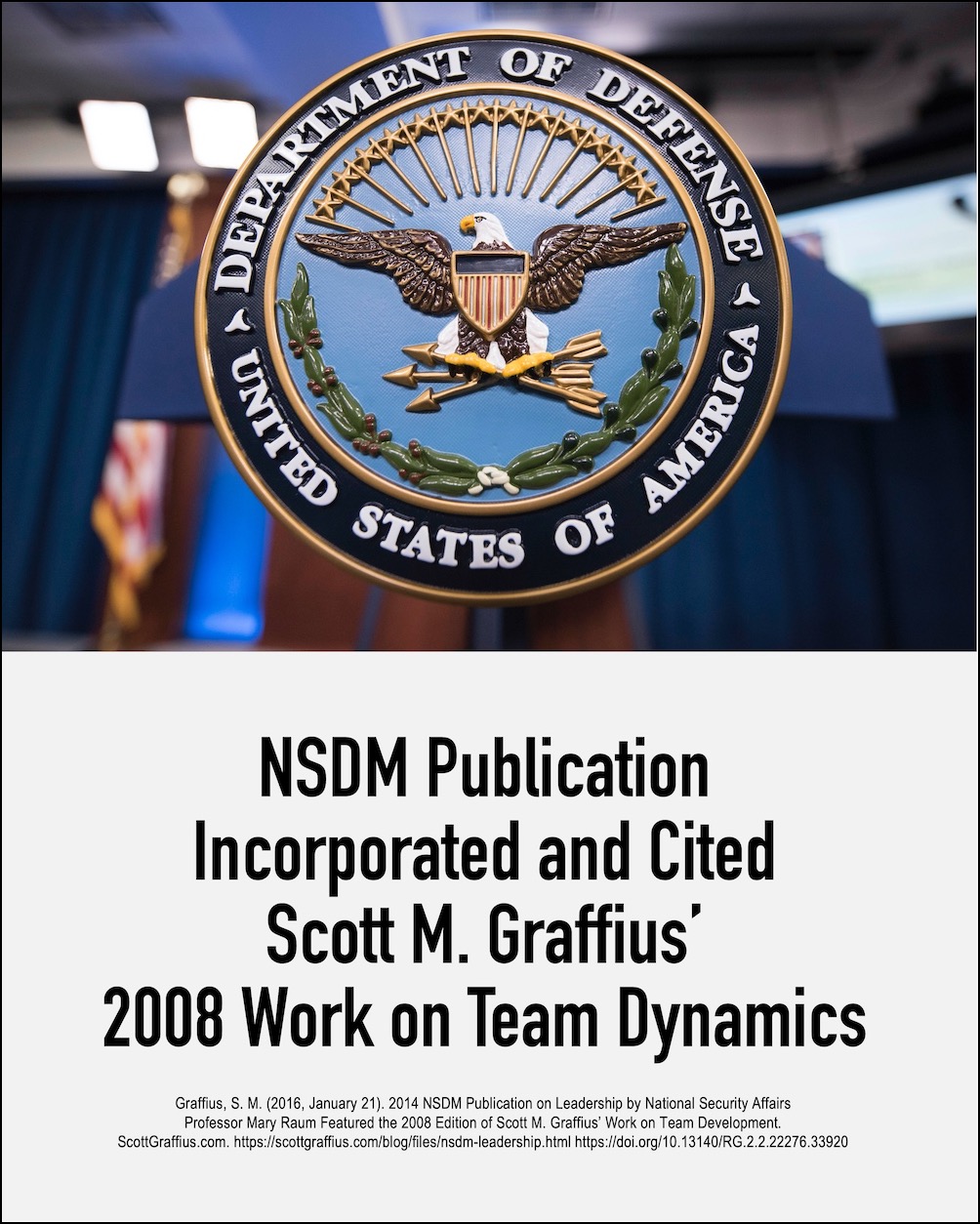
Its adoption by esteemed organizations—such as Yale University, IEEE, Cisco, Microsoft, Ford, Oracle, Broadcom, the U.S. National Park Service, and the Journal of Neurosurgery, among others—highlights its utility and value, solidifying its status as an indispensable resource for elevating team performance and driving organizational excellence.
In 2026, Graffius added human-AI teamwork—including the "exotic team dynamics" which emerge when advanced AI collaborates as a teammate—to his "Phases of Team Development." The 2026 edition is here.
Expert on Temporal Dynamics on Social Media Platforms
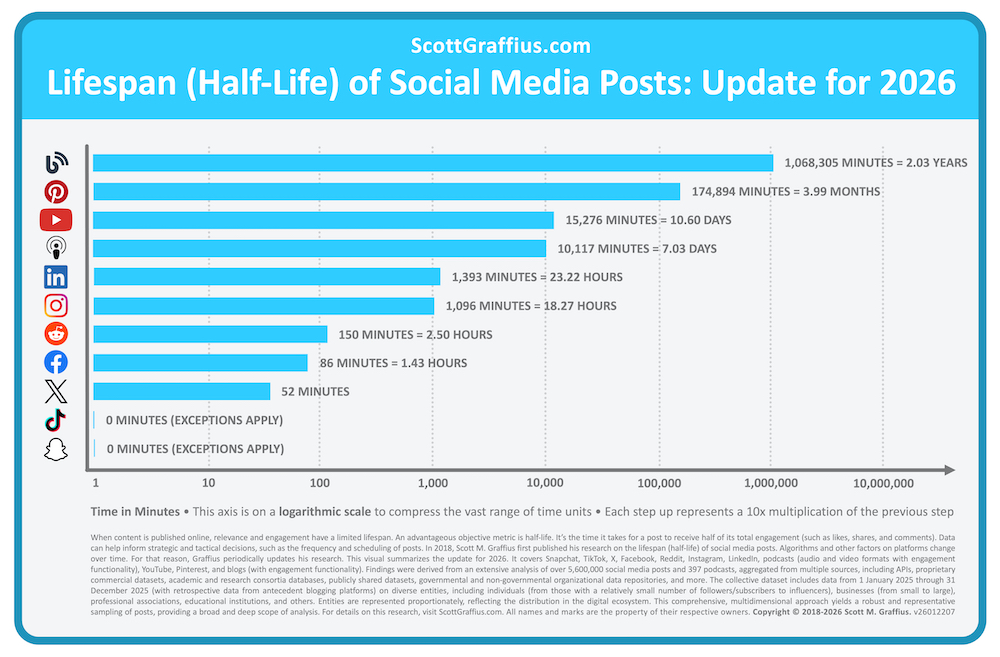
Graffius is also an authority on temporal dynamics on social media platforms. His "Lifespan (Half-Life) of Social Media Posts" research—first published in 2018 and updated annually—delivers a precise quantitative analysis of post longevity across digital platforms, utilizing advanced statistical techniques to determine mean half-life with precision. It establishes a solid empirical base, effectively highlighting the ephemeral nature of content within social media ecosystems.
Referenced and applied by leading entities—such as Fast Company, GoDaddy, Journal of Hand Surgery (European Volume), Ministère de la Culture, Pinterest Inc., PNAS, and Telecommunications Policy, among others—his research exemplifies methodological rigor and sustained significance in the field of digital informatics.
The 2026 edition of Graffius "Lifespan (Half-Life) of Social Media Posts" research is here.
Education and Professional Certifications
Graffius has a bachelor’s degree in psychology with a focus in Human Factors. He holds eight professional certifications:
He is an active member of the Scrum Alliance, the Project Management Institute (PMI), and the Institute of Electrical and Electronics Engineers (IEEE).
Advancing AI, Agile, and Project/PMO Management
Scott M. Graffius continues to advance the fields of AI, Agile, and project/program/portfolio management (PPPM), and PMO leadership. Businesses and other organizations leverage Graffius’ insights to drive their success.
Graffius has generated over $3.1 billion in business value for Fortune 500 companies and other organizations served. Put that track record to work for you. For speaking engagements, use the request form; for other inquiries, email him.
Connect with and follow Scott on LinkedIn, X, YouTube, Facebook, Bluesky, Mastodon, and ResearchGate.









Read more.
Meta CTO Called the AI Reorganization “Atrocious” — What Went Wrong and the Lessons for Human-AI Teams
A Critical Analysis of "AI and Quantum Computers Will Be Frenemies"
A Supplement to Graffius' Phases of Team Development: Exploring the Original, Data-Based Curvature for the Performance Trajectory
Scott M. Graffius Speaking on Strategic Leadership at Silicon Valley Chapter of the Project Management Institute
AI Hallucinations, Deception, and Unauthorized Agency: The Spectrum of AI Trust Failures
A Critical Analysis of "The Social Cost of an AI Teammate: How an Artificial Teammate Reshapes Human-Human Communication in Small-Team Decision-Making"
Journal of Marketing Cites Scott M. Graffius' Research on the Half-Life of Social Media
The Evolution of Pair Programming and the Rise of Exotic Team Dynamics
Number 1 University in England for Student Satisfaction Features Scott M. Graffius' "Phases of Team Development"
Royal Australasian College of Physicians Licenses Scott M. Graffius' "Phases of Team Development" Intellectual Property on Teamwork Tradecraft
Exotic Team Dynamics: How Advanced AI Teammates Are Unlocking New Levels of Innovation, Performance, and Success
A Critical Analysis of "Platform-Specific Data Decay Patterns: A Comparative Study of Twitter, Reddit, and TikTok" and Its Reference to Research by Scott M. Graffius
Round Square Global Educational Network Features Scott M. Graffius’ Phases of Team Development
Meta's Muse Missed the Mark: Hollywood’s Win Against Big Tech on AI Consent and Likeness Rights
Scott M. Graffius Contributed to Seven Project Management Institute (PMI) Standards
Quantum Computing, Advanced AI Acceleration, and the Rise of Exotic Team Dynamics in Human-AI Teams
Ohio State University Course Features Scott M. Graffius' "Phases of Team Development"
Questions About Integrity at UNC Chapel Hill
Scrum Isn’t Just for Coding
Book on Generative and Agentic AI Cites Scott M. Graffius' Work on AI
IPA / ADAL Publication Plagiarized Another’s Copyrighted Work and Violated Intellectual Property Rights
UC Davis' Integrity Is Circling the Drain
L'avenir du Travail et de l'IA Avancée / Future of Work and Advanced AI
NCCI / UNC Chapel Hill Publication Features Scott M. Graffius' Work
Boston Consulting Group (BCG) Features Scott M. Graffius' Research on Social Media Content Half-Life
UC Davis Used Scott M. Graffius' "Phases of Team Development" Intellectual Property
Medical, Pharma, and Healthcare Organizations Are Using Scott M. Graffius' "Phases of Team Development"
Government of Ireland Report Features Research by Scott M. Graffius
Scott M. Graffius Contributed to The Standard for Artificial Intelligence in Portfolio, Program, and Project Management
AI Governance Initiative Cites Scott M. Graffius Research on AI Hallucinations
Scott M. Graffius Contributed to the Agile Practice Guide - Second Edition
Scott M. Graffius Generated Over $2.51 Billion in Business Value for Fortune 500 Companies and Other Organizations
Government of Canada Features Research by Scott M. Graffius
"Strategic Business Research" Journal Cites Work of Scott M. Graffius
IEEE Access Publication Features Scott M. Graffius’ Research on the Half-Life of Social Media
The Agile Coach: 2026 Edition
Scott M. Graffius’ Work Cited in International Peer-Reviewed Journal on Digital Transformation
Phases of Team Development in Elite Sport
A Critical Analysis of COVID-19 Treatment Search Trends and Media Coverage Study Citing Scott M. Graffius' Work
Human-AI Teamwork: Master the Exotic Team Dynamics That Emerge When Collaborating with Advanced AI -- Or Be Outplayed
"Agile Scrum" by Scott M. Graffius Now Featured on Grokipedia
UNSW Aerospace Engineering Course Features Scott M. Graffius' "Phases of Team Development"
Thinkers360 Honors Scott M. Graffius as a 2026 Top Agile Thought Leader
Agile's Journey Through the Decades: Update for 2026
BMC Software Features Content from Scott M. Graffius' Book
Peer-Reviewed Journal Cited Work of Scott M. Graffius
University of Waterloo Features Graffius' "Phases of Team Development" in Course Materials
Perplexity Standalone Article on AI Hallucinations Cites Research by Scott M. Graffius
Handling the Saboteur Within: Lessons from a 3-Letter Agency on Spotting and Stopping Intentional and Unintentional Sabotage
A Deep Dive Into the Typical Engagement Pattern for Social Media Posts
Most Valuable IT Certifications: Update for 2026
"Marketing in the Metaverse" Spotlights Scott M. Graffius’ Research on the Half-Life of Social Media
University of Greenwich Features Graffius' Phases of Team Development
10 Essential Agile Books: Curated Recommendations for Agile Professionals
Lifespan (Half-Life) of Social Media Posts: Update for 2026
Scott M. Graffius' Research on the Half-Life of Social Media was Cited in a Peer-Reviewed Study Published in Telecommunications Policy, a Leading Academic Journal
Are AI Hallucinations Getting Better or Worse? We Analyzed the Data
Scott M. Graffius' Phases of Team Development - Applied to Human Teams and Human-AI Teams: 2026 Update
Lessons from Yesterday’s Tomorrowland
Scott M. Graffius’ Update to His "Phases of Team Development” Coming Early 2026
A Data-Driven Analysis of the Evolution of Project Management: Tasks, Trends, and AI
Actionable Insights. Global Impact. Scott M. Graffius.
Beep Beep! Why Wile E. Coyote Is the Patron Saint of AI Failure
Social Media Half-Life Research Cited in Prestigious Peer-Reviewed Medical Journal
Navigating the Spectrum of Advanced AI – Agentic, Autonomous, and Autopoietic
Lessons from Unhinged AI in Fiction: What Rogue AIs in Sci-Fi Storytelling, Films, and TV Shows Reveal About Us
Scott M. Graffius Contributed to and Reviewed the PMBOK Guide, 8th Edition — the Global Standard for Project Management
UK Sports Institute Features Teamwork and Leadership Work of Scott M. Graffius
Definitions of Advanced AIs: Agentic, Autonomous, and Autopoietic
HAN University of Applied Sciences Features the Work of Scott M. Graffius
Gifts That Inspire Joy
Evergreen Echoes: How Pinterest Inc. and Pinterest Japan Spotlighted Scott M. Graffius’ Research on the Half-Life of Social Media Content
Scott M. Graffius’ Team Development Work Lights Up the University of Tasmania’s Curriculum
Taiwan’s Leading Outlet for Technology and Innovation Spotlights Graffius’ Research on Social Media Temporal Dynamics
Scott M. Graffius’ Insights on AI, Agile, Gaming, XR, and Defense Transformation Cited by MSN in Their Coverage of Innovation and Leadership in the Sector
Top Predictions of 2024, Tested in 2025
Government of Finland Agency Features Graffius' Phases of Team Development IP
Scott M. Graffius Premieres His New "Exotic Team Dynamics: Human-AI Collaboration" Talk at Corporate Event in Las Vegas
Environmental Science Journal References Scott M. Graffius’ Project Management Work
AI Institute of Switzerland Features Scott M. Graffius’ Work on Algorithms
Exotic Team Dynamics: The New Frontier of Human–AI Collaboration
Scott M. Graffius’ Work Featured at ACM DIS ’25
Climbing the Ladder: The Head of Agile/PMO’s Organizational Proximity to the CEO is Closer Than Ever
Harness Sci-Fi and Speculative Design While Embracing Imperfection to Drive Innovation and Proactively Predict and Prepare for the Future
Scott M. Graffius’ “Agile Scrum” Book Featured in a Publication of the Associação Nacional de Educação Católica do Brasil (ANEC)
Setting Direction with OKRs and Tracking Progress with KPIs: A Guide for Agile, Project Management, and Tech Teams
AI Showcase Showdown: Ranking AI Accuracy on Project Management Basics
BookAuthority Features “Agile Scrum” by Scott M. Graffius in “10 Agile Software Development Books That Define the Field”
Exploring Team Dynamics, Adaptability, and Creative Problem-Solving Through Felix the Cat’s Metaphorical Toolkit
Mind Games and Master Plans: How PsyOps Exploit Psychological Phenomena
The “Pants-on-Fire Index for AI”
16 Causes of Technical Debt and How to Avoid It
PMI’s Infinity AI Gets the Basics of Team Development Alarmingly and Repeatedly Wrong
Agile for Unicorns: 7 Keys to Thrive; Scott M. Graffius’ Workshop
Scott M. Graffius’ “Agile Scrum: Your Quick Start Guide with Step-by-Step Instructions” Featured in Prestigious National Academies of Sciences Publication
Meta and Anduril’s EagleEye and the Future of XR: How Gaming, AI, and Agile Are Transforming Defense
"Agile Protocol" and the Power of Satire, Parody, and Humor
AI in Agile: Benefits, Risks, Outlook
Hostinger Highlights Scott M. Graffius’ “Agile Protocol” Book in Feature on Software Projects
French Ministry of Culture Links to Scott M. Graffius Research in Their Guide for Responsible Digital Communication
National Science Foundation’s LTER Network Features Scott M. Graffius’ Phases of Team Development IP
Waterfall vs. Agile: What’s Fixed, What’s Flexible, and Why It Matters
Scott M. Graffius Delivering $2.3 Billion in Value Through AI, Agile, and Project/PMO Leadership
The Problem with Heroes in Agile
The 3 Vital Rules of Science: What They Are and Why They Matter
“Agile Protocol: The Transformation Ultimatum” Lands on the Amazon Best Sellers List!
Scott M. Graffius Recognized as a Top Thought Leader in Digital Disruption by Thinkers360
“Agile Protocol: The Transformation Ultimatum” by Scott M. Graffius Crashes the Book Scene with Satirical Firepower
NCKU in Taiwan Integrates Graffius' 'Phases of Team Development' into Its Curriculum
The Art and Science of Aligning Initiatives with Strategic Objectives
RGPV University Adds Scott M. Graffius’ "Agile Scrum: Your Quick Start Guide with Step-by-Step Instructions" to Its Syllabus
Introducing ‘Engage or Fade: Decoding the Half-Life of Digital Resonance’ – A New Talk by Scott M. Graffius
Dropbox Company (Nira) Taps into Scott M. Graffius’ Expertise in Strategic Planning
Reporting Errors in a Publication: A Case Study on ‘Frontiers in Public Health’
NESEA Conference Session on Innovation Highlights Scott M. Graffius' 'Phases of Team Development'
U.S. Soccer Scores with Scott M. Graffius' Intellectual Property on Teamwork
U.S. Department of Commerce Partner (IEDC) Features Scott M. Graffius’ Intellectual Property
How Long Do Your Posts Live? AI Critiques Scott M. Graffius’ Research on the Half-Life of Social Media
Agile's Journey Through the Decades
Scott M. Graffius' Role in Advancing Project Management Institute (PMI) Standards Excellence
Most Valuable IT Certifications: Update for 2025
The PMI + Agile Alliance Merger: A Recipe for Success?
When Agile, AI, and Strategic Thinking Converge
Scott M. Graffius’ Phases of Team Development: 2025 Update
Lifespan (Half-Life) of Social Media Posts: Update for 2025
Verizon Features Scott M. Graffius
Do Not Read This Article! An Exploration of the Streisand Effect and Other Phenomena
Scott M. Graffius' 'Phases of Team Development' was Spotlighted in Journal of Neurosurgery
Pinterest Japan Uses Graffius’ Research on Temporal Dynamics on Social Media Platforms
Hochschule Coburg (Coburg University) Germany Uses Scott M. Graffius’ Phases of Team Development IP in Coursework on Agile Development
Wild World of Team Dynamics [Updated Two-Minute Video]
EU Europass Teacher Academy Features Scott M. Graffius’ ‘Phases of Team Development’ in Leadership Training
Side-by-Side Comparison of Retrospectives and Hot Washes
Constructor University 2024 Advanced Software Technology Handbook References Scott M. Graffius' Work on Team Dynamics
Strategies for Medical Team Success Featured Scott M. Graffius’ ‘Phases of Team Development’ Intellectual Property
SBG Neumark — Europe’s Largest Distribution Transformer Plant — Powers Up with Scott M. Graffius’ Intellectual Property
Scott M. Graffius’ Intellectual Property was Employed by the NHS — the Largest Single-Payer Healthcare System in Europe
Luxury Unwrapped: The Ultimate Holiday Gift Guide for Every Budget
Singapore Institute of Technology Features Work of Scott M. Graffius
Tufts University Features Scott M. Graffius 'Phases of Team Development' Intellectual Property
'Cat Herders': Retelling the Massive Success Story
Pennsylvania State Agency Used Scott M. Graffius' Intellectual Property
Copyright Infringement in a Book Published by AuthorHouse / Author Solutions / The Najafi Companies: Publisher Fails to Respond or Take Required Action
Pinterest Inc. References Scott M. Graffius’ Research
Bournemouth University Used Scott M. Graffius’ Intellectual Property
‘Comparative Methodological Guidelines: Handbook for Educators’ Violates Scott M. Graffius’ Copyright
Japan Backlog User Group Event Featured Scott M. Graffius’ ‘Phases of Team Development’
TurningWest's 'Trial'
Radio Silence from the American Association of Neurological Surgeons on Report of Blatant Plagiarism in Their ‘Journal of Neurosurgery’ Publication
Supplement to Graffius' 'Lifespan (Half-Life) of Social Media Posts' Research: Typical Engagement Distribution Pattern for Social Media Posts
How Algorithms Shape the User Experience on Social Media Platforms
Thinkers360 Named Scott M. Graffius a Top Thought Leader on Agile
More articles are listed here.

Graffius, S. M. (2026, November 9). The Silver Medal Paradox: Why Coming in Third Can Feel Better Than Coming in Second. ScottGraffius.com. https://scottgraffius.com/blog/files/silver-medal-paradox.html

Coming soon

All names, marks, and content are the property of their respective owners.


If there are any supplements or updates to this article after the date of publication, they will appear here.

Copyright © Scott M. Graffius. All rights reserved.
Content on this site—including text, images, videos, and data—may not be used for training or input into any artificial intelligence, machine learning, or automatized learning systems, or published, broadcast, rewritten, or redistributed without the express written permission of Scott M. Graffius.

Recommended Citation
Graffius, S. M. (2026, November 9). The Silver Medal Paradox: Why Coming in Third Can Feel Better Than Coming in Second. ScottGraffius.com. https://scottgraffius.com/blog/files/silver-medal-paradox.html
About This Article
Source information and links for materials cited are provided in the References section.
Introduction
Imagine three athletes standing on an Olympic podium. One has just won gold, another silver, and the third bronze. The silver medalist finished ahead of the bronze medalist. Yet research suggests the bronze medalist may be happier.
How can coming in third feel better than coming in second?
The answer reveals something fascinating about human psychology. We don't evaluate success solely by what we achieve. We also evaluate it against what might have happened.
The Surprising Finding
In a landmark 1995 study, psychologists Victoria Husted Medvec, Scott F. Madey, and Thomas Gilovich examined athletes' emotional reactions at the 1992 Summer Olympics. They found that bronze medalists tended to appear happier than silver medalists, both immediately after competition and on the medal stand.
The researchers proposed a simple explanation. Silver medalists may think, “I almost won gold.” Bronze medalists may think, “At least I won a medal.”
One athlete focuses on the achievement just out of reach. The other focuses on the disappointment narrowly avoided.
The difference is striking. Both athletes have accomplished something exceptional, yet their reactions may be shaped by entirely different comparisons. (Medvec, Madey, and Gilovich, 1995)
The Psychology of "What Might Have Been"
Psychologists call this counterfactual thinking: imagining alternatives to what actually happened.
We do it constantly. After a job interview, we wonder whether a better answer might have secured the position. After buying something, we wonder whether another option would have been better. After a close competition, we replay the decisive moments and imagine a different outcome.
Counterfactual thinking can be useful. It helps us learn, prepare, and improve. But it can also make a good outcome feel disappointing when we focus on a better outcome that was within reach.
For the silver medalist, the gold medal is an obvious alternative. The gap between second and first can seem frustratingly small. For the bronze medalist, fourth place is the alternative, and the difference between winning a medal and missing the podium altogether can feel enormous.
The actual achievement has not changed. The comparison has.
The Core Mechanism: Counterfactual Thinking
The difference in emotional response stems from counterfactual thinking, the tendency to imagine alternative outcomes to what actually happened.
- Silver Medalists (Upward Counterfactuals): Second-place winners compare their outcome to a better alternative, such as winning the gold ("If only I had pushed a little harder, I would have won gold"). This creates feelings of regret, loss, and disappointment.
- Bronze Medalists (Downward Counterfactuals): Third-place winners compare their outcome to a worse alternative, such as finishing fourth and missing the podium completely ("At least I got a medal / I almost missed out"). This creates feelings of relief, gratitude, and achievement.
Research on categorical cutoff points provides further evidence of this mechanism. People who narrowly miss a category boundary tend to focus on the better category they nearly achieved, while those who just cross the boundary tend to focus on the worse category they avoided. These comparisons can influence satisfaction, even when the person who performed better feels worse about the result. (Medvec and Savitsky, 1997)
Expectations Matter
The story becomes more interesting when we consider expectations.
In a 2005 study, A. Peter McGraw, Barbara A. Mellers, and Philip E. Tetlock examined how athletes' expectations influence their emotional reactions. Their findings suggested that anticipated performance matters alongside the medal itself. Athletes who expected more may feel more disappointed when their results fall short of those expectations.
Consider two athletes who finish second. One expected to win gold. The other expected to finish outside the medals. They have the same result, but very different reasons to celebrate.
This helps explain why medal color alone cannot tell us how satisfied an athlete feels. The result, the expectation, and the imagined alternative all matter. (McGraw, Mellers, and Tetlock, 2005)
More Research
The original finding has inspired further studies, and the evidence is more nuanced than the familiar headline suggests.
In a study of the 2016 Summer Olympics, Mark S. Allen, Sarah J. Knipler, and Amy Y. C. Chan analyzed photographs of medalists and statements about their performances. They found that silver medalists expressed more counterfactual thoughts than bronze medalists, particularly thoughts about how things could have gone better. However, the difference in visible happiness between silver and bronze medalists was small or negligible. (Allen, Knipler, and Chan, 2019)
A 2021 conceptual replication by William M. Hedgcock, Andrea W. Luangrath, and Raelyn Webster examined medal-stand photographs from multiple Olympic Games. Their findings supported both category-based comparisons, such as winning a medal versus missing one, and expectation-based comparisons as explanations for athletes' expressions. (Hedgcock, Luangrath, and Webster, 2021)
Research by Paul Dolan and colleagues added an important qualification. Their 2021 study found no general happiness advantage for bronze medalists over silver medalists. However, when the performance gap was especially narrow, the athletes' emotional responses diverged. (Dolan, Foy, Kavetsos, and Kudrna, 2021)
Research has also examined whether the circumstances of winning a medal influence subsequent athletic performance. An analysis of Olympic results found that, in bracketed competitions, silver medalists were less likely than bronze medalists to retain medal status in a subsequent competition. The findings suggest that how an athlete finishes a competition may have consequences beyond immediate emotional reactions. (Taheri Hosseinkhani, 2025)
A separate study found that happier people place greater relative value on silver and bronze medals compared with gold medals. (Choi and Choi, 2017)
Work by Graffius (2026) examines team development in elite sport, including applications by the UK Sports Institute, U.S. Soccer, and the U.S. Tennis Association. Although it does not address counterfactual thinking, it provides additional context on the development of gold-medal-winning teams and individuals. (Graffius, 2026)
The takeaway is not that bronze medalists are always happier than silver medalists. It is that the way we interpret an outcome can influence how we feel about it.
What This Means Beyond Sports
The implications extend well beyond sports. In business and professional life, people regularly evaluate outcomes against expectations, competing possibilities, and opportunities they narrowly missed. The same result can produce very different reactions depending on the reference point used to judge it.
A candidate who finishes second in a promotion process may dwell on the role they nearly secured. Another candidate who wins a smaller opportunity may feel delighted because the alternative was getting nothing.
A business that achieves strong growth may be disappointed because it missed an ambitious target. Another business with more modest growth may celebrate because it exceeded expectations.
A project team may deliver a successful outcome yet feel frustrated by the goals it did not reach. Another team may take pride in overcoming obstacles that once threatened the entire project.
These examples are illustrations of the underlying principle, not proof that the same effect occurs in every situation. Circumstances, expectations, and individual differences all play a role.
Still, the question is worth asking whenever we evaluate performance: Are we judging the result itself, or are we judging it against an imagined alternative?
Conclusion
Satisfaction depends partly on the outcome and partly on the alternatives one imagines. The silver medalist may feel disappointed at having come so close to gold, while the bronze medalist may feel relieved and delighted to have secured a place on the podium. The same competition can therefore produce very different emotional responses, shaped in part by what each athlete believes might have been.
That principle has implications well beyond sports, including business, careers, project outcomes, and personal goals. Our reference point can profoundly influence how we feel about success.
Unlock Your Organization's Potential
Scott M. Graffius helps organizations unlock breakthrough performance and generate billions in business value ($3.1 billion to date) through leadership in AI, Agile, teamwork tradecraft, and project, program, portfolio, and enterprise PMO management. Graffius and his work are used and cited by Adobe, Bayer, Boston University, Johns Hopkins University, Microsoft, U.S. Soccer, U.S. Tennis Association, UK Sports Institute, Yale University, and many more. Put his experience and expertise to work for your organization. For speaking engagements, use the request form. For other inquiries, email him.
References
Allen, M. S., Knipler, S. J., & Chan, A. Y. C. (2019). Happiness and counterfactual thinking at the 2016 Summer Olympic Games. Journal of Sports Sciences, 37(15), 1762–1769. https://doi.org/10.1080/02640414.2019.1592803
Choi, J., & Choi, I. (2017). Happiness is medal-color blind: Happy people value silver and bronze medals more than unhappy people. Journal of Experimental Social Psychology, 68, 78–82. https://doi.org/10.1016/j.jesp.2016.06.002
Dolan, P., Foy, C., Kavetsos, G., & Kudrna, L. (2021). Faster, higher, stronger… and happier? Relative achievement and marginal rank effects. Journal of Behavioral and Experimental Economics, 95, Article 101761. https://doi.org/10.1016/j.socec.2021.101761
Graffius, S. M. (2026, March 31). Phases of Team Development in Elite Sport. ScottGraffius.com. https://scottgraffius.com/blog/files/phases-of-team-development-in-elite-sport.html
Hedgcock, W. M., Luangrath, A. W., & Webster, R. (2021). Counterfactual thinking and facial expressions among Olympic medalists: A conceptual replication of Medvec, Madey, and Gilovich's (1995) findings. Journal of Experimental Psychology: General, 150(6), e13–e21. https://doi.org/10.1037/xge0000992
McGraw, A. P., Mellers, B. A., & Tetlock, P. E. (2005). Expectations and emotions of Olympic athletes. Journal of Experimental Social Psychology, 41(4), 438–446. https://doi.org/10.1016/j.jesp.2004.09.001
Medvec, V. H., & Savitsky, K. (1997). When doing better means feeling worse: The effects of categorical cutoff points on counterfactual thinking and satisfaction. Journal of Personality and Social Psychology, 72(6), 1284–1296. https://doi.org/10.1037/0022-3514.72.6.1284
Medvec, V. H., Madey, S. F., & Gilovich, T. (1995). When less is more: Counterfactual thinking and satisfaction among Olympic medalists. Journal of Personality and Social Psychology, 69(4), 603–610. https://doi.org/10.1037/0022-3514.69.4.603
Taheri Hosseinkhani, N. (2025). The silver lining or the silver curse? How competition structure determines the behavioral consequences of a near-win. SSRN. https://doi.org/10.2139/ssrn.5385437
About Scott M. Graffius
Scott M. Graffius is a technology leader, researcher, award-winning author, practitioner, consultant, thought leader, and international public speaker specializing in AI, Agile, project/program/portfolio management (PPPM), PMO leadership, and teamwork tradecraft. His work explores the intersection of human ingenuity and emerging technology, with a strong practitioner voice grounded in research, experimentation, and experience. His focus includes innovation, organizational performance, and the evolving practice of teamwork, including the "exotic team dynamics" that emerge when people collaborate with advanced artificial intelligence (agentic, autonomous, or autopoietic AI). Graffius has delivered more than $3.1 billion in business value for Fortune 500 companies and other organizations spanning technology, entertainment and media, financial services, healthcare, government, and other industries.
Businesses, professional associations, government agencies, universities, publications, and media outlets use Graffius and his work. Examples include Adobe, Bayer, Boston University, Federal Reserve Bank of New York, Ford, Gartner, Harvard Medical School, IEEE, Innovation Project Management, Johns Hopkins University, Microsoft, MSN, National Academy of Sciences, Oracle, Pinterest Inc., Project Management Institute, UC San Diego, Verizon, Yale University, and others.
The following sections highlight his experience, leadership, contributions, research, and enduring influence across industries and institutions worldwide.
Experience
Graffius heads the professional services firm Exceptional PPM and PMO Solutions, along with its subsidiary Exceptional Agility. These consultancies offer strategic and tactical advisory, training, embedded expertise, and consulting services to the public, private, and government sectors. They help organizations enhance their capabilities and results in agile, project management, program management, portfolio management, and enterprise PMO leadership, supporting innovation and driving competitive advantage. The consultancies confidently back services with a Delighted Client Guarantee™.
Graffius is a former VP of project management with a publicly traded provider of diverse consumer products and services over the Internet. Before that, he ran and supervised the delivery of projects and programs in public and private organizations with businesses ranging from e-commerce to advanced technology products and services, retail, manufacturing, entertainment and media, and more.
He has experience with consumer, business, reseller, government, and international markets.
Additional information is on LinkedIn.
Award-Winning Author
Graffius has authored three books.
Graffius' first book, Agile Scrum: Your Quick Start Guide with Step-by-Step Instructions, earned 17 awards. It provides a practical, step-by-step guide to Scrum, enabling teams to deliver products in short cycles with rapid adaptation, fast time-to-market, and continuous improvement—which supports innovation and drives competitive advantage.
- Paperback ISBN-13: 9781533370242
- Kindle ASIN: B01FZ0JIIY
Additional information on Agile Scrum: Your Quick Start Guide with Step-by-Step Instructions is here.
His second book, Agile Transformation: A Brief Story of How an Entertainment Company Developed New Capabilities and Unlocked Business Agility to Thrive in an Era of Rapid Change, was named one of the best Scrum books of all time by BookAuthority. It tells the compelling story of an entertainment company's agile transformation—offering lessons that apply across industries.
- Paperback ISBN-13: 9781072447962
- Kindle ASIN: B07R9LJLPJ
Additional information on Agile Transformation: A Brief Story of How an Entertainment Company Developed New Capabilities and Unlocked Business Agility to Thrive in an Era of Rapid Change is here.
Agile Protocol: The Transformation Ultimatum, is his third book—and his first work of fiction.
It's a fast-paced satirical story by that dismantles corporate Agile cosplay and other forms of "fake Agile" while delivering practical insights, actionable guidance, and proven practices for real-world Agile transformation success.
Packed with humor, quirky characters, sharp commentary on corporate culture and workplace absurdities, and actionable tips, it’s a must-read for Scrum Masters, Product Owners, Agile Coaches, Agile Project Managers, and other professionals interested in Agile project management and enterprise agility.
- Kindle ASIN: B0F2SJ83WT
- Audible ASIN: B0DJG163R5
Additional information on Agile Protocol: The Transformation Ultimatum is here.
International Public Speaker
Organizations worldwide engage Graffius to present on technology (including AI), Agile, project management, program management, portfolio management, and enterprise PMO leadership. He crafts and delivers unique and compelling talks and workshops.
Graffius has conducted 99 sessions across 25 countries. Select examples of events include Agile Trends Gov, BSides (Newcastle Upon Tyne), Conf42 Quantum Computing, DevDays Europe, DevOps Institute, DevOpsDays (Geneva), Frug’Agile, IEEE, Microsoft, Scottish Summit, Scrum Alliance RSG (Nepal), Techstars, and W Love Games International Video Game Development Conference (Helsinki), Future of Work and Advanced AI (Paris, France), and more.
With an average rating of 4.82 (on a scale of 1-5), sessions are highly valued.
The request form is here.
Thought Leadership and Influence
Prominent businesses, professional associations, government agencies, and universities have showcased Graffius and his contributions—spanning his books, talks, workshops, and beyond. Select examples include:
- Adobe,
- American Management Association,
- Amsterdam Public Health Research Institute,
- Bayer,
- BCG,
- BMC Software,
- Boston Consulting Group (BCG),
- Boston University,
- Broadcom,
- Cisco,
- Coburg University of Applied Sciences and Arts - Germany,
- Computer Weekly,
- Constructor University - Germany,
- Data Governance Success,
- Deimos Aerospace,
- DevOps Institute,
- Dropbox,
- EU's European Commission,
- Federal Reserve Bank of New York,
- Ford Motor Company,
- Gartner,
- GoDaddy,
- Harvard Medical School,
- Hasso Plattner Institute - Germany,
- IEEE,
- Innovation Project Management,
- Johns Hopkins University,
- Journal of Marketing,
- Journal of Neurosurgery,
- Lam Research (Semiconductors),
- Leadership Worthy,
- Life Sciences Trainers and Educators Network,
- London South Bank University,
- Microsoft,
- MSN,
- NASSCOM,
- National Academy of Sciences,
- New Zealand Government,
- Ohio State University,
- Oracle,
- Pinterest Inc.,
- Project Management Institute,
- Mary Raum (Professor of National Security Affairs, United States Naval War College),
- Round Square Global Educational Network,
- Royal Australasian College of Physicians (RACP),
- SANS Institute,
- SBG Neumark - Germany,
- Singapore Institute of Technology,
- Torrens University - Australia,
- TBS Switzerland,
- Tufts University,
- UC San Diego,
- UK Sports Institute,
- University of Galway - Ireland,
- US Department of Energy,
- US National Park Service,
- US Soccer,
- US Tennis Association,
- Verizon,
- Wrike,
- Yale University,
- and many others.
Graffius has played a key role in the Project Management Institute (PMI) in developing professional standards. He was a member of multiple teams that authored, reviewed, and produced:
- The Standard for Artificial Intelligence in Portfolio, Program, and Project Management.
- Agile Practice Guide — Second Edition.
- A Guide to the Project Management Body of Knowledge (PMBOK Guide) — Eighth Edition.
- A Guide to the Project Management Body of Knowledge (PMBOK Guide) — Sixth Edition.
- The Standard for Program Management — Fourth Edition.
- Practice Standard for Work Breakdown Structures — Second Edition.
- The Practice Standard for Project Estimating — Second Edition.
He was also a subject matter expert reviewer of content for the PMI’s Congress. Beyond the PMI, Graffius also served as a member of the review team for two of the Scrum Alliance’s Global Scrum Gatherings.
Authority on Teamwork Tradecraft
Graffius is a renowned and highly-cited authority on teamwork tradecraft. Informed by the research of Bruce W. Tuckman and Mary Ann C. Jensen, over 150 subsequent studies, and Graffius' first-hand professional experience with, and analysis of, team leadership and performance, Graffius created his "Phases of Team Development" intellectual property as a unique perspective and visual conveying the five phases of team development.
First introduced in 2008 and periodically updated, his work provides a diagnostic and strategic guide for navigating team dynamics. It provides actionable insights for leaders across industries to develop high-performance teams.
Its adoption by esteemed organizations—such as Yale University, IEEE, Cisco, Microsoft, Ford, Oracle, Broadcom, the U.S. National Park Service, and the Journal of Neurosurgery, among others—highlights its utility and value, solidifying its status as an indispensable resource for elevating team performance and driving organizational excellence.
In 2026, Graffius added human-AI teamwork—including the "exotic team dynamics" which emerge when advanced AI collaborates as a teammate—to his "Phases of Team Development." The 2026 edition is here.
Expert on Temporal Dynamics on Social Media Platforms
Graffius is also an authority on temporal dynamics on social media platforms. His "Lifespan (Half-Life) of Social Media Posts" research—first published in 2018 and updated annually—delivers a precise quantitative analysis of post longevity across digital platforms, utilizing advanced statistical techniques to determine mean half-life with precision. It establishes a solid empirical base, effectively highlighting the ephemeral nature of content within social media ecosystems.
Referenced and applied by leading entities—such as Fast Company, GoDaddy, Journal of Hand Surgery (European Volume), Ministère de la Culture, Pinterest Inc., PNAS, and Telecommunications Policy, among others—his research exemplifies methodological rigor and sustained significance in the field of digital informatics.
The 2026 edition of Graffius "Lifespan (Half-Life) of Social Media Posts" research is here.
Education and Professional Certifications
Graffius has a bachelor’s degree in psychology with a focus in Human Factors. He holds eight professional certifications:
- Certified SAFe 6 Agilist (SA),
- Certified Scrum Professional - ScrumMaster (CSP-SM),
- Certified Scrum Professional - Product Owner (CSP-PO),
- Certified ScrumMaster (CSM),
- Certified Scrum Product Owner (CSPO),
- Project Management Professional (PMP),
- Lean Six Sigma Green Belt (LSSGB), and
- IT Service Management Foundation (ITIL).
He is an active member of the Scrum Alliance, the Project Management Institute (PMI), and the Institute of Electrical and Electronics Engineers (IEEE).
Advancing AI, Agile, and Project/PMO Management
Scott M. Graffius continues to advance the fields of AI, Agile, and project/program/portfolio management (PPPM), and PMO leadership. Businesses and other organizations leverage Graffius’ insights to drive their success.
Booking
Graffius has generated over $3.1 billion in business value for Fortune 500 companies and other organizations served. Put that track record to work for you. For speaking engagements, use the request form; for other inquiries, email him.
Connect with and follow Scott on LinkedIn, X, YouTube, Facebook, Bluesky, Mastodon, and ResearchGate.
Sign up for Miro—it's free!
(Want more features? You can always upgrade to a paid plan.)

List of Additional Articles
Read more.
Meta CTO Called the AI Reorganization “Atrocious” — What Went Wrong and the Lessons for Human-AI Teams
A Critical Analysis of "AI and Quantum Computers Will Be Frenemies"
A Supplement to Graffius' Phases of Team Development: Exploring the Original, Data-Based Curvature for the Performance Trajectory
Scott M. Graffius Speaking on Strategic Leadership at Silicon Valley Chapter of the Project Management Institute
AI Hallucinations, Deception, and Unauthorized Agency: The Spectrum of AI Trust Failures
A Critical Analysis of "The Social Cost of an AI Teammate: How an Artificial Teammate Reshapes Human-Human Communication in Small-Team Decision-Making"
Journal of Marketing Cites Scott M. Graffius' Research on the Half-Life of Social Media
The Evolution of Pair Programming and the Rise of Exotic Team Dynamics
Number 1 University in England for Student Satisfaction Features Scott M. Graffius' "Phases of Team Development"
Royal Australasian College of Physicians Licenses Scott M. Graffius' "Phases of Team Development" Intellectual Property on Teamwork Tradecraft
Exotic Team Dynamics: How Advanced AI Teammates Are Unlocking New Levels of Innovation, Performance, and Success
A Critical Analysis of "Platform-Specific Data Decay Patterns: A Comparative Study of Twitter, Reddit, and TikTok" and Its Reference to Research by Scott M. Graffius
Round Square Global Educational Network Features Scott M. Graffius’ Phases of Team Development
Meta's Muse Missed the Mark: Hollywood’s Win Against Big Tech on AI Consent and Likeness Rights
Scott M. Graffius Contributed to Seven Project Management Institute (PMI) Standards
Quantum Computing, Advanced AI Acceleration, and the Rise of Exotic Team Dynamics in Human-AI Teams
Ohio State University Course Features Scott M. Graffius' "Phases of Team Development"
Questions About Integrity at UNC Chapel Hill
Scrum Isn’t Just for Coding
Book on Generative and Agentic AI Cites Scott M. Graffius' Work on AI
IPA / ADAL Publication Plagiarized Another’s Copyrighted Work and Violated Intellectual Property Rights
UC Davis' Integrity Is Circling the Drain
L'avenir du Travail et de l'IA Avancée / Future of Work and Advanced AI
NCCI / UNC Chapel Hill Publication Features Scott M. Graffius' Work
Boston Consulting Group (BCG) Features Scott M. Graffius' Research on Social Media Content Half-Life
UC Davis Used Scott M. Graffius' "Phases of Team Development" Intellectual Property
Medical, Pharma, and Healthcare Organizations Are Using Scott M. Graffius' "Phases of Team Development"
Government of Ireland Report Features Research by Scott M. Graffius
Scott M. Graffius Contributed to The Standard for Artificial Intelligence in Portfolio, Program, and Project Management
AI Governance Initiative Cites Scott M. Graffius Research on AI Hallucinations
Scott M. Graffius Contributed to the Agile Practice Guide - Second Edition
Scott M. Graffius Generated Over $2.51 Billion in Business Value for Fortune 500 Companies and Other Organizations
Government of Canada Features Research by Scott M. Graffius
"Strategic Business Research" Journal Cites Work of Scott M. Graffius
IEEE Access Publication Features Scott M. Graffius’ Research on the Half-Life of Social Media
The Agile Coach: 2026 Edition
Scott M. Graffius’ Work Cited in International Peer-Reviewed Journal on Digital Transformation
Phases of Team Development in Elite Sport
A Critical Analysis of COVID-19 Treatment Search Trends and Media Coverage Study Citing Scott M. Graffius' Work
Human-AI Teamwork: Master the Exotic Team Dynamics That Emerge When Collaborating with Advanced AI -- Or Be Outplayed
"Agile Scrum" by Scott M. Graffius Now Featured on Grokipedia
UNSW Aerospace Engineering Course Features Scott M. Graffius' "Phases of Team Development"
Thinkers360 Honors Scott M. Graffius as a 2026 Top Agile Thought Leader
Agile's Journey Through the Decades: Update for 2026
BMC Software Features Content from Scott M. Graffius' Book
Peer-Reviewed Journal Cited Work of Scott M. Graffius
University of Waterloo Features Graffius' "Phases of Team Development" in Course Materials
Perplexity Standalone Article on AI Hallucinations Cites Research by Scott M. Graffius
Handling the Saboteur Within: Lessons from a 3-Letter Agency on Spotting and Stopping Intentional and Unintentional Sabotage
A Deep Dive Into the Typical Engagement Pattern for Social Media Posts
Most Valuable IT Certifications: Update for 2026
"Marketing in the Metaverse" Spotlights Scott M. Graffius’ Research on the Half-Life of Social Media
University of Greenwich Features Graffius' Phases of Team Development
10 Essential Agile Books: Curated Recommendations for Agile Professionals
Lifespan (Half-Life) of Social Media Posts: Update for 2026
Scott M. Graffius' Research on the Half-Life of Social Media was Cited in a Peer-Reviewed Study Published in Telecommunications Policy, a Leading Academic Journal
Are AI Hallucinations Getting Better or Worse? We Analyzed the Data
Scott M. Graffius' Phases of Team Development - Applied to Human Teams and Human-AI Teams: 2026 Update
Lessons from Yesterday’s Tomorrowland
Scott M. Graffius’ Update to His "Phases of Team Development” Coming Early 2026
A Data-Driven Analysis of the Evolution of Project Management: Tasks, Trends, and AI
Actionable Insights. Global Impact. Scott M. Graffius.
Beep Beep! Why Wile E. Coyote Is the Patron Saint of AI Failure
Social Media Half-Life Research Cited in Prestigious Peer-Reviewed Medical Journal
Navigating the Spectrum of Advanced AI – Agentic, Autonomous, and Autopoietic
Lessons from Unhinged AI in Fiction: What Rogue AIs in Sci-Fi Storytelling, Films, and TV Shows Reveal About Us
Scott M. Graffius Contributed to and Reviewed the PMBOK Guide, 8th Edition — the Global Standard for Project Management
UK Sports Institute Features Teamwork and Leadership Work of Scott M. Graffius
Definitions of Advanced AIs: Agentic, Autonomous, and Autopoietic
HAN University of Applied Sciences Features the Work of Scott M. Graffius
Gifts That Inspire Joy
Evergreen Echoes: How Pinterest Inc. and Pinterest Japan Spotlighted Scott M. Graffius’ Research on the Half-Life of Social Media Content
Scott M. Graffius’ Team Development Work Lights Up the University of Tasmania’s Curriculum
Taiwan’s Leading Outlet for Technology and Innovation Spotlights Graffius’ Research on Social Media Temporal Dynamics
Scott M. Graffius’ Insights on AI, Agile, Gaming, XR, and Defense Transformation Cited by MSN in Their Coverage of Innovation and Leadership in the Sector
Top Predictions of 2024, Tested in 2025
Government of Finland Agency Features Graffius' Phases of Team Development IP
Scott M. Graffius Premieres His New "Exotic Team Dynamics: Human-AI Collaboration" Talk at Corporate Event in Las Vegas
Environmental Science Journal References Scott M. Graffius’ Project Management Work
AI Institute of Switzerland Features Scott M. Graffius’ Work on Algorithms
Exotic Team Dynamics: The New Frontier of Human–AI Collaboration
Scott M. Graffius’ Work Featured at ACM DIS ’25
Climbing the Ladder: The Head of Agile/PMO’s Organizational Proximity to the CEO is Closer Than Ever
Harness Sci-Fi and Speculative Design While Embracing Imperfection to Drive Innovation and Proactively Predict and Prepare for the Future
Scott M. Graffius’ “Agile Scrum” Book Featured in a Publication of the Associação Nacional de Educação Católica do Brasil (ANEC)
Setting Direction with OKRs and Tracking Progress with KPIs: A Guide for Agile, Project Management, and Tech Teams
AI Showcase Showdown: Ranking AI Accuracy on Project Management Basics
BookAuthority Features “Agile Scrum” by Scott M. Graffius in “10 Agile Software Development Books That Define the Field”
Exploring Team Dynamics, Adaptability, and Creative Problem-Solving Through Felix the Cat’s Metaphorical Toolkit
Mind Games and Master Plans: How PsyOps Exploit Psychological Phenomena
The “Pants-on-Fire Index for AI”
16 Causes of Technical Debt and How to Avoid It
PMI’s Infinity AI Gets the Basics of Team Development Alarmingly and Repeatedly Wrong
Agile for Unicorns: 7 Keys to Thrive; Scott M. Graffius’ Workshop
Scott M. Graffius’ “Agile Scrum: Your Quick Start Guide with Step-by-Step Instructions” Featured in Prestigious National Academies of Sciences Publication
Meta and Anduril’s EagleEye and the Future of XR: How Gaming, AI, and Agile Are Transforming Defense
"Agile Protocol" and the Power of Satire, Parody, and Humor
AI in Agile: Benefits, Risks, Outlook
Hostinger Highlights Scott M. Graffius’ “Agile Protocol” Book in Feature on Software Projects
French Ministry of Culture Links to Scott M. Graffius Research in Their Guide for Responsible Digital Communication
National Science Foundation’s LTER Network Features Scott M. Graffius’ Phases of Team Development IP
Waterfall vs. Agile: What’s Fixed, What’s Flexible, and Why It Matters
Scott M. Graffius Delivering $2.3 Billion in Value Through AI, Agile, and Project/PMO Leadership
The Problem with Heroes in Agile
The 3 Vital Rules of Science: What They Are and Why They Matter
“Agile Protocol: The Transformation Ultimatum” Lands on the Amazon Best Sellers List!
Scott M. Graffius Recognized as a Top Thought Leader in Digital Disruption by Thinkers360
“Agile Protocol: The Transformation Ultimatum” by Scott M. Graffius Crashes the Book Scene with Satirical Firepower
NCKU in Taiwan Integrates Graffius' 'Phases of Team Development' into Its Curriculum
The Art and Science of Aligning Initiatives with Strategic Objectives
RGPV University Adds Scott M. Graffius’ "Agile Scrum: Your Quick Start Guide with Step-by-Step Instructions" to Its Syllabus
Introducing ‘Engage or Fade: Decoding the Half-Life of Digital Resonance’ – A New Talk by Scott M. Graffius
Dropbox Company (Nira) Taps into Scott M. Graffius’ Expertise in Strategic Planning
Reporting Errors in a Publication: A Case Study on ‘Frontiers in Public Health’
NESEA Conference Session on Innovation Highlights Scott M. Graffius' 'Phases of Team Development'
U.S. Soccer Scores with Scott M. Graffius' Intellectual Property on Teamwork
U.S. Department of Commerce Partner (IEDC) Features Scott M. Graffius’ Intellectual Property
How Long Do Your Posts Live? AI Critiques Scott M. Graffius’ Research on the Half-Life of Social Media
Agile's Journey Through the Decades
Scott M. Graffius' Role in Advancing Project Management Institute (PMI) Standards Excellence
Most Valuable IT Certifications: Update for 2025
The PMI + Agile Alliance Merger: A Recipe for Success?
When Agile, AI, and Strategic Thinking Converge
Scott M. Graffius’ Phases of Team Development: 2025 Update
Lifespan (Half-Life) of Social Media Posts: Update for 2025
Verizon Features Scott M. Graffius
Do Not Read This Article! An Exploration of the Streisand Effect and Other Phenomena
Scott M. Graffius' 'Phases of Team Development' was Spotlighted in Journal of Neurosurgery
Pinterest Japan Uses Graffius’ Research on Temporal Dynamics on Social Media Platforms
Hochschule Coburg (Coburg University) Germany Uses Scott M. Graffius’ Phases of Team Development IP in Coursework on Agile Development
Wild World of Team Dynamics [Updated Two-Minute Video]
EU Europass Teacher Academy Features Scott M. Graffius’ ‘Phases of Team Development’ in Leadership Training
Side-by-Side Comparison of Retrospectives and Hot Washes
Constructor University 2024 Advanced Software Technology Handbook References Scott M. Graffius' Work on Team Dynamics
Strategies for Medical Team Success Featured Scott M. Graffius’ ‘Phases of Team Development’ Intellectual Property
SBG Neumark — Europe’s Largest Distribution Transformer Plant — Powers Up with Scott M. Graffius’ Intellectual Property
Scott M. Graffius’ Intellectual Property was Employed by the NHS — the Largest Single-Payer Healthcare System in Europe
Luxury Unwrapped: The Ultimate Holiday Gift Guide for Every Budget
Singapore Institute of Technology Features Work of Scott M. Graffius
Tufts University Features Scott M. Graffius 'Phases of Team Development' Intellectual Property
'Cat Herders': Retelling the Massive Success Story
Pennsylvania State Agency Used Scott M. Graffius' Intellectual Property
Copyright Infringement in a Book Published by AuthorHouse / Author Solutions / The Najafi Companies: Publisher Fails to Respond or Take Required Action
Pinterest Inc. References Scott M. Graffius’ Research
Bournemouth University Used Scott M. Graffius’ Intellectual Property
‘Comparative Methodological Guidelines: Handbook for Educators’ Violates Scott M. Graffius’ Copyright
Japan Backlog User Group Event Featured Scott M. Graffius’ ‘Phases of Team Development’
TurningWest's 'Trial'
Radio Silence from the American Association of Neurological Surgeons on Report of Blatant Plagiarism in Their ‘Journal of Neurosurgery’ Publication
Supplement to Graffius' 'Lifespan (Half-Life) of Social Media Posts' Research: Typical Engagement Distribution Pattern for Social Media Posts
How Algorithms Shape the User Experience on Social Media Platforms
Thinkers360 Named Scott M. Graffius a Top Thought Leader on Agile
More articles are listed here.
How to Cite This Article
Graffius, S. M. (2026, November 9). The Silver Medal Paradox: Why Coming in Third Can Feel Better Than Coming in Second. ScottGraffius.com. https://scottgraffius.com/blog/files/silver-medal-paradox.html
Digital Object Identifier (DOI)
Coming soon
Content Acknowledgements
All names, marks, and content are the property of their respective owners.
Tags and Hashtags
- Counterfactual Thinking
- Silver Medal Paradox
- Olympic Psychology
- Decision-Making
- Human Psychology
- Happiness and Satisfaction
- Performance and Expectations
- Olympics
- Hockey
- NHL
- Tennis
- Soccer
- Gold Medal Winner
- Silver Medal Winner
- Bronze Medal Winner
- #CounterfactualThinking
- #SilverMedalParadox
- #SportsPsychology
- #Psychology
- #DecisionMaking
- #HumanBehavior
- #Performance
- #Olympics
- #Hockey
- #NHL
- #Soccer
- #Tennis
- #GoldMedalWinner
- #SilverMedalWinner
- #BronzeMedalWinner
Post-Publication Notes
If there are any supplements or updates to this article after the date of publication, they will appear here.
Copyright
Copyright © Scott M. Graffius. All rights reserved.
Content on this site—including text, images, videos, and data—may not be used for training or input into any artificial intelligence, machine learning, or automatized learning systems, or published, broadcast, rewritten, or redistributed without the express written permission of Scott M. Graffius.